Writing for Media
Session #2: Writing in the Media Environment
        UCSD Extension Spring 2012
News culture

• Accuracy
• Efficiency
• Processes
• Deadlines
• Ethics
Accuracy

• Spell names correctly (follow up!)
• Quote sources correctly (follow up!)
• Check it out (follow up!)
• Do the math (follow up!)
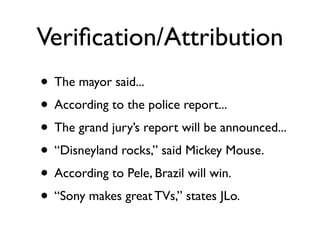
Verification/Attribution
• The mayor said...
• According to the police report...
• The grand jury’s report will be announced...
• “Disneyland rocks,” said Mickey Mouse.
• According to Pele, Brazil will win.
• “Sony makes great TVs,” states JLo.
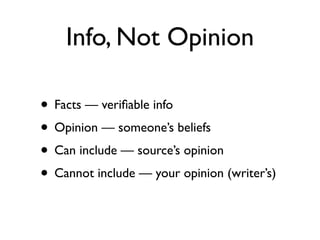
Info, Not Opinion

• Facts — verifiable info
• Opinion — someone’s beliefs
• Can include — source’s opinion
• Cannot include — your opinion (writer’s)
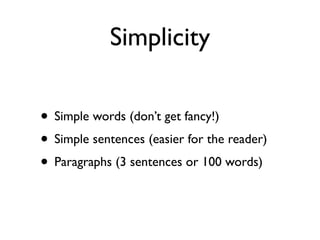
Simplicity

• Simple words (don’t get fancy!)
• Simple sentences (easier for the reader)
• Paragraphs (3 sentences or 100 words)
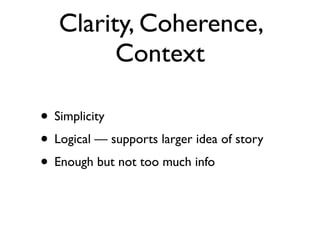
Clarity, Coherence,
         Context

• Simplicity
• Logical — supports larger idea of story
• Enough but not too much info
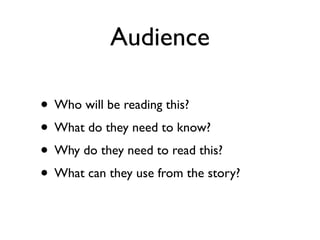
Audience

• Who will be reading this?
• What do they need to know?
• Why do they need to read this?
• What can they use from the story?
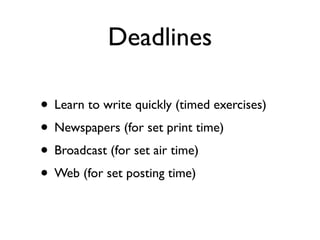
Deadlines

• Learn to write quickly (timed exercises)
• Newspapers (for set print time)
• Broadcast (for set air time)
• Web (for set posting time)
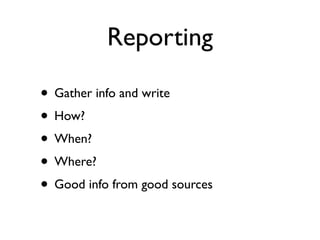
Reporting

• Gather info and write
• How?
• When?
• Where?
• Good info from good sources
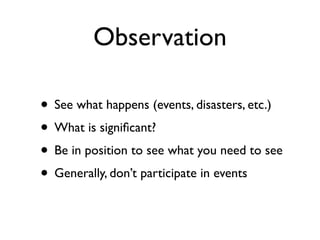
Observation

• See what happens (events, disasters, etc.)
• What is significant?
• Be in position to see what you need to see
• Generally, don’t participate in events
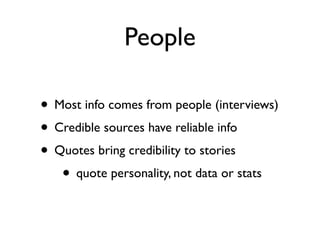
People

• Most info comes from people (interviews)
• Credible sources have reliable info
• Quotes bring credibility to stories
   • quote personality, not data or stats
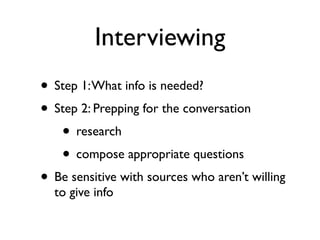
Interviewing
• Step 1: What info is needed?
• Step 2: Prepping for the conversation
   • research
   • compose appropriate questions
• Be sensitive with sources who aren’t willing
  to give info
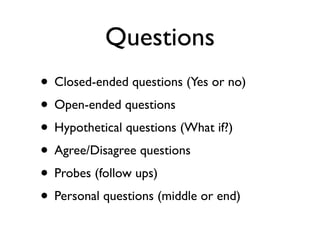
Questions
• Closed-ended questions (Yes or no)
• Open-ended questions
• Hypothetical questions (What if?)
• Agree/Disagree questions
• Probes (follow ups)
• Personal questions (middle or end)
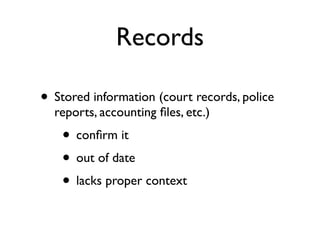
Records

• Stored information (court records, police
  reports, accounting files, etc.)
    • confirm it
    • out of date
    • lacks proper context
Skepticism


• Confirm info with other sources
• Is this information accurate?
Ethical behavior

• Tell the truth
• Dishonesty, plagiarism, falsification (#1 sin)
• Using words of others w/o attribution
• Misrepresentation — ID yourself
• Lose all credibility
Hardware/Software

• Google — maps, news, images (source)
• Digital camera/video (accompany stories)
• Social — Twitter, Facebook,YouTube
Conclusion

• Know traditions and practices of editors
• Gather acceptable info
• Convey info clearly and concisely
• Builds trust for you and your organization!
Questions...

Writefor media ucsd_ext_spring12_2

  • 1.
    Writing for Media Session#2: Writing in the Media Environment UCSD Extension Spring 2012
  • 2.
    News culture • Accuracy •Efficiency • Processes • Deadlines • Ethics
  • 3.
    Accuracy • Spell namescorrectly (follow up!) • Quote sources correctly (follow up!) • Check it out (follow up!) • Do the math (follow up!)
  • 4.
    Verification/Attribution • The mayorsaid... • According to the police report... • The grand jury’s report will be announced... • “Disneyland rocks,” said Mickey Mouse. • According to Pele, Brazil will win. • “Sony makes great TVs,” states JLo.
  • 5.
    Info, Not Opinion •Facts — verifiable info • Opinion — someone’s beliefs • Can include — source’s opinion • Cannot include — your opinion (writer’s)
  • 6.
    Simplicity • Simple words(don’t get fancy!) • Simple sentences (easier for the reader) • Paragraphs (3 sentences or 100 words)
  • 7.
    Clarity, Coherence, Context • Simplicity • Logical — supports larger idea of story • Enough but not too much info
  • 8.
    Audience • Who willbe reading this? • What do they need to know? • Why do they need to read this? • What can they use from the story?
  • 9.
    Deadlines • Learn towrite quickly (timed exercises) • Newspapers (for set print time) • Broadcast (for set air time) • Web (for set posting time)
  • 10.
    Reporting • Gather infoand write • How? • When? • Where? • Good info from good sources
  • 11.
    Observation • See whathappens (events, disasters, etc.) • What is significant? • Be in position to see what you need to see • Generally, don’t participate in events
  • 12.
    People • Most infocomes from people (interviews) • Credible sources have reliable info • Quotes bring credibility to stories • quote personality, not data or stats
  • 13.
    Interviewing • Step 1:What info is needed? • Step 2: Prepping for the conversation • research • compose appropriate questions • Be sensitive with sources who aren’t willing to give info
  • 14.
    Questions • Closed-ended questions(Yes or no) • Open-ended questions • Hypothetical questions (What if?) • Agree/Disagree questions • Probes (follow ups) • Personal questions (middle or end)
  • 15.
    Records • Stored information(court records, police reports, accounting files, etc.) • confirm it • out of date • lacks proper context
  • 16.
    Skepticism • Confirm infowith other sources • Is this information accurate?
  • 17.
    Ethical behavior • Tellthe truth • Dishonesty, plagiarism, falsification (#1 sin) • Using words of others w/o attribution • Misrepresentation — ID yourself • Lose all credibility
  • 18.
    Hardware/Software • Google —maps, news, images (source) • Digital camera/video (accompany stories) • Social — Twitter, Facebook,YouTube
  • 19.
    Conclusion • Know traditionsand practices of editors • Gather acceptable info • Convey info clearly and concisely • Builds trust for you and your organization!
  • 20.