A Presentation of Communication Skills - III BCU341
Plato & Note-Taking
“The act of
writing
something
down is
basically the
decision to
forget it.”
Pictured: Aristotle & Homer
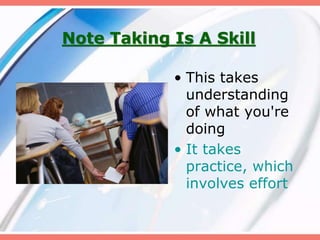
Note Taking Is A Skill
• This takes
understanding
of what you're
doing
• It takes
practice, which
involves effort
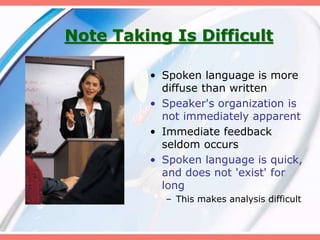
Note Taking Is Difficult
• Spoken language is more
diffuse than written
• Speaker's organization is
not immediately apparent
• Immediate feedback
seldom occurs
• Spoken language is quick,
and does not 'exist' for
long
– This makes analysis difficult
Four Purposes For Note Taking
• Provides a written record
for review
• Forces the listener to
pay attention
• Requires organization,
which involves active
effort on the part of the
listener
• Listener must condense
and rephrase, which aids
understanding
Before Taking Notes
• Prepare yourself mentally
– Be sure of your purpose and
the speaker's purpose
• Review your notes and
other background material
– Reading should be done
BEFORE class
• Think through what has
happened in the class to
date
Before Taking Notes
• Generate enthusiasm and
interest
– Increased knowledge results in
increased interest
– A clear sense of purpose on your
part will make the course content
more relevant
– Acting as if you are interested can
help
– Don't let the personality or
mannerisms of a speaker put you
off
• What, not how, is important
While Taking Notes
• Don't try for a verbatim transcript
– Get all of the main ideas
– Record some details, illustrations,
implications, etc.
• Paraphrase
– But remember that the speaker
may serve as a model
• Integrate with other knowledge
you already have
– But don't allow preconceived
notions to distort what you are
hearing
• Use form to indicate relative
importance of items
– Underscore or star major points
• Leave plenty of white space for
later additions
While Taking Notes
• Be an aggressive, not a
passive, listener
– Ask questions and discuss if it's
permitted
– If not, jot questions in your notes
– Seek out meanings.
– Develop a system of mechanics
• Jot down words or phrases, not
entire sentences
• Develop some system of
shorthand and be consistent in its
use
• Leave out small service words
• Use contractions and
abbreviations
• Use symbols +, =, &, @
After Taking Notes
• Review and reword them as soon
as possible
– You should consider this in scheduling
your work load
• Don't just recopy or type – think!
• " Reminiscing " may provide forgotten
material later
• Rewrite skimpy parts
• Fill in gaps as you remember points
• Arrange with another to compare notes
• Find answers to any questions
remaining unanswered
• Write a brief summary of the event
After Taking Notes
• Review and reword them as
soon as possible
– We forget 50% of what we hear
immediately;
– two months later, another 25% is
gone.
– Relearning is rapid if regular review
is used
– Compare the information with your
own experience
– Don't swallow everything uncritically
– Don't reject what seems strange or
incorrect. Check it out.
– Be willing to hold some seeming
inconsistencies in your mind over a
period of time
– Make meaningful associations
After Taking Notes
• Sharpen your note
taking technique by
looking at your
colleagues' notes.
– How are they better than
your own?
– How are your notes
superior?
• Practice those skills you
wish to develop
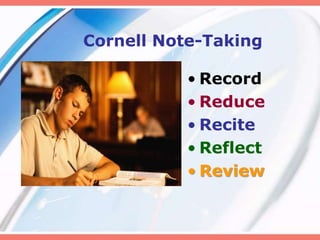
Cornell Note-Taking
• Record
• Reduce
• Recite
• Reflect
• Review
Cornell Note-Taking
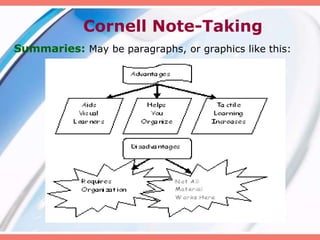
Summaries: May be paragraphs, or graphics like this:
Cornell Note-Taking:
Asking Questions
• Most students ask only:
– Who
– What
– When
– Where
– Why
– How
•Only works for fact-level questioning
THANK YOU !

Note taking Process and Techniques

  • 1.
    A Presentation ofCommunication Skills - III BCU341
  • 2.
    Plato & Note-Taking “Theact of writing something down is basically the decision to forget it.” Pictured: Aristotle & Homer
  • 3.
    Note Taking IsA Skill • This takes understanding of what you're doing • It takes practice, which involves effort
  • 4.
    Note Taking IsDifficult • Spoken language is more diffuse than written • Speaker's organization is not immediately apparent • Immediate feedback seldom occurs • Spoken language is quick, and does not 'exist' for long – This makes analysis difficult
  • 5.
    Four Purposes ForNote Taking • Provides a written record for review • Forces the listener to pay attention • Requires organization, which involves active effort on the part of the listener • Listener must condense and rephrase, which aids understanding
  • 8.
    Before Taking Notes •Prepare yourself mentally – Be sure of your purpose and the speaker's purpose • Review your notes and other background material – Reading should be done BEFORE class • Think through what has happened in the class to date
  • 9.
    Before Taking Notes •Generate enthusiasm and interest – Increased knowledge results in increased interest – A clear sense of purpose on your part will make the course content more relevant – Acting as if you are interested can help – Don't let the personality or mannerisms of a speaker put you off • What, not how, is important
  • 10.
    While Taking Notes •Don't try for a verbatim transcript – Get all of the main ideas – Record some details, illustrations, implications, etc. • Paraphrase – But remember that the speaker may serve as a model • Integrate with other knowledge you already have – But don't allow preconceived notions to distort what you are hearing • Use form to indicate relative importance of items – Underscore or star major points • Leave plenty of white space for later additions
  • 11.
    While Taking Notes •Be an aggressive, not a passive, listener – Ask questions and discuss if it's permitted – If not, jot questions in your notes – Seek out meanings. – Develop a system of mechanics • Jot down words or phrases, not entire sentences • Develop some system of shorthand and be consistent in its use • Leave out small service words • Use contractions and abbreviations • Use symbols +, =, &, @
  • 12.
    After Taking Notes •Review and reword them as soon as possible – You should consider this in scheduling your work load • Don't just recopy or type – think! • " Reminiscing " may provide forgotten material later • Rewrite skimpy parts • Fill in gaps as you remember points • Arrange with another to compare notes • Find answers to any questions remaining unanswered • Write a brief summary of the event
  • 13.
    After Taking Notes •Review and reword them as soon as possible – We forget 50% of what we hear immediately; – two months later, another 25% is gone. – Relearning is rapid if regular review is used – Compare the information with your own experience – Don't swallow everything uncritically – Don't reject what seems strange or incorrect. Check it out. – Be willing to hold some seeming inconsistencies in your mind over a period of time – Make meaningful associations
  • 14.
    After Taking Notes •Sharpen your note taking technique by looking at your colleagues' notes. – How are they better than your own? – How are your notes superior? • Practice those skills you wish to develop
  • 18.
    Cornell Note-Taking • Record •Reduce • Recite • Reflect • Review
  • 19.
    Cornell Note-Taking Summaries: Maybe paragraphs, or graphics like this:
  • 20.
    Cornell Note-Taking: Asking Questions •Most students ask only: – Who – What – When – Where – Why – How •Only works for fact-level questioning
  • 27.