
Critical Thinking


What does it mean to be a critical thinker?
AGENDA
•Understand the complexity of thinking
critically
•Improve critical thinking skills
•Learn to apply critical thinking in
everyday life
•Questions? (Stop me and ask throughout)
A THINKING METAPHOR

The performance of a car does not depend on the horsepower of the
   car, but upon the skill with which the car is driven by the driver.
   So, if intelligence is the horsepower of the car, then “thinking” is
   the skill with which that horsepower is used.

Intelligence is a potential. Thinking is an operating skill.

Thinking is the operating skill through which intelligence acts upon
   experience
                                 - Edward DeBono Thinking Course, p. 2
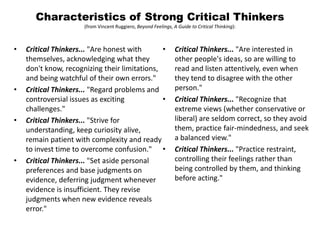
Characteristics of Strong Critical Thinkers
                      (from Vincent Ruggiero, Beyond Feelings, A Guide to Critical Thinking):


•   Critical Thinkers... "Are honest with      •                Critical Thinkers... "Are interested in
    themselves, acknowledging what they                         other people's ideas, so are willing to
    don't know, recognizing their limitations,                  read and listen attentively, even when
    and being watchful of their own errors."                    they tend to disagree with the other
•   Critical Thinkers... "Regard problems and                   person."
    controversial issues as exciting           •                Critical Thinkers... "Recognize that
    challenges."                                                extreme views (whether conservative or
•   Critical Thinkers... "Strive for                            liberal) are seldom correct, so they avoid
    understanding, keep curiosity alive,                        them, practice fair-mindedness, and seek
    remain patient with complexity and ready                    a balanced view."
    to invest time to overcome confusion." •                    Critical Thinkers... "Practice restraint,
•   Critical Thinkers... "Set aside personal                    controlling their feelings rather than
    preferences and base judgments on                           being controlled by them, and thinking
    evidence, deferring judgment whenever                       before acting."
    evidence is insufficient. They revise
    judgments when new evidence reveals
    error."
Critical thinking is about understanding, analyzing
  and evaluating “texts” in order to comprehend,
             judge accuracy, & relevancy.


              UNDERSTANDING
                ANALYZING
                EVALUATING
What
Do
You
See
???
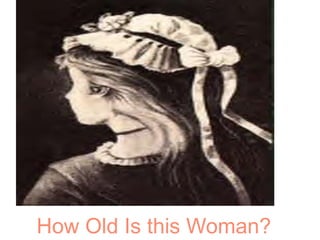
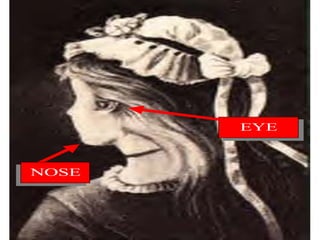
How Old Is this Woman?
EYE


NOSE
EAR


CHIN
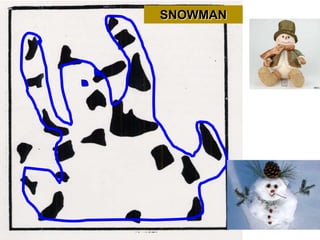
Processing INFORMATION - Ink Blot
              Picture
Pablo Picasso's black on
   white drawing of Don
          Quixote


DON QUIXOTE
DALMATION
GEORGE
WASHINGTON
SNOWMAN
ARCHIPELAGO - ISLANDS


                        The Dahlak Archipelago is an
                        island group located in the Red
                          Sea near Massawa, Eritrea.


                          The Archipelago of Albion
Bloom’s Taxonomy
EVALUATION - Student appraises, assesses, or critiques
    on a basis of specific standards and criteria.

  SYNTHESIS - Student originates, integrates, and combines
ideas into a product, plan or proposal that is new to him or her.


ANALYSIS - Student distinguishes, classifies, and relates
the assumptions, hypotheses, evidence, or structure of a
                statement or question.

  APPLICATION - Student selects, transfers, and uses
data and principles to complete a problem or task with a
                 minimum of direction.


COMPREHENSION - Student translates, comprehends, or
   interprets information based on prior learning.


 KNOWLEDGE - Student recalls or recognizes information,
ideas, and principles in the approximate form in which they
                        were learned.
Real Life Example – A Drum
• Knowledge – What is it?
• Comprehension – Classification
• Application – What does it do?
• Analysis – How does it work?
• Synthesis – What happens when
  you…
• Evaluation – What was the quality?
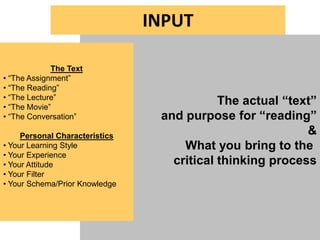
INPUT

             The Text
• “The Assignment”
• “The Reading”
• “The Lecture”
• “The Movie”
                                            The actual “text”
• “The Conversation”             and purpose for “reading”
     Personal Characteristics                              &
• Your Learning Style                What you bring to the
• Your Experience
• Your Attitude                    critical thinking process
• Your Filter
• Your Schema/Prior Knowledge
UNDERSTANDING
   What is “understanding”?
• Knowing what needs to be known
and why/what will be done with the
information

• Activated Schema
• “Thinking”
• Comprehending – Key Issues/        The meaning you gain/make
        Main Points
                                         as you “read” the “text”
• Summarizing in your own words

   Strategies for how to get it            Your comprehension
         Activating Schema
               SQ3R                                -of the “text”
             Says/Does
           Summarizing
            Note Taking
         Graphic Organizing
ANALYSIS

             What is “analysis”
• Identify the Elements, Relationships and
Organization of the “text”

• Know the Parts of the “text”

• Look for the relationships between ideas

• Interpretation

      Strategies for how to do it              How you piece together the
             Context Clues                   significance and organization
        Association with Schema                      of the parts of the text
               Says/Does
                Outlining
    Graphic Organizing/Mindmapping
                  PTR2
      Interpretation of Intent/Facts
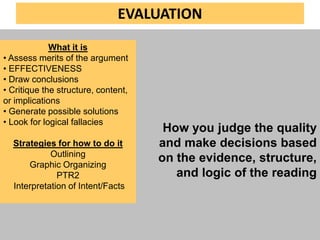
EVALUATION
             What it is
• Assess merits of the argument
• EFFECTIVENESS
• Draw conclusions
• Critique the structure, content,
or implications
• Generate possible solutions
• Look for logical fallacies
                                      How you judge the quality
  Strategies for how to do it        and make decisions based
            Outlining
      Graphic Organizing
                                     on the evidence, structure,
              PTR2                      and logic of the reading
  Interpretation of Intent/Facts
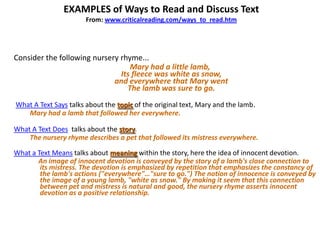
EXAMPLES of Ways to Read and Discuss Text
                       From: www.criticalreading.com/ways_to_read.htm


Consider the following nursery rhyme...
                                  Mary had a little lamb,
                               Its fleece was white as snow,
                             and everywhere that Mary went
                                 The lamb was sure to go.
What A Text Says talks about the topic of the original text, Mary and the lamb.
   Mary had a lamb that followed her everywhere.

What A Text Does talks about the story.
    The nursery rhyme describes a pet that followed its mistress everywhere.

What a Text Means talks about meaning within the story, here the idea of innocent devotion.
       An image of innocent devotion is conveyed by the story of a lamb's close connection to
        its mistress. The devotion is emphasized by repetition that emphasizes the constancy of
        the lamb's actions ("everywhere"…"sure to go.") The notion of innocence is conveyed by
        the image of a young lamb, "white as snow." By making it seem that this connection
        between pet and mistress is natural and good, the nursery rhyme asserts innocent
        devotion as a positive relationship.
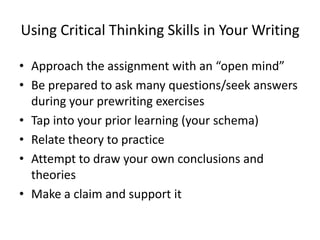
Using Critical Thinking Skills in Your Writing

• Approach the assignment with an “open mind”
• Be prepared to ask many questions/seek answers
  during your prewriting exercises
• Tap into your prior learning (your schema)
• Relate theory to practice
• Attempt to draw your own conclusions and
  theories
• Make a claim and support it
PTR 2

P =
roblem
                   INTRO
 T       hesis


R  =
   easons          BODY
R =esults          Conclusion
Summary of Critical Thinking
• It’s a process
• You can improve it                       Input

• Embrace the challenge
                            Evalutation              Understanding


                                          Analysis
              Evaluation

              Synthesis

               Analysis      1.   Consider the problem
                             2.   Evaluate your options
             Application
                             3.   Gather more information
            Comprehension    4.   Determine your answer
             Knowledge
Fun Websites to Boost your Brain Power
•   http://queendom.com/
•   http://www.braingle.com/
•   http://www.brainbashers.com/
•   http://www.khanacademy.org brain teasers

Critical thinking

  • 1.
    Critical Thinking What doesit mean to be a critical thinker?
  • 2.
    AGENDA •Understand the complexityof thinking critically •Improve critical thinking skills •Learn to apply critical thinking in everyday life •Questions? (Stop me and ask throughout)
  • 3.
    A THINKING METAPHOR Theperformance of a car does not depend on the horsepower of the car, but upon the skill with which the car is driven by the driver. So, if intelligence is the horsepower of the car, then “thinking” is the skill with which that horsepower is used. Intelligence is a potential. Thinking is an operating skill. Thinking is the operating skill through which intelligence acts upon experience - Edward DeBono Thinking Course, p. 2
  • 4.
    Characteristics of StrongCritical Thinkers (from Vincent Ruggiero, Beyond Feelings, A Guide to Critical Thinking): • Critical Thinkers... "Are honest with • Critical Thinkers... "Are interested in themselves, acknowledging what they other people's ideas, so are willing to don't know, recognizing their limitations, read and listen attentively, even when and being watchful of their own errors." they tend to disagree with the other • Critical Thinkers... "Regard problems and person." controversial issues as exciting • Critical Thinkers... "Recognize that challenges." extreme views (whether conservative or • Critical Thinkers... "Strive for liberal) are seldom correct, so they avoid understanding, keep curiosity alive, them, practice fair-mindedness, and seek remain patient with complexity and ready a balanced view." to invest time to overcome confusion." • Critical Thinkers... "Practice restraint, • Critical Thinkers... "Set aside personal controlling their feelings rather than preferences and base judgments on being controlled by them, and thinking evidence, deferring judgment whenever before acting." evidence is insufficient. They revise judgments when new evidence reveals error."
  • 5.
    Critical thinking isabout understanding, analyzing and evaluating “texts” in order to comprehend, judge accuracy, & relevancy. UNDERSTANDING ANALYZING EVALUATING
  • 6.
  • 7.
    How Old Isthis Woman?
  • 8.
  • 9.
  • 10.
    Processing INFORMATION -Ink Blot Picture
  • 11.
    Pablo Picasso's blackon white drawing of Don Quixote DON QUIXOTE
  • 12.
  • 13.
  • 14.
  • 15.
    ARCHIPELAGO - ISLANDS The Dahlak Archipelago is an island group located in the Red Sea near Massawa, Eritrea. The Archipelago of Albion
  • 16.
    Bloom’s Taxonomy EVALUATION -Student appraises, assesses, or critiques on a basis of specific standards and criteria. SYNTHESIS - Student originates, integrates, and combines ideas into a product, plan or proposal that is new to him or her. ANALYSIS - Student distinguishes, classifies, and relates the assumptions, hypotheses, evidence, or structure of a statement or question. APPLICATION - Student selects, transfers, and uses data and principles to complete a problem or task with a minimum of direction. COMPREHENSION - Student translates, comprehends, or interprets information based on prior learning. KNOWLEDGE - Student recalls or recognizes information, ideas, and principles in the approximate form in which they were learned.
  • 17.
    Real Life Example– A Drum • Knowledge – What is it? • Comprehension – Classification • Application – What does it do? • Analysis – How does it work? • Synthesis – What happens when you… • Evaluation – What was the quality?
  • 18.
    INPUT The Text • “The Assignment” • “The Reading” • “The Lecture” • “The Movie” The actual “text” • “The Conversation” and purpose for “reading” Personal Characteristics & • Your Learning Style What you bring to the • Your Experience • Your Attitude critical thinking process • Your Filter • Your Schema/Prior Knowledge
  • 19.
    UNDERSTANDING What is “understanding”? • Knowing what needs to be known and why/what will be done with the information • Activated Schema • “Thinking” • Comprehending – Key Issues/ The meaning you gain/make Main Points as you “read” the “text” • Summarizing in your own words Strategies for how to get it Your comprehension Activating Schema SQ3R -of the “text” Says/Does Summarizing Note Taking Graphic Organizing
  • 20.
    ANALYSIS What is “analysis” • Identify the Elements, Relationships and Organization of the “text” • Know the Parts of the “text” • Look for the relationships between ideas • Interpretation Strategies for how to do it How you piece together the Context Clues significance and organization Association with Schema of the parts of the text Says/Does Outlining Graphic Organizing/Mindmapping PTR2 Interpretation of Intent/Facts
  • 21.
    EVALUATION What it is • Assess merits of the argument • EFFECTIVENESS • Draw conclusions • Critique the structure, content, or implications • Generate possible solutions • Look for logical fallacies How you judge the quality Strategies for how to do it and make decisions based Outlining Graphic Organizing on the evidence, structure, PTR2 and logic of the reading Interpretation of Intent/Facts
  • 22.
    EXAMPLES of Waysto Read and Discuss Text From: www.criticalreading.com/ways_to_read.htm Consider the following nursery rhyme... Mary had a little lamb, Its fleece was white as snow, and everywhere that Mary went The lamb was sure to go. What A Text Says talks about the topic of the original text, Mary and the lamb. Mary had a lamb that followed her everywhere. What A Text Does talks about the story. The nursery rhyme describes a pet that followed its mistress everywhere. What a Text Means talks about meaning within the story, here the idea of innocent devotion. An image of innocent devotion is conveyed by the story of a lamb's close connection to its mistress. The devotion is emphasized by repetition that emphasizes the constancy of the lamb's actions ("everywhere"…"sure to go.") The notion of innocence is conveyed by the image of a young lamb, "white as snow." By making it seem that this connection between pet and mistress is natural and good, the nursery rhyme asserts innocent devotion as a positive relationship.
  • 23.
    Using Critical ThinkingSkills in Your Writing • Approach the assignment with an “open mind” • Be prepared to ask many questions/seek answers during your prewriting exercises • Tap into your prior learning (your schema) • Relate theory to practice • Attempt to draw your own conclusions and theories • Make a claim and support it
  • 24.
    PTR 2 P = roblem INTRO T hesis R = easons BODY R =esults Conclusion
  • 25.
    Summary of CriticalThinking • It’s a process • You can improve it Input • Embrace the challenge Evalutation Understanding Analysis Evaluation Synthesis Analysis 1. Consider the problem 2. Evaluate your options Application 3. Gather more information Comprehension 4. Determine your answer Knowledge
  • 26.
    Fun Websites toBoost your Brain Power • http://queendom.com/ • http://www.braingle.com/ • http://www.brainbashers.com/ • http://www.khanacademy.org brain teasers

Editor's Notes

  • #18 A drum, it is a percussion instrument, it makes music, by hitting the top with a drumstick it makes a sound, when you hit it with a specific rhythm it will create music, depending on the skill and experience of the player the music might be good or bad or anywhere in between.
  • #20 Survey, question, read (skim), recite, review
  • #21 Problem, Thesis, Reasons, Results