WOUND ASSESSMENT AND
MODERN DRESSING
Presentor: Dr CHAN JIA HUI
Mentor: Dr Vegnesh
General Assessment
The general assessment is to identify and eliminate
any underlying causes or contributing factors which
may impede the wound healing process
• Age (extreme of age)
• Diseases or co morbidities
• Medications
• Obesity
• Nutrition
• Impaired blood supply
• Lifestyle
Local Wound Assessment
• Review of wound history
• Assessment of physical wound characteristic
– Location,size,base,depth
– Presence of pain
– Condition of wound bed
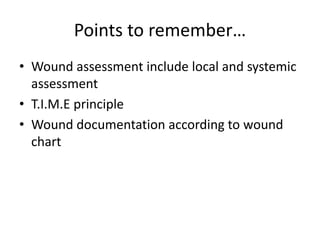
Points to remember…
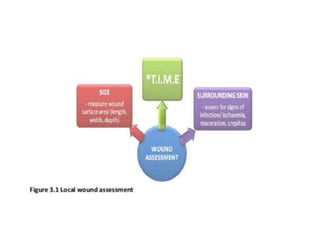
• Wound assessment include local and systemic
assessment
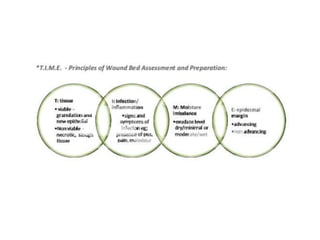
• T.I.M.E principle
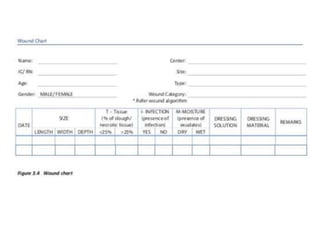
• Wound documentation according to wound
chart
Dressing
• The purpose of dressing is to protect wound
from trauma and infection
• Reduce pain
• Maintain moisture and temperature
• Absorb drainage and debride the wound
• Control and prevent haemorhage
• Provide psychological comfort
Ideal dresing
• Remove excess exudate
• Waterproof
• Maintain moist wound healing environment
• Trauma protection
• Allow gaseous exchange if appropriate
• Non adherant
• Provide barrier to pathogen
• Safe and easy to use
• Provide thermal insulation
Dressing category
• Conventional/Inert
• Modern/advanced/active
Coventional dressing is
-gauze soaked with NS/antiseptic , gamgee as
secondary dressing
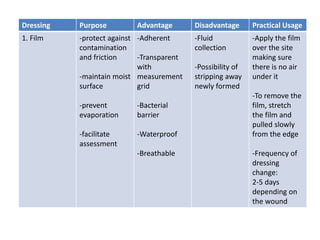
Modern DressingDressing Purpose Advantage Disadvantage Practical Usage
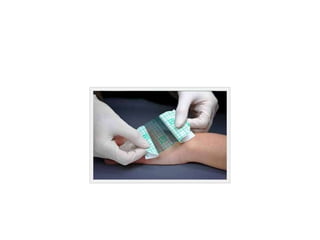
1. Film -protect against
contamination
and friction
-maintain moist
surface
-prevent
evaporation
-facilitate
assessment
-Adherent
-Transparent
with
measurement
grid
-Bacterial
barrier
-Waterproof
-Breathable
-Fluid
collection
-Possibility of
stripping away
newly formed
-Apply the film
over the site
making sure
there is no air
under it
-To remove the
film, stretch
the film and
pulled slowly
from the edge
-Frequency of
dressing
change:
2-5 days
depending on
the wound
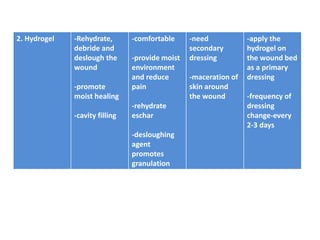
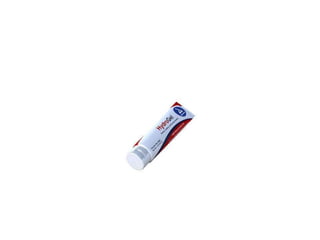
2. Hydrogel -Rehydrate,
debride and
deslough the
wound
-promote
moist healing
-cavity filling
-comfortable
-provide moist
environment
and reduce
pain
-rehydrate
eschar
-desloughing
agent
promotes
granulation
-need
secondary
dressing
-maceration of
skin around
the wound
-apply the
hydrogel on
the wound bed
as a primary
dressing
-frequency of
dressing
change-every
2-3 days
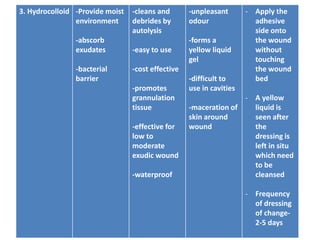
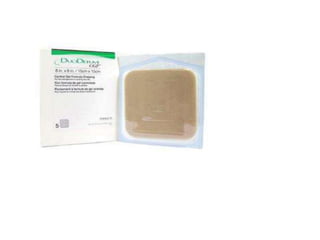
3. Hydrocolloid -Provide moist
environment
-abscorb
exudates
-bacterial
barrier
-cleans and
debrides by
autolysis
-easy to use
-cost effective
-promotes
grannulation
tissue
-effective for
low to
moderate
exudic wound
-waterproof
-unpleasant
odour
-forms a
yellow liquid
gel
-difficult to
use in cavities
-maceration of
skin around
wound
- Apply the
adhesive
side onto
the wound
without
touching
the wound
bed
- A yellow
liquid is
seen after
the
dressing is
left in situ
which need
to be
cleansed
- Frequency
of dressing
of change-
2-5 days
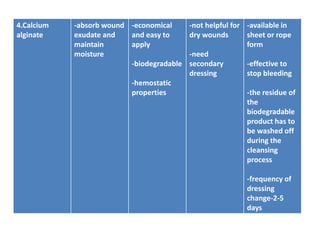
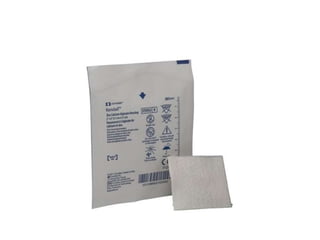
4.Calcium
alginate
-absorb wound
exudate and
maintain
moisture
-economical
and easy to
apply
-biodegradable
-hemostatic
properties
-not helpful for
dry wounds
-need
secondary
dressing
-available in
sheet or rope
form
-effective to
stop bleeding
-the residue of
the
biodegradable
product has to
be washed off
during the
cleansing
process
-frequency of
dressing
change-2-5
days
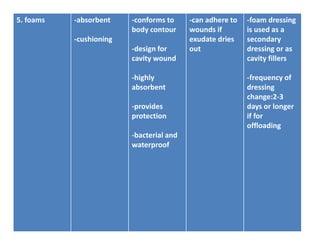
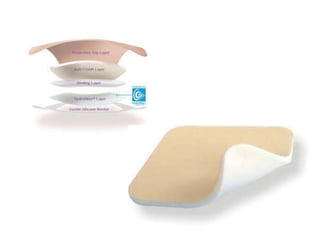
5. foams -absorbent
-cushioning
-conforms to
body contour
-design for
cavity wound
-highly
absorbent
-provides
protection
-bacterial and
waterproof
-can adhere to
wounds if
exudate dries
out
-foam dressing
is used as a
secondary
dressing or as
cavity fillers
-frequency of
dressing
change:2-3
days or longer
if for
offloading
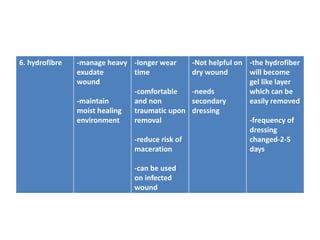
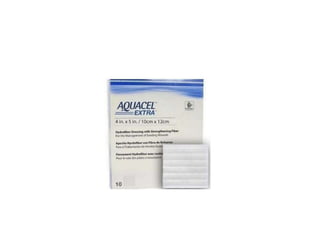
6. hydrofibre -manage heavy
exudate
wound
-maintain
moist healing
environment
-longer wear
time
-comfortable
and non
traumatic upon
removal
-reduce risk of
maceration
-can be used
on infected
wound
-Not helpful on
dry wound
-needs
secondary
dressing
-the hydrofiber
will become
gel like layer
which can be
easily removed
-frequency of
dressing
changed-2-5
days
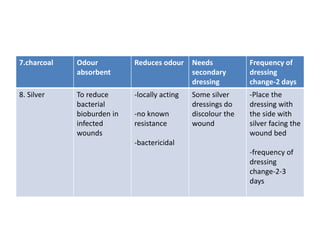
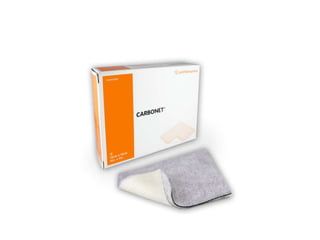
7.charcoal Odour
absorbent
Reduces odour Needs
secondary
dressing
Frequency of
dressing
change-2 days
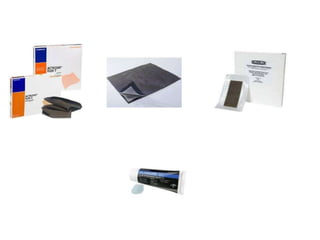
8. Silver To reduce
bacterial
bioburden in
infected
wounds
-locally acting
-no known
resistance
-bactericidal
Some silver
dressings do
discolour the
wound
-Place the
dressing with
the side with
silver facing the
wound bed
-frequency of
dressing
change-2-3
days
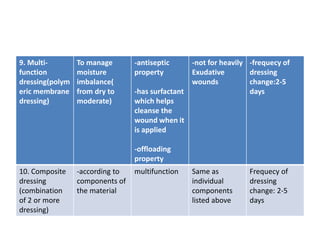
9. Multi-
function
dressing(polym
eric membrane
dressing)
To manage
moisture
imbalance(
from dry to
moderate)
-antiseptic
property
-has surfactant
which helps
cleanse the
wound when it
is applied
-offloading
property
-not for heavily
Exudative
wounds
-frequecy of
dressing
change:2-5
days
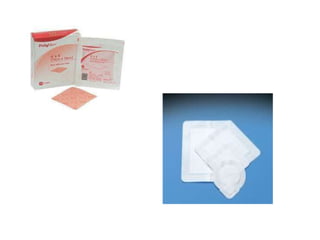
10. Composite
dressing
(combination
of 2 or more
dressing)
-according to
components of
the material
multifunction Same as
individual
components
listed above
Frequecy of
dressing
change: 2-5
days
Other
advanced
dressing
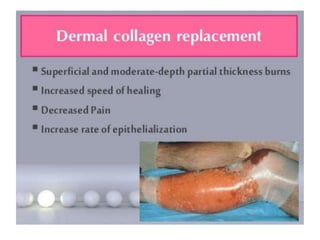
-not widely used –some may be used in specialised centre-
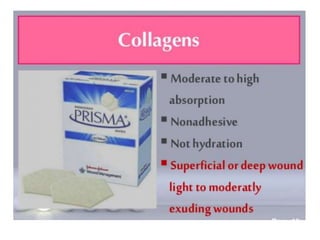
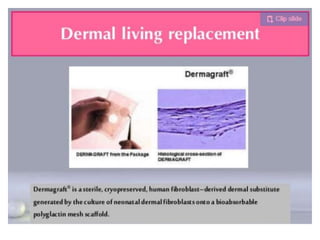
eg: collagen, matrix and regenerative dressings, cultured epidermis,
growth factor,stem cells
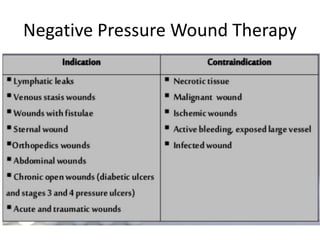
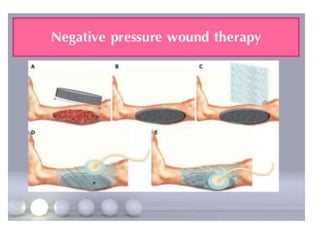
Negative Pressure Wound Therapy-
Vacumm Dressing
• For slow healing wound
• Involved controlled application of sub-
atmospheric pressure to the local wound
environment, using a sealed wound dressing
connected to a vacumm pump
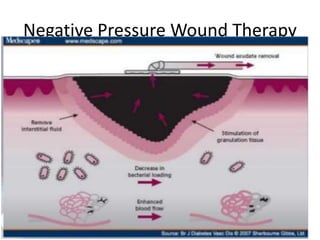
• The continued vacumm draws out fluid from
the wound and increases blood flow to the
area
Negative Pressure Wound Therapy
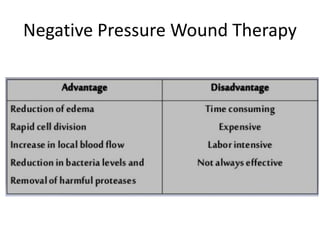
• The vacumm maybe applied continuosly or
intermittently, depending on the type of
wound being treated and the clinical objective
• Typically dressing changed 2-3times per weeks
Negative Pressure Wound Therapy
Points to remember:
• -know your dressing material well and use it
judiciously
• -all wounds need to be cleaned thoroughly
before applying any type of dressing material
THANK YOU
Reference
• Datuk Dr Noor Hisyam, Wound care manual
,ministry of health malaysia, edition 2014
• https://www.bbraun.com/content/dam/catalog/
bbraun/bbraunProductCatalog/S/AEM2015/en-
01/b8/time-concept.pdf.bb-.66460533/time-
concept.pdf
• https://woundeducators.
• https://www.slideshare.net/MookyMook/advanc
ed-dressing?from_m_app=androidcom
• https://www.slideshare.net/rohanparis1/wound-
dressing-45940763?from_m_app=android

Wound assessment and modern dressing

  • 1.
    WOUND ASSESSMENT AND MODERNDRESSING Presentor: Dr CHAN JIA HUI Mentor: Dr Vegnesh
  • 2.
    General Assessment The generalassessment is to identify and eliminate any underlying causes or contributing factors which may impede the wound healing process • Age (extreme of age) • Diseases or co morbidities • Medications • Obesity • Nutrition • Impaired blood supply • Lifestyle
  • 3.
    Local Wound Assessment •Review of wound history • Assessment of physical wound characteristic – Location,size,base,depth – Presence of pain – Condition of wound bed
  • 9.
    Points to remember… •Wound assessment include local and systemic assessment • T.I.M.E principle • Wound documentation according to wound chart
  • 10.
    Dressing • The purposeof dressing is to protect wound from trauma and infection • Reduce pain • Maintain moisture and temperature • Absorb drainage and debride the wound • Control and prevent haemorhage • Provide psychological comfort
  • 11.
    Ideal dresing • Removeexcess exudate • Waterproof • Maintain moist wound healing environment • Trauma protection • Allow gaseous exchange if appropriate • Non adherant • Provide barrier to pathogen • Safe and easy to use • Provide thermal insulation
  • 12.
    Dressing category • Conventional/Inert •Modern/advanced/active Coventional dressing is -gauze soaked with NS/antiseptic , gamgee as secondary dressing
  • 13.
    Modern DressingDressing PurposeAdvantage Disadvantage Practical Usage 1. Film -protect against contamination and friction -maintain moist surface -prevent evaporation -facilitate assessment -Adherent -Transparent with measurement grid -Bacterial barrier -Waterproof -Breathable -Fluid collection -Possibility of stripping away newly formed -Apply the film over the site making sure there is no air under it -To remove the film, stretch the film and pulled slowly from the edge -Frequency of dressing change: 2-5 days depending on the wound
  • 15.
    2. Hydrogel -Rehydrate, debrideand deslough the wound -promote moist healing -cavity filling -comfortable -provide moist environment and reduce pain -rehydrate eschar -desloughing agent promotes granulation -need secondary dressing -maceration of skin around the wound -apply the hydrogel on the wound bed as a primary dressing -frequency of dressing change-every 2-3 days
  • 17.
    3. Hydrocolloid -Providemoist environment -abscorb exudates -bacterial barrier -cleans and debrides by autolysis -easy to use -cost effective -promotes grannulation tissue -effective for low to moderate exudic wound -waterproof -unpleasant odour -forms a yellow liquid gel -difficult to use in cavities -maceration of skin around wound - Apply the adhesive side onto the wound without touching the wound bed - A yellow liquid is seen after the dressing is left in situ which need to be cleansed - Frequency of dressing of change- 2-5 days
  • 19.
    4.Calcium alginate -absorb wound exudate and maintain moisture -economical andeasy to apply -biodegradable -hemostatic properties -not helpful for dry wounds -need secondary dressing -available in sheet or rope form -effective to stop bleeding -the residue of the biodegradable product has to be washed off during the cleansing process -frequency of dressing change-2-5 days
  • 21.
    5. foams -absorbent -cushioning -conformsto body contour -design for cavity wound -highly absorbent -provides protection -bacterial and waterproof -can adhere to wounds if exudate dries out -foam dressing is used as a secondary dressing or as cavity fillers -frequency of dressing change:2-3 days or longer if for offloading
  • 23.
    6. hydrofibre -manageheavy exudate wound -maintain moist healing environment -longer wear time -comfortable and non traumatic upon removal -reduce risk of maceration -can be used on infected wound -Not helpful on dry wound -needs secondary dressing -the hydrofiber will become gel like layer which can be easily removed -frequency of dressing changed-2-5 days
  • 25.
    7.charcoal Odour absorbent Reduces odourNeeds secondary dressing Frequency of dressing change-2 days 8. Silver To reduce bacterial bioburden in infected wounds -locally acting -no known resistance -bactericidal Some silver dressings do discolour the wound -Place the dressing with the side with silver facing the wound bed -frequency of dressing change-2-3 days
  • 28.
    9. Multi- function dressing(polym eric membrane dressing) Tomanage moisture imbalance( from dry to moderate) -antiseptic property -has surfactant which helps cleanse the wound when it is applied -offloading property -not for heavily Exudative wounds -frequecy of dressing change:2-5 days 10. Composite dressing (combination of 2 or more dressing) -according to components of the material multifunction Same as individual components listed above Frequecy of dressing change: 2-5 days
  • 30.
    Other advanced dressing -not widely used–some may be used in specialised centre- eg: collagen, matrix and regenerative dressings, cultured epidermis, growth factor,stem cells
  • 35.
    Negative Pressure WoundTherapy- Vacumm Dressing • For slow healing wound • Involved controlled application of sub- atmospheric pressure to the local wound environment, using a sealed wound dressing connected to a vacumm pump • The continued vacumm draws out fluid from the wound and increases blood flow to the area
  • 36.
    Negative Pressure WoundTherapy • The vacumm maybe applied continuosly or intermittently, depending on the type of wound being treated and the clinical objective • Typically dressing changed 2-3times per weeks
  • 37.
  • 38.
  • 39.
  • 40.
    Points to remember: •-know your dressing material well and use it judiciously • -all wounds need to be cleaned thoroughly before applying any type of dressing material
  • 41.
  • 42.
    Reference • Datuk DrNoor Hisyam, Wound care manual ,ministry of health malaysia, edition 2014 • https://www.bbraun.com/content/dam/catalog/ bbraun/bbraunProductCatalog/S/AEM2015/en- 01/b8/time-concept.pdf.bb-.66460533/time- concept.pdf • https://woundeducators. • https://www.slideshare.net/MookyMook/advanc ed-dressing?from_m_app=androidcom • https://www.slideshare.net/rohanparis1/wound- dressing-45940763?from_m_app=android

Editor's Notes

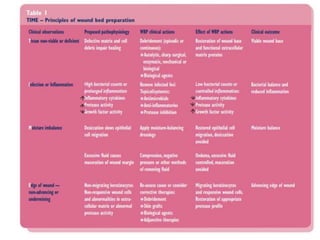
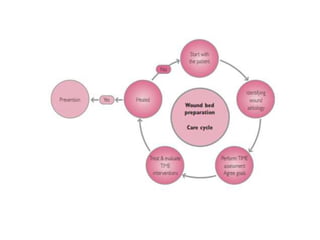
  • #10 The management of chronic wounds has progressed from merely assessing the status of the wound to understanding the underlying molecular and cellular abnormalities that prevent the wound from healing. The concept of wound bed preparation has simultaneously evolved to provide a systematic approach to removing the barriers to natural healing and enhancing the effects of advanced therapies. Wound bed preparation and the TIME framework are most likely to be successful when used alongside the wound bed preparation care cycle.
  • #21 Calcium alginate is a highly absorbent, biodegradable alginate dressing derived from seaweed. Alginate dressings maintain a physiologically moist microenvironment that promotes healing and the formation of granulation tissue. Calcium alginate is readily removed with saline irrigation, making dressing changes virtually painless.1 Calcium alginate has been around for years. More recently, it has been added to wound gels, hydrocolloids, and cleansers. Silver, a known antimicrobial agent, also has been added to many wound products, including calcium alginate. Unadulterated calcium alginate comes in the form of a flat square or mat (in many sizes) or a rope. The ropes can be manipulated to fit easily in wound cavities. Although one of its stated uses is to provide homeostasis, calcium alginate is more commonly thought of as the dressing that can absorb 20 times its weight in exudate, soak up loose debris from the wound bed, provide an optimal environment for healing, and provide a painless dressing change. This study is a reminder that calcium alginate is a valuable tool in our wound care arsenal.
  • #23 Made of semipermeable polyurethane, foam dressings contain foamed polymer solutions with small, open cells that can hold fluids. These cells may be layered with other materials. Their absorptiveness varies depending on the thickness of the dressing. The contact area of a foam dressing is nonadherent and nonlinting, so the dressing is easy to remove. The outer layer of the dressing is often hydrophobic or waterproof to keep out bacteria and other contaminants. Foam dressings come either with or without an adhesive border and in many sizes and shapes. Some foam dressings also include a bacterial barrier made from a transparent film. Additionally, some foam dressings are impregnated with an antimicrobial agent such as silver, Manuka honey, cadexomer iodine, antibiotics, or include surfactants as a vehicle for delivery of these substances to the wound bed. A primary feature of foam dressings is that they help maintain a moist wound environment. Also important is that foam helps cushion the wound and periwound area from additional trauma, as well as providing thermal insulation for wounds. Easy to apply and remove, foam dressings don't cause wound trauma. Foam dressings can be used when there is an infection and during compression therapy. In addition, foam dressings are compatible with enzymatic debridment agents. Depending on the amount of exudate, foam dressings have a wear time of one to seven days.
  • #25 Hydrofiber® Technology is a soft, absorbent material that transforms into a gel on contact with wound fluid The gelling action creates an optimal environment for wound healing*1, Alginate and hydrofiber dressings are popular absorptive dressings indicated for wounds with moderate to high levels of exudate. While they are similar, there are some important differences between them. Alginate dressings are biodegradable, absorb up to 20 times their weight in wound fluid, and serve as hemostatic agents. Hydrofiber dressings absorb up to 30 times their weight and provide less risk of maceration because of their vertical fluid absorption properties
  • #27 Charcoal has been introduced into several classes of wound care . Although charcoal in itself does not enhance wound healing, it can help to control odors associated with wounds, such as fungating and/or infected wounds
  • #28 Silver dressings are topical wound care products derived from ionic silver. These products release a steady amount of silver to the wound and provide antimicrobial or antibacterial action. The silver is activated from the dressing to the wound’s surface based on the amount of exudate and bacteria in the wound. Silver dressings are available as foam dressings, hydrocolloids, barrier layers, and charcoal cloth dressings
  • #30  Polymeric membrane dressings (PMDs), cavity filler, extra-absorptive with or without silver, or rope were applied depending on depth, exudate or suspected infection. Collagenase was applied with standard PMDs for fibrinous wounds. Antibiotic ointment was applied with PMDs to help eliminate pseudomonas infections quickly UNDERSTANDING COMPOSITE WOUND DRESSINGS September 12, 2013 37 SHARES Composite combine different types of dressings with several functions in one single dressing that can address different needs. They can be used as a primary and/or secondary dressing and feature an absorptive layer, and a strike-through barrier