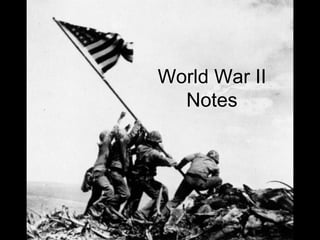
World War II
Notes
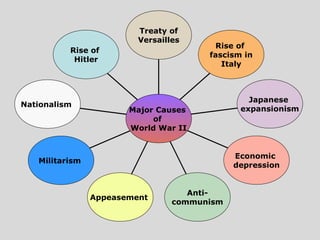
Rise of
Hitler
Nationalism
Militarism
Appeasement
Anti-
communism
Economic
depression
Japanese
expansionism
Rise of
fascism in
Italy
Treaty of
Versailles
Major Causes
of
World War II
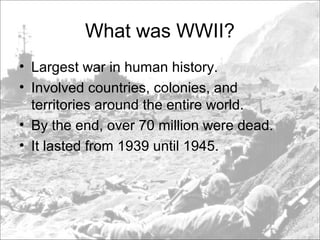
What was WWII?
• Largest war in human history.
• Involved countries, colonies, and
territories around the entire world.
• By the end, over 70 million were dead.
• It lasted from 1939 until 1945.
Causes
•W WI and the Treaty of Versailles
•Appeasement
•Rise of Totalitarianism
WWI and the Treaty of
Versailles
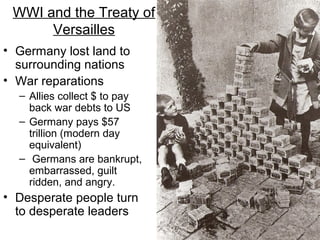
• Germany lost land to
surrounding nations
• War reparations
– Allies collect $ to pay
back war debts to US
– Germany pays $57
trillion (modern day
equivalent)
– Germans are bankrupt,
embarrassed, guilt
ridden, and angry.
• Desperate people turn
to desperate leaders
Appeasement
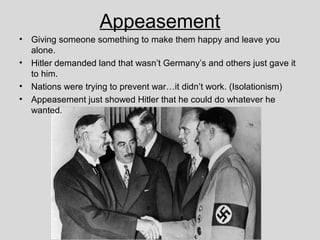
• Giving someone something to make them happy and leave you
alone.
• Hitler demanded land that wasn’t Germany’s and others just gave it
to him.
• Nations were trying to prevent war…it didn’t work. (Isolationism)
• Appeasement just showed Hitler that he could do whatever he
wanted.
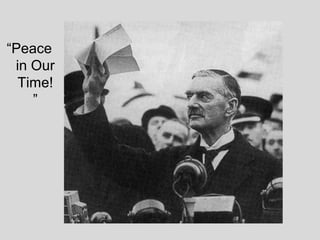
“Peace
in Our
Time!
”
Appeasement
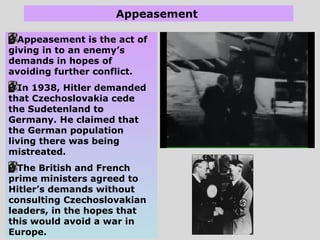
Appeasement is the act of
giving in to an enemy’s
demands in hopes of
avoiding further conflict.
In 1938, Hitler demanded
that Czechoslovakia cede
the Sudetenland to
Germany. He claimed that
the German population
living there was being
mistreated.
The British and French
prime ministers agreed to
Hitler’s demands without
consulting Czechoslovakian
leaders, in the hopes that
this would avoid a war in
Europe.
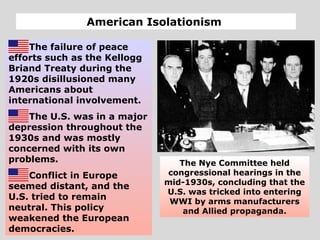
American Isolationism
The failure of peace
efforts such as the Kellogg
Briand Treaty during the
1920s disillusioned many
Americans about
international involvement.
The U.S. was in a major
depression throughout the
1930s and was mostly
concerned with its own
problems.
Conflict in Europe
seemed distant, and the
U.S. tried to remain
neutral. This policy
weakened the European
democracies.
The Nye Committee held
congressional hearings in the
mid-1930s, concluding that the
U.S. was tricked into entering
WWI by arms manufacturers
and Allied propaganda.
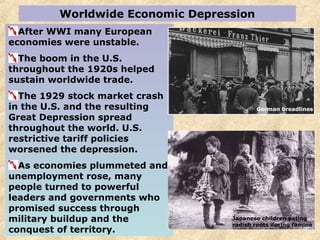
Worldwide Economic Depression
After WWI many European
economies were unstable.
The boom in the U.S.
throughout the 1920s helped
sustain worldwide trade.
The 1929 stock market crash
in the U.S. and the resulting
Great Depression spread
throughout the world. U.S.
restrictive tariff policies
worsened the depression.
As economies plummeted and
unemployment rose, many
people turned to powerful
leaders and governments who
promised success through
military buildup and the
conquest of territory.
German breadlines
Japanese children eating
radish roots during famine
Mean While….
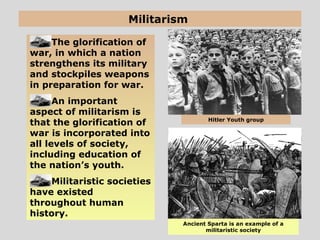
Militarism
The glorification of
war, in which a nation
strengthens its military
and stockpiles weapons
in preparation for war.
An important
aspect of militarism is
that the glorification of
war is incorporated into
all levels of society,
including education of
the nation’s youth.
Militaristic societies
have existed
throughout human
history.
Ancient Sparta is an example of a
militaristic society
Hitler Youth group
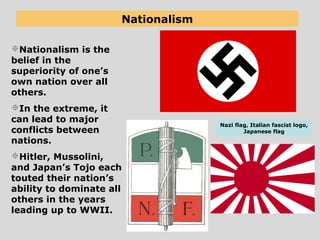
Nationalism
Nationalism is the
belief in the
superiority of one’s
own nation over all
others.
In the extreme, it
can lead to major
conflicts between
nations.
Hitler, Mussolini,
and Japan’s Tojo each
touted their nation’s
ability to dominate all
others in the years
leading up to WWII.
Nazi flag, Italian fascist logo,
Japanese flag
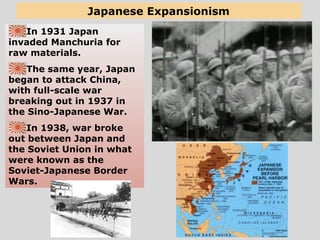
Japanese Expansionism
In 1931 Japan
invaded Manchuria for
raw materials.
The same year, Japan
began to attack China,
with full-scale war
breaking out in 1937 in
the Sino-Japanese War.
In 1938, war broke
out between Japan and
the Soviet Union in what
were known as the
Soviet-Japanese Border
Wars.
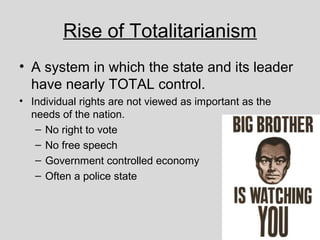
Rise of Totalitarianism
• A system in which the state and its leader
have nearly TOTAL control.
• Individual rights are not viewed as important as the
needs of the nation.
– No right to vote
– No free speech
– Government controlled economy
– Often a police state
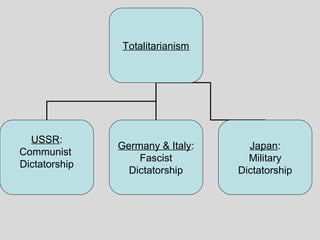
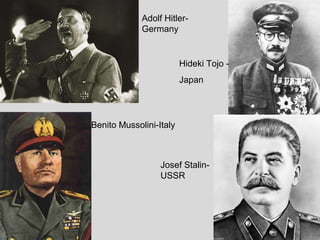
Totalitarianism
USSR:
Communist
Dictatorship
Germany & Italy:
Fascist
Dictatorship
Japan:
Military
Dictatorship
Adolf Hitler-
Germany
Hideki Tojo -
Japan
Benito Mussolini-Italy
Josef Stalin-
USSR
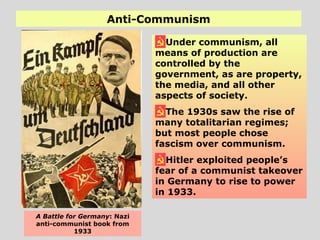
Anti-Communism
Under communism, all
means of production are
controlled by the
government, as are property,
the media, and all other
aspects of society.
The 1930s saw the rise of
many totalitarian regimes;
but most people chose
fascism over communism.
Hitler exploited people’s
fear of a communist takeover
in Germany to rise to power
in 1933.
A Battle for Germany: Nazi
anti-communist book from
1933
What is Fascism?
• Political belief that says the individual is
less important than the nation.
• Glorifies violence, believes it is needed to
“prove” strength of a people.
• Uses nationalism and racism.
• Dictatorships.
• Italy and then Germany became fascist.
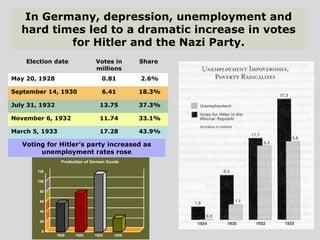
In Germany, depression, unemployment and
hard times led to a dramatic increase in votes
for Hitler and the Nazi Party.
Election date Votes in
millions
Share
May 20, 1928 0.81 2.6%
September 14, 1930 6.41 18.3%
July 31, 1932 13.75 37.3%
November 6, 1932 11.74 33.1%
March 5, 1933 17.28 43.9%
Voting for Hitler’s party increased as
unemployment rates rose
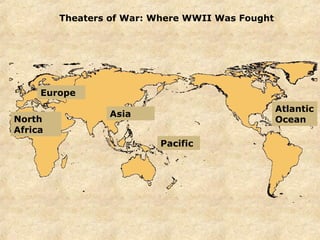
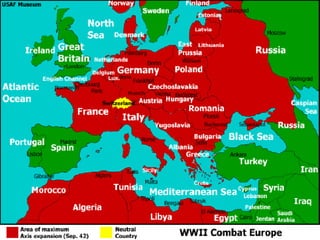
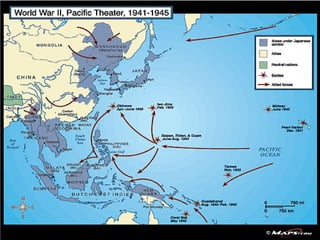
Theaters of War: Where WWII Was Fought
Pacific
Asia
North
Africa
Europe
Atlantic
Ocean
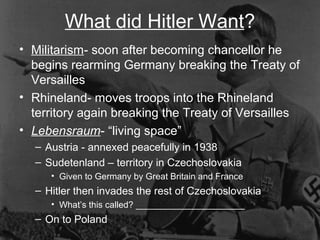
What did Hitler Want?
• Militarism- soon after becoming chancellor he
begins rearming Germany breaking the Treaty of
Versailles
• Rhineland- moves troops into the Rhineland
territory again breaking the Treaty of Versailles
• Lebensraum- “living space”
– Austria - annexed peacefully in 1938
– Sudetenland – territory in Czechoslovakia
• Given to Germany by Great Britain and France
– Hitler then invades the rest of Czechoslovakia
• What’s this called? ______________________
– On to Poland
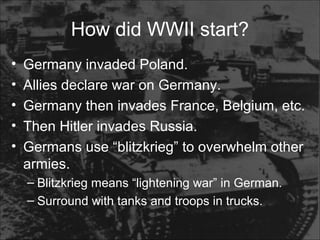
How did WWII start?
• Germany invaded Poland.
• Allies declare war on Germany.
• Germany then invades France, Belgium, etc.
• Then Hitler invades Russia.
• Germans use “blitzkrieg” to overwhelm other
armies.
– Blitzkrieg means “lightening war” in German.
– Surround with tanks and troops in trucks.
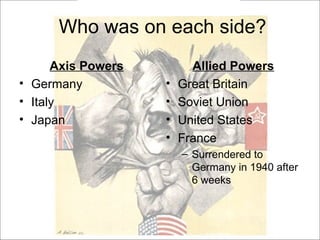
Who was on each side?
Axis Powers
• Germany
• Italy
• Japan
Allied Powers
• Great Britain
• Soviet Union
• United States
• France
– Surrendered to
Germany in 1940 after
6 weeks
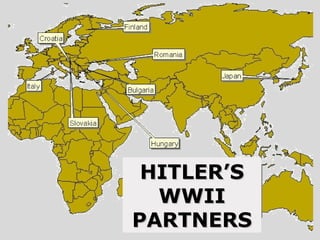
HITLER’SHITLER’S
WWIIWWII
PARTNERSPARTNERS
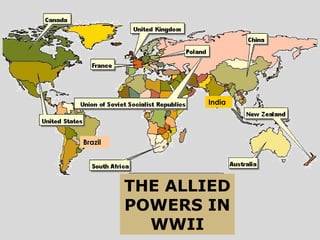
Brazil
India
THE ALLIED
POWERS IN
WWII
What about the Pacific War?
• The US (mostly) fought the Japanese.
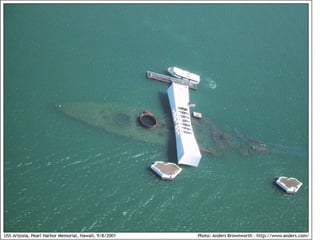
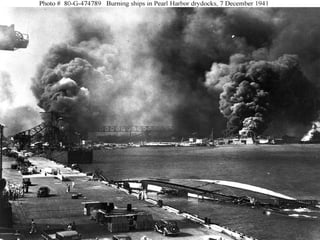
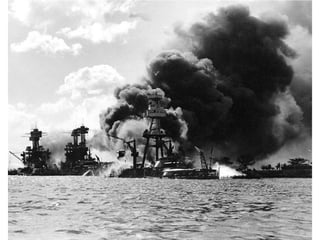
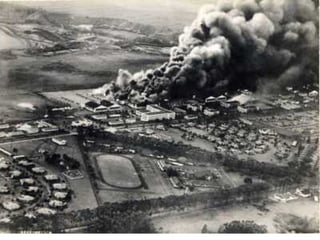
• December 7, 1941 Japan bombed Pearl
Harbor in Hawaii to sink US ships there.
– Two hours = most US navy destroyed and
2,000 sailors killed
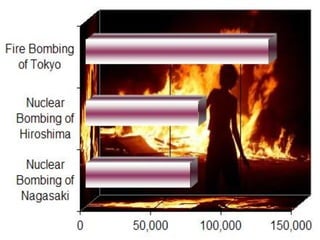
• Japan surrenders after US drops atomic
bombs on Hiroshima and Nagasaki.
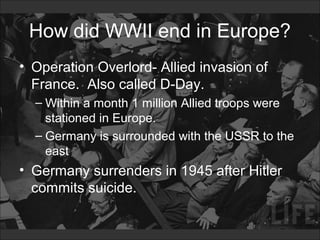
How did WWII end in Europe?
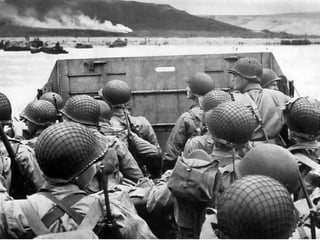
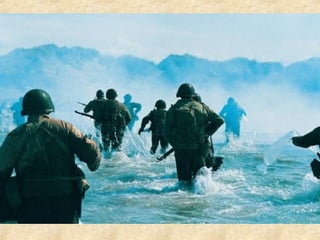
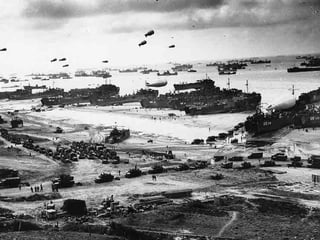
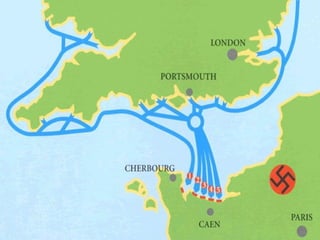
• Operation Overlord- Allied invasion of
France. Also called D-Day.
– Within a month 1 million Allied troops were
stationed in Europe.
– Germany is surrounded with the USSR to the
east
• Germany surrenders in 1945 after Hitler
commits suicide.
How did WWII end in Europe?
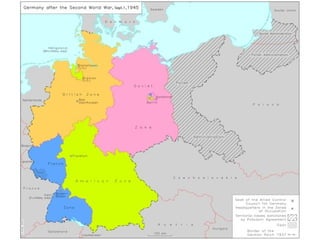
• Allies divide Germany up between them.
– This helps start the Cold War.
• Trials are held in Germany (and Japan) to
try the people responsible for the war.
– Many are executed and jailed for war crimes.
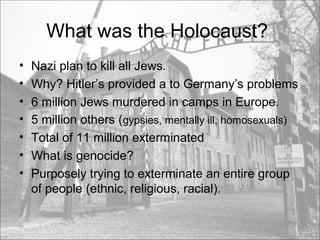
What was the Holocaust?
• Nazi plan to kill all Jews.
• Why? Hitler’s provided a to Germany’s problems
• 6 million Jews murdered in camps in Europe.
• 5 million others (gypsies, mentally ill, homosexuals)
• Total of 11 million exterminated
• What is genocide?
• Purposely trying to exterminate an entire group
of people (ethnic, religious, racial).
Quick Facts
• War Costs
–US Debt 1940 - $9 Billion
–US Debt 1945 - $98 Billion
• WWII cost $330 billion – 10 times the
cost of WWI & equivalent to all
previous federal spending since 1776
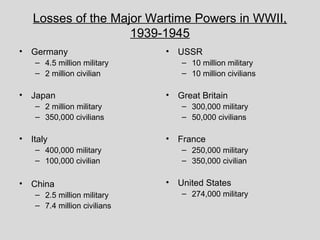
Losses of the Major Wartime Powers in WWII,
1939-1945
• Germany
– 4.5 million military
– 2 million civilian
• Japan
– 2 million military
– 350,000 civilians
• Italy
– 400,000 military
– 100,000 civilian
• China
– 2.5 million military
– 7.4 million civilians
• USSR
– 10 million military
– 10 million civilians
• Great Britain
– 300,000 military
– 50,000 civilians
• France
– 250,000 military
– 350,000 civilian
• United States
– 274,000 military

WWII Causes and Outcomes

  • 1.
  • 2.
  • 3.
    What was WWII? •Largest war in human history. • Involved countries, colonies, and territories around the entire world. • By the end, over 70 million were dead. • It lasted from 1939 until 1945.
  • 4.
    Causes •W WI andthe Treaty of Versailles •Appeasement •Rise of Totalitarianism
  • 5.
    WWI and theTreaty of Versailles • Germany lost land to surrounding nations • War reparations – Allies collect $ to pay back war debts to US – Germany pays $57 trillion (modern day equivalent) – Germans are bankrupt, embarrassed, guilt ridden, and angry. • Desperate people turn to desperate leaders
  • 6.
    Appeasement • Giving someonesomething to make them happy and leave you alone. • Hitler demanded land that wasn’t Germany’s and others just gave it to him. • Nations were trying to prevent war…it didn’t work. (Isolationism) • Appeasement just showed Hitler that he could do whatever he wanted.
  • 7.
  • 8.
    Appeasement Appeasement is theact of giving in to an enemy’s demands in hopes of avoiding further conflict. In 1938, Hitler demanded that Czechoslovakia cede the Sudetenland to Germany. He claimed that the German population living there was being mistreated. The British and French prime ministers agreed to Hitler’s demands without consulting Czechoslovakian leaders, in the hopes that this would avoid a war in Europe.
  • 9.
    American Isolationism The failureof peace efforts such as the Kellogg Briand Treaty during the 1920s disillusioned many Americans about international involvement. The U.S. was in a major depression throughout the 1930s and was mostly concerned with its own problems. Conflict in Europe seemed distant, and the U.S. tried to remain neutral. This policy weakened the European democracies. The Nye Committee held congressional hearings in the mid-1930s, concluding that the U.S. was tricked into entering WWI by arms manufacturers and Allied propaganda.
  • 10.
    Worldwide Economic Depression AfterWWI many European economies were unstable. The boom in the U.S. throughout the 1920s helped sustain worldwide trade. The 1929 stock market crash in the U.S. and the resulting Great Depression spread throughout the world. U.S. restrictive tariff policies worsened the depression. As economies plummeted and unemployment rose, many people turned to powerful leaders and governments who promised success through military buildup and the conquest of territory. German breadlines Japanese children eating radish roots during famine
  • 11.
  • 12.
    Militarism The glorification of war,in which a nation strengthens its military and stockpiles weapons in preparation for war. An important aspect of militarism is that the glorification of war is incorporated into all levels of society, including education of the nation’s youth. Militaristic societies have existed throughout human history. Ancient Sparta is an example of a militaristic society Hitler Youth group
  • 13.
    Nationalism Nationalism is the beliefin the superiority of one’s own nation over all others. In the extreme, it can lead to major conflicts between nations. Hitler, Mussolini, and Japan’s Tojo each touted their nation’s ability to dominate all others in the years leading up to WWII. Nazi flag, Italian fascist logo, Japanese flag
  • 14.
    Japanese Expansionism In 1931Japan invaded Manchuria for raw materials. The same year, Japan began to attack China, with full-scale war breaking out in 1937 in the Sino-Japanese War. In 1938, war broke out between Japan and the Soviet Union in what were known as the Soviet-Japanese Border Wars.
  • 15.
    Rise of Totalitarianism •A system in which the state and its leader have nearly TOTAL control. • Individual rights are not viewed as important as the needs of the nation. – No right to vote – No free speech – Government controlled economy – Often a police state
  • 16.
  • 17.
    Adolf Hitler- Germany Hideki Tojo- Japan Benito Mussolini-Italy Josef Stalin- USSR
  • 18.
    Anti-Communism Under communism, all meansof production are controlled by the government, as are property, the media, and all other aspects of society. The 1930s saw the rise of many totalitarian regimes; but most people chose fascism over communism. Hitler exploited people’s fear of a communist takeover in Germany to rise to power in 1933. A Battle for Germany: Nazi anti-communist book from 1933
  • 19.
    What is Fascism? •Political belief that says the individual is less important than the nation. • Glorifies violence, believes it is needed to “prove” strength of a people. • Uses nationalism and racism. • Dictatorships. • Italy and then Germany became fascist.
  • 20.
    In Germany, depression,unemployment and hard times led to a dramatic increase in votes for Hitler and the Nazi Party. Election date Votes in millions Share May 20, 1928 0.81 2.6% September 14, 1930 6.41 18.3% July 31, 1932 13.75 37.3% November 6, 1932 11.74 33.1% March 5, 1933 17.28 43.9% Voting for Hitler’s party increased as unemployment rates rose
  • 23.
    Theaters of War:Where WWII Was Fought Pacific Asia North Africa Europe Atlantic Ocean
  • 24.
    What did HitlerWant? • Militarism- soon after becoming chancellor he begins rearming Germany breaking the Treaty of Versailles • Rhineland- moves troops into the Rhineland territory again breaking the Treaty of Versailles • Lebensraum- “living space” – Austria - annexed peacefully in 1938 – Sudetenland – territory in Czechoslovakia • Given to Germany by Great Britain and France – Hitler then invades the rest of Czechoslovakia • What’s this called? ______________________ – On to Poland
  • 25.
    How did WWIIstart? • Germany invaded Poland. • Allies declare war on Germany. • Germany then invades France, Belgium, etc. • Then Hitler invades Russia. • Germans use “blitzkrieg” to overwhelm other armies. – Blitzkrieg means “lightening war” in German. – Surround with tanks and troops in trucks.
  • 26.
    Who was oneach side? Axis Powers • Germany • Italy • Japan Allied Powers • Great Britain • Soviet Union • United States • France – Surrendered to Germany in 1940 after 6 weeks
  • 27.
  • 28.
  • 30.
    What about thePacific War? • The US (mostly) fought the Japanese. • December 7, 1941 Japan bombed Pearl Harbor in Hawaii to sink US ships there. – Two hours = most US navy destroyed and 2,000 sailors killed • Japan surrenders after US drops atomic bombs on Hiroshima and Nagasaki.
  • 38.
    How did WWIIend in Europe? • Operation Overlord- Allied invasion of France. Also called D-Day. – Within a month 1 million Allied troops were stationed in Europe. – Germany is surrounded with the USSR to the east • Germany surrenders in 1945 after Hitler commits suicide.
  • 43.
    How did WWIIend in Europe? • Allies divide Germany up between them. – This helps start the Cold War. • Trials are held in Germany (and Japan) to try the people responsible for the war. – Many are executed and jailed for war crimes.
  • 44.
    What was theHolocaust? • Nazi plan to kill all Jews. • Why? Hitler’s provided a to Germany’s problems • 6 million Jews murdered in camps in Europe. • 5 million others (gypsies, mentally ill, homosexuals) • Total of 11 million exterminated • What is genocide? • Purposely trying to exterminate an entire group of people (ethnic, religious, racial).
  • 46.
    Quick Facts • WarCosts –US Debt 1940 - $9 Billion –US Debt 1945 - $98 Billion • WWII cost $330 billion – 10 times the cost of WWI & equivalent to all previous federal spending since 1776
  • 47.
    Losses of theMajor Wartime Powers in WWII, 1939-1945 • Germany – 4.5 million military – 2 million civilian • Japan – 2 million military – 350,000 civilians • Italy – 400,000 military – 100,000 civilian • China – 2.5 million military – 7.4 million civilians • USSR – 10 million military – 10 million civilians • Great Britain – 300,000 military – 50,000 civilians • France – 250,000 military – 350,000 civilian • United States – 274,000 military

Editor's Notes

  • #29 These are the nations that had a substantial number of soldiers involved in the fighting.