CONTENT
• THIS PRESENTATION WILL TELL
YOU THE THE TWO BIGGEST
WAR OF THE WORLD.WORLD
WAR 1& WORLD WAR 2 AND
OUR PRESENTATION WILL
START WITH WORLD WAR
1THEN WORLD WAR 2.IT WILL
DESCRIBE THE MYSTERIOUS
PAST OF THE
WORLD.SO,EVERYONE HOLDS
YOUR BREATH AND LETS MOVE
TO THE PAST.
•WORLD
WAR1
•WORLD
WAR2
MAIN Causes of WWI
1. Militarism – the aggressive build-up of a nations armed
forces.
2. Alliances – nations formed partnerships to help protect
and defend themselves.
3. Imperialism – stronger nations began to take over
weaker nations.
4. Nationalism – everybody thought their nation was the
best.
5
ABOUT The First World War:
•World War involving nearly all the nations of the world
• It was held in 1914-1918
CAUSES OF WORLD WAR 1
• Long term -
–Alliance system
–Imperialist Competition
–Stockpiling of Weapons
• Short term
–Assassination of Franz Ferdinand of the Austro-Hungarian
Empire.
WHO ARE IN THE WWI?
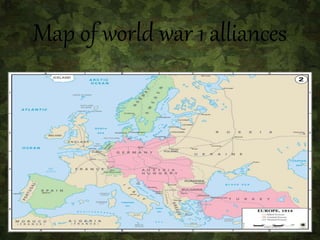
• Central Powers – Germany , Austria , Ottoman
Empire , Bulgaria
• Allies - Russia , France , Great Britain , Italy,
Japan , United States
The spark!
• The Balkans
• Austro/Hungarian Empire holds Bosnia-Herzegovina
• Ethnically Slavic (As are Russians and Serbs)
• Assassination of Arch Duke Ferdinand of Austro-Hung
• Black Hand Society (Serbs)
• Austria gives Serbia an Ultimatum
A Disastrous Chain of Events
• June 28th – August 4th 1914
– Assassination of Arch Duke Ferdinand
–Austro-Hung declares war on Serbia
–Russia vows to Protect Serbia
– Germany vows to protect Austro-Hung
–Russia mobilizes to German/Polish Boarder
–Germany fears attack and attacks Russia
–France allies with Russia based on old treaty
Map of world war 1 alliances
The battle plans for victory?
Schrieffer Plan
–Germany’s problem was a war on two fronts
–Invade France by way of Luxemburg/Belgium defeat
France quickly
–Turn to the Eastern Front and defeat Russia
 Plan 17
–Frances plan to invade Germany across the open plain of
Alsace-Lorraine with bicycles and horses.
WhenBattlePlansFailStalemate
 Plans Fail
–Plans are based on false assumptions of enemy strength
–Plan 17 fails, German defences are much to strong
–Schrieffer invasion starts well, ends bad
 Belgium and France do not have the infrastructure to support
German advance
–600 taxi cabs rush French & British forces to the battle
–Hold line 40 miles from Paris
World War I Weapons
• Tank , Machine Gun
• Armour protection, mobile gun, unreliable in WWI
• Submarine
• German U-Boat, Torpedoes, Shipping Blockades
• Poison Gas
• Mustard Gas & Chlorine, Choked-Blinded & Killed
• Caused Trench warfare, Two men could operate
• Air recon., Bombing, Dog Fighting , Air Plane
Battle of Gallipoli
Gallipoli Peninsula
–April 25, 1915
Casualties
–Turkish 250,000
Allied Forces
–British – 205,000
–French – 43,000
–ANZAC – 36,000
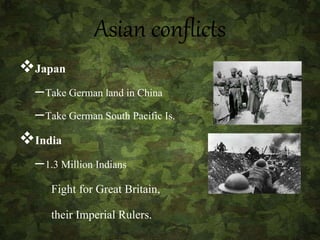
Asian conflicts
Japan
–Take German land in China
–Take German South Pacific Is.
India
–1.3 Million Indians
Fight for Great Britain,
their Imperial Rulers.
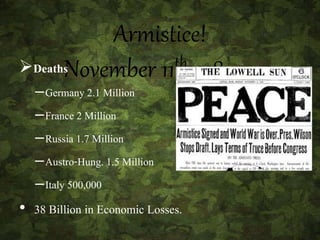
Armistice!
November 11th1918Deaths
–Germany 2.1 Million
–France 2 Million
–Russia 1.7 Million
–Austro-Hung. 1.5 Million
–Italy 500,000
• 38 Billion in Economic Losses.
A Flawed PeaceTreaty of Versailles
–France and Britain impose harsh penalties on Germany
Must take full responsibility for war
Pay 33 Billion to allies
Restrictions on German Army and Navy - 100,000 Soldiers
Took traditional German Lands
Wilson’s Fourteen Point Plan
–Rejected as to forgiving to Germans
–Point 14 a League of Nations accepted by Europe
World war I legacy “the war to end all
wars”?10 Million Killed
338 Billion in Economic Lose
Europe
– German hostilities to European Powers
– German Economic Depression
– Italians feel slighted by concessions
– Russian Collapses Leads to Revolution
• World
– U.S. Industrial Boom
• Changing borders in Asia and Africa
From Versailles to Pearl
Harbour U.S. Isolationism:
1919 - 1941
AMERICAN’S DURING 1920
• Many Americans were disillusioned by WWI and wanted to “return to
normalcy”.
• “The Business of America was business!”
• The U.S. embraced isolationism in the face of prosperity.
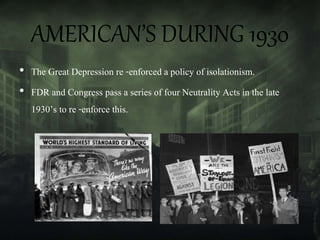
AMERICAN’S DURING 1930
• The Great Depression re -enforced a policy of isolationism.
• FDR and Congress pass a series of four Neutrality Acts in the late
1930’s to re -enforce this.
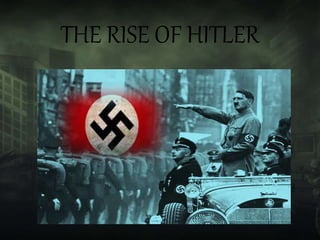
THE RISE OF HITLER
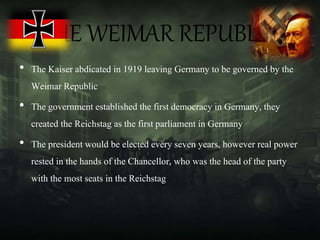
THE WEIMAR REPUBLIC
• The Kaiser abdicated in 1919 leaving Germany to be governed by the
Weimar Republic
• The government established the first democracy in Germany, they
created the Reichstag as the first parliament in Germany
• The president would be elected every seven years, however real power
rested in the hands of the Chancellor, who was the head of the party
with the most seats in the Reichstag
• The Weimar Republic was unpopular for several reasons:
• It was associated with the Treaty of Versailles which was
extremely unpopular in Germany
• It was associated with the massive inflation and economic ruin of
the 20’s
• Democracy was not running smoothly in Germany, there were too
many parties and no clear majority
Timeline of German Aggression
• 1921 - takes control of the National Socialist Party (a.k.a. the Nazis)
• 1923 - attempts Putsch (seizure of government) and fails; lands in jail, where he
writes Mein Kampf
• 1933 - becomes Germany’s Chancellor – Begins passing restrictive laws for
Jews – Germany leaves League of Nations – Dachau opens
• 1934 - German president dies; Hitler takes over
• 1936 - Takes back the Rhineland (forbidden!)
• 1937 - Hitler renounces Treaty of Versailles
• 1938 - Munich Pact - gives Hitler Czechoslovakia
• 1939 - Non-aggression Pact with USSR
Mussolini’sRisetoPoweranda“New
RomanEmpire”
• Originally disliked Hitler (viewed Germany as competition in his
conquest)
• 1935 - retakes Ethiopia easily (tanks vs. rifles) –Germany fully
supports
• 1936 - Germany and Italy form “an axis around which all European
states animated by the desire for peace may collaborate”
Franco’s Rise to Power and the
Spanish Civil War (1936-1939)
Franco and the Fascists vs. The
Republic
• Nationalists = rebels
• Conservative
• Strongly supported by Germany and Italy
• Loyalists = current government
• Liberal
• Had a little support from the US, USSR, and the International Brigade,
but not much (British/French/US isolationism)
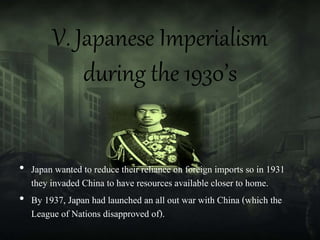
V. Japanese Imperialism
during the 1930’s
• Japan wanted to reduce their reliance on foreign imports so in 1931
they invaded China to have resources available closer to home.
• By 1937, Japan had launched an all out war with China (which the
League of Nations disapproved of).
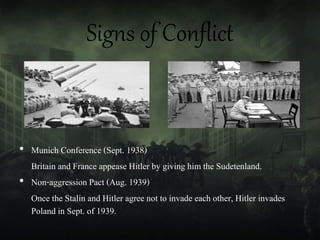
Signs of Conflict
• Munich Conference (Sept. 1938)
Britain and France appease Hitler by giving him the Sudetenland.
• Non-aggression Pact (Aug. 1939)
Once the Stalin and Hitler agree not to invade each other, Hitler invades
Poland in Sept. of 1939.
The Axis Take Control
• Germany invades Czech. and Poland and war is declared in 1939.
• Germany is relentless in it’s BLITZKRIEG, or lightening warfare and
focuses on the Western front.
• France falls to Germany in June of 1940.
• Hitler breaks the Non-Aggression Pact and invades the Soviet Union.
• Japan extends much of it’s control into southeast Asia and begins
planning an invasion of the U.S.
• The United States still maintains it’s isolationist stance, but gives aid
under the “Cash and Carry System” and later under the “Lend Lease
Act”.
The Alliances of WWII
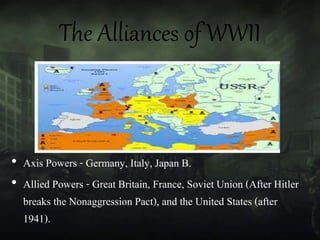
• Axis Powers - Germany, Italy, Japan B.
• Allied Powers - Great Britain, France, Soviet Union (After Hitler
breaks the Nonaggression Pact), and the United States (after
1941).
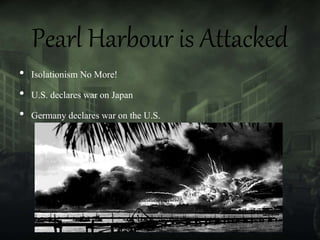
Pearl Harbour is Attacked
• Isolationism No More!
• U.S. declares war on Japan
• Germany declares war on the U.S.
The United States Home Front 1941 -
1945
Mobilization of Industry
• The War Production Board converted factories to meet the necessities
of war.
• Tanks, jeeps, guns, ammunition, uniforms, and food rations were
produced in full force.
Violation of Civil Liberties
• Japanese American Internment
• American Hatred for the German / Italian Enemy
was different than the hatred for the Japanese
Enemy
• While the Army was not yet desegregated, more
and more minorities were proving their equality on
the battlefields of WWII
Allied Campaigns :North Africa
and Italy
• FDR and Churchill agreed to defeat Germany first .
• The Allies push the Axis forces out of North Africa
• Then succeed in taking Italy (the “soft underbelly ” of the
enemy) by April 1945.
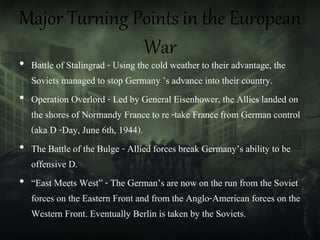
Major Turning Points in the European
War
• Battle of Stalingrad - Using the cold weather to their advantage, the
Soviets managed to stop Germany ’s advance into their country.
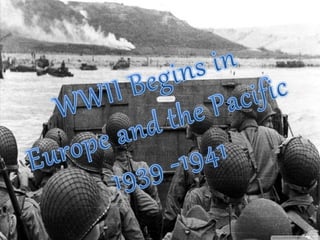
• Operation Overlord - Led by General Eisenhower, the Allies landed on
the shores of Normandy France to re -take France from German control
(aka D -Day, June 6th, 1944).
• The Battle of the Bulge - Allied forces break Germany’s ability to be
offensive D.
• “East Meets West” - The German’s are now on the run from the Soviet
forces on the Eastern Front and from the Anglo-American forces on the
Western Front. Eventually Berlin is taken by the Soviets.
Victory in Europe (V -E Day) and
Consequences of War
• Hitler commits suicide on April 30th, 1945 German officers
surrender on May 8th, 1945.
• Americans rejoice for a brief period, then focus on ending the
war in the Pacific against the Japanese.
• The Holocaust of the Jews in Europe under the Nazis became
more real with every concentration camp uncovered during the
Allied liberation of Nazi territory.
Japanese Forces Expand into
the Pacific
• Japanese forces quickly expanded into the Pacific Ocean after
Pearl Harbour
• They boldly captured Allied possessions (including U.S.
controlled Guam and the Philippines, British controlled Hong
Kong, and much of French and Dutch controlled Indochina.)
Major Turning Points in the
Pacific War
• The Battle of Coral Sea - Thanks to a broken code, the U.S. destroyed
several vital Japanese carriers.
• The Battle of Midway - Involved planes trying to sink the other’s
battleships; a victory and turning point for the Allies; Japan was now
on the defensive!
• As the U.S. got closer to the main island of Japan, fighting got more
brutal as was seen in Okinawa.
Victory in the Pacific (aka V -J Day)
and the Consequences of War
• “Island Hopping ” - the U.S. moved closer to the main islands of Japan with
every battle won.
• Japan’s Military Code of Honour and Kamikazes - dying in war was a glorious
death, so Japanese pilots would crash planes into U.S. ships in suicide missions.
• After V -E Day - Americans feared the loss of life that a homeland invasion of
Japan would cause and looked to the Atomic Bomb as an answer.
• After some debate, the U.S. decided to use the atomic bomb developed in the
secretive Manhattan Project.
• Harry S. Truman (the new president after FDR ’s death) was the one to make the
decision, and historians / Americans still debate this heavily today.
Atomic Bombs
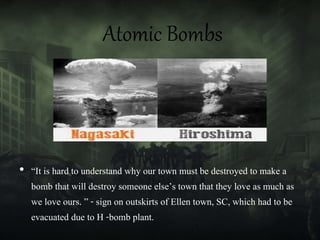
• “It is hard to understand why our town must be destroyed to make a
bomb that will destroy someone else’s town that they love as much as
we love ours. ” - sign on outskirts of Ellen town, SC, which had to be
evacuated due to H -bomb plant.
Explosion
• August 6, 1945, 8:15 AM –
–“Little Boy” explodes 2000 feet over Hiroshima 80,000
killed immediately.
–Most buildings within 1.5 miles of the detention site
destroyed.
• August 9, 11:02 AM –
–“Fat Man” hits Nagasaki 40,000 killed Bomb more
powerful, but less damage because of geography.
First-hand Accounts
• Co-Pilot of the Enola Gay (plane that dropped LittleBoy) could actuallytaste the nuclear
fission.
• “I was in my office. I had just entered the room and said "Good morning." to colleagues and I
was about to approach my desk when outside it suddenly turned bright red…I felt very hot on
my cheeks. I felt weightlessas if I were an astronaut. I was then unconsciousfor 20 or 30
seconds. When I came to, I realized that everybodyincludingmyself was lying at one side of
the room. Nobody was standing. The desks and chairs had also blown off to one side. At the
windows, there was no window glass and the window frames had been blown out as well.” -
Dr. Hiroshi Sawachika, 4.1 km from epicentre
• “When I was rescued, my hair was burned; my face was inflatedlike a balloon.Though my
mother did not say, I knew it. I wondered why my shirt had been burnt and hanging around my
arms, I soon realizedthey were pieces of my skin. It was hell. I saw people looking for water
and they died soon after they drank it.” - Ms. Yamaoka.
Legacies of World War II
• Genocide Civilian
• Bombing Atomic Warfare
• The issues of War Crimes
• The United Nations
• The Cold War
PRESENTATION BY:
PRATIK KU. MISHRA(
AKHILESH YADAV(
KRISHNA KATARUKA(534)

WW1 WW2

  • 2.
    CONTENT • THIS PRESENTATIONWILL TELL YOU THE THE TWO BIGGEST WAR OF THE WORLD.WORLD WAR 1& WORLD WAR 2 AND OUR PRESENTATION WILL START WITH WORLD WAR 1THEN WORLD WAR 2.IT WILL DESCRIBE THE MYSTERIOUS PAST OF THE WORLD.SO,EVERYONE HOLDS YOUR BREATH AND LETS MOVE TO THE PAST. •WORLD WAR1 •WORLD WAR2
  • 4.
    MAIN Causes ofWWI 1. Militarism – the aggressive build-up of a nations armed forces. 2. Alliances – nations formed partnerships to help protect and defend themselves. 3. Imperialism – stronger nations began to take over weaker nations. 4. Nationalism – everybody thought their nation was the best.
  • 5.
    5 ABOUT The FirstWorld War: •World War involving nearly all the nations of the world • It was held in 1914-1918
  • 6.
    CAUSES OF WORLDWAR 1 • Long term - –Alliance system –Imperialist Competition –Stockpiling of Weapons • Short term –Assassination of Franz Ferdinand of the Austro-Hungarian Empire.
  • 7.
    WHO ARE INTHE WWI? • Central Powers – Germany , Austria , Ottoman Empire , Bulgaria • Allies - Russia , France , Great Britain , Italy, Japan , United States
  • 8.
    The spark! • TheBalkans • Austro/Hungarian Empire holds Bosnia-Herzegovina • Ethnically Slavic (As are Russians and Serbs) • Assassination of Arch Duke Ferdinand of Austro-Hung • Black Hand Society (Serbs) • Austria gives Serbia an Ultimatum
  • 9.
    A Disastrous Chainof Events • June 28th – August 4th 1914 – Assassination of Arch Duke Ferdinand –Austro-Hung declares war on Serbia –Russia vows to Protect Serbia – Germany vows to protect Austro-Hung –Russia mobilizes to German/Polish Boarder –Germany fears attack and attacks Russia –France allies with Russia based on old treaty
  • 10.
    Map of worldwar 1 alliances
  • 11.
    The battle plansfor victory? Schrieffer Plan –Germany’s problem was a war on two fronts –Invade France by way of Luxemburg/Belgium defeat France quickly –Turn to the Eastern Front and defeat Russia  Plan 17 –Frances plan to invade Germany across the open plain of Alsace-Lorraine with bicycles and horses.
  • 12.
    WhenBattlePlansFailStalemate  Plans Fail –Plansare based on false assumptions of enemy strength –Plan 17 fails, German defences are much to strong –Schrieffer invasion starts well, ends bad  Belgium and France do not have the infrastructure to support German advance –600 taxi cabs rush French & British forces to the battle –Hold line 40 miles from Paris
  • 13.
    World War IWeapons • Tank , Machine Gun • Armour protection, mobile gun, unreliable in WWI • Submarine • German U-Boat, Torpedoes, Shipping Blockades • Poison Gas • Mustard Gas & Chlorine, Choked-Blinded & Killed • Caused Trench warfare, Two men could operate • Air recon., Bombing, Dog Fighting , Air Plane
  • 14.
    Battle of Gallipoli GallipoliPeninsula –April 25, 1915 Casualties –Turkish 250,000 Allied Forces –British – 205,000 –French – 43,000 –ANZAC – 36,000
  • 15.
    Asian conflicts Japan –Take Germanland in China –Take German South Pacific Is. India –1.3 Million Indians Fight for Great Britain, their Imperial Rulers.
  • 16.
    Armistice! November 11th1918Deaths –Germany 2.1Million –France 2 Million –Russia 1.7 Million –Austro-Hung. 1.5 Million –Italy 500,000 • 38 Billion in Economic Losses.
  • 17.
    A Flawed PeaceTreatyof Versailles –France and Britain impose harsh penalties on Germany Must take full responsibility for war Pay 33 Billion to allies Restrictions on German Army and Navy - 100,000 Soldiers Took traditional German Lands Wilson’s Fourteen Point Plan –Rejected as to forgiving to Germans –Point 14 a League of Nations accepted by Europe
  • 18.
    World war Ilegacy “the war to end all wars”?10 Million Killed 338 Billion in Economic Lose Europe – German hostilities to European Powers – German Economic Depression – Italians feel slighted by concessions – Russian Collapses Leads to Revolution • World – U.S. Industrial Boom • Changing borders in Asia and Africa
  • 20.
    From Versailles toPearl Harbour U.S. Isolationism: 1919 - 1941
  • 21.
    AMERICAN’S DURING 1920 •Many Americans were disillusioned by WWI and wanted to “return to normalcy”. • “The Business of America was business!” • The U.S. embraced isolationism in the face of prosperity.
  • 22.
    AMERICAN’S DURING 1930 •The Great Depression re -enforced a policy of isolationism. • FDR and Congress pass a series of four Neutrality Acts in the late 1930’s to re -enforce this.
  • 23.
  • 24.
    THE WEIMAR REPUBLIC •The Kaiser abdicated in 1919 leaving Germany to be governed by the Weimar Republic • The government established the first democracy in Germany, they created the Reichstag as the first parliament in Germany • The president would be elected every seven years, however real power rested in the hands of the Chancellor, who was the head of the party with the most seats in the Reichstag
  • 25.
    • The WeimarRepublic was unpopular for several reasons: • It was associated with the Treaty of Versailles which was extremely unpopular in Germany • It was associated with the massive inflation and economic ruin of the 20’s • Democracy was not running smoothly in Germany, there were too many parties and no clear majority
  • 26.
    Timeline of GermanAggression • 1921 - takes control of the National Socialist Party (a.k.a. the Nazis) • 1923 - attempts Putsch (seizure of government) and fails; lands in jail, where he writes Mein Kampf • 1933 - becomes Germany’s Chancellor – Begins passing restrictive laws for Jews – Germany leaves League of Nations – Dachau opens • 1934 - German president dies; Hitler takes over • 1936 - Takes back the Rhineland (forbidden!) • 1937 - Hitler renounces Treaty of Versailles • 1938 - Munich Pact - gives Hitler Czechoslovakia • 1939 - Non-aggression Pact with USSR
  • 27.
  • 28.
    • Originally dislikedHitler (viewed Germany as competition in his conquest) • 1935 - retakes Ethiopia easily (tanks vs. rifles) –Germany fully supports • 1936 - Germany and Italy form “an axis around which all European states animated by the desire for peace may collaborate”
  • 29.
    Franco’s Rise toPower and the Spanish Civil War (1936-1939)
  • 30.
    Franco and theFascists vs. The Republic • Nationalists = rebels • Conservative • Strongly supported by Germany and Italy • Loyalists = current government • Liberal • Had a little support from the US, USSR, and the International Brigade, but not much (British/French/US isolationism)
  • 31.
    V. Japanese Imperialism duringthe 1930’s • Japan wanted to reduce their reliance on foreign imports so in 1931 they invaded China to have resources available closer to home. • By 1937, Japan had launched an all out war with China (which the League of Nations disapproved of).
  • 32.
    Signs of Conflict •Munich Conference (Sept. 1938) Britain and France appease Hitler by giving him the Sudetenland. • Non-aggression Pact (Aug. 1939) Once the Stalin and Hitler agree not to invade each other, Hitler invades Poland in Sept. of 1939.
  • 34.
    The Axis TakeControl • Germany invades Czech. and Poland and war is declared in 1939. • Germany is relentless in it’s BLITZKRIEG, or lightening warfare and focuses on the Western front. • France falls to Germany in June of 1940. • Hitler breaks the Non-Aggression Pact and invades the Soviet Union. • Japan extends much of it’s control into southeast Asia and begins planning an invasion of the U.S. • The United States still maintains it’s isolationist stance, but gives aid under the “Cash and Carry System” and later under the “Lend Lease Act”.
  • 35.
    The Alliances ofWWII • Axis Powers - Germany, Italy, Japan B. • Allied Powers - Great Britain, France, Soviet Union (After Hitler breaks the Nonaggression Pact), and the United States (after 1941).
  • 36.
    Pearl Harbour isAttacked • Isolationism No More! • U.S. declares war on Japan • Germany declares war on the U.S.
  • 37.
    The United StatesHome Front 1941 - 1945
  • 38.
    Mobilization of Industry •The War Production Board converted factories to meet the necessities of war. • Tanks, jeeps, guns, ammunition, uniforms, and food rations were produced in full force.
  • 39.
    Violation of CivilLiberties • Japanese American Internment • American Hatred for the German / Italian Enemy was different than the hatred for the Japanese Enemy • While the Army was not yet desegregated, more and more minorities were proving their equality on the battlefields of WWII
  • 40.
    Allied Campaigns :NorthAfrica and Italy • FDR and Churchill agreed to defeat Germany first . • The Allies push the Axis forces out of North Africa • Then succeed in taking Italy (the “soft underbelly ” of the enemy) by April 1945.
  • 41.
    Major Turning Pointsin the European War • Battle of Stalingrad - Using the cold weather to their advantage, the Soviets managed to stop Germany ’s advance into their country. • Operation Overlord - Led by General Eisenhower, the Allies landed on the shores of Normandy France to re -take France from German control (aka D -Day, June 6th, 1944). • The Battle of the Bulge - Allied forces break Germany’s ability to be offensive D. • “East Meets West” - The German’s are now on the run from the Soviet forces on the Eastern Front and from the Anglo-American forces on the Western Front. Eventually Berlin is taken by the Soviets.
  • 42.
    Victory in Europe(V -E Day) and Consequences of War • Hitler commits suicide on April 30th, 1945 German officers surrender on May 8th, 1945. • Americans rejoice for a brief period, then focus on ending the war in the Pacific against the Japanese. • The Holocaust of the Jews in Europe under the Nazis became more real with every concentration camp uncovered during the Allied liberation of Nazi territory.
  • 43.
    Japanese Forces Expandinto the Pacific • Japanese forces quickly expanded into the Pacific Ocean after Pearl Harbour • They boldly captured Allied possessions (including U.S. controlled Guam and the Philippines, British controlled Hong Kong, and much of French and Dutch controlled Indochina.)
  • 44.
    Major Turning Pointsin the Pacific War • The Battle of Coral Sea - Thanks to a broken code, the U.S. destroyed several vital Japanese carriers. • The Battle of Midway - Involved planes trying to sink the other’s battleships; a victory and turning point for the Allies; Japan was now on the defensive! • As the U.S. got closer to the main island of Japan, fighting got more brutal as was seen in Okinawa.
  • 45.
    Victory in thePacific (aka V -J Day) and the Consequences of War • “Island Hopping ” - the U.S. moved closer to the main islands of Japan with every battle won. • Japan’s Military Code of Honour and Kamikazes - dying in war was a glorious death, so Japanese pilots would crash planes into U.S. ships in suicide missions. • After V -E Day - Americans feared the loss of life that a homeland invasion of Japan would cause and looked to the Atomic Bomb as an answer. • After some debate, the U.S. decided to use the atomic bomb developed in the secretive Manhattan Project. • Harry S. Truman (the new president after FDR ’s death) was the one to make the decision, and historians / Americans still debate this heavily today.
  • 46.
    Atomic Bombs • “Itis hard to understand why our town must be destroyed to make a bomb that will destroy someone else’s town that they love as much as we love ours. ” - sign on outskirts of Ellen town, SC, which had to be evacuated due to H -bomb plant.
  • 47.
    Explosion • August 6,1945, 8:15 AM – –“Little Boy” explodes 2000 feet over Hiroshima 80,000 killed immediately. –Most buildings within 1.5 miles of the detention site destroyed. • August 9, 11:02 AM – –“Fat Man” hits Nagasaki 40,000 killed Bomb more powerful, but less damage because of geography.
  • 48.
    First-hand Accounts • Co-Pilotof the Enola Gay (plane that dropped LittleBoy) could actuallytaste the nuclear fission. • “I was in my office. I had just entered the room and said "Good morning." to colleagues and I was about to approach my desk when outside it suddenly turned bright red…I felt very hot on my cheeks. I felt weightlessas if I were an astronaut. I was then unconsciousfor 20 or 30 seconds. When I came to, I realized that everybodyincludingmyself was lying at one side of the room. Nobody was standing. The desks and chairs had also blown off to one side. At the windows, there was no window glass and the window frames had been blown out as well.” - Dr. Hiroshi Sawachika, 4.1 km from epicentre • “When I was rescued, my hair was burned; my face was inflatedlike a balloon.Though my mother did not say, I knew it. I wondered why my shirt had been burnt and hanging around my arms, I soon realizedthey were pieces of my skin. It was hell. I saw people looking for water and they died soon after they drank it.” - Ms. Yamaoka.
  • 49.
    Legacies of WorldWar II • Genocide Civilian • Bombing Atomic Warfare • The issues of War Crimes • The United Nations • The Cold War
  • 50.
    PRESENTATION BY: PRATIK KU.MISHRA( AKHILESH YADAV( KRISHNA KATARUKA(534)