World War II
Adolph Hitler & Nazi Germany
Adolph Hitler & Nazis
given emergency dictatorial
powers in March 1933
Used resentment of treaty &
Jews as scapegoats
Nuremburg Laws (1935)
Kristallnacht
Began secretly rebuilding
military in 1935
Reoccupied Rhineland in
1936
Aftermath of Kristallnacht
SS Blood Flag Ritual
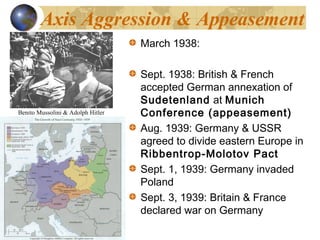
Axis Aggression & Appeasement
March 1938:
Sept. 1938: British & French
accepted German annexation of
Sudetenland at Munich
Conference (appeasement)
Aug. 1939: Germany & USSR
agreed to divide eastern Europe in
Ribbentrop-Molotov Pact
Sept. 1, 1939: Germany invaded
Poland
Sept. 3, 1939: Britain & France
declared war on Germany
© 2000 Wadsworth / Thomson Learning
Benito Mussolini & Adolph Hitler
The European Theater, 1939-41
Blitzkrieg
revolutionized warfare
Planes
Tanks
April 1940: Germany
conquered Denmark &
Norway
May 1940: Germany
overran Low Countries
June 1940: France
surrendered to
Germany
American Isolationism
Nye Committee (1934-37)
investigated whether the U.S. had
been duped into entering World
War I
1937 Gallup Poll showed 2/3 of
Americans thought U.S.
involvement in WWI had been a
mistake
1937 Neutrality Act:
Copyright 1997 Prentice-Hall
The Arsenal of Democracy
Nov. 1939 – Neutrality Act amended to allow arms
sales to belligerents
July 1940 – Republicans Henry Stimson & Frank Knox
brought into cabinet as War & Navy Secretaries
Sept. 1940 –
Destroyer-Base Deal
Selective Service Act –
March 1941 – Lend-Lease Act
U.S. got into undeclared naval war in Atlantic
escorted British convoys – several shooting incidents in fall
Marines took over Greenland & Iceland to secure route
Declaring War Aims
Aug. 1941 – FDR &
Churchill meet & issue
Atlantic Charter:
Collective security
Disarmament
Norman Rockwell,
“Freedom of Worship”
Churchill & Roosevelt, Aug. 1941
Pearl Harbor – Dec. 7, 1941
Copyright 2000, Bedford/St. Martins
U.S.-Japanese Conflict
Japanese had long resented U.S.
immigration policy & coveted
Philippines
After Japan signed Tripartite
Pact (Sept. 1940) & joined Axis,
U.S. embargoed aviation fuel &
scrap metal
MAGIC intercepts revealed attack
was coming, but not where it
would come
Hideki Tojo,
Japanese
Prime Minister
1941-44
The Attack on Pearl Harbor
Japanese fleet crossed
Pacific in radio silence
60 ships
6 carriers with 360 planes
U.S. lost:
U.S. aircraft carriers
spared because out at
sea on exercises
USS Shaw
USS Arizona
Aerial Photo of Pearl Harbor
The War in Europe
Stalin wanted second
front immediately
British preferred to
attack “soft underbelly”
(N. Africa & Italy)
Russians deserve most
of the credit for winning
the war in Europe
Battle of Stalingrad
The War in Europe
Nov. 1942: U.S. & British
land at Casablanca
July 1943: U.S. & British
invade Sicily, then Italy
June 1944: Normandy
invasion (Operation
Overlord)
May 7, 1945 =
Race War in the Pacific
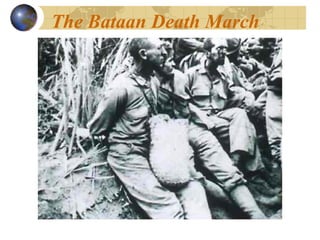
The Bataan Death March
The War in the Pacific
Turning point =
U.S. Strategy: “island-
hopping”
Victory at Leyte Gulf (Oct.
1944) began reconquest of
Philippines
Bloodbaths at Iwo Jima
(Feb.-March 1945) &
Okinawa (April-June 1945),
coupled with kamikaze
attacks, made invasion of
Japan unappealing
U.S. dropped atomic bombs on
Hiroshima (Aug. 6) &
Nagasaki (Aug. 9)
Aug. 14/15, 1945 = V-J Day
The Pacific Theater
Marines Raising the Flag on Mt.
Suribachi, Iwo Jima, Feb. 1945
Gen. Macarthur Returns to the Philippines
WWII Deaths
USSR = 25 million
China = 15 million
Poland = 6 million
Germany = 4 million
Japan = 2 million
Yugoslavia 1.5 – 2
million
USA = 400,000
U.S. Military Cemetery, Normandy
The Home Front
War Production Board oversaw
plant conversion & production
Big business benefitted the most
Received 2/3 of gov’t contracts
Corporate profits doubled, 1939-43
Union membership rose from 8.5
million to 14.75 million, 1940-45
Wages rose 135%, 140-45
6 million women entered workforce
• 2.5 million in industry
• 75% married
WWII Propaganda Posters
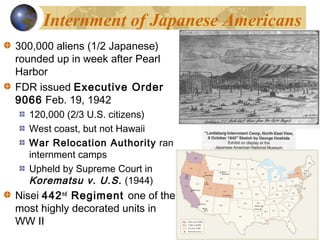
Internment of Japanese Americans
300,000 aliens (1/2 Japanese)
rounded up in week after Pearl
Harbor
FDR issued Executive Order
9066 Feb. 19, 1942
120,000 (2/3 U.S. citizens)
West coast, but not Hawaii
War Relocation Authority ran
internment camps
Upheld by Supreme Court in
Korematsu v. U.S. (1944)
Nisei 442nd
Regiment one of the
most highly decorated units in
WW II

Wwii(us) students

  • 1.
  • 2.
    Adolph Hitler &Nazi Germany Adolph Hitler & Nazis given emergency dictatorial powers in March 1933 Used resentment of treaty & Jews as scapegoats Nuremburg Laws (1935) Kristallnacht Began secretly rebuilding military in 1935 Reoccupied Rhineland in 1936 Aftermath of Kristallnacht SS Blood Flag Ritual
  • 3.
    Axis Aggression &Appeasement March 1938: Sept. 1938: British & French accepted German annexation of Sudetenland at Munich Conference (appeasement) Aug. 1939: Germany & USSR agreed to divide eastern Europe in Ribbentrop-Molotov Pact Sept. 1, 1939: Germany invaded Poland Sept. 3, 1939: Britain & France declared war on Germany © 2000 Wadsworth / Thomson Learning Benito Mussolini & Adolph Hitler
  • 4.
    The European Theater,1939-41 Blitzkrieg revolutionized warfare Planes Tanks April 1940: Germany conquered Denmark & Norway May 1940: Germany overran Low Countries June 1940: France surrendered to Germany
  • 5.
    American Isolationism Nye Committee(1934-37) investigated whether the U.S. had been duped into entering World War I 1937 Gallup Poll showed 2/3 of Americans thought U.S. involvement in WWI had been a mistake 1937 Neutrality Act: Copyright 1997 Prentice-Hall
  • 6.
    The Arsenal ofDemocracy Nov. 1939 – Neutrality Act amended to allow arms sales to belligerents July 1940 – Republicans Henry Stimson & Frank Knox brought into cabinet as War & Navy Secretaries Sept. 1940 – Destroyer-Base Deal Selective Service Act – March 1941 – Lend-Lease Act U.S. got into undeclared naval war in Atlantic escorted British convoys – several shooting incidents in fall Marines took over Greenland & Iceland to secure route
  • 7.
    Declaring War Aims Aug.1941 – FDR & Churchill meet & issue Atlantic Charter: Collective security Disarmament Norman Rockwell, “Freedom of Worship” Churchill & Roosevelt, Aug. 1941
  • 8.
    Pearl Harbor –Dec. 7, 1941 Copyright 2000, Bedford/St. Martins
  • 9.
    U.S.-Japanese Conflict Japanese hadlong resented U.S. immigration policy & coveted Philippines After Japan signed Tripartite Pact (Sept. 1940) & joined Axis, U.S. embargoed aviation fuel & scrap metal MAGIC intercepts revealed attack was coming, but not where it would come Hideki Tojo, Japanese Prime Minister 1941-44
  • 10.
    The Attack onPearl Harbor Japanese fleet crossed Pacific in radio silence 60 ships 6 carriers with 360 planes U.S. lost: U.S. aircraft carriers spared because out at sea on exercises USS Shaw USS Arizona
  • 11.
    Aerial Photo ofPearl Harbor
  • 12.
    The War inEurope Stalin wanted second front immediately British preferred to attack “soft underbelly” (N. Africa & Italy) Russians deserve most of the credit for winning the war in Europe Battle of Stalingrad
  • 13.
    The War inEurope Nov. 1942: U.S. & British land at Casablanca July 1943: U.S. & British invade Sicily, then Italy June 1944: Normandy invasion (Operation Overlord) May 7, 1945 =
  • 14.
    Race War inthe Pacific
  • 15.
  • 16.
    The War inthe Pacific Turning point = U.S. Strategy: “island- hopping” Victory at Leyte Gulf (Oct. 1944) began reconquest of Philippines Bloodbaths at Iwo Jima (Feb.-March 1945) & Okinawa (April-June 1945), coupled with kamikaze attacks, made invasion of Japan unappealing U.S. dropped atomic bombs on Hiroshima (Aug. 6) & Nagasaki (Aug. 9) Aug. 14/15, 1945 = V-J Day
  • 17.
    The Pacific Theater MarinesRaising the Flag on Mt. Suribachi, Iwo Jima, Feb. 1945 Gen. Macarthur Returns to the Philippines
  • 18.
    WWII Deaths USSR =25 million China = 15 million Poland = 6 million Germany = 4 million Japan = 2 million Yugoslavia 1.5 – 2 million USA = 400,000 U.S. Military Cemetery, Normandy
  • 19.
    The Home Front WarProduction Board oversaw plant conversion & production Big business benefitted the most Received 2/3 of gov’t contracts Corporate profits doubled, 1939-43 Union membership rose from 8.5 million to 14.75 million, 1940-45 Wages rose 135%, 140-45 6 million women entered workforce • 2.5 million in industry • 75% married
  • 20.
  • 21.
    Internment of JapaneseAmericans 300,000 aliens (1/2 Japanese) rounded up in week after Pearl Harbor FDR issued Executive Order 9066 Feb. 19, 1942 120,000 (2/3 U.S. citizens) West coast, but not Hawaii War Relocation Authority ran internment camps Upheld by Supreme Court in Korematsu v. U.S. (1944) Nisei 442nd Regiment one of the most highly decorated units in WW II