Ā 
Christian Motherhood Home, childrearing, and childbearing are the most important things Be a Christian example for her family ā€˜ Women’s great mission is to train immature, weak, and ignorant creatures, to obey the laws of Godā€ Women were expected to teach Christianity to their family, school, neighborhood, and nation (in that order)
Between 1825-1860, 25% of all women were teachers at some point in their lives Men’s lust out of control, so women did not lust in order to maintain order Prostitution was looked down upon 1820’s first female missionaries Ann Hasseltine Judson was the first American female missionary to Africa
Middle-Class Ideology ā€œ true womanhoodā€ fell as middle class Dependent on a husband Poor were poor because they did not practice the true womanhood Only the wealthiest had free time Laundry was the most burdensome of domestic obligation Many writings and books
Domesticity in a Market Age Start to see market-oriented production Women alone did work for direct use Soap, candles, flour and spices can now be bought at the market Since women do not get paid, they become invisible Lucy Larcom
Market Revolution to Industrial Revolution Women begin working from their homes Shoes and clothing were examples Paid very poorly Mill Girls of Lowell Textile production was the most female dominated 13 hour days, 6 days a week, 1-2 bucks a week Boarding homes were provided for women
Panic of 1837 and declining prices in cotton and wool hurt women Unsuccessful strikes and protest took place trying to get more wages and fewer hours Women were not suppose to get into the political world Immigration hurt women
The Bottom of the Wage Economy Irish More Irish immigrant women than me Those that were hired to cook, clean and do laundry were seen as nothing more than dirty, ignorant, and immoral Catholics A Society for the Relief of Poor Widows formed in New York City in 1799 was the first charity organized by women for women
What does this flag stand for?
Women and Slavery By the 1800’s many states in the North had abolished slavery Slaves were capital but also human beings Wealthy women would many times have slaves raise their children White masters would have sex with their slaves, which resulted in them giving birth
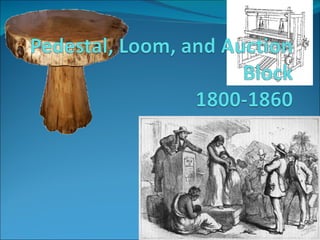
Elite white women in plantation society were elevated to a lofty pedestal that was the ideological inverse of the auction block on which slave women’s fate was sealed In the south white women’s purity was defined by its contrast to the condition of black slave women Some brought slaves from their parents when they married
Non-Elite Midwives and nurses for slave women Made many more things such as spinning and wearing homespun even after the North had begun to buy their own cloth Church about the only time these women left their homes
Slave Women Excluded from the category of women all together 90 percent of slave women labored in the cotton, sugar, tobacco, and rice fields Nowhere in the early 19 th  century America was labor less separated by gender than in the plantation fields
Many terminated their pregnancies Or killed their kids to avoid slavery Margaret Garner a Kentucky slave who fled to Ohio, slit the throat of her youngest child in anticipation of their capture ā€œ Breedersā€ brought a good price on the auction block

Pedestal, loom, and auction block

  • 1.
  • 2.
    Christian Motherhood Home,childrearing, and childbearing are the most important things Be a Christian example for her family ā€˜ Women’s great mission is to train immature, weak, and ignorant creatures, to obey the laws of Godā€ Women were expected to teach Christianity to their family, school, neighborhood, and nation (in that order)
  • 3.
    Between 1825-1860, 25%of all women were teachers at some point in their lives Men’s lust out of control, so women did not lust in order to maintain order Prostitution was looked down upon 1820’s first female missionaries Ann Hasseltine Judson was the first American female missionary to Africa
  • 4.
    Middle-Class Ideology ā€œtrue womanhoodā€ fell as middle class Dependent on a husband Poor were poor because they did not practice the true womanhood Only the wealthiest had free time Laundry was the most burdensome of domestic obligation Many writings and books
  • 5.
    Domesticity in aMarket Age Start to see market-oriented production Women alone did work for direct use Soap, candles, flour and spices can now be bought at the market Since women do not get paid, they become invisible Lucy Larcom
  • 6.
    Market Revolution toIndustrial Revolution Women begin working from their homes Shoes and clothing were examples Paid very poorly Mill Girls of Lowell Textile production was the most female dominated 13 hour days, 6 days a week, 1-2 bucks a week Boarding homes were provided for women
  • 7.
    Panic of 1837and declining prices in cotton and wool hurt women Unsuccessful strikes and protest took place trying to get more wages and fewer hours Women were not suppose to get into the political world Immigration hurt women
  • 8.
    The Bottom ofthe Wage Economy Irish More Irish immigrant women than me Those that were hired to cook, clean and do laundry were seen as nothing more than dirty, ignorant, and immoral Catholics A Society for the Relief of Poor Widows formed in New York City in 1799 was the first charity organized by women for women
  • 9.
    What does thisflag stand for?
  • 10.
    Women and SlaveryBy the 1800’s many states in the North had abolished slavery Slaves were capital but also human beings Wealthy women would many times have slaves raise their children White masters would have sex with their slaves, which resulted in them giving birth
  • 11.
    Elite white womenin plantation society were elevated to a lofty pedestal that was the ideological inverse of the auction block on which slave women’s fate was sealed In the south white women’s purity was defined by its contrast to the condition of black slave women Some brought slaves from their parents when they married
  • 12.
    Non-Elite Midwives andnurses for slave women Made many more things such as spinning and wearing homespun even after the North had begun to buy their own cloth Church about the only time these women left their homes
  • 13.
    Slave Women Excludedfrom the category of women all together 90 percent of slave women labored in the cotton, sugar, tobacco, and rice fields Nowhere in the early 19 th century America was labor less separated by gender than in the plantation fields
  • 14.
    Many terminated theirpregnancies Or killed their kids to avoid slavery Margaret Garner a Kentucky slave who fled to Ohio, slit the throat of her youngest child in anticipation of their capture ā€œ Breedersā€ brought a good price on the auction block