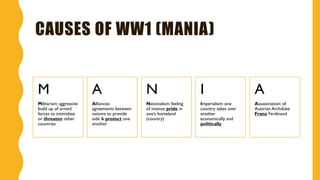
CAUSES OF WW1(MANIA)
Militarism: aggressive
build up of armed
forces to intimidate
or threaten other
countries
M
Alliances:
agreements between
nations to provide
aide & protect one
another
A
Nationalism: feeling
of intense pride in
one’s homeland
(country)
N
Imperialism: one
country takes over
another
economically and
politically
I
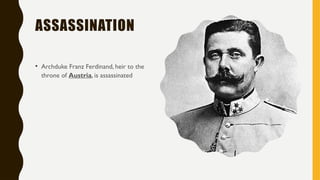
Assassination: of
Austrian Archduke
Franz Ferdinand
A
3.
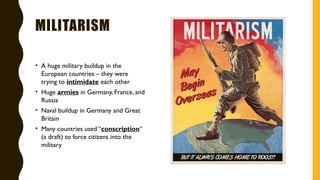
MILITARISM
• A hugemilitary buildup in the
European countries – they were
trying to intimidate each other
• Huge armies in Germany, France, and
Russia
• Naval buildup in Germany and Great
Britain
• Many countries used “conscription”
(a draft) to force citizens into the
military
4.
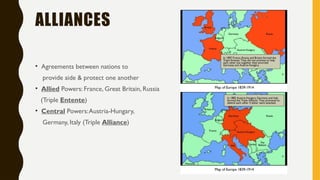
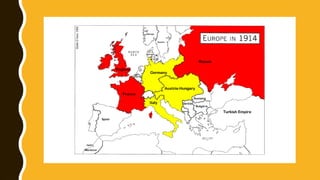
ALLIANCES
• Agreements betweennations to
provide aide & protect one another
• Allied Powers: France, Great Britain, Russia
(Triple Entente)
• Central Powers:Austria-Hungary,
Germany, Italy (Triple Alliance)
6.
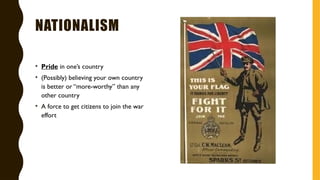
NATIONALISM
• Pride inone’s country
• (Possibly) believing your own country
is better or “more-worthy” than any
other country
• A force to get citizens to join the war
effort
7.
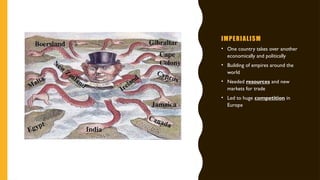
IMPERIALISM
• One countrytakes over another
economically and politically
• Building of empires around the
world
• Needed resources and new
markets for trade
• Led to huge competition in
Europe
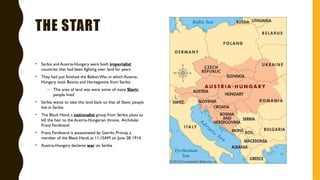
THE START
• Serbiaand Austria-Hungary were both imperialist
countries that had been fighting over land for years
• They had just finished the BalkanWar, in which Austria-
Hungary took Bosnia and Herzegovina from Serbia
– This area of land was were some of many Slavic
people lived
• Serbia wants to take this land back so that all Slavic people
live in Serbia
• The Black Hand, a nationalist group from Serbia, plots to
kill the heir to the Austria-Hungarian throne, Archduke
Franz Ferdinand
• Franz Ferdinand is assassinated by Gavrilo Princip, a
member of the Black Hand, at 11:15AM on June 28, 1914
• Austria-Hungary declares war on Serbia
12.
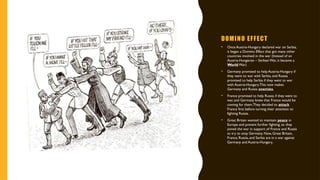
DOMINO EFFECT
• OnceAustria-Hungary declared war on Serbia,
it began a Domino Effect that got many other
countries involved in the war (Instead of an
Austria-Hungarian – Serbian War, it became a
World War)
• Germany promised to help Austria-Hungary if
they went to war with Serbia, and Russia
promised to help Serbia if they went to war
with Austria-Hungary.This now makes
Germany and Russia enemies.
• France promised to help Russia if they went to
war, and Germany knew that France would be
coming for them.They decided to attack
France first before turning their attention to
fighting Russia.
• Great Britain wanted to maintain peace in
Europe and prevent further fighting, so they
joined the war in support of France and Russia
to try to stop Germany. Now, Great Britain,
France, Russia, and Serbia are in a war against
Germany and Austria-Hungary.
13.
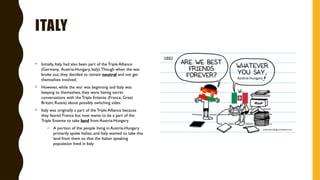
ITALY
• Initially, Italyhad also been part of the Triple Alliance
(Germany, Austria-Hungary, Italy).Though when the war
broke out, they decided to remain neutral and not get
themselves involved.
• However, while the war was beginning and Italy was
keeping to themselves, they were having secret
conversations with the Triple Entente (France, Great
Britain, Russia) about possibly switching sides.
• Italy was originally a part of the Triple Alliance because
they feared France but now wants to be a part of the
Triple Entente to take land from Austria-Hungary.
– A portion of the people living in Austria-Hungary
primarily spoke Italian, and Italy wanted to take this
land from them so that the Italian speaking
population lived in Italy
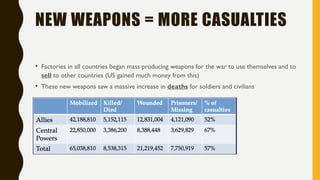
NEW WEAPONS =MORE CASUALTIES
• Factories in all countries began mass producing weapons for the war to use themselves and to
sell to other countries (US gained much money from this)
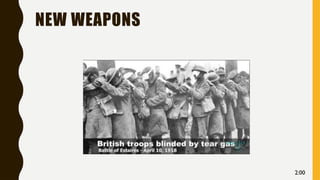
• These new weapons saw a massive increase in deaths for soldiers and civilians
16.
TYPES OF WEAPONS
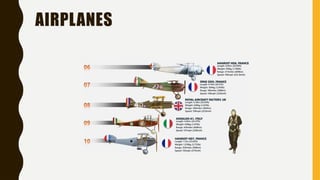
•Airplanes – first time used in war. Used mostly for spying on enemy troops. Eventually they carried bombs
and guns to fire on troops.
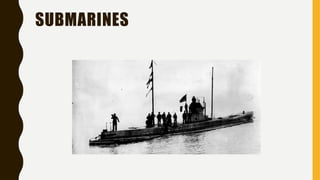
• Submarines – fired on enemy navy ships and merchant vessels. German subs were called U-boats.
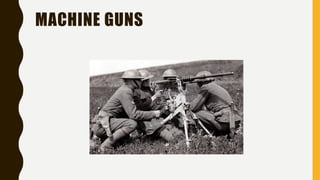
• Machine guns – took 4-6 men to operate. Could fire 400 bullets a minute (= to 100 guns during this time)
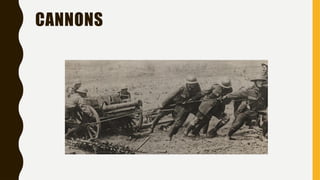
• Long-range artillery (cannons) – took up to 12 men to operate. Could shoot up to 75 miles away.
Terrorized troops well behind fighting lines.
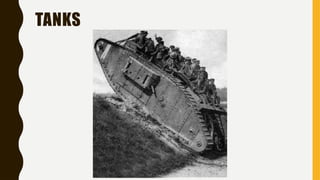
• Tanks – used toward the end of the war. Could roll through barbed wire. Provided protection for
attacking soldiers.
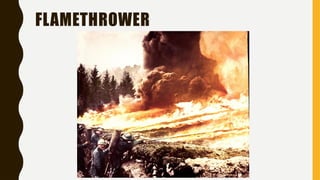
• Flamethrower – shot fire at troops and into foxholes.
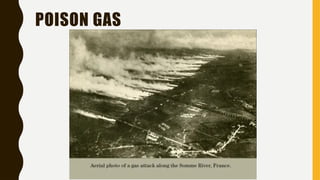
• Poison gas – Chlorine gas: Suffocates a person, Mustard gas: burns/blisters any exposed skin
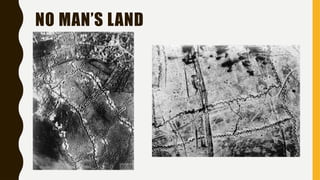
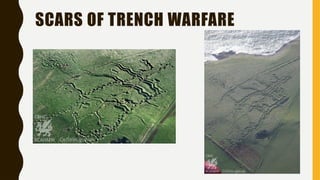
TRENCH WARFARE/NO MAN’SLAND
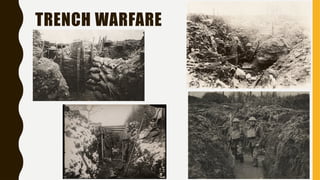
• Because of the advancements made in guns, it became hard to fight a war above ground.The power
of these machine guns forced soldiers to dig trenches to crouch in so they wouldn’t be seen by the
enemy.
• Trenches were very narrow and constructed with sandbags, wooden planks, woven sticks, tangled
barbed wire, and mud, making them unsanitary and difficult to move around in.The constant wet
caused soldiers to get “trenchfoot”, which could require amputation or cause death.
• One British soldier stated,“The mud in Belgium varies in consistency from water to about the
thickness of dough ready for the oven.”
• “No Man’s Land” is the flat land in between the trenches from both sides of the battle. Being seen
on this part of the battlefield made you an easy target.
US ENTRY INTO
WW1
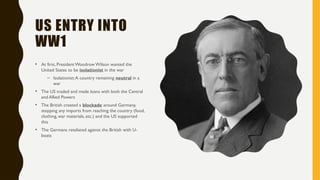
•At first, President Woodrow Wilson wanted the
United States to be isolationist in the war
– Isolationist:A country remaining neutral in a
war
• The US traded and made loans with both the Central
and Allied Powers
• The British created a blockade around Germany,
stopping any imports from reaching the country (food,
clothing, war materials, etc.) and the US supported
this
• The Germans retaliated against the British with U-
boats
29.
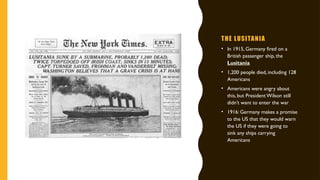
THE LUSITANIA
• In1915, Germany fired on a
British passenger ship, the
Lusitania
• 1,200 people died, including 128
Americans
• Americans were angry about
this, but President Wilson still
didn’t want to enter the war
• 1916: Germany makes a promise
to the US that they would warn
the US if they were going to
sink any ships carrying
Americans
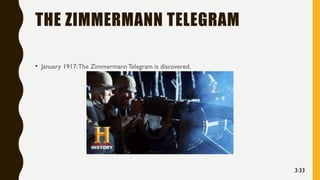
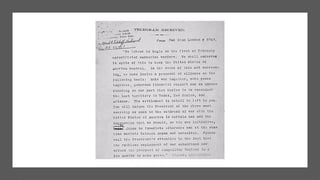
THE ZIMMERMANN TELEGRAM
•In January 1917, a German official sends a telegram to a German ambassador,Arthur Zimmerman, in
Mexico.The telegram states that if Mexico becomes allies with the Central Powers and attacks the U.S.,
Germany will help Mexico get back the land from the United States that was taken in the Mexican-
American war. (Texas, Arizona, New Mexico area)
• This telegram is intercepted by the British, who share it with the United States.The American public is
furious with Germany.
• In February 1917, Germany announced “unrestricted submarine warfare” and begins sinking every ship in
sight.
– Germany did this because they thought they could end the war in 4-6 months, before the US had time to get
involved.
• President Wilson decides that it’s time for the United States to enter the war.
33.
WOODROW WILSON
SPEECH, 1917
Propertycan be paid for; the lives of peaceful and innocent people cannot be. The present
German submarine warfare against commerce is a warfare against mankind.
The German policy has swept every restriction aside. Ships of every kind, whatever their
flag, their character, their cargo, their destination, their errand, have been ruthlessly sent to
the bottom of the ocean without warning. American ships have been sunk,American lives
taken.
I advise that the Congress declare the recent actions of the Imperial German Government
to be, in fact, nothing less than war against the Government and people of the United States.
Neutrality is no longer feasible or desirable where the peace of the world is involved.
The world must be made safe for democracy.We have no selfish ends to serve.We desire
no conquest, no dominion.We seek not material compensation for the sacrifices we shall
freely make.We are but one of the champions of the rights of mankind.
It is a fearful, but right thing to lead this great peaceful people to war.
We shall fight for the things which we have always carried nearest our hearts – for
democracy, for the right of [people] to have a voice in their own government, for the rights
and liberties of small nations.
34.
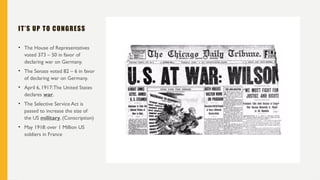
IT’S UP TOCONGRESS
• The House of Representatives
voted 373 – 50 in favor of
declaring war on Germany.
• The Senate voted 82 – 6 in favor
of declaring war on Germany.
• April 6, 1917:The United States
declares war.
• The Selective Service Act is
passed to increase the size of
the US military. (Conscription)
• May 1918: over 1 Million US
soldiers in France
35.
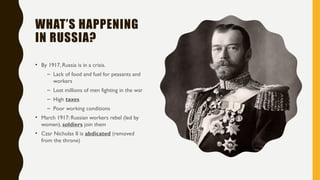
WHAT’S HAPPENING
IN RUSSIA?
•By 1917, Russia is in a crisis.
– Lack of food and fuel for peasants and
workers
– Lost millions of men fighting in the war
– High taxes
– Poor working conditions
• March 1917: Russian workers rebel (led by
women), soldiers join them
• Czar Nicholas II is abdicated (removed
from the throne)
36.
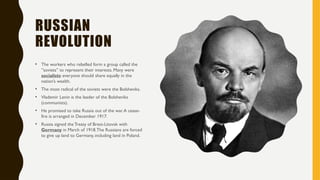
RUSSIAN
REVOLUTION
• The workerswho rebelled form a group called the
”soviets” to represent their interests. Many were
socialists: everyone should share equally in the
nation’s wealth.
• The most radical of the soviets were the Bolsheviks.
• Vlademir Lenin is the leader of the Bolsheviks
(communists).
• He promised to take Russia out of the war.A cease-
fire is arranged in December 1917.
• Russia signed theTreaty of Brest-Litovsk with
Germany in March of 1918.The Russians are forced
to give up land to Germany, including land in Poland.
37.
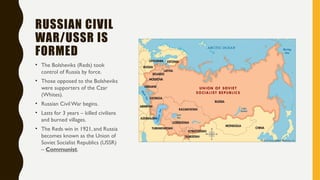
RUSSIAN CIVIL
WAR/USSR IS
FORMED
•The Bolsheviks (Reds) took
control of Russia by force.
• Those opposed to the Bolsheviks
were supporters of the Czar
(Whites).
• Russian Civil War begins.
• Lasts for 3 years – killed civilians
and burned villages.
• The Reds win in 1921, and Russia
becomes known as the Union of
Soviet Socialist Republics (USSR)
– Communist.
38.
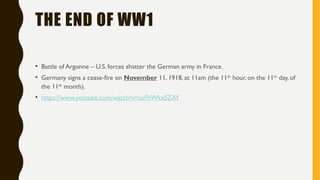
THE END OFWW1
• Battle of Argonne – U.S. forces shatter the German army in France.
• Germany signs a cease-fire on November 11, 1918, at 11am (the 11th
hour, on the 11th
day, of
the 11th
month).
• https://www.youtube.com/watch?v=soFhWkxSZAY
39.
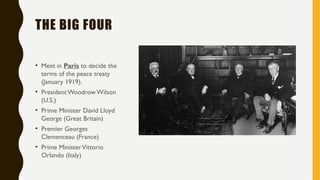
THE BIG FOUR
•Meet in Paris to decide the
terms of the peace treaty
(January 1919).
• President WoodrowWilson
(U.S.)
• Prime Minister David Lloyd
George (Great Britain)
• Premier Georges
Clemenceau (France)
• Prime MinisterVittorio
Orlando (Italy)
40.
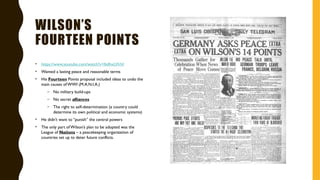
WILSON’S
FOURTEEN POINTS
• https://www.youtube.com/watch?v=lbdhxLVlrhI
•Wanted a lasting peace and reasonable terms
• His Fourteen Points proposal included ideas to undo the
main causes ofWWI (M.A.N.I.A.)
– No military build-ups
– No secret alliances
– The right to self-determination (a country could
determine its own political and economic systems)
• He didn’t want to “punish” the central powers
• The only part ofWilson’s plan to be adopted was the
League of Nations – a peacekeeping organization of
countries set up to deter future conflicts.
41.
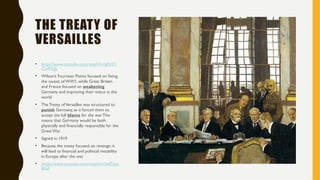
THE TREATY OF
VERSAILLES
•https://www.youtube.com/watch?v=gKzZ1
OwPXgk
• Wilson’s Fourteen Points focused on fixing
the causes of WW1, while Great Britain
and France focused on weakening
Germany and improving their status in the
world
• The Treaty ofVersailles was structured to
punish Germany, as it forced them to
accept the full blame for the war.This
means that Germany would be both
physically and financially responsible for the
Great War.
• Signed in 1919
• Because the treaty focused on revenge, it
will lead to financial and political instability
in Europe after the war.
• https://www.youtube.com/watch?v=lwf7jtxs
BGA
42.
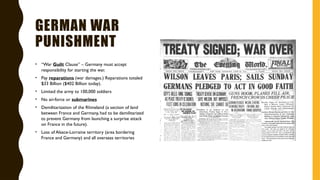
GERMAN WAR
PUNISHMENT
• “WarGuilt Clause” – Germany must accept
responsibility for starting the war.
• Pay reparations (war damages.) Reparations totaled
$33 Billion ($402 Billion today).
• Limited the army to 100,000 soldiers
• No air-force or submarines
• Demilitarization of the Rhineland (a section of land
between France and Germany, had to be demilitarized
to prevent Germany from launching a surprise attack
on France in the future).
• Loss of Alsace-Lorraine territory (area bordering
France and Germany) and all overseas territories
43.
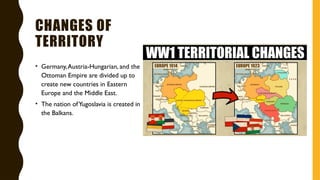
CHANGES OF
TERRITORY
• Germany,Austria-Hungarian,and the
Ottoman Empire are divided up to
create new countries in Eastern
Europe and the Middle East.
• The nation ofYugoslavia is created in
the Balkans.
44.
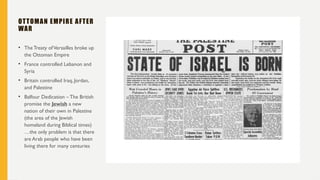
OTTOMAN EMPIRE AFTER
WAR
•The Treaty ofVersailles broke up
the Ottoman Empire
• France controlled Lebanon and
Syria
• Britain controlled Iraq, Jordan,
and Palestine
• Balfour Dedication – The British
promise the Jewish a new
nation of their own in Palestine
(the area of the Jewish
homeland during Biblical times)
…the only problem is that there
are Arab people who have been
living there for many centuries
45.
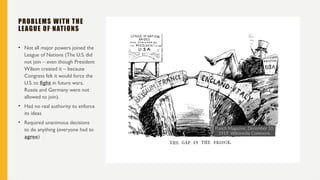
PROBLEMS WITH THE
LEAGUEOF NATIONS
• Not all major powers joined the
League of Nations (The U.S. did
not join – even though President
Wilson created it – because
Congress felt it would force the
U.S. to fight in future wars,
Russia and Germany were not
allowed to join).
• Had no real authority to enforce
its ideas
• Required unanimous decisions
to do anything (everyone had to
agree)


![WOODROW WILSON
SPEECH, 1917
Property can be paid for; the lives of peaceful and innocent people cannot be. The present
German submarine warfare against commerce is a warfare against mankind.
The German policy has swept every restriction aside. Ships of every kind, whatever their
flag, their character, their cargo, their destination, their errand, have been ruthlessly sent to
the bottom of the ocean without warning. American ships have been sunk,American lives
taken.
I advise that the Congress declare the recent actions of the Imperial German Government
to be, in fact, nothing less than war against the Government and people of the United States.
Neutrality is no longer feasible or desirable where the peace of the world is involved.
The world must be made safe for democracy.We have no selfish ends to serve.We desire
no conquest, no dominion.We seek not material compensation for the sacrifices we shall
freely make.We are but one of the champions of the rights of mankind.
It is a fearful, but right thing to lead this great peaceful people to war.
We shall fight for the things which we have always carried nearest our hearts – for
democracy, for the right of [people] to have a voice in their own government, for the rights
and liberties of small nations.](https://image.slidesharecdn.com/ww1-250927001303-4840f7a5/85/World-War-One-1-PowerPoint-for-Contemporary-Studies-33-320.jpg)