U.S. and World War I
Causes of WWI – MANIA!
• Militarism - policy of building up a strong military to prepare for war,
military used as a tool for diplomacy
• Alliances – agreements between nations to provide aid and protect on
another
• Nationalism – extreme pride in one’s country, national interests should be
placed above international affairs
• Imperialism – when one country takes over another country economically
and politically.
• Assassination – of Austrian Archduke Francis Ferdinand
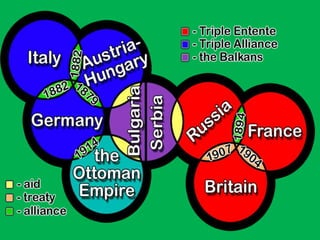
Alliances
• There were 2 major alliances in Europe before
WW1. Alliances were made to protect each
nation from attack
• The Triple Alliance – Germany, Italy, Austria
Hungry
• The Triple Entente – Russia, France, Britain
The Spark
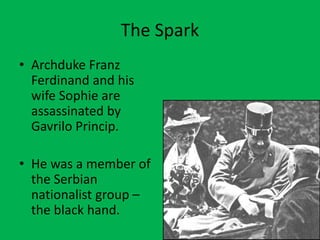
• Archduke Franz
Ferdinand and his
wife Sophie are
assassinated by
Gavrilo Princip.
• He was a member of
the Serbian
nationalist group –
the black hand.
The Domino Effect
• Austria blamed Serbia for Ferdinand’s
death and declared war on Serbia.
• Germany pledged their support for
Austria –Hungary
• Russia pledged their support for Serbia.
• Germany declares war on Russia.
• France pledges their support for Russia.
• Germany declares war on France.
• Germany invades Belgium on the way to France.
• Great Britain supports Belgium and declares war
on Germany.
Who was fighting?
Allied Powers Central Powers
• Britain & its colonies
• France & its colonies
• Russia
• Italy
• United States
• Many more
• Germany
• Austria-Hungry
• Ottoman Empire
• Bulgaria
Stalemate
• Outdated military tactics and new technology quickly turn the war
into a stalemate
• Trenches were dug in France to protect soldiers and solidify gains.
The area between the Central Powers and Allied Powers was known
as no mans land.
New Technology
• New Technology was used to turn WW1 into a
modern war.
– Tanks, Planes, Submarines, Poison Gas, Machine
Guns all see use in the war.
U.S. Neutrality
• U.S. remains neutral until 1917
• Practicing (foreign) policy of Isolationism
Reason:
1. Europe’s war
2. Economic reasons
- trade
- financial backing
3. Immigrant sympathizers
U.S. getting drawn into WWI
• Germany counter-attack to GB’s blockaded with
• the U-boats (sinking without warning)
• May 7, 1915 U-boat sank the Lusitania
- German’s defense - was carrying ammunition
• March 1916 Germany torpedoes the Sussex liner
• Sussex Pledge – agreement - Germany would stop attacking
ships if U.S. could get G.B. to lift blockade
• Election of 1916: Wilson wins on campaign promise to keep
the U.S. out of war
Neutrality Ends
Immediate Causes:
• Violation of Sussex - Germany announces the U-boats will
sink ships again - no warning
• Rev. in Russia- attempting democratic gov’t
now an acceptable ally
• Zimmermann Note (telegram from Germany to Mexico)
suggesting an alliance between them and promising to help
them recover the territories of TX,
NM, & AZ
* 1917 – U.S. had no option but to enter the war
Big IDEAS for the
U.S. entrance
• Financial - to ensure Allies victory and
repayment of debts to the U.S.
• Threat - to prevent the Germans harming
U.S. shipping and protect U.S. territory
The "I WANT
YOU" Army
recruiting poster
from World War I
became the most
recognized image
of Uncle Sam, a
character first
made popular by
Thomas Nast and
other 19th century
political cartoonists.
The poster was
painted by James
Montgomery Flagg
in 1916-
1917. Flagg
reportedly used his
own face as the
model for Uncle
Sam’s stern visage.
www.klasek.com/90th/1917_timeline.html
Home Front Production
• shifting in production of goods
• must make war & consumer goods
pro.corbis.com/search/Enlargement.aspx?CID=is...
Selective Service Act
• a draft
• eventually 24 million draftees
• ages of 21-23
(some lied about their age)
• Those excused
- married men
- those with dependents
- medical reasons
Citation: Records of the Selective Service System (World War I)
Women and WWI
• filled all types of roles/jobs in society
i.e.
• driving cabs and delivery trucks
• bricklayers
• cooks
• railroad workers
• dock workers and shipbuilder
• Roles in society gave them the final
ammunition needed for the 19th amendment
• women filled industry jobs
https://www.allposters.co.jp/RedirectLocale.a...
War Industries Board (WIB)
• encourage mass production techniques
• to increase efficiency & eliminate waste
- production increased by 20%
- i.e. corsets
tall leather boots
hemlines
laracorsets.com
By Howard
Christy.
Used in
WW I
recruiting
campaigns.
Supporting the War
• Propaganda
~ persuasive technique used to influence
opinions
~ A campaign to help people feel justified
in the sacrifices they were making.
• promote patriotism
• it manufactured hate
By Norman
Lindsey.
“?” was one
of six
posters
designed
for the last
Australian
recruiting
campaign.
Fuel Administration
• monitored coal supplies, rationed gasoline &
heating oil
• adopted to help conserve for the war
i.e.
• gasless Sunday
• heatless Monday
• lightless nights
~ daylight-savings
time used
www.rainfall.com/posters/WWI/195.htm
Food Administration
• established to conserve food (voluntary)
• Herbert Hoover - director
• each day special emphasis
i.e.
- wheatless Mon. and Wed.
- meatless Tues.
- porkless Thurs. and Sat.
- sweetless Fri
(calling it Hooverizing)
• victory gardens
- planted at people’s homes
- on city buildings and
in allies staff.imsa.edu/.../jiang_3_7/conservation.htm
Financing the War
• U.S. spent 33 billion
• raised 1/3 with taxes
(higher income taxes)
• higher excise tax on
luxury goods
• Liberty Loans
- war bonds
Attack on Civil Liberties
• worst attacks directed at German - Americans
i.e.
• lost their jobs
• would not play music by German composers
• Schools stopped teaching German language
• German books were removed from libraries
Government ‘s Role
• Sedition Act (p. 598)
no disloyalties to the U.S. gov., its symbols, or the war,
• Espionage Act
punish those found helping the enemy
• Trading with the Enemy Act
postmaster could censor publications exchanged
* What did all of these violate?
Civil Liberties cont…
Wilson’s Fourteen Points
• Jan. 1918
• Wilson presented to Congress
- Causes of war
- boundaries
- plan for peace /League of Nations
(international peace organization)
Peace Conference
• Allied leaders / Council of Ten
• new Russian leaders did not attend
• Purpose: decide end of war issues
• Wilson presented his 14 pts.
- wanted peace organization
• Clash between Wilson’s ideas & Allies
rewards/punishments
- Allies wanted territory & Germany punished
Treaty of Versailles
• agreement to end the war
• between Allies & Central Powers
• League of Nations included
- U.S. Congress did not support
- made it a WEAK organization
Terms of the Treaty
• Germany had to accept full responsibility for war.
• Germany had to surrender all land back to its
surrounding nations.
• Germany would reduce its military and give up all
warships.
• Germany would transfer all colonies to a mandate
where the Allies could watch them.
• Germany must pay reparations for the entire cost of
the war to the Allies.
• Territory divided (Ottoman, A-H, Russia)
• League of Nations established
U.S. Congress would not support plan
Reasons…
• Economic reasons
• Did not fit policy of Isolationism
• Did not want to be responsible for
world peace
* Why did Congress believe the League violated
Isolationism?
War Impact
On the U.S.
• Industrial production increased
• became richest country in the world
• achieved a high standard of living
• citizens became materialistic
• women more opportunities/recognition
• rejecting the Treaty/League of Nations
• U.S. shifts back to a policy of Isolation
War Impact
On Europe:
• All economies were bad
• Land was destroyed
• German develop a depression in 1923
• German $ became almost worthless
• Germans were looking for someone to
blame
On Middle East:
• Territory divided among Allies
Casualties
• Total troops mobilized by all countries in WW1
– 65,038,810
• Total troops dead from all countries in WW1
– 8,556,315
• Total troops wounded from all countries in WW1
– 21,219,452
• Total missing or POWs
– 7,750,945

WW1.pptx

  • 1.
  • 2.
    Causes of WWI– MANIA! • Militarism - policy of building up a strong military to prepare for war, military used as a tool for diplomacy • Alliances – agreements between nations to provide aid and protect on another • Nationalism – extreme pride in one’s country, national interests should be placed above international affairs • Imperialism – when one country takes over another country economically and politically. • Assassination – of Austrian Archduke Francis Ferdinand
  • 4.
    Alliances • There were2 major alliances in Europe before WW1. Alliances were made to protect each nation from attack • The Triple Alliance – Germany, Italy, Austria Hungry • The Triple Entente – Russia, France, Britain
  • 6.
    The Spark • ArchdukeFranz Ferdinand and his wife Sophie are assassinated by Gavrilo Princip. • He was a member of the Serbian nationalist group – the black hand.
  • 7.
    The Domino Effect •Austria blamed Serbia for Ferdinand’s death and declared war on Serbia. • Germany pledged their support for Austria –Hungary • Russia pledged their support for Serbia.
  • 8.
    • Germany declareswar on Russia. • France pledges their support for Russia. • Germany declares war on France. • Germany invades Belgium on the way to France. • Great Britain supports Belgium and declares war on Germany.
  • 9.
    Who was fighting? AlliedPowers Central Powers • Britain & its colonies • France & its colonies • Russia • Italy • United States • Many more • Germany • Austria-Hungry • Ottoman Empire • Bulgaria
  • 11.
    Stalemate • Outdated militarytactics and new technology quickly turn the war into a stalemate • Trenches were dug in France to protect soldiers and solidify gains. The area between the Central Powers and Allied Powers was known as no mans land.
  • 13.
    New Technology • NewTechnology was used to turn WW1 into a modern war. – Tanks, Planes, Submarines, Poison Gas, Machine Guns all see use in the war.
  • 14.
    U.S. Neutrality • U.S.remains neutral until 1917 • Practicing (foreign) policy of Isolationism Reason: 1. Europe’s war 2. Economic reasons - trade - financial backing 3. Immigrant sympathizers
  • 15.
    U.S. getting drawninto WWI • Germany counter-attack to GB’s blockaded with • the U-boats (sinking without warning) • May 7, 1915 U-boat sank the Lusitania - German’s defense - was carrying ammunition • March 1916 Germany torpedoes the Sussex liner • Sussex Pledge – agreement - Germany would stop attacking ships if U.S. could get G.B. to lift blockade • Election of 1916: Wilson wins on campaign promise to keep the U.S. out of war
  • 16.
    Neutrality Ends Immediate Causes: •Violation of Sussex - Germany announces the U-boats will sink ships again - no warning • Rev. in Russia- attempting democratic gov’t now an acceptable ally • Zimmermann Note (telegram from Germany to Mexico) suggesting an alliance between them and promising to help them recover the territories of TX, NM, & AZ * 1917 – U.S. had no option but to enter the war
  • 19.
    Big IDEAS forthe U.S. entrance • Financial - to ensure Allies victory and repayment of debts to the U.S. • Threat - to prevent the Germans harming U.S. shipping and protect U.S. territory
  • 20.
    The "I WANT YOU"Army recruiting poster from World War I became the most recognized image of Uncle Sam, a character first made popular by Thomas Nast and other 19th century political cartoonists. The poster was painted by James Montgomery Flagg in 1916- 1917. Flagg reportedly used his own face as the model for Uncle Sam’s stern visage. www.klasek.com/90th/1917_timeline.html
  • 21.
    Home Front Production •shifting in production of goods • must make war & consumer goods pro.corbis.com/search/Enlargement.aspx?CID=is...
  • 22.
    Selective Service Act •a draft • eventually 24 million draftees • ages of 21-23 (some lied about their age) • Those excused - married men - those with dependents - medical reasons
  • 23.
    Citation: Records ofthe Selective Service System (World War I)
  • 24.
    Women and WWI •filled all types of roles/jobs in society i.e. • driving cabs and delivery trucks • bricklayers • cooks • railroad workers • dock workers and shipbuilder • Roles in society gave them the final ammunition needed for the 19th amendment
  • 25.
    • women filledindustry jobs https://www.allposters.co.jp/RedirectLocale.a...
  • 26.
    War Industries Board(WIB) • encourage mass production techniques • to increase efficiency & eliminate waste - production increased by 20% - i.e. corsets tall leather boots hemlines laracorsets.com
  • 27.
    By Howard Christy. Used in WWI recruiting campaigns.
  • 28.
    Supporting the War •Propaganda ~ persuasive technique used to influence opinions ~ A campaign to help people feel justified in the sacrifices they were making. • promote patriotism • it manufactured hate
  • 29.
    By Norman Lindsey. “?” wasone of six posters designed for the last Australian recruiting campaign.
  • 30.
    Fuel Administration • monitoredcoal supplies, rationed gasoline & heating oil • adopted to help conserve for the war i.e. • gasless Sunday • heatless Monday • lightless nights ~ daylight-savings time used www.rainfall.com/posters/WWI/195.htm
  • 31.
    Food Administration • establishedto conserve food (voluntary) • Herbert Hoover - director • each day special emphasis i.e. - wheatless Mon. and Wed. - meatless Tues. - porkless Thurs. and Sat. - sweetless Fri (calling it Hooverizing) • victory gardens - planted at people’s homes - on city buildings and in allies staff.imsa.edu/.../jiang_3_7/conservation.htm
  • 32.
    Financing the War •U.S. spent 33 billion • raised 1/3 with taxes (higher income taxes) • higher excise tax on luxury goods • Liberty Loans - war bonds
  • 34.
    Attack on CivilLiberties • worst attacks directed at German - Americans i.e. • lost their jobs • would not play music by German composers • Schools stopped teaching German language • German books were removed from libraries
  • 35.
    Government ‘s Role •Sedition Act (p. 598) no disloyalties to the U.S. gov., its symbols, or the war, • Espionage Act punish those found helping the enemy • Trading with the Enemy Act postmaster could censor publications exchanged * What did all of these violate? Civil Liberties cont…
  • 36.
    Wilson’s Fourteen Points •Jan. 1918 • Wilson presented to Congress - Causes of war - boundaries - plan for peace /League of Nations (international peace organization)
  • 37.
    Peace Conference • Alliedleaders / Council of Ten • new Russian leaders did not attend • Purpose: decide end of war issues • Wilson presented his 14 pts. - wanted peace organization • Clash between Wilson’s ideas & Allies rewards/punishments - Allies wanted territory & Germany punished
  • 38.
    Treaty of Versailles •agreement to end the war • between Allies & Central Powers • League of Nations included - U.S. Congress did not support - made it a WEAK organization
  • 39.
    Terms of theTreaty • Germany had to accept full responsibility for war. • Germany had to surrender all land back to its surrounding nations. • Germany would reduce its military and give up all warships. • Germany would transfer all colonies to a mandate where the Allies could watch them. • Germany must pay reparations for the entire cost of the war to the Allies. • Territory divided (Ottoman, A-H, Russia) • League of Nations established
  • 40.
    U.S. Congress wouldnot support plan Reasons… • Economic reasons • Did not fit policy of Isolationism • Did not want to be responsible for world peace * Why did Congress believe the League violated Isolationism?
  • 42.
    War Impact On theU.S. • Industrial production increased • became richest country in the world • achieved a high standard of living • citizens became materialistic • women more opportunities/recognition • rejecting the Treaty/League of Nations • U.S. shifts back to a policy of Isolation
  • 43.
    War Impact On Europe: •All economies were bad • Land was destroyed • German develop a depression in 1923 • German $ became almost worthless • Germans were looking for someone to blame On Middle East: • Territory divided among Allies
  • 44.
    Casualties • Total troopsmobilized by all countries in WW1 – 65,038,810 • Total troops dead from all countries in WW1 – 8,556,315 • Total troops wounded from all countries in WW1 – 21,219,452 • Total missing or POWs – 7,750,945