The MAIN(S) Causes of WW1

     •Militarism
     •Alliances
     •Imperialism
     •Nationalism
     •Significant individuals
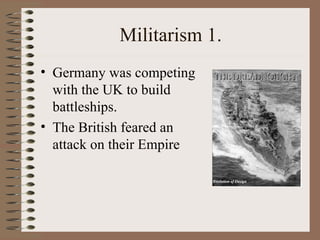
Militarism 1.
• Germany was competing
  with the UK to build
  battleships.
• The British feared an
  attack on their Empire
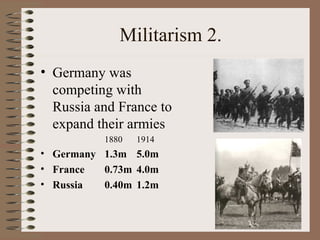
Militarism 2.
• Germany was
  competing with
  Russia and France to
  expand their armies
          1880   1914
• Germany 1.3m 5.0m
• France  0.73m 4.0m
• Russia  0.40m 1.2m
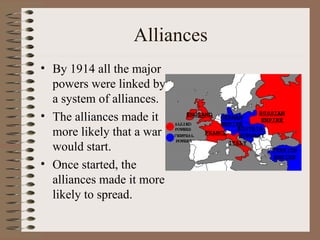
Alliances
• By 1914 all the major
  powers were linked by
  a system of alliances.
• The alliances made it
  more likely that a war
  would start.
• Once started, the
  alliances made it more
  likely to spread.
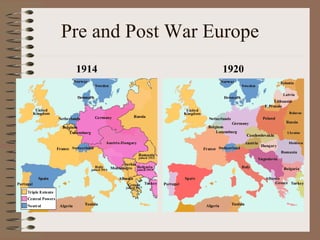
Pre and Post War Europe
 1914             1920
Imperialism
• All the great powers were competing for
  colonies / territory.
• The British feared Germany in Africa.
• The Austrians feared Serbia / Russia in
  the Balkans
Nationalism
• This was an age when all nations wanted to
  assert their power and independence.
• In Europe Slavs, aided by Serbia and
  Russia, wanted to be free of Austrian rule.


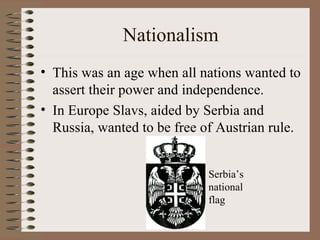
                             Serbia’s
                             national
                             flag
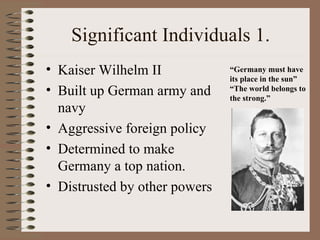
Significant Individuals 1.
• Kaiser Wilhelm II            “Germany must have
                               its place in the sun”
• Built up German army and     “The world belongs to
                               the strong.”
  navy
• Aggressive foreign policy
• Determined to make
  Germany a top nation.
• Distrusted by other powers
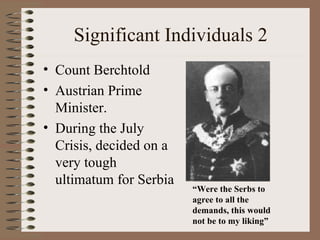
Significant Individuals 2
• Count Berchtold
• Austrian Prime
  Minister.
• During the July
  Crisis, decided on a
  very tough
  ultimatum for Serbia
                         “Were the Serbs to
                         agree to all the
                         demands, this would
                         not be to my liking”
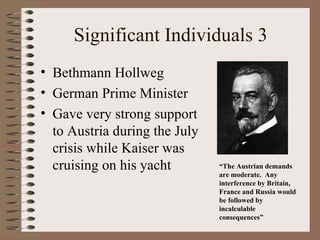
Significant Individuals 3
• Bethmann Hollweg
• German Prime Minister
• Gave very strong support
  to Austria during the July
  crisis while Kaiser was
  cruising on his yacht        “The Austrian demands
                               are moderate. Any
                               interference by Britain,
                               France and Russia would
                               be followed by
                               incalculable
                               consequences”
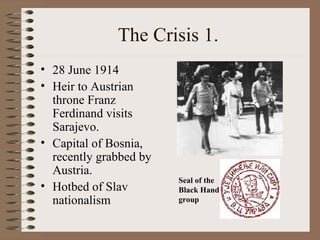
The Crisis 1.
• 28 June 1914
• Heir to Austrian
  throne Franz
  Ferdinand visits
  Sarajevo.
• Capital of Bosnia,
  recently grabbed by
  Austria.
                        Seal of the
• Hotbed of Slav        Black Hand
  nationalism           group
The Crisis 2.
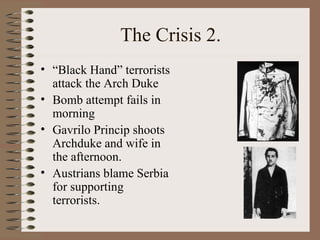
• “Black Hand” terrorists
  attack the Arch Duke
• Bomb attempt fails in
  morning
• Gavrilo Princip shoots
  Archduke and wife in
  the afternoon.
• Austrians blame Serbia
  for supporting
  terrorists.
The Crisis 3.
• Austrians, supported by
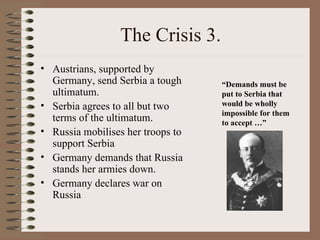
  Germany, send Serbia a tough     “Demands must be
  ultimatum.                       put to Serbia that
• Serbia agrees to all but two     would be wholly
                                   impossible for them
  terms of the ultimatum.          to accept …”
• Russia mobilises her troops to
  support Serbia
• Germany demands that Russia
  stands her armies down.
• Germany declares war on
  Russia
Why did Britain get involved?
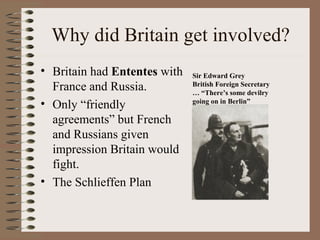
• Britain had Ententes with   Sir Edward Grey
  France and Russia.          British Foreign Secretary
                              … “There’s some devilry
• Only “friendly              going on in Berlin”

  agreements” but French
  and Russians given
  impression Britain would
  fight.
• The Schlieffen Plan
The Schlieffen Plan
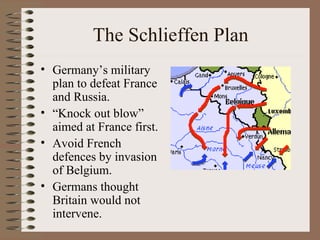
• Germany’s military
  plan to defeat France
  and Russia.
• “Knock out blow”
  aimed at France first.
• Avoid French
  defences by invasion
  of Belgium.
• Germans thought
  Britain would not
  intervene.
Britain’s Reaction
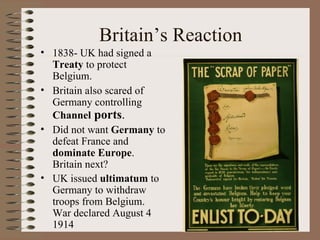
• 1838- UK had signed a
  Treaty to protect
  Belgium.
• Britain also scared of
  Germany controlling
  Channel ports.
• Did not want Germany to
  defeat France and
  dominate Europe.
  Britain next?
• UK issued ultimatum to
  Germany to withdraw
  troops from Belgium.
  War declared August 4
  1914
Reasons U.S entered War
•   Economic ties
     – The U.S. traded more with Britain and France. (U.S. was not
       strictly neutral) Many sympathized w/Br. & Fr.
•   Submarine warfare
     – German U-boats attack ships in British ports
     – U.S. protested unrestricted submarine warfare
     – Wilson vows to hold Germany responsible for loss of American
       life or property
•   Germany sinks the Lusitania (British ship)
     – 128 Americans are killed
     – At this point, Germany did not want war with the U.S. and
       agreed to stop attacking neutral ships.
     – Later, Germany continued unrestricted submarine warfare in
       British waters
Zimmerman Telegram
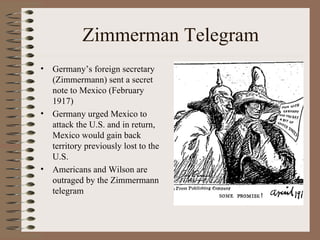
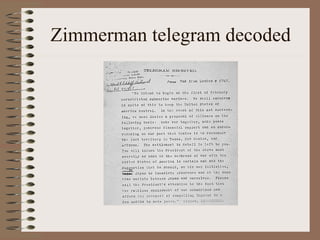
•   Germany’s foreign secretary
    (Zimmermann) sent a secret
    note to Mexico (February
    1917)
•   Germany urged Mexico to
    attack the U.S. and in return,
    Mexico would gain back
    territory previously lost to the
    U.S.
•   Americans and Wilson are
    outraged by the Zimmermann
    telegram
Zimmerman telegram decoded
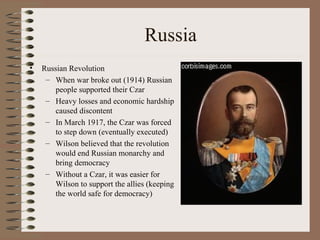
Russia
•   Russian Revolution
     – When war broke out (1914) Russian
        people supported their Czar
     – Heavy losses and economic hardship
        caused discontent
     – In March 1917, the Czar was forced
        to step down (eventually executed)
     – Wilson believed that the revolution
        would end Russian monarchy and
        bring democracy
     – Without a Czar, it was easier for
        Wilson to support the allies (keeping
        the world safe for democracy)
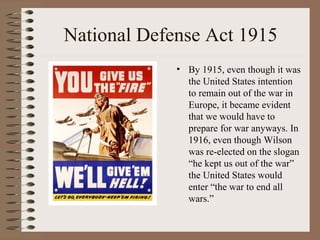
National Defense Act 1915
             • By 1915, even though it was
               the United States intention
               to remain out of the war in
               Europe, it became evident
               that we would have to
               prepare for war anyways. In
               1916, even though Wilson
               was re-elected on the slogan
               “he kept us out of the war”
               the United States would
               enter “the war to end all
               wars.”
Summary for U.S. entrance:
•   Why did the U.S. abandon neutrality and enter WWI?
     – America had economic ties to the British & French
        • Sold millions in war materials to both/sympathy for Br. & Fr.
     – Fear of German power
        • Possible threat to US security
     – Unrestricted submarine warfare
        • German interference with US shipping
        • Sinking of the Lusitania
     – The Zimmerman Telegram
        • Americans were outraged when details of the telegram were
           published in newspapers
     – The Russian Revolution
        • With the Czar gone, it was easier to support the allies (Democracy)
Standards addressed:
•   c. events that led to the United States’
    involvement in World War I; United States’
    rationale for entry into World War I and impact
    on military process,
•   public opinion and policy;
•   d. United States’ mobilization in World War I
    (e.g., its impact on politics, economics and
    society);
•   e. United States’ impact on the outcome of World
    War I; United States’ role in settling the peace
    (e.g., Woodrow Wilson, treaty of Versailles,
    league of
•   nations, Senator Henry Cabot Lodge, Sr.);

Causesof wwi

  • 1.
    The MAIN(S) Causesof WW1 •Militarism •Alliances •Imperialism •Nationalism •Significant individuals
  • 2.
    Militarism 1. • Germanywas competing with the UK to build battleships. • The British feared an attack on their Empire
  • 3.
    Militarism 2. • Germanywas competing with Russia and France to expand their armies 1880 1914 • Germany 1.3m 5.0m • France 0.73m 4.0m • Russia 0.40m 1.2m
  • 4.
    Alliances • By 1914all the major powers were linked by a system of alliances. • The alliances made it more likely that a war would start. • Once started, the alliances made it more likely to spread.
  • 5.
    Pre and PostWar Europe 1914 1920
  • 6.
    Imperialism • All thegreat powers were competing for colonies / territory. • The British feared Germany in Africa. • The Austrians feared Serbia / Russia in the Balkans
  • 7.
    Nationalism • This wasan age when all nations wanted to assert their power and independence. • In Europe Slavs, aided by Serbia and Russia, wanted to be free of Austrian rule. Serbia’s national flag
  • 8.
    Significant Individuals 1. •Kaiser Wilhelm II “Germany must have its place in the sun” • Built up German army and “The world belongs to the strong.” navy • Aggressive foreign policy • Determined to make Germany a top nation. • Distrusted by other powers
  • 9.
    Significant Individuals 2 •Count Berchtold • Austrian Prime Minister. • During the July Crisis, decided on a very tough ultimatum for Serbia “Were the Serbs to agree to all the demands, this would not be to my liking”
  • 10.
    Significant Individuals 3 •Bethmann Hollweg • German Prime Minister • Gave very strong support to Austria during the July crisis while Kaiser was cruising on his yacht “The Austrian demands are moderate. Any interference by Britain, France and Russia would be followed by incalculable consequences”
  • 11.
    The Crisis 1. •28 June 1914 • Heir to Austrian throne Franz Ferdinand visits Sarajevo. • Capital of Bosnia, recently grabbed by Austria. Seal of the • Hotbed of Slav Black Hand nationalism group
  • 12.
    The Crisis 2. •“Black Hand” terrorists attack the Arch Duke • Bomb attempt fails in morning • Gavrilo Princip shoots Archduke and wife in the afternoon. • Austrians blame Serbia for supporting terrorists.
  • 13.
    The Crisis 3. •Austrians, supported by Germany, send Serbia a tough “Demands must be ultimatum. put to Serbia that • Serbia agrees to all but two would be wholly impossible for them terms of the ultimatum. to accept …” • Russia mobilises her troops to support Serbia • Germany demands that Russia stands her armies down. • Germany declares war on Russia
  • 14.
    Why did Britainget involved? • Britain had Ententes with Sir Edward Grey France and Russia. British Foreign Secretary … “There’s some devilry • Only “friendly going on in Berlin” agreements” but French and Russians given impression Britain would fight. • The Schlieffen Plan
  • 15.
    The Schlieffen Plan •Germany’s military plan to defeat France and Russia. • “Knock out blow” aimed at France first. • Avoid French defences by invasion of Belgium. • Germans thought Britain would not intervene.
  • 16.
    Britain’s Reaction • 1838-UK had signed a Treaty to protect Belgium. • Britain also scared of Germany controlling Channel ports. • Did not want Germany to defeat France and dominate Europe. Britain next? • UK issued ultimatum to Germany to withdraw troops from Belgium. War declared August 4 1914
  • 17.
    Reasons U.S enteredWar • Economic ties – The U.S. traded more with Britain and France. (U.S. was not strictly neutral) Many sympathized w/Br. & Fr. • Submarine warfare – German U-boats attack ships in British ports – U.S. protested unrestricted submarine warfare – Wilson vows to hold Germany responsible for loss of American life or property • Germany sinks the Lusitania (British ship) – 128 Americans are killed – At this point, Germany did not want war with the U.S. and agreed to stop attacking neutral ships. – Later, Germany continued unrestricted submarine warfare in British waters
  • 18.
    Zimmerman Telegram • Germany’s foreign secretary (Zimmermann) sent a secret note to Mexico (February 1917) • Germany urged Mexico to attack the U.S. and in return, Mexico would gain back territory previously lost to the U.S. • Americans and Wilson are outraged by the Zimmermann telegram
  • 19.
  • 20.
    Russia • Russian Revolution – When war broke out (1914) Russian people supported their Czar – Heavy losses and economic hardship caused discontent – In March 1917, the Czar was forced to step down (eventually executed) – Wilson believed that the revolution would end Russian monarchy and bring democracy – Without a Czar, it was easier for Wilson to support the allies (keeping the world safe for democracy)
  • 21.
    National Defense Act1915 • By 1915, even though it was the United States intention to remain out of the war in Europe, it became evident that we would have to prepare for war anyways. In 1916, even though Wilson was re-elected on the slogan “he kept us out of the war” the United States would enter “the war to end all wars.”
  • 22.
    Summary for U.S.entrance: • Why did the U.S. abandon neutrality and enter WWI? – America had economic ties to the British & French • Sold millions in war materials to both/sympathy for Br. & Fr. – Fear of German power • Possible threat to US security – Unrestricted submarine warfare • German interference with US shipping • Sinking of the Lusitania – The Zimmerman Telegram • Americans were outraged when details of the telegram were published in newspapers – The Russian Revolution • With the Czar gone, it was easier to support the allies (Democracy)
  • 23.
    Standards addressed: • c. events that led to the United States’ involvement in World War I; United States’ rationale for entry into World War I and impact on military process, • public opinion and policy; • d. United States’ mobilization in World War I (e.g., its impact on politics, economics and society); • e. United States’ impact on the outcome of World War I; United States’ role in settling the peace (e.g., Woodrow Wilson, treaty of Versailles, league of • nations, Senator Henry Cabot Lodge, Sr.);