BBA – IV SEM
MANAGEMENT OF SALES FORCE
UNIT – 5
BY: MS.MANSI TYAGI
Meaning ~
Managing the sales force involves two key personal
selling decisions which are
•Size of sales force
•Selling styles
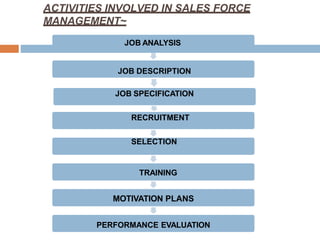
This task starts with job analysis ,followed by job
description , job specification , recruitment , selection ,
training and controlling.
Sales force management activities work as a system
,faulty decision relating to one activity results in
complications for other activities.
 Efforts put forth to attain a company’s sales objectives.
 Sales management can involve any of the following activities:
(1)formulation of sales strategy through development of account
management policies, sales force compensation policies, sales revenue
forecasts, and sales plan.
(2)implementation of sales strategy through selecting, training, motivating,
and supporting the sales force, setting sales revenue targets.
(3)sales force management through development and implementation of
sales performance, monitoring, and evaluation methods, and analysis of
associated behavioral patterns and costs
 Prospecting – search for leads
 Targeting – allocation of time between prospects and customers
 Communicating – info about company and products
 Selling – Approach, presentation, answering objections, closing sales
 Servicing – consulting, technical, financing, etc.
 Info gathering – market research
 Allocating – scarce products to customers.
 Rep to buyer – discuss issues with a prospect or customer
 Rep to buyer group – rep gets to know as many members of buyer group as possible
 Sales team to buyer group –
 Conference selling – company sales rep and resource group to customer to talk big
problems or opportunities
 Selling Seminar – Company team to group of buyers/customers
 Once company has strategy can go with direct sales force or contractual force. Direct
sales force is standard sales force with office and field reps, while contractual reps are
purely commission sales forces.
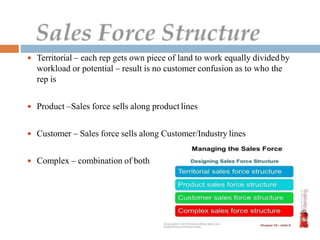
 Territorial – each rep gets own piece of land to work equally dividedby
workload or potential – result is no customer confusion as to who the
rep is
 Product –Sales force sells along product lines
 Customer – Sales force sells along Customer/Industry lines
 Complex – combination of both
Depends upon the number of customers you want to reach then:
 Group customers into classes by annual sales volume
 Establish desired call frequency-The number of calls to be made per
year on each account in a size class
 Classes size time freq. = workload
 Determine number of calls a rep can make a year
 Workload divided by rep calls per year = number of reps needed
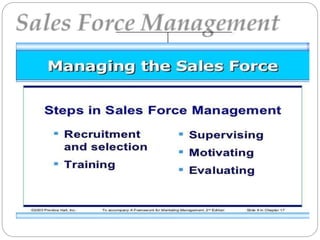
JOB ANALYSIS
JOB DESCRIPTION
JOB SPECIFICATION
RECRUITMENT
SELECTION
TRAINING
MOTIVATION PLANS
PERFORMANCE EVALUATION
ACTIVITIES INVOLVED IN SALES FORCE
MANAGEMENT~
Job analysis~
“Job analysis is a process in which jobs are studied
to determine
what tasks and responsibilities they include ,
their relationship to other jobs ,
conditions under which work is performed ,
and personal capabilities required to perform the
job”~ DALE YODER
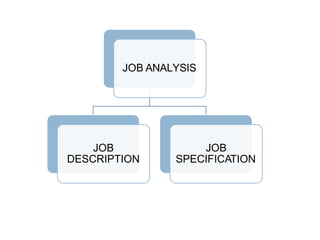
The process of job analysis results in two sets of
data i.e.
1. Job description
2. Job specification
JOB ANALYSIS
JOB
DESCRIPTION
JOB
SPECIFICATION
Job description~
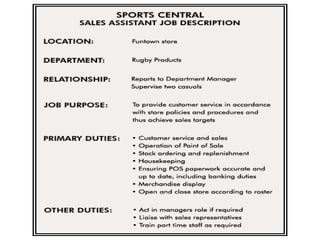
•It defines the scope of sales job activities , major
responsibilities and positioning of job in the organization.
•It specifies the parameters within which a job is to be
performed in an organization; it is thus a guide to any
employee recruited for a particular job.
•These parameters not only include the duties &
responsibilities of a particular job but also the working
hours, reporting relationship and co ordination with other
departments.
•Job description is the foundation for the management to
set standard for performance within the organization. J.
D. also acts as a legal document for any kind of disputes
arising out of lack of role clarification and at the same
time protects an employee from an unreasonable
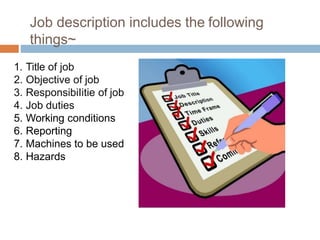
Job description includes the following
things~
1. Title of job
2. Objective of job
3. ResponsibiIitie of job
4. Job duties
5. Working conditions
6. Reporting
7. Machines to be used
8. Hazards
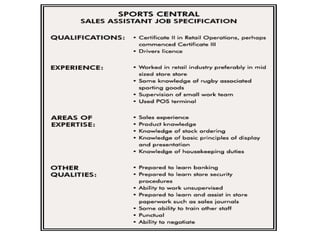
Job specification~
It is the personal quality and skills needed in an
employee to successfully perform the task of a work
position. Job specification evolves factors like
education, physical skills & communication ability in
an employee.
It includes~
1. Educational qualifications
2. Experience
3. Training
4. Physical characteristics
5. Personal characteristics
6. Skills
Recruitment~
•“Process of searching for prospective employees and
stimulating them to apply for jobs” ~ EDWIN B
FLIPPO
•The Process of generating a pool of qualified candidates
for a particular job.
or
•The Process of discovering potential candidates.
It is the process of finding out candidates, who are encouraged toapply.
Selection is the process of choosing some out of many candidates.
Therefore, we can say that selection is recruitment, but recruitment is not
selection.
Selection is the process of rejection of unfits.
Recruitment precedes the selection process.
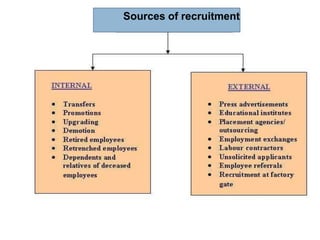
Sources of recruitment
Selection~
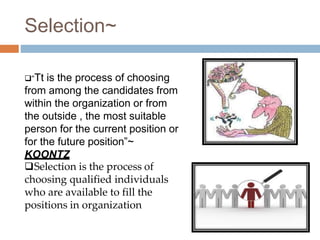
“Tt is the process of choosing
from among the candidates from
within the organization or from
the outside , the most suitable
person for the current position or
for the future position”~
KOONTZ
Selection is the process of
choosing qualified individuals
who are available to fill the
positions in organization
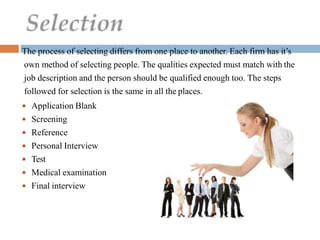
The process of selecting differs from one place to another. Each firm has it’s
own method of selecting people. The qualities expected must match with the
job description and the person should be qualified enough too. The steps
followed for selection is the same in all the places.
 Application Blank
 Screening
 Reference
 Personal Interview
 Test
 Medical examination
 Final interview
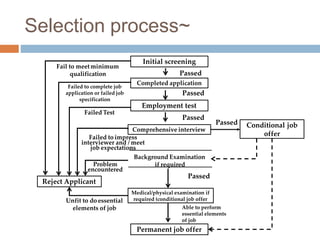
Selection process~
Initial screening
Completed application
Medical/physical examination if
required (conditional job offer
Comprehensive interview
Employment test
Permanent job offer
Reject Applicant
Conditional job
offer
Passed
Passed
Passed
if required
Passed
Passed
Able to perform
essential elements
of job
Fail to meetminimum
qualification
Failed to complete job
application or failed job
specification
Failed Test
Failed to impress
interviewer and / meet
job expectations
Background Examination
Problem
encountered
Unfit to do essential
elements of job
Training~
“Training is the act of increasing the knowledge of an
employee for doing a particular job”~ EDWARD B FLIPPO
 Importance of Training
1.Respond to technology changes affecting job
requirements.
2. Respond to organizational restructuring .
3. Adapt to increased diversity of the workforce.
4. Support career development.
5. Fulfill employee need for growth
Training methods~
A. On-the-job Training Methods:
1. Coaching
2. Mentoring
3. Job Rotation
4. Job Instruction Technology
5. Apprenticeship
6. Understudy
B. Off-the-Job Training Methods:
1. Lectures and Conferences
2. Vestibule Training
3. Simulation Exercises
4. Sensitivity Training
5. Transactional Training
 Directing the sales force
 Identify customer targets and set call norms
 Develop prospect targets
 Ensure efficient use of time and assets
 Mostly believed that the higher the salesperson’s motivation, the greater
the effort and the resulting performance, rewards, and satisfaction-and
thus further motivation.
 Sales managers must be able to convince salespeople that they can sell
more by working harder or by begun trained to work smarter
 Sales managers must be able to convince salespeople that the rewards
for better performance are worth the extra effort.
Motivation and compensation
plans~
Motivation is derived from Latin word “movere”, which
means “to move”
“ It means a process of stimulating people to action to
accomplish desired goals”~ WG SCOTT
Motivation is the effort the salesperson makes to complete
various activities of the sales job
Majority of salespeople are not adequately motivated
Importance of motivating salespeople is recognized,
because financial performance of the company depends
upon the achievement of sales volume objective
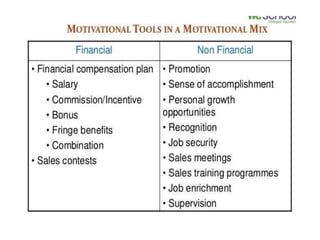
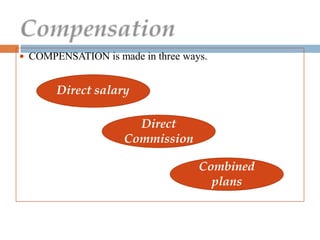
 COMPENSATION is made in three ways.
Direct salary
Direct
Commission
Combined
plans
 Direct salary:
In this method sales executives are given fixed salary per month.
 Direct commission:
In this case the executives will be working on commission basis…Eg :Life
insurance agents.
 Combined Plans:
It is a mixture of straight salary and straight commission plans. In this
method the sales executives are paid their regular salary plus their commission
on the sales they make.
Eg. BMTC pays their conductors a fixed salary + 2% Commission on the sale
of tickets.
Compensating the sales
force~
A good compensation plan should consider objectives from
the company’s and salespeople’s viewpoint
Objectives of compensation plan from the company’s
viewpoint • To attract, retain, and motivate competent
salespeople
•To control salespeople’s activities
•To be competitive, yet economical: It is difficult to balance
these two objectives
•To be flexible to adapt to new products, changing
markets, and differing territory sales potentials
 To know whether the sales executives are achieving the quotas set for them
i.e sales plans, the reports of their performances are compared against theset
standards.
 On the basis of the information, the conclusions are drawn and accordingly
incentives are announced.
 If required the sales executives are motivated and trained.
Performance evaluation AND
control~
 Controlling includes the following steps:
1. Establishing Performance Standards
2. Recording Performances
3. Evaluating Performances against Standards
4. TakingAction
It ensures that the sales force is working according
to the objectives set and helps to keep the
organisation on the right track.
And,
 Performance appraisal is a process of periodic and
impartial rating of an employees excellence in
matters pertaining to his present job and to his
potentialities for a better job.

Unit 5 Sales Management

  • 1.
    BBA – IVSEM MANAGEMENT OF SALES FORCE UNIT – 5 BY: MS.MANSI TYAGI
  • 2.
    Meaning ~ Managing thesales force involves two key personal selling decisions which are •Size of sales force •Selling styles This task starts with job analysis ,followed by job description , job specification , recruitment , selection , training and controlling. Sales force management activities work as a system ,faulty decision relating to one activity results in complications for other activities.
  • 3.
     Efforts putforth to attain a company’s sales objectives.  Sales management can involve any of the following activities: (1)formulation of sales strategy through development of account management policies, sales force compensation policies, sales revenue forecasts, and sales plan. (2)implementation of sales strategy through selecting, training, motivating, and supporting the sales force, setting sales revenue targets. (3)sales force management through development and implementation of sales performance, monitoring, and evaluation methods, and analysis of associated behavioral patterns and costs
  • 4.
     Prospecting –search for leads  Targeting – allocation of time between prospects and customers  Communicating – info about company and products  Selling – Approach, presentation, answering objections, closing sales  Servicing – consulting, technical, financing, etc.  Info gathering – market research  Allocating – scarce products to customers.
  • 5.
     Rep tobuyer – discuss issues with a prospect or customer  Rep to buyer group – rep gets to know as many members of buyer group as possible  Sales team to buyer group –  Conference selling – company sales rep and resource group to customer to talk big problems or opportunities  Selling Seminar – Company team to group of buyers/customers  Once company has strategy can go with direct sales force or contractual force. Direct sales force is standard sales force with office and field reps, while contractual reps are purely commission sales forces.
  • 6.
     Territorial –each rep gets own piece of land to work equally dividedby workload or potential – result is no customer confusion as to who the rep is  Product –Sales force sells along product lines  Customer – Sales force sells along Customer/Industry lines  Complex – combination of both
  • 7.
    Depends upon thenumber of customers you want to reach then:  Group customers into classes by annual sales volume  Establish desired call frequency-The number of calls to be made per year on each account in a size class  Classes size time freq. = workload  Determine number of calls a rep can make a year  Workload divided by rep calls per year = number of reps needed
  • 9.
    JOB ANALYSIS JOB DESCRIPTION JOBSPECIFICATION RECRUITMENT SELECTION TRAINING MOTIVATION PLANS PERFORMANCE EVALUATION ACTIVITIES INVOLVED IN SALES FORCE MANAGEMENT~
  • 10.
    Job analysis~ “Job analysisis a process in which jobs are studied to determine what tasks and responsibilities they include , their relationship to other jobs , conditions under which work is performed , and personal capabilities required to perform the job”~ DALE YODER The process of job analysis results in two sets of data i.e. 1. Job description 2. Job specification
  • 11.
  • 12.
    Job description~ •It definesthe scope of sales job activities , major responsibilities and positioning of job in the organization. •It specifies the parameters within which a job is to be performed in an organization; it is thus a guide to any employee recruited for a particular job. •These parameters not only include the duties & responsibilities of a particular job but also the working hours, reporting relationship and co ordination with other departments. •Job description is the foundation for the management to set standard for performance within the organization. J. D. also acts as a legal document for any kind of disputes arising out of lack of role clarification and at the same time protects an employee from an unreasonable
  • 13.
    Job description includesthe following things~ 1. Title of job 2. Objective of job 3. ResponsibiIitie of job 4. Job duties 5. Working conditions 6. Reporting 7. Machines to be used 8. Hazards
  • 15.
    Job specification~ It isthe personal quality and skills needed in an employee to successfully perform the task of a work position. Job specification evolves factors like education, physical skills & communication ability in an employee. It includes~ 1. Educational qualifications 2. Experience 3. Training 4. Physical characteristics 5. Personal characteristics 6. Skills
  • 17.
    Recruitment~ •“Process of searchingfor prospective employees and stimulating them to apply for jobs” ~ EDWIN B FLIPPO •The Process of generating a pool of qualified candidates for a particular job. or •The Process of discovering potential candidates.
  • 18.
    It is theprocess of finding out candidates, who are encouraged toapply. Selection is the process of choosing some out of many candidates. Therefore, we can say that selection is recruitment, but recruitment is not selection. Selection is the process of rejection of unfits. Recruitment precedes the selection process.
  • 19.
  • 20.
    Selection~ “Tt is theprocess of choosing from among the candidates from within the organization or from the outside , the most suitable person for the current position or for the future position”~ KOONTZ Selection is the process of choosing qualified individuals who are available to fill the positions in organization
  • 21.
    The process ofselecting differs from one place to another. Each firm has it’s own method of selecting people. The qualities expected must match with the job description and the person should be qualified enough too. The steps followed for selection is the same in all the places.  Application Blank  Screening  Reference  Personal Interview  Test  Medical examination  Final interview
  • 22.
    Selection process~ Initial screening Completedapplication Medical/physical examination if required (conditional job offer Comprehensive interview Employment test Permanent job offer Reject Applicant Conditional job offer Passed Passed Passed if required Passed Passed Able to perform essential elements of job Fail to meetminimum qualification Failed to complete job application or failed job specification Failed Test Failed to impress interviewer and / meet job expectations Background Examination Problem encountered Unfit to do essential elements of job
  • 23.
    Training~ “Training is theact of increasing the knowledge of an employee for doing a particular job”~ EDWARD B FLIPPO  Importance of Training 1.Respond to technology changes affecting job requirements. 2. Respond to organizational restructuring . 3. Adapt to increased diversity of the workforce. 4. Support career development. 5. Fulfill employee need for growth
  • 24.
    Training methods~ A. On-the-jobTraining Methods: 1. Coaching 2. Mentoring 3. Job Rotation 4. Job Instruction Technology 5. Apprenticeship 6. Understudy B. Off-the-Job Training Methods: 1. Lectures and Conferences 2. Vestibule Training 3. Simulation Exercises 4. Sensitivity Training 5. Transactional Training
  • 25.
     Directing thesales force  Identify customer targets and set call norms  Develop prospect targets  Ensure efficient use of time and assets
  • 26.
     Mostly believedthat the higher the salesperson’s motivation, the greater the effort and the resulting performance, rewards, and satisfaction-and thus further motivation.  Sales managers must be able to convince salespeople that they can sell more by working harder or by begun trained to work smarter  Sales managers must be able to convince salespeople that the rewards for better performance are worth the extra effort.
  • 27.
    Motivation and compensation plans~ Motivationis derived from Latin word “movere”, which means “to move” “ It means a process of stimulating people to action to accomplish desired goals”~ WG SCOTT Motivation is the effort the salesperson makes to complete various activities of the sales job Majority of salespeople are not adequately motivated Importance of motivating salespeople is recognized, because financial performance of the company depends upon the achievement of sales volume objective
  • 29.
     COMPENSATION ismade in three ways. Direct salary Direct Commission Combined plans
  • 30.
     Direct salary: Inthis method sales executives are given fixed salary per month.  Direct commission: In this case the executives will be working on commission basis…Eg :Life insurance agents.  Combined Plans: It is a mixture of straight salary and straight commission plans. In this method the sales executives are paid their regular salary plus their commission on the sales they make. Eg. BMTC pays their conductors a fixed salary + 2% Commission on the sale of tickets.
  • 31.
    Compensating the sales force~ Agood compensation plan should consider objectives from the company’s and salespeople’s viewpoint Objectives of compensation plan from the company’s viewpoint • To attract, retain, and motivate competent salespeople •To control salespeople’s activities •To be competitive, yet economical: It is difficult to balance these two objectives •To be flexible to adapt to new products, changing markets, and differing territory sales potentials
  • 32.
     To knowwhether the sales executives are achieving the quotas set for them i.e sales plans, the reports of their performances are compared against theset standards.  On the basis of the information, the conclusions are drawn and accordingly incentives are announced.  If required the sales executives are motivated and trained.
  • 33.
    Performance evaluation AND control~ Controlling includes the following steps: 1. Establishing Performance Standards 2. Recording Performances 3. Evaluating Performances against Standards 4. TakingAction It ensures that the sales force is working according to the objectives set and helps to keep the organisation on the right track. And,  Performance appraisal is a process of periodic and impartial rating of an employees excellence in matters pertaining to his present job and to his potentialities for a better job.