INTERNATIONAL MONETARY
FUND
INTERNATIONAL MONETARY FUND
 IMF is the intergovernmental organization that
oversees the global financial system by following
the macroeconomic policies of its member countries,
in particular those with an impact on exchange rate
and the balance of payments.
 It is an organization formed with a stated objective
of stabilizing international exchange rates and
facilitating development through the enforcement
of liberalising economic policies on other countries
as a condition for loans, restructuring or aid.
INTERNATIONAL MONETARY FUND
 IMF is a forum of national economic policies,
international monetary and financial systems,
which involves active dialogue with each
member country.
 Total quotas of $312 billion; outstanding loans
of $71 billion to 82 countries (According to the
report of August 31, 2005).
 Five largest shareholders:United States,
Japan, Germany, France, United Kingdom.
INTERNATIONAL MONETARY FUND
 The IMF was created to support orderly
international currency exchanges and to help
nations having balance of payment problems
through short term loans of cash.
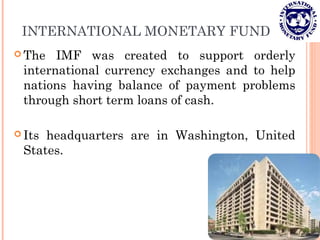
 Its headquarters are in Washington, United
States.
HISTORY
 The International Monetary Fund was
conceived in July 1944 originally with 45
members and came into existence in December
1945 when 29 countries signed the agreement
 IMF started to make service with IBRD in
1947.
 The IMF works to improve the economies of its
member countries
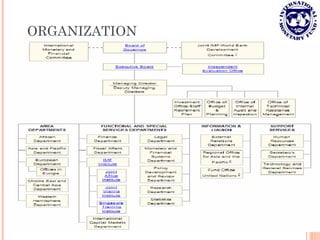
ORGANIZATION
OBJECTIVE OF THE IMF
o Promote international monetary cooperation.
o Expansion and balanced growth of international
trade.
o Promote exchange rate stability.
o The elimination of restrictions on the
international flow of capital.
o Help establish multilateral system of
payments and eliminate foreign exchange
restrictions.
o Make resources of the Fund available to
members
o Shorten the duration and lessen the degree
of disequilibrium in international balances
of payments
o Promote international monetary cooperation,
exchange stability, and orderly exchange
arrangements.
o Foster economic growth and high levels of
employment.
o Temporary financial assistance to countries to
help the balance of payments adjustments
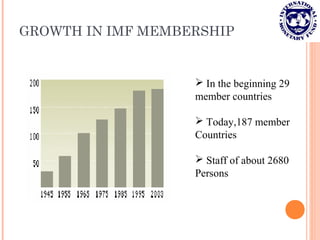
GROWTH IN IMF MEMBERSHIP
 In the beginning 29
member countries
 Today,187 member
Countries
 Staff of about 2680
Persons
ROLE OF IMF
 Focusing on its core macroeconomic and financial
areas of responsibility.
 Working in a complementary fashion with other
institutions established.
 Collection and allocation of reserves. Rendering
advice to member countries on their international
monetary affairs.
ROLE OF IMF
 Promoting research in various areas of
international economics and monetary economics.
 Providing a forum for discussion and consultation
among member countries. Being in the center of
competence.
FUNCTIONS OF IMF
 Surveillance (like a doctor) Gathering data and
assessing economic policies of countries.
 Technical Assistance (like a teacher) Strengthening
human skills and institutional capacity of
countries.
 Financial Assistance (like a banker) Lending to
countries to support reforms
OPERATIONS
 Monitoring economic and financial developments
and policies, in member countries and at the global
level, giving policy advance to its members based
on its more than fifty years of experience.
 Lending to member countries with balance of
payments problems, supporting adjustment and
reform policies aimed at correcting the underlying
problems.
 Providing the governments and central banks of its
member countries with technical assistance and
training in its areas of expertise.
OPERATIONS
 IMF looks at the performance of the economy as a
whole (macroeconomic performance)
 Focuses also on the financial sector policies Ex:
regulation and supervision of banks and other
financial institutions.
 Pays attention to structural policies that affect
macroeconomic performance.
 Ex: labor market policies (affect employment and
wage behavior)
HOW THE POLICES ARE
DETERMINED:
… in their headquarters in Washington:
 The Executive Board meets three times a week,
maybe more.
 The Board has a voting system:- The larger the
economy, the more voting power it has
 - But, most decisions are based on consensus
WHERE DOES THE IMF GET IT’S MONEY
FROM?
 Most loans are provided by member countries,
determined by their quota, which is calculated
based upon a country’s relative size in the world
economy.
 For a closer look at the Member Quotas we can
reference the IMF website.
 Upon joining, the 25% of the quota is paid in some
major currency US Dollar, British Pound, Yen
while the remaining 75% is paid in their own
currency.
WHAT IS THE IMF’S LENDING
CAPACITY?
 IMF can only borrow from financially strong
economies to finance lending.
 The IMF Board selects these “strong currencies” every
three months, which make up its “usable” resources.
INDIA AND THE IMF
 India and the IMF has a positive relationship. The
IMF has provided financial assistance to India,
which has helped in boosting the country's
economy.
 The IMF praised the country for it was able to
avoid the Asian Financial Crisis in 1999 and was
also able to maintain the average rate of growth of
its economy.
 In 2005, the IMF said that the budget of India is
very positive for it points that the economy of the
country will grow at the rate of 6.7%.
INDIA AND THE IMF
 The Managing Director of International
Monetary Fund Rodrigo De Rato visited India
in May 2005.
 International Monetary Fund said that the
reasons behind the economy growth of India are
that the RBI has been able to control inflation
and has also handled its monetary policies very
skillfully.
 The IMF has suggested that India can become
a financial super power by bringing in more
reforms in its economic policies that will
increase its growth rate to 8%.
COLLABORATING WITH OTHER
INSTITUTIONS
 The IMF collaborates with
the World Bank,
the regional development banks,
the World Trade Organization,
United Nations agencies, and
other international bodies.
Each of these institutions has its own area of
responsibility and specialization and its particular
contribution to make to the world economy.
HOW DOES THE IMF SERVE ITS
MEMBER COUNTRIES?
I. Monitoring national, global, and regional economic and
financial developments and advising member countries
on their economic policies (“surveillance”).
II. Lending members hard currencies to support policy
programs designed to correct balance of payments
problems.
III. Offering technical assistance in its areas of expertise, as
well as training for government and central bank
officials.

Bretton Woods system
 The Bretton Woods system of monetary
management established the rules for commercial and
financial relations among the world's industrial
states. independent nation-states.
 Preparing to rebuild the international economic
system as World War II was still raging, 730 delegates
from all 44 Allied nations gathered at the Mount
Washington Hotel in Bretton Woods, New Hampshire,
United States, for the United Nations Monetary and
Financial Conference. The delegates deliberated upon
and signed the Bretton Woods Agreements during
the first three weeks of July 1944.
WHAT IS THE SDR?
 The SDR, or Special Drawing Rights, is an
international reserve asset that member countries can
add to their foreign currency and gold reserves and use
for payments requiring foreign exchange.
 Its value is set daily using a basket of four major
currencies: the euro, Japanese yen, pound sterling,
and U.S. dollar.
 The IMF introduced the SDR in 1969 because of
concern that the stock and prospective growth of
international reserves might not be sufficient to
support the expansion of world trade. (The main
reserve assets at the time were gold and U.S. dollars.)
WHAT IS THE SDR? (CONT.)
 The SDR was introduced as a supplementary reserve
asset, which the IMF could "allocate" periodically to
members when the need arose, and cancel, as
necessary.
 IMF member countries may use SDRs in transactions
among themselves, with 16 "institutional" holders of
SDRs, and with the IMF.
 The SDR is also the IMF's unit of account. A number
of other international and regional organizations and
international conventions use it as a unit of account, or
as the basis for a unit of account.
WHERE THE IMF GETS ITS MONEY
 Most comes from the quota subscriptions
 the money each member contributes when joining the
IMF
 General Arrangements to Borrow (1962)
 line of credit set up with several governments and
banks throughout the world
WHEN IS A COUNTRY IN NEED ?
 A country that had not taken in enough foreign
currency to pay the other countries for what they
have bought
 spends more money than it takes in
 IMF will lend foreign exchange to that member
 hoping to stabilize its currency which will strengthen its
trade
HOW DOES THE IMF HELP POOR
COUNTRIES?
1. Most of the IMF's loans to low-income countries are
made on concessional terms, under the Poverty
Reduction and Growth Facility.
2. Under a mechanism introduced by the IMF in 2005—
the Policy Support Instrument—countries can
request that the IMF regularly and frequently review
their economic programs to ensure that they are on
track.
HOW DOES THE IMF HELP POOR
COUNTRIES? (CONT.)
3. The success of a country's program is assessed
against the goals set forth in the country's poverty
reduction strategy, and the IMF's assessment can
be made public if the country wishes.
4. The IMF also participates in debt relief efforts for
poor countries that are unable to reduce their debt
to a sustainable level even after benefiting from aid,
concessional loans, and the pursuit of sound policies.
5. To ensure that developing countries reap full benefit
from the loans and debt relief they receive, in 1999
the IMF and the World Bank introduced a process
known as the Poverty Reduction Strategy Paper
(PRSP) process.
HOW MUCH MONEY A MEMBER CAN
BORROW FROM THE IMF
 25% of the country’s quota may be used
 If this is not sufficient, then members can
borrow up to 3 times the amount of its quota
present plans for reform to Executive Directors
 If these plans are sufficient for the
Executive Directors, the IMF grants the
member a loan
CONCLUSION
 The IMF works to foster global growth and
economic stability. It provides policy advice and
financing to members in economic difficulties and
also works with developing nations to help them
achieve macroeconomic stability and reduce
poverty.

Imf

  • 1.
  • 2.
    INTERNATIONAL MONETARY FUND IMF is the intergovernmental organization that oversees the global financial system by following the macroeconomic policies of its member countries, in particular those with an impact on exchange rate and the balance of payments.  It is an organization formed with a stated objective of stabilizing international exchange rates and facilitating development through the enforcement of liberalising economic policies on other countries as a condition for loans, restructuring or aid.
  • 3.
    INTERNATIONAL MONETARY FUND IMF is a forum of national economic policies, international monetary and financial systems, which involves active dialogue with each member country.  Total quotas of $312 billion; outstanding loans of $71 billion to 82 countries (According to the report of August 31, 2005).  Five largest shareholders:United States, Japan, Germany, France, United Kingdom.
  • 4.
    INTERNATIONAL MONETARY FUND The IMF was created to support orderly international currency exchanges and to help nations having balance of payment problems through short term loans of cash.  Its headquarters are in Washington, United States.
  • 5.
    HISTORY  The InternationalMonetary Fund was conceived in July 1944 originally with 45 members and came into existence in December 1945 when 29 countries signed the agreement  IMF started to make service with IBRD in 1947.  The IMF works to improve the economies of its member countries
  • 6.
  • 7.
    OBJECTIVE OF THEIMF o Promote international monetary cooperation. o Expansion and balanced growth of international trade. o Promote exchange rate stability. o The elimination of restrictions on the international flow of capital.
  • 8.
    o Help establishmultilateral system of payments and eliminate foreign exchange restrictions. o Make resources of the Fund available to members o Shorten the duration and lessen the degree of disequilibrium in international balances of payments
  • 9.
    o Promote internationalmonetary cooperation, exchange stability, and orderly exchange arrangements. o Foster economic growth and high levels of employment. o Temporary financial assistance to countries to help the balance of payments adjustments
  • 10.
    GROWTH IN IMFMEMBERSHIP  In the beginning 29 member countries  Today,187 member Countries  Staff of about 2680 Persons
  • 11.
    ROLE OF IMF Focusing on its core macroeconomic and financial areas of responsibility.  Working in a complementary fashion with other institutions established.  Collection and allocation of reserves. Rendering advice to member countries on their international monetary affairs.
  • 12.
    ROLE OF IMF Promoting research in various areas of international economics and monetary economics.  Providing a forum for discussion and consultation among member countries. Being in the center of competence.
  • 13.
    FUNCTIONS OF IMF Surveillance (like a doctor) Gathering data and assessing economic policies of countries.  Technical Assistance (like a teacher) Strengthening human skills and institutional capacity of countries.  Financial Assistance (like a banker) Lending to countries to support reforms
  • 14.
    OPERATIONS  Monitoring economicand financial developments and policies, in member countries and at the global level, giving policy advance to its members based on its more than fifty years of experience.  Lending to member countries with balance of payments problems, supporting adjustment and reform policies aimed at correcting the underlying problems.  Providing the governments and central banks of its member countries with technical assistance and training in its areas of expertise.
  • 15.
    OPERATIONS  IMF looksat the performance of the economy as a whole (macroeconomic performance)  Focuses also on the financial sector policies Ex: regulation and supervision of banks and other financial institutions.  Pays attention to structural policies that affect macroeconomic performance.  Ex: labor market policies (affect employment and wage behavior)
  • 16.
    HOW THE POLICESARE DETERMINED: … in their headquarters in Washington:  The Executive Board meets three times a week, maybe more.  The Board has a voting system:- The larger the economy, the more voting power it has  - But, most decisions are based on consensus
  • 17.
    WHERE DOES THEIMF GET IT’S MONEY FROM?  Most loans are provided by member countries, determined by their quota, which is calculated based upon a country’s relative size in the world economy.  For a closer look at the Member Quotas we can reference the IMF website.  Upon joining, the 25% of the quota is paid in some major currency US Dollar, British Pound, Yen while the remaining 75% is paid in their own currency.
  • 18.
    WHAT IS THEIMF’S LENDING CAPACITY?  IMF can only borrow from financially strong economies to finance lending.  The IMF Board selects these “strong currencies” every three months, which make up its “usable” resources.
  • 19.
    INDIA AND THEIMF  India and the IMF has a positive relationship. The IMF has provided financial assistance to India, which has helped in boosting the country's economy.  The IMF praised the country for it was able to avoid the Asian Financial Crisis in 1999 and was also able to maintain the average rate of growth of its economy.  In 2005, the IMF said that the budget of India is very positive for it points that the economy of the country will grow at the rate of 6.7%.
  • 20.
    INDIA AND THEIMF  The Managing Director of International Monetary Fund Rodrigo De Rato visited India in May 2005.  International Monetary Fund said that the reasons behind the economy growth of India are that the RBI has been able to control inflation and has also handled its monetary policies very skillfully.  The IMF has suggested that India can become a financial super power by bringing in more reforms in its economic policies that will increase its growth rate to 8%.
  • 21.
    COLLABORATING WITH OTHER INSTITUTIONS The IMF collaborates with the World Bank, the regional development banks, the World Trade Organization, United Nations agencies, and other international bodies. Each of these institutions has its own area of responsibility and specialization and its particular contribution to make to the world economy.
  • 22.
    HOW DOES THEIMF SERVE ITS MEMBER COUNTRIES? I. Monitoring national, global, and regional economic and financial developments and advising member countries on their economic policies (“surveillance”). II. Lending members hard currencies to support policy programs designed to correct balance of payments problems. III. Offering technical assistance in its areas of expertise, as well as training for government and central bank officials.
  • 23.
     Bretton Woods system The Bretton Woods system of monetary management established the rules for commercial and financial relations among the world's industrial states. independent nation-states.  Preparing to rebuild the international economic system as World War II was still raging, 730 delegates from all 44 Allied nations gathered at the Mount Washington Hotel in Bretton Woods, New Hampshire, United States, for the United Nations Monetary and Financial Conference. The delegates deliberated upon and signed the Bretton Woods Agreements during the first three weeks of July 1944.
  • 24.
    WHAT IS THESDR?  The SDR, or Special Drawing Rights, is an international reserve asset that member countries can add to their foreign currency and gold reserves and use for payments requiring foreign exchange.  Its value is set daily using a basket of four major currencies: the euro, Japanese yen, pound sterling, and U.S. dollar.  The IMF introduced the SDR in 1969 because of concern that the stock and prospective growth of international reserves might not be sufficient to support the expansion of world trade. (The main reserve assets at the time were gold and U.S. dollars.)
  • 25.
    WHAT IS THESDR? (CONT.)  The SDR was introduced as a supplementary reserve asset, which the IMF could "allocate" periodically to members when the need arose, and cancel, as necessary.  IMF member countries may use SDRs in transactions among themselves, with 16 "institutional" holders of SDRs, and with the IMF.  The SDR is also the IMF's unit of account. A number of other international and regional organizations and international conventions use it as a unit of account, or as the basis for a unit of account.
  • 26.
    WHERE THE IMFGETS ITS MONEY  Most comes from the quota subscriptions  the money each member contributes when joining the IMF  General Arrangements to Borrow (1962)  line of credit set up with several governments and banks throughout the world
  • 27.
    WHEN IS ACOUNTRY IN NEED ?  A country that had not taken in enough foreign currency to pay the other countries for what they have bought  spends more money than it takes in  IMF will lend foreign exchange to that member  hoping to stabilize its currency which will strengthen its trade
  • 28.
    HOW DOES THEIMF HELP POOR COUNTRIES? 1. Most of the IMF's loans to low-income countries are made on concessional terms, under the Poverty Reduction and Growth Facility. 2. Under a mechanism introduced by the IMF in 2005— the Policy Support Instrument—countries can request that the IMF regularly and frequently review their economic programs to ensure that they are on track.
  • 29.
    HOW DOES THEIMF HELP POOR COUNTRIES? (CONT.) 3. The success of a country's program is assessed against the goals set forth in the country's poverty reduction strategy, and the IMF's assessment can be made public if the country wishes. 4. The IMF also participates in debt relief efforts for poor countries that are unable to reduce their debt to a sustainable level even after benefiting from aid, concessional loans, and the pursuit of sound policies. 5. To ensure that developing countries reap full benefit from the loans and debt relief they receive, in 1999 the IMF and the World Bank introduced a process known as the Poverty Reduction Strategy Paper (PRSP) process.
  • 30.
    HOW MUCH MONEYA MEMBER CAN BORROW FROM THE IMF  25% of the country’s quota may be used  If this is not sufficient, then members can borrow up to 3 times the amount of its quota present plans for reform to Executive Directors  If these plans are sufficient for the Executive Directors, the IMF grants the member a loan
  • 31.
    CONCLUSION  The IMFworks to foster global growth and economic stability. It provides policy advice and financing to members in economic difficulties and also works with developing nations to help them achieve macroeconomic stability and reduce poverty.