Special Drawing
Rights(SDR)
Presented By
Antaj K Singh
Roll no. 15
MIB Ist Yr.
The Bretton Woods Conference



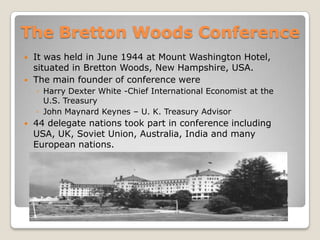
It was held in June 1944 at Mount Washington Hotel,
situated in Bretton Woods, New Hampshire, USA.
The main founder of conference were
◦ Harry Dexter White -Chief International Economist at the
U.S. Treasury
◦ John Maynard Keynes – U. K. Treasury Advisor



44 delegate nations took part in conference including
USA, UK, Soviet Union, Australia, India and many
European nations.
Main Conference Agreements


Formation of the IMF and the IBRD (World Bank).



Adjustably pegged foreign exchange market rate system:
◦ The exchange rates were fixed, with the provision of changing
them if necessary. (The U.S. dollar tied to gold at $35 an
ounce)



Currencies were required to be convertible for trade related
and other current account transactions.



All member countries were required to subscribe to the
IMF's capital.



Member countries contributed their currencies and gold to
the fund.



Using the US dollar as a global gold standard.
Fall of Bretton-Woods


Increasing balance of payment crises.



U.S. currency pressure brought about partly from cost of
Vietnam War and a growing trade deficit.



President Nixon issued an executive order in 1971
eliminating the gold standard and devaluing the dollar.



Floating exchange rates determined by market trading
replaced fixed exchange rates.
Balance of Payment Crisis


Till 1970s International trade was conducted in dollar
denominations.



Foreign central banks held their international reserves in
dollar assets.



The probability of “Fundamental Disequilibrium” was
thought to exist for various nations.



Large current account surpluses made countries candidates
for revaluation.



Selling local currency in the foreign exchange market with
the intent of slowing appreciation resulted in large official
reserves.



Money supply would grow to quickly which in turn would
push up the price level and disrupt the internal balance.
Special Drawing Rights (SDR)


Special drawing rights were created by the IMF in 1969 and
were intended to be an asset held in foreign exchange
reserves.



They were Issued to supplement a shortfall of preferred
foreign exchange reserve assets, namely Gold and the US
dollar.



They were allocated to participating members in portion to
their Fund quotas.



The value of a SDR is defined by a weighted currency
basket of four major currencies: the US dollar, the Euro,
the British pound, and the Japanese yen.



SDRs are denoted with the ISO 4217 currency code XDR.
Valuation of SDR


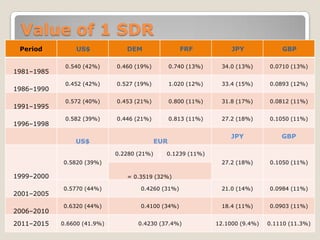
The value of the SDR is determined by the value of several
currencies important to the world‟s trading and financial
systems.



Initially its value was fixed
1 SDR = 1 US dollar



The basket of currencies used to value the SDR is
„weighted‟, meaning that the more important currencies
have a larger impact on its value.



Current valuation

◦ Due to fluctuating exchange rates, the relative value of each
currency varies continuously and so does the value of the SDR.
The IMF fixes the value of one SDR in terms of US dollars daily.
SDR or Paper Gold


A country's IMF quota, the maximum amount of financial
resources that it is obligated to contribute to the fund,
determines its allotment of SDRs.



It cannot be used for trading purposes.



Only central governments can hold SDR and no private firm
can have its ownership rights.



They can only be exchanged for Euros, Japanese
yen, pounds sterling, or US dollars.



Any new allocations must be voted on in the SDR
Department of the IMF and pass with an 85% majority.
SDR Market


Various Fund members and one prescribed SDR holder
have agreed to stand ready to buy and sell SDRs on a
voluntary basis.



The Fund facilitates transactions between members seeking
to sell or buy SDRs and these counterparties to the
voluntary agreements that effectively make a market in
SDRs.



In the event that there are not enough voluntary buyers of
SDRs, the IMF can designate members with strong balance
of payments positions to provide freely usable currency in
exchange for SDRs.
Value of 1 SDR
Period
1981–1985
1986–1990
1991–1995
1996–1998

 US$

 DEM

 FRF

 JPY

 GBP

0.540 (42%)

0.460 (19%)

0.740 (13%)

34.0 (13%)

0.0710 (13%)

0.452 (42%)

0.527 (19%)

1.020 (12%)

33.4 (15%)

0.0893 (12%)

0.572 (40%)

0.453 (21%)

0.800 (11%)

31.8 (17%)

0.0812 (11%)

0.582 (39%)

0.446 (21%)

0.813 (11%)

27.2 (18%)

0.1050 (11%)

JPY

GBP

27.2 (18%)

0.1050 (11%)

US$

 EUR
0.2280 (21%)

0.1239 (11%)

0.5820 (39%)

1999–2000
2001–2005

2006–2010
2011–2015

= 0.3519 (32%)
0.5770 (44%)

0.4260 (31%)

21.0 (14%)

0.0984 (11%)

0.6320 (44%)

0.4100 (34%)

18.4 (11%)

0.0903 (11%)

0.6600 (41.9%)

0.4230 (37.4%)

12.1000 (9.4%)

0.1110 (11.3%)
Allocation of SDRs








Special drawing rights are allocated to member countries
by the IMF.
A country's IMF quota, the maximum amount of financial
resources that it is obligated to contribute to the fund,
determines its allotment of SDRs.
Any new allocations must be voted on in the SDR
Department of the IMF and pass with an 85% majority.
All IMF member countries are represented in the SDR
Department.
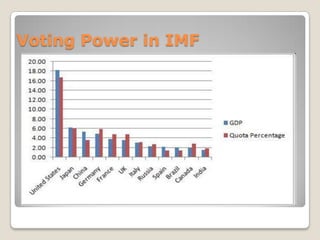
Voting power is determined by a member country's IMF
quota. For example, the US has 16.7% of the vote as of
March 2, 2011.
SDR allocations


SDR 9.3 billion was allocated in yearly instalments in
1970–72.



SDR 12.1 billion was allocated in yearly instalments in
1979–81.



SDR 161.2 billion was allocated on August 28, 2009.
◦ The general SDR allocation of August 28, 2009 is by far the
biggest allocation to date



A special one-time allocation of SDR 21.5 billion took effect
on September 9, 2009, bringing total cumulative
allocations to about SDR 204 billion (equivalent to about
US$318 billion).
Voting Power in IMF
Borrowings by India


India's current quota in the IMF is SDR 5821.50 million,
giving it a shareholding of 2.44%.



India borrowed SDR 3.9 billion during the period 1981-84.



Again during 1991 to 1993, India borrowed an amount of
SDR 3.56 billion because of BOP crisis.



Repayment of all the loans taken from International
Monetary Fund has been completed on May 31, 2000.



India received allocation of about USD 4.5 billion in General
allocations of 2009.



India is now a contributor to the IMF.
Thank You

SDR- Special Drawing Rights, IMF

  • 1.
    Special Drawing Rights(SDR) Presented By AntajK Singh Roll no. 15 MIB Ist Yr.
  • 2.
    The Bretton WoodsConference   It was held in June 1944 at Mount Washington Hotel, situated in Bretton Woods, New Hampshire, USA. The main founder of conference were ◦ Harry Dexter White -Chief International Economist at the U.S. Treasury ◦ John Maynard Keynes – U. K. Treasury Advisor  44 delegate nations took part in conference including USA, UK, Soviet Union, Australia, India and many European nations.
  • 3.
    Main Conference Agreements  Formationof the IMF and the IBRD (World Bank).  Adjustably pegged foreign exchange market rate system: ◦ The exchange rates were fixed, with the provision of changing them if necessary. (The U.S. dollar tied to gold at $35 an ounce)  Currencies were required to be convertible for trade related and other current account transactions.  All member countries were required to subscribe to the IMF's capital.  Member countries contributed their currencies and gold to the fund.  Using the US dollar as a global gold standard.
  • 4.
    Fall of Bretton-Woods  Increasingbalance of payment crises.  U.S. currency pressure brought about partly from cost of Vietnam War and a growing trade deficit.  President Nixon issued an executive order in 1971 eliminating the gold standard and devaluing the dollar.  Floating exchange rates determined by market trading replaced fixed exchange rates.
  • 5.
    Balance of PaymentCrisis  Till 1970s International trade was conducted in dollar denominations.  Foreign central banks held their international reserves in dollar assets.  The probability of “Fundamental Disequilibrium” was thought to exist for various nations.  Large current account surpluses made countries candidates for revaluation.  Selling local currency in the foreign exchange market with the intent of slowing appreciation resulted in large official reserves.  Money supply would grow to quickly which in turn would push up the price level and disrupt the internal balance.
  • 6.
    Special Drawing Rights(SDR)  Special drawing rights were created by the IMF in 1969 and were intended to be an asset held in foreign exchange reserves.  They were Issued to supplement a shortfall of preferred foreign exchange reserve assets, namely Gold and the US dollar.  They were allocated to participating members in portion to their Fund quotas.  The value of a SDR is defined by a weighted currency basket of four major currencies: the US dollar, the Euro, the British pound, and the Japanese yen.  SDRs are denoted with the ISO 4217 currency code XDR.
  • 7.
    Valuation of SDR  Thevalue of the SDR is determined by the value of several currencies important to the world‟s trading and financial systems.  Initially its value was fixed 1 SDR = 1 US dollar  The basket of currencies used to value the SDR is „weighted‟, meaning that the more important currencies have a larger impact on its value.  Current valuation ◦ Due to fluctuating exchange rates, the relative value of each currency varies continuously and so does the value of the SDR. The IMF fixes the value of one SDR in terms of US dollars daily.
  • 8.
    SDR or PaperGold  A country's IMF quota, the maximum amount of financial resources that it is obligated to contribute to the fund, determines its allotment of SDRs.  It cannot be used for trading purposes.  Only central governments can hold SDR and no private firm can have its ownership rights.  They can only be exchanged for Euros, Japanese yen, pounds sterling, or US dollars.  Any new allocations must be voted on in the SDR Department of the IMF and pass with an 85% majority.
  • 9.
    SDR Market  Various Fundmembers and one prescribed SDR holder have agreed to stand ready to buy and sell SDRs on a voluntary basis.  The Fund facilitates transactions between members seeking to sell or buy SDRs and these counterparties to the voluntary agreements that effectively make a market in SDRs.  In the event that there are not enough voluntary buyers of SDRs, the IMF can designate members with strong balance of payments positions to provide freely usable currency in exchange for SDRs.
  • 10.
    Value of 1SDR Period 1981–1985 1986–1990 1991–1995 1996–1998  US$  DEM  FRF  JPY  GBP 0.540 (42%) 0.460 (19%) 0.740 (13%) 34.0 (13%) 0.0710 (13%) 0.452 (42%) 0.527 (19%) 1.020 (12%) 33.4 (15%) 0.0893 (12%) 0.572 (40%) 0.453 (21%) 0.800 (11%) 31.8 (17%) 0.0812 (11%) 0.582 (39%) 0.446 (21%) 0.813 (11%) 27.2 (18%) 0.1050 (11%) JPY GBP 27.2 (18%) 0.1050 (11%) US$  EUR 0.2280 (21%) 0.1239 (11%) 0.5820 (39%) 1999–2000 2001–2005 2006–2010 2011–2015 = 0.3519 (32%) 0.5770 (44%) 0.4260 (31%) 21.0 (14%) 0.0984 (11%) 0.6320 (44%) 0.4100 (34%) 18.4 (11%) 0.0903 (11%) 0.6600 (41.9%) 0.4230 (37.4%) 12.1000 (9.4%) 0.1110 (11.3%)
  • 11.
    Allocation of SDRs      Specialdrawing rights are allocated to member countries by the IMF. A country's IMF quota, the maximum amount of financial resources that it is obligated to contribute to the fund, determines its allotment of SDRs. Any new allocations must be voted on in the SDR Department of the IMF and pass with an 85% majority. All IMF member countries are represented in the SDR Department. Voting power is determined by a member country's IMF quota. For example, the US has 16.7% of the vote as of March 2, 2011.
  • 12.
    SDR allocations  SDR 9.3billion was allocated in yearly instalments in 1970–72.  SDR 12.1 billion was allocated in yearly instalments in 1979–81.  SDR 161.2 billion was allocated on August 28, 2009. ◦ The general SDR allocation of August 28, 2009 is by far the biggest allocation to date  A special one-time allocation of SDR 21.5 billion took effect on September 9, 2009, bringing total cumulative allocations to about SDR 204 billion (equivalent to about US$318 billion).
  • 13.
  • 14.
    Borrowings by India  India'scurrent quota in the IMF is SDR 5821.50 million, giving it a shareholding of 2.44%.  India borrowed SDR 3.9 billion during the period 1981-84.  Again during 1991 to 1993, India borrowed an amount of SDR 3.56 billion because of BOP crisis.  Repayment of all the loans taken from International Monetary Fund has been completed on May 31, 2000.  India received allocation of about USD 4.5 billion in General allocations of 2009.  India is now a contributor to the IMF.
  • 15.

Editor's Notes

  • #6 This may lead to a devaluation of the currency. Anyone holding this currency would incur a loss equal to the amount of the exchange rate change.
  • #7 This basket is re-evaluated every five years, and the currencies included as well as the weights given to them can then change. A currency's importance is currently measured by the degree to which it is used as a foreign exchange reserve asset and the amount of exports sold in that currency.
  • #10 This so-called "designation mechanism" ensures that a participant can use its SDRs to readily obtain an equivalent amount of currency if it has a need for such a currency because of its balance of payments, its reserve position, or developments in its reserves.
  • #12 India donatedd to Iraq