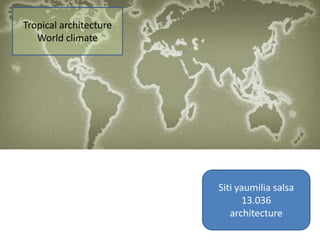
Tropical architecture
World climate

Siti yaumilia salsa
13.036
architecture
Climatic parameters which form
climate
•

•

•

•
•

Air / Ambient temperature (F/OC)
Temperature is the measure of how hot or cold the air is.
Solar radiation(kWh/m2 )
Solar radiation is the heat energy that is emitted from the Sun and radiated out to all parts
of the solar system.
Humidity (%)
Humidity is the level of water in the air, the more water vapour in the air the higher the
humidity
Air movement/ Wind (m/s)
Air pressure is simply the weight of the air above the Earth.
Precipation (rain, snow) (mm/year)
Precipitation is the term given to moisture that falls from the air to the ground.
World climate
• Cold climate
•Temperate (Sub trop) climate
• Desert/ arid climate
•Semi arid climate
•Warm humid tropical climate
Cold climate
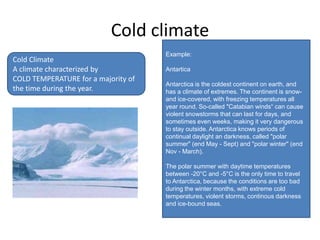
Cold Climate
A climate characterized by
COLD TEMPERATURE for a majority of
the time during the year.

Example:
Antartica
Antarctica is the coldest continent on earth, and
has a climate of extremes. The continent is snowand ice-covered, with freezing temperatures all
year round. So-called "Catabian winds“ can cause
violent snowstorms that can last for days, and
sometimes even weeks, making it very dangerous
to stay outside. Antarctica knows periods of
continual daylight an darkness, called "polar
summer" (end May - Sept) and "polar winter" (end
Nov - March).
The polar summer with daytime temperatures
between -20°C and -5°C is the only time to travel
to Antarctica, because the conditions are too bad
during the winter months, with extreme cold
temperatures, violent storms, continous darkness
and ice-bound seas.
Temperate climate
The temperate climate occurs in a zone that
falls within the 40° and 60/70o latitudes. This
area normally experiences windy weather but
does not have excessive temperatures. In this
zone, the four seasons have clear
demarcations.

TEMPERATE (SUB TROPICAL)
CLIMATE
● Low Air/ Ambient
Temperature
● Small to Medium
Solar Radiation
● Low Relative
Humidity
● High Air
Movement/ Wind
● Small to Medium
Rains, Small to
Heavy Snows
The desert / arid

Temperatures exhibit daily extremes because the
atmosphere contains little humidity to block the
Sun's rays. Desert surfaces receive a little more than
twice the solar radiation received by humid regions
and lose almost twice as much heat at night. Many
mean annual temperatures range from 20-25° C. The
extreme maximum ranges from 43.5-49° C. Minimum
temperatures sometimes drop to -18° C.

● Medium to High
Air/ Ambient
Temperatures
● High Solar
Radiation
● Low Relative
Humidity/ Dry Air
● High Air
Movement/ Wind
● Small to No
Rains
Semi arid climate

From left: Red Rock Canyon National Conservation Area, southern Nevada; sagebrush near
Bridger, Montana; Castle Valley, Utah, east of Arches National Park.

The summers are moderately long and dry, and like hot deserts, the winters normally bring
low concentrations of rainfall. Summer temperatures usually average between 21-27° C. It
normally does not go above 38° C and evening temperatures are cool, at around 10° C. Cool
nights help both plants and animals by reducing moisture loss from transpiration, sweating
and breathing. Furthermore, condensation of dew caused by night cooling may equal or
exceed the rainfall received by some deserts. As in the hot desert, rainfall is often very low
and/or concentrated. The average rainfall ranges from 2-4 cm annually.
Humid tropical climate
The humid tropical climate is characterised by season-long precipitation, which is
particularly intensive during the so called rain season in the spring and in the
autumn (when the sun stands directly above the equator)

• s

GENERAL CHARACTERISTIC OF WARM HUMID TROPIC
● Medium to High Air/ Ambient Temperatures (22 to
35oC)
● High Solar Radiation (3 to 6 kWh/m2day)
● High Relative Humidity/ Humid Air (60 to 100%)
● Low Air Movement/ Wind (<5m/s)
● Medium to Heavy Rains (500mm to 5000mm/years)
INDONESIAN CLIMATE
● Coastal/ Lowland regions (Medium to high
temperatures)
● Highland regions (Medium to low temperatures)
● Mountainous regions (Low temperature)
● Savannah regions (Little rain)
Coastal and low land region
The coast is where the land meets the sea. Thishighly variable region begins where
salt spray reaches and affects land-based plant communities and extends seaward
through the surf zone as far as wave action still disturbs the sea bottom, usually to
depths of about 200 ft. Indeed, the coast environment has the greatest diversity of
habitats and microhabitats on Earth.
Coastal life must be adapted to environmental factors that grade from one
extreme to another, especially from wet to dry; wave action; and particle sizes of
bottom materials.

Bali

Bandung

Ambon
High land region
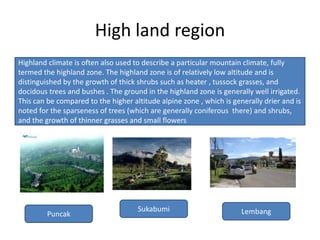
Highland climate is often also used to describe a particular mountain climate, fully
termed the highland zone. The highland zone is of relatively low altitude and is
distinguished by the growth of thick shrubs such as heater , tussock grasses, and
docidous trees and bushes . The ground in the highland zone is generally well irrigated.
This can be compared to the higher altitude alpine zone , which is generally drier and is
noted for the sparseness of trees (which are generally coniferous there) and shrubs,
and the growth of thinner grasses and small flowers

Puncak

Sukabumi

Lembang
Savannah region
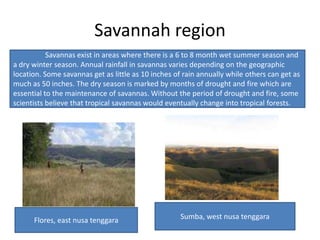
Savannas exist in areas where there is a 6 to 8 month wet summer season and
a dry winter season. Annual rainfall in savannas varies depending on the geographic
location. Some savannas get as little as 10 inches of rain annually while others can get as
much as 50 inches. The dry season is marked by months of drought and fire which are
essential to the maintenance of savannas. Without the period of drought and fire, some
scientists believe that tropical savannas would eventually change into tropical forests.

Flores, east nusa tenggara

Sumba, west nusa tenggara
Mountainius region
Most of the larger islands are mountainous, with peaks ranging between 3,000 and 3,800
metres (9,843 and 12,467 ft) meters above sea level in Sumatra, Java, Bali, Lombok, Sulawesi,
and Seram. The country's tallest mountains are located in the Jayawijaya Mountains and
the Sudirman Range in Papua. The highest peak, Puncak Jaya (4,884 metres (16,024 ft)), is
located in the Sudirman Mountains.

Jaya wijaya

Parahyangan

Foja
• http://en.wikibooks.org/wiki/Basic_Geography/Climate/Climate_El
ements
• http://answers.yahoo.com/question/index?qid=20101209152142A
AQ5t6s
• http://arcticwind.vtt.fi/
• http://www.definitions.net/definition/cold%20climate
• http://www.ask.com/question/what-is-a-temperate-climate
• http://www.study-in-china.org/university/shanxi/Yangquan.asp
• http://en.wikipedia.org/wiki/Geography_of_Indonesia#Mountains_
and_tectonics
• http://en.wikipedia.org/wiki/Geography_of_Indonesia

world climate type n definition

  • 1.
    Tropical architecture World climate Sitiyaumilia salsa 13.036 architecture
  • 2.
    Climatic parameters whichform climate • • • • • Air / Ambient temperature (F/OC) Temperature is the measure of how hot or cold the air is. Solar radiation(kWh/m2 ) Solar radiation is the heat energy that is emitted from the Sun and radiated out to all parts of the solar system. Humidity (%) Humidity is the level of water in the air, the more water vapour in the air the higher the humidity Air movement/ Wind (m/s) Air pressure is simply the weight of the air above the Earth. Precipation (rain, snow) (mm/year) Precipitation is the term given to moisture that falls from the air to the ground.
  • 3.
    World climate • Coldclimate •Temperate (Sub trop) climate • Desert/ arid climate •Semi arid climate •Warm humid tropical climate
  • 4.
    Cold climate Cold Climate Aclimate characterized by COLD TEMPERATURE for a majority of the time during the year. Example: Antartica Antarctica is the coldest continent on earth, and has a climate of extremes. The continent is snowand ice-covered, with freezing temperatures all year round. So-called "Catabian winds“ can cause violent snowstorms that can last for days, and sometimes even weeks, making it very dangerous to stay outside. Antarctica knows periods of continual daylight an darkness, called "polar summer" (end May - Sept) and "polar winter" (end Nov - March). The polar summer with daytime temperatures between -20°C and -5°C is the only time to travel to Antarctica, because the conditions are too bad during the winter months, with extreme cold temperatures, violent storms, continous darkness and ice-bound seas.
  • 5.
    Temperate climate The temperateclimate occurs in a zone that falls within the 40° and 60/70o latitudes. This area normally experiences windy weather but does not have excessive temperatures. In this zone, the four seasons have clear demarcations. TEMPERATE (SUB TROPICAL) CLIMATE ● Low Air/ Ambient Temperature ● Small to Medium Solar Radiation ● Low Relative Humidity ● High Air Movement/ Wind ● Small to Medium Rains, Small to Heavy Snows
  • 6.
    The desert /arid Temperatures exhibit daily extremes because the atmosphere contains little humidity to block the Sun's rays. Desert surfaces receive a little more than twice the solar radiation received by humid regions and lose almost twice as much heat at night. Many mean annual temperatures range from 20-25° C. The extreme maximum ranges from 43.5-49° C. Minimum temperatures sometimes drop to -18° C. ● Medium to High Air/ Ambient Temperatures ● High Solar Radiation ● Low Relative Humidity/ Dry Air ● High Air Movement/ Wind ● Small to No Rains
  • 7.
    Semi arid climate Fromleft: Red Rock Canyon National Conservation Area, southern Nevada; sagebrush near Bridger, Montana; Castle Valley, Utah, east of Arches National Park. The summers are moderately long and dry, and like hot deserts, the winters normally bring low concentrations of rainfall. Summer temperatures usually average between 21-27° C. It normally does not go above 38° C and evening temperatures are cool, at around 10° C. Cool nights help both plants and animals by reducing moisture loss from transpiration, sweating and breathing. Furthermore, condensation of dew caused by night cooling may equal or exceed the rainfall received by some deserts. As in the hot desert, rainfall is often very low and/or concentrated. The average rainfall ranges from 2-4 cm annually.
  • 8.
    Humid tropical climate Thehumid tropical climate is characterised by season-long precipitation, which is particularly intensive during the so called rain season in the spring and in the autumn (when the sun stands directly above the equator) • s GENERAL CHARACTERISTIC OF WARM HUMID TROPIC ● Medium to High Air/ Ambient Temperatures (22 to 35oC) ● High Solar Radiation (3 to 6 kWh/m2day) ● High Relative Humidity/ Humid Air (60 to 100%) ● Low Air Movement/ Wind (<5m/s) ● Medium to Heavy Rains (500mm to 5000mm/years) INDONESIAN CLIMATE ● Coastal/ Lowland regions (Medium to high temperatures) ● Highland regions (Medium to low temperatures) ● Mountainous regions (Low temperature) ● Savannah regions (Little rain)
  • 9.
    Coastal and lowland region The coast is where the land meets the sea. Thishighly variable region begins where salt spray reaches and affects land-based plant communities and extends seaward through the surf zone as far as wave action still disturbs the sea bottom, usually to depths of about 200 ft. Indeed, the coast environment has the greatest diversity of habitats and microhabitats on Earth. Coastal life must be adapted to environmental factors that grade from one extreme to another, especially from wet to dry; wave action; and particle sizes of bottom materials. Bali Bandung Ambon
  • 10.
    High land region Highlandclimate is often also used to describe a particular mountain climate, fully termed the highland zone. The highland zone is of relatively low altitude and is distinguished by the growth of thick shrubs such as heater , tussock grasses, and docidous trees and bushes . The ground in the highland zone is generally well irrigated. This can be compared to the higher altitude alpine zone , which is generally drier and is noted for the sparseness of trees (which are generally coniferous there) and shrubs, and the growth of thinner grasses and small flowers Puncak Sukabumi Lembang
  • 11.
    Savannah region Savannas existin areas where there is a 6 to 8 month wet summer season and a dry winter season. Annual rainfall in savannas varies depending on the geographic location. Some savannas get as little as 10 inches of rain annually while others can get as much as 50 inches. The dry season is marked by months of drought and fire which are essential to the maintenance of savannas. Without the period of drought and fire, some scientists believe that tropical savannas would eventually change into tropical forests. Flores, east nusa tenggara Sumba, west nusa tenggara
  • 12.
    Mountainius region Most ofthe larger islands are mountainous, with peaks ranging between 3,000 and 3,800 metres (9,843 and 12,467 ft) meters above sea level in Sumatra, Java, Bali, Lombok, Sulawesi, and Seram. The country's tallest mountains are located in the Jayawijaya Mountains and the Sudirman Range in Papua. The highest peak, Puncak Jaya (4,884 metres (16,024 ft)), is located in the Sudirman Mountains. Jaya wijaya Parahyangan Foja
  • 13.
    • http://en.wikibooks.org/wiki/Basic_Geography/Climate/Climate_El ements • http://answers.yahoo.com/question/index?qid=20101209152142A AQ5t6s •http://arcticwind.vtt.fi/ • http://www.definitions.net/definition/cold%20climate • http://www.ask.com/question/what-is-a-temperate-climate • http://www.study-in-china.org/university/shanxi/Yangquan.asp • http://en.wikipedia.org/wiki/Geography_of_Indonesia#Mountains_ and_tectonics • http://en.wikipedia.org/wiki/Geography_of_Indonesia