CLIMATE
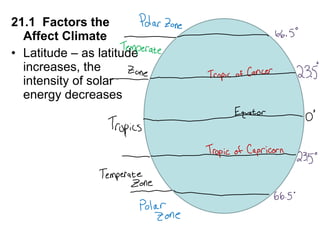
21.1  Factors the Affect Climate Latitude – as latitude increases, the intensity of solar energy decreases
Elevation – the higher the elevation, the colder the climate Air temperature decreases with elevation by an average of about 6.5 oC every  1000 meters. Increasing altitude has the same affect on climate as increasing latitude
Topography – the windward side of a mountain has more precipitation than the leeward (sheltered) side.
Water Bodies  Large bodies of water such as lakes and oceans have an important effect on the temperature of an area because the temperature of the water body influences the temperature of the air above it. Places downwind of a large body of water have cooler summers and milder winters than inland.
Atmospheric Circulation - global pressure zones creates areas of precipitation (lows) and dry areas (highs)
Vegetation  Vegetation influences how much of the sun’s energy is absorbed and how quickly this energy is released.  Areas with vegetation will be cooler and more humid than areas without vegetation. Deforestation dries the climate.
21.2  World Climates Climates are classified by the temperature and precipitation.  Climate determines the type of plants in an area and the type of plants determines the types of animals.
 
Humid Tropical Climates – border the equator No winters Mean temperature of 18 oC Rainfall can exceed 200 cm Wet tropical forms the tropical rain forest with high temperatures and high precipitation throughout the year Wet and dry tropical have high temperatures but periods of low precipitation.
 
Humid Mid-latitude with mild winters 1.  Humid subtropical climates – southeastern US Summers- hot and humid Winters – relatively mild 2.  Marine West Coast Climates Mild winters and cool summers 3.  Dry-summer subtropical climates – Mediterranean Climates California Wet winters, dry summers
 
Humid Mid-Latitude With Severe Winters 1.  Humid Continental Climates –winters are severe and summers quite long,  upper mid-west 2.  Subarctic climate– winters are long and bitterly cold, summers are warm and  short, northern Canada Highest annual temperature range on Earth
 
Dry Climates – annual precipitation not as great as evaporation Located near the Tropics of Caner and Capricorn due to sinking air (High  pressure) areas Arid or desert Semi-arid or steppe (marginal area and more humid than desert) Polar Climates – mean temperature during the warmest month is below 19 oC, the temperatures remain cool and very little precipitation Tundra – plants are low to the ground Polar ice cap Highland Climates – cooler and wetter than nearby areas at lower elevations South-facing slopes will be warmer than north-facing slopes
 
 
21.3  Climate  Changes Natural Processes that Change Climate Volcanic eruptions – causes more solar radiation to be reflected and cools the  atmosphere El Nino causes parts of the eastern tropical Pacific to become warmer than usual.  Some areas will receive more rainfall and some areas will have drought. Solar activity – the formation of sunspots appears to correspond with warm  periods in Europe and North America Tectonic Plate movements Changes in the Earth’s orbit or tilt of the Earth
Human Impact on Climate Change The greenhouse effect is the natural warming of both Earth’s surface and the lower atmosphere. The greenhouse effect is important because it makes life on earth possible
 
Global warming As a result of increases in carbon dioxide levels, as well as other greenhouse gases, global temperatures have increased. Warmer temperatures results in greater evaporation.  More water vapor in the atmosphere results in more radiation absorbed. Climate patterns will change and as ice caps melt, global sea levels will rise. Global warming might cause a greater number of hurricanes, intense heat waves and droughts, changing vegetation patterns and more disease-causing insects
 

Ch 21 climate

  • 1.
  • 2.
    21.1 Factorsthe Affect Climate Latitude – as latitude increases, the intensity of solar energy decreases
  • 3.
    Elevation – thehigher the elevation, the colder the climate Air temperature decreases with elevation by an average of about 6.5 oC every 1000 meters. Increasing altitude has the same affect on climate as increasing latitude
  • 4.
    Topography – thewindward side of a mountain has more precipitation than the leeward (sheltered) side.
  • 5.
    Water Bodies Large bodies of water such as lakes and oceans have an important effect on the temperature of an area because the temperature of the water body influences the temperature of the air above it. Places downwind of a large body of water have cooler summers and milder winters than inland.
  • 6.
    Atmospheric Circulation -global pressure zones creates areas of precipitation (lows) and dry areas (highs)
  • 7.
    Vegetation Vegetationinfluences how much of the sun’s energy is absorbed and how quickly this energy is released. Areas with vegetation will be cooler and more humid than areas without vegetation. Deforestation dries the climate.
  • 8.
    21.2 WorldClimates Climates are classified by the temperature and precipitation. Climate determines the type of plants in an area and the type of plants determines the types of animals.
  • 9.
  • 10.
    Humid Tropical Climates– border the equator No winters Mean temperature of 18 oC Rainfall can exceed 200 cm Wet tropical forms the tropical rain forest with high temperatures and high precipitation throughout the year Wet and dry tropical have high temperatures but periods of low precipitation.
  • 11.
  • 12.
    Humid Mid-latitude withmild winters 1. Humid subtropical climates – southeastern US Summers- hot and humid Winters – relatively mild 2. Marine West Coast Climates Mild winters and cool summers 3. Dry-summer subtropical climates – Mediterranean Climates California Wet winters, dry summers
  • 13.
  • 14.
    Humid Mid-Latitude WithSevere Winters 1. Humid Continental Climates –winters are severe and summers quite long, upper mid-west 2. Subarctic climate– winters are long and bitterly cold, summers are warm and short, northern Canada Highest annual temperature range on Earth
  • 15.
  • 16.
    Dry Climates –annual precipitation not as great as evaporation Located near the Tropics of Caner and Capricorn due to sinking air (High pressure) areas Arid or desert Semi-arid or steppe (marginal area and more humid than desert) Polar Climates – mean temperature during the warmest month is below 19 oC, the temperatures remain cool and very little precipitation Tundra – plants are low to the ground Polar ice cap Highland Climates – cooler and wetter than nearby areas at lower elevations South-facing slopes will be warmer than north-facing slopes
  • 17.
  • 18.
  • 19.
    21.3 Climate Changes Natural Processes that Change Climate Volcanic eruptions – causes more solar radiation to be reflected and cools the atmosphere El Nino causes parts of the eastern tropical Pacific to become warmer than usual. Some areas will receive more rainfall and some areas will have drought. Solar activity – the formation of sunspots appears to correspond with warm periods in Europe and North America Tectonic Plate movements Changes in the Earth’s orbit or tilt of the Earth
  • 20.
    Human Impact onClimate Change The greenhouse effect is the natural warming of both Earth’s surface and the lower atmosphere. The greenhouse effect is important because it makes life on earth possible
  • 21.
  • 22.
    Global warming Asa result of increases in carbon dioxide levels, as well as other greenhouse gases, global temperatures have increased. Warmer temperatures results in greater evaporation. More water vapor in the atmosphere results in more radiation absorbed. Climate patterns will change and as ice caps melt, global sea levels will rise. Global warming might cause a greater number of hurricanes, intense heat waves and droughts, changing vegetation patterns and more disease-causing insects
  • 23.