By: AYUSH MISHRA
PRESENTATION ON IMF
The IMF is an intergovernmental institution
established by an international treaty in
1945 to create a framework for
international economic cooperation,
focusing on balance of payment problem &
stability of currencies.
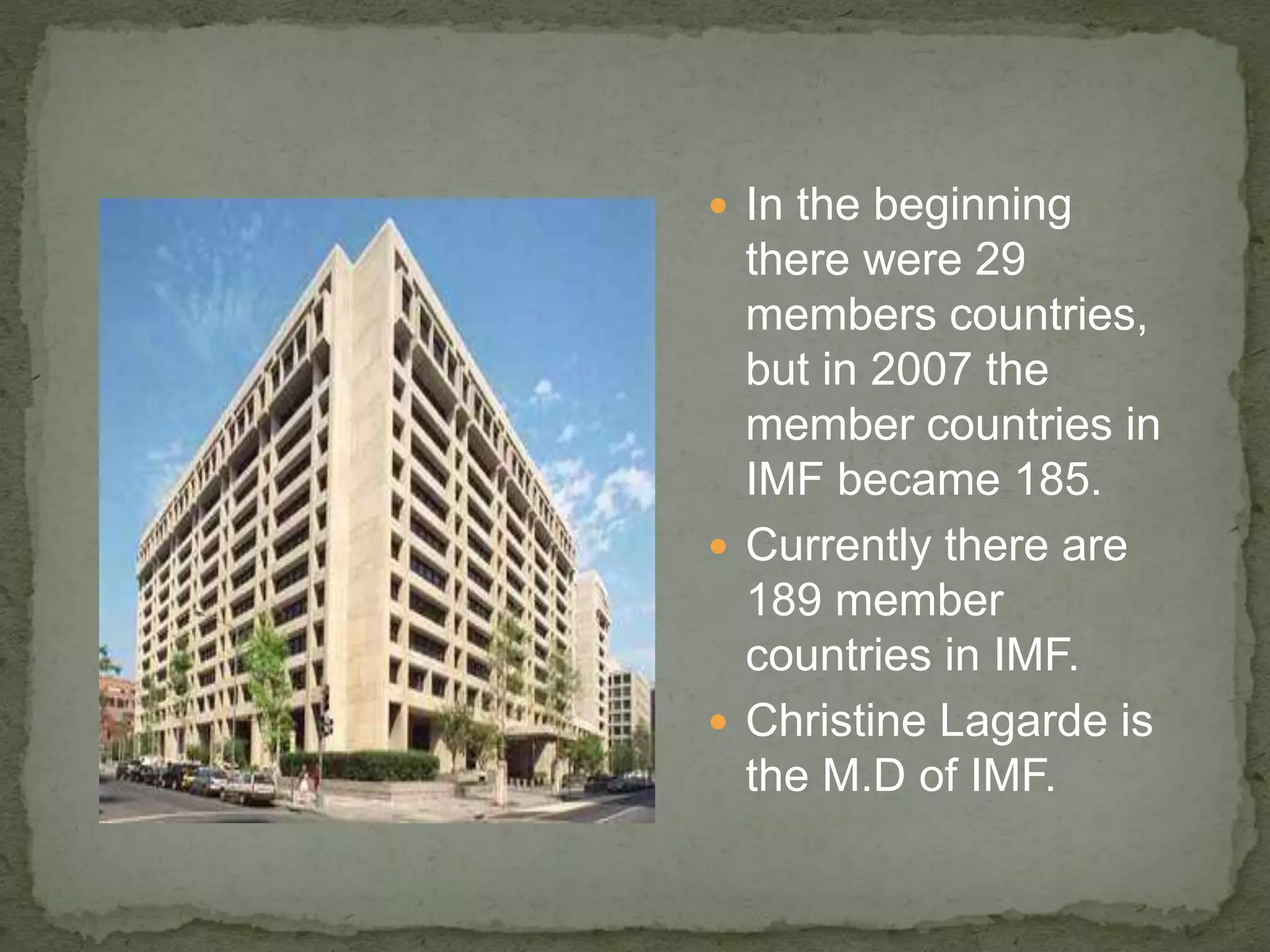
IMF headquarter is in Washington D.C.,
US.
 In the beginning
there were 29
members countries,
but in 2007 the
member countries in
IMF became 185.
 Currently there are
189 member
countries in IMF.
 Christine Lagarde is
the M.D of IMF.
Christine Lagarde, M.D IMF
 IMF was founded on 27th December 1945 after Bretton
woods conference in New Hampshire (U.S). During
the closing years of world war 2 different countries
realized that there must be a common International
forum for achieving economic cooperation, promoting
international trade & providing help to needy nations
during emergency.
 To remedy the adverse effects of world war 2 on the
global economy Bretton woods conference was held in
1945 in U.S.
 It was attended by members of 44 countries including
India.
 It was decided in this conference to setup IMF for
economic development of all countries.
 To provide International monetary cooperation.
 To establish a system of multilateral payments.
 To maintain stability in rate of exchange.
 To provide aid to members during emergency.
 To promote balanced economic development.
 It provide a mechanism for improving short term
balance of payments (BoP).
 It provide machinery for international consultations.
 Technical Assistance
 Imparts training
 Provide various facilities during emergency.
 It serve as a short term credit institution.
 Determine exchange rate for every currency.
 Most of the money comes from quota subscriptions.
 Each member nation contributes money when it joins
IMF. The capital resources of funds are subscribed
by various member by way of their respective
quotas.
 Each member country is required to subscribe its
quota partly in gold and partly in its own national
currency.
 SDR is an invented currency. Its value is based on the
worth of worlds 5 major currencies i.e. U.S dollar,
Pound sterling, Euro, Chinese RMB and Japanese yen.
 Countries add SDR to their holding of foreign
currencies. The current SDR reserve is $285 billion.
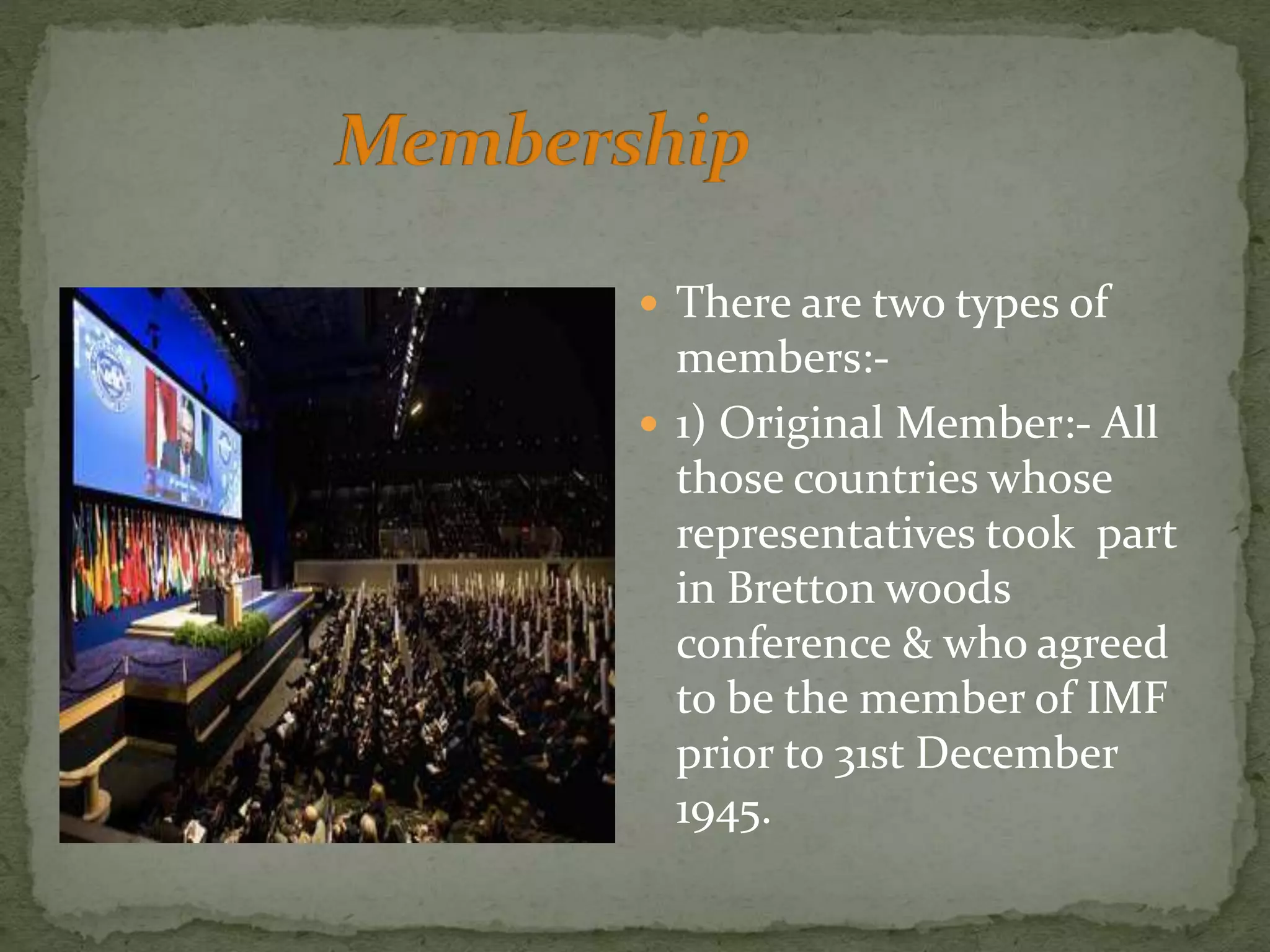
 There are two types of
members:-
 1) Original Member:- All
those countries whose
representatives took part
in Bretton woods
conference & who agreed
to be the member of IMF
prior to 31st December
1945.
 2) Ordinary member:- All those countries who became its
member subsequently are called Ordinary members.
 Any country can be its member after giving a notice in
writing to that effect. IMF can terminate the membership
of such a country which does not observe its rules.
 International monetary cooperation.
 Reconstruction of European countries especially
European Union.
 Multilateral system of foreign payments.
 Increase in International trade.
 Easiness & flexibility in making international
payments.
 Lack of stability in exchange rate.
 Lack of stability in the price of gold.
 Inability to remove restriction on foreign trade.
 Inability to tackle monetary crisis.
 Interference in domestic economies.
 India is a founder
member of IMF. Earlier
India was a permanent
executive director of the
board of governors.
 At present India is no
longer a permanent
director in board. India is
now an elected member
of IMF.
 Facility of foreign exchange
 Freedom from British pound
 Membership of work bank
 Economic consultation
 Help in foreign exchange crisis
 Special Drawing Rights
 The IMF works to foster global and economic stability.
It provides policy advice and financing to members in
economic difficulties and also with developing nations
to help then achieve macroeconomic stability and
reduce poverty.
INTERNATIONAL MONETARY FUND

INTERNATIONAL MONETARY FUND

  • 1.
  • 2.
    The IMF isan intergovernmental institution established by an international treaty in 1945 to create a framework for international economic cooperation, focusing on balance of payment problem & stability of currencies. IMF headquarter is in Washington D.C., US.
  • 3.
     In thebeginning there were 29 members countries, but in 2007 the member countries in IMF became 185.  Currently there are 189 member countries in IMF.  Christine Lagarde is the M.D of IMF.
  • 4.
  • 5.
     IMF wasfounded on 27th December 1945 after Bretton woods conference in New Hampshire (U.S). During the closing years of world war 2 different countries realized that there must be a common International forum for achieving economic cooperation, promoting international trade & providing help to needy nations during emergency.
  • 6.
     To remedythe adverse effects of world war 2 on the global economy Bretton woods conference was held in 1945 in U.S.  It was attended by members of 44 countries including India.  It was decided in this conference to setup IMF for economic development of all countries.
  • 7.
     To provideInternational monetary cooperation.  To establish a system of multilateral payments.  To maintain stability in rate of exchange.  To provide aid to members during emergency.  To promote balanced economic development.
  • 8.
     It providea mechanism for improving short term balance of payments (BoP).  It provide machinery for international consultations.  Technical Assistance  Imparts training  Provide various facilities during emergency.  It serve as a short term credit institution.  Determine exchange rate for every currency.
  • 9.
     Most ofthe money comes from quota subscriptions.  Each member nation contributes money when it joins IMF. The capital resources of funds are subscribed by various member by way of their respective quotas.  Each member country is required to subscribe its quota partly in gold and partly in its own national currency.
  • 10.
     SDR isan invented currency. Its value is based on the worth of worlds 5 major currencies i.e. U.S dollar, Pound sterling, Euro, Chinese RMB and Japanese yen.  Countries add SDR to their holding of foreign currencies. The current SDR reserve is $285 billion.
  • 11.
     There aretwo types of members:-  1) Original Member:- All those countries whose representatives took part in Bretton woods conference & who agreed to be the member of IMF prior to 31st December 1945.
  • 12.
     2) Ordinarymember:- All those countries who became its member subsequently are called Ordinary members.  Any country can be its member after giving a notice in writing to that effect. IMF can terminate the membership of such a country which does not observe its rules.
  • 13.
     International monetarycooperation.  Reconstruction of European countries especially European Union.  Multilateral system of foreign payments.  Increase in International trade.  Easiness & flexibility in making international payments.
  • 14.
     Lack ofstability in exchange rate.  Lack of stability in the price of gold.  Inability to remove restriction on foreign trade.  Inability to tackle monetary crisis.  Interference in domestic economies.
  • 15.
     India isa founder member of IMF. Earlier India was a permanent executive director of the board of governors.  At present India is no longer a permanent director in board. India is now an elected member of IMF.
  • 16.
     Facility offoreign exchange  Freedom from British pound  Membership of work bank  Economic consultation  Help in foreign exchange crisis  Special Drawing Rights
  • 17.
     The IMFworks to foster global and economic stability. It provides policy advice and financing to members in economic difficulties and also with developing nations to help then achieve macroeconomic stability and reduce poverty.