Presentation on world bank 
Presented By 
GIRIDHAR KATTI 
MBA-12-10 
Central University of Karnataka
The World Bank (WB) 
The World Bank is an international financial 
institution that provides financial and technical 
assistance to developing countries for 
development programs 
Headquarters: 
Washington, DC, and more than 100 country 
offices 
Established: 
July 1, 1944 during a conference of 44 
countries in Bretton Woods, 
WB mission is to 
Reduce poverty in the globe 
Improve the living standard
The World Bank (WB) 
WB provides low-interest loans, interest-free credit 
and grants (Grants are designed to facilitate 
development projects by encouraging innovation, co-operation 
between organizations and local 
stakeholders’ participation in projects) to developing 
countries 
These loans are for education, health, infrastructure, 
communications and many other purposes. 
Unlike other financial institutions, WB does not 
operate for profit.
Objective and Function 
Provide assistance to developing countries 
Promote the economic development of the world's 
poorer countries 
Finance the poorest developing countries whose per 
capita GNP is less than $865 a year special financial 
assistance through the International Development 
Association (IDA).
The Bank offers two basic types of 
loans: 
Investment loans: Support of economic 
and social development projects 
Development policy loans: Quick 
disbursing finance to support countries
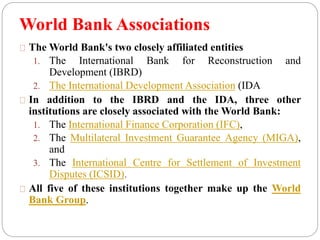
World Bank Associations 
TheWorld Bank's two closely affiliated entities 
1. The International Bank for Reconstruction and 
Development (IBRD) 
2. The International Development Association (IDA 
In addition to the IBRD and the IDA, three other 
institutions are closely associated with theWorld Bank: 
1. The International Finance Corporation (IFC), 
2. The Multilateral Investment Guarantee Agency (MIGA), 
and 
3. The International Centre for Settlement of Investment 
Disputes (ICSID). 
All five of these institutions together make up the World 
Bank Group.
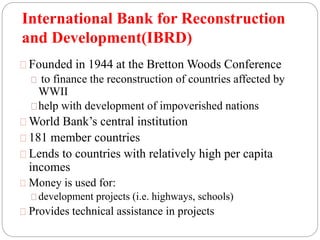
International Bank for Reconstruction 
and Development(IBRD) 
Founded in 1944 at the Bretton Woods Conference 
to finance the reconstruction of countries affected by 
WWII 
help with development of impoverished nations 
World Bank’s central institution 
181 member countries 
Lends to countries with relatively high per capita 
incomes 
Money is used for: 
development projects (i.e. highways, schools) 
Provides technical assistance in projects
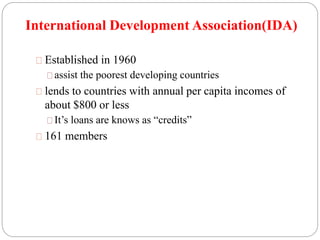
International Development Association(IDA) 
Established in 1960 
assist the poorest developing countries 
lends to countries with annual per capita incomes of 
about $800 or less 
It’s loans are knows as “credits” 
161 members
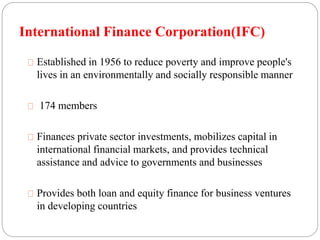
International Finance Corporation(IFC) 
Established in 1956 to reduce poverty and improve people's 
lives in an environmentally and socially responsible manner 
174 members 
Finances private sector investments, mobilizes capital in 
international financial markets, and provides technical 
assistance and advice to governments and businesses 
Provides both loan and equity finance for business ventures 
in developing countries
Multilateral Investment Guarantee Agency(MIGA) 
Established in 1988 
Helps developing countries attract foreign 
investment 
Provides investment marketing services and legal 
advisory services to its members 
152 members
International Center for the Settlement of 
Investment Disputes(ICSID) 
Established in 1966 to promote increased flow of 
international investment 
Provides facilities for the reconciliation of disputes 
between governments and foreign investors 
131 members
The World Bank (WB) 
WB focuses on achievement of the Millennium 
Development Goals that call for the elimination of 
poverty and sustained development. 
Millennium Development Goals based on Five key factors: 
Build capacity 
Infrastructure creation 
Development of Financial Systems 
Combating corruption 
Research, Consultancy and Training.
Areas of operation 
Agriculture and Rural 
Development 
Conflict and Development 
Development Operations and 
Activities 
Economic Policy 
Education 
Energy 
Environment 
Financial Sector 
Gender 
Governance 
Health, Nutrition and 
Population 
Industry 
Information and 
Communication Technologies 
Information, Computing and 
Telecommunications 
International Economics and 
Trade 
Labor and Social Protections 
Law and Justice 
Macroeconomic and Economic 
Growth 
Mining 
Poverty Reduction 
Poverty 
Private Sector 
Public Sector Governance 
Rural Development 
Social Development 
Social Protection 
Trade 
Transport 
Urban Development 
Water Resources 
Water Supply and Sanitation
How is World Bank Run? 
The World Bank is like a cooperative, where its 184 member 
countries are shareholders. The shareholders are represented by a 
Board of Governors, who are the ultimate policy makers at the 
World Bank. 
The governors are member countries' ministers of finance or 
ministers of development. 
They meet once a year at the Annual Meetings of the Boards of 
Governors of the World Bank Group and the International 
Monetary Fund. 
Because the governors only meet annually, they delegate specific 
duties to 24 Executive Directors, who work on-site at the bank.
How is World Bank Run? 
The five largest shareholders, France, Germany, 
Japan, the United Kingdom and the United States 
appoint an executive director, 
The other member countries are represented by 19 
executive directors. 
The President is elected by the Board of Governors for a five-year, 
renewable term.
How is World Bank Run? 
The executive directors make the boards of directors of 
the world bank. 
They normally meet at least twice a week to oversee the 
bank's business, 
Including approval of loans and 
Approve guarantees, 
New policies, 
Country assistance strategies and borrowing and financial 
decisions. 
The world bank operates day-to-day under the leadership 
and direction of the president, management and senior 
staff, and the vice presidents in charge of regions, sectors, 
networks and functions
Where Does the Money Come from to Operate the 
World Bank 
IBRD lending to developing countries is primarily financed by 
selling AAA-rated bonds in the world's financial markets. 
The greater proportion of its income comes from lending out its own 
capital. 
This capital consists of reserves built up over the years and money 
paid in from the bank's 184 member country shareholders. 
IBRD’s income also pays for world bank operating expenses and has 
contributed to IDA and debt relief.
CONT… 
IDA is the world's largest source of interest-free 
loans and grant assistance to the poorest countries. 
This source is replenished every three years by 40 
donor countries. 
Additional funds are regenerated through 
repayments of 
loan principal on 35-to-40-year, 
no-interest loans, which are then available for re-lending. 
IDA accounts for nearly 40% of our lending
What is World Bank Now? 
Last year, the World Bank provided $23.6 billion for 
279 projects in developing countries worldwide, with 
the financial and/or technical expertise aimed at 
helping those countries reduce poverty. 
The bank is currently involved in more than 1,800 
projects in virtually every sector and developing 
country. 
There are more than 63,000 donor-funded 
development projects worldwide, each governed by 
countless demands, guidelines and procedures 
designed to protect the project and ensure that aid gets 
to the poor.
Summary 
Since inception in 1944, the World Bank has expanded from a 
single institution to a closely associated group of five 
development institutions. 
Our mission evolved from the IBRD as facilitator of post-war 
reconstruction and development to the present day mandate of 
worldwide poverty alleviation in conjunction with our affiliate, 
the International Development Association. 
Once we had a homogeneous staff of engineers and financial 
analysts, based solely in Washington, DC. Today, we have a 
multidisciplinary and diverse staff that includes economists, 
public policy experts, sector experts and social scientists, and 
30% of our staff is now based in country offices.
Summary 
Reconstruction remains an important focus of our 
work, given the natural disasters and post conflict 
rehabilitation needs that affect developing and 
transition economies. 
We have, however, broadened our portfolio's focus to 
include social sector lending projects, poverty 
alleviation, debt relief and good governance. At 
today's World Bank, we have sharpened our focus on 
poverty reduction as the overarching goal of all our 
work. 
For more on the world bank visit: 
www.worldbank.org
PPT On World bank

PPT On World bank

  • 1.
    Presentation on worldbank Presented By GIRIDHAR KATTI MBA-12-10 Central University of Karnataka
  • 2.
    The World Bank(WB) The World Bank is an international financial institution that provides financial and technical assistance to developing countries for development programs Headquarters: Washington, DC, and more than 100 country offices Established: July 1, 1944 during a conference of 44 countries in Bretton Woods, WB mission is to Reduce poverty in the globe Improve the living standard
  • 3.
    The World Bank(WB) WB provides low-interest loans, interest-free credit and grants (Grants are designed to facilitate development projects by encouraging innovation, co-operation between organizations and local stakeholders’ participation in projects) to developing countries These loans are for education, health, infrastructure, communications and many other purposes. Unlike other financial institutions, WB does not operate for profit.
  • 4.
    Objective and Function Provide assistance to developing countries Promote the economic development of the world's poorer countries Finance the poorest developing countries whose per capita GNP is less than $865 a year special financial assistance through the International Development Association (IDA).
  • 5.
    The Bank offerstwo basic types of loans: Investment loans: Support of economic and social development projects Development policy loans: Quick disbursing finance to support countries
  • 6.
    World Bank Associations TheWorld Bank's two closely affiliated entities 1. The International Bank for Reconstruction and Development (IBRD) 2. The International Development Association (IDA In addition to the IBRD and the IDA, three other institutions are closely associated with theWorld Bank: 1. The International Finance Corporation (IFC), 2. The Multilateral Investment Guarantee Agency (MIGA), and 3. The International Centre for Settlement of Investment Disputes (ICSID). All five of these institutions together make up the World Bank Group.
  • 7.
    International Bank forReconstruction and Development(IBRD) Founded in 1944 at the Bretton Woods Conference to finance the reconstruction of countries affected by WWII help with development of impoverished nations World Bank’s central institution 181 member countries Lends to countries with relatively high per capita incomes Money is used for: development projects (i.e. highways, schools) Provides technical assistance in projects
  • 8.
    International Development Association(IDA) Established in 1960 assist the poorest developing countries lends to countries with annual per capita incomes of about $800 or less It’s loans are knows as “credits” 161 members
  • 9.
    International Finance Corporation(IFC) Established in 1956 to reduce poverty and improve people's lives in an environmentally and socially responsible manner 174 members Finances private sector investments, mobilizes capital in international financial markets, and provides technical assistance and advice to governments and businesses Provides both loan and equity finance for business ventures in developing countries
  • 10.
    Multilateral Investment GuaranteeAgency(MIGA) Established in 1988 Helps developing countries attract foreign investment Provides investment marketing services and legal advisory services to its members 152 members
  • 11.
    International Center forthe Settlement of Investment Disputes(ICSID) Established in 1966 to promote increased flow of international investment Provides facilities for the reconciliation of disputes between governments and foreign investors 131 members
  • 12.
    The World Bank(WB) WB focuses on achievement of the Millennium Development Goals that call for the elimination of poverty and sustained development. Millennium Development Goals based on Five key factors: Build capacity Infrastructure creation Development of Financial Systems Combating corruption Research, Consultancy and Training.
  • 13.
    Areas of operation Agriculture and Rural Development Conflict and Development Development Operations and Activities Economic Policy Education Energy Environment Financial Sector Gender Governance Health, Nutrition and Population Industry Information and Communication Technologies Information, Computing and Telecommunications International Economics and Trade Labor and Social Protections Law and Justice Macroeconomic and Economic Growth Mining Poverty Reduction Poverty Private Sector Public Sector Governance Rural Development Social Development Social Protection Trade Transport Urban Development Water Resources Water Supply and Sanitation
  • 14.
    How is WorldBank Run? The World Bank is like a cooperative, where its 184 member countries are shareholders. The shareholders are represented by a Board of Governors, who are the ultimate policy makers at the World Bank. The governors are member countries' ministers of finance or ministers of development. They meet once a year at the Annual Meetings of the Boards of Governors of the World Bank Group and the International Monetary Fund. Because the governors only meet annually, they delegate specific duties to 24 Executive Directors, who work on-site at the bank.
  • 15.
    How is WorldBank Run? The five largest shareholders, France, Germany, Japan, the United Kingdom and the United States appoint an executive director, The other member countries are represented by 19 executive directors. The President is elected by the Board of Governors for a five-year, renewable term.
  • 16.
    How is WorldBank Run? The executive directors make the boards of directors of the world bank. They normally meet at least twice a week to oversee the bank's business, Including approval of loans and Approve guarantees, New policies, Country assistance strategies and borrowing and financial decisions. The world bank operates day-to-day under the leadership and direction of the president, management and senior staff, and the vice presidents in charge of regions, sectors, networks and functions
  • 17.
    Where Does theMoney Come from to Operate the World Bank IBRD lending to developing countries is primarily financed by selling AAA-rated bonds in the world's financial markets. The greater proportion of its income comes from lending out its own capital. This capital consists of reserves built up over the years and money paid in from the bank's 184 member country shareholders. IBRD’s income also pays for world bank operating expenses and has contributed to IDA and debt relief.
  • 18.
    CONT… IDA isthe world's largest source of interest-free loans and grant assistance to the poorest countries. This source is replenished every three years by 40 donor countries. Additional funds are regenerated through repayments of loan principal on 35-to-40-year, no-interest loans, which are then available for re-lending. IDA accounts for nearly 40% of our lending
  • 19.
    What is WorldBank Now? Last year, the World Bank provided $23.6 billion for 279 projects in developing countries worldwide, with the financial and/or technical expertise aimed at helping those countries reduce poverty. The bank is currently involved in more than 1,800 projects in virtually every sector and developing country. There are more than 63,000 donor-funded development projects worldwide, each governed by countless demands, guidelines and procedures designed to protect the project and ensure that aid gets to the poor.
  • 20.
    Summary Since inceptionin 1944, the World Bank has expanded from a single institution to a closely associated group of five development institutions. Our mission evolved from the IBRD as facilitator of post-war reconstruction and development to the present day mandate of worldwide poverty alleviation in conjunction with our affiliate, the International Development Association. Once we had a homogeneous staff of engineers and financial analysts, based solely in Washington, DC. Today, we have a multidisciplinary and diverse staff that includes economists, public policy experts, sector experts and social scientists, and 30% of our staff is now based in country offices.
  • 21.
    Summary Reconstruction remainsan important focus of our work, given the natural disasters and post conflict rehabilitation needs that affect developing and transition economies. We have, however, broadened our portfolio's focus to include social sector lending projects, poverty alleviation, debt relief and good governance. At today's World Bank, we have sharpened our focus on poverty reduction as the overarching goal of all our work. For more on the world bank visit: www.worldbank.org