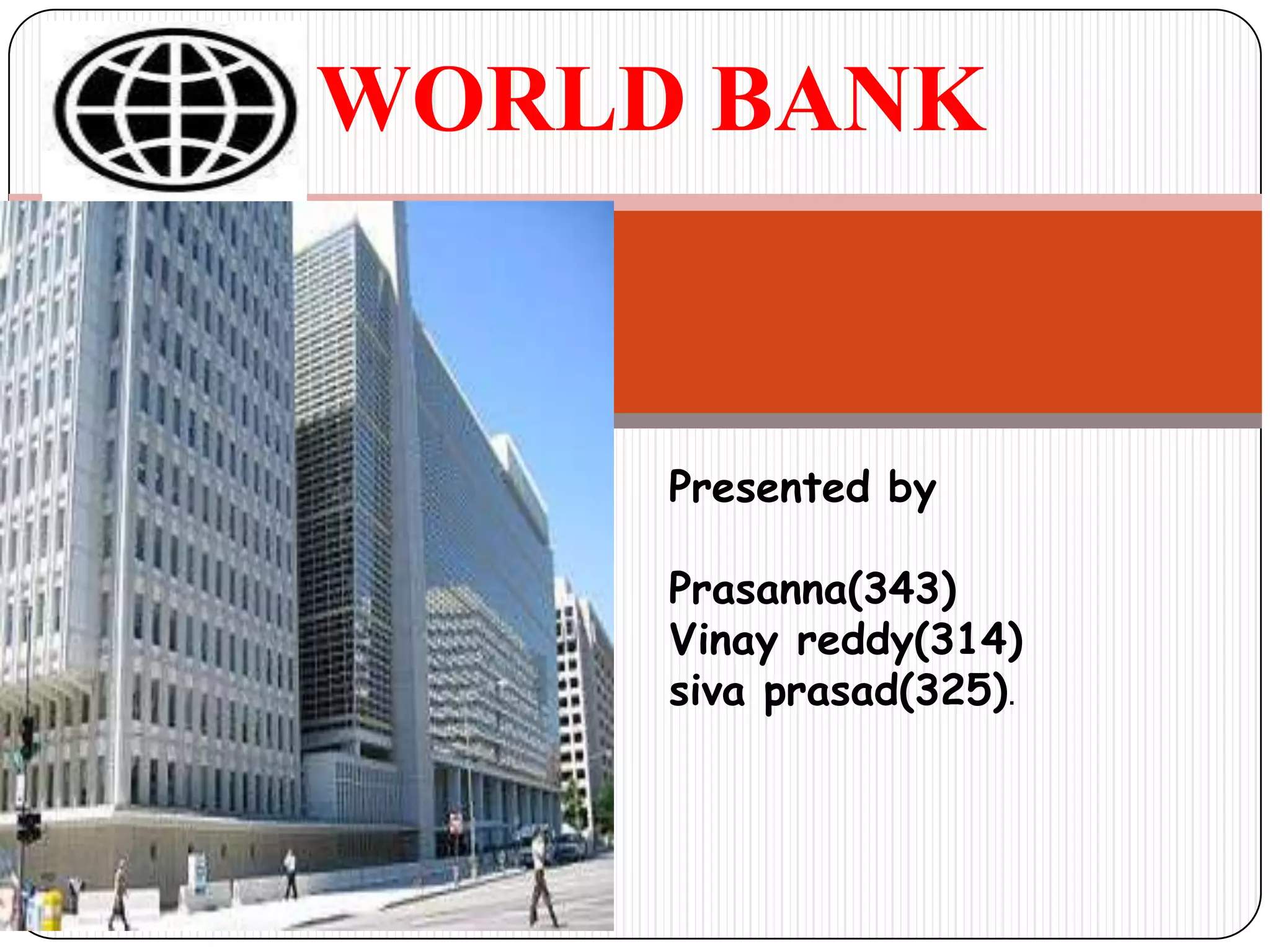
WORLD BANK

Presented by
Prasanna(343)
Vinay reddy(314)
siva prasad(325).
AGENDA
 WORLD BANK INTRODUCTION

 WORLD BANK MISSION
 HISTORY
 MEMBERSHIP OF WORLD BANK
 NEED OF WORLD BANK

 OPERATIONS
 AREA OF OPERATIONS
 SUPPORT TO INDIA
 5 PRIORTIES OF WORLD BANK
 INTERNATIONAL MONETARY FUND
 DIFFERENCE BETWEEN IMF & WORLD BANK
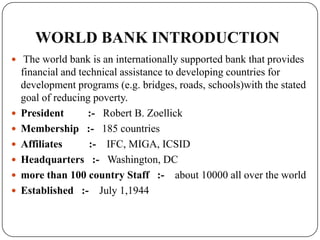
WORLD BANK INTRODUCTION
 The world bank is an internationally supported bank that provides








financial and technical assistance to developing countries for
development programs (e.g. bridges, roads, schools)with the stated
goal of reducing poverty.
President
:- Robert B. Zoellick
Membership :- 185 countries
Affiliates
:- IFC, MIGA, ICSID
Headquarters :- Washington, DC
more than 100 country Staff :- about 10000 all over the world
Established :- July 1,1944
WORLD BANK MISSION
HISTORY
 The world bank is one of the two Breton Woods Institutions which were











created in 1944 to rebuild a war torn Europe after World War II .
Since inception in 1944, the World Bank has expanded from a single
institution to a closely associated group of five development institutions.
Their mission evolved from the International Bank for Reconstruction and
Development (IBRD)
Development to the present-day mandate of worldwide poverty alleviation in
close coordination with their affiliate.
the International Development Association, and other members of the World
Bank Groups
International Bank of Reconstruction and development (IBRD)
International Development Association(IDA)
International Finance Corporation(IFC)
Multilateral Investment Guarantee Agency(MIGA)
International Centre for Settlement of Investment Disputes
Membership of world bank
 The organizations that make up the World Bank Group are owned by

the governments of member nations, which have the ultimate decisionmaking power within the organizations on all matters, including policy,
financial or membership issues.
 Member countries govern the World Bank Group through the Boards of
Governors and the Boards of Executive Directors. These bodies make
all major decisions for the organizations.
 To become a member of the Bank, under the IBRD Articles of
Agreement, a country must first join the International Monetary
Fund (IMF). Membership in IDA, IFC and MIGA are conditional on
membership in IBRD.
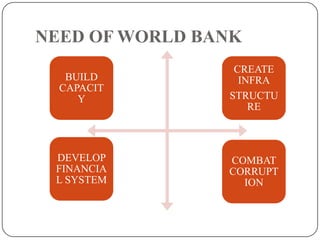
NEED OF WORLD BANK
BUILD
CAPACIT
Y

CREATE
INFRA
STRUCTU
RE

DEVELOP
FINANCIA
L SYSTEM

COMBAT
CORRUPT
ION
OPERATIONS
 Fund generation
 Grants
 Analytic & Advisory Services
 Capacity building
 Granting reconstruction & development loans
 Providing loans to governments & private concerns
 Promoting foreign investment
 Providing technical, economic and monetary advice
 Encouraging industrial development
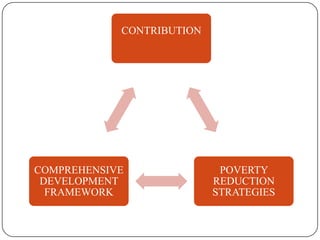
CONTRIBUTION

COMPREHENSIVE
DEVELOPMENT
FRAMEWORK

POVERTY
REDUCTION
STRATEGIES
AREA OF OPERATION
 Agriculture and Rural Development
 Economic policy
 Education
 Energy
 Environment
 Financial sector
 Health, nutrition and population industry
 Information, computing and telecommunication
 Law and justice
 Private sector
 Social protection

 Trade
 Water resources
 Water supply and sanitation
SUPPORT TO INDIA
 India is home to over one-quarter of the world’s poor,

and the World Bank Group is focused on sharing best
practices as well as financing for development as a part
of its mission to help reduce global poverty.
5 PRIORITIES OF WORLD BANK
 World bank provides the largest external funds for education.
 It is a big support in reducing poverty.
 It provides fund for biodiversity projects.
 it helps to bring clean water, electricity, and transport to poor

people.
 It helps in controlling emerging conflicts.
IMF- International Monetary Fund
 Roles Of IMF:
• Tracks global economic trends and performance
• Alerts its member countries
• Provides a forum for policy dialogue
• Provides policy advice and financing to members
 Objectives:
• To provide the global public good of financial stability

• Facilitate the growth of international trade, thus promoting job creation,

economic growth, and poverty reduction
• Promote exchange rate stability and an open system of international
payments
• Lend countries foreign exchange when needed, on a temporary basis and
under adequate safeguards, to help them address balance of payments
problems
IMF’s 9 Functional Departments
 External Relations Department
 Finance Department
 IMF Institute
 Legal Department
 Monetary and Capital Markets Department
 Research Department
 Statistics Department
 Strategy, Policy, and Review Department
Difference Between IMF & World
Bank
 The International Monetary Fund
 Oversees the international monetary system

 Promotes exchange stability and orderly exchange relations among its







member countries
Assists all members--both industrial and developing countries--that find
themselves in temporary balance of payments difficulties by providing
short- to medium-term credits
Draws its financial resources principally from the quota subscriptions
of its member countries
Has at its disposal fully paid-in quotas now totaling SDR 145 billion
(about $215 billion)
Has a staff of 2,300 drawn from 182 member countries
Cont.….
 World Bank
 Seeks to promote the economic development of the world's poorer countries

 Assists developing countries through long-term financing of development projects

and programs
 Provides to the poorest developing countries whose per capita GNP is less than $865

a year special financial assistance through the international development association
(IDA)
 Acquires most of its financial resources by borrowing on the international bond

market
 Has an authorized capital of $184 billion, of which members pay in about 10 percent
 Has a staff of 7,000 drawn from 180 member countries
World bank.

World bank.

  • 1.
    WORLD BANK Presented by Prasanna(343) Vinayreddy(314) siva prasad(325).
  • 2.
    AGENDA  WORLD BANKINTRODUCTION  WORLD BANK MISSION  HISTORY  MEMBERSHIP OF WORLD BANK  NEED OF WORLD BANK  OPERATIONS  AREA OF OPERATIONS  SUPPORT TO INDIA  5 PRIORTIES OF WORLD BANK  INTERNATIONAL MONETARY FUND  DIFFERENCE BETWEEN IMF & WORLD BANK
  • 3.
    WORLD BANK INTRODUCTION The world bank is an internationally supported bank that provides       financial and technical assistance to developing countries for development programs (e.g. bridges, roads, schools)with the stated goal of reducing poverty. President :- Robert B. Zoellick Membership :- 185 countries Affiliates :- IFC, MIGA, ICSID Headquarters :- Washington, DC more than 100 country Staff :- about 10000 all over the world Established :- July 1,1944
  • 4.
  • 5.
    HISTORY  The worldbank is one of the two Breton Woods Institutions which were          created in 1944 to rebuild a war torn Europe after World War II . Since inception in 1944, the World Bank has expanded from a single institution to a closely associated group of five development institutions. Their mission evolved from the International Bank for Reconstruction and Development (IBRD) Development to the present-day mandate of worldwide poverty alleviation in close coordination with their affiliate. the International Development Association, and other members of the World Bank Groups International Bank of Reconstruction and development (IBRD) International Development Association(IDA) International Finance Corporation(IFC) Multilateral Investment Guarantee Agency(MIGA) International Centre for Settlement of Investment Disputes
  • 6.
    Membership of worldbank  The organizations that make up the World Bank Group are owned by the governments of member nations, which have the ultimate decisionmaking power within the organizations on all matters, including policy, financial or membership issues.  Member countries govern the World Bank Group through the Boards of Governors and the Boards of Executive Directors. These bodies make all major decisions for the organizations.  To become a member of the Bank, under the IBRD Articles of Agreement, a country must first join the International Monetary Fund (IMF). Membership in IDA, IFC and MIGA are conditional on membership in IBRD.
  • 7.
    NEED OF WORLDBANK BUILD CAPACIT Y CREATE INFRA STRUCTU RE DEVELOP FINANCIA L SYSTEM COMBAT CORRUPT ION
  • 8.
    OPERATIONS  Fund generation Grants  Analytic & Advisory Services  Capacity building  Granting reconstruction & development loans  Providing loans to governments & private concerns  Promoting foreign investment  Providing technical, economic and monetary advice  Encouraging industrial development
  • 9.
  • 10.
    AREA OF OPERATION Agriculture and Rural Development  Economic policy  Education  Energy  Environment  Financial sector  Health, nutrition and population industry  Information, computing and telecommunication  Law and justice  Private sector  Social protection  Trade  Water resources  Water supply and sanitation
  • 11.
    SUPPORT TO INDIA India is home to over one-quarter of the world’s poor, and the World Bank Group is focused on sharing best practices as well as financing for development as a part of its mission to help reduce global poverty.
  • 12.
    5 PRIORITIES OFWORLD BANK  World bank provides the largest external funds for education.  It is a big support in reducing poverty.  It provides fund for biodiversity projects.  it helps to bring clean water, electricity, and transport to poor people.  It helps in controlling emerging conflicts.
  • 13.
    IMF- International MonetaryFund  Roles Of IMF: • Tracks global economic trends and performance • Alerts its member countries • Provides a forum for policy dialogue • Provides policy advice and financing to members  Objectives: • To provide the global public good of financial stability • Facilitate the growth of international trade, thus promoting job creation, economic growth, and poverty reduction • Promote exchange rate stability and an open system of international payments • Lend countries foreign exchange when needed, on a temporary basis and under adequate safeguards, to help them address balance of payments problems
  • 14.
    IMF’s 9 FunctionalDepartments  External Relations Department  Finance Department  IMF Institute  Legal Department  Monetary and Capital Markets Department  Research Department  Statistics Department  Strategy, Policy, and Review Department
  • 15.
    Difference Between IMF& World Bank  The International Monetary Fund  Oversees the international monetary system  Promotes exchange stability and orderly exchange relations among its     member countries Assists all members--both industrial and developing countries--that find themselves in temporary balance of payments difficulties by providing short- to medium-term credits Draws its financial resources principally from the quota subscriptions of its member countries Has at its disposal fully paid-in quotas now totaling SDR 145 billion (about $215 billion) Has a staff of 2,300 drawn from 182 member countries
  • 16.
    Cont.….  World Bank Seeks to promote the economic development of the world's poorer countries  Assists developing countries through long-term financing of development projects and programs  Provides to the poorest developing countries whose per capita GNP is less than $865 a year special financial assistance through the international development association (IDA)  Acquires most of its financial resources by borrowing on the international bond market  Has an authorized capital of $184 billion, of which members pay in about 10 percent  Has a staff of 7,000 drawn from 180 member countries