The Liturgies of Passion (Palm) Sunday,  The Chrism Mass,  Holy Thursday and Good Friday A Grief Observed
Introduction Lent: Forty Days of Preparation Points toward Baptism & reminds those already baptized of its benefits. Holy Week   Follows upon Lent Reenacts, relives, participates in the Passion (the suffering, death and resurrection) of Christ Palm Sunday, followed by the  Easter Triduum : Holy Thursday, Good Friday, Holy Saturday/ Easter Sunday
Passion (Palm) Sunday
Introduction Palm Sunday as part of Holy Week Focus Different layers OT prophecy Expectation of the Jews Expectation of the Disciples Mind of Jesus Our Expectations
History Significance of Palm branches Ancient times: symbol of victory and triumph New Testament: symbol of martyrdom Psalm 91 – represents Paradise Fourth century – symbol of Resurrection    [foinix & phoenix]
History 1 st  century – one of 12 Major Feasts 5 th  century – practiced in Jerusalem Circa  600 AD – name of Palm Sunday 8 th  century – Rite of Blessing of Palms Middle Ages – Procession of Palms 1955 – Complete reform of Holy Week
Liturgical Matters Paradox  – desolation and exaltation Kenosis  – key to understanding paradox Assembly – threshold nature Procession – journey with Jesus Ending – open ended
Readings Sequence of events Gospel before Procession with Palms: Mark 11:1-10  First Reading: Isaiah 50:4-7 [3 rd  servant song] Second Reading: Philippians 2:6-11 [ carmina christi ] Gospel: Mark 15:1-39
First Reading The third “servant song:” discipleship, teaching Sufferings: overcome by meekness & faith Our struggles = Christ’s Trust in God in the midst of distress Solidarity with marginalized
Second Reading Carmina Christi:  An ancient liturgical hymn of the Judeo-Christian Church v.6  Divine Pre-existence v.7  Humiliation of Incarnation v.8  Humiliation of Death v.9  Celestial Exaltation v.10  Adoration by the Universe v.11 Jesus’ New Title:  Kyrios Kenosis  (Greek – “emptying out”) Thankfulness The story of Holy Week in miniature
Gospel (Mark) Mark’s story (written for persecuted Christians) resonates with the feast  God’s presence is a great discovery Trust Conversion
Tuesday of Holy Week: The Chrism Mass
History & Tradition Origin of Chrism Mass Blessed Oil already used for Baptismal ritual in Third Century Blessing reserved for bishops Baptism on Easter Vigil. Practical to consecrate oil on Holy Thursday In 13 th  Century, priests began to join in prayers of blessings with bishops
History & Tradition By the 20 th  Century, many dioceses were moving the Chrism Mass to Tuesday or Wednesday of Holy Week to allow more priests and others to be present. Part of the Chrism Mass became a renewal act whereby the priest dedicated himself to Christ and promised that he would carry out his priestly duties, as "an expression of the communion between the priests and their bishop." 
The Chrism Mass The role of the bishop as the high priest of his flock, and source of unity for the ministers of the entire diocese.  The blessing of oils for liturgical use:  The Oil of Catechumens  (for Baptisms),  The Sacred Chrism  (for Baptisms, Confirmation, Holy Orders and consecrations), and  The Oil of the Infirm  (for Anointing of the Sick). A celebration of the institution of priesthood.
The Chrism Mass The renewal of commitment of ordained ministers (priests and deacons) to service.  The importance of the “priesthood of all believers.”  The gathering of the entire diocese in the Cathedral.
Holy Thursday (Based on a presentation by Rev. Joseph Koh, O.F.M.)
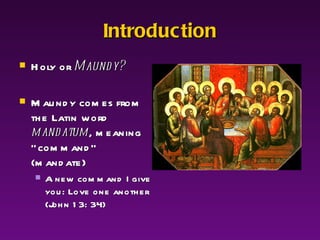
Introduction Holy or  Maundy? Maundy comes from the Latin word  mandatum , meaning “command” (mandate) A new command I give you: Love one another (John 13: 34)
Introduction The end of Lent, and beginning of the  Paschal Triduum  (three days) True Climax – The Lord’s Supper The Three principal mysteries: The Institution of the Eucharist The Establishment of Christian Priesthood The Commandment to Love One Another
Biblical References The Last Supper:  Mt 26:20, Mk 14:17, Lk 22:14 The Washing of Feet:  Jn 13:1-17 Institution of the Eucharist:  Mt 26:26-29, Mk 14:22-25, Lk 22:15-20 The Agony & the Arrest:  Mt 26:50-56, Mk 14:46-52, Lk 22:49-54, Jn 18:10-11
History & Tradition Began to take shape  circa  Seventh Century Celebration of two Masses survive: Chrism Mass Evening Mass of the Lord’s Supper
History & Tradition Medieval Times Also known as “Shere Thursday” Men sheared (shaved) beard and cut hair Performed penances throughout Lent Baptism on Thursday
Holy Thursday Readings Washing of Feet Liturgy of the Eucharist Reposition of Blessed Sacrament Stripping of Altar Adoration of Blessed Sacrament
Holy Thursday First Reading: Exodus 12: 1-8, 11-14 The establishment of the first Passover meal Moses and Aaron went to Pharaoh repeatedly  to allow the Israelites to leave Egypt to pray to their God in the desert for three days, but was refused The work of the Lord in the Passover
Holy Thursday First Reading (Con’t)   The command of the Lord for the Israelites to keep this feast To be observed as an ordinance forever Important point to note… A memorial feast is the type of sacrifice that is repeated on a regular basis. A memorial feast DOES NOT simply recall what was once done. It makes the participants  just as present  as the participants in the original sacrifice
Holy Thursday Second Reading: 1 Corinthians 11: 23-26 The Proclamation of the Lord’s Death Participation in the memorial sacrifice that makes the participants present at the first institution   “ This cup is the New Covenant in my Blood” Fulfilling the Old Covenant
Holy Thursday Second Reading (Con’t)   By proclaiming the death of the Lord, we are UNITING ourselves with Him as He celebrates the Last Supper, and then is tried, and later crucified on Calvary
Holy Thursday Gospel: John 13: 1-15 The perfection of Love To serve and NOT to be served Jesus showed by example what love is all about, even to the point of dying on the cross
Holy Thursday Washing of Feet It shows both the worth God ascribes to the humility of service, and the need for cleansing with water (a symbol of baptism) in the  Mandatum , washing, in Jesus' washing the feet of His disciples The hymn  Ubi Caritas  is usually sung at this time (“Where there is charity and love, there God is…”)
Holy Thursday Reposition of the Blessed Sacrament Witnesses to the Church's esteem for Christ's Body present in the consecrated Host The Sacrament will remain "entombed" until the Communion service on Good Friday No Mass will be celebrated in the Church until the Easter Vigil proclaims the Resurrection Only the dying ( Viaticum ) may receive Communion in between Holy Thursday/Good Friday and Good Friday / Easter Vigil
Holy Thursday Stripping of the Altar Recalls the Agony in the Garden, and the arrest and imprisonment of Jesus  Altar bared, crosses removed or covered,  symbolising the moment in the Passion of Christ when He was stripped of His garments   Transformed from the communion table into the tomb slab of Good Friday   Usually done with a bare minimum of ceremony
Holy Thursday Adoration of the Blessed Sacrament Eucharist placed in an altar of repose The Sacrament is  not  exposed in a monstrance, but kept in the  ciborium  (Latin  cibum,  “food”) Silent adoration Answer to Christ's invitation "Could you not, then, watch one hour with me?" (Matt 26:40)
Good Friday
A Remembrance and a Promise The mystery of death and resurrection Fourth century: Easter is historical commemoration Preparation of Catechumens for Baptism at Easter The meaning of the Cross Veneration of the Cross became a custom of the people of Jerusalem  Veneration of the Cross described by pilgrims: Bordeaux in 333 and the Spanish Lady Etheria later in that century  N.B.: Good Friday is a day of  fasting , and  abstinence  from meat, for those aged 14 – 60 and in good health.
The Good Friday Liturgy Good Friday liturgy is from an ancient form Celebrated in a bare Church Cross has either been removed, or is covered  No altar frontal or ornamentation used  Clergy wear albs with red stoles (Red = martyrdom) The presider may wear a cope or chasuble (The Cope is for events outside of Mass) In the Latin Church, the only time the clergy  prostrates  (goes face-down) before the altar all year If Communion is to be distributed, the corporal and chalice are placed on the credence table
Good Friday Readings Isaiah 52:13-53:12 The fourth “servant song" The song begins with the triumph of the servant  Then the triumph of the enemy  The servant is the redeemer of Israel  Commentary
Good Friday Readings Hebrews 4:4-16;5:9 The high priesthood of Jesus  Affirms Jesus’ divinity and humanity  Obedience to the Father  Commentary
Good Friday Readings John 18:1-19:42 Arrest and questioning (18:1-27) Trial before Pilate (18:28-19:16a) Crucifixion, death and burial (19:16b-42) Commentary
Veneration of the Cross The Cross is processed in and revealed (“Behold, the wood of the Cross…) Revealed after a brief time covered Brings the Passion story to a climax Permits individual forms of veneration

Holy Week Liturgies

  • 1.
    The Liturgies ofPassion (Palm) Sunday, The Chrism Mass, Holy Thursday and Good Friday A Grief Observed
  • 2.
    Introduction Lent: FortyDays of Preparation Points toward Baptism & reminds those already baptized of its benefits. Holy Week Follows upon Lent Reenacts, relives, participates in the Passion (the suffering, death and resurrection) of Christ Palm Sunday, followed by the Easter Triduum : Holy Thursday, Good Friday, Holy Saturday/ Easter Sunday
  • 3.
  • 4.
    Introduction Palm Sundayas part of Holy Week Focus Different layers OT prophecy Expectation of the Jews Expectation of the Disciples Mind of Jesus Our Expectations
  • 5.
    History Significance ofPalm branches Ancient times: symbol of victory and triumph New Testament: symbol of martyrdom Psalm 91 – represents Paradise Fourth century – symbol of Resurrection [foinix & phoenix]
  • 6.
    History 1 st century – one of 12 Major Feasts 5 th century – practiced in Jerusalem Circa 600 AD – name of Palm Sunday 8 th century – Rite of Blessing of Palms Middle Ages – Procession of Palms 1955 – Complete reform of Holy Week
  • 7.
    Liturgical Matters Paradox – desolation and exaltation Kenosis – key to understanding paradox Assembly – threshold nature Procession – journey with Jesus Ending – open ended
  • 8.
    Readings Sequence ofevents Gospel before Procession with Palms: Mark 11:1-10 First Reading: Isaiah 50:4-7 [3 rd servant song] Second Reading: Philippians 2:6-11 [ carmina christi ] Gospel: Mark 15:1-39
  • 9.
    First Reading Thethird “servant song:” discipleship, teaching Sufferings: overcome by meekness & faith Our struggles = Christ’s Trust in God in the midst of distress Solidarity with marginalized
  • 10.
    Second Reading CarminaChristi: An ancient liturgical hymn of the Judeo-Christian Church v.6 Divine Pre-existence v.7 Humiliation of Incarnation v.8 Humiliation of Death v.9 Celestial Exaltation v.10 Adoration by the Universe v.11 Jesus’ New Title: Kyrios Kenosis (Greek – “emptying out”) Thankfulness The story of Holy Week in miniature
  • 11.
    Gospel (Mark) Mark’sstory (written for persecuted Christians) resonates with the feast God’s presence is a great discovery Trust Conversion
  • 12.
    Tuesday of HolyWeek: The Chrism Mass
  • 13.
    History & TraditionOrigin of Chrism Mass Blessed Oil already used for Baptismal ritual in Third Century Blessing reserved for bishops Baptism on Easter Vigil. Practical to consecrate oil on Holy Thursday In 13 th Century, priests began to join in prayers of blessings with bishops
  • 14.
    History & TraditionBy the 20 th Century, many dioceses were moving the Chrism Mass to Tuesday or Wednesday of Holy Week to allow more priests and others to be present. Part of the Chrism Mass became a renewal act whereby the priest dedicated himself to Christ and promised that he would carry out his priestly duties, as "an expression of the communion between the priests and their bishop." 
  • 15.
    The Chrism MassThe role of the bishop as the high priest of his flock, and source of unity for the ministers of the entire diocese. The blessing of oils for liturgical use: The Oil of Catechumens (for Baptisms), The Sacred Chrism (for Baptisms, Confirmation, Holy Orders and consecrations), and The Oil of the Infirm (for Anointing of the Sick). A celebration of the institution of priesthood.
  • 16.
    The Chrism MassThe renewal of commitment of ordained ministers (priests and deacons) to service. The importance of the “priesthood of all believers.” The gathering of the entire diocese in the Cathedral.
  • 17.
    Holy Thursday (Basedon a presentation by Rev. Joseph Koh, O.F.M.)
  • 18.
    Introduction Holy or Maundy? Maundy comes from the Latin word mandatum , meaning “command” (mandate) A new command I give you: Love one another (John 13: 34)
  • 19.
    Introduction The endof Lent, and beginning of the Paschal Triduum (three days) True Climax – The Lord’s Supper The Three principal mysteries: The Institution of the Eucharist The Establishment of Christian Priesthood The Commandment to Love One Another
  • 20.
    Biblical References TheLast Supper: Mt 26:20, Mk 14:17, Lk 22:14 The Washing of Feet: Jn 13:1-17 Institution of the Eucharist: Mt 26:26-29, Mk 14:22-25, Lk 22:15-20 The Agony & the Arrest: Mt 26:50-56, Mk 14:46-52, Lk 22:49-54, Jn 18:10-11
  • 21.
    History & TraditionBegan to take shape circa Seventh Century Celebration of two Masses survive: Chrism Mass Evening Mass of the Lord’s Supper
  • 22.
    History & TraditionMedieval Times Also known as “Shere Thursday” Men sheared (shaved) beard and cut hair Performed penances throughout Lent Baptism on Thursday
  • 23.
    Holy Thursday ReadingsWashing of Feet Liturgy of the Eucharist Reposition of Blessed Sacrament Stripping of Altar Adoration of Blessed Sacrament
  • 24.
    Holy Thursday FirstReading: Exodus 12: 1-8, 11-14 The establishment of the first Passover meal Moses and Aaron went to Pharaoh repeatedly to allow the Israelites to leave Egypt to pray to their God in the desert for three days, but was refused The work of the Lord in the Passover
  • 25.
    Holy Thursday FirstReading (Con’t) The command of the Lord for the Israelites to keep this feast To be observed as an ordinance forever Important point to note… A memorial feast is the type of sacrifice that is repeated on a regular basis. A memorial feast DOES NOT simply recall what was once done. It makes the participants just as present as the participants in the original sacrifice
  • 26.
    Holy Thursday SecondReading: 1 Corinthians 11: 23-26 The Proclamation of the Lord’s Death Participation in the memorial sacrifice that makes the participants present at the first institution “ This cup is the New Covenant in my Blood” Fulfilling the Old Covenant
  • 27.
    Holy Thursday SecondReading (Con’t) By proclaiming the death of the Lord, we are UNITING ourselves with Him as He celebrates the Last Supper, and then is tried, and later crucified on Calvary
  • 28.
    Holy Thursday Gospel:John 13: 1-15 The perfection of Love To serve and NOT to be served Jesus showed by example what love is all about, even to the point of dying on the cross
  • 29.
    Holy Thursday Washingof Feet It shows both the worth God ascribes to the humility of service, and the need for cleansing with water (a symbol of baptism) in the Mandatum , washing, in Jesus' washing the feet of His disciples The hymn Ubi Caritas is usually sung at this time (“Where there is charity and love, there God is…”)
  • 30.
    Holy Thursday Repositionof the Blessed Sacrament Witnesses to the Church's esteem for Christ's Body present in the consecrated Host The Sacrament will remain "entombed" until the Communion service on Good Friday No Mass will be celebrated in the Church until the Easter Vigil proclaims the Resurrection Only the dying ( Viaticum ) may receive Communion in between Holy Thursday/Good Friday and Good Friday / Easter Vigil
  • 31.
    Holy Thursday Strippingof the Altar Recalls the Agony in the Garden, and the arrest and imprisonment of Jesus Altar bared, crosses removed or covered, symbolising the moment in the Passion of Christ when He was stripped of His garments Transformed from the communion table into the tomb slab of Good Friday Usually done with a bare minimum of ceremony
  • 32.
    Holy Thursday Adorationof the Blessed Sacrament Eucharist placed in an altar of repose The Sacrament is not exposed in a monstrance, but kept in the ciborium (Latin cibum, “food”) Silent adoration Answer to Christ's invitation "Could you not, then, watch one hour with me?" (Matt 26:40)
  • 33.
  • 34.
    A Remembrance anda Promise The mystery of death and resurrection Fourth century: Easter is historical commemoration Preparation of Catechumens for Baptism at Easter The meaning of the Cross Veneration of the Cross became a custom of the people of Jerusalem Veneration of the Cross described by pilgrims: Bordeaux in 333 and the Spanish Lady Etheria later in that century N.B.: Good Friday is a day of fasting , and abstinence from meat, for those aged 14 – 60 and in good health.
  • 35.
    The Good FridayLiturgy Good Friday liturgy is from an ancient form Celebrated in a bare Church Cross has either been removed, or is covered No altar frontal or ornamentation used Clergy wear albs with red stoles (Red = martyrdom) The presider may wear a cope or chasuble (The Cope is for events outside of Mass) In the Latin Church, the only time the clergy prostrates (goes face-down) before the altar all year If Communion is to be distributed, the corporal and chalice are placed on the credence table
  • 36.
    Good Friday ReadingsIsaiah 52:13-53:12 The fourth “servant song" The song begins with the triumph of the servant Then the triumph of the enemy The servant is the redeemer of Israel Commentary
  • 37.
    Good Friday ReadingsHebrews 4:4-16;5:9 The high priesthood of Jesus Affirms Jesus’ divinity and humanity Obedience to the Father Commentary
  • 38.
    Good Friday ReadingsJohn 18:1-19:42 Arrest and questioning (18:1-27) Trial before Pilate (18:28-19:16a) Crucifixion, death and burial (19:16b-42) Commentary
  • 39.
    Veneration of theCross The Cross is processed in and revealed (“Behold, the wood of the Cross…) Revealed after a brief time covered Brings the Passion story to a climax Permits individual forms of veneration