




FROM CO-CREATION TO
STRUCTURAL COLLABORATION
Tom De Ruyck & Anouk Willems
InSites Consulting
3 Statements

#1: Collaboration and co-creation
are trends; in 3 years, these will
blow over.


 Collaborating with consumers
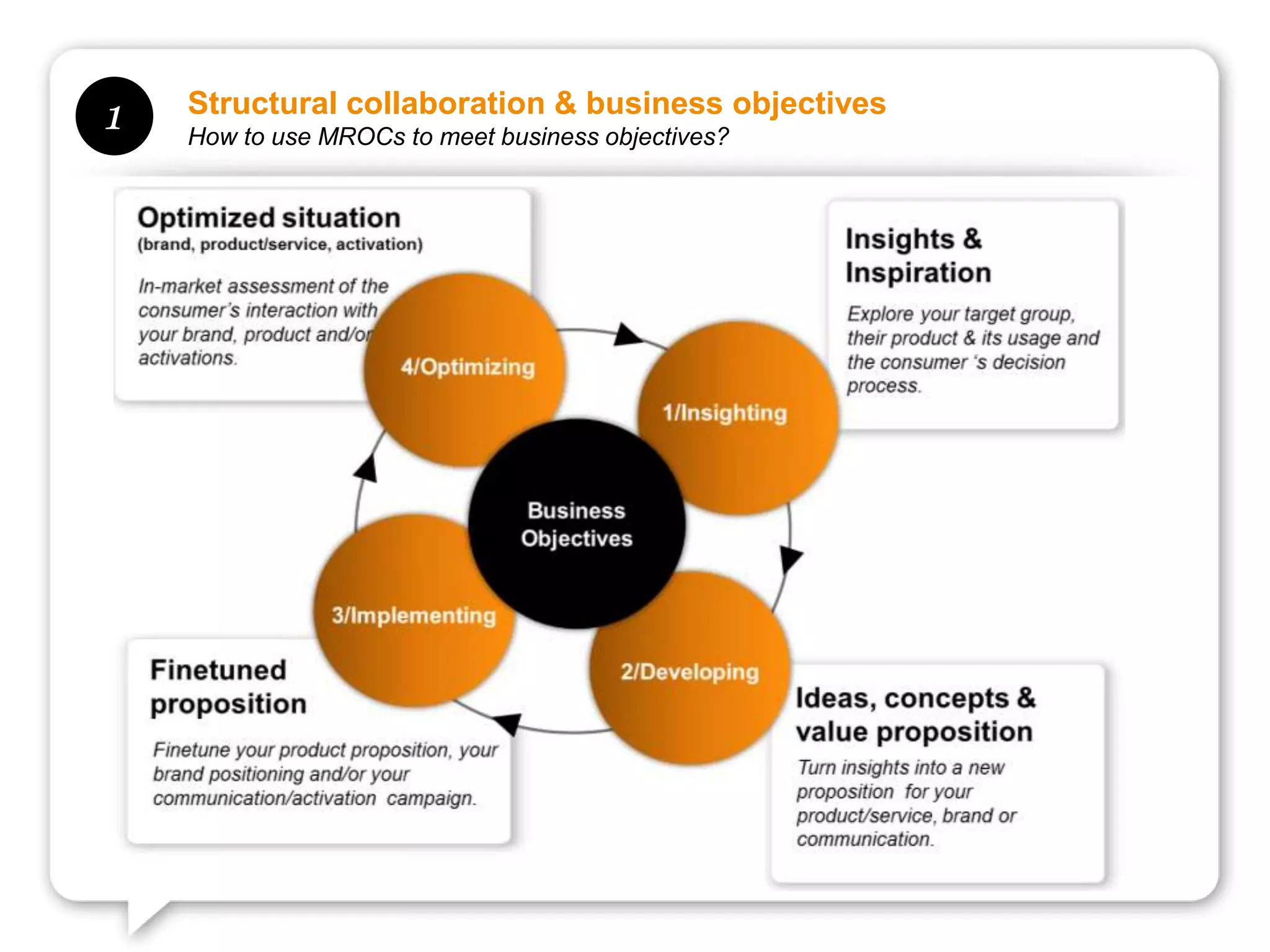
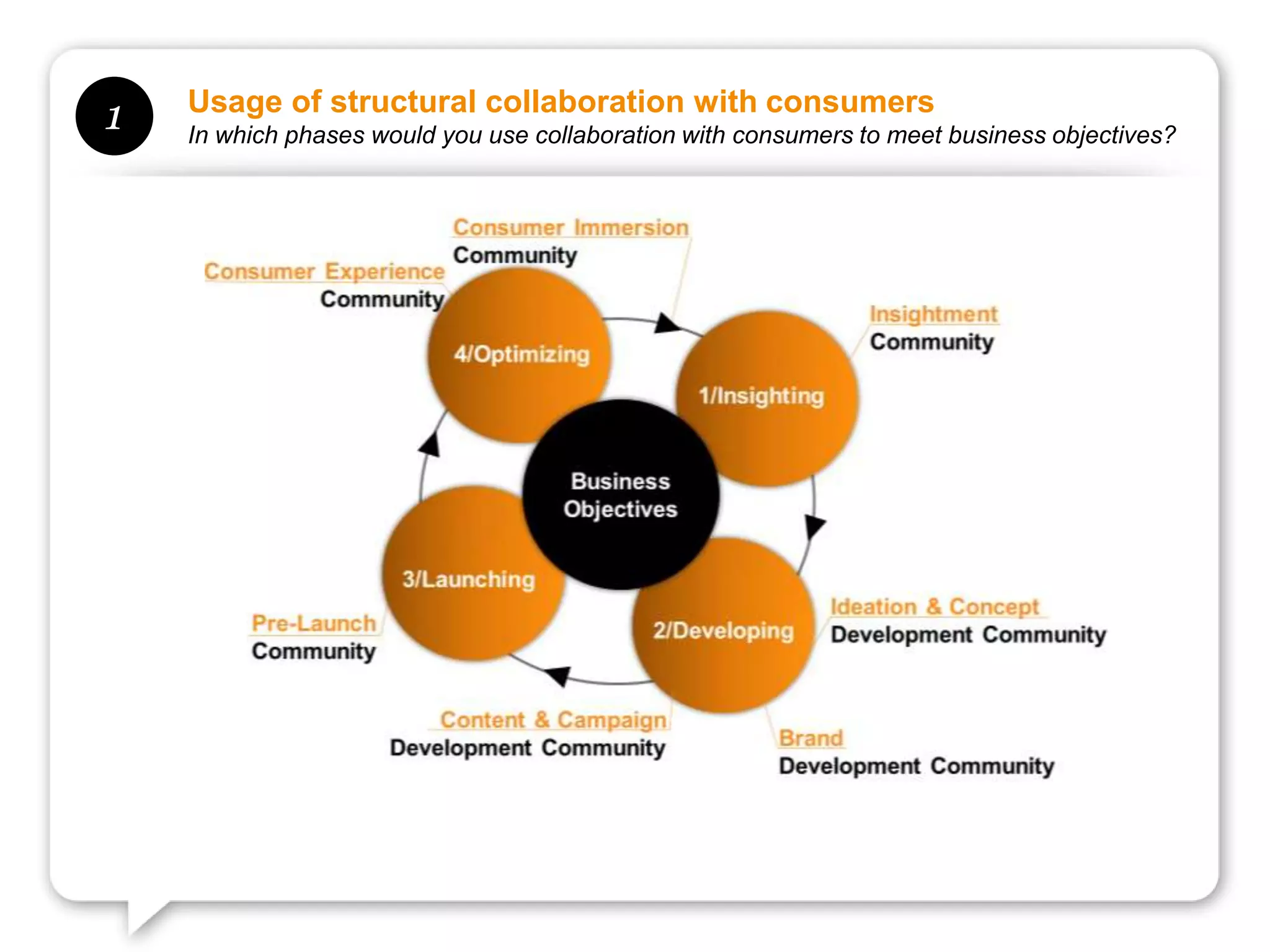
1   Structural collaboration & business objectives
    How to use MROCs to meet business objectives?
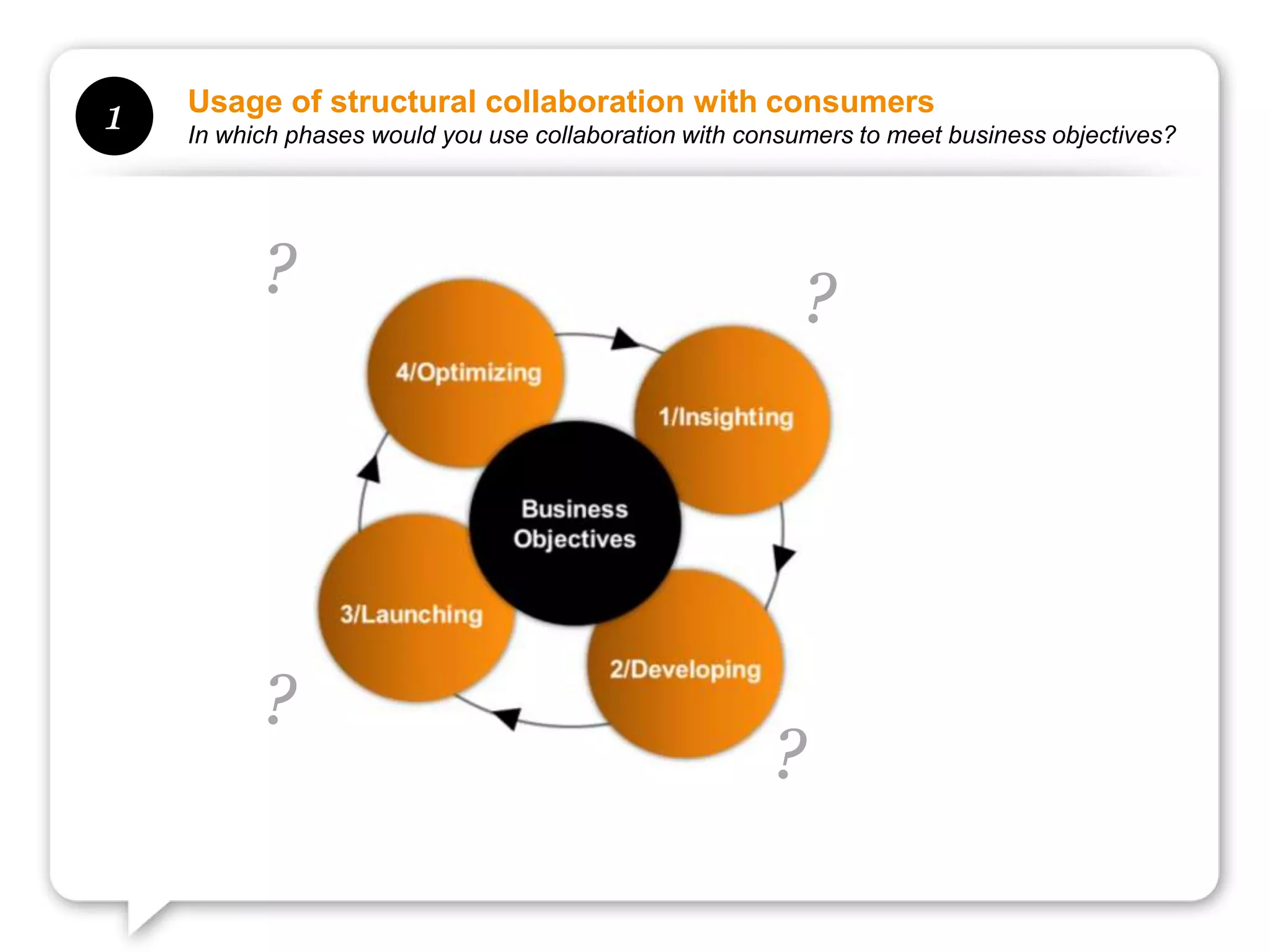
Usage of structural collaboration with consumers
1   In which phases would you use collaboration with consumers to meet business objectives?


          ?                                               ?


          ?
                                                       ?
Usage of structural collaboration with consumers
1   In which phases would you use collaboration with consumers to meet business objectives?
3 Statements
#2: Collaboration is more
important for the company than
for the consumer


  Collaborating with consumers
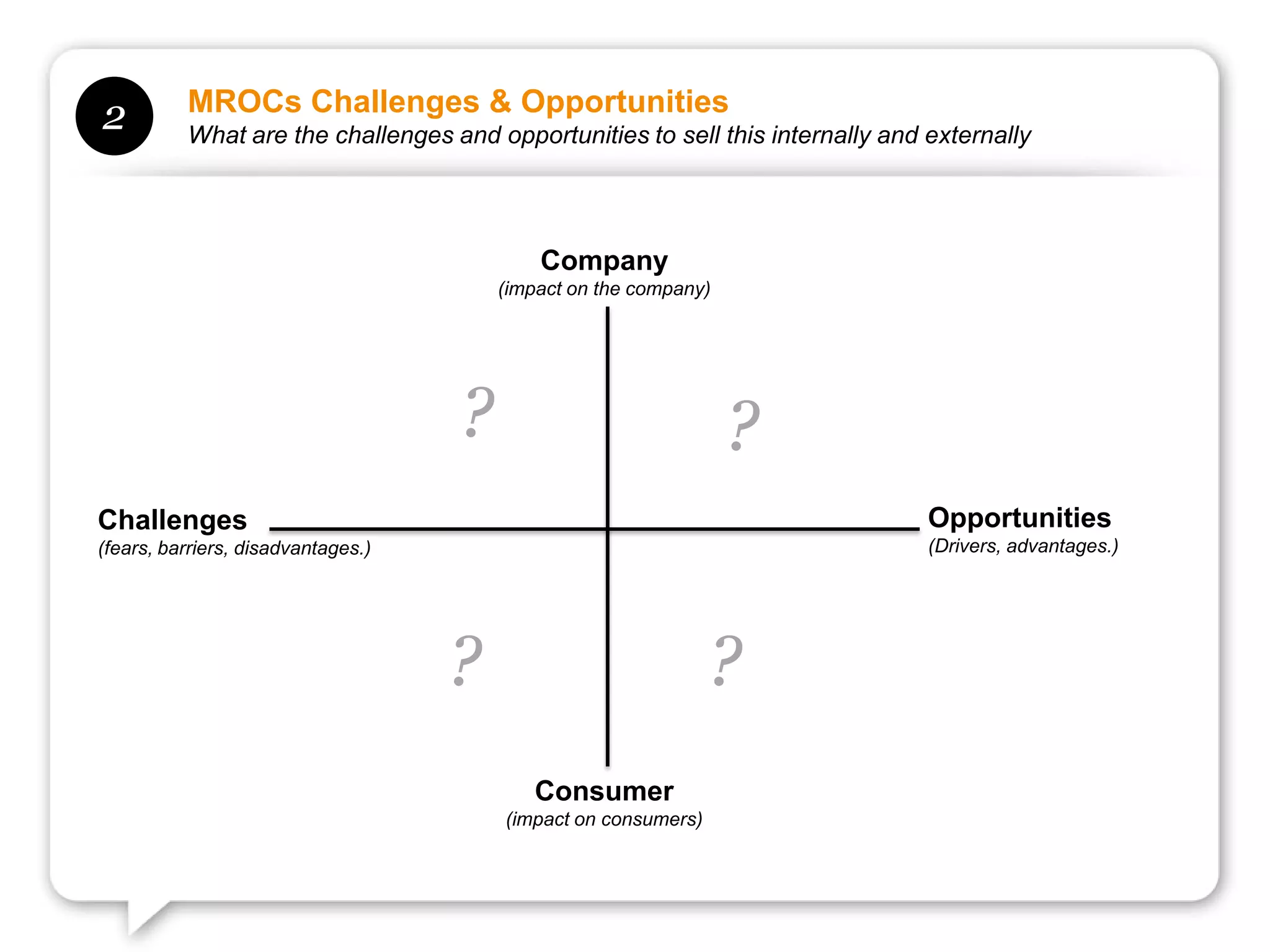
MROCs Challenges & Opportunities
2         What are the challenges and opportunities to sell this internally and externally


                                                    Outline
                                            Company
                                        (impact on the company)
                                                    Research objective & approach


                                    ?               Meet the UK mums
                                                                  ?
                                                    Moments & Needs:
                                                    A week in the life of a UK mum
Challenges                                                                    Opportunities
(fears, barriers, disadvantages.)                                               (Drivers, advantages.)
                                                    Opportunities


                                    ?                           ?
                                           Consumer
                                        (impact on consumers)
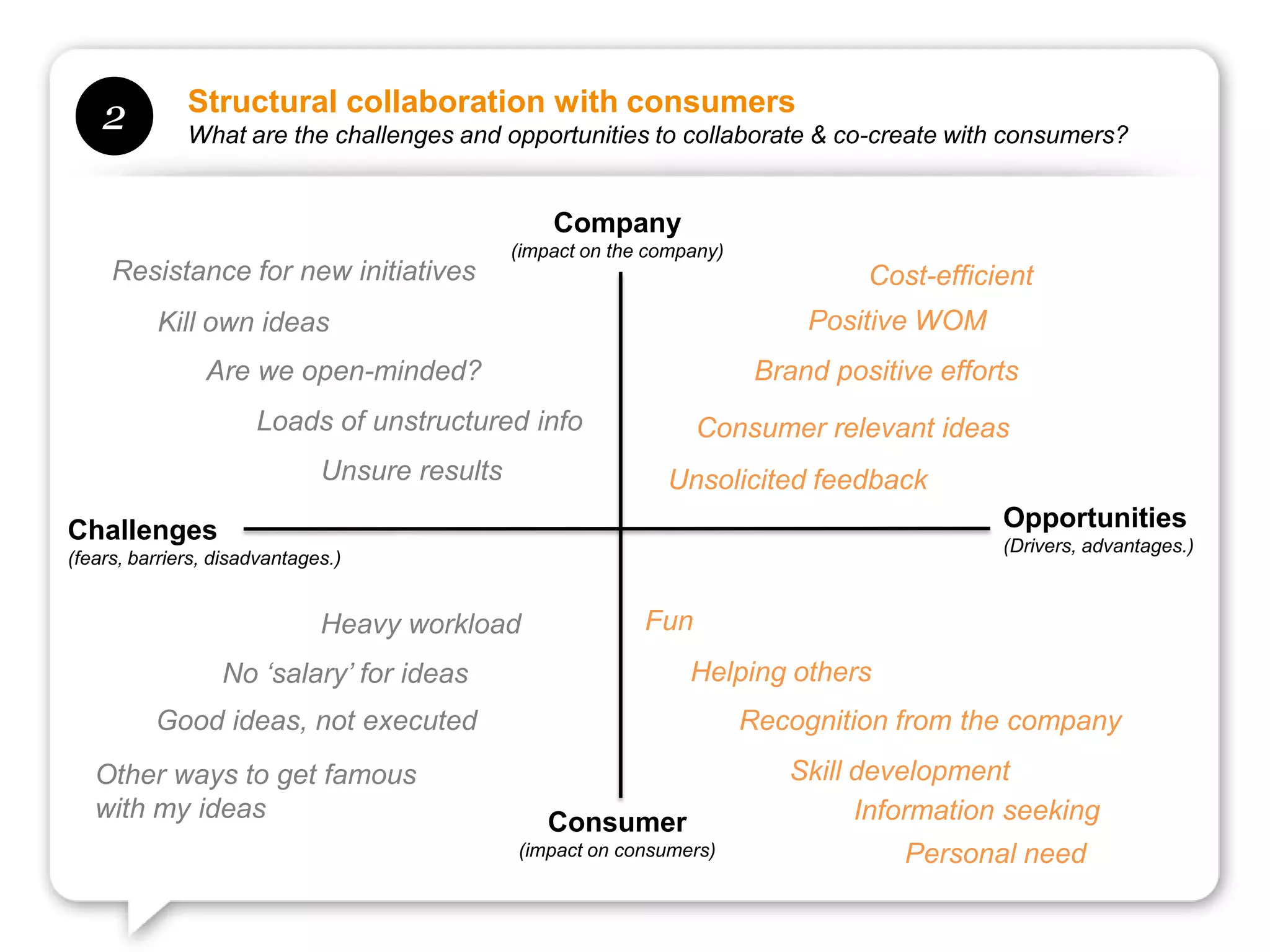
Structural collaboration with consumers
    2         What are the challenges and opportunities to collaborate & co-create with consumers?


                                                   CompanyOutline
                                               (impact on the company)
     Resistance for new initiatives                                               Cost-efficient
          Kill own ideas                                               Positive WOM
                                                          Research objective & approach
                Are we open-minded?                                  Brand positive efforts
                                                          Meet the UK mums
                      Loads of unstructured info                Consumer relevant ideas
                              Unsure results              Moments & Needs:
                                                             Unsolicited feedback
                                                          A week in the life of a UK mum
Challenges                                                                                Opportunities
                                                                                             (Drivers, advantages.)
(fears, barriers, disadvantages.)                         Opportunities

                              Heavy workload                 Fun
                  No ‘salary’ for ideas                           Helping others
          Good ideas, not executed                                       Recognition from the company
   Other ways to get famous                                                 Skill development
   with my ideas                                  Consumer                        Information seeking
                                               (impact on consumers)                 Personal need
Structural collaboration with consumers
    2         What are the challenges and opportunities to collaborate & co-create with consumers?


                                                            Outline
                                                        Company
                                                 (impact on the company)
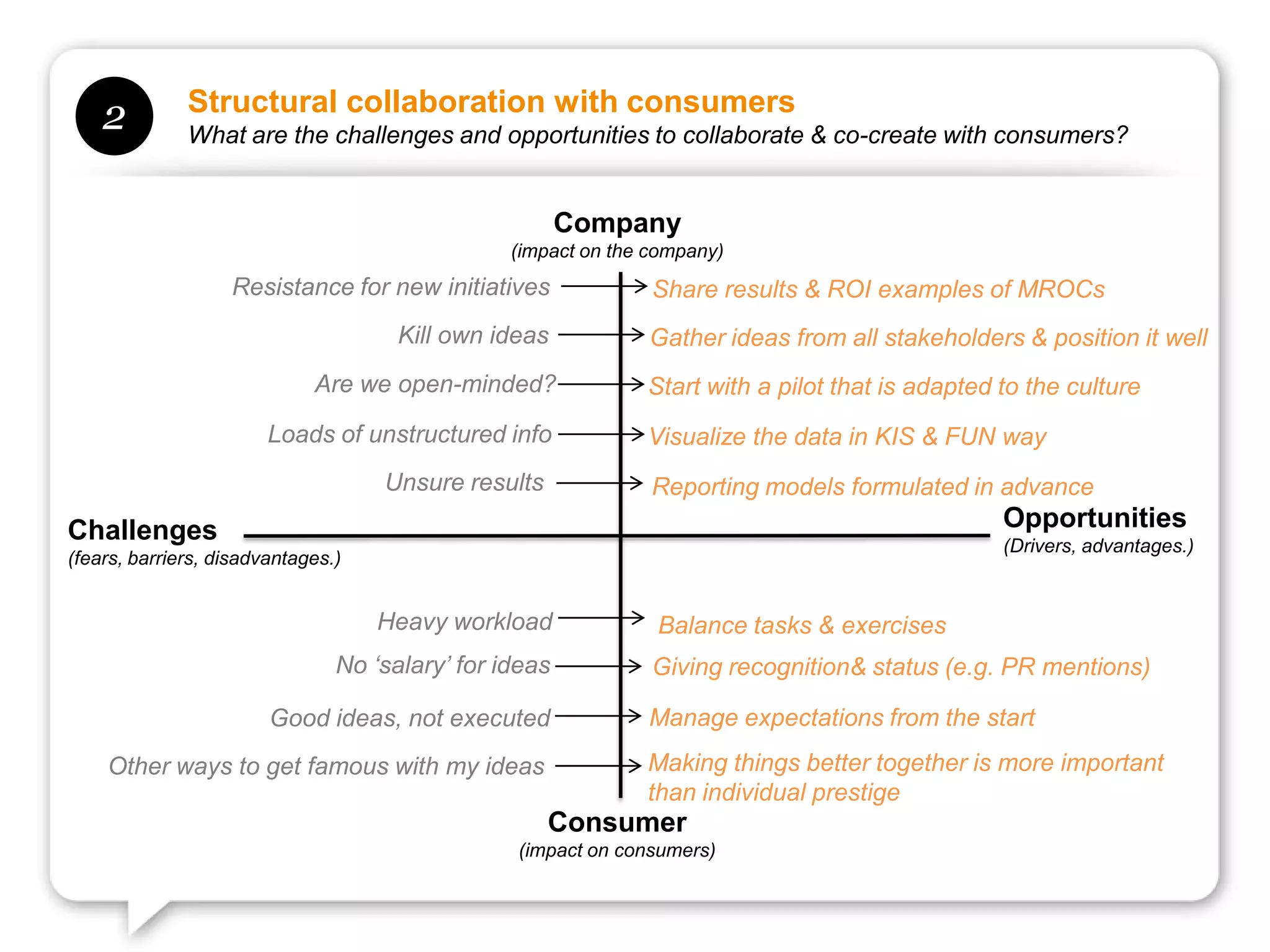
                   Resistance for new initiatives               Share results & ROI examples of MROCs
                                      Kill own ideas        Research objective & approach& position it well
                                                              Gather ideas from all stakeholders
                             Are we open-minded?            Meet the UK pilot that is adapted to the culture
                                                              Start with a mums
                        Loads of unstructured info             Visualize the data in KIS & FUN way
                                                            Moments & Needs:
                                    Unsure results
                                                            A week in the life of a UK mumadvance
                                                               Reporting models formulated in
Challenges                                                                                    Opportunities
                                                                                               (Drivers, advantages.)
(fears, barriers, disadvantages.)                           Opportunities

                                    Heavy workload              Balance tasks & exercises
                                No ‘salary’ for ideas           Giving recognition& status (e.g. PR mentions)

                        Good ideas, not executed               Manage expectations from the start
    Other ways to get famous with my ideas                     Making things better together is more important
                                                               than individual prestige
                                                     Consumer
                                                 (impact on consumers)
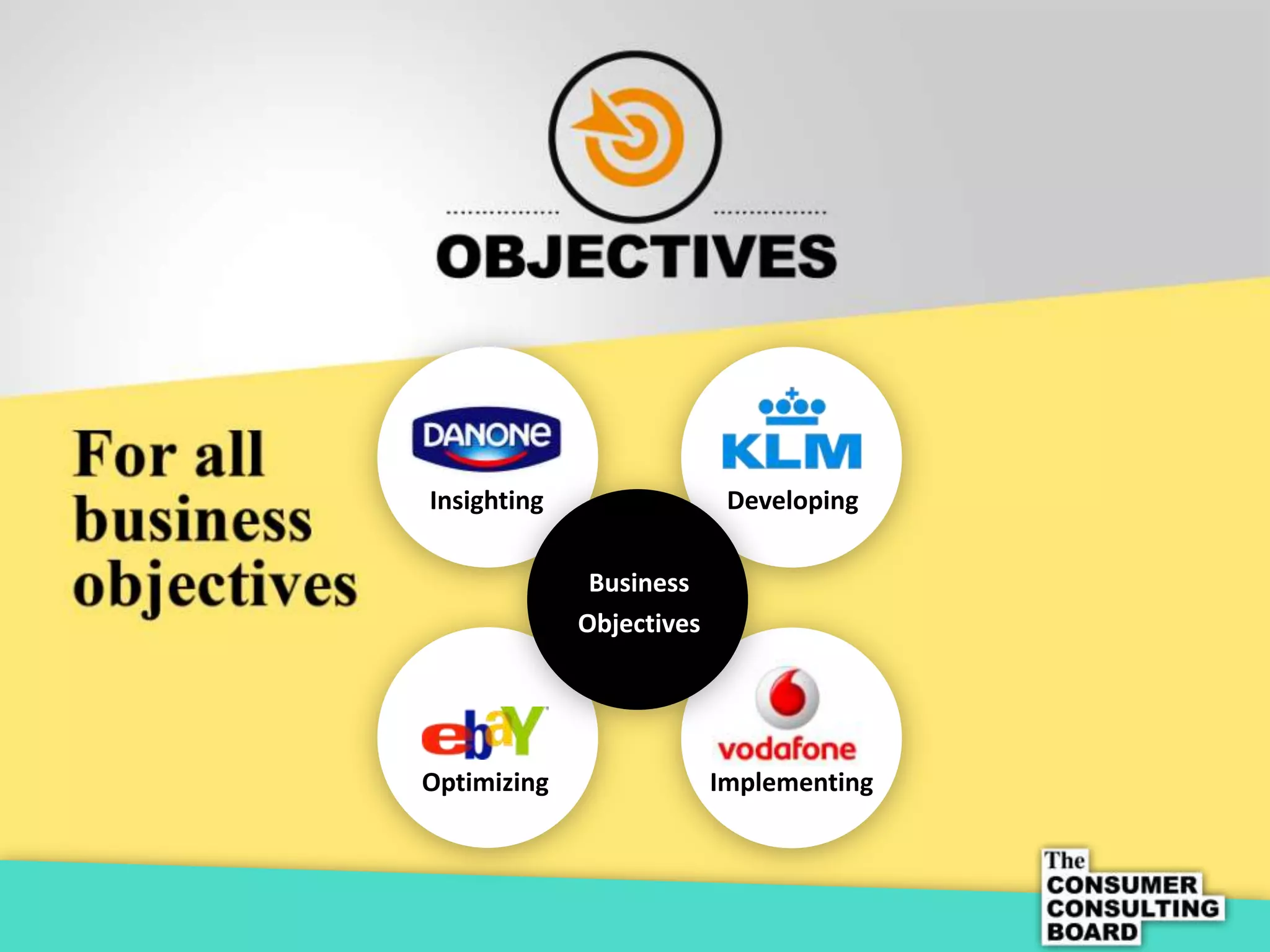
Insighting                 Developing

              Business
             Objectives


Optimizing                Implementing
http://www.youtube.com/watch?v=6-H6z00bZu8
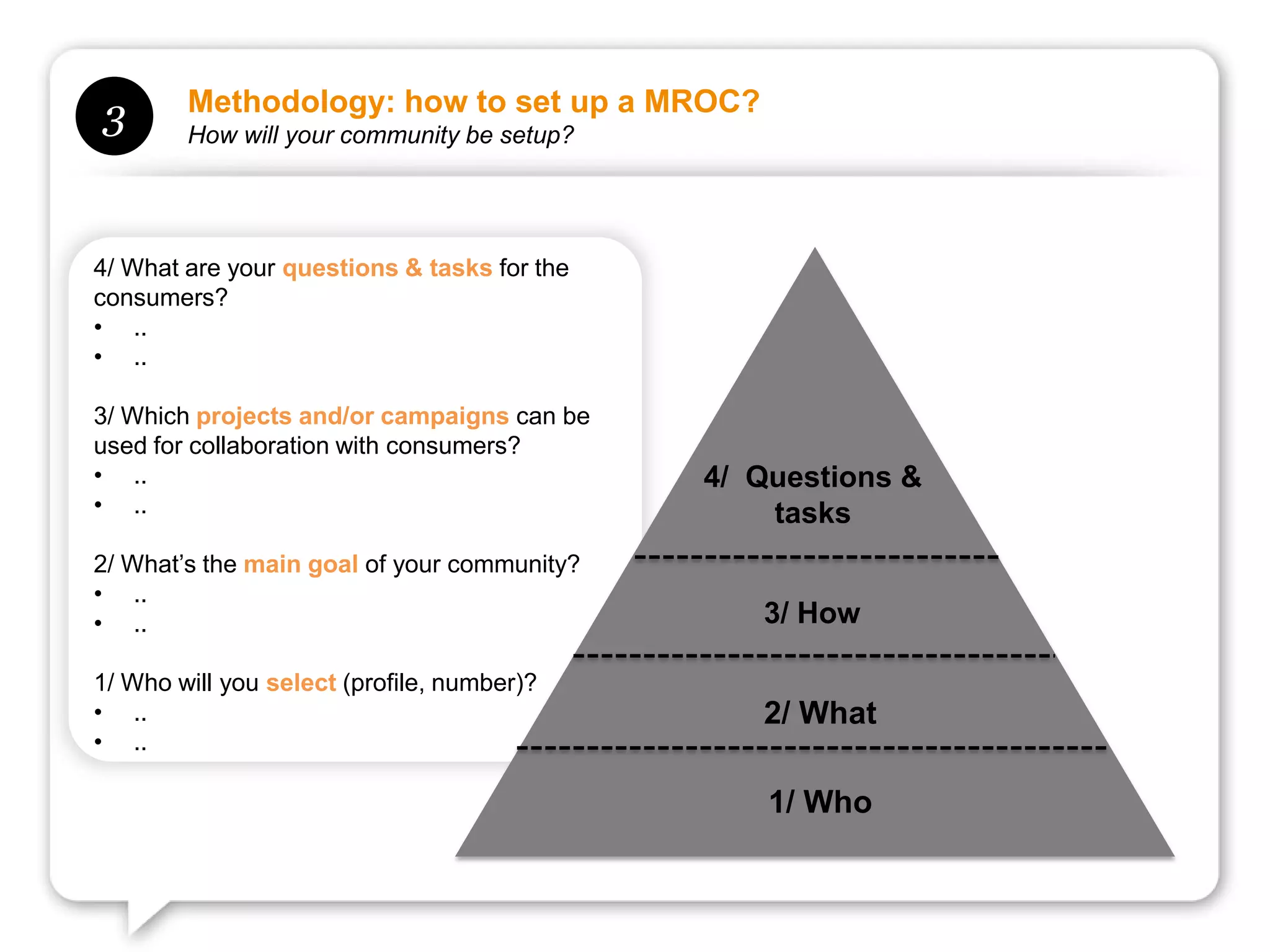
Methodology: how to set up a MROC?
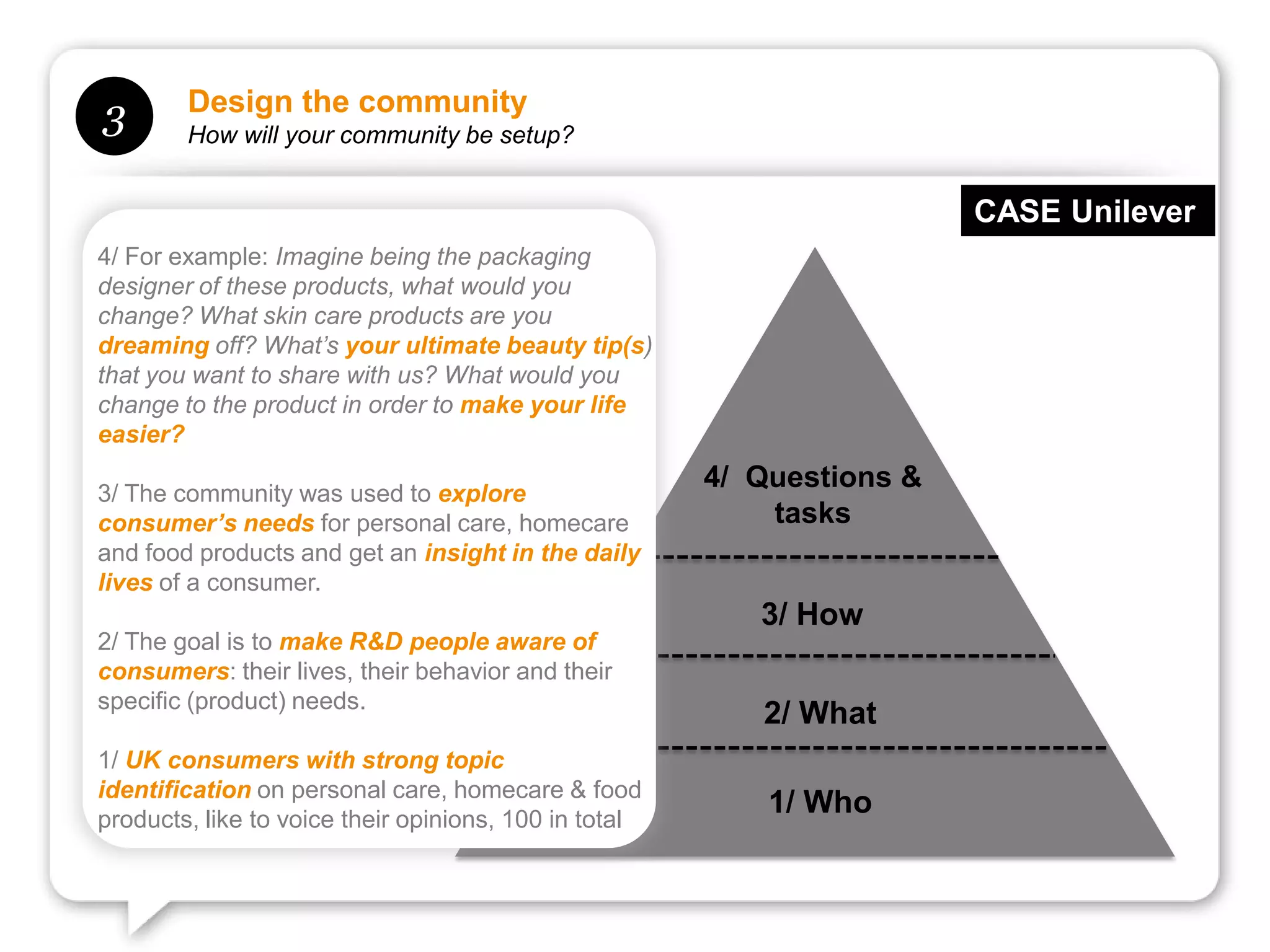
3       How will your community be setup?


4/ What are your questions & tasks for the
consumers?
• ..
• ..

3/ Which projects and/or campaigns can be
used for collaboration with consumers?
• ..                                         4/ Questions &
• ..                                             tasks
2/ What’s the main goal of your community?
• ..
• ..                                            3/ How

1/ Who will you select (profile, number)?
• ..                                            2/ What
• ..

                                                 1/ Who
Design the community
3       How will your community be setup?


                                                                        CASE Unilever
4/ For example: Imagine being the packaging
designer of these products, what would you
change? What skin care products are you
dreaming off? What’s your ultimate beauty tip(s)
that you want to share with us? What would you
change to the product in order to make your life
easier?

3/ The community was used to explore
                                                       4/ Questions &
consumer’s needs for personal care, homecare               tasks
and food products and get an insight in the daily
lives of a consumer.
                                                          3/ How
2/ The goal is to make R&D people aware of
consumers: their lives, their behavior and their
specific (product) needs.
                                                          2/ What
1/ UK consumers with strong topic
identification on personal care, homecare & food
products, like to voice their opinions, 100 in total
                                                           1/ Who
CHOOSING YOUR
Pilot Project
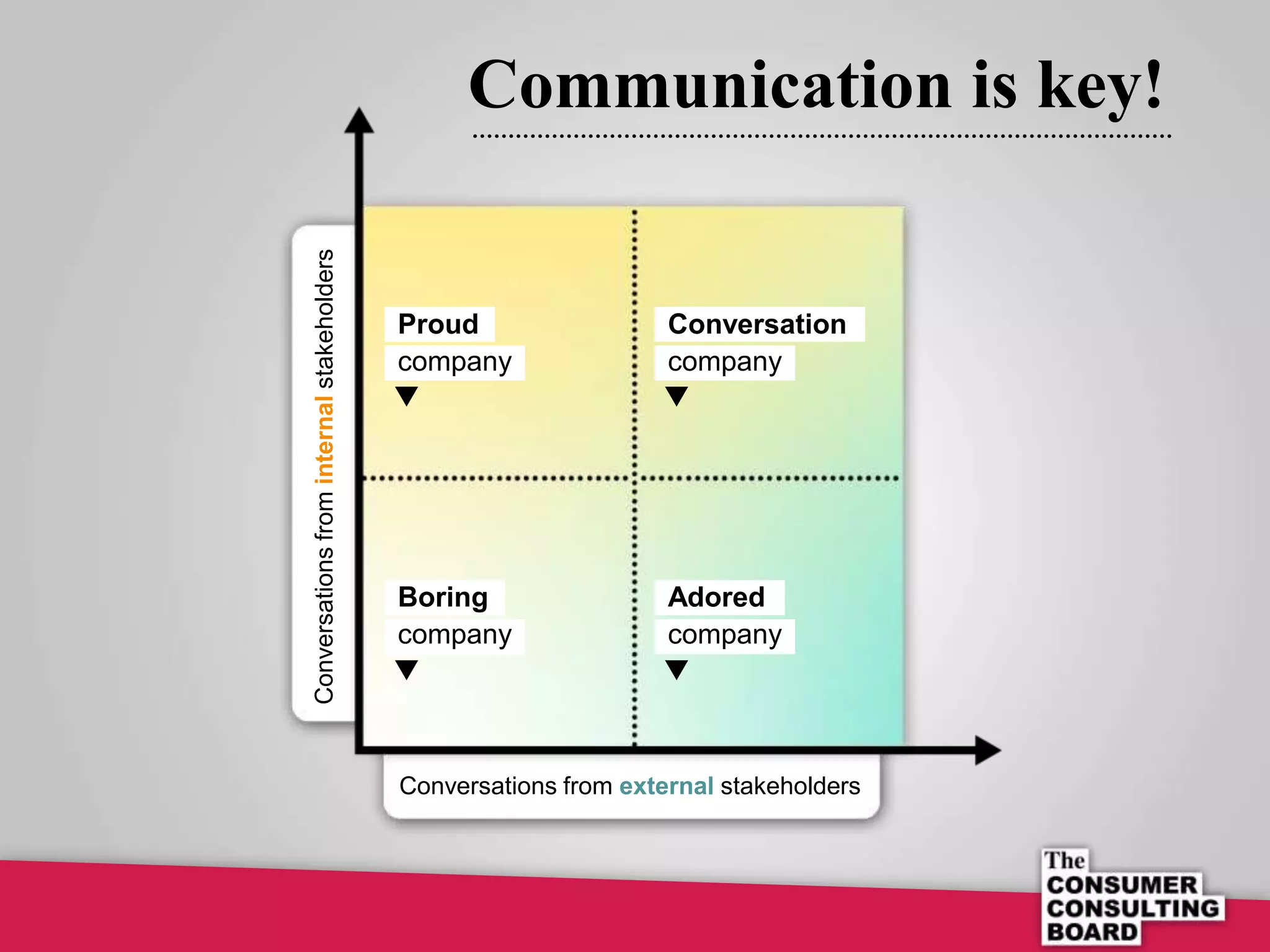
Communication is key!


Conversations from internal stakeholders   Proud                  Conversation
                                           company                company


                                           Boring                 Adored
                                           company                company


                                           Conversations from external stakeholders
3 Statements
#3: Collaboration is not about the
outcome. The process is more
valuable.


  Collaborating with consumers
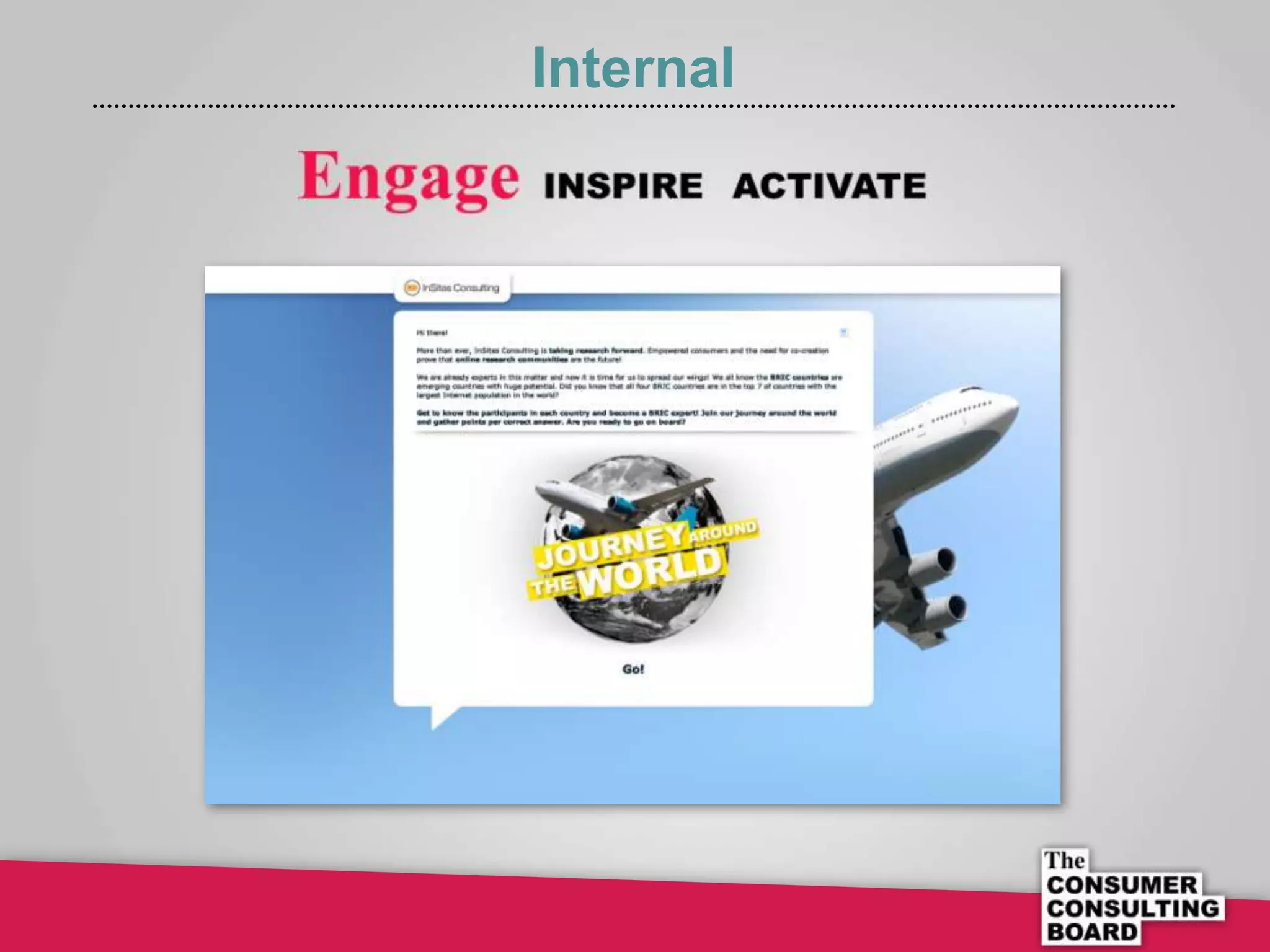
Internal
Internal
Internal
Internal
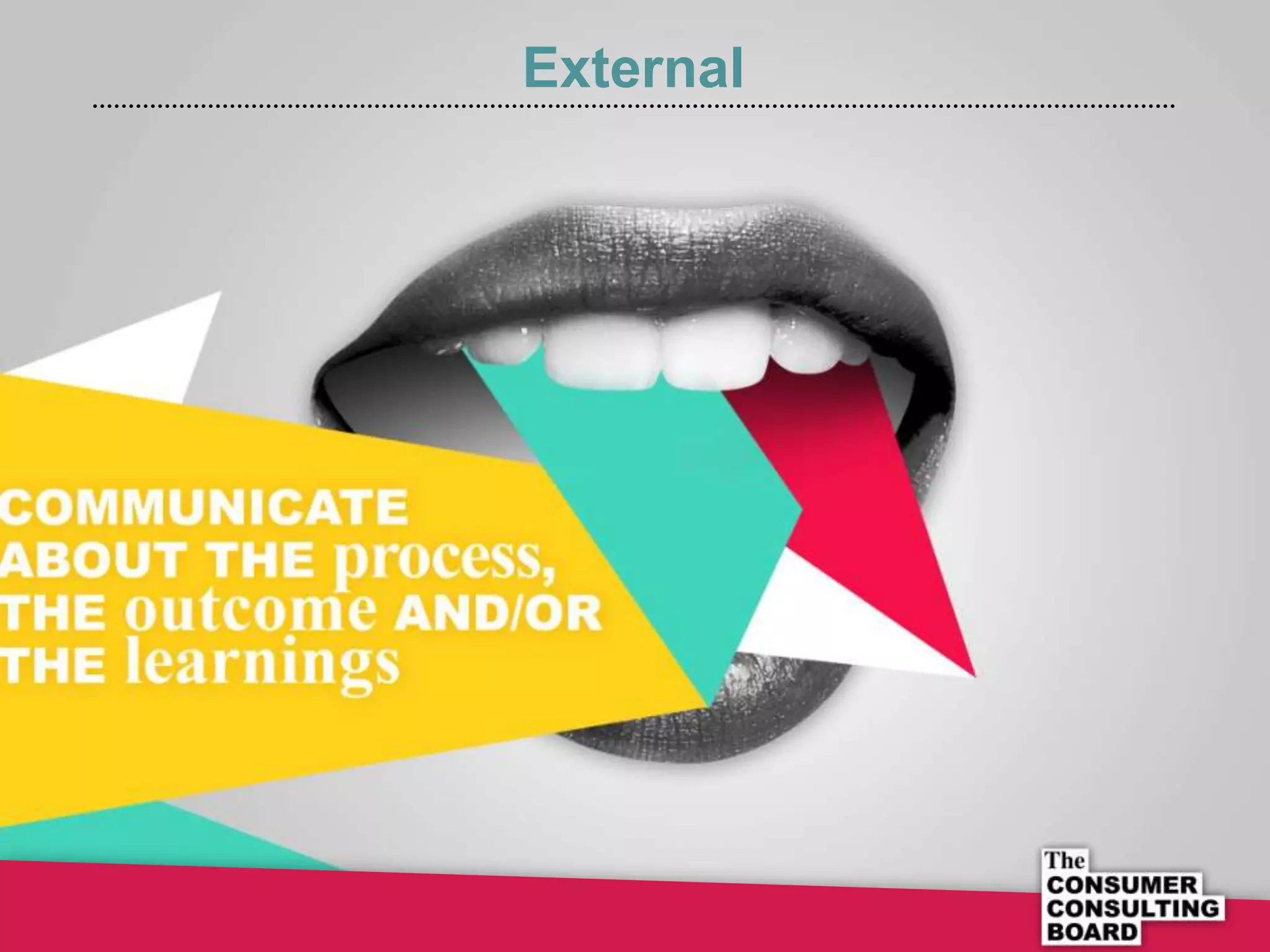
External
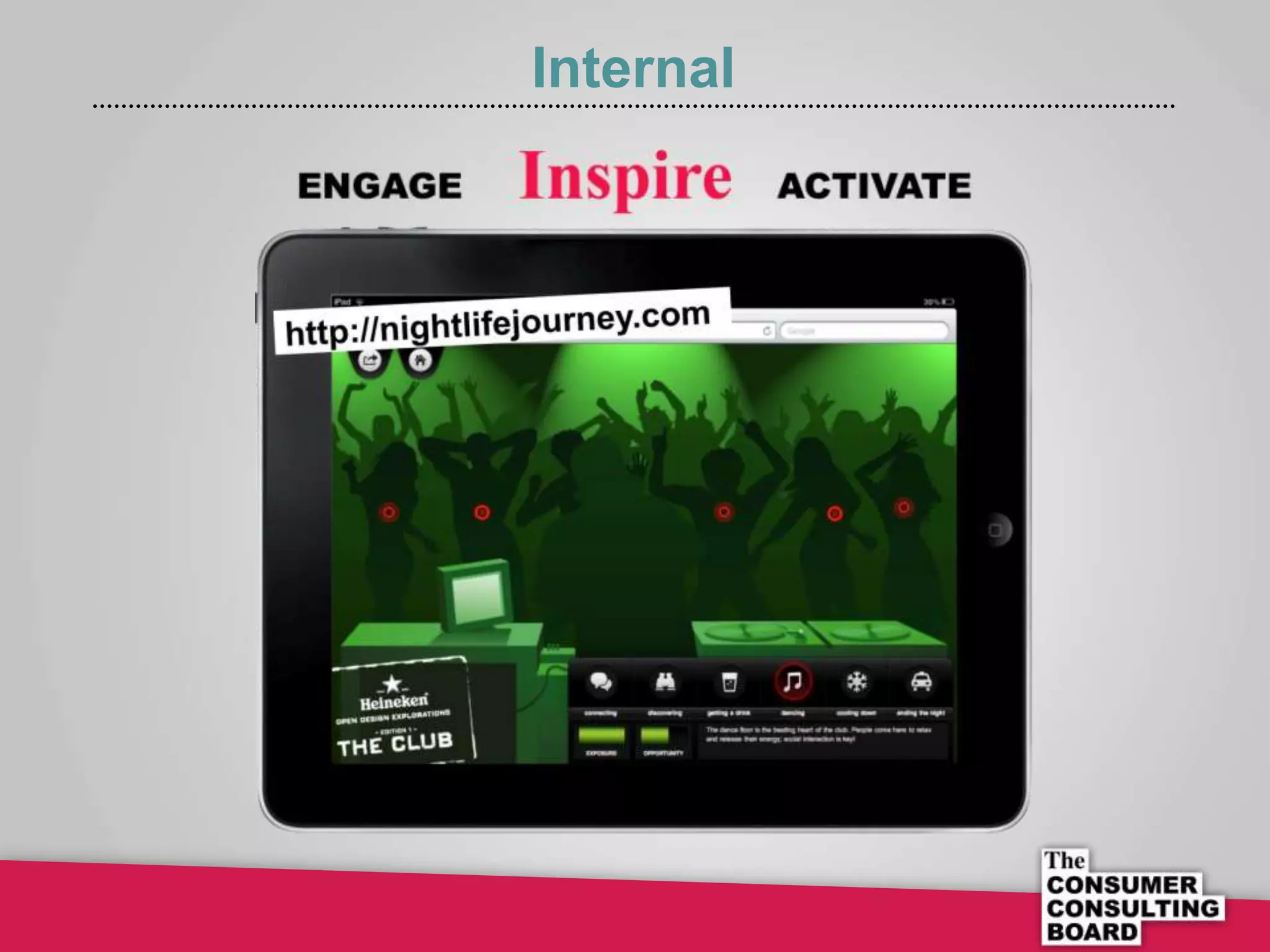
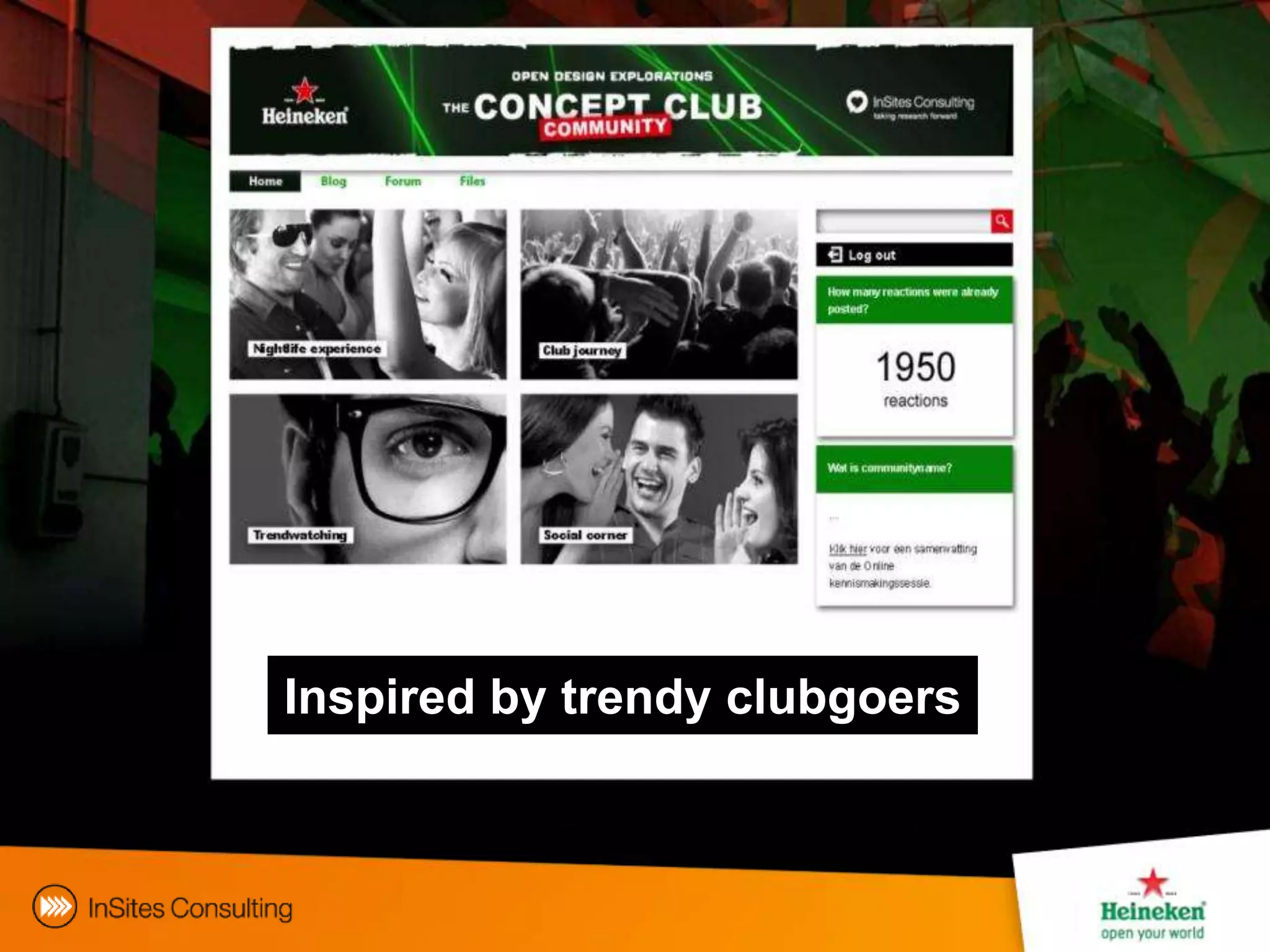
Inspired by trendy clubgoers
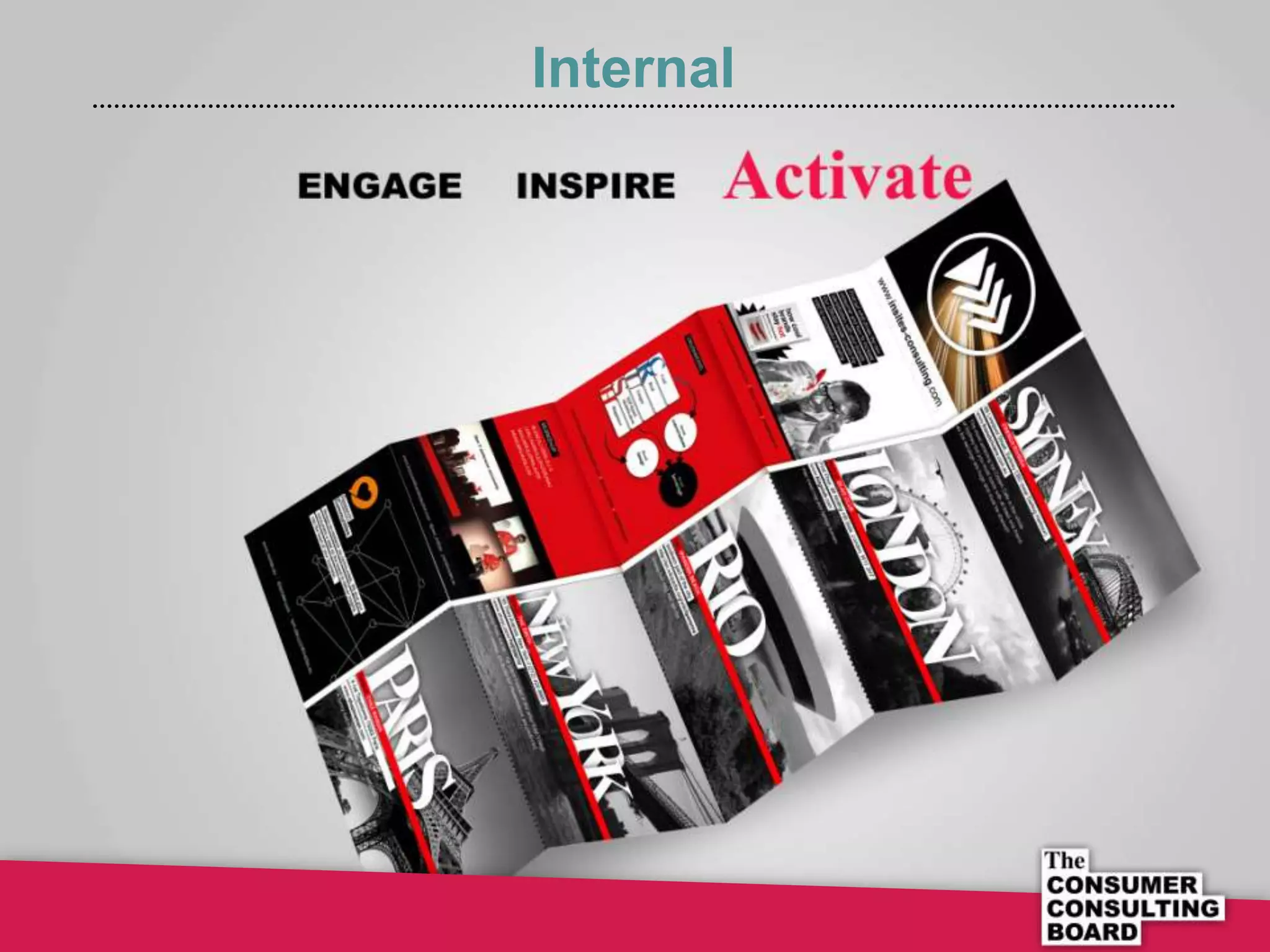
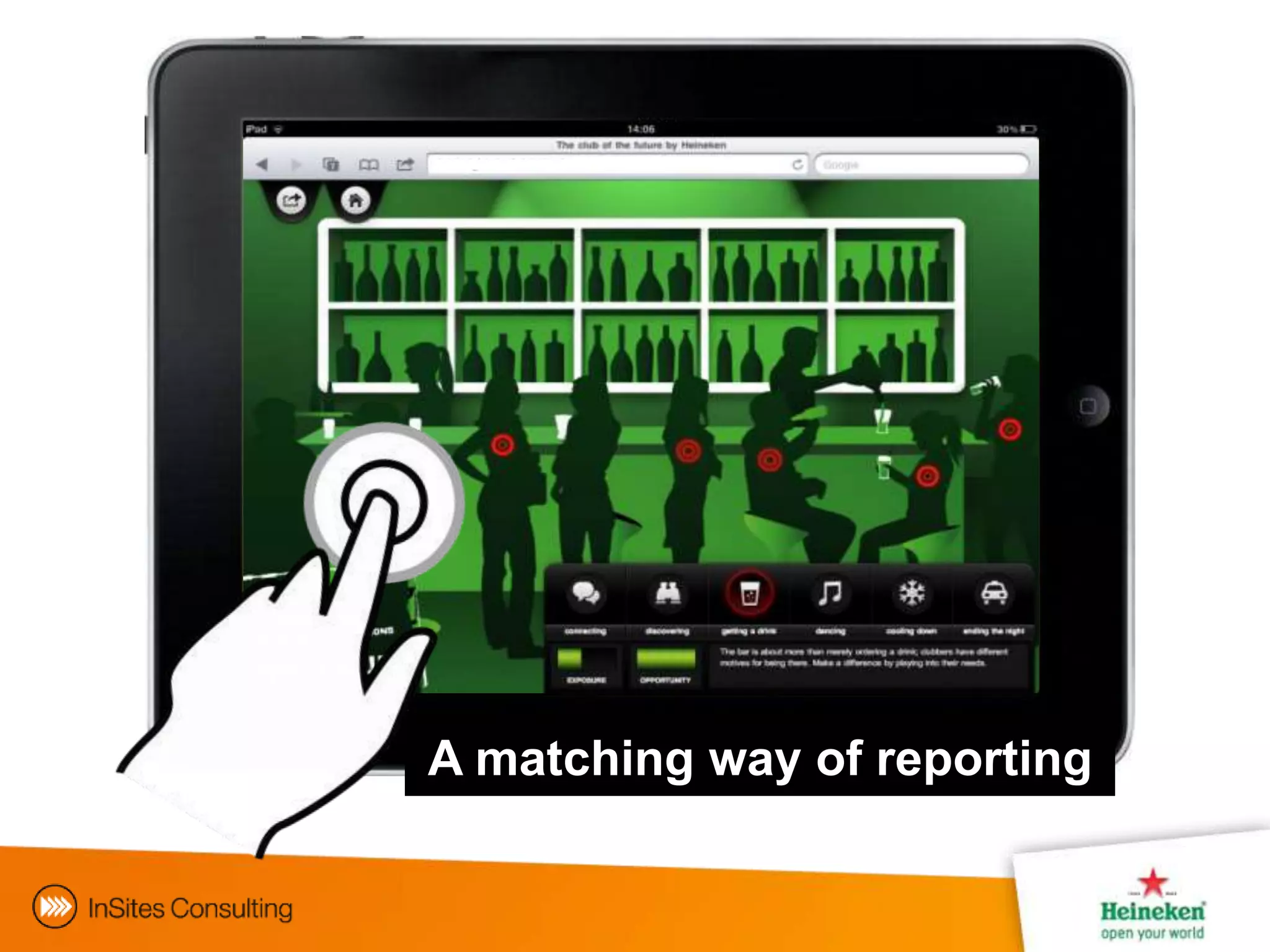
A matching way of reporting
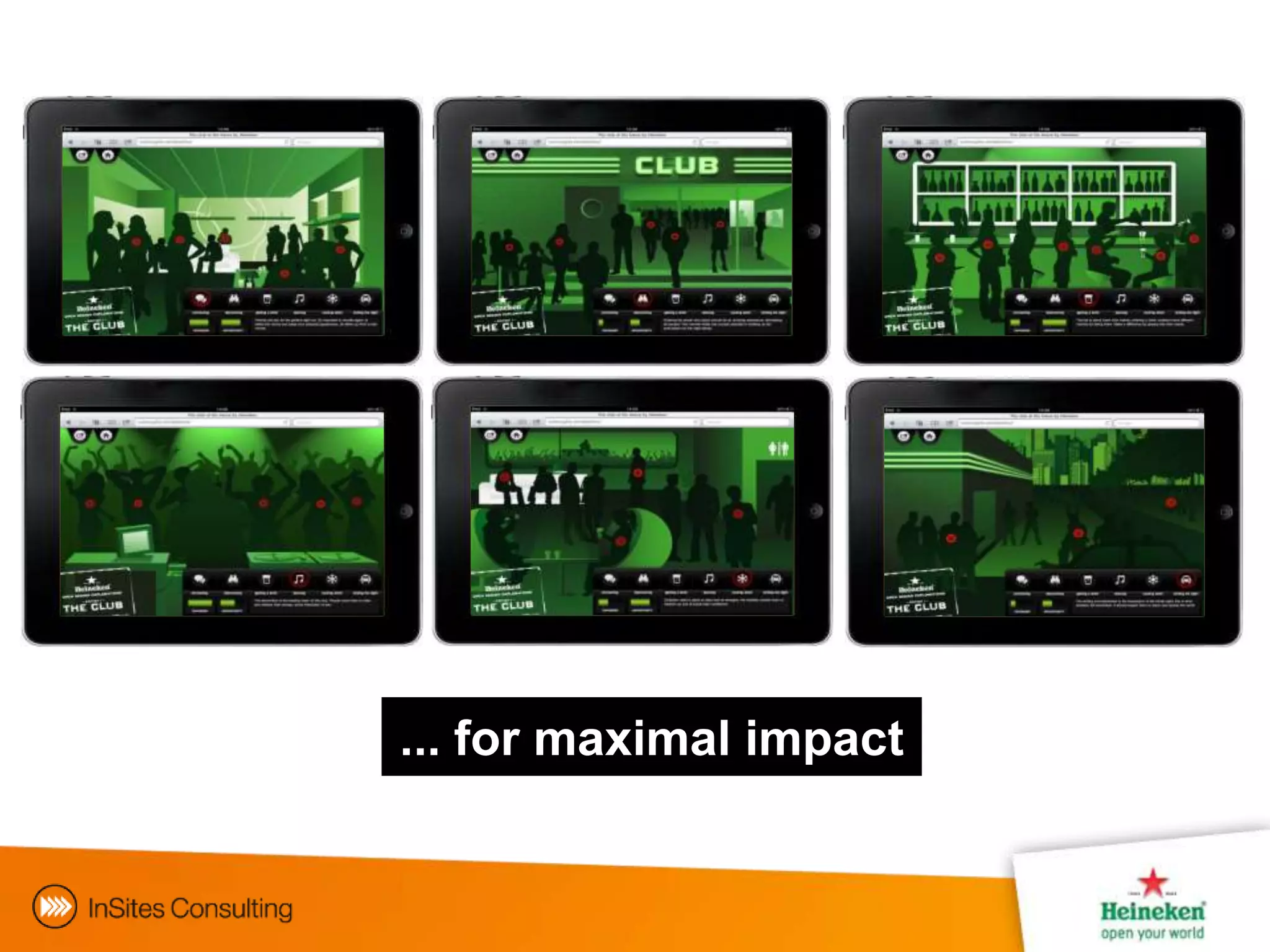
... for maximal impact
Collaborating with consumers
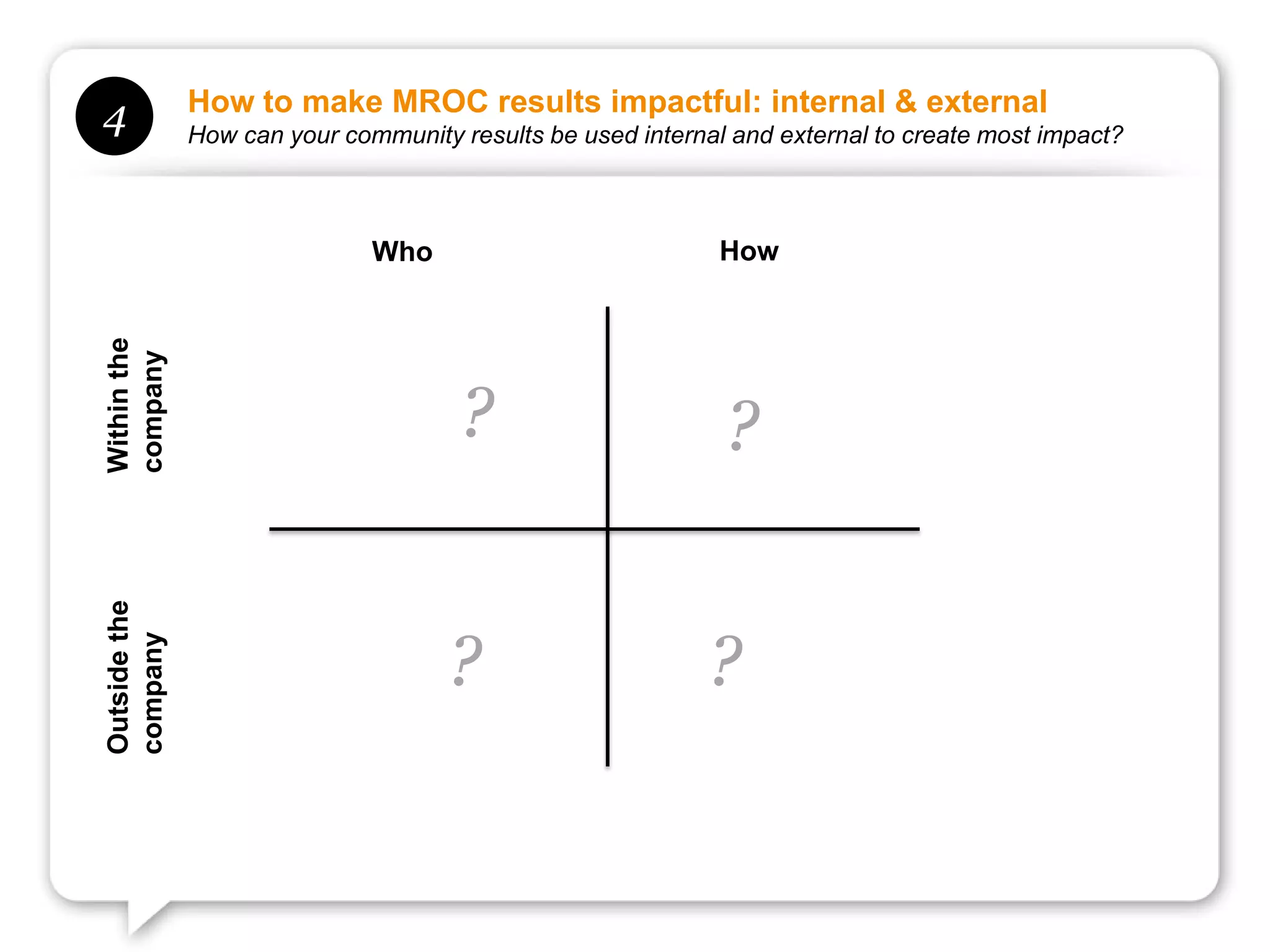
How to make MROC results impactful: internal & external
4             How can your community results be used internal and external to create most impact?


                              Who                            How
Within the
company


                                      ?                      ?
Outside the


                                     ?                      ?
company
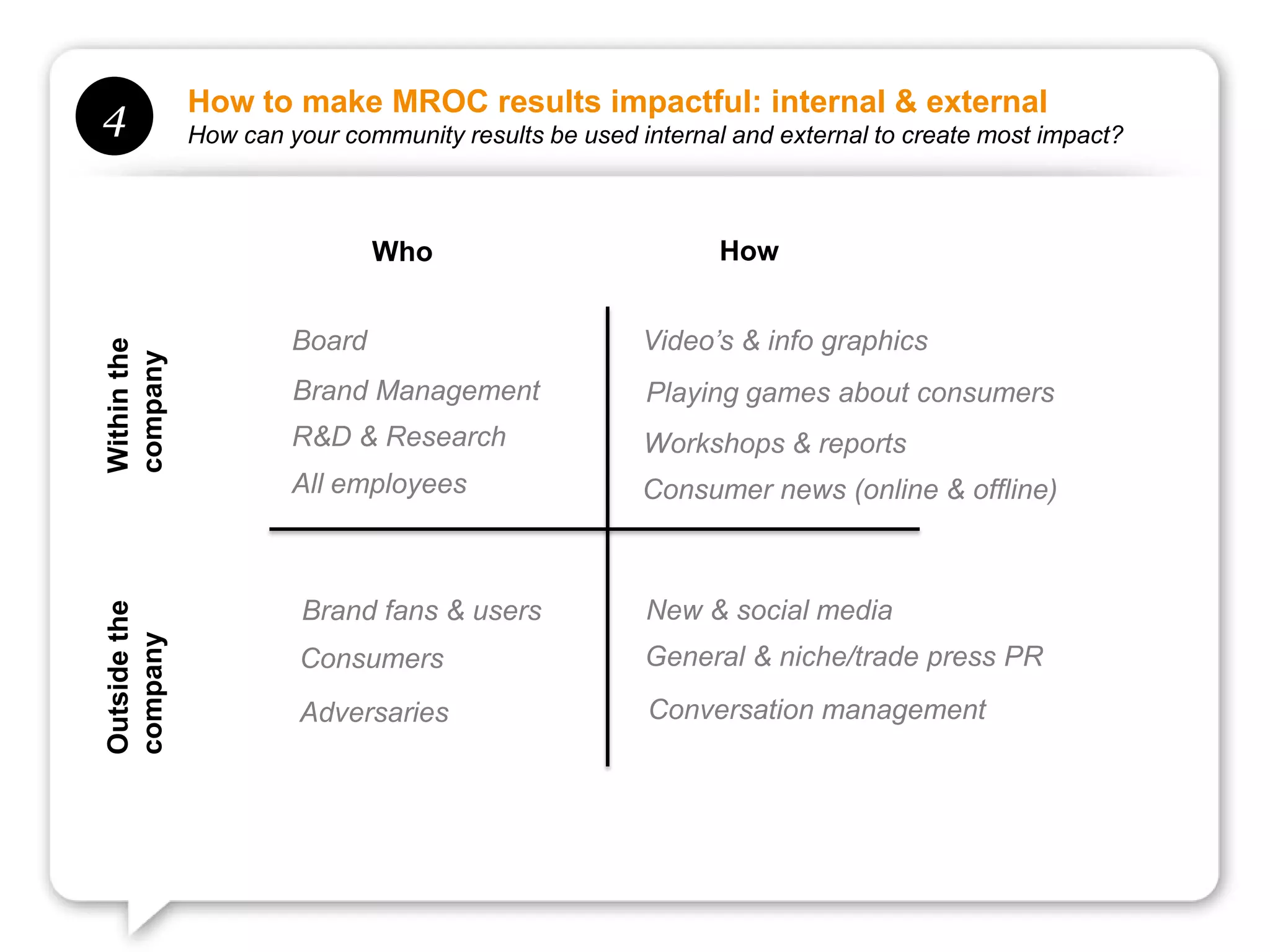
How to make MROC results impactful: internal & external
4             How can your community results be used internal and external to create most impact?


                               Who                           How


                       Board                          Video’s & info graphics
Within the
company


                       Brand Management               Playing games about consumers
                       R&D & Research                 Workshops & reports
                       All employees                  Consumer news (online & offline)


                        Brand fans & users            New & social media
Outside the
company


                       Consumers                      General & niche/trade press PR
                       Adversaries                    Conversation management
It’s an EVOLUTION,
not a REVOLUTION!
Sharing
IS caring
Workshop: From Co-creation to Structural Collaboration with Consumers

Workshop: From Co-creation to Structural Collaboration with Consumers

  • 2.
    FROM CO-CREATION TO STRUCTURALCOLLABORATION Tom De Ruyck & Anouk Willems InSites Consulting
  • 21.
    3 Statements #1: Collaborationand co-creation are trends; in 3 years, these will blow over. Collaborating with consumers
  • 22.
    1 Structural collaboration & business objectives How to use MROCs to meet business objectives?
  • 23.
    Usage of structuralcollaboration with consumers 1 In which phases would you use collaboration with consumers to meet business objectives? ? ? ? ?
  • 24.
    Usage of structuralcollaboration with consumers 1 In which phases would you use collaboration with consumers to meet business objectives?
  • 25.
    3 Statements #2: Collaborationis more important for the company than for the consumer Collaborating with consumers
  • 26.
    MROCs Challenges &Opportunities 2 What are the challenges and opportunities to sell this internally and externally Outline Company (impact on the company) Research objective & approach ? Meet the UK mums ? Moments & Needs: A week in the life of a UK mum Challenges Opportunities (fears, barriers, disadvantages.) (Drivers, advantages.) Opportunities ? ? Consumer (impact on consumers)
  • 27.
    Structural collaboration withconsumers 2 What are the challenges and opportunities to collaborate & co-create with consumers? CompanyOutline (impact on the company) Resistance for new initiatives Cost-efficient Kill own ideas Positive WOM Research objective & approach Are we open-minded? Brand positive efforts Meet the UK mums Loads of unstructured info Consumer relevant ideas Unsure results Moments & Needs: Unsolicited feedback A week in the life of a UK mum Challenges Opportunities (Drivers, advantages.) (fears, barriers, disadvantages.) Opportunities Heavy workload Fun No ‘salary’ for ideas Helping others Good ideas, not executed Recognition from the company Other ways to get famous Skill development with my ideas Consumer Information seeking (impact on consumers) Personal need
  • 28.
    Structural collaboration withconsumers 2 What are the challenges and opportunities to collaborate & co-create with consumers? Outline Company (impact on the company) Resistance for new initiatives Share results & ROI examples of MROCs Kill own ideas Research objective & approach& position it well Gather ideas from all stakeholders Are we open-minded? Meet the UK pilot that is adapted to the culture Start with a mums Loads of unstructured info Visualize the data in KIS & FUN way Moments & Needs: Unsure results A week in the life of a UK mumadvance Reporting models formulated in Challenges Opportunities (Drivers, advantages.) (fears, barriers, disadvantages.) Opportunities Heavy workload Balance tasks & exercises No ‘salary’ for ideas Giving recognition& status (e.g. PR mentions) Good ideas, not executed Manage expectations from the start Other ways to get famous with my ideas Making things better together is more important than individual prestige Consumer (impact on consumers)
  • 30.
    Insighting Developing Business Objectives Optimizing Implementing
  • 47.
  • 65.
    Methodology: how toset up a MROC? 3 How will your community be setup? 4/ What are your questions & tasks for the consumers? • .. • .. 3/ Which projects and/or campaigns can be used for collaboration with consumers? • .. 4/ Questions & • .. tasks 2/ What’s the main goal of your community? • .. • .. 3/ How 1/ Who will you select (profile, number)? • .. 2/ What • .. 1/ Who
  • 66.
    Design the community 3 How will your community be setup? CASE Unilever 4/ For example: Imagine being the packaging designer of these products, what would you change? What skin care products are you dreaming off? What’s your ultimate beauty tip(s) that you want to share with us? What would you change to the product in order to make your life easier? 3/ The community was used to explore 4/ Questions & consumer’s needs for personal care, homecare tasks and food products and get an insight in the daily lives of a consumer. 3/ How 2/ The goal is to make R&D people aware of consumers: their lives, their behavior and their specific (product) needs. 2/ What 1/ UK consumers with strong topic identification on personal care, homecare & food products, like to voice their opinions, 100 in total 1/ Who
  • 68.
  • 71.
    Communication is key! Conversationsfrom internal stakeholders Proud Conversation company company Boring Adored company company Conversations from external stakeholders
  • 72.
    3 Statements #3: Collaborationis not about the outcome. The process is more valuable. Collaborating with consumers
  • 73.
  • 74.
  • 75.
  • 76.
  • 78.
  • 81.
  • 82.
    A matching wayof reporting
  • 83.
  • 85.
  • 86.
    How to makeMROC results impactful: internal & external 4 How can your community results be used internal and external to create most impact? Who How Within the company ? ? Outside the ? ? company
  • 87.
    How to makeMROC results impactful: internal & external 4 How can your community results be used internal and external to create most impact? Who How Board Video’s & info graphics Within the company Brand Management Playing games about consumers R&D & Research Workshops & reports All employees Consumer news (online & offline) Brand fans & users New & social media Outside the company Consumers General & niche/trade press PR Adversaries Conversation management
  • 93.
  • 94.

Editor's Notes

  • #18 Mention definition of an MROC - HERE!
  • #19 2-way & ongoing COMBINED!
  • #22 Go over the 3 statements quickly:Read the statement and ask individuals whether they agree or disagree AND why3 minutes per statement
  • #24 This exercise should be applied to the client’s situation; If not possible, take the case and apply all exercises to this specific case
  • #27 Divide the group in 2 parts; one subgroup is the consumer, one subgroup is the company.Together they have 5 minutes to think about challenges & opportunities. For the company subgroup; this exercise should be applied to the client’s situation; If not possible, take the case and apply all exercises to this specific case
  • #28 MESSAGE:There are many more challenges and barriers than included in this example.
  • #29 How to turn the challenges around?
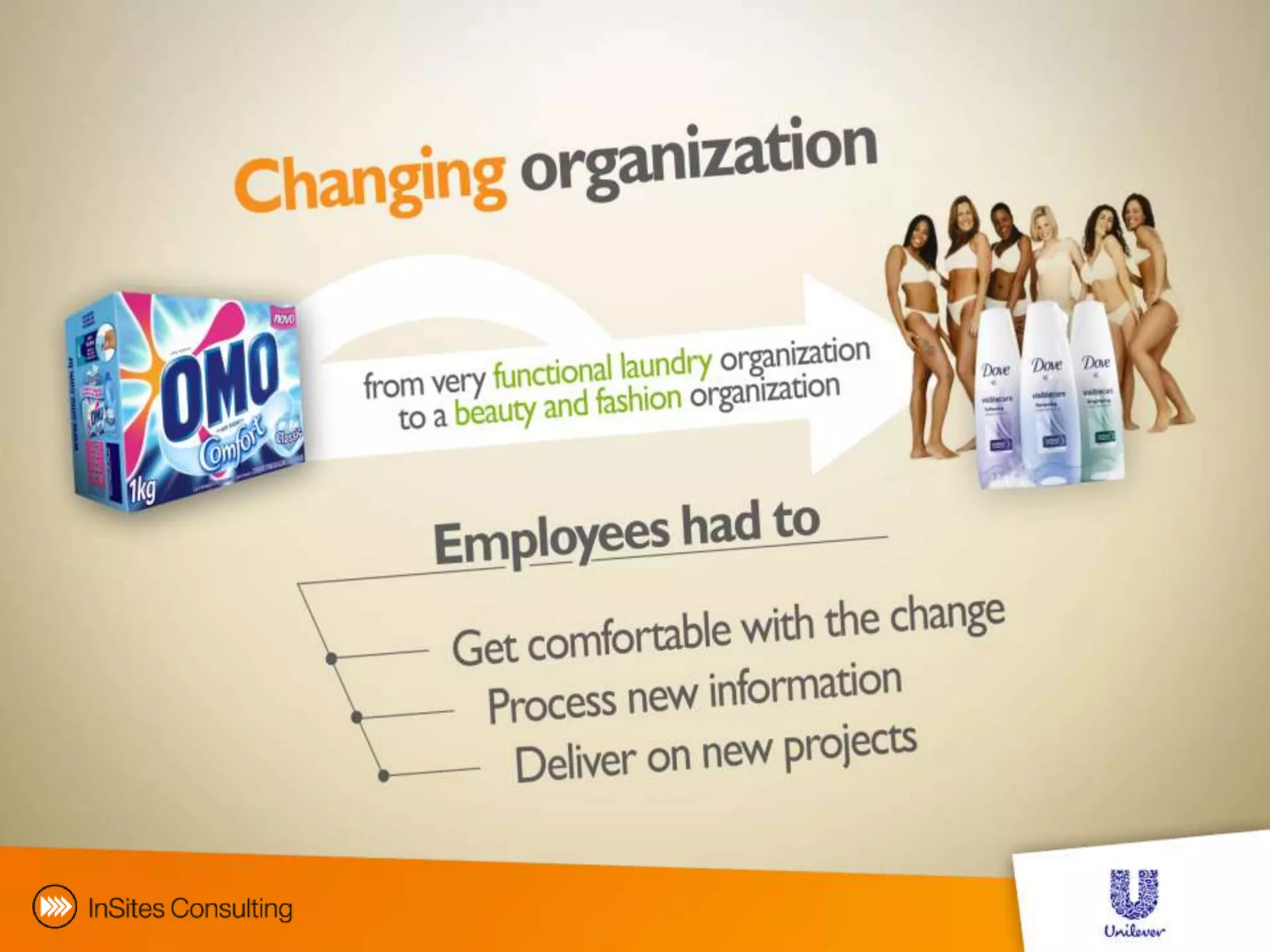
  • #49 “Changing organization”For the Research & Development centre in the Netherlands, in Vlaardingen, it meant a big change. It was a large R&D centre for the functional laundry products, and now changed into the more emotional and beauty categories such as hair and skin products.  This all makes lots of sense, it allows people to work more efficient, it is exciting to work on new brands and share the knowledge between categories. But it does mean there is a sudden gap in understanding of the consumer for these new categories. Think about Anita, she has been working in Unilever on laundry products for 8 years, she knows that white clothing is very important for the Indian consumer, she knows exactly what stains are causing frustrations with consumers, and how to get these out. Now, in only a few months period, she had to change to working on skin products. She disliked that she lost touch with the consumer and understood she needs to learn again what consumers find important. But she simply did not know where to begin. This had an effect on her engagement, performance and delivery on projects.
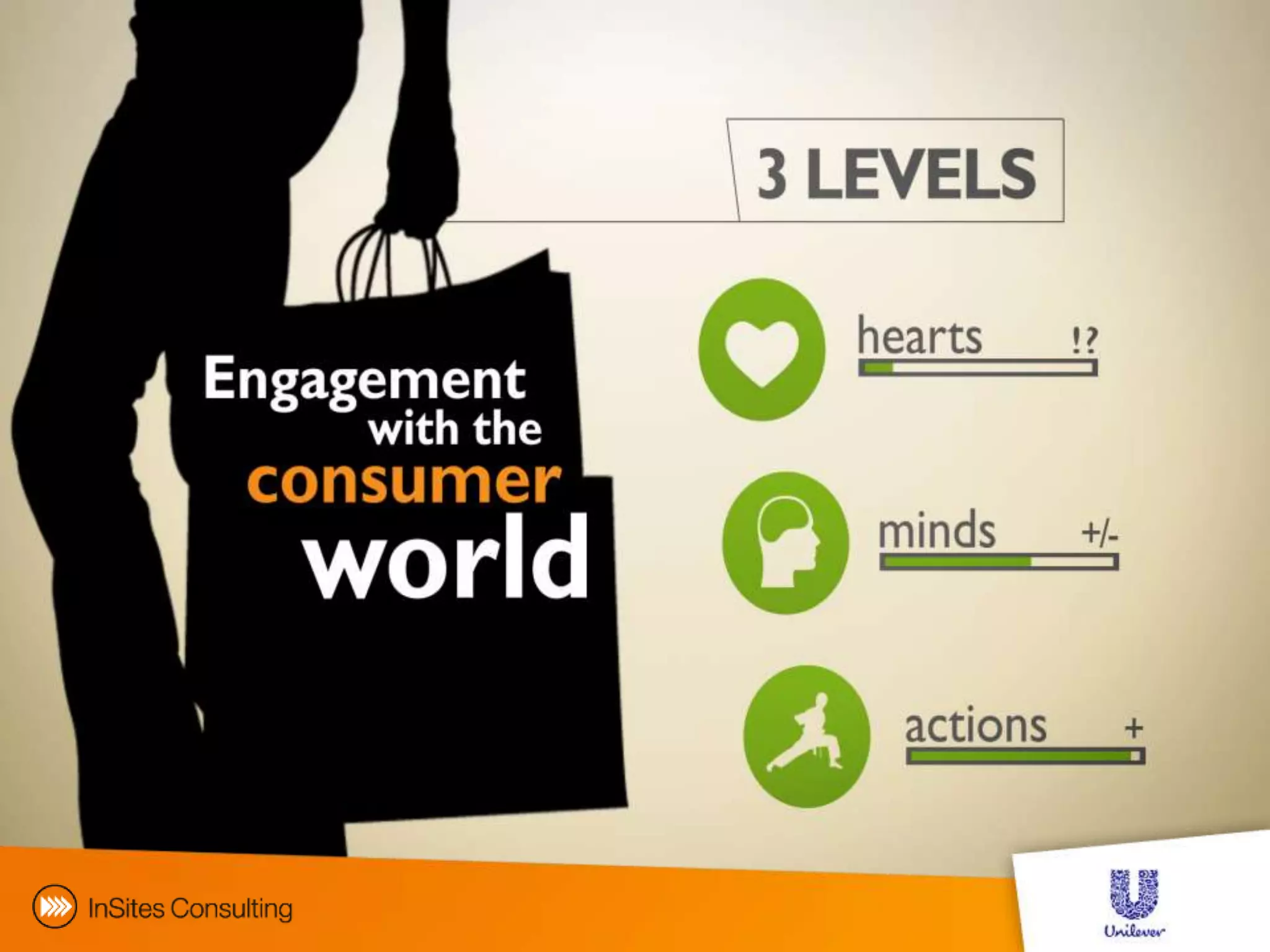
  • #50 “3 levels”A standard approach is to focus on actions only: providing data and conclusions. In order to unlock the full potential of Anita, and the organization, we knew we had to do things differently. The underlying principle is simple, yet powerful. To engage people, and inspire them, to create an impact on their hearts and minds and not only on actions. 
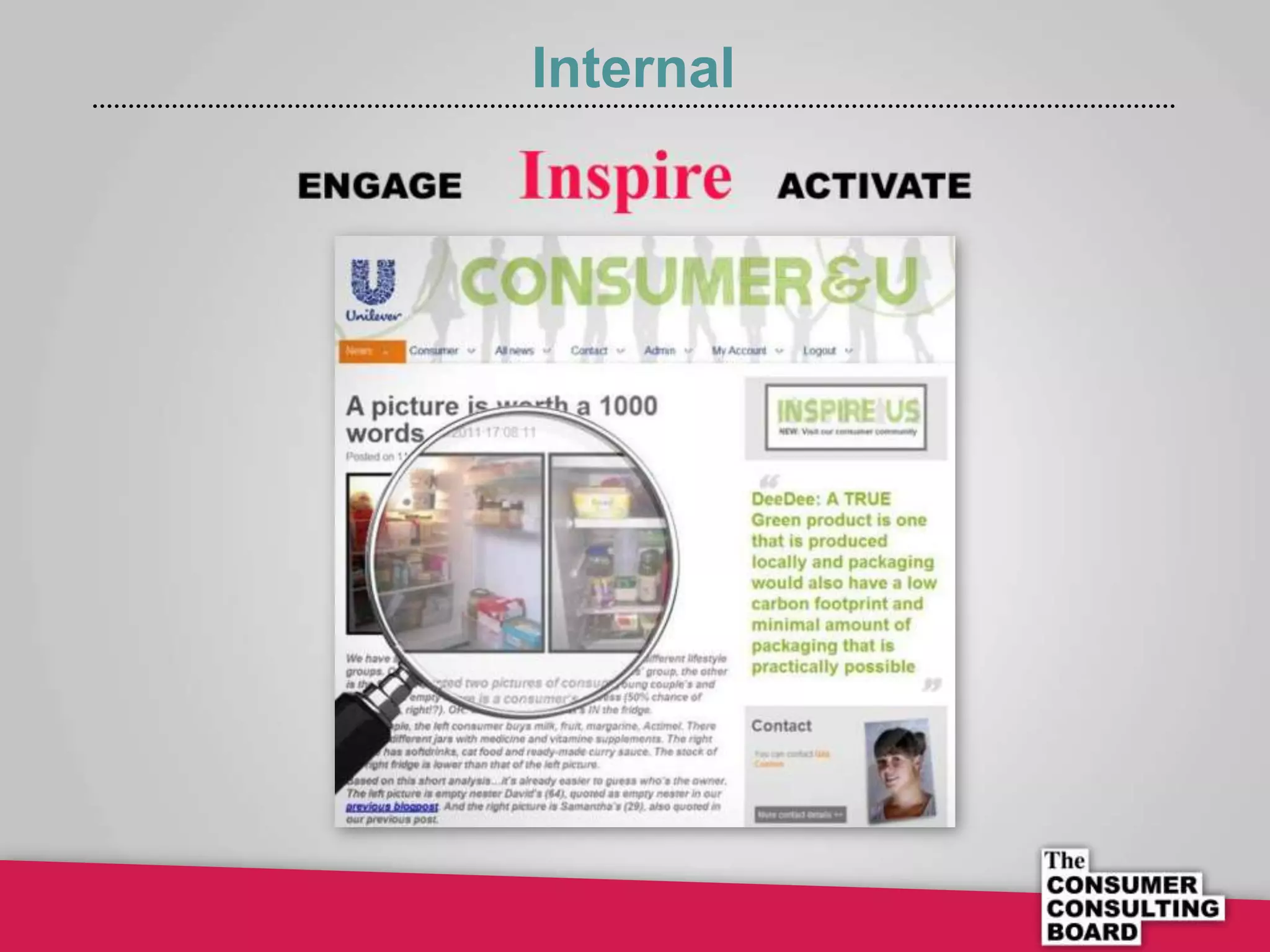
  • #51 Consumer&U made Anita & all of her 1000+ colleagues at the Vlaardingen plant go through 3 different phases, in order to connect with the consumer world and by doing so eventually create more impactful products:- In step one, they engaged with the consumer world by playing games;- Step two inspired them by answering questions they had about consumers’ daily life;- And step three made them dive into the assembled learnings and take action upon them; Let’s take a closer look at each of the phases, illustrated by the project we conducted about the UK consumer...
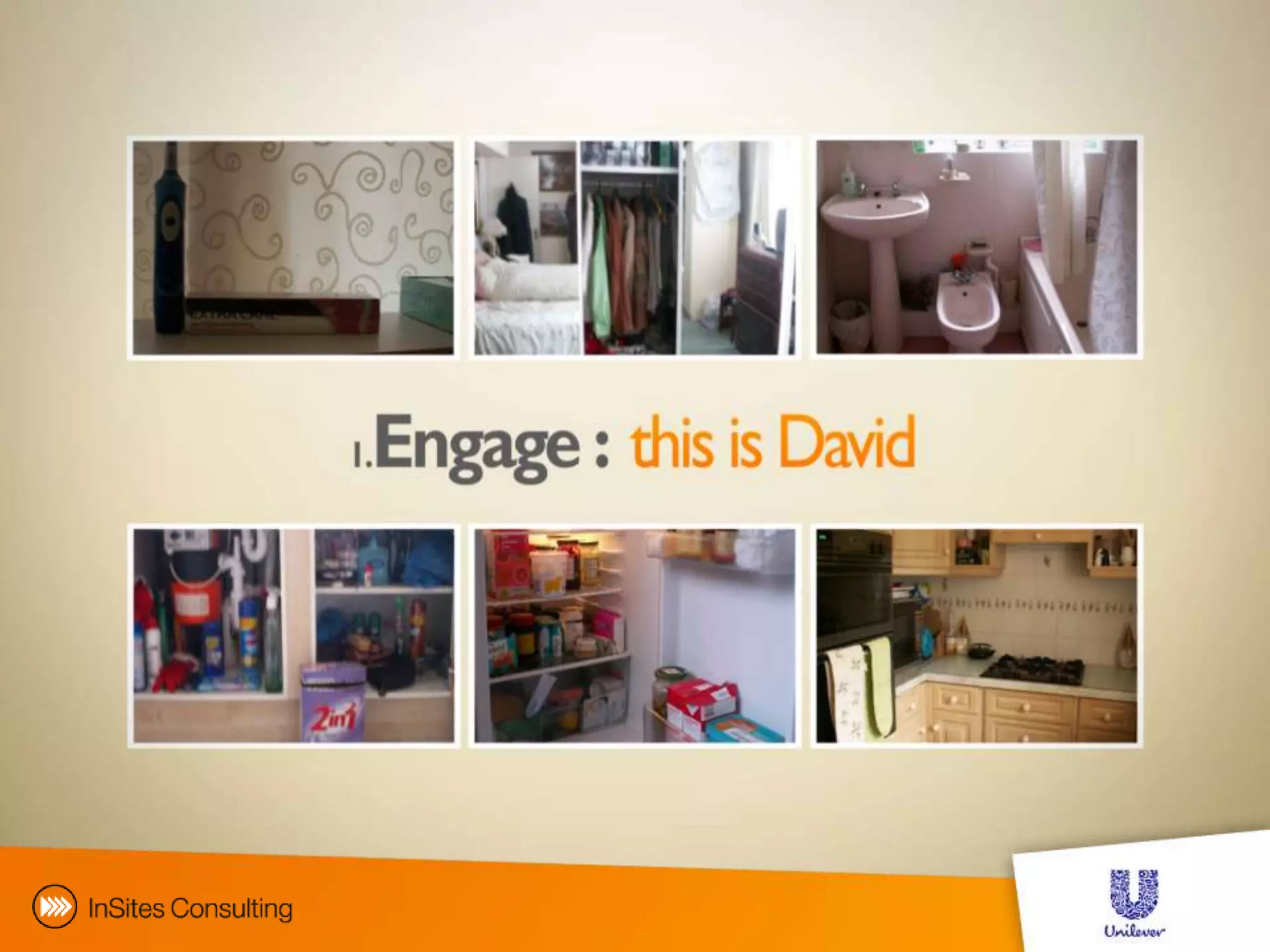
  • #52 During the ENGAGE phase all R&D employees were invited to play games about one specific consumer they were connected with – like David – and facts & figures about the UK consumer in general: In total there were 90 consumers who have given us an insight into their daily lifes via photos & stories; The general data were eye openers coming from other, older, pieces of research; We had 3 of these games played over the course of 3 consecutive weeks. Each quiz tackled different topics, linked to one of the product categories that are researched and developed at the Vlaardingen plant.
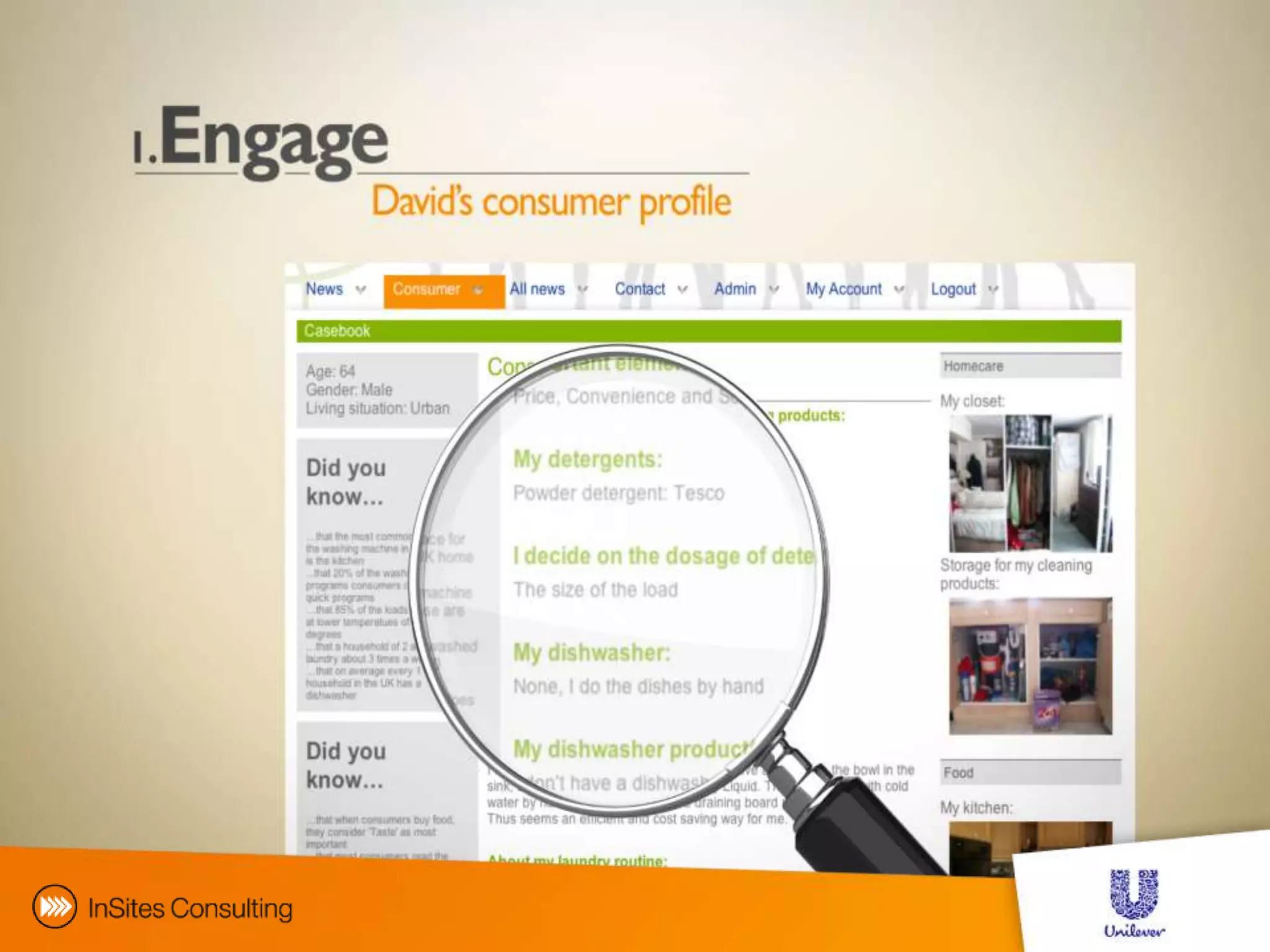
  • #53 By playing a game, the R&D executives unlocked extra information about the consumer they were connected with on a Facebook-like profile page. Allowing them to play the next quiz even better!
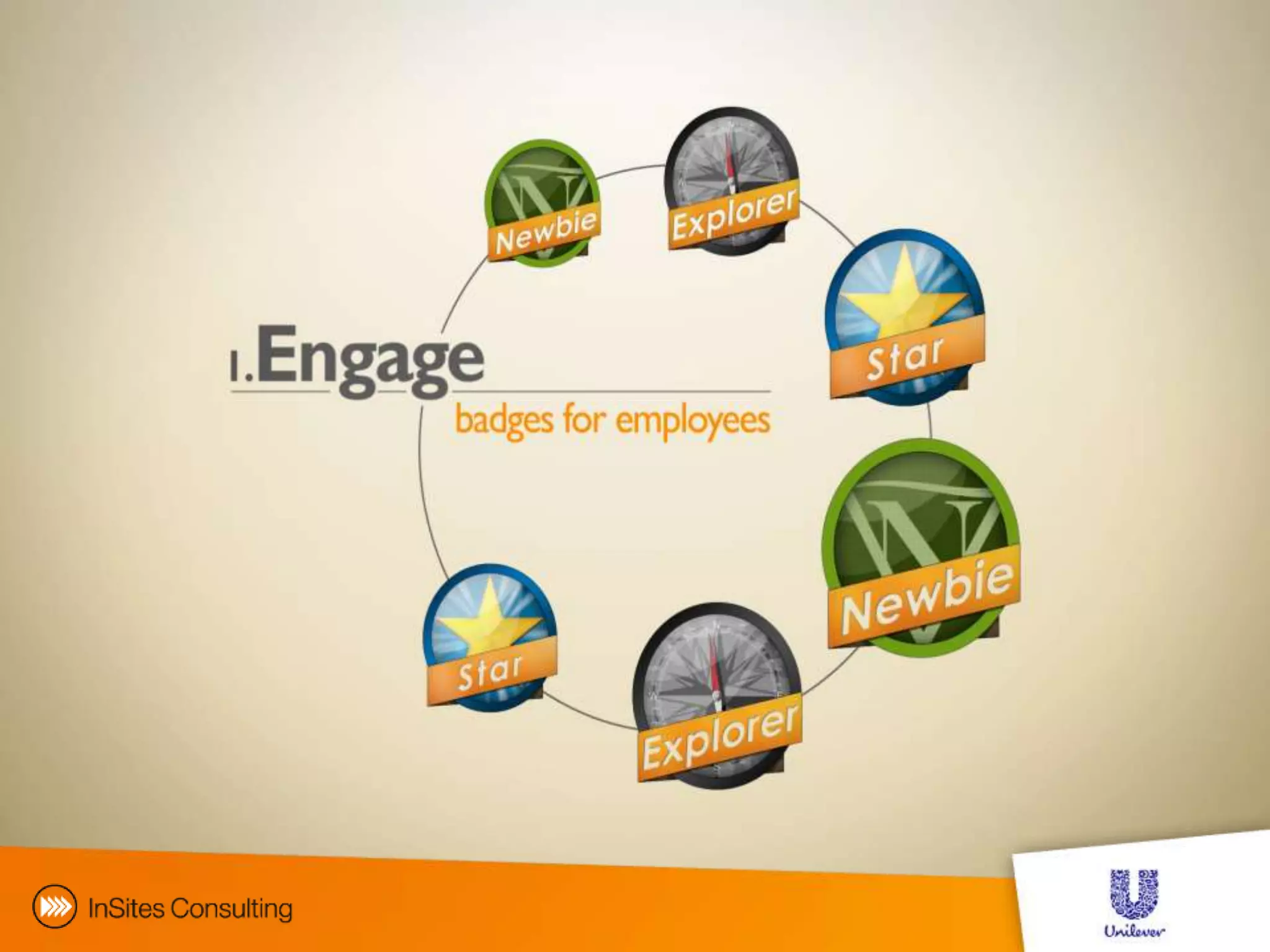
  • #54 To motivate the employees to take part and to take all 3 of the games, we made use of 3 techniques:1/ offline promotion and special events at the plant: posters were distributed, video’s were played & ‘consumer lunches’ were organised;2/ within each of the different departments the team leaders were given the tools to explain to their team what the importance of the project was & they were asked to keep on motivating their team;and 3/ we applied ‘gamification’ principles: after playing a game well, badges were aerned. Next to that, we worked with both an individual leaderboard and an aggregated one on a team level. Playing on both the competetive aspect and the team spirit!
  • #55 By analysing the results of the games we discovered which consumer issues R&D employees did not know enough about. Knowing that the average score in the games was a 4,7 on a 10 point scale, there were enough knowledge gaps to close. Next to that, being confronted with consumers’ daily life and some eye-opening facts, figures and stories triggered questions in the minds of the R&D people. In order to close the knowledge gaps and to get an answer to these questions we invited the 90 UK consumers from the consumer diaries into an online research community called ‘InSpireUs’, and this during again 3 weeks.
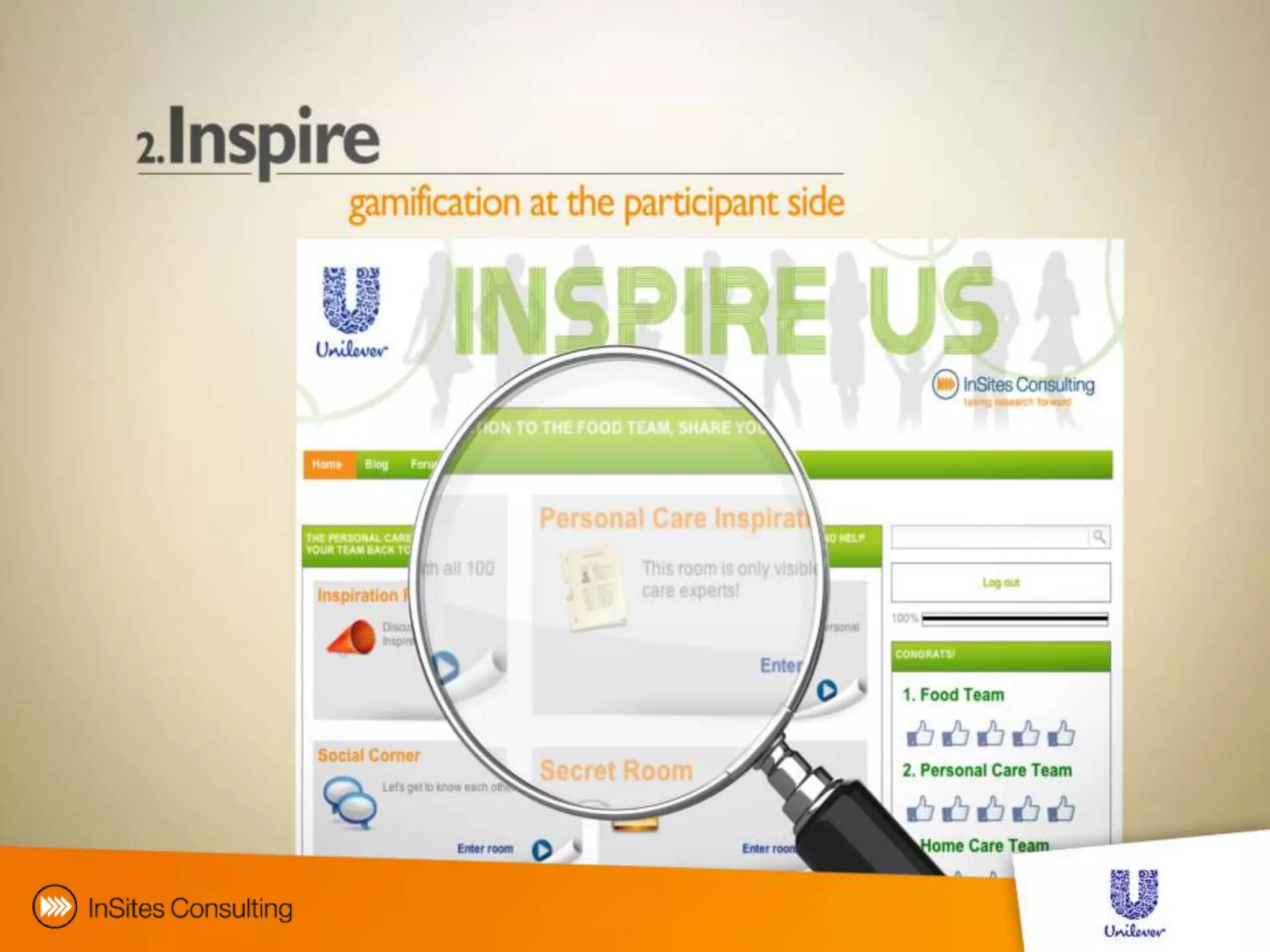
  • #56 Also at the participant side, in our InspireUs community, we applied gamification techniques. This time to motivate our research participants to take part more often and to think harder. Game dynamics were introduced on 3 levels:1/ on an individual level: consumers could earn badges and status by contributing high quality comments;2/ on the level of certain subgroups: for specific questions we created 3 subgroups within the community each of them working on a specific product category. We challenged the different groups or teams to battle against oneanother in coming-up with the best insights and ideas. The winning team, unlocked access to a ‘secret room’ in which ‘secret’ Unilever innovations could be seen in ‘avant-premiere’; 3/ on a community level: if a given number of high quality posts was reached in the community, all members who participated actively unlocked an extra incentive;
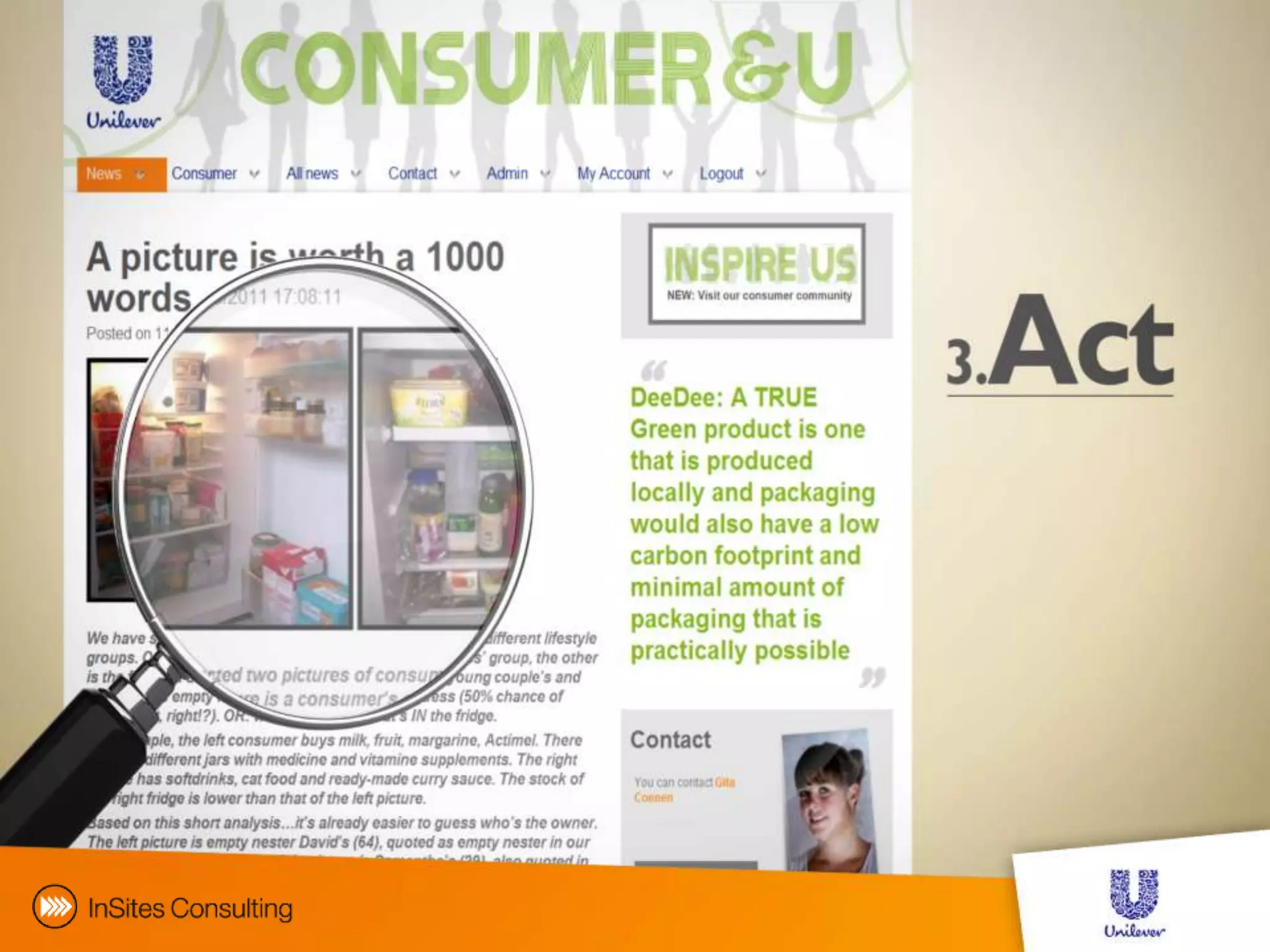
  • #57 Answers to the questions asked and additional information on the knowledge gaps were reported to the organization while the consumer community was running on a news-website.2 fresh articles were shared every working day during the 3 weeks that the community was in the air. Making use a lot of pictures, quotes and consumer stories.After 3 weeks of games & 3 weeks of community and news articles, each team leader got a summary slide deck and the task to organize a workshop within his team to discuss the learnings and to define actions.
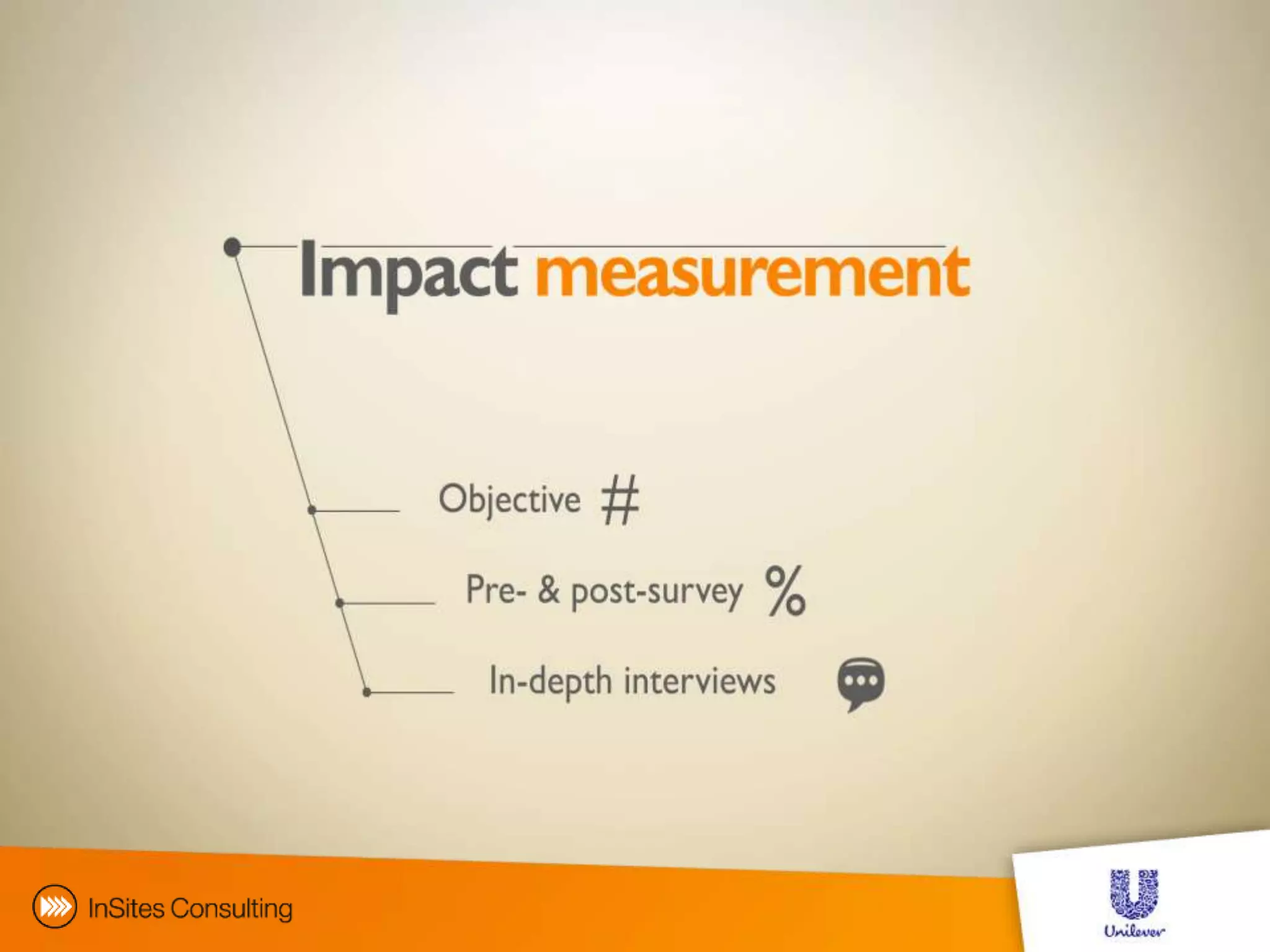
  • #58 What was the impact we created within Unilever R&D Vlaaringen by running this project?Well, we measured this, by making use of 3 different data sources:Objective measures: subscriptions to the games, visits on the newswebsite, etc.;A pre- and post-survey was conducted among participating employees, to see our progress on certain KPI’s;And last but not least, in-depth interviews were conducted among a selection of them to understand what really happened on the workfloor.Let’s take a look at the most striking results!
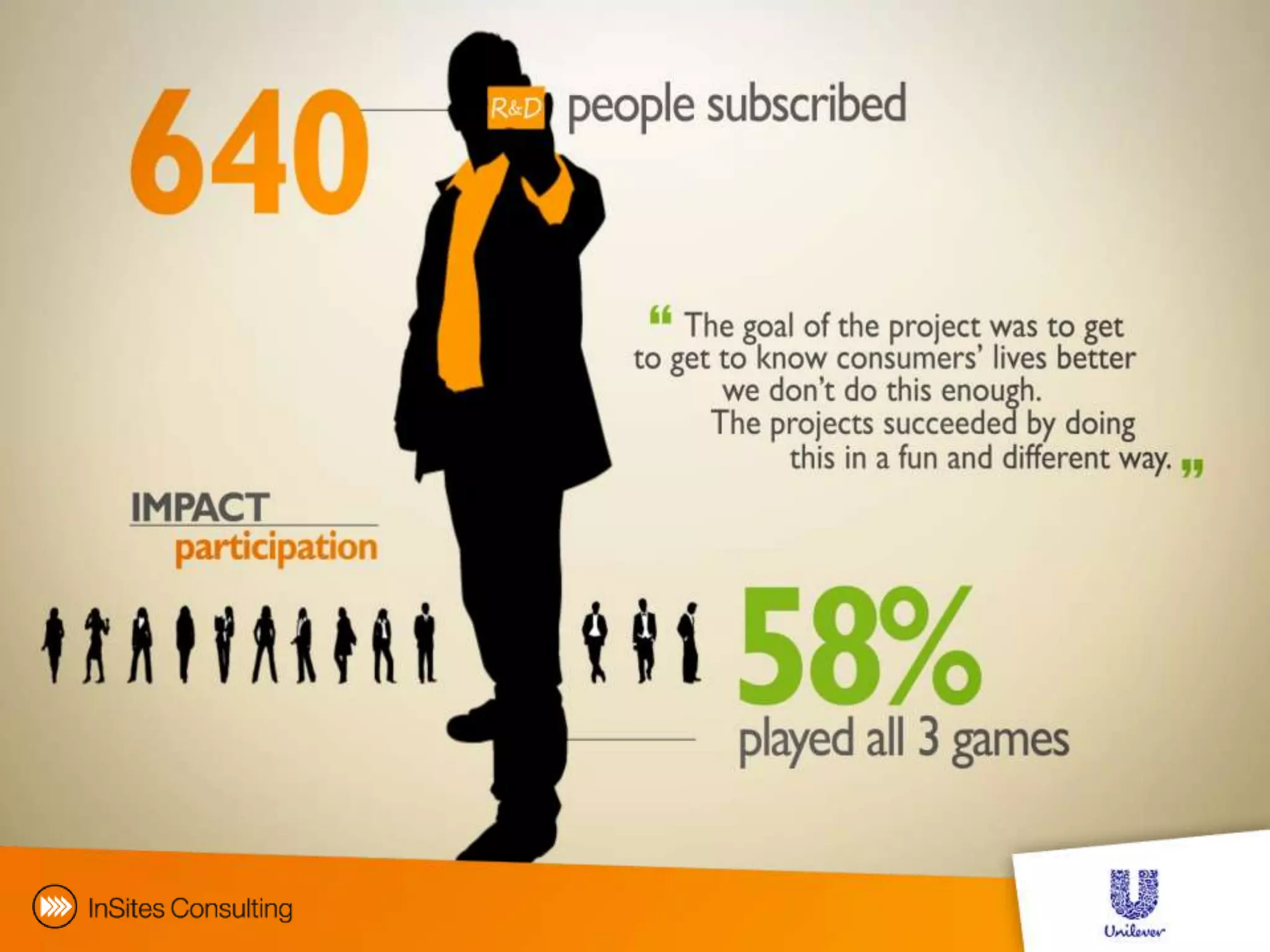
  • #59 In terms of participation:640 R&D executives subscribed to play the games;58% played all 3 of themThe main reason why we were able to engage so many employees is that the project was very relevant to them, it was something new and different and it was just fun to do, because all was gamified!
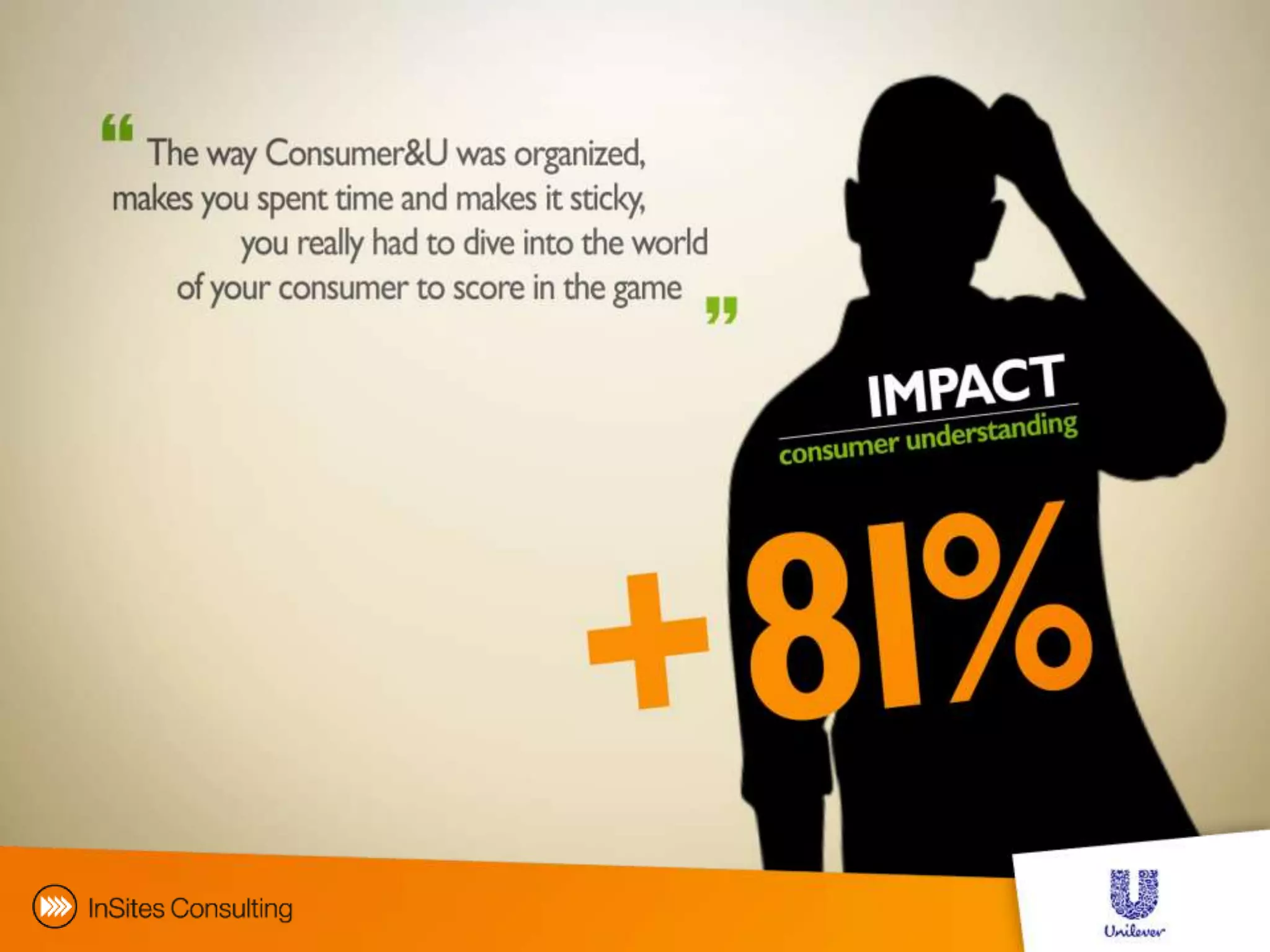
  • #60 We managed to create IMPACT on 3 different levels:Firstly, on an individual level: out of the pre- and post test we know that the self-declared level of consumer understanding had a relative increase of 81%. We generated this impact by the fact that executives were connected with one individual consumer (giving a 360 degree view on that individual) and that the games and the created learning effects were spread over a longer period of time. All well explained by this employee: “The way Consumer&U was organized makes you spent time and makes it sticky, you really had to dive into the world of your consumer to score in the games”. Again a prove that the fact that we gamified it, played an important rol in getting this high figures.
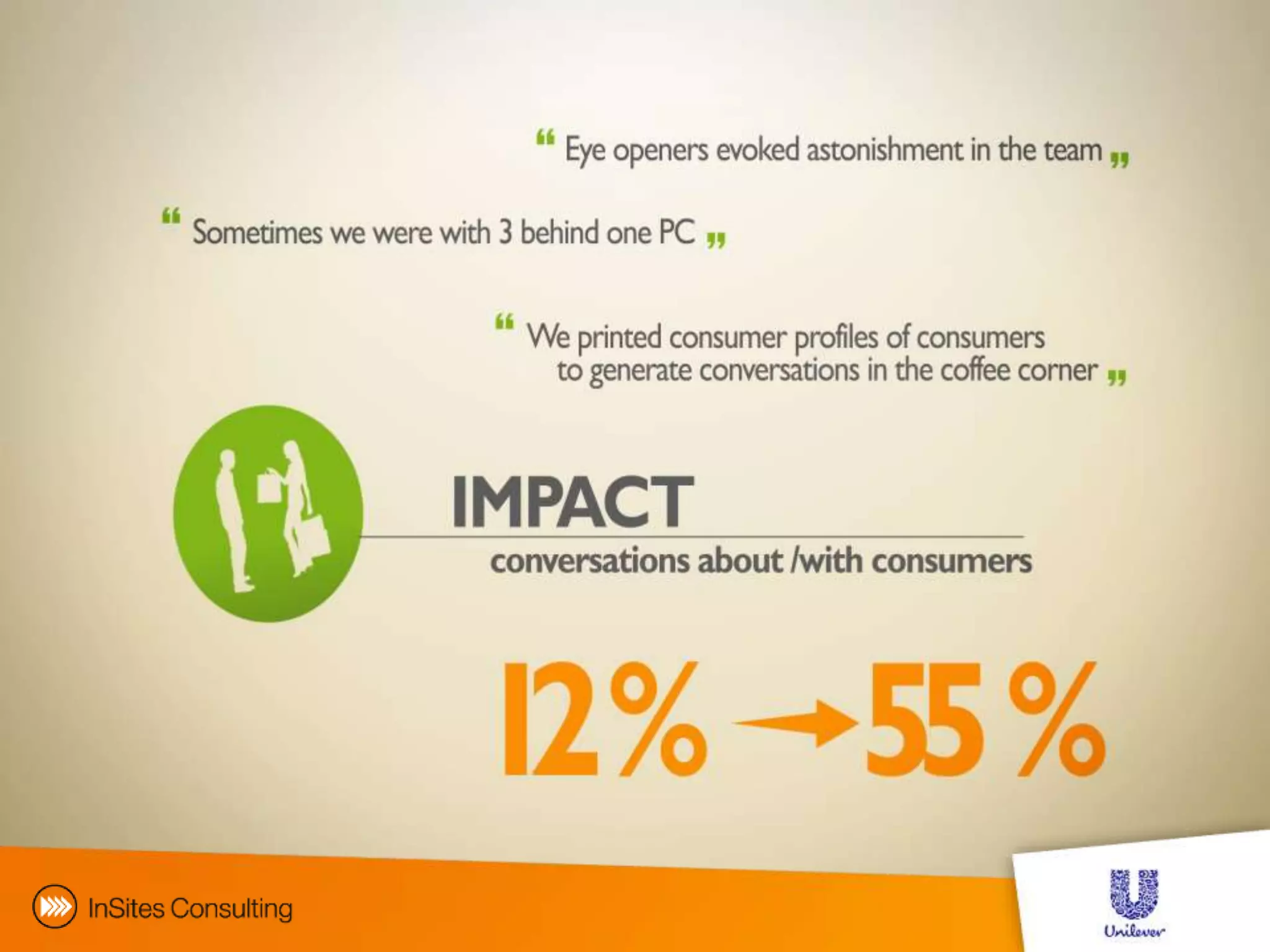
  • #61 Secondly, we saw that the project triggered a lot of conversations about the consumer world internally:“Eye openers evoked astonishement in teams”“Sometimes people were with 3 behind one PC”“Some of them printed the consumer profiles to trigger conversations in the coffee corner”Offcourse the team leaders and the way they were briefed played a big role in getting this result!Next to that we are happy to see that employees also interacted more with the consumer world than they did before. Having conversations about products and their features with family and friends went up from 12 to 55% of the executives doing it frequently.
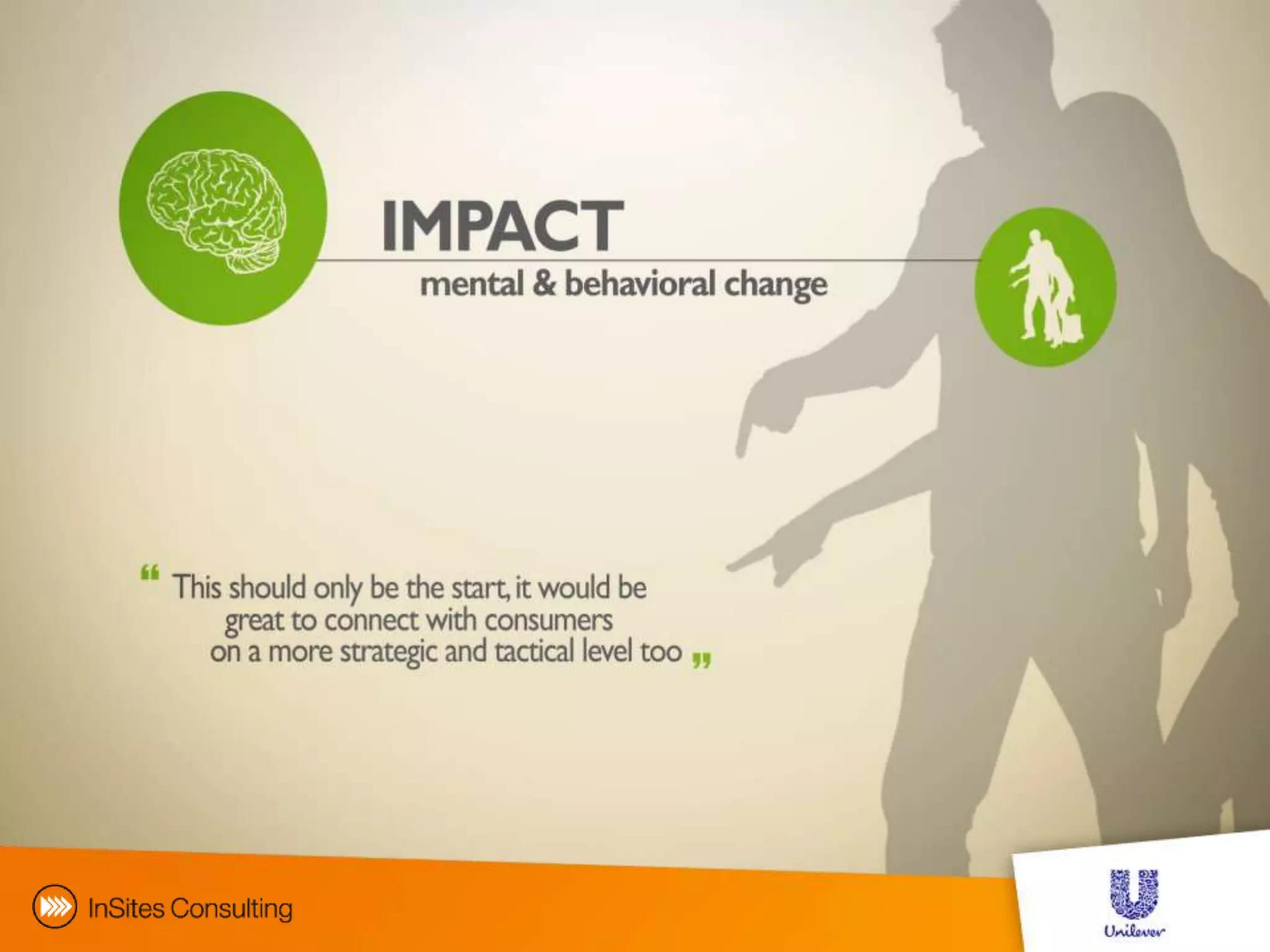
  • #62 And finaly, we also createda certain mental and behavioral change:R&D executives say that due to the project they pay more attention now to how people behave in their daily live and when they go shopping they pay more attention to products of other companies and what they have to offer.Secondly, they indicate that this ‘community’ way of working is really valuable and that this way of connecting with consumers should be applied to day-to-day projects too.
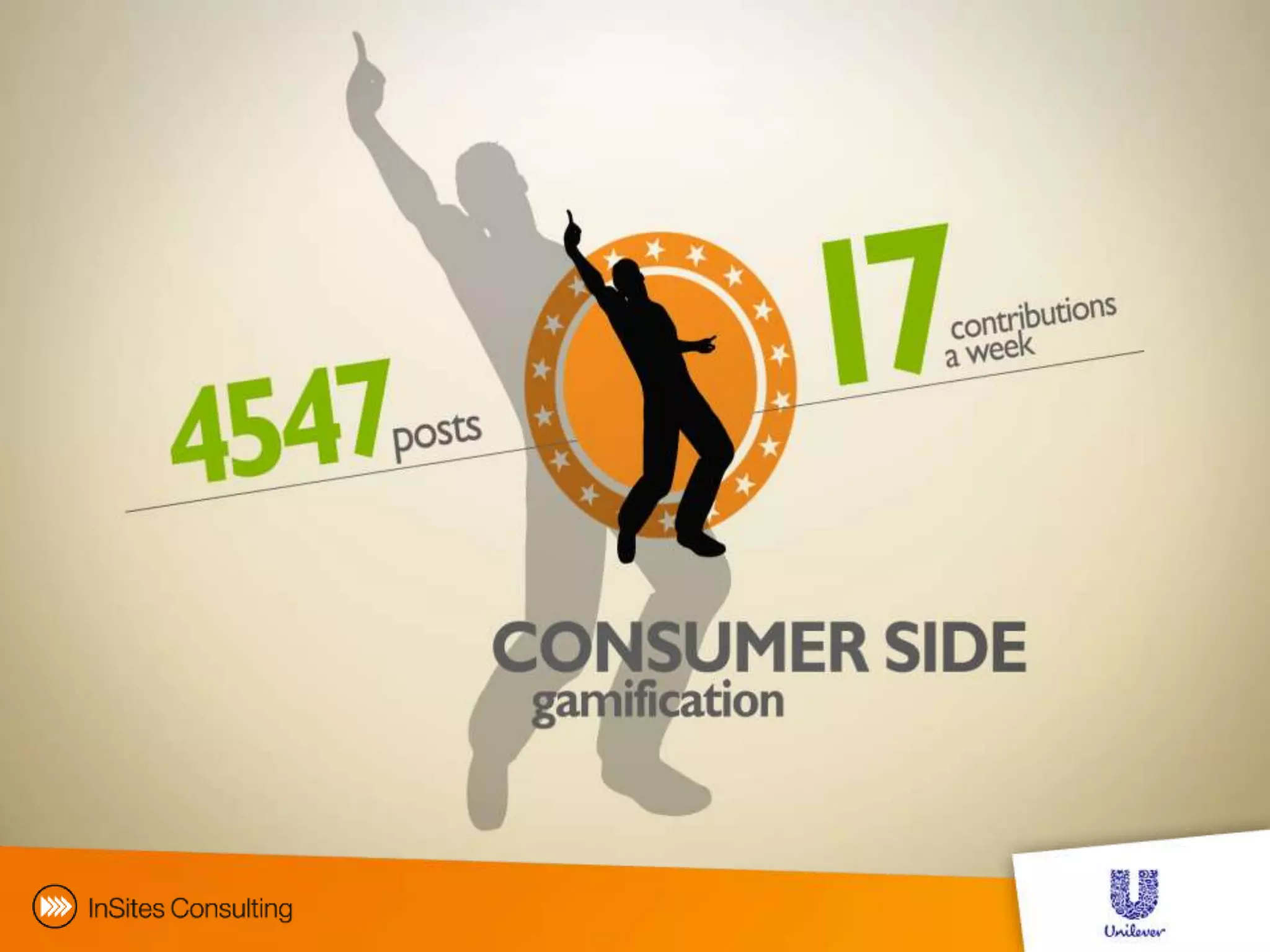
  • #63 We have seen that the fact that we applied game techniques played an important role in the success of this project. What about the effect it had on the consumers participating in our online research community?In total they generated 4547 posts in 3 weeks time. Resulting in an average of 17 contributions a week per member. Which makes it one of the most successful projects we ever did. After coding the number of unique insights coming out of the posts and benchmarking it with non-gamified communities, we came to the conclusion that a gamified community delivers up to 7 times more insights than a non-gamified one! So, also at the consumer side, ‘gamification’ is of great value!
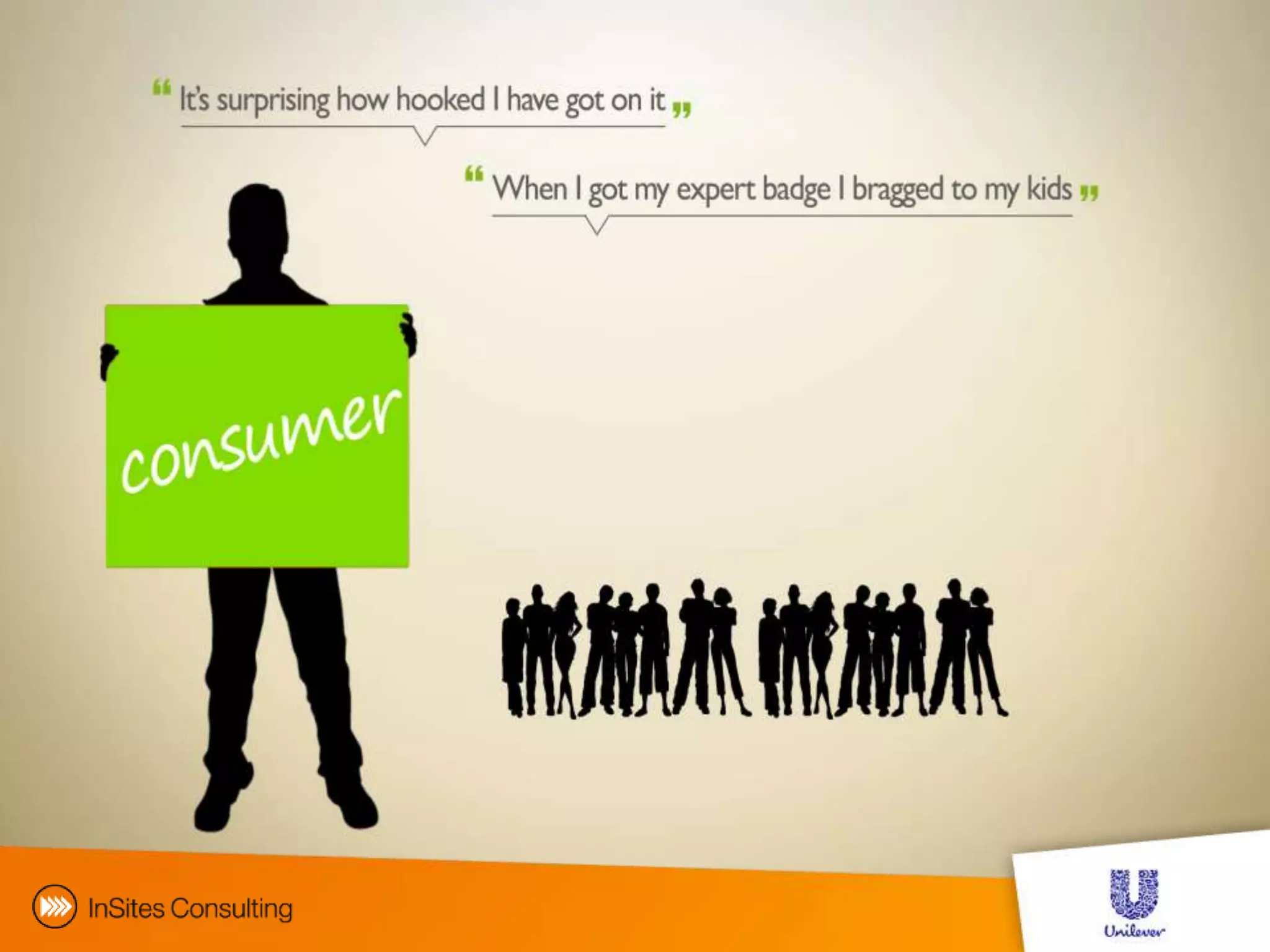
  • #64 And research participants really like it:Some of them are surprised by how hooked to got on it;Othersbragedtotheirkidswhentheygottheir ‘expert’ badge;
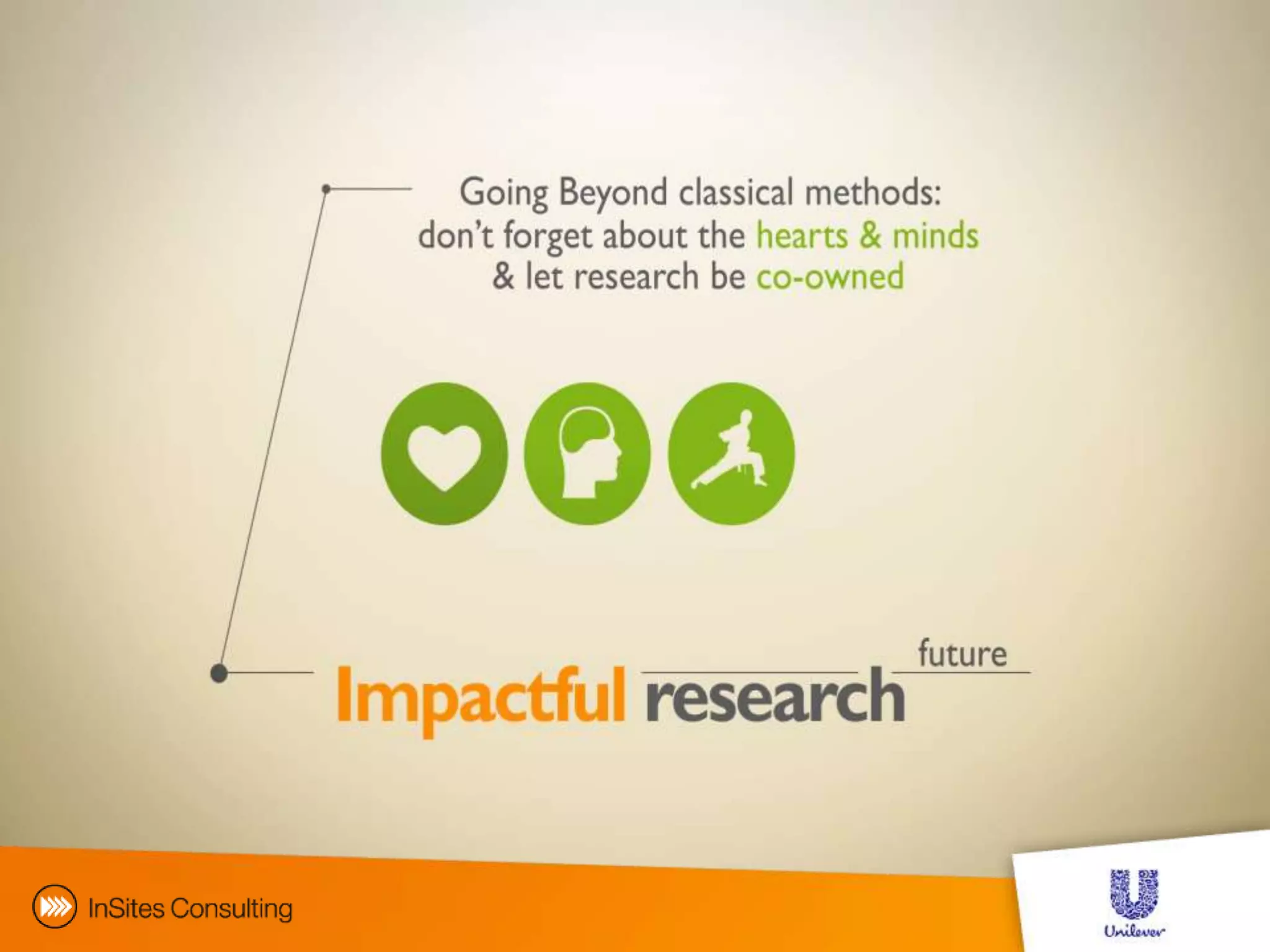
  • #65 You might ask yourself, why such an intensive process? To make sure research is used more often! Well, based on the posttest we discovered the critical success factors for doing impactful research:It should be engaging >>> like we did by engaging the R&D executives with the consumers by playing gamesResearch should give the feeling of being close to the consumer >>> like we did by offering the opportunity to be connected to 1 specific consumerResearch should discover new insights that are worth sharing >>> we shared insights and eye-openers through the news website that created conversations on the workfloor and beyondAnd finally, it should be inspiring >> the creative methods drive the usage of research. Of course it’s still very important to have a good sample and solid research settings, but these have become hygiene factors. Creative methods are the factors that inspire executives.
  • #66 This exercise should be applied to the client’s situation; If not possible, take the case and apply all exercises to this specific case
  • #69 Criteria
  • #70 FAMOUS story
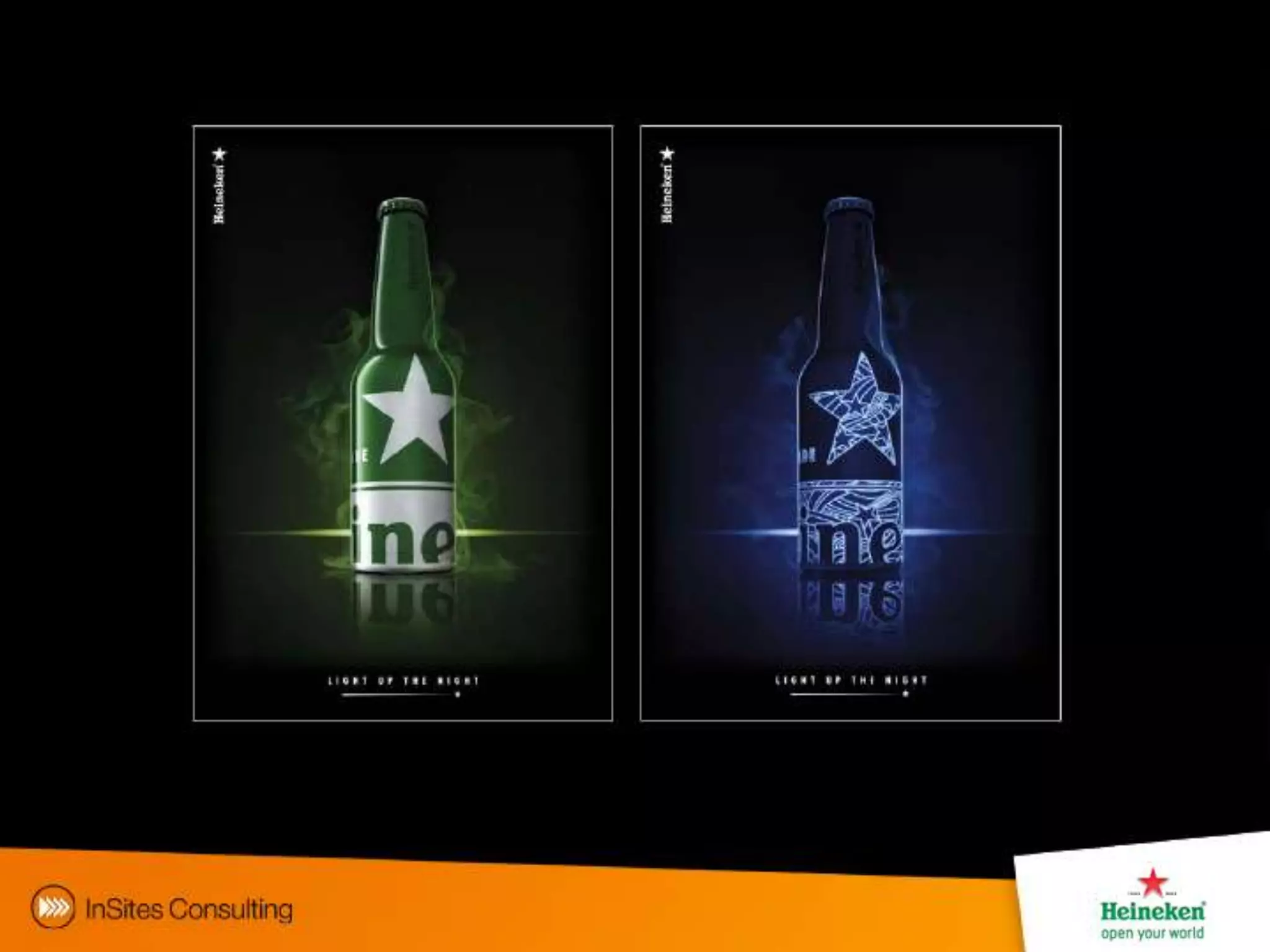
  • #79 Refer to Telenet, Chiquita, Heineken, ...
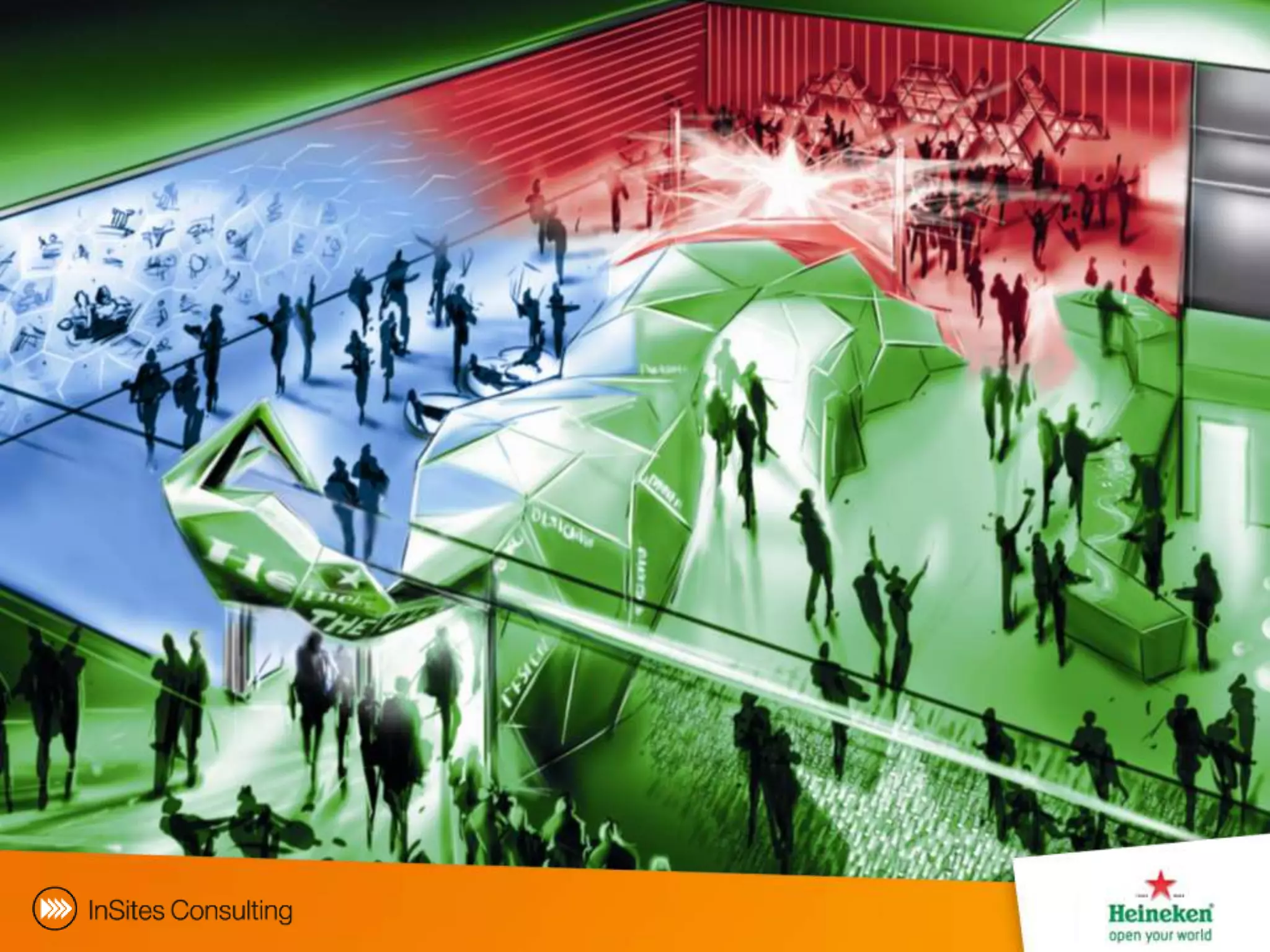
  • #80 THE INITIATIVEIN THE OPEN DESIGN EXPLORATIONS PROJECT EDITION ONE, THE CLUBWE CHALLENGED DESIGNERS AROUND THE WORLD TO CREATE THEIR VISION OF THE FUTURE CLUB, TO BE BUILD AT THE PRESTIGUES DESIGN FAIR IN MLANO APRIL 2012.A GREAT PODIUM FOR DESIGNERS TO SHOWCASE THEIR TALENT.NOT FOR MONEY BUT FOR THE GLORY.
  • #82 TO GIVE THEM THE RIGHT BAKCGROUND AND INSPIRATION, WE AKSED 140 CLUBBERS TO SHARE THEIR EXPERIENCES.SOMETIMES THE SIMPLEST, OBSERVATIONS CAN LEAD TO GREAT DESIGN SOLUTIONS.
  • #84 WE CHALLENEG OURSELVES TO BE INNOVATIVE AND GROUNDBREAKING, WE ALSO CHALLENGE OUR PARTNERS.
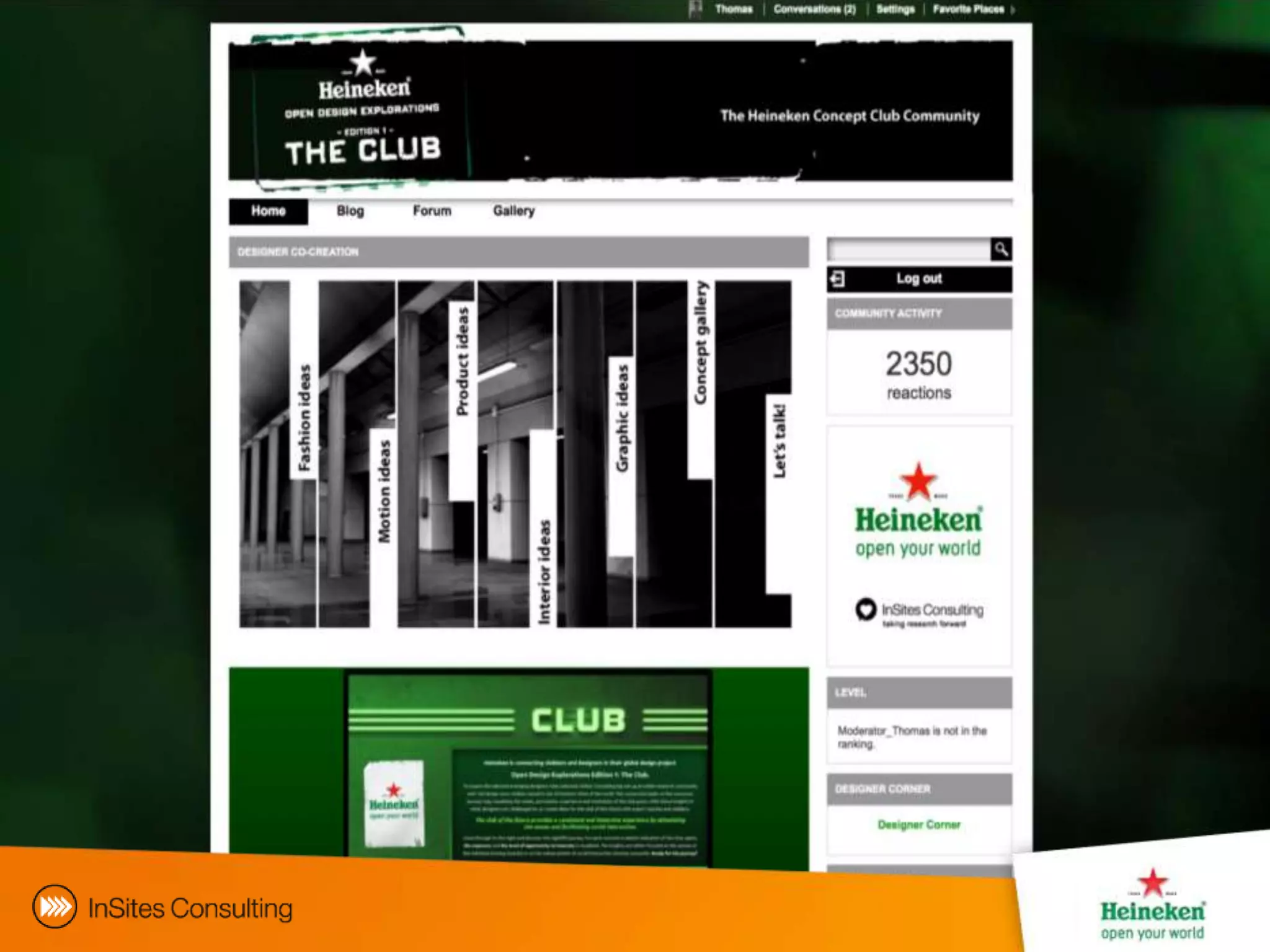
  • #85 THE DESINGERS WERE STRANGERS, SO WE TOOK THEM ON A CLUB TOUR TO OBSERVE INTERIORS, BEHAVIOUR AND SHARE THOUGHTS IDEAS AND GET TO KNOW EACH OTHER. A GREAT TEAM SPIRIT WAS CREATED!TO ENABLE CO-CREATION WE HAVE ASKED INSITES TO SET UP A PLATFORM WITH US.AS DESIGNERS WORK FROM ALL OVER THE WORLD THE Y HAVE TO BE ABLE TO SHARE IDEAS, BUILD ON EACH OTHER IDEAS, GET FEEDBACK FROM EACH OTHER AND THE COACHES AND BE INSPIRED.
  • #86 Followup: measure the effect and ROI of the club, to what extent they actually meet consumer’s needs
  • #87 This exercise should be applied to the client’s situation; If not possible, take the case and apply all exercises to this specific case
  • #88 *adversaries: better able to cope with negative WOM because the results from consumer collaboration are the ‘weapons’ to guard against negative conversations
  • #90 Heinz, Heineken, Telenet