Workplace
learning in
2018
Bob Price
Learning and
Development Business
Partner
United Welsh
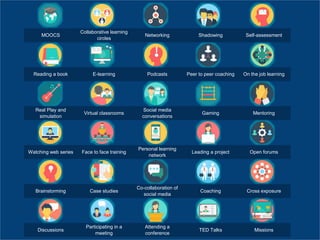
MOOCS
Collaborative learning
circles
Networking Shadowing Self-assessment
Reading a book E-learning Podcasts Peer to peer coaching On the job learning
Real Play and
simulation
Virtual classrooms
Social media
conversations
Gaming Mentoring
Watching web series Face to face training
Personal learning
network
Leading a project Open forums
Brainstorming Case studies
Co-collaboration of
social media
Coaching Cross exposure
Discussions
Participating in a
meeting
Attending a
conference
TED Talks Missions
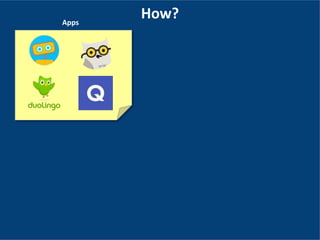
How?Apps
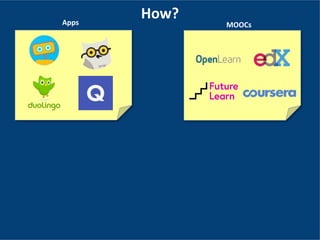
How?Apps MOOCs
How?Apps
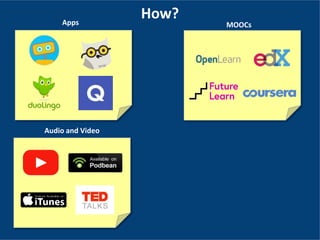
Audio and Video
MOOCs
How?Apps
Audio and Video
MOOCs
Online tools
Next steps?
Virtual reality, augmented reality, artificial intelligence
Thank You
Bob Price
About.me/bob.price

Workplace learning 2018

Editor's Notes

  • #2 I was walking out of work one evening when a young man approached me and said “hey Bob I haven't had any training recently, put me on a course Bob, put me on a course!”   The irony of this was that this particular young man, on a weekly basis, sat with his team where they discussed cases they completed that week. They looked at what was new, what was different, what was the same, and more importantly, what they had learnt. But to him learning was something that happened when you attended training, he didn’t see this as learning.
  • #3 So why is this? This image I first saw in a talk given by Donald Clark. It shows the King of Germany, that gentleman in the pulpit with a magnificent beard, speaking to a university in the 14th century. You'll notice that the structure of one person at the front speaking to a room full of people in rows of desks is very similar to that that is seen in schools, colleges, universities, and workplaces across the UK. Whilst a lot of work has been made to transfer school work and college work to projects for many learning is seen as being a classroom based activity. It's no wonder then that so many people see training as learning.
  • #4 The reality is that there are many different ways to learn. This image shows some of them. You'll notice that face-to-face training is on the list because this is still an important way of learning. However it's not the only one and it's not one that we take control of and use to develop ourselves. It is a means to an end especially for compliance and practical hands-on subjects. In many cases what is learnt in the classroom can be learnt by other means. It should also be remembered that what we learn in a classroom we rapidly forget Ebbinghaus forgetting curve shows clearly that within 30 days we can have forgotten up to 79% of what we've learnt in a face-to-face training course. To put that in money terms if we spend ÂŁ1,000 on a training course we could end up putting ÂŁ790 into the bin.
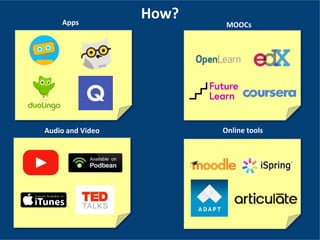
  • #5 These are some of the alternatives that we can use to learn in apps. There are many apps on Google Play and at the Apple store which we can use for learning. These examples include Woebot which is a chatbot used to train cognitive behavioural therapy. Duolingo, the owl, is a language app which can be used with many modern foreign languages including French German and Spanish as well as Welsh. It analyses what you're learning and then create lessons for you based on what you need to develop. There are apps such as Quizlet and Socriatic which can be used by teachers and learning specialists to allow refreshing of learning. These can be use as part of a wider blended model to underpin the learning from face to face training. Less is forgotten and we get a better return on investment.
  • #6 MOOCs were once touted as being the future of learning however the standard of consistency has been variable in some cases. However there remains a phenomenal amount of really high quality online learning with structured courses delivered by global universities. In some cases your pay for a certificate of completion but in others you can just simply do it. Some offer open badges and others would just give you the satisfaction of doing it. This year I've done two courses with the University of Derby, one on dementia and one on depression, I've completed one with Julian Stodd Sea Salt Learning on Social Leadership and, just for fun, one with the University of Sunway on coffee. There are many of these suppliers around and from a tech point of view it should be noted eDx offer a wide range of Microsoft accredited courses covering Dev Opps, Azure, SharePoint, etc
  • #7 In this year's top 100 tools for learning just released by Jane Hart, an infographic shows within the top 10 firmly planted at the top of the tree is YouTube. So many people learn so many things from YouTube it's not just about kittens and sneezing Pandas. For years I've been asked to deliver advanced Excel training but when I try and tie down what people want from Excel they don't actually know. I send the back to study their work and how Excel could do that and therefore what formulas they need. I then ask them look up what they need on YouTube, and funny enough after that I tend not to get people coming to me and saying can I have advanced Excel courses.   Podcasts through Podbean for Android and iTunes for iOS are massively popular way of delivering learning and delivering knowledge. There's a lot of good funny podcast but there are a lot podcast on a range of topics relevant to tech and to other subjects within the workplace. Finally TED talks by experts on technology, philosophy and life in general. I would look at getting the app, there is a new talk pushed to it daily.
  • #8 Finally there are the tools to develop these things yourself. They are very good authoring tools such as iSpring and Articulate storyline which allow people to develop their own content using subject matter experts within their organisations. Adapt is a free tool but can be also obtained as part of subscriptions with companies such as Learning Pool. It delivers screen scrolling based learning again in HTML5 format. The old staple Moodle is available as a learning management system allowing users to upload the content for viewing by others.
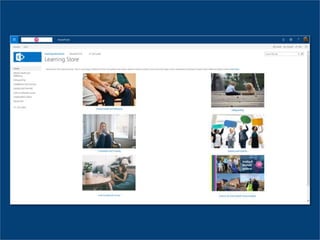
  • #9 Within United Welsh we use SharePoint to host media libraries where we curate YouTube videos, TED talks National Geographic videos, and a range of articles and documents. These relate to subjects such as mental health, safeguarding, equality and diversity and housing and compliance. Making use of subject matter experts online modules have been created in equality and diversity, universal credit, and domestic abuse. A new module on staying safe online aimed at front line staff will be launched shortly. This is the start of an online journey for our particular organisation, one which hopefully will cumulate in a learning platform
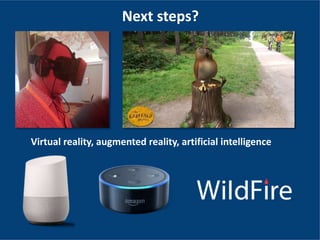
  • #10 So what's next? It's very clear that virtual reality has a real place in learning. It's fascinating to see South Wales police creating environments and scenarios using VR to train their staff in the Waterton training centre. With regard to augmented reality there are many uses, a lot of them at the moment are focused on leisure. The example here is the Forestry Commission Gruffalo Trail where uses pointed their phones at targets and a tree stump with characters from the book appeared in a life like form.   When discussing artificial intelligence I don't yet think we have found the killer app yet for Alexa and Google home. However we have been talking about how these could be incorporated into housing. For example 50+ sheltered schemes;- “hey Alexa call my son” “hey Alexa what's my rent?” “hey Alexa I need to make maintenance call”   Likewsie “Julie it's 3 o’clock, it's time to take your medication”   Wildfire is a company set up by Donald Clark that uses an artificial intelligence engine to rapidly create online learning modules. By sending in your PowerPoint, word, and pdf materials they can create instructional materials which can be used online to cover compliance and other training.  
  • #11 At the heart of all this is people taking control of their own learning, taking control of what they learn, how they learn, and when they learn. It is identifying what learning is and where learning is taking place and by doing this we can start accepting we are being developed and we are learning.   Therefore at the end of the day I may get a few less people walking up to me saying “hey Bob, put me on a course”