RISK MANAGEMENT SAFETY
APPLIED TO SAFETY,
SECURITY AND SANITATION
Ice Breaker!!
TYPES OF HAZARDS
Where can we find hazards?
We can find hazards commonly at work. A
hazard is a potential source of harm.
Substances, events, or circumstances can
constitute hazards when their nature
would allow them, even just theoretically,
to cause damage to health, life, property,
or any other interest of value.
How hazards are classified?
Hazards can be classified in several ways;
they can be classified as natural,
anthropogenic, technological, or any
combination, such as in the case of the
natural phenomenon of wildfire becoming
more common due to human-made
climate change or more harmful due to
changes in building practices.
SAFETY HAZARD
PHYSICAL HAZARD
ERGONOMIC HAZARD
ORGANIZATION HAZARD
CHEMICAL HAZARD
BIOLOGICAL HAZARD
4 steps to manage hazards and
risk
The best way to prevent injuries or illness in your workplace is to find the
hazards that could cause injury or illness, and fix them. Do this by
following four simple steps:
Spot the Hazard
Assess the Risk
Fix the Problem
Evaluate Results
This process is often called risk assessment.
 SPOT THE HAZARD
A hazard is anything that has the potential to
cause injury, illness or damage to your health.
ASSESS THE RISK
A risk is the likelihood of a hazard
causing injury, illness or damage to
your health.
What is the potential impact of the hazard?
• How severe could an injury or illness be?
• Would it require simple first aid only? Or cause permanent ill
health or disability? Or could it kill?
FIX THE PROBLEM
You should always aim to remove a
hazard completely from your workplace.
Where this isn’t practical, you should
work through the other alternatives
systematically.
FIND A SOLUTION TO FIX THE PROBLEM!!
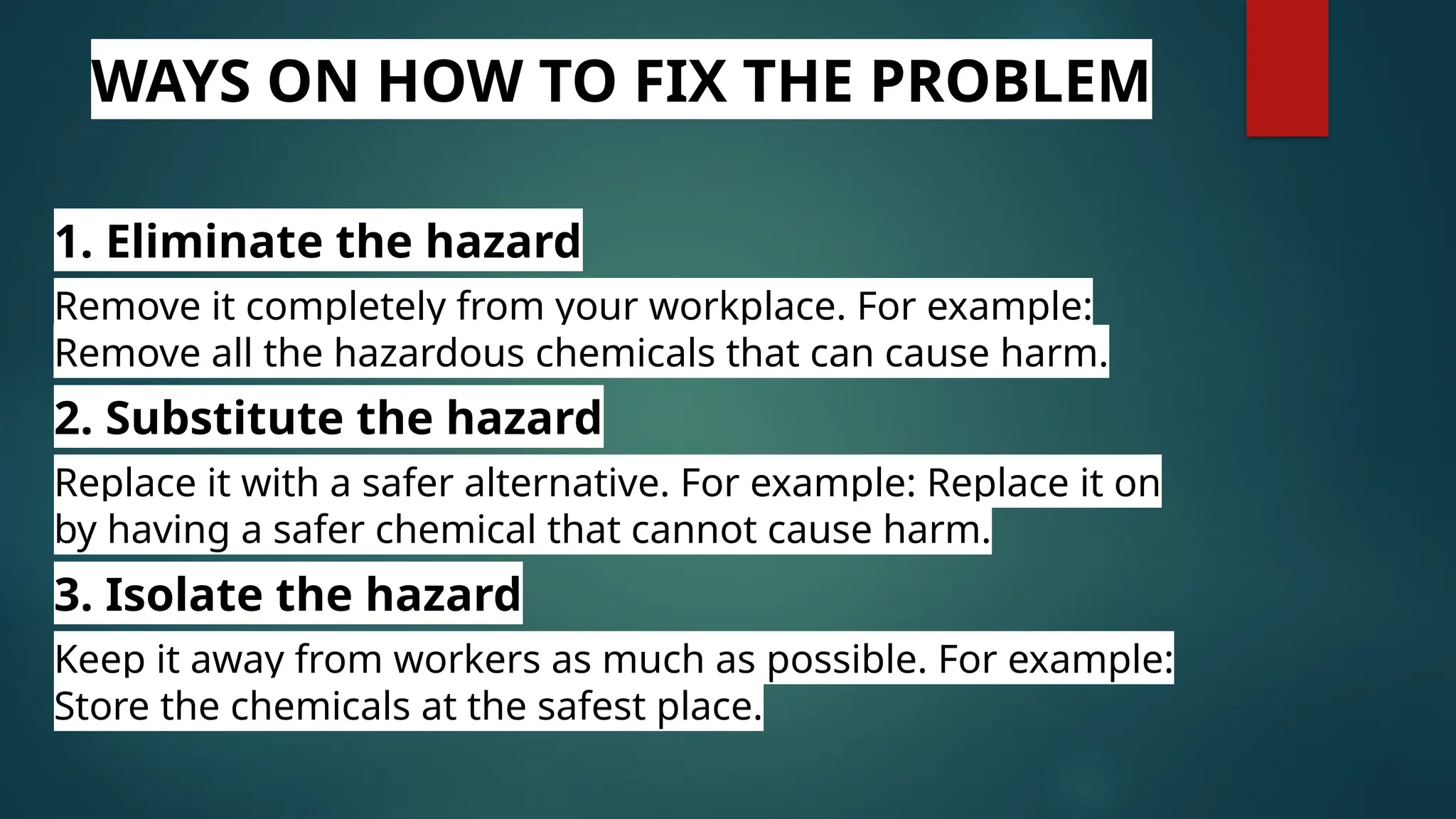
WAYS ON HOW TO FIX THE PROBLEM
1. Eliminate the hazard
Remove it completely from your workplace. For example:
Remove all the hazardous chemicals that can cause harm.
2. Substitute the hazard
Replace it with a safer alternative. For example: Replace it on
by having a safer chemical that cannot cause harm.
3. Isolate the hazard
Keep it away from workers as much as possible. For example:
Store the chemicals at the safest place.
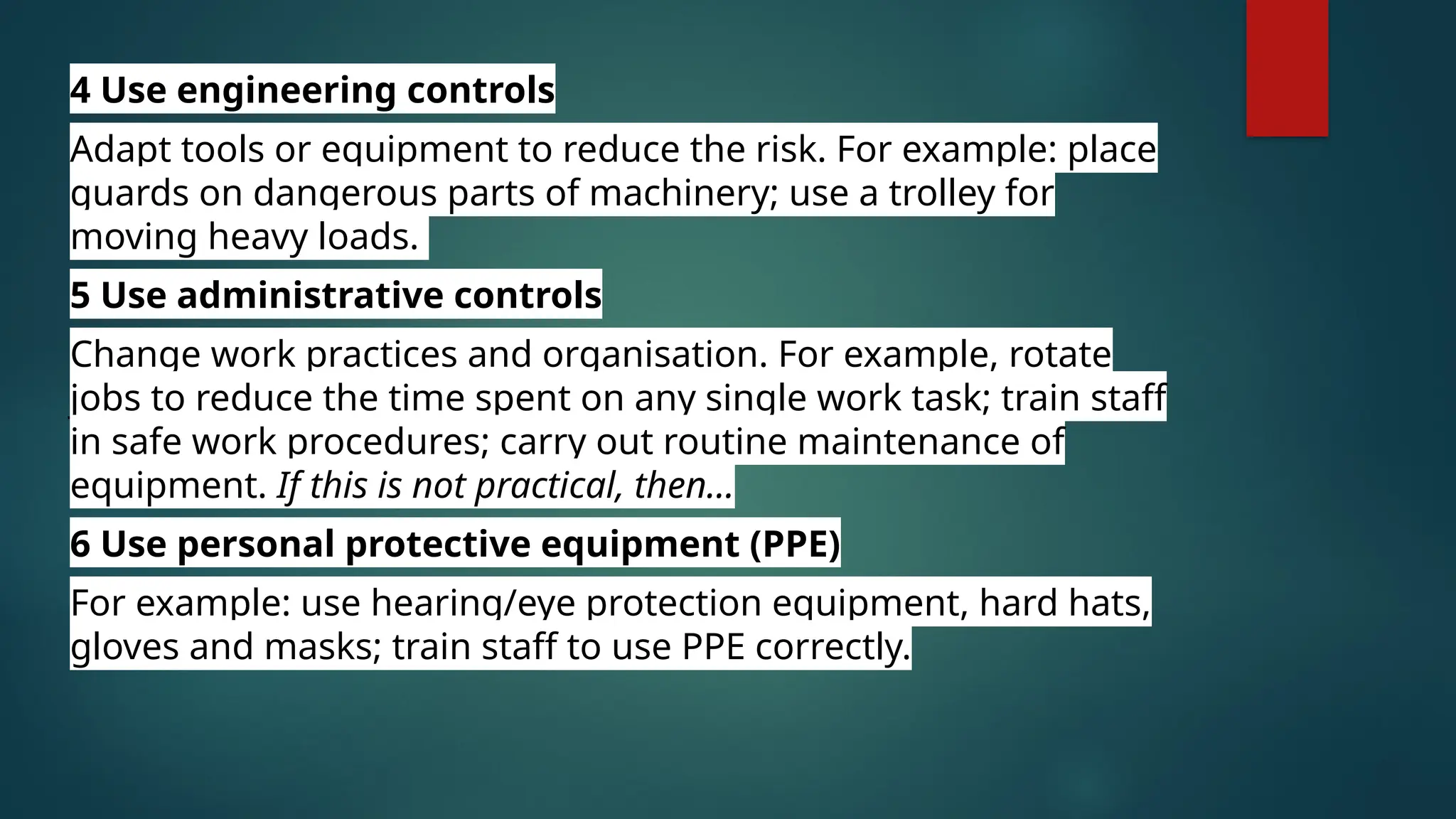
4 Use engineering controls
Adapt tools or equipment to reduce the risk. For example: place
guards on dangerous parts of machinery; use a trolley for
moving heavy loads.
5 Use administrative controls
Change work practices and organisation. For example, rotate
jobs to reduce the time spent on any single work task; train staff
in safe work procedures; carry out routine maintenance of
equipment. If this is not practical, then…
6 Use personal protective equipment (PPE)
For example: use hearing/eye protection equipment, hard hats,
gloves and masks; train staff to use PPE correctly.
EVALUATE RESULTS
After you think you’ve fixed the problem,
find out whether the changes have been
effective.

RISK MANAGEMENT SAFETY APPLIED TO SAFETY, SECURITY.pptx

  • 1.
    RISK MANAGEMENT SAFETY APPLIEDTO SAFETY, SECURITY AND SANITATION
  • 2.
  • 4.
  • 5.
    Where can wefind hazards? We can find hazards commonly at work. A hazard is a potential source of harm. Substances, events, or circumstances can constitute hazards when their nature would allow them, even just theoretically, to cause damage to health, life, property, or any other interest of value.
  • 6.
    How hazards areclassified? Hazards can be classified in several ways; they can be classified as natural, anthropogenic, technological, or any combination, such as in the case of the natural phenomenon of wildfire becoming more common due to human-made climate change or more harmful due to changes in building practices.
  • 9.
  • 10.
  • 11.
  • 12.
  • 13.
  • 14.
  • 15.
    4 steps tomanage hazards and risk The best way to prevent injuries or illness in your workplace is to find the hazards that could cause injury or illness, and fix them. Do this by following four simple steps: Spot the Hazard Assess the Risk Fix the Problem Evaluate Results This process is often called risk assessment.
  • 16.
     SPOT THEHAZARD A hazard is anything that has the potential to cause injury, illness or damage to your health.
  • 17.
    ASSESS THE RISK Arisk is the likelihood of a hazard causing injury, illness or damage to your health. What is the potential impact of the hazard? • How severe could an injury or illness be? • Would it require simple first aid only? Or cause permanent ill health or disability? Or could it kill?
  • 18.
    FIX THE PROBLEM Youshould always aim to remove a hazard completely from your workplace. Where this isn’t practical, you should work through the other alternatives systematically. FIND A SOLUTION TO FIX THE PROBLEM!!
  • 19.
    WAYS ON HOWTO FIX THE PROBLEM 1. Eliminate the hazard Remove it completely from your workplace. For example: Remove all the hazardous chemicals that can cause harm. 2. Substitute the hazard Replace it with a safer alternative. For example: Replace it on by having a safer chemical that cannot cause harm. 3. Isolate the hazard Keep it away from workers as much as possible. For example: Store the chemicals at the safest place.
  • 20.
    4 Use engineeringcontrols Adapt tools or equipment to reduce the risk. For example: place guards on dangerous parts of machinery; use a trolley for moving heavy loads. 5 Use administrative controls Change work practices and organisation. For example, rotate jobs to reduce the time spent on any single work task; train staff in safe work procedures; carry out routine maintenance of equipment. If this is not practical, then… 6 Use personal protective equipment (PPE) For example: use hearing/eye protection equipment, hard hats, gloves and masks; train staff to use PPE correctly.
  • 21.
    EVALUATE RESULTS After youthink you’ve fixed the problem, find out whether the changes have been effective.