Working Principles of Internet
Prepared By,
Ms.N.RUBA.,MCA.,M.Phil.,
Dept. of Computer Applications,
Bon Secours College For Women,
Thanjavur.
What Is Internet?
The Internet is the biggest world-wide
communication network of computers.
The Internet has millions of smaller domestic, academic,
business, and government networks, which together
carry many different kinds of information.
The term is sometimes abbreviated as "the net".
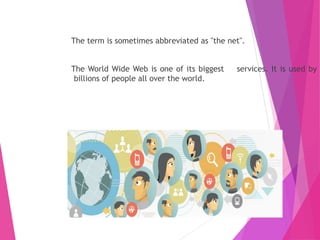
The World Wide Web is one of its biggest services. It is used by
billions of people all over the world.
World Wide Web-web browser
 To access webpages, you must use a Web
browser, usually referred to as a browser.
 Web browsers are programs that display text,
data, pictures, animation and video on the
Internet.
 Web browsers provide the software interface that
enables you to use your mouse to click hyperlinked
resources on the World Wide Web.
Web browser-cont’d
 Web browsers were initially only used for surfing
the Web. They are now more universal and allow
users to do many more tasks, including conducting
searches, e-mailing, transferring multimedia files,
participating in discussion groups and much more.
 Some examples of commonly used Web browsers
are Internet Explorer, Mozilla Firefox, Google
Chrome and Safari.
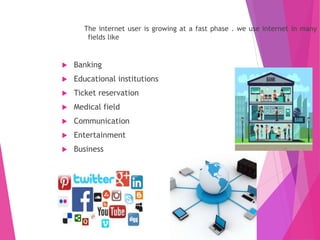
The internet user is growing at a fast phase . we use internet in many
fields like
 Banking
 Educational institutions
 Ticket reservation
 Medical field
 Communication
 Entertainment
 Business
Required Component
 Server : Machine that store the information we seek on
the internet.
 Node : A node can be a computer or some other device.
It is also referred as hub.
 Router: Their job is to ensure
the packets always arrive at
the proper destination.
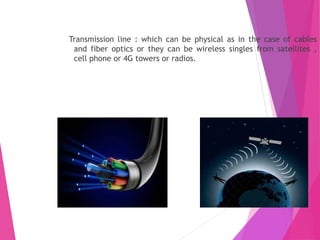
Transmission line : which can be physical as in the case of cables
and fiber optics or they can be wireless singles from satellites ,
cell phone or 4G towers or radios.
Protocols
 Protocols are sets of rules that machine follow to
complete tasks.
 Hypertext transfer protocol(HTTP)
 Transmission control protocols (TCP)
 Internet protocols (IP)
Thank You

Working principles of internet

  • 1.
    Working Principles ofInternet Prepared By, Ms.N.RUBA.,MCA.,M.Phil., Dept. of Computer Applications, Bon Secours College For Women, Thanjavur.
  • 2.
    What Is Internet? TheInternet is the biggest world-wide communication network of computers. The Internet has millions of smaller domestic, academic, business, and government networks, which together carry many different kinds of information.
  • 3.
    The term issometimes abbreviated as "the net". The World Wide Web is one of its biggest services. It is used by billions of people all over the world.
  • 4.
    World Wide Web-webbrowser  To access webpages, you must use a Web browser, usually referred to as a browser.  Web browsers are programs that display text, data, pictures, animation and video on the Internet.  Web browsers provide the software interface that enables you to use your mouse to click hyperlinked resources on the World Wide Web.
  • 5.
    Web browser-cont’d  Webbrowsers were initially only used for surfing the Web. They are now more universal and allow users to do many more tasks, including conducting searches, e-mailing, transferring multimedia files, participating in discussion groups and much more.  Some examples of commonly used Web browsers are Internet Explorer, Mozilla Firefox, Google Chrome and Safari.
  • 6.
    The internet useris growing at a fast phase . we use internet in many fields like  Banking  Educational institutions  Ticket reservation  Medical field  Communication  Entertainment  Business
  • 7.
    Required Component  Server: Machine that store the information we seek on the internet.  Node : A node can be a computer or some other device. It is also referred as hub.  Router: Their job is to ensure the packets always arrive at the proper destination.
  • 8.
    Transmission line :which can be physical as in the case of cables and fiber optics or they can be wireless singles from satellites , cell phone or 4G towers or radios.
  • 9.
    Protocols  Protocols aresets of rules that machine follow to complete tasks.  Hypertext transfer protocol(HTTP)  Transmission control protocols (TCP)  Internet protocols (IP)
  • 10.