Applications of ICT
Sanduni Amalka Gamage
Bsc in Software Engineering
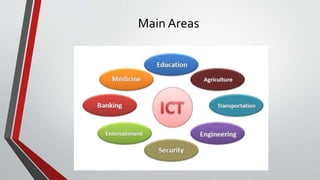
Main Areas
E- Government
• Usage of ICT by government of a country to communicates with its citizens,
companies, government and non-government Organizations and foreign
governments is called e-government.
E-government services
Online bill payment(Via government online portals, mcash)
Apply for vehicle license and renewal
Retrieve government information (gov.lk)
Register a Company ( roc.lk)
Online loan apply for government employees
Provide visa details and custom information, information on tourism
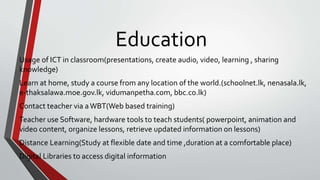
Education
Usage of ICT in classroom(presentations, create audio, video, learning , sharing
knowledge)
Learn at home, study a course from any location of the world.(schoolnet.lk, nenasala.lk,
e-thaksalawa.moe.gov.lk, vidumanpetha.com, bbc.co.lk)
Contact teacher via aWBT(Web based training)
Teacher use Software, hardware tools to teach students( powerpoint, animation and
video content, organize lessons, retrieve updated information on lessons)
Distance Learning(Study at flexible date and time ,duration at a comfortable place)
Digital Libraries to access digital information
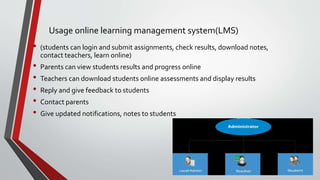
• (students can login and submit assignments, check results, download notes,
contact teachers, learn online)
• Parents can view students results and progress online
• Teachers can download students online assessments and display results
• Reply and give feedback to students
• Contact parents
• Give updated notifications, notes to students
Usage online learning management system(LMS)
ICT in Health Sector• ICT Usage in Diagnosis
1) CAT (computerized axial tomography Machine) – generate 3D images on body to identify the
diseases.
2) MRI (Magnetic Resonance Imaging Machine) – Using strong magnetic fields and radio waves
digitalized images will be generated on internal organs of the body to detect diseases.
3) ECG(Electrocardiogram Machine) – machine records electronic impulses that generate when heart
pumps blood to different parts of body.
4) Cardiac Screening Machine – Help to identify the issues such as thinning of the veins, diseases
inside the heart.
5) EEG(Electro –encephalography) – retrieve electrical impulses in the brain via a electrical probe
attached to head
6) Blood sugar testing machine – determine blood glucose level on a blood sample
7) Blood pleasure measuring Machine – wearing the wrist band will measure the blood pressure of the
person at the time
Telemedicine
• Emergency telemedicine – process of providing a emergency care by a trained
person in consultation with a specialist in a hospital to patient in different
place via a telecommunication network.
• Home health medicine - Monitoring health of a patient located at home via
network home monitoring system to decide transfer of patient to hospital.
• Telemedicine Consultation – Get medical consultation to emergency
treatment unit (ETU) from a specialist who stays in a different location.
• Tele surgery – (Remote surgery) Perform surgery on patient in consultation
with a specialist who not at the patient presence with the help of
telecommunication technologies.
• MedicalTele training –Training and consultation of specialist can be obtain to
trainers from specialists around the world.
ICT in Agriculture
ICT for Farming
1) Meteorological Devices – Gather information (weather, climate changes, rainfall, wind direction) to
decide on cultivation and harvesting times.
2) Automated Insect Control Devices – Minimize insects' effects on crops. Detect insect growth and
behavior.
3) Field Conditions Measuring Devices – Measure fertility and humidity levels of soil
4) Drip Irrigation – Control water supply and minimize wastage of water and lack of water supply to
crops.
5) AutomaticWeed Remover- machine identity crops and weed, removes weeds per instructions.
6) Seedlings planter using Robotics – Carry seedlings across field and plant them orderly manner.
7) Crop harvesting using robotics – robots monitor plant growth levels, record them and harvesting in
farm lands.
8) Greenhouse – ICT is used to control light moisture, air inside to give high quality products of rare
crops to market.
ICT in management of
Farmhouse
• RFID – (Radio Frequency Identification Device) Counting and
locating animals in a large area.
• Automated milking and examination of cows – monitor health
status and milking, quality of milk.
• For Security – ( Closed circuitTV CCTV ) CCTV placed across the
farm connected via wifi to protect cows from animal attacks and
thieves.
• Farm Management – Keep records of animals, profits and losses,
employee details, market rates, updated business and exchange
information
Demerits of ICT
• Addiction
• Unsuitable Friendships and Relationships in social media
• Insecure use of internet may cause computer infected with viruses.
• Due to use of improper sites a person can be affected by mental disorders
• Passing around personal photos and videos can harm personal lives
• Become unhealthy due to les of exercise
• Isolation due to lack of friendships in real life
• Violating copyrights.

Applications of ICT

  • 1.
    Applications of ICT SanduniAmalka Gamage Bsc in Software Engineering
  • 2.
  • 3.
    E- Government • Usageof ICT by government of a country to communicates with its citizens, companies, government and non-government Organizations and foreign governments is called e-government.
  • 4.
    E-government services Online billpayment(Via government online portals, mcash) Apply for vehicle license and renewal Retrieve government information (gov.lk) Register a Company ( roc.lk) Online loan apply for government employees Provide visa details and custom information, information on tourism
  • 5.
    Education Usage of ICTin classroom(presentations, create audio, video, learning , sharing knowledge) Learn at home, study a course from any location of the world.(schoolnet.lk, nenasala.lk, e-thaksalawa.moe.gov.lk, vidumanpetha.com, bbc.co.lk) Contact teacher via aWBT(Web based training) Teacher use Software, hardware tools to teach students( powerpoint, animation and video content, organize lessons, retrieve updated information on lessons) Distance Learning(Study at flexible date and time ,duration at a comfortable place) Digital Libraries to access digital information
  • 6.
    • (students canlogin and submit assignments, check results, download notes, contact teachers, learn online) • Parents can view students results and progress online • Teachers can download students online assessments and display results • Reply and give feedback to students • Contact parents • Give updated notifications, notes to students Usage online learning management system(LMS)
  • 7.
    ICT in HealthSector• ICT Usage in Diagnosis 1) CAT (computerized axial tomography Machine) – generate 3D images on body to identify the diseases. 2) MRI (Magnetic Resonance Imaging Machine) – Using strong magnetic fields and radio waves digitalized images will be generated on internal organs of the body to detect diseases. 3) ECG(Electrocardiogram Machine) – machine records electronic impulses that generate when heart pumps blood to different parts of body. 4) Cardiac Screening Machine – Help to identify the issues such as thinning of the veins, diseases inside the heart. 5) EEG(Electro –encephalography) – retrieve electrical impulses in the brain via a electrical probe attached to head 6) Blood sugar testing machine – determine blood glucose level on a blood sample 7) Blood pleasure measuring Machine – wearing the wrist band will measure the blood pressure of the person at the time
  • 8.
    Telemedicine • Emergency telemedicine– process of providing a emergency care by a trained person in consultation with a specialist in a hospital to patient in different place via a telecommunication network. • Home health medicine - Monitoring health of a patient located at home via network home monitoring system to decide transfer of patient to hospital. • Telemedicine Consultation – Get medical consultation to emergency treatment unit (ETU) from a specialist who stays in a different location. • Tele surgery – (Remote surgery) Perform surgery on patient in consultation with a specialist who not at the patient presence with the help of telecommunication technologies. • MedicalTele training –Training and consultation of specialist can be obtain to trainers from specialists around the world.
  • 9.
    ICT in Agriculture ICTfor Farming 1) Meteorological Devices – Gather information (weather, climate changes, rainfall, wind direction) to decide on cultivation and harvesting times. 2) Automated Insect Control Devices – Minimize insects' effects on crops. Detect insect growth and behavior. 3) Field Conditions Measuring Devices – Measure fertility and humidity levels of soil 4) Drip Irrigation – Control water supply and minimize wastage of water and lack of water supply to crops. 5) AutomaticWeed Remover- machine identity crops and weed, removes weeds per instructions. 6) Seedlings planter using Robotics – Carry seedlings across field and plant them orderly manner. 7) Crop harvesting using robotics – robots monitor plant growth levels, record them and harvesting in farm lands. 8) Greenhouse – ICT is used to control light moisture, air inside to give high quality products of rare crops to market.
  • 10.
    ICT in managementof Farmhouse • RFID – (Radio Frequency Identification Device) Counting and locating animals in a large area. • Automated milking and examination of cows – monitor health status and milking, quality of milk. • For Security – ( Closed circuitTV CCTV ) CCTV placed across the farm connected via wifi to protect cows from animal attacks and thieves. • Farm Management – Keep records of animals, profits and losses, employee details, market rates, updated business and exchange information
  • 11.
    Demerits of ICT •Addiction • Unsuitable Friendships and Relationships in social media • Insecure use of internet may cause computer infected with viruses. • Due to use of improper sites a person can be affected by mental disorders • Passing around personal photos and videos can harm personal lives • Become unhealthy due to les of exercise • Isolation due to lack of friendships in real life • Violating copyrights.