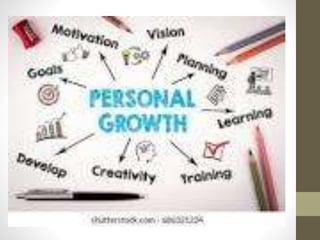
- it’s who we are.
Our personalities
determine how we act
and react, as well as
how we interact with
and respond to the
world.
Parents
Environment
Genetics
Culture
Friends
Work
- derived from the Latin
word ‘persona’ meaning
‘mask’.
- The relatively stable
feelings, thoughts, and
behavioural patterns a
person has.
If personality is stable, does
this mean that it does not
change?
It does. Changes occur.
-animprovementinallspheresofan
individual’slife,beitwithfriends,in
theofficeorinanyotherenvironment.
IMPORTANCE:
• Personality development grooms an individual and helps him make
a mark of his/her own
• Personality development goes a long way in reducing stress and
conflicts.
• Personality development helps you develop a positive attitude in
life.
Openness
- the degree to which a person is curious, original, intellectual,
creative, and open to new ideas
People high in openness are highly motivated to
learn new skills, and they do well in training
settings
They also have an advantage when they enter
into a new organization. Their open-mindedness
leads them to seek a lot of information and
feedback about how they are doing and to build
relationships, which leads to quicker adjustment
to the new job.
Conscientiousness
- the degree to which a person is organized, systematic, punctual,
achievement oriented, and dependable
Conscientiousness is the one
personality trait that uniformly
predicts how high a person’s
performance will be, across a
variety of occupations and jobs.
In addition to their high
performance, conscientious
people have higher levels of
Extraversion
- the degree to which a person is outgoing, talkative, and sociable,
and enjoys being in social situations
Extraverts do well in social situations, and as a
result they tend to be effective in job interviews.
They have an easier time than introverts when
adjusting to a new job. They actively seek
information and feedback, and build effective
relationships, which helps with their adjustment.
Neuroticism
- the degree to which a person is anxious, irritable, aggressive,
temperamental, and moody
These people have a tendency to have emotional
adjustment problems and experience stress and
depression on a habitual basis.
People very high in neuroticism experience a
number of problems at work.
Values and Attitudes
- refer to stable life goals that people have, reflecting what is most
important to them
- Broad preferences concerning appropriate courses of action or
outcomes
The values that are important to people tend to affect the types of
decisions they make, how they perceive their environment, and their
actual behaviors.
Early family experiences are important influences over the
dominant values.
Values of a generation also change and evolve in response to the
historical context that the generation grows up in.
The values a person holds will affect his or her employment.
Attitude
- A predisposition to respond in a positive or negative way to
someone or something in one’s environment
- Influences by values and are acquired from the same sources as
values
- Focus on specific people or objects, whereas values have a more
general focus and are more stable than attitude
Self-esteem
- the degree to which a person has
overall positive feelings about his or
herself
People with high self-esteem view
themselves in a positive light, are
confident, and respect themselves.
On the other hand, people with low
self-esteem experience high levels of
self-doubt and question their self-
worth.
Self-Efficacy
- a belief that one can perform a specific task successfully
.
Self-efficacy is different from other
personality traits in that it is job specific.
People with high self-efficacy setting
higher goals for themselves and being
more committed to these goals, whereas
people with low self-efficacy tend to
procrastinate.
Ways to Build Your Self-Confidence
• Take a self-inventory. (self-assessment)
Ways to Build Your Self-Confidence
• Set manageable goals.
Ways to Build Your Self-Confidence
• Don’t judge yourself by your failures.
Ways to Build Your Self-Confidence
• Until you can feel confident, be sure to act confident.
Ways to Build Your Self-Confidence
Know when to ignore negative advice
THANK YOU

Personality development.pptx

  • 2.
    - it’s whowe are. Our personalities determine how we act and react, as well as how we interact with and respond to the world. Parents Environment Genetics Culture Friends Work
  • 3.
    - derived fromthe Latin word ‘persona’ meaning ‘mask’. - The relatively stable feelings, thoughts, and behavioural patterns a person has. If personality is stable, does this mean that it does not change? It does. Changes occur.
  • 4.
    -animprovementinallspheresofan individual’slife,beitwithfriends,in theofficeorinanyotherenvironment. IMPORTANCE: • Personality developmentgrooms an individual and helps him make a mark of his/her own • Personality development goes a long way in reducing stress and conflicts. • Personality development helps you develop a positive attitude in life.
  • 5.
    Openness - the degreeto which a person is curious, original, intellectual, creative, and open to new ideas People high in openness are highly motivated to learn new skills, and they do well in training settings They also have an advantage when they enter into a new organization. Their open-mindedness leads them to seek a lot of information and feedback about how they are doing and to build relationships, which leads to quicker adjustment to the new job.
  • 6.
    Conscientiousness - the degreeto which a person is organized, systematic, punctual, achievement oriented, and dependable Conscientiousness is the one personality trait that uniformly predicts how high a person’s performance will be, across a variety of occupations and jobs. In addition to their high performance, conscientious people have higher levels of
  • 7.
    Extraversion - the degreeto which a person is outgoing, talkative, and sociable, and enjoys being in social situations Extraverts do well in social situations, and as a result they tend to be effective in job interviews. They have an easier time than introverts when adjusting to a new job. They actively seek information and feedback, and build effective relationships, which helps with their adjustment.
  • 8.
    Neuroticism - the degreeto which a person is anxious, irritable, aggressive, temperamental, and moody These people have a tendency to have emotional adjustment problems and experience stress and depression on a habitual basis. People very high in neuroticism experience a number of problems at work.
  • 9.
    Values and Attitudes -refer to stable life goals that people have, reflecting what is most important to them - Broad preferences concerning appropriate courses of action or outcomes The values that are important to people tend to affect the types of decisions they make, how they perceive their environment, and their actual behaviors.
  • 10.
    Early family experiencesare important influences over the dominant values. Values of a generation also change and evolve in response to the historical context that the generation grows up in. The values a person holds will affect his or her employment.
  • 11.
    Attitude - A predispositionto respond in a positive or negative way to someone or something in one’s environment - Influences by values and are acquired from the same sources as values - Focus on specific people or objects, whereas values have a more general focus and are more stable than attitude
  • 12.
    Self-esteem - the degreeto which a person has overall positive feelings about his or herself People with high self-esteem view themselves in a positive light, are confident, and respect themselves. On the other hand, people with low self-esteem experience high levels of self-doubt and question their self- worth.
  • 13.
    Self-Efficacy - a beliefthat one can perform a specific task successfully . Self-efficacy is different from other personality traits in that it is job specific. People with high self-efficacy setting higher goals for themselves and being more committed to these goals, whereas people with low self-efficacy tend to procrastinate.
  • 14.
    Ways to BuildYour Self-Confidence • Take a self-inventory. (self-assessment)
  • 15.
    Ways to BuildYour Self-Confidence • Set manageable goals.
  • 16.
    Ways to BuildYour Self-Confidence • Don’t judge yourself by your failures.
  • 17.
    Ways to BuildYour Self-Confidence • Until you can feel confident, be sure to act confident. Ways to Build Your Self-Confidence Know when to ignore negative advice
  • 18.

Editor's Notes

  • #3 Personality is how people affect others and how they understand and view themselves How people affect others depends primarily on their external appearance (height, weight, facial features, color, and other physical aspects) and traits.
  • #5 Personality development – converting negative to positive personalities, acquiring new, improving what you already have. Importance: 1. Help us to be unique. Sometimes, we wear mask in order to fit in the society/peers. 2.