BY
N.RUBA
ASST.PROF/DEPT. OF CA,
BONSECOURS COLLEGE FOR WOMEN,
THANJAVUR.
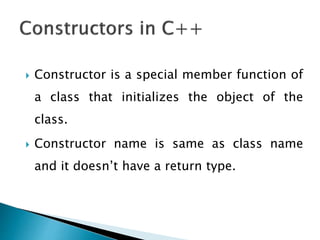
 Constructor is a special member function of
a class that initializes the object of the
class.
 Constructor name is same as class name
and it doesn’t have a return type.
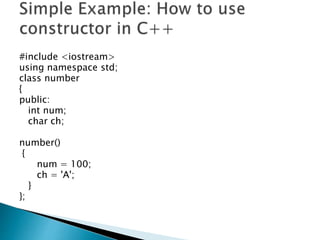
#include <iostream>
using namespace std;
class number
{
public:
int num;
char ch;
number()
{
num = 100;
ch = 'A';
}
};
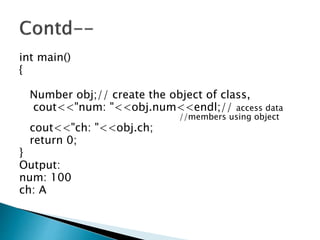
int main()
{
Number obj;// create the object of class,
cout<<"num: "<<obj.num<<endl;// access data
//members using object
cout<<"ch: "<<obj.ch;
return 0;
}
Output:
num: 100
ch: A
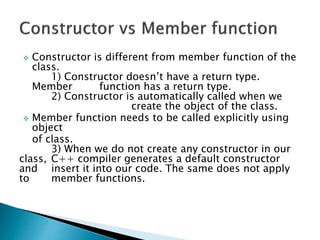
 Constructor is different from member function of the
class.
1) Constructor doesn’t have a return type.
Member function has a return type.
2) Constructor is automatically called when we
create the object of the class.
 Member function needs to be called explicitly using
object
of class.
3) When we do not create any constructor in our
class, C++ compiler generates a default constructor
and insert it into our code. The same does not apply
to member functions.
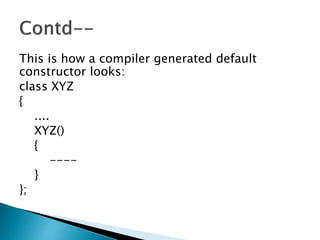
This is how a compiler generated default
constructor looks:
class XYZ
{
....
XYZ()
{
----
}
};
There are two types of constructor in C++.
1) Default constructor
2) Parameterized constructor
1) Default Constructor
A default constructor doesn’t have any arguments (or parameters)
#include <iostream>
using namespace std;
class Website{
public:
//Default constructor
Website()
{
cout<<"Welcome to Bonsecours"<<endl;
}
};
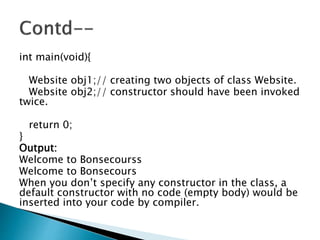
int main(void){
Website obj1;// creating two objects of class Website.
Website obj2;// constructor should have been invoked
twice.
return 0;
}
Output:
Welcome to Bonsecourss
Welcome to Bonsecours
When you don’t specify any constructor in the class, a
default constructor with no code (empty body) would be
inserted into your code by compiler.
 Constructors with parameters are known as
Parameterized constructors. These type of
constructor allows us to pass arguments while
object creation.
Parameterized Constructor:
XYZ(int a, int b)
{
}
...
XYZ obj(10, 20);
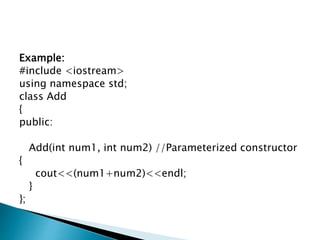
Example:
#include <iostream>
using namespace std;
class Add
{
public:
Add(int num1, int num2) //Parameterized constructor
{
cout<<(num1+num2)<<endl;
}
};
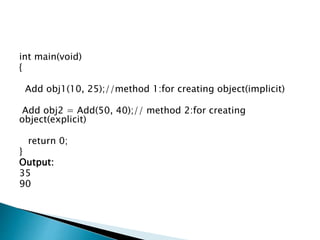
int main(void)
{
Add obj1(10, 25);//method 1:for creating object(implicit)
Add obj2 = Add(50, 40);// method 2:for creating
object(explicit)
return 0;
}
Output:
35
90
Constructors in C++

Constructors in C++

  • 1.
    BY N.RUBA ASST.PROF/DEPT. OF CA, BONSECOURSCOLLEGE FOR WOMEN, THANJAVUR.
  • 2.
     Constructor isa special member function of a class that initializes the object of the class.  Constructor name is same as class name and it doesn’t have a return type.
  • 3.
    #include <iostream> using namespacestd; class number { public: int num; char ch; number() { num = 100; ch = 'A'; } };
  • 4.
    int main() { Number obj;//create the object of class, cout<<"num: "<<obj.num<<endl;// access data //members using object cout<<"ch: "<<obj.ch; return 0; } Output: num: 100 ch: A
  • 5.
     Constructor isdifferent from member function of the class. 1) Constructor doesn’t have a return type. Member function has a return type. 2) Constructor is automatically called when we create the object of the class.  Member function needs to be called explicitly using object of class. 3) When we do not create any constructor in our class, C++ compiler generates a default constructor and insert it into our code. The same does not apply to member functions.
  • 6.
    This is howa compiler generated default constructor looks: class XYZ { .... XYZ() { ---- } };
  • 7.
    There are twotypes of constructor in C++. 1) Default constructor 2) Parameterized constructor 1) Default Constructor A default constructor doesn’t have any arguments (or parameters) #include <iostream> using namespace std; class Website{ public: //Default constructor Website() { cout<<"Welcome to Bonsecours"<<endl; } };
  • 8.
    int main(void){ Website obj1;//creating two objects of class Website. Website obj2;// constructor should have been invoked twice. return 0; } Output: Welcome to Bonsecourss Welcome to Bonsecours When you don’t specify any constructor in the class, a default constructor with no code (empty body) would be inserted into your code by compiler.
  • 9.
     Constructors withparameters are known as Parameterized constructors. These type of constructor allows us to pass arguments while object creation. Parameterized Constructor: XYZ(int a, int b) { } ... XYZ obj(10, 20);
  • 10.
    Example: #include <iostream> using namespacestd; class Add { public: Add(int num1, int num2) //Parameterized constructor { cout<<(num1+num2)<<endl; } };
  • 11.
    int main(void) { Add obj1(10,25);//method 1:for creating object(implicit) Add obj2 = Add(50, 40);// method 2:for creating object(explicit) return 0; } Output: 35 90