VIBHA PANDEYTOLANI COLLEGETYBMSROLL NO: 24
CAPITALBUDGETING
CAPITAL BUDGETINGCapital budgeting is a decision situation where large funds are committed (invested) in the initial stages of the project and the returns are expected over a long period of time. These decisions are related to allocation of investible funds to different long-term assets. Capital budgeting is a continuous process and it is carried out by different functional areas of management such as production, marketing, engineering, financial management etc.
Classification of capital budgeting projectCapital expenditure projects can be classified in Replacement, Modernization, Expansion, Diversification, New project, Cost reduction, Statutory projects, etc. statutory projects are like a waste recycling plant in case of chemical plant.
BASIC FEATURES OF CAPITAL BUDGETINGCapital budgeting decisions have long-term implications.
These decisions involve substantial commitment of funds.
These decisions are irreversible and require analysis of minute details.
These decisions determine and affect the future growth of the firm.Capital Budgeting ProcessThere are six steps to the Capital Budgeting Process.Identification of potential investment opportunities Assembling of investment proposalDecision making,Preparation of capital budget and appropriationImplementation, andPerformance Review.
Capital Budgeting Decision ProcessCapital Budgeting is the process of evaluating and selecting long-term investment projects that achieve the goal of owner wealth maximization.Capital budgeting decisions are treated separately from the related financing decisions.
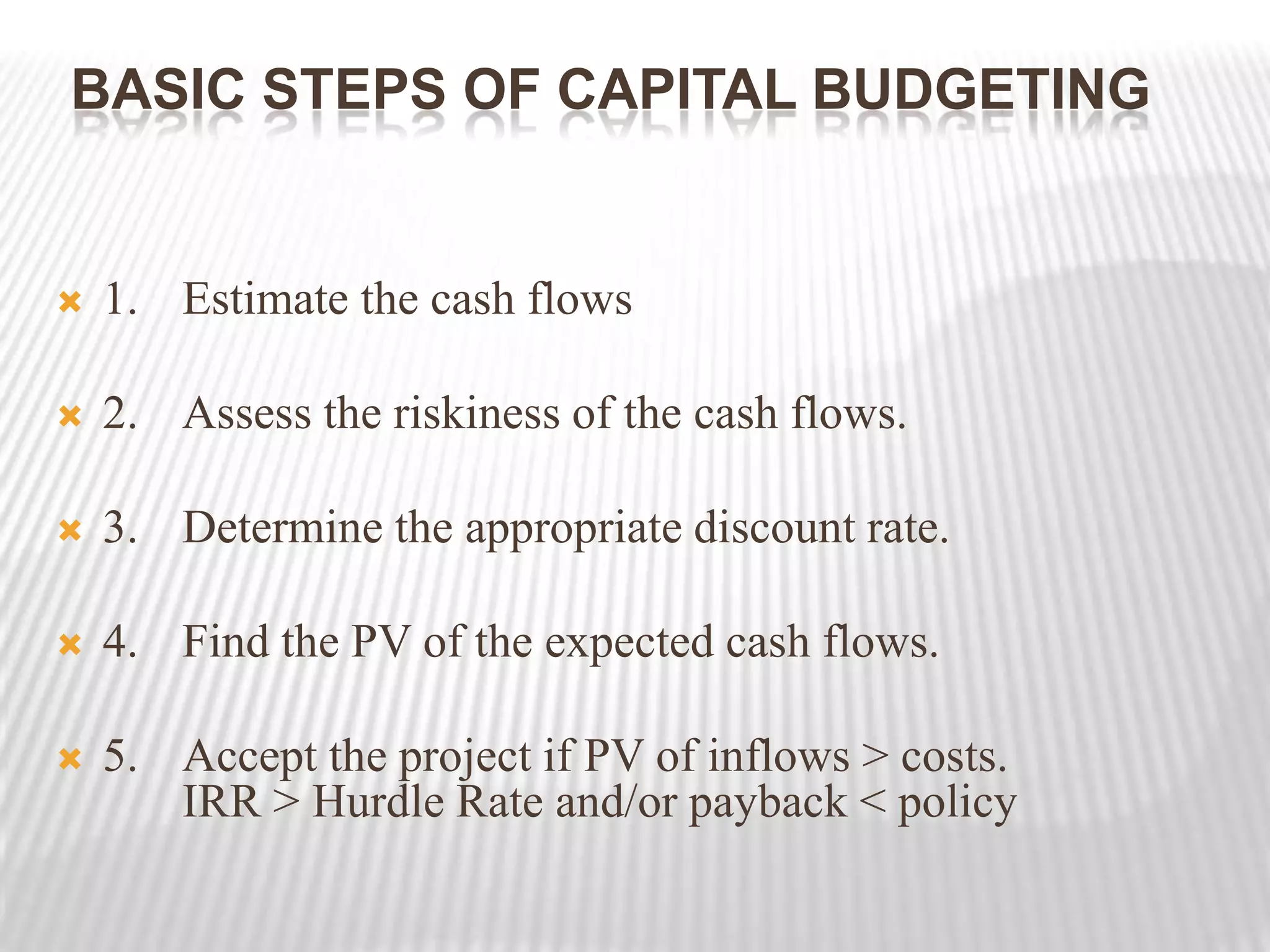
 Basic Steps of Capital Budgeting 1.	Estimate the cash flows 2.	Assess the riskiness of the cash flows. 3.	Determine the appropriate discount rate. 4.	Find the PV of the expected cash flows. 5.	Accept the project if PV of inflows > costs.                 	IRR > Hurdle Rate and/or payback < policy
CAPITAL BUDGETING DECISION :ACCEPT-REJECT DECISIONMUTUALLY EXCLUSIVE PROJCTSCAPITAL RATIONINGREPLACEMENT DECISION
CAPITAL BUDGETING DECISION INVOLVES THREE STEPS:Estimation of costs and benefits of a proposal or of each alternative.Estimation of the required rate of  return, i.e., the cost of capital  Selection and applying the decision criterion.
Capital Rationing Situation Select the projects which have payback periods lower than or equivalent to the stipulated payback period. Arrange these selected projects in increasing order of their respective payback periods. Select those projects from the top of the list till the capital Budget is exhausted.
Mutually Exclusive Projects In the case of two mutually exclusive projects, the one with a lower payback period is accepted, when the respective payback periods are less than or equivalent to the stipulated payback period.
ESTIMATION OF CASH FLOWSThe costs and benefits for a capital budgeting decision situation are measured in terms of cash flows.An important point is that all cash flows are considered on after tax basis. The rule is that all financial decisions are subservient to tax laws.The cash flow from the project are compared with the cost of acquiring the project.
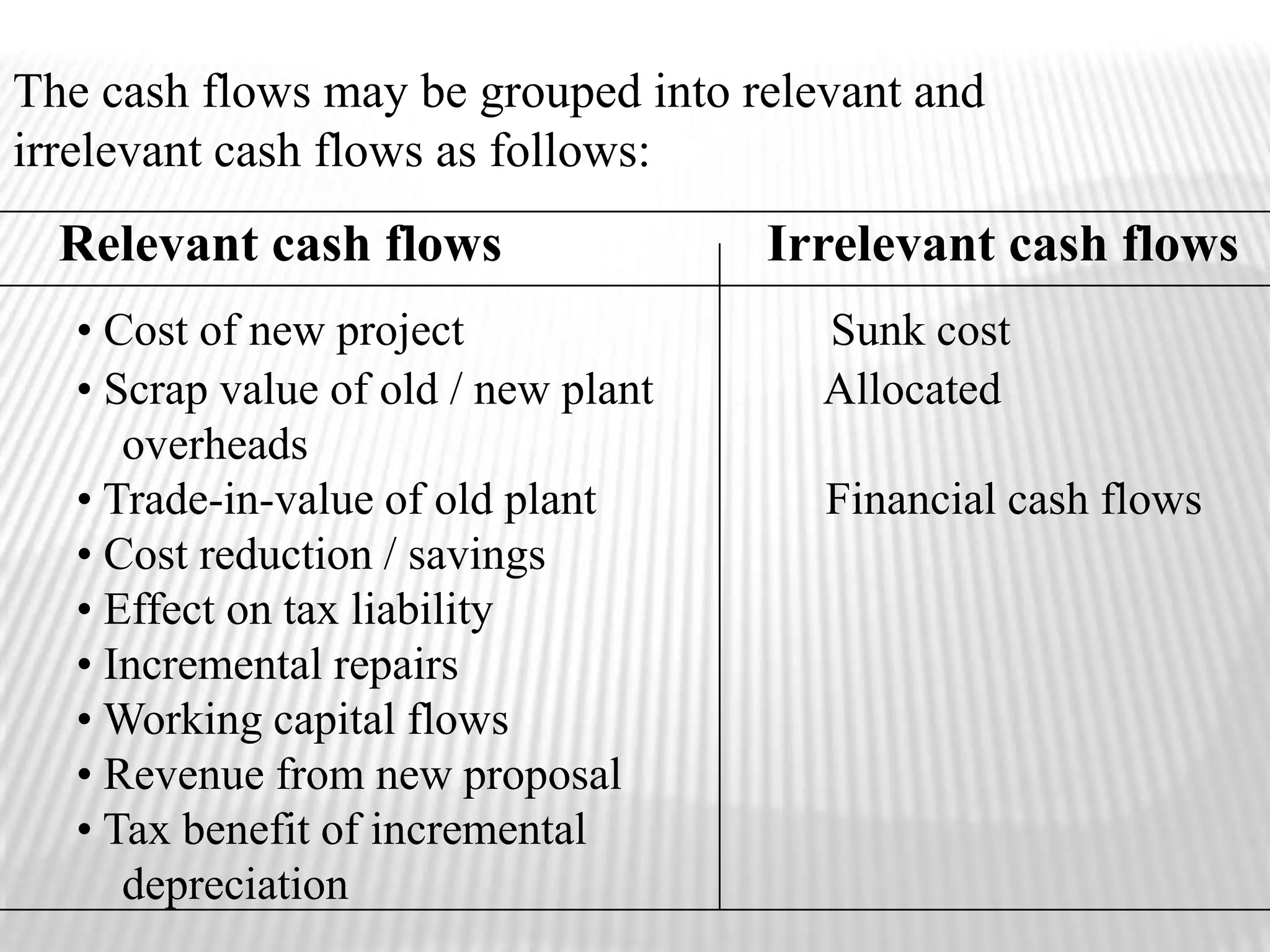
The cash flows may be grouped into relevant and                                                                                               irrelevant cash flows as follows:Relevant cash flows                    Irrelevant cash flows Cost of new project                                Sunk cost
 Scrap value of old / new plant               Allocated    overheads Trade-in-value of oldplant                    Financial cash flows
 Cost reduction / savings
 Effect on tax liability
 Incremental repairs
 Working capital flows
 Revenue from new proposal
 Tax benefit of incremental    depreciation
TAX ShieldTax shield is like a capital saving. Expenses which are deductible before tax lower the PBT and therefore lower tax payable. A tax shield is the reduction in income tax that results from taking an allowable deduction from taxable income. For e.g, because interest on debt is a tax deductible expenses , taking on debt creates a tax shiled. Since tax shield is a way to save cash flows, it increases the value of business, and it is an important aspect of financial management.
Sunk Costs, Opportunity CostsSunk Costs: outlays that have already been made and therefore have no effect on the cash flows relevant to a current decision.Opportunity Costs: cash flows that could be realized from the best alternative use of an owned asset.
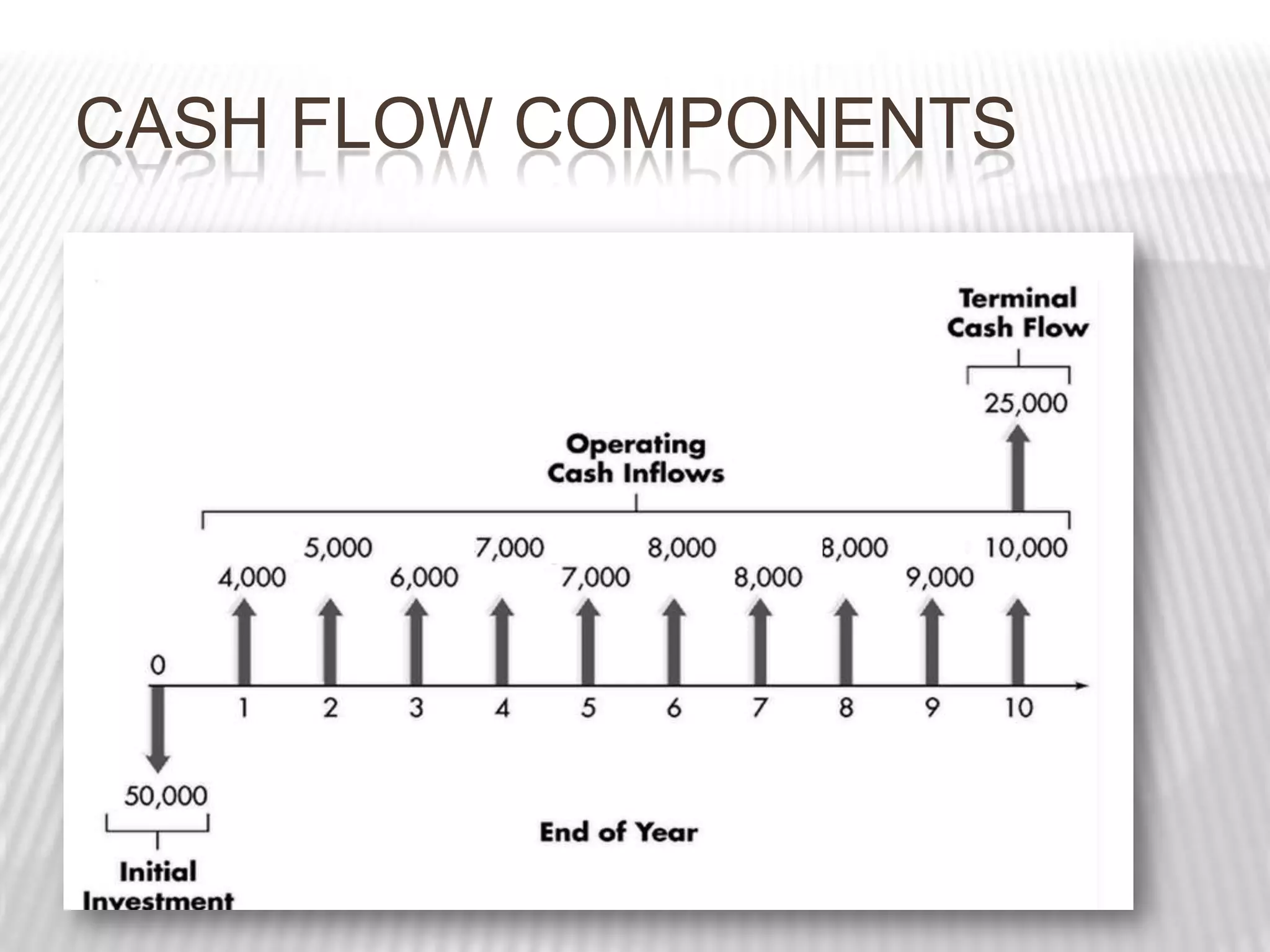
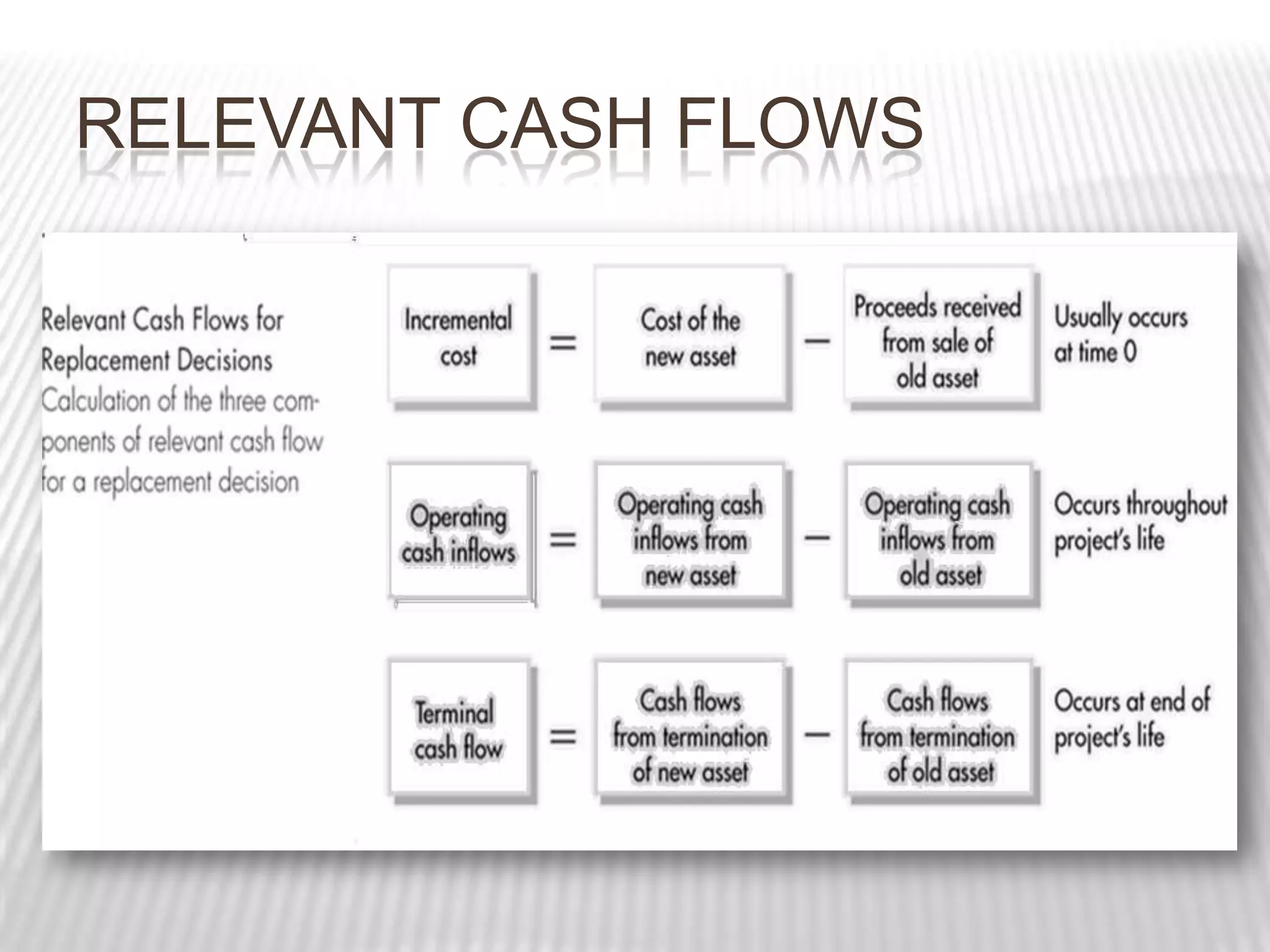
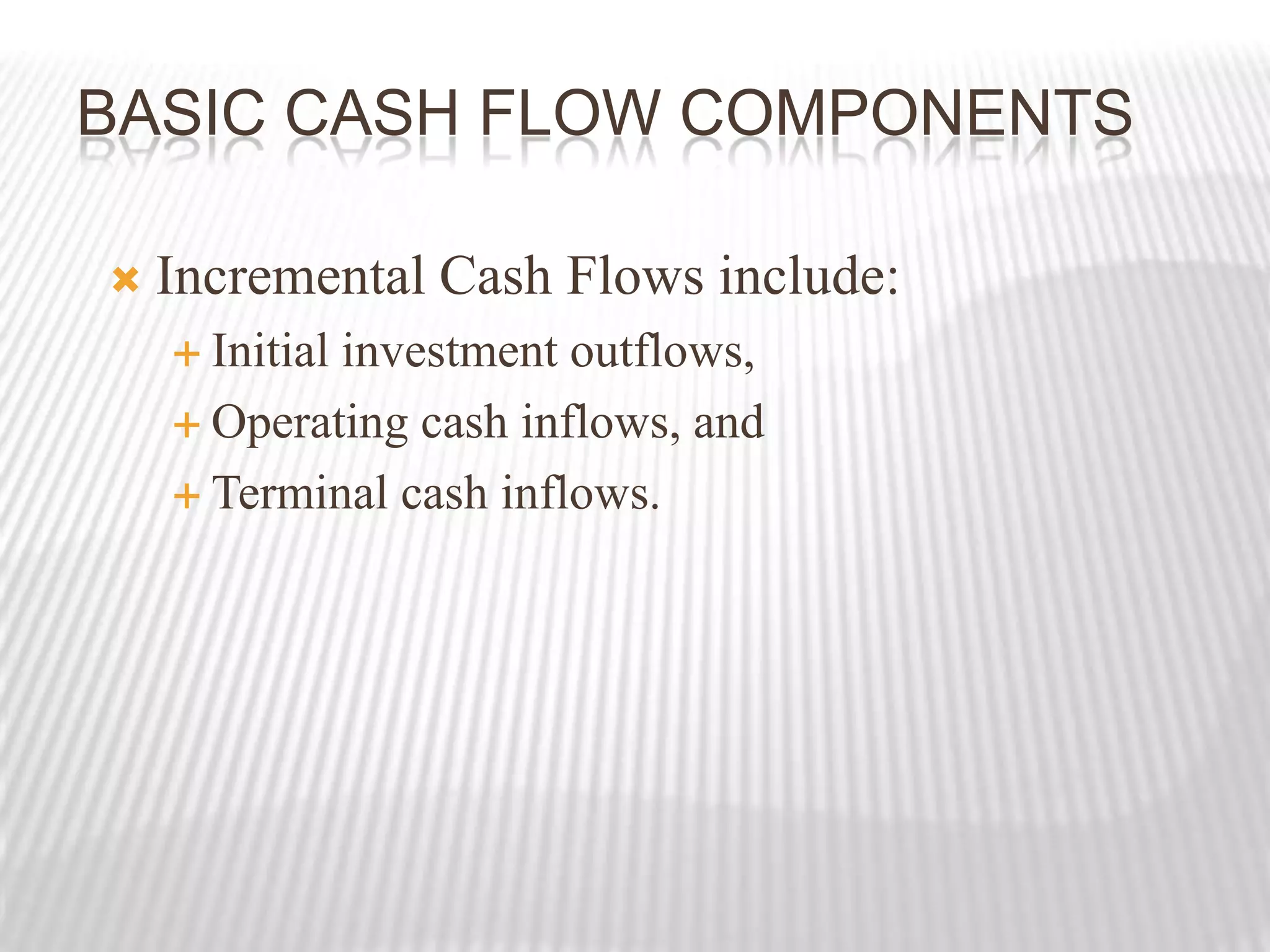
Basic Cash Flow ComponentsIncremental Cash Flows include:Initial investment outflows,Operating cash inflows, andTerminal cash inflows.
 Cash Flow Components
 Relevant Cash Flows
Operational and Financial Cash FlowsOperational items that affect EBIT should be considered relevant, while financial costs like interest, lease payments, and dividends are ignored.Financial costs are considered in the discounting process of calculating NPV.
Calculating Cash FlowsOnly incremental amounts are considered; compare the new asset with the old.Ignore sunk costs but include opportunity costs.Only include operational items; ignore financial costs.Cash inflows must be after-tax; the firm only receives benefits after paying appropriate taxes.
Determining Initial InvestmentThe Initial Investment is the relevant cash outflows incurred if a capital budgeting project is implemented.This often includes installation costs, and incremental costs of getting the asset to the point of generating cash inflows, less proceeds from the sale of old assets when replacement is taking place.
Change in Net Working CapitalThe difference between the change in current assets and current liabilities associated with an investment project.Changes in new working capital are not taxable because they merely involve the net buildup or reduction of current accounts.
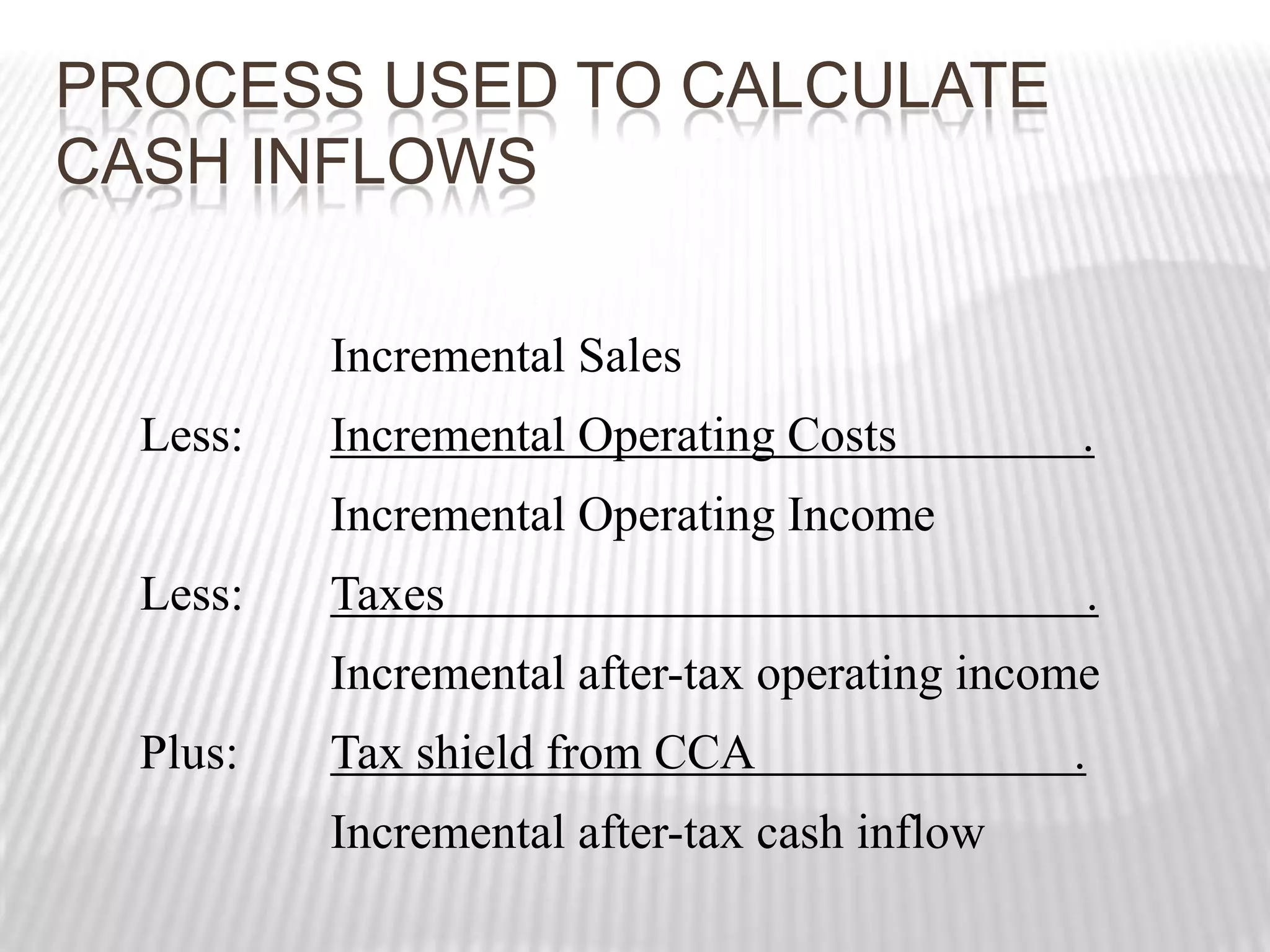
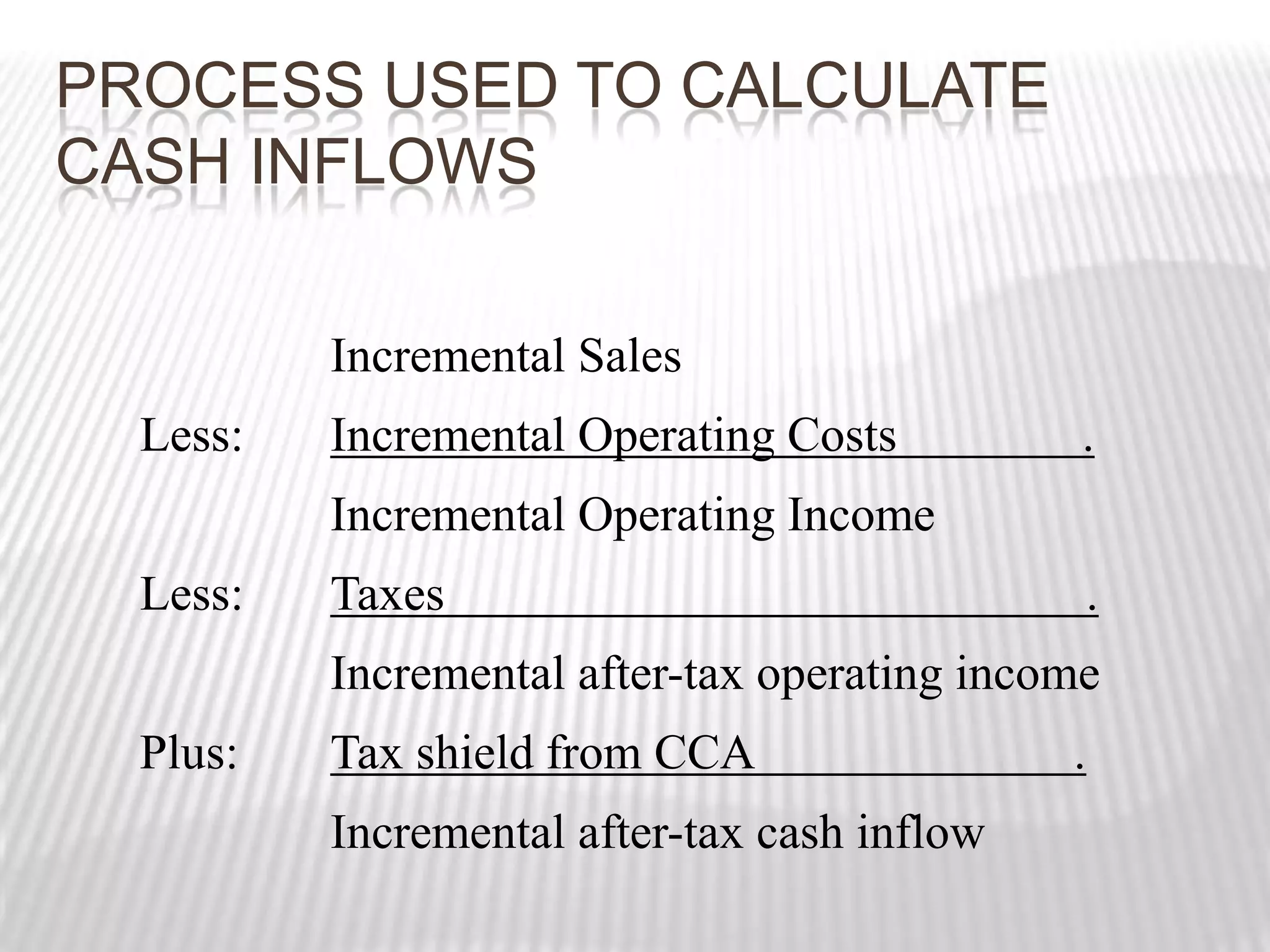
Process Used to Calculate Cash Inflows
Basic Cash Flow ComponentsIncremental Cash Flows include:Initial investment outflows,Operating cash inflows, andTerminal cash inflows.
Process Used to Calculate Cash Inflows
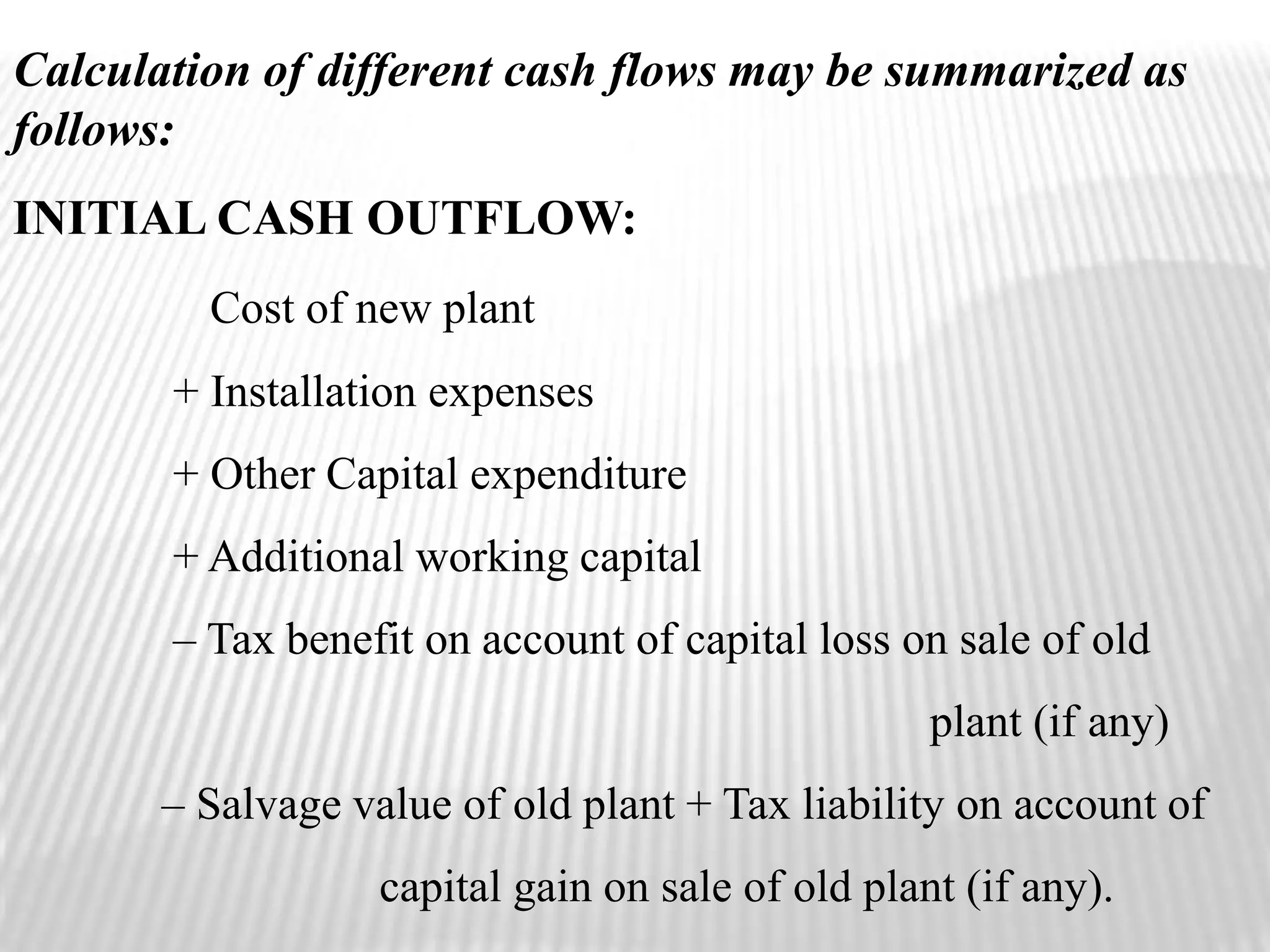
Calculation of different cash flows may be summarized as follows:INITIAL CASH OUTFLOW:Cost of new plant              + Installation expenses               + Other Capital expenditure              + Additional working capital               – Tax benefit on account of capital loss on sale of old                                                                                plant (if any)             – Salvage value of old plant + Tax liability on account of                                capital gain on sale of old plant (if any).
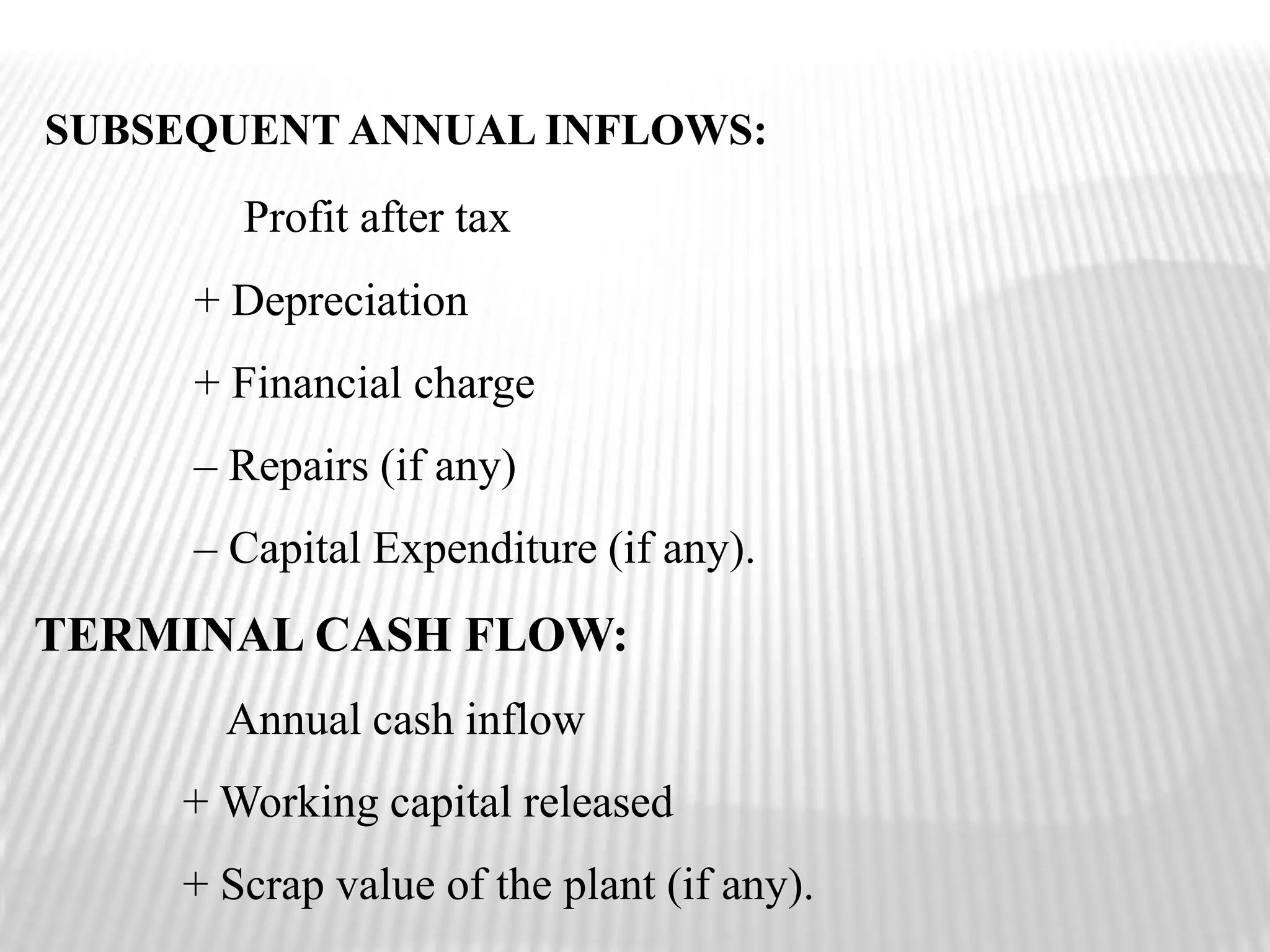
SUBSEQUENT ANNUAL INFLOWS:Profit after tax               + Depreciation               + Financial charge               – Repairs (if any)               – Capital Expenditure (if any).TERMINAL CASH FLOW:                 Annual cash inflow              + Working capital released               + Scrap value of the plant (if any).
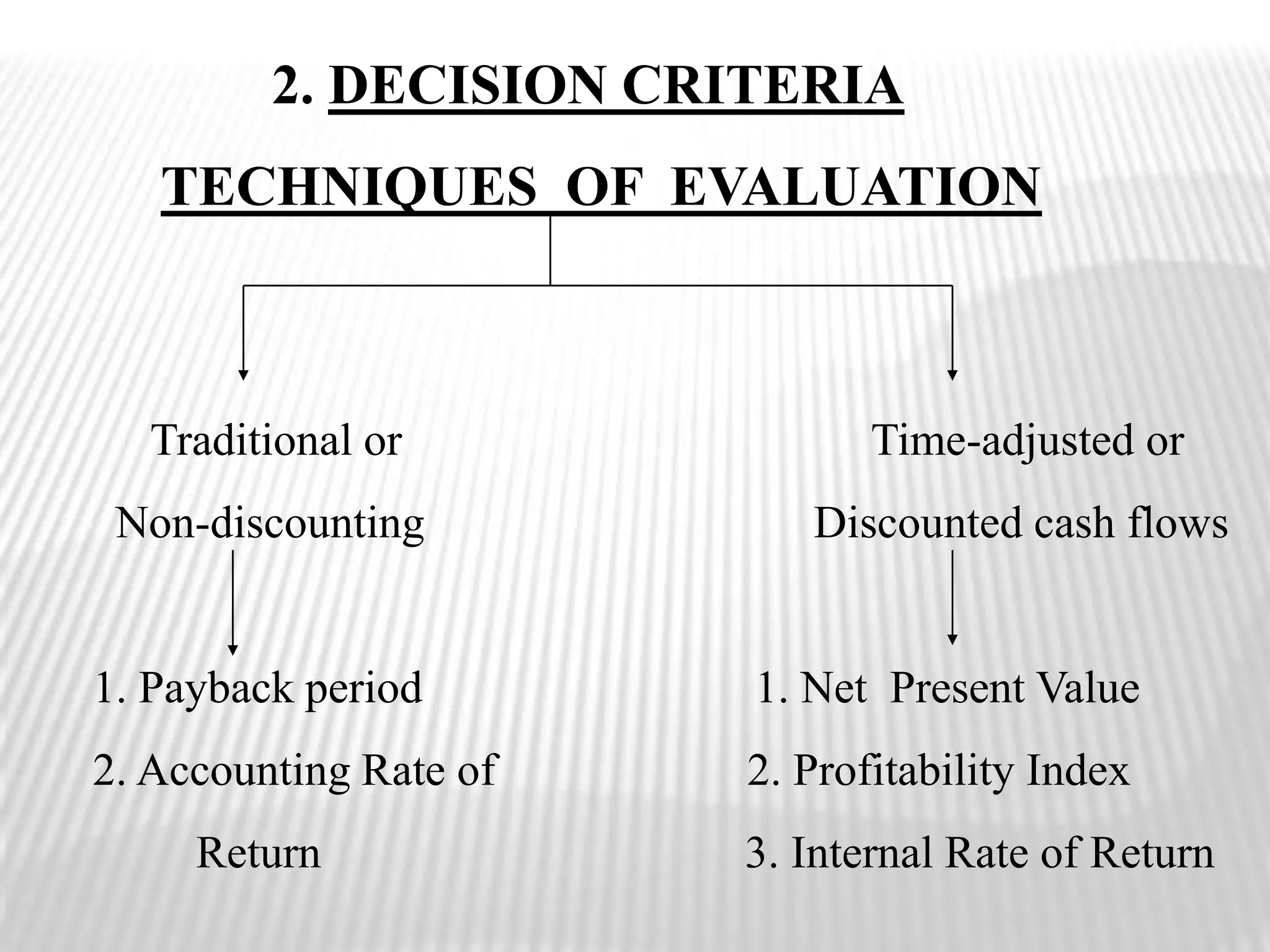
2. DECISION CRITERIATECHNIQUES  OF  EVALUATIONTraditional or                                         Time-adjusted or          Non-discounting                                  Discounted cash flows       1. Payback period                             1. Net  Present Value       2. Accounting Rate of                      2. Profitability Index                Return                                     3. Internal Rate of Return
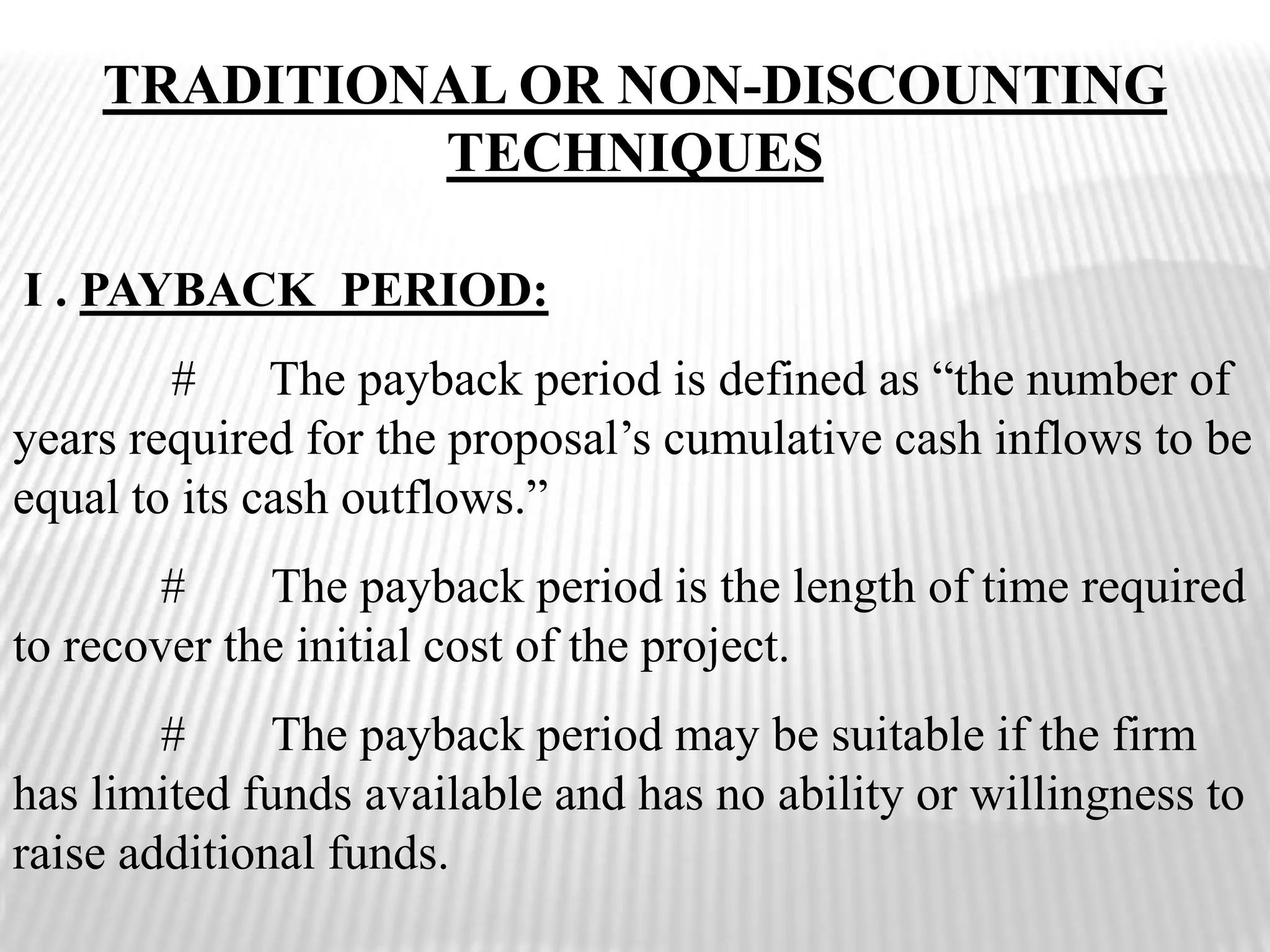
TRADITIONAL OR NON-DISCOUNTING TECHNIQUESI . PAYBACK  PERIOD:#      The payback period is defined as “the number of years required for the proposal’s cumulative cash inflows to be equal to its cash outflows.”            #       The payback period is the length of time required to recover the initial cost of the project.            #       The payback period may be suitable if the firm has limited funds available and has no ability or willingness to raise additional funds.
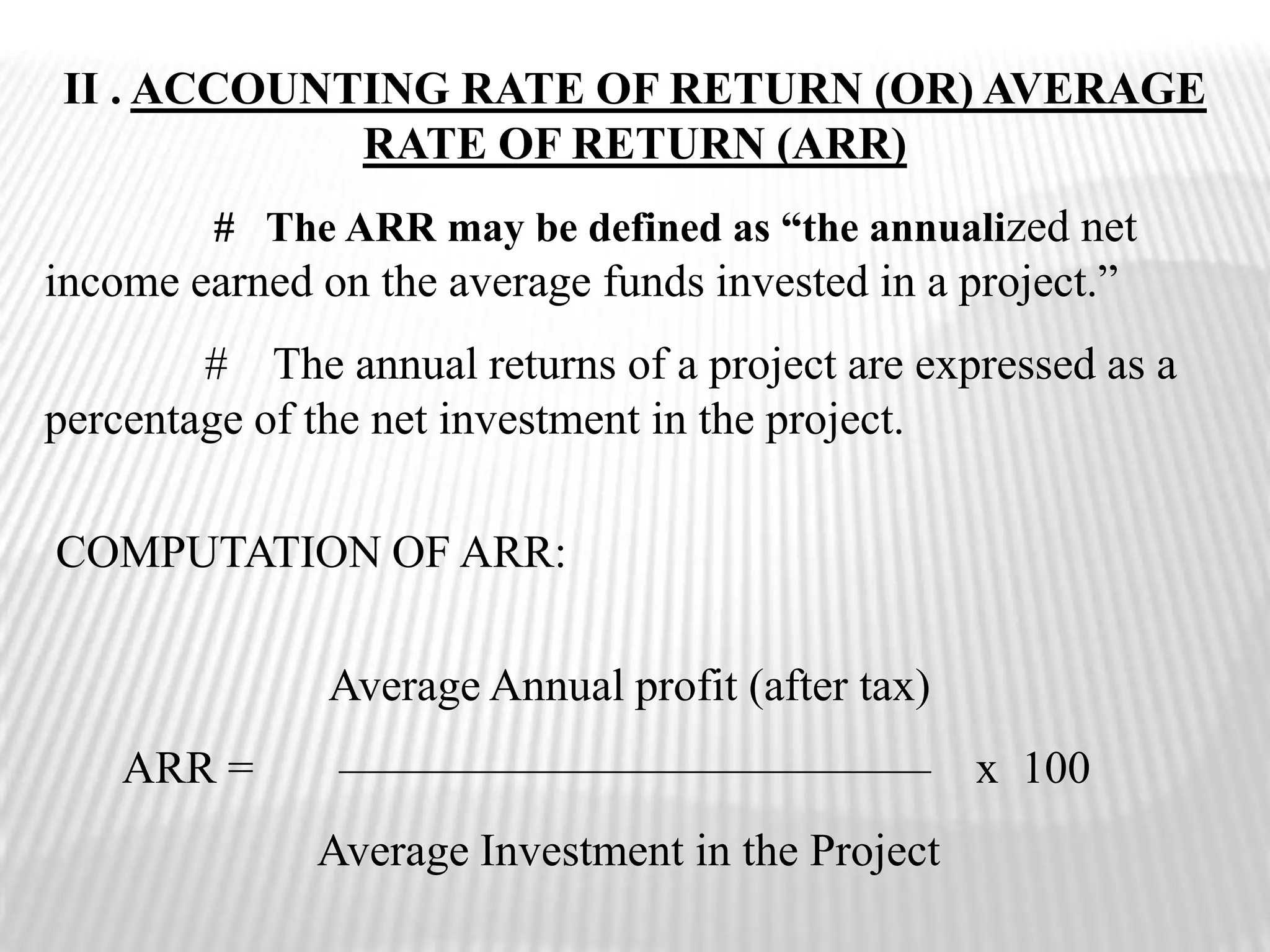
II . ACCOUNTING RATE OF RETURN (OR) AVERAGE                                                                                                                                                                                RATE OF RETURN (ARR)                #   The ARR may be defined as “the annualized net income earned on the average funds invested in a project.”              #    The annual returns of a project are expressed as a percentage of the net investment in the project. COMPUTATION OF ARR:                         Average Annual profit (after tax)       ARR =                                                               x  100                        Average Investment in the Project

Presentation Final

  • 1.
  • 2.
  • 3.
    CAPITAL BUDGETINGCapital budgetingis a decision situation where large funds are committed (invested) in the initial stages of the project and the returns are expected over a long period of time. These decisions are related to allocation of investible funds to different long-term assets. Capital budgeting is a continuous process and it is carried out by different functional areas of management such as production, marketing, engineering, financial management etc.
  • 4.
    Classification of capitalbudgeting projectCapital expenditure projects can be classified in Replacement, Modernization, Expansion, Diversification, New project, Cost reduction, Statutory projects, etc. statutory projects are like a waste recycling plant in case of chemical plant.
  • 5.
    BASIC FEATURES OFCAPITAL BUDGETINGCapital budgeting decisions have long-term implications.
  • 6.
    These decisions involvesubstantial commitment of funds.
  • 7.
    These decisions areirreversible and require analysis of minute details.
  • 8.
    These decisions determineand affect the future growth of the firm.Capital Budgeting ProcessThere are six steps to the Capital Budgeting Process.Identification of potential investment opportunities Assembling of investment proposalDecision making,Preparation of capital budget and appropriationImplementation, andPerformance Review.
  • 9.
    Capital Budgeting DecisionProcessCapital Budgeting is the process of evaluating and selecting long-term investment projects that achieve the goal of owner wealth maximization.Capital budgeting decisions are treated separately from the related financing decisions.
  • 10.
    Basic Stepsof Capital Budgeting 1. Estimate the cash flows 2. Assess the riskiness of the cash flows. 3. Determine the appropriate discount rate. 4. Find the PV of the expected cash flows. 5. Accept the project if PV of inflows > costs. IRR > Hurdle Rate and/or payback < policy
  • 11.
    CAPITAL BUDGETING DECISION:ACCEPT-REJECT DECISIONMUTUALLY EXCLUSIVE PROJCTSCAPITAL RATIONINGREPLACEMENT DECISION
  • 12.
    CAPITAL BUDGETING DECISIONINVOLVES THREE STEPS:Estimation of costs and benefits of a proposal or of each alternative.Estimation of the required rate of return, i.e., the cost of capital Selection and applying the decision criterion.
  • 13.
    Capital Rationing SituationSelect the projects which have payback periods lower than or equivalent to the stipulated payback period. Arrange these selected projects in increasing order of their respective payback periods. Select those projects from the top of the list till the capital Budget is exhausted.
  • 14.
    Mutually Exclusive ProjectsIn the case of two mutually exclusive projects, the one with a lower payback period is accepted, when the respective payback periods are less than or equivalent to the stipulated payback period.
  • 15.
    ESTIMATION OF CASHFLOWSThe costs and benefits for a capital budgeting decision situation are measured in terms of cash flows.An important point is that all cash flows are considered on after tax basis. The rule is that all financial decisions are subservient to tax laws.The cash flow from the project are compared with the cost of acquiring the project.
  • 16.
    The cash flowsmay be grouped into relevant and irrelevant cash flows as follows:Relevant cash flows Irrelevant cash flows Cost of new project Sunk cost
  • 17.
    Scrap valueof old / new plant Allocated overheads Trade-in-value of oldplant Financial cash flows
  • 18.
  • 19.
    Effect ontax liability
  • 20.
  • 21.
  • 22.
    Revenue fromnew proposal
  • 23.
    Tax benefitof incremental depreciation
  • 24.
    TAX ShieldTax shieldis like a capital saving. Expenses which are deductible before tax lower the PBT and therefore lower tax payable. A tax shield is the reduction in income tax that results from taking an allowable deduction from taxable income. For e.g, because interest on debt is a tax deductible expenses , taking on debt creates a tax shiled. Since tax shield is a way to save cash flows, it increases the value of business, and it is an important aspect of financial management.
  • 25.
    Sunk Costs, OpportunityCostsSunk Costs: outlays that have already been made and therefore have no effect on the cash flows relevant to a current decision.Opportunity Costs: cash flows that could be realized from the best alternative use of an owned asset.
  • 26.
    Basic Cash FlowComponentsIncremental Cash Flows include:Initial investment outflows,Operating cash inflows, andTerminal cash inflows.
  • 27.
    Cash FlowComponents
  • 28.
  • 29.
    Operational and FinancialCash FlowsOperational items that affect EBIT should be considered relevant, while financial costs like interest, lease payments, and dividends are ignored.Financial costs are considered in the discounting process of calculating NPV.
  • 30.
    Calculating Cash FlowsOnlyincremental amounts are considered; compare the new asset with the old.Ignore sunk costs but include opportunity costs.Only include operational items; ignore financial costs.Cash inflows must be after-tax; the firm only receives benefits after paying appropriate taxes.
  • 31.
    Determining Initial InvestmentTheInitial Investment is the relevant cash outflows incurred if a capital budgeting project is implemented.This often includes installation costs, and incremental costs of getting the asset to the point of generating cash inflows, less proceeds from the sale of old assets when replacement is taking place.
  • 32.
    Change in NetWorking CapitalThe difference between the change in current assets and current liabilities associated with an investment project.Changes in new working capital are not taxable because they merely involve the net buildup or reduction of current accounts.
  • 33.
    Process Used toCalculate Cash Inflows
  • 34.
    Basic Cash FlowComponentsIncremental Cash Flows include:Initial investment outflows,Operating cash inflows, andTerminal cash inflows.
  • 35.
    Process Used toCalculate Cash Inflows
  • 36.
    Calculation of differentcash flows may be summarized as follows:INITIAL CASH OUTFLOW:Cost of new plant + Installation expenses + Other Capital expenditure + Additional working capital – Tax benefit on account of capital loss on sale of old plant (if any) – Salvage value of old plant + Tax liability on account of capital gain on sale of old plant (if any).
  • 37.
    SUBSEQUENT ANNUAL INFLOWS:Profitafter tax + Depreciation + Financial charge – Repairs (if any) – Capital Expenditure (if any).TERMINAL CASH FLOW: Annual cash inflow + Working capital released + Scrap value of the plant (if any).
  • 38.
    2. DECISION CRITERIATECHNIQUES OF EVALUATIONTraditional or Time-adjusted or Non-discounting Discounted cash flows 1. Payback period 1. Net Present Value 2. Accounting Rate of 2. Profitability Index Return 3. Internal Rate of Return
  • 39.
    TRADITIONAL OR NON-DISCOUNTINGTECHNIQUESI . PAYBACK PERIOD:# The payback period is defined as “the number of years required for the proposal’s cumulative cash inflows to be equal to its cash outflows.” # The payback period is the length of time required to recover the initial cost of the project. # The payback period may be suitable if the firm has limited funds available and has no ability or willingness to raise additional funds.
  • 40.
    II . ACCOUNTINGRATE OF RETURN (OR) AVERAGE RATE OF RETURN (ARR) # The ARR may be defined as “the annualized net income earned on the average funds invested in a project.” # The annual returns of a project are expressed as a percentage of the net investment in the project. COMPUTATION OF ARR: Average Annual profit (after tax) ARR = x 100 Average Investment in the Project
  • 41.
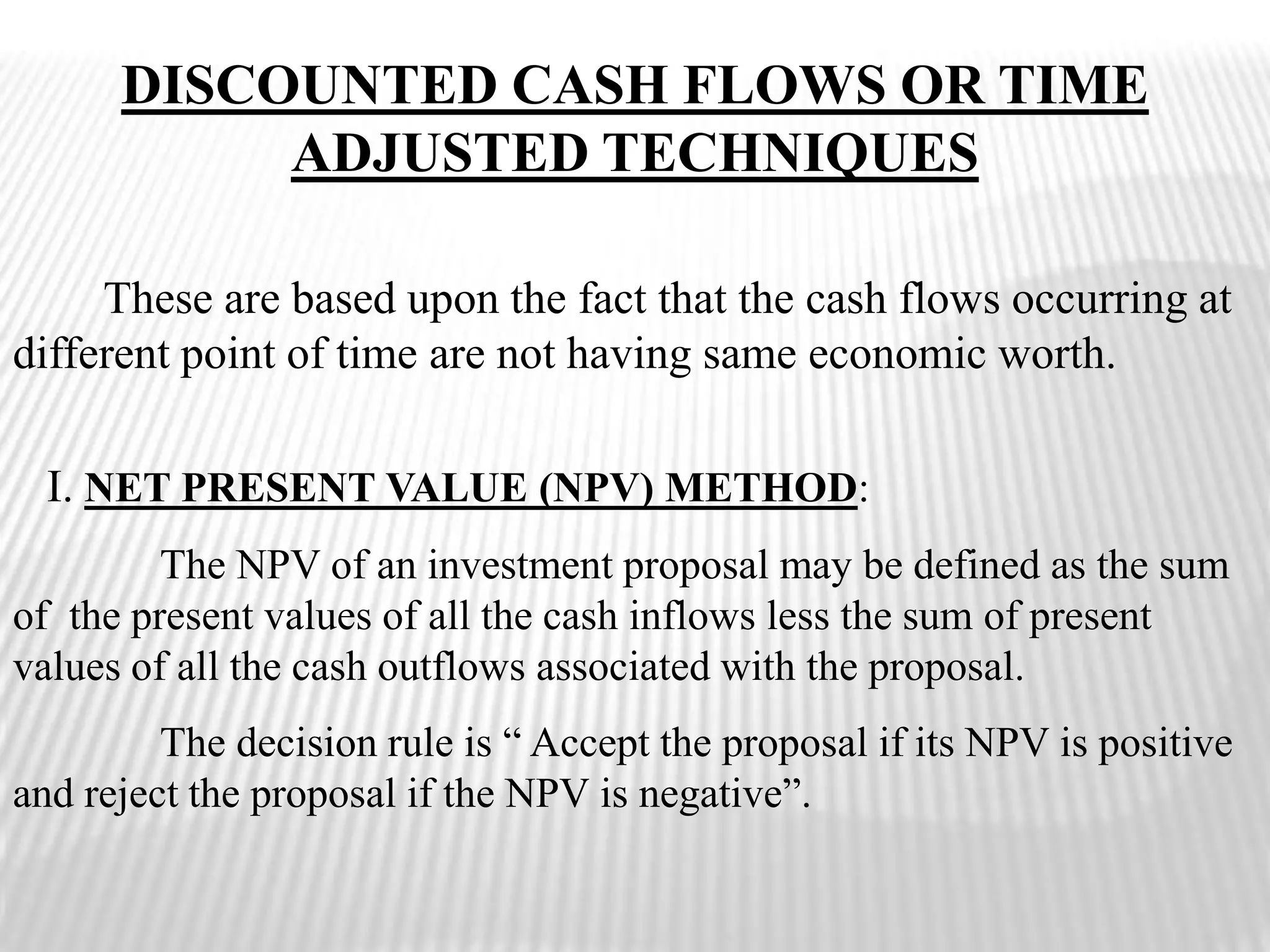
    DISCOUNTED CASH FLOWSOR TIME ADJUSTED TECHNIQUES These are based upon the fact that the cash flows occurring at different point of time are not having same economic worth. I.NET PRESENT VALUE (NPV) METHOD: The NPV of an investment proposal may be defined as the sum of the present values of all the cash inflows less the sum of present values of all the cash outflows associated with the proposal. The decision rule is “ Accept the proposal if its NPV is positive and reject the proposal if the NPV is negative”.
  • 42.
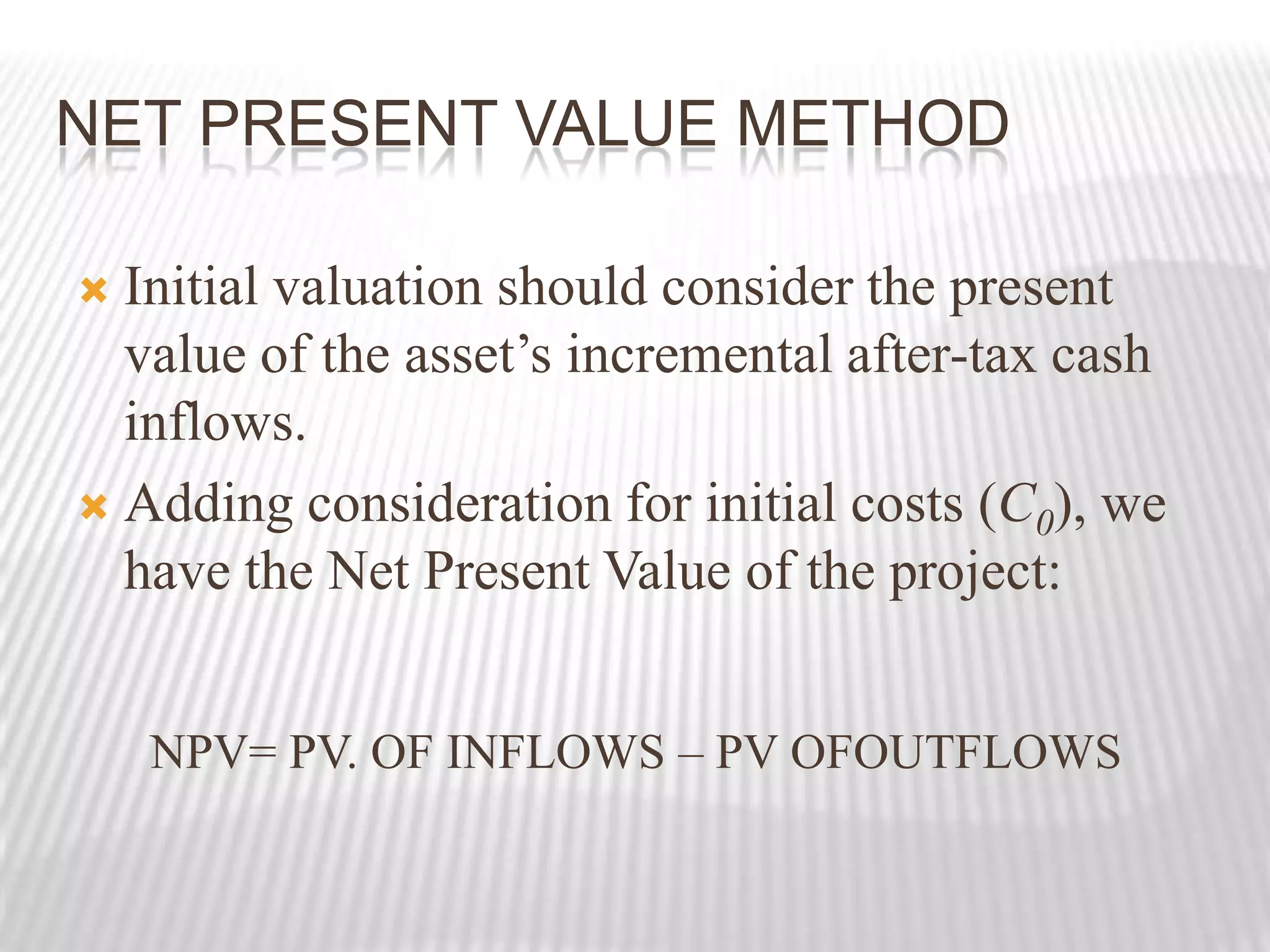
    Net Present ValueMethodInitial valuation should consider the present value of the asset’s incremental after-tax cash inflows.Adding consideration for initial costs (C0), we have the Net Present Value of the project: NPV= PV. OF INFLOWS – PV OFOUTFLOWS
  • 43.
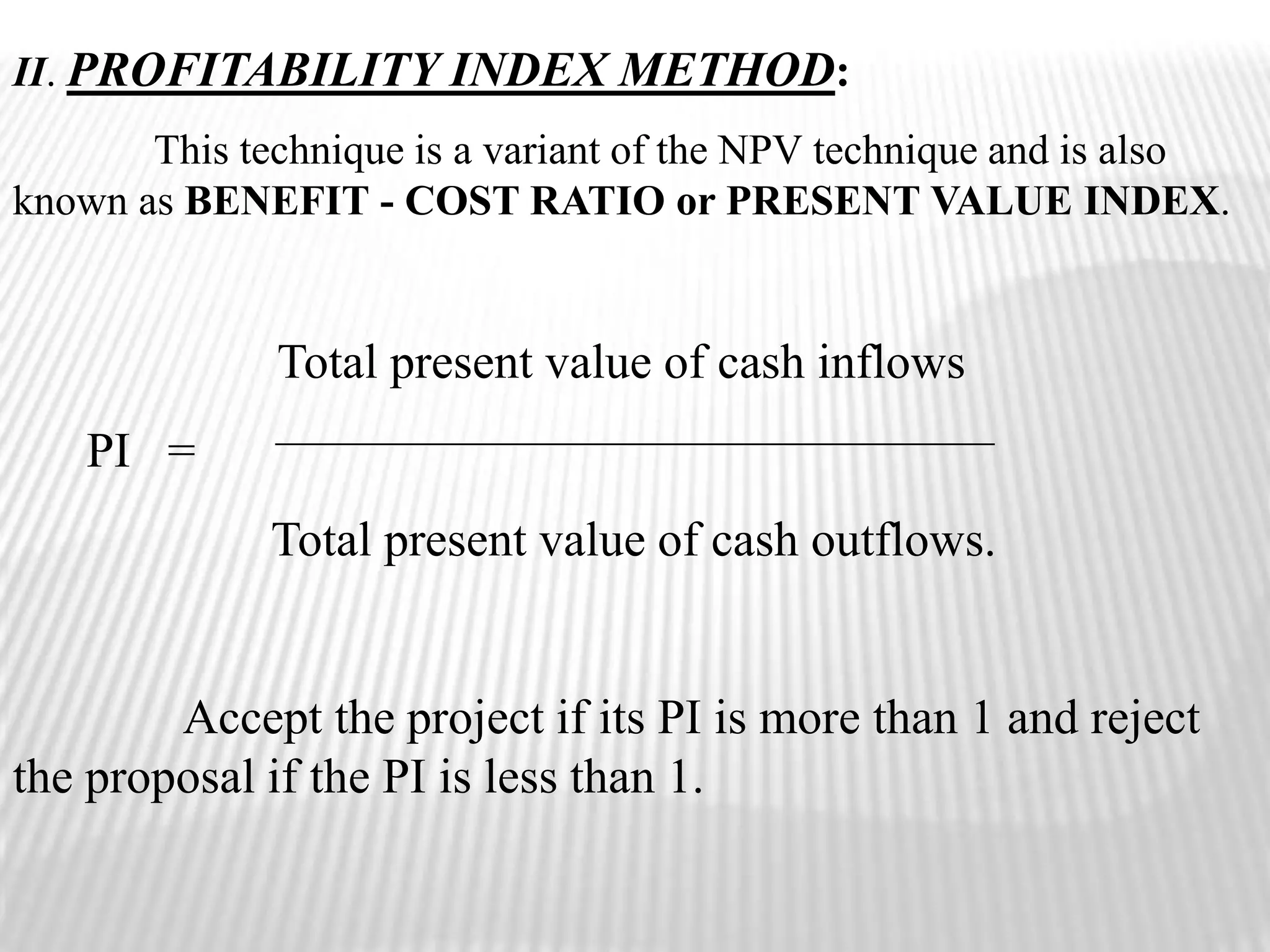
    II. PROFITABILITY INDEXMETHOD:This technique is a variant of the NPV technique and is also known as BENEFIT - COST RATIO or PRESENT VALUE INDEX.Total present value of cash inflows PI = Total present value of cash outflows. Accept the project if its PI is more than 1 and reject the proposal if the PI is less than 1.
  • 44.
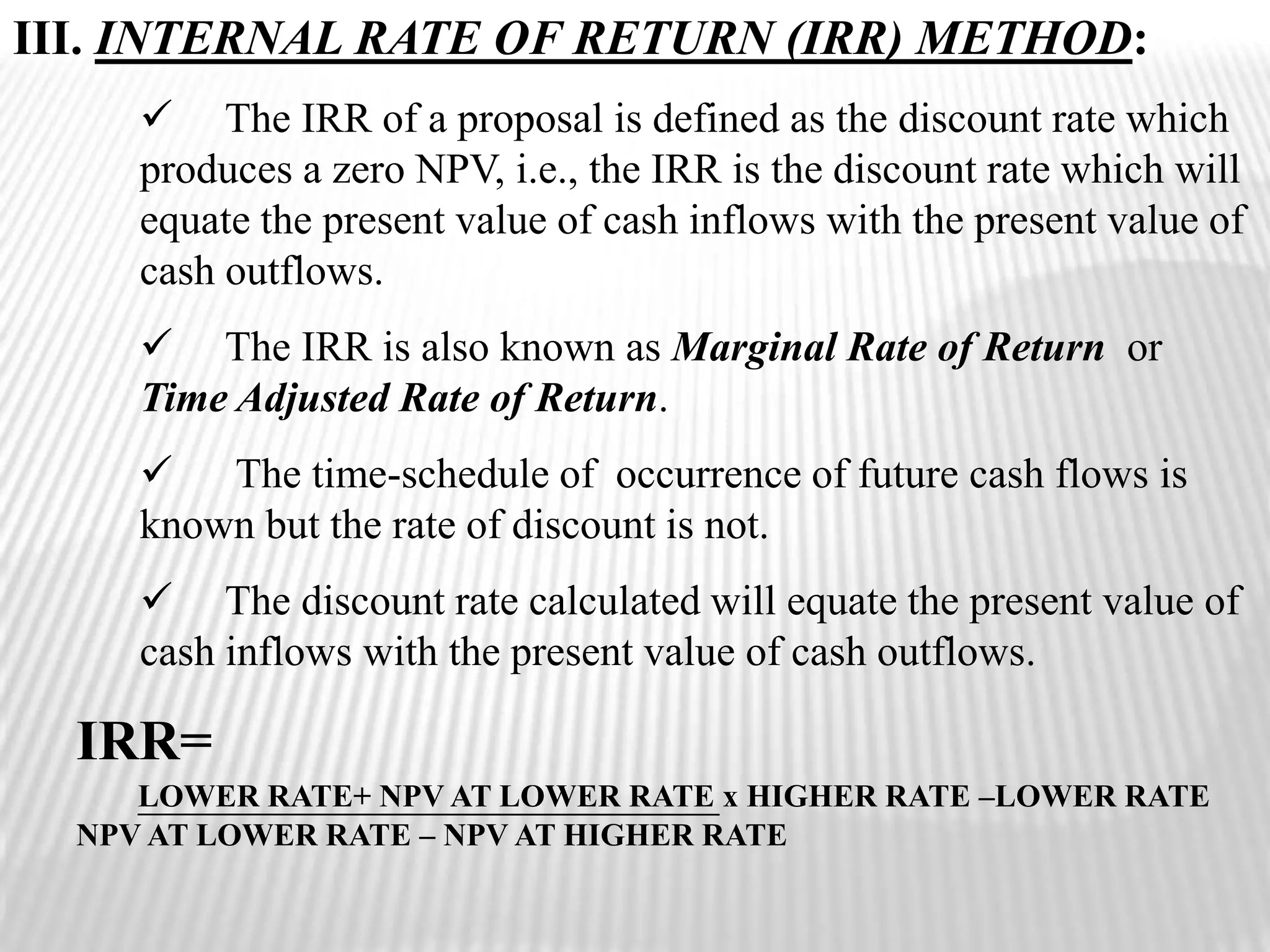
    III. INTERNAL RATEOF RETURN (IRR) METHOD: The IRR of a proposal is defined as the discount rate which produces a zero NPV, i.e., the IRR is the discount rate which will equate the present value of cash inflows with the present value of cash outflows.
  • 45.
    The IRR isalso known as Marginal Rate of Return or Time Adjusted Rate of Return.
  • 46.
    The time-schedule of occurrence of future cash flows is known but the rate of discount is not.
  • 47.
    The discount rate calculated will equate the present value of cash inflows with the present value of cash outflows.IRR= LOWER RATE+ NPV AT LOWER RATE x HIGHER RATE –LOWER RATE NPV AT LOWER RATE – NPV AT HIGHER RATE
  • 48.
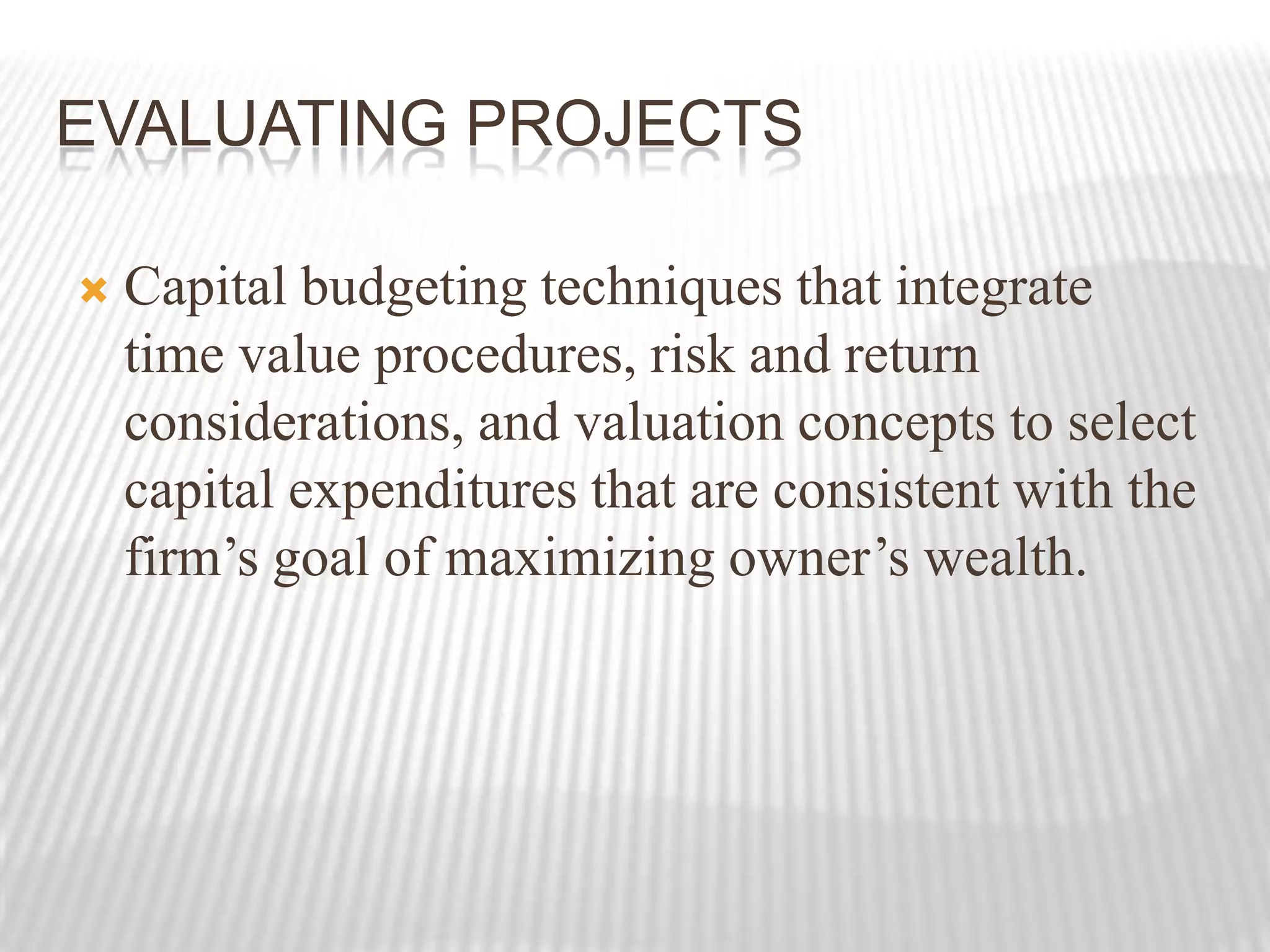
    Evaluating ProjectsCapital budgetingtechniques that integrate time value procedures, risk and return considerations, and valuation concepts to select capital expenditures that are consistent with the firm’s goal of maximizing owner’s wealth.
  • 49.
    Issues with CalculatingCash Inflows Each YearAssets with very long lives requires different calculations for each year’s CCA tax shield, since CCA is calculated on a declining balance of UCC.A related problem is that the declining balance of UCC never reaches zero, so even at the end of a long lived project, the assets may still have a positive UCC value.
  • 50.
    Capital Expenditure MotivesCapitalExpenditures are an outlay of funds that are expected to produce benefits over a period of time greater than one year.Operating Expenditures are an outlay of funds resulting in benefits received within one year.The basic motives for capital expenditures are to expand, replace, or renew fixed assets over a long period.
  • 51.
    CAPITAL BUDGETING PRACTICESIN INDIACapital budgeting decisions are undertaken at the top management level and are planned in advance. The Corporates follow mostly top-down approach in this regard.
  • 52.
    Discounted cash flow techniques are more popular now.
  • 53.
    High growth firms use IRR more frequently whereas Payback period is more widely used by small firms.
  • 54.
    PI technique is used more by public sector units than by private sector units.Capital budgeting decisions are of paramount importance as they affect the profitability of a firm, and are the major determinants of its efficiency and competing power.
  • 55.