Analysis of New Rule 6 of Cenvat Credit Rules, 2004
CA Sri Harsha
harsha@sbsandco.com
by
2 of 29
 Overview of Rule 6 of Cenvat Credit Rules, 2004
 Understanding Rule 6(3)
 Instances where Rule 6(3) is applicable
 Methodology to reverse common cenvat credit
 Understanding Rule 6(3)(i)
 Case Studies for Rule 6(3)(i)
 Understanding Rule 6(3)(ii) – 6(3A)
 Case Study for Rule 6(3)(ii) – 6(3A)
 Old vs New - Rule 6(3)
Discussion Items
3 of 29
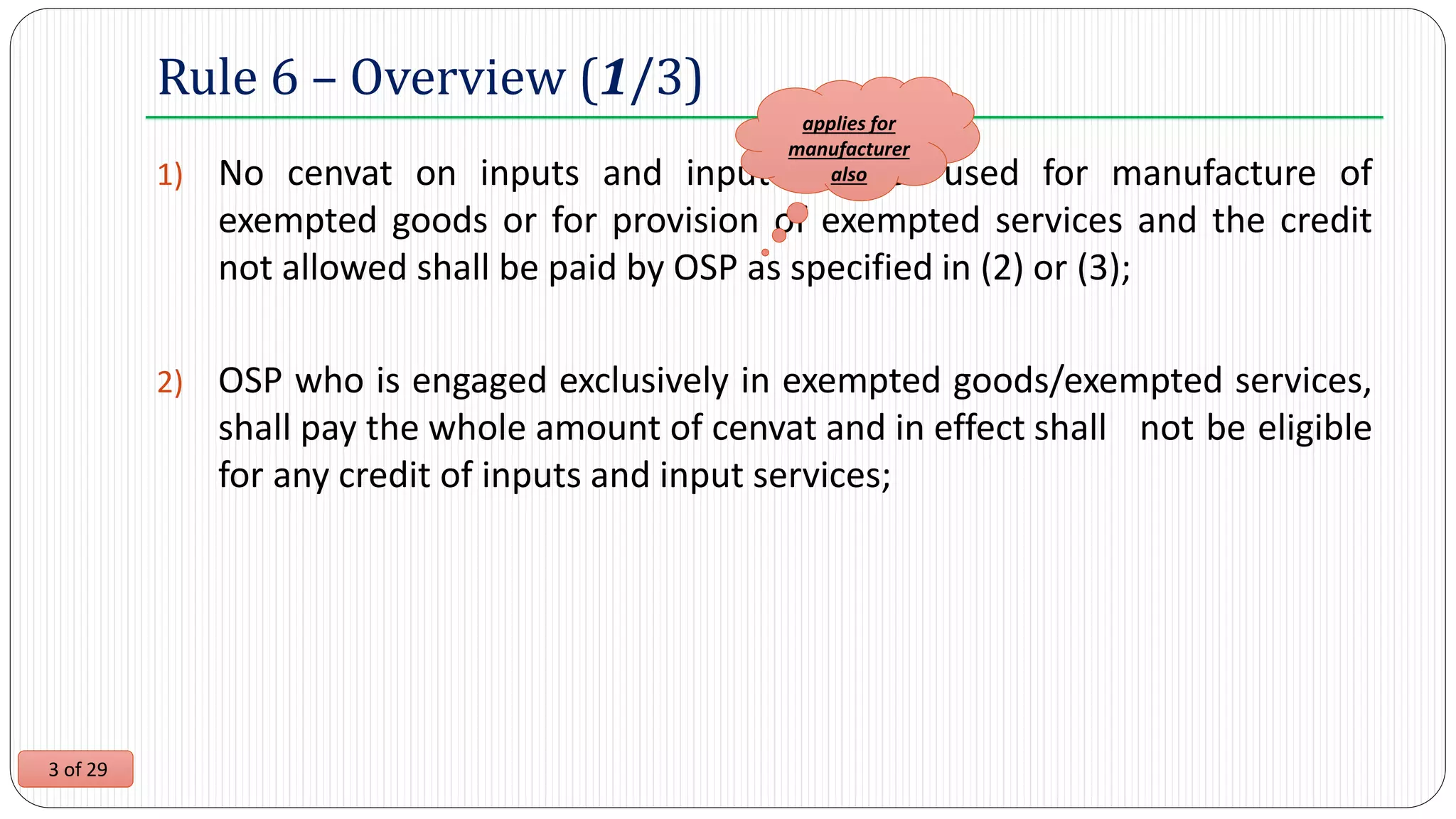
1) No cenvat on inputs and input services used for manufacture of
exempted goods or for provision of exempted services and the credit
not allowed shall be paid by OSP as specified in (2) or (3);
2) OSP who is engaged exclusively in exempted goods/exempted services,
shall pay the whole amount of cenvat and in effect shall not be eligible
for any credit of inputs and input services;
Rule 6 – Overview (1/3)
applies for
manufacturer
also
4 of 29
3) OSP who provides non-exempted services and exempted services, shall
adopt any of the 2 options to restrict the credit pertaining to exempted
services;
4) OSP cannot avail credit of capital goods if such capital goods are
exclusively used for provision of exempted services for a period of 2
years from the date of commencement of provision of services;
Rule 6 – Overview (2/3)
5 of 29
6) Certain clearances made by manufacturer without payment of duty
does not require reversal mentioned under (1), (2), (3) and (4);
7) Certain services without payment of tax does not require reversal
mentioned under (1), (2), (3) and (4);
8) Instances where export of service shall be treated as exempted services
for the purposes of Rule 6.
Rule 6 – Overview (3/3)
6 of 29
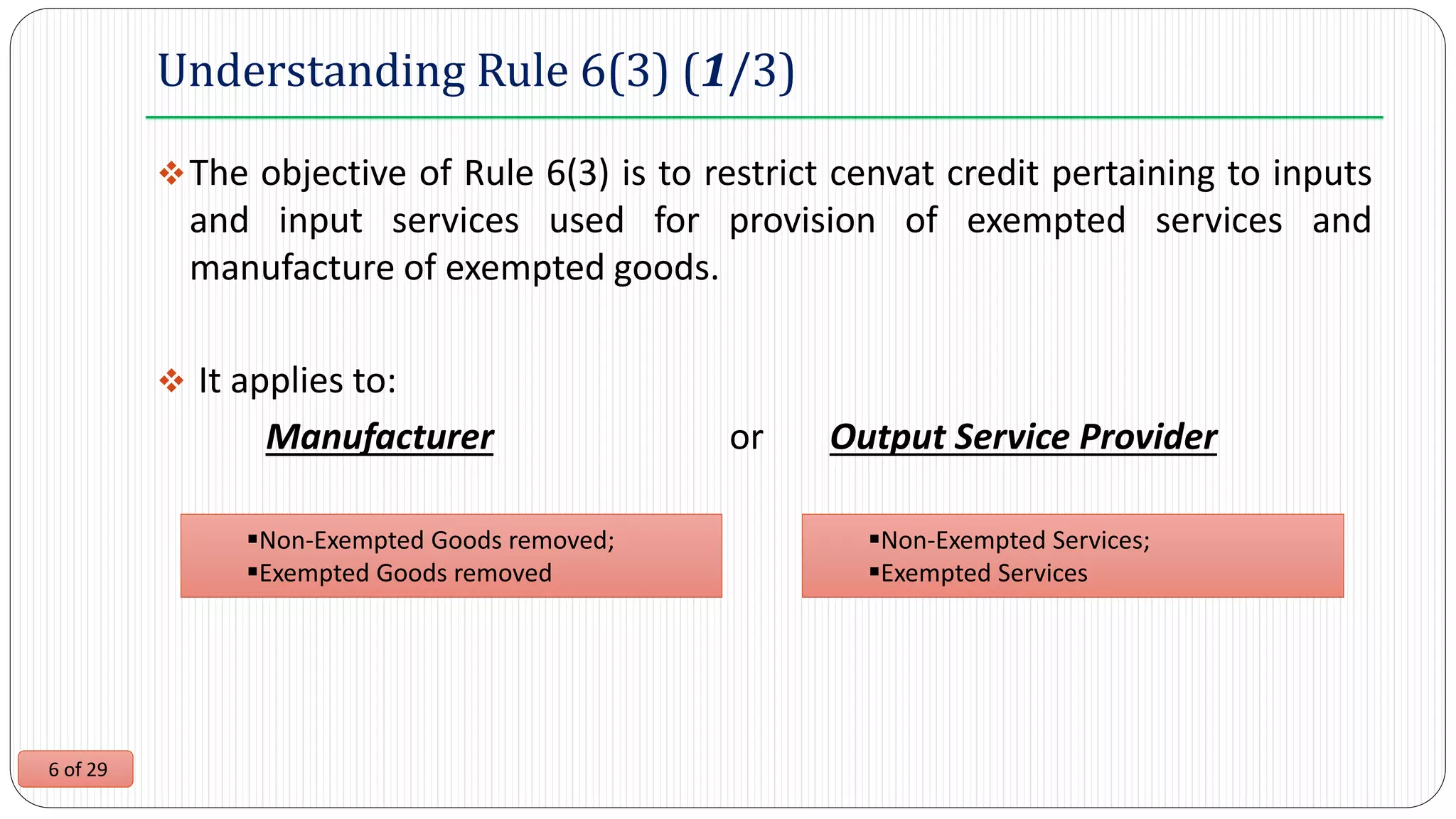
Understanding Rule 6(3) (1/3)
The objective of Rule 6(3) is to restrict cenvat credit pertaining to inputs
and input services used for provision of exempted services and
manufacture of exempted goods.
 It applies to:
Manufacturer or Output Service Provider
Non-Exempted Goods removed;
Exempted Goods removed
Non-Exempted Services;
Exempted Services
7 of 29
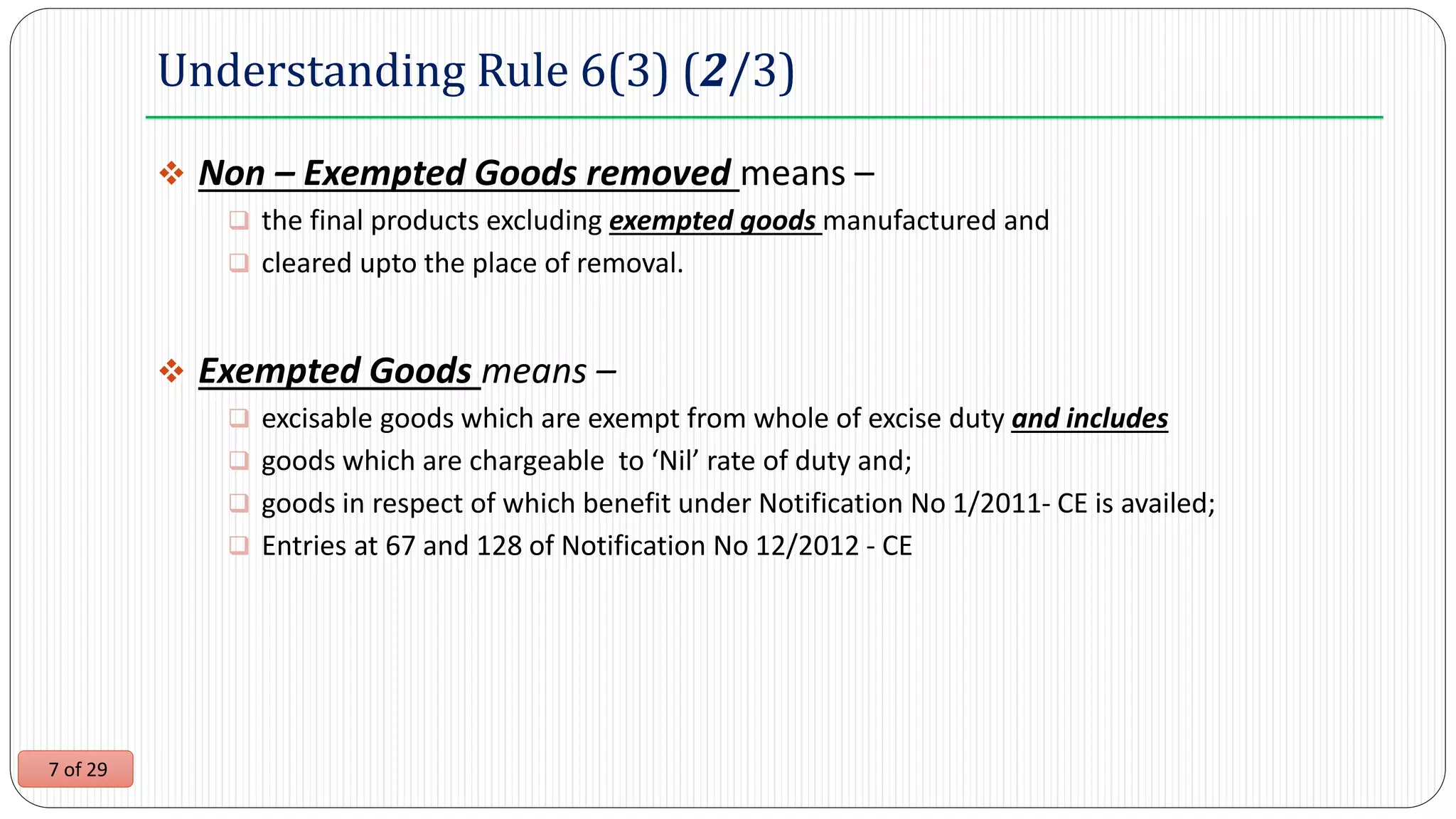
Understanding Rule 6(3) (2/3)
 Non – Exempted Goods removed means –
 the final products excluding exempted goods manufactured and
 cleared upto the place of removal.
 Exempted Goods means –
 excisable goods which are exempt from whole of excise duty and includes
 goods which are chargeable to ‘Nil’ rate of duty and;
 goods in respect of which benefit under Notification No 1/2011- CE is availed;
 Entries at 67 and 128 of Notification No 12/2012 - CE
8 of 29
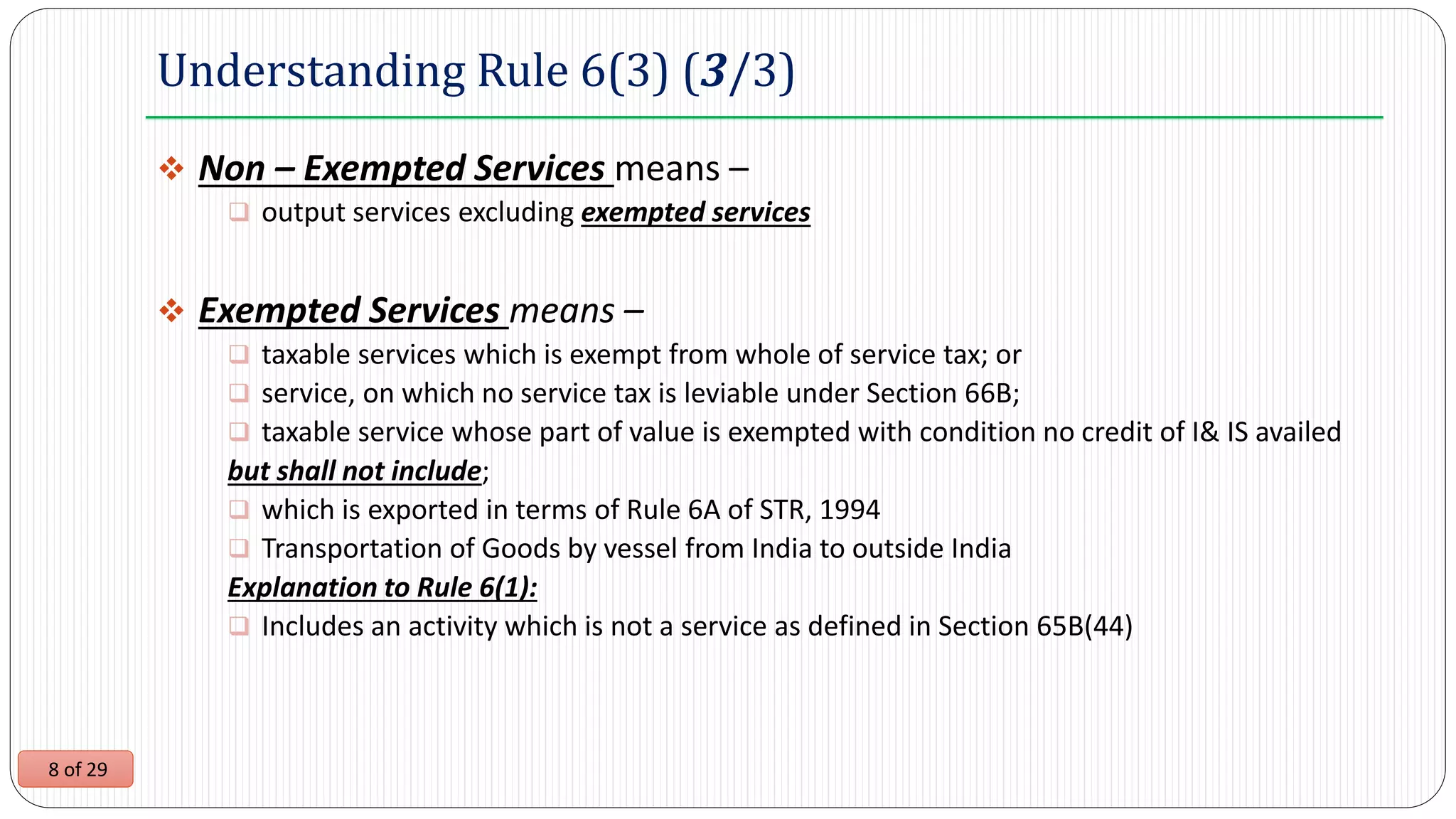
Understanding Rule 6(3) (3/3)
 Non – Exempted Services means –
 output services excluding exempted services
 Exempted Services means –
 taxable services which is exempt from whole of service tax; or
 service, on which no service tax is leviable under Section 66B;
 taxable service whose part of value is exempted with condition no credit of I& IS availed
but shall not include;
 which is exported in terms of Rule 6A of STR, 1994
 Transportation of Goods by vessel from India to outside India
Explanation to Rule 6(1):
 Includes an activity which is not a service as defined in Section 65B(44)
9 of 29
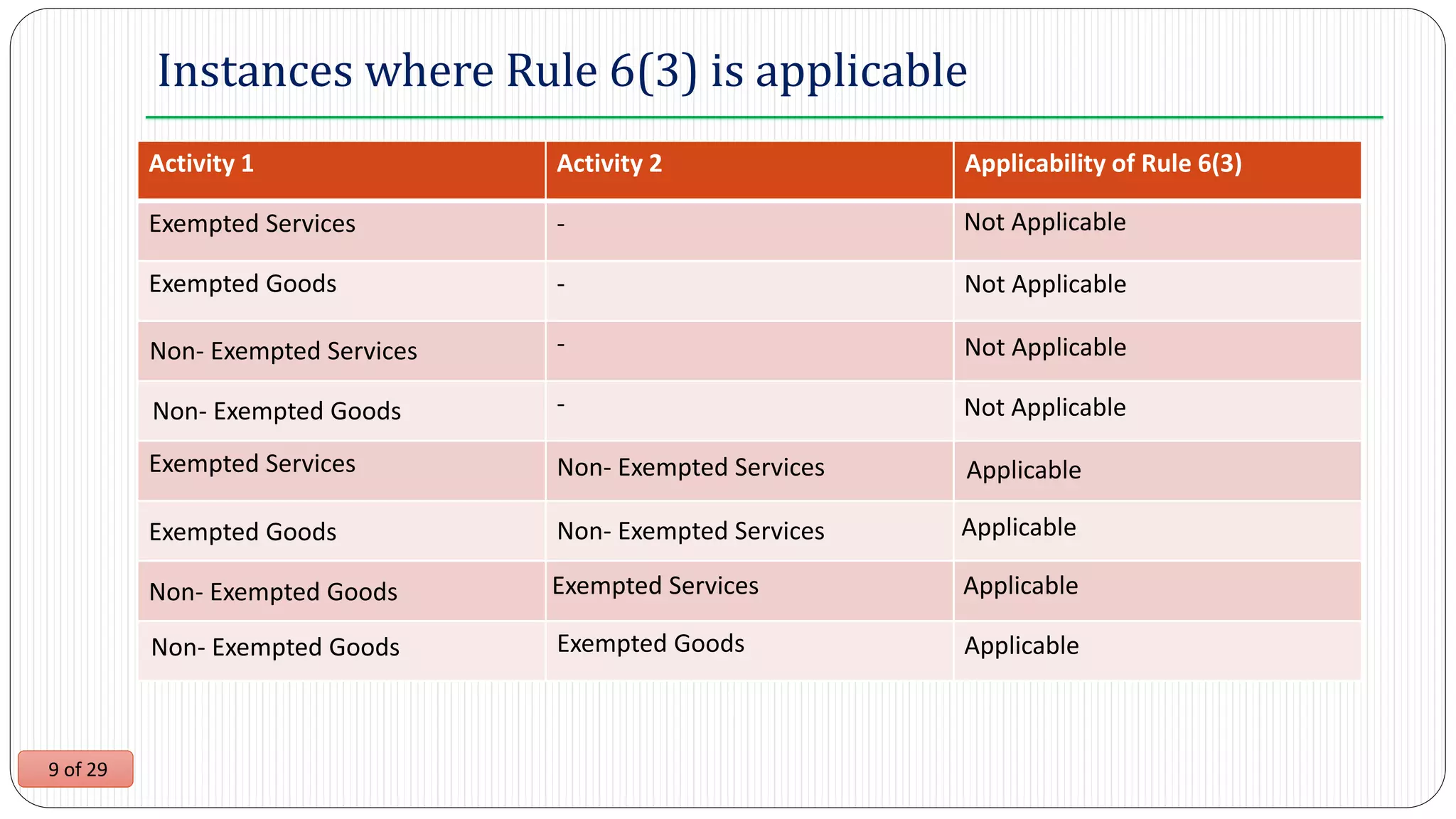
Instances where Rule 6(3) is applicable
Activity 1 Activity 2 Applicability of Rule 6(3)
Exempted Services -
-
-
-
Exempted Services
Exempted Goods
Not Applicable
Not Applicable
Not Applicable
Not Applicable
Applicable
Applicable
Applicable
Applicable
Exempted Goods
Non- Exempted Services
Non- Exempted Goods
Non- Exempted Services
Non- Exempted ServicesExempted Goods
Non- Exempted Goods
Non- Exempted Goods
Exempted Services
10 of 29
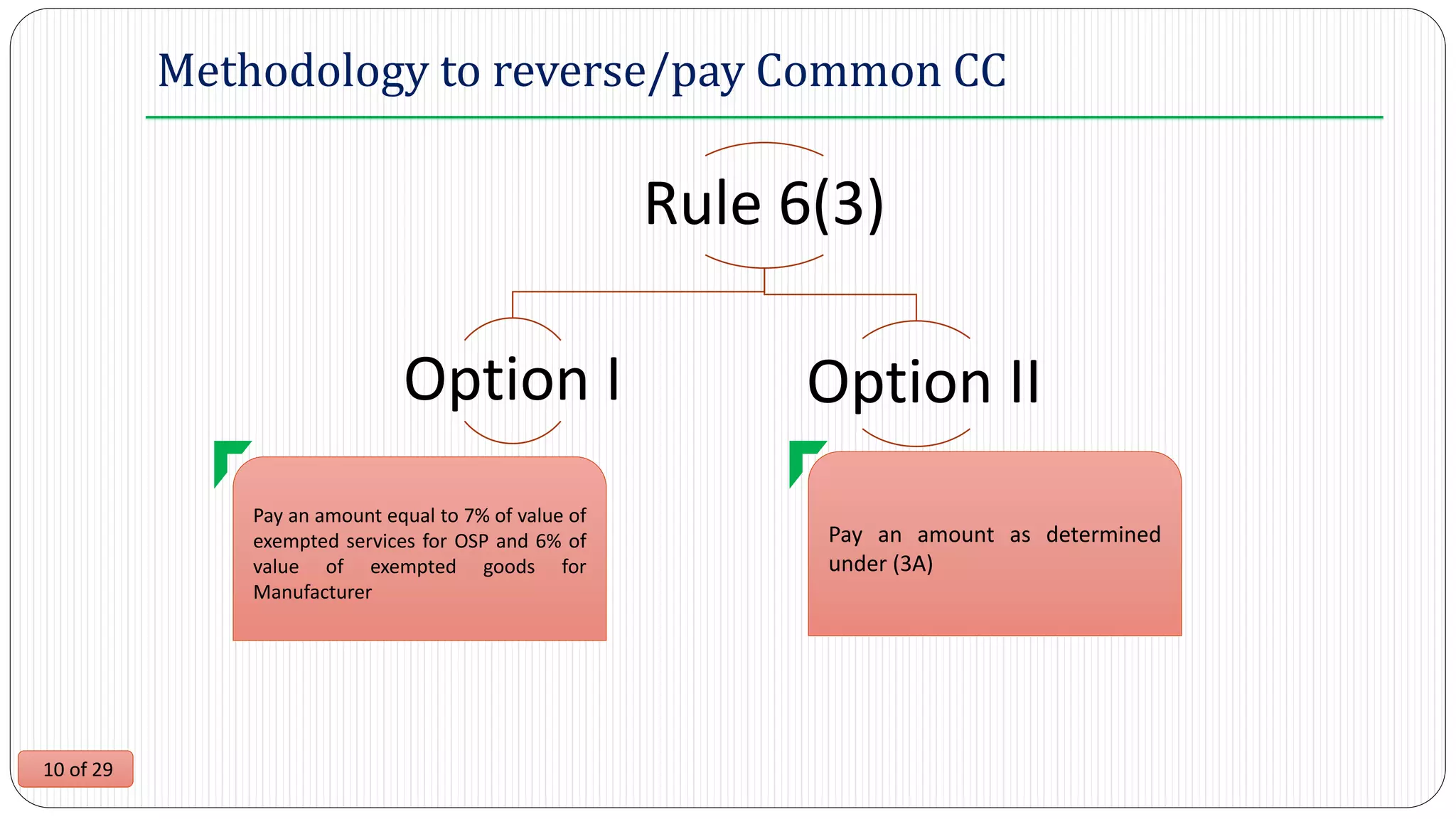
Rule 6(3)
Option I Option II
Methodology to reverse/pay Common CC
Pay an amount equal to 7% of value of
exempted services for OSP and 6% of
value of exempted goods for
Manufacturer
Pay an amount as determined
under (3A)
11 of 29
Understanding Rule 6(3)(i) (1/3)
 Under this method, the manufacturer/OSP can avail the total cenvat
credit subject to reversal of the following amounts:
 6% * [value of exempted goods ] and
 7% * [value of exempted services]
 Such reversal has to be made every month/quarter, as the case may be
and if failed, the same shall be recovered in terms of Rule 14 of CCR, 2004
The option shall be applicable for all exempted services and exempted
goods and cannot be changed during the year.
12 of 29
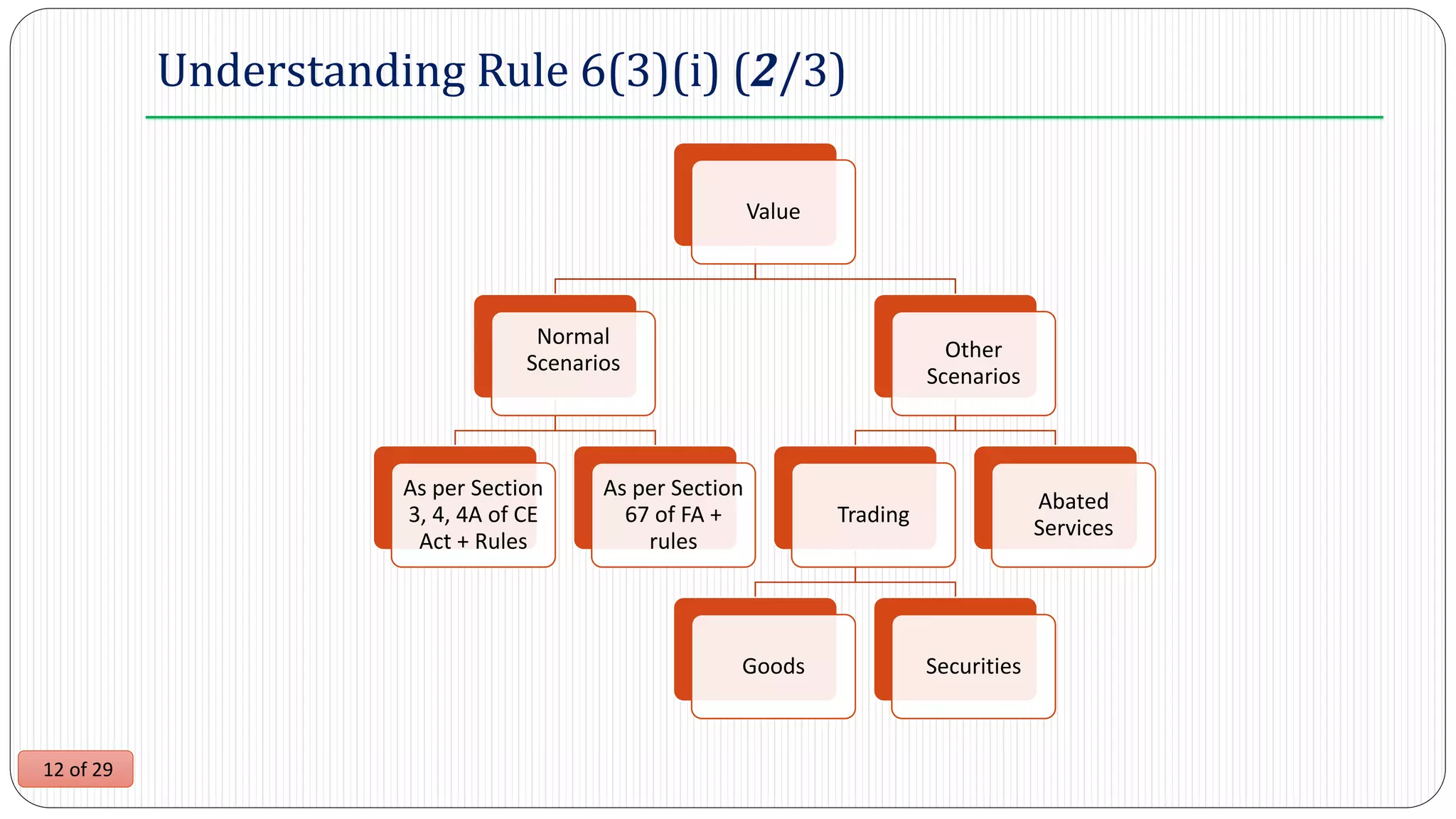
Understanding Rule 6(3)(i) (2/3)
Value
Normal
Scenarios
As per Section
3, 4, 4A of CE
Act + Rules
As per Section
67 of FA +
rules
Other
Scenarios
Trading
Goods Securities
Abated
Services
13 of 29
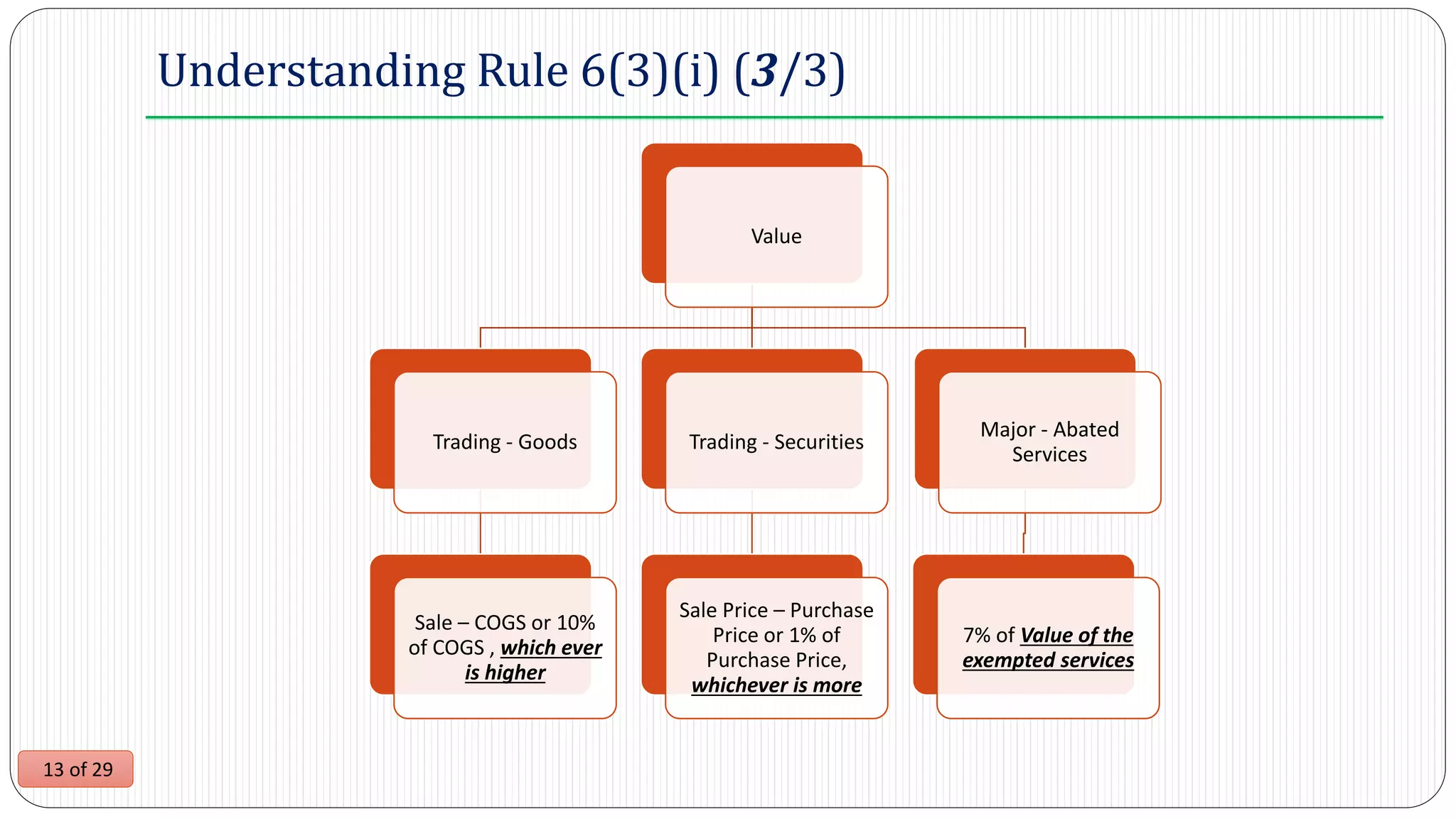
Understanding Rule 6(3)(i) (3/3)
Value
Trading - Goods
Sale – COGS or 10%
of COGS , which ever
is higher
Trading - Securities
Sale Price – Purchase
Price or 1% of
Purchase Price,
whichever is more
Major - Abated
Services
7% of Value of the
exempted services
14 of 29
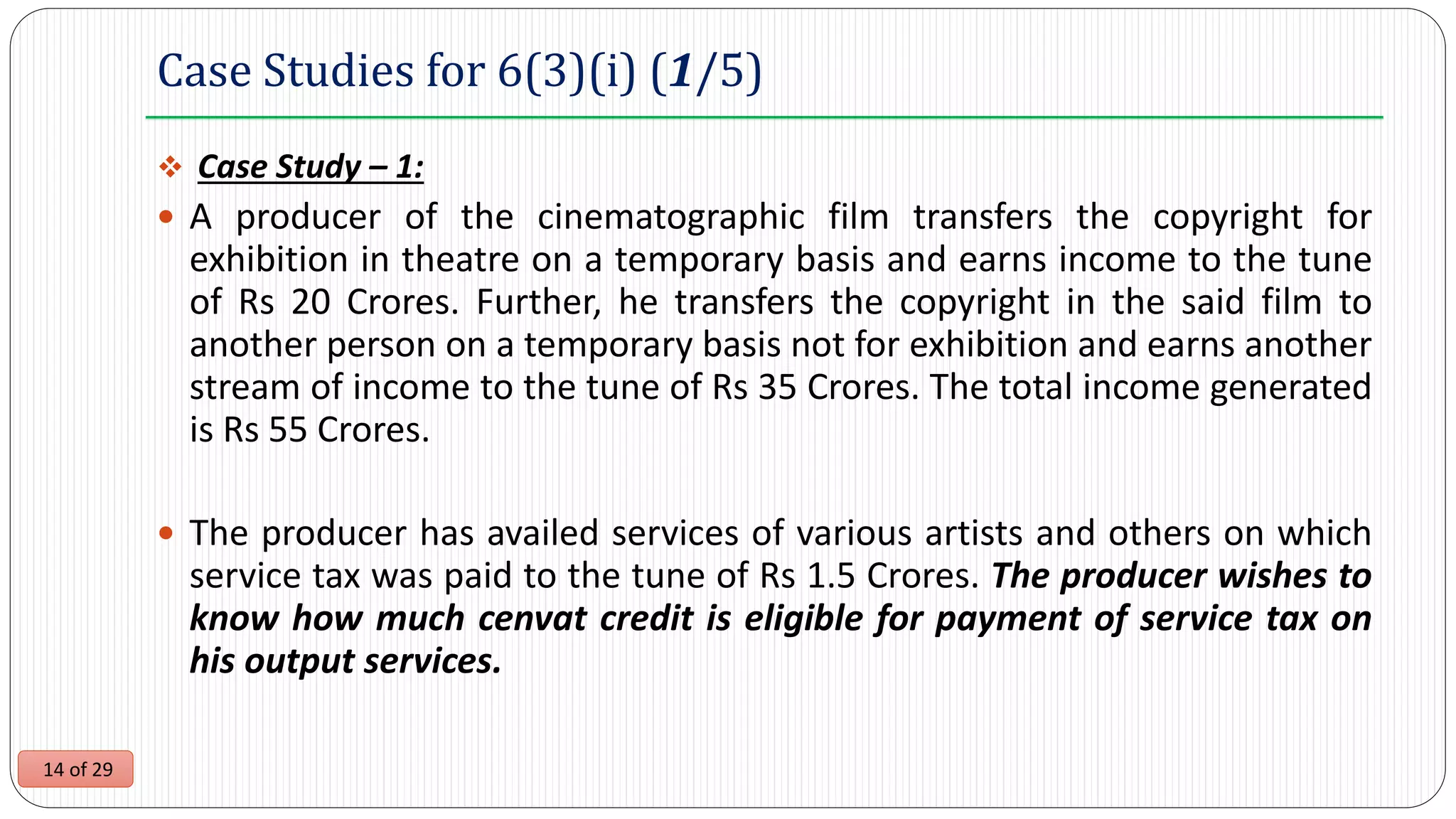
Case Studies for 6(3)(i) (1/5)
 Case Study – 1:
 A producer of the cinematographic film transfers the copyright for
exhibition in theatre on a temporary basis and earns income to the tune
of Rs 20 Crores. Further, he transfers the copyright in the said film to
another person on a temporary basis not for exhibition and earns another
stream of income to the tune of Rs 35 Crores. The total income generated
is Rs 55 Crores.
 The producer has availed services of various artists and others on which
service tax was paid to the tune of Rs 1.5 Crores. The producer wishes to
know how much cenvat credit is eligible for payment of service tax on
his output services.
15 of 29
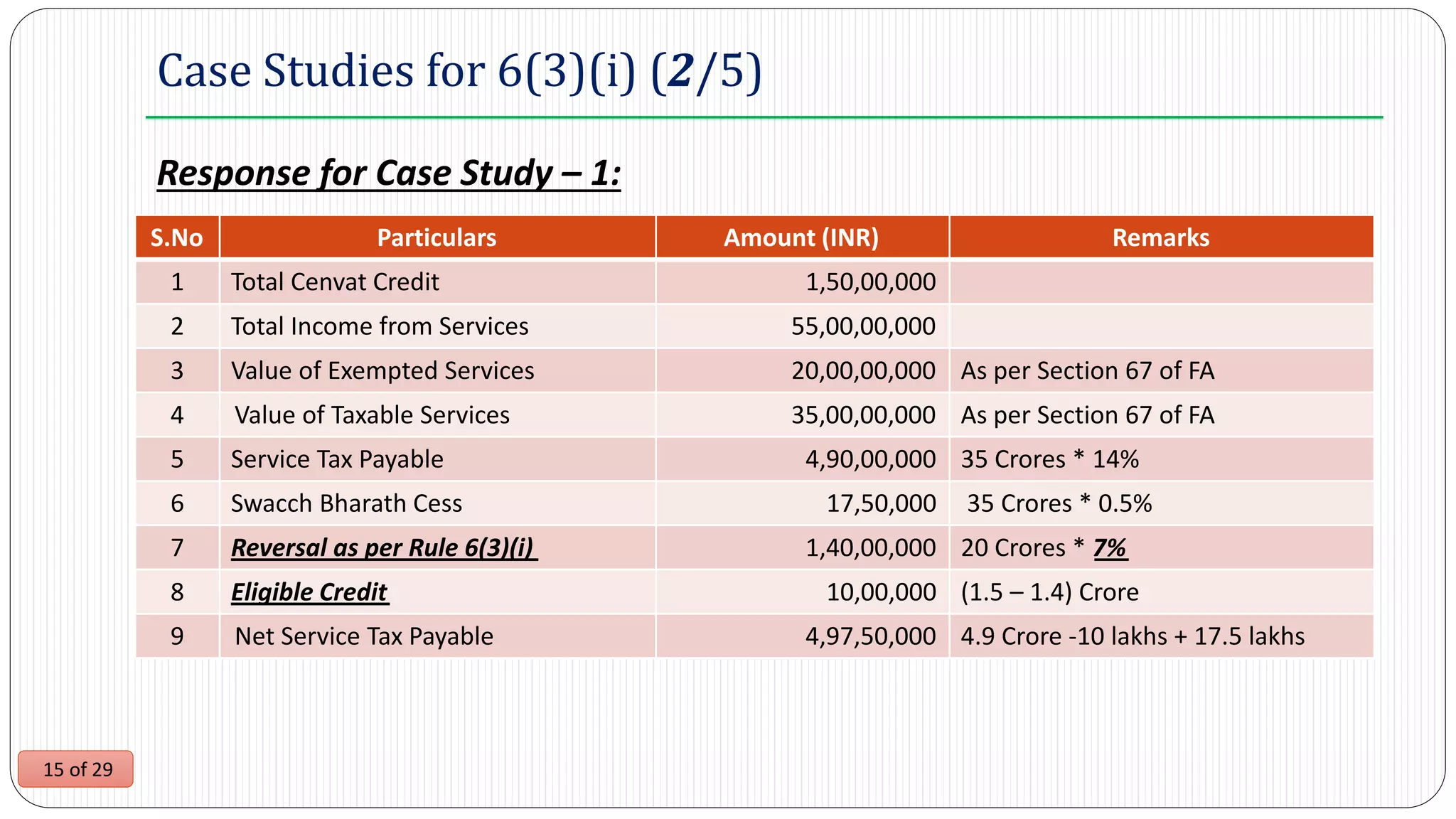
Case Studies for 6(3)(i) (2/5)
Response for Case Study – 1:
S.No Particulars Amount (INR) Remarks
1 Total Cenvat Credit 1,50,00,000
2 Total Income from Services 55,00,00,000
3 Value of Exempted Services 20,00,00,000
4 Value of Taxable Services 35,00,00,000 As per Section 67 of FA
5 Service Tax Payable 4,90,00,000 35 Crores * 14%
6 Swacch Bharath Cess 17,50,000 35 Crores * 0.5%
7 Reversal as per Rule 6(3)(i) 1,40,00,000 20 Crores * 7%
8 Eligible Credit 10,00,000 (1.5 – 1.4) Crore
9 Net Service Tax Payable 4,97,50,000 4.9 Crore -10 lakhs + 17.5 lakhs
As per Section 67 of FA
16 of 29
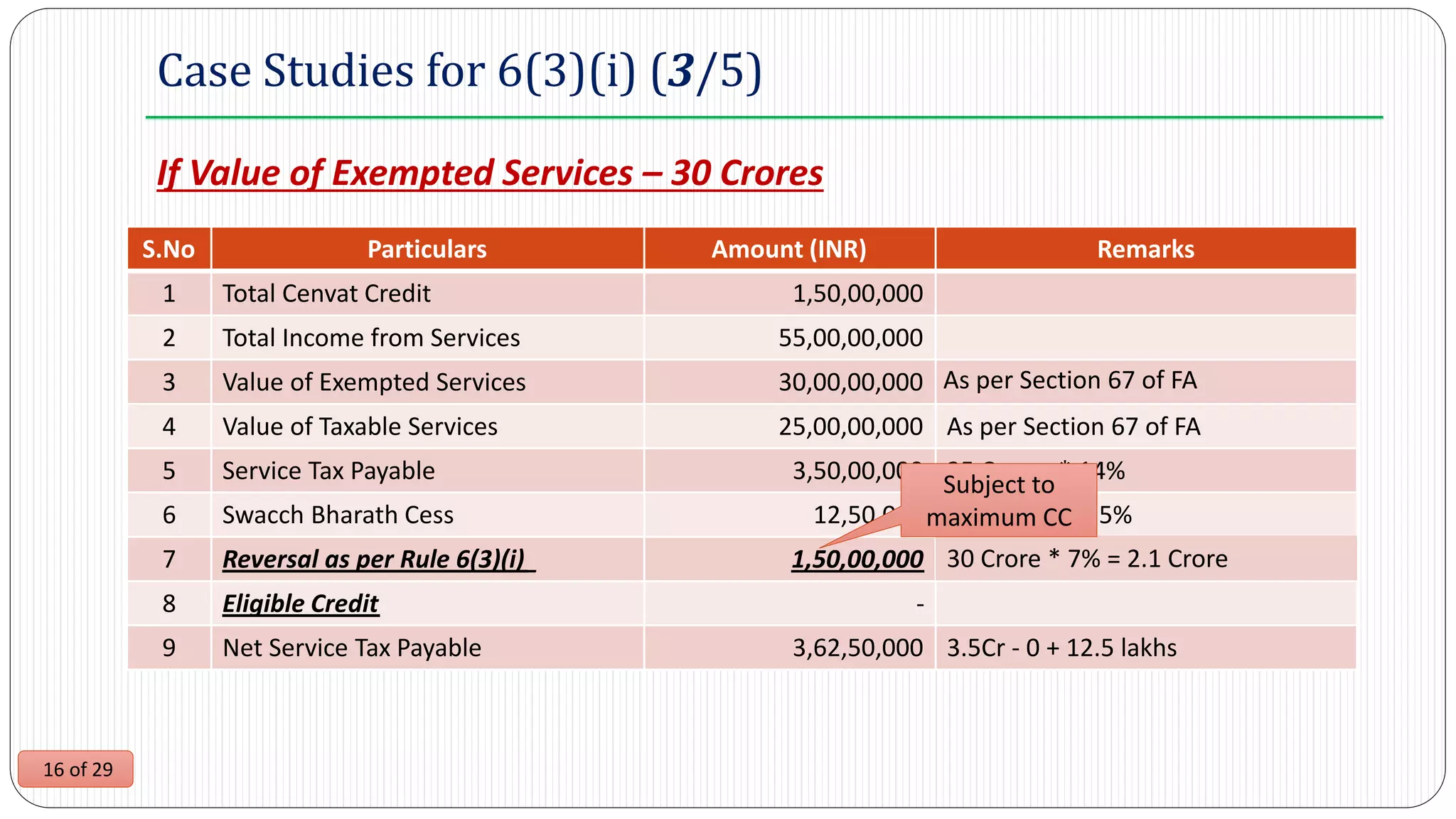
Case Studies for 6(3)(i) (3/5)
If Value of Exempted Services – 30 Crores
S.No Particulars Amount (INR) Remarks
1 Total Cenvat Credit 1,50,00,000
2 Total Income from Services 55,00,00,000
3 Value of Exempted Services 30,00,00,000
4 Value of Taxable Services 25,00,00,000 As per Section 67 of FA
5 Service Tax Payable 3,50,00,000 25 Crores * 14%
6 Swacch Bharath Cess 12,50,000 25 Crores * 0.5%
7 Reversal as per Rule 6(3)(i)_ 1,50,00,000
8 Eligible Credit -
9 Net Service Tax Payable 3,62,50,000 3.5Cr - 0 + 12.5 lakhs
As per Section 67 of FA
30 Crore * 7% = 2.1 Crore
Subject to
maximum CC
17 of 29
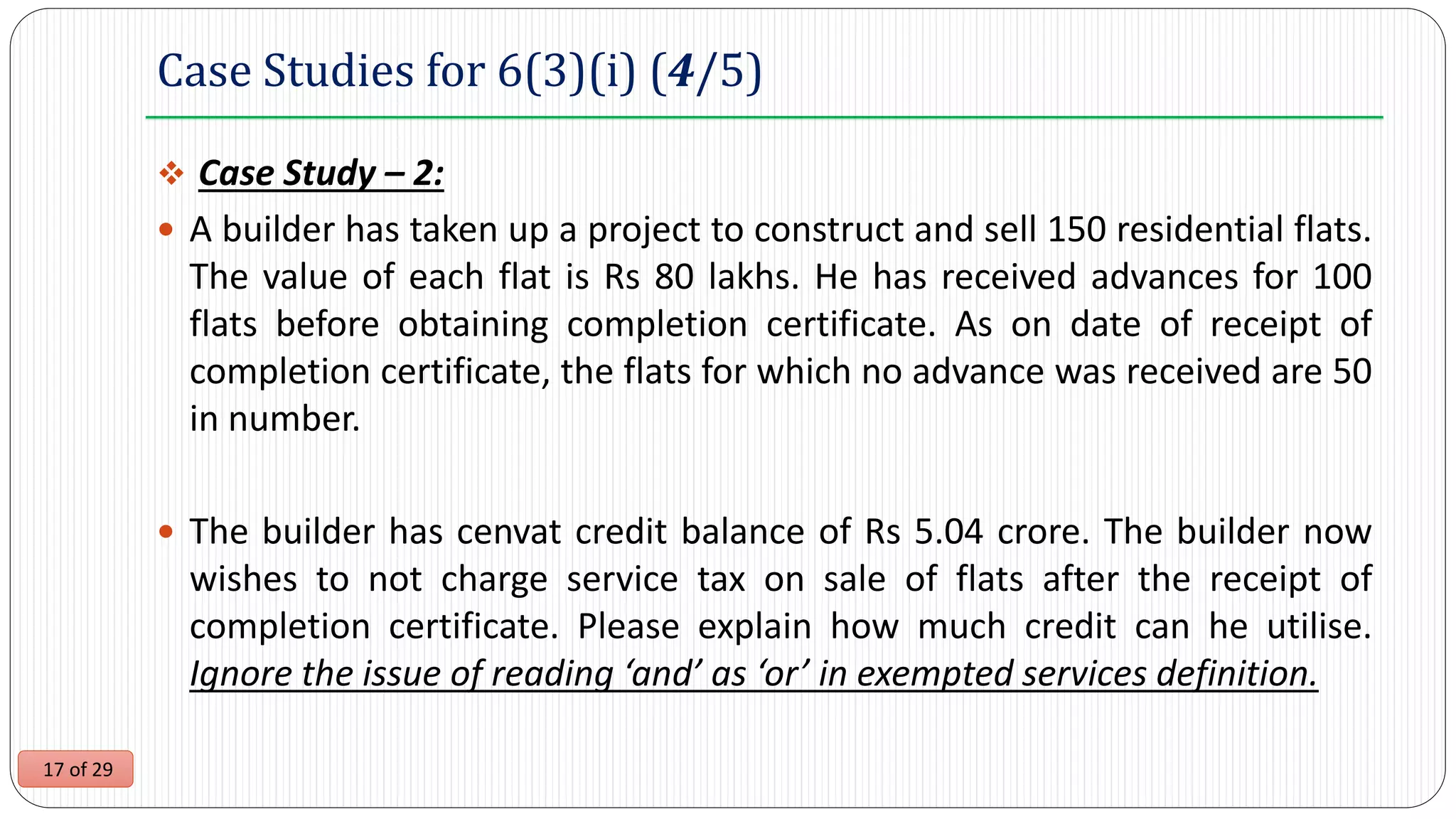
Case Studies for 6(3)(i) (4/5)
 Case Study – 2:
 A builder has taken up a project to construct and sell 150 residential flats.
The value of each flat is Rs 80 lakhs. He has received advances for 100
flats before obtaining completion certificate. As on date of receipt of
completion certificate, the flats for which no advance was received are 50
in number.
 The builder has cenvat credit balance of Rs 5.04 crore. The builder now
wishes to not charge service tax on sale of flats after the receipt of
completion certificate. Please explain how much credit can he utilise.
Ignore the issue of reading ‘and’ as ‘or’ in exempted services definition.
18 of 29
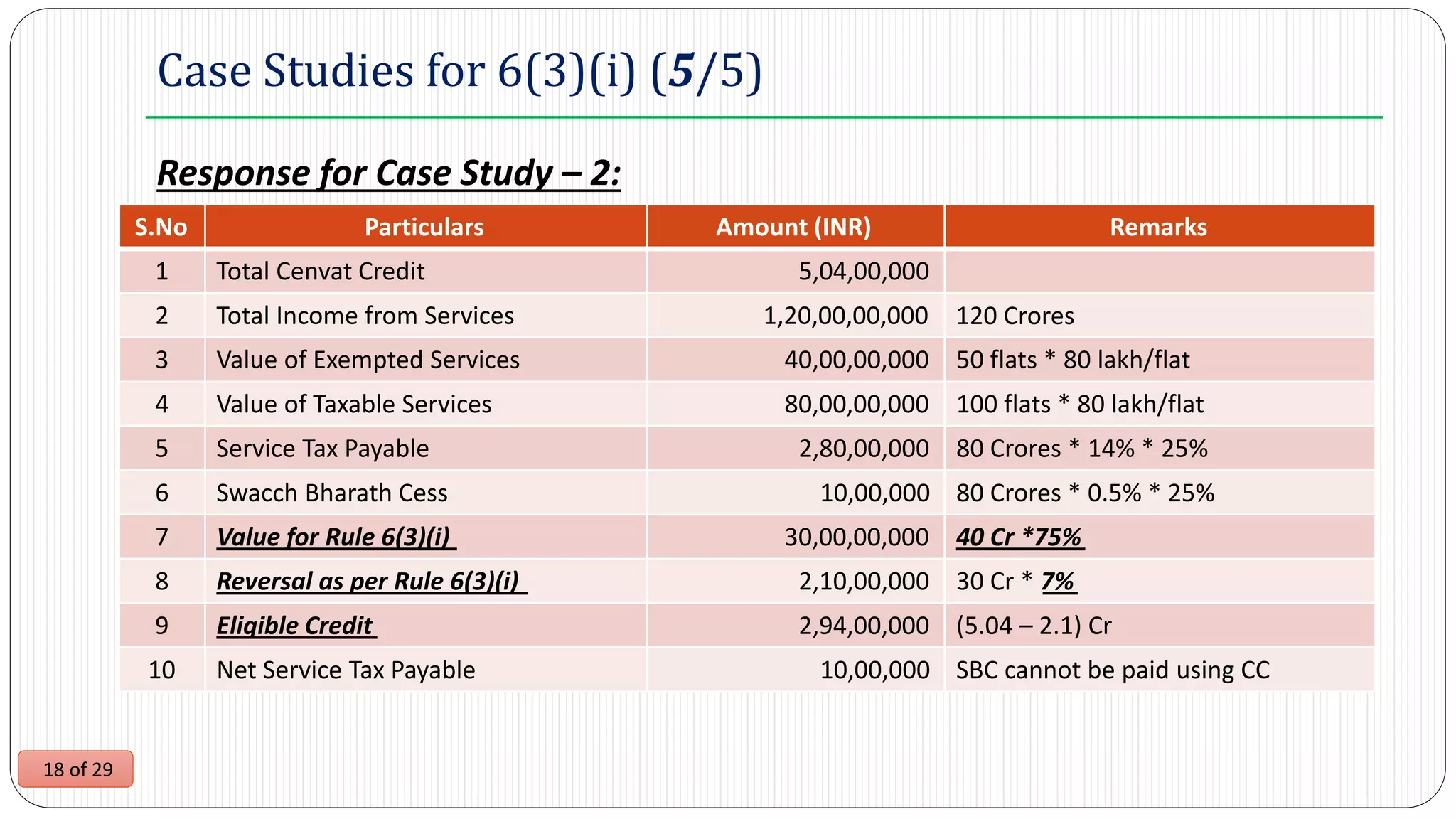
Case Studies for 6(3)(i) (5/5)
Response for Case Study – 2:
120 Crores
S.No Particulars Amount (INR) Remarks
1 Total Cenvat Credit 5,04,00,000
2 Total Income from Services 1,20,00,00,000
3 Value of Exempted Services 40,00,00,000 50 flats * 80 lakh/flat
4 Value of Taxable Services 80,00,00,000 100 flats * 80 lakh/flat
5 Service Tax Payable 2,80,00,000 80 Crores * 14% * 25%
6 Swacch Bharath Cess 10,00,000 80 Crores * 0.5% * 25%
7 Value for Rule 6(3)(i) 30,00,00,000 40 Cr *75%
8 Reversal as per Rule 6(3)(i) 2,10,00,000 30 Cr * 7%
9 Eligible Credit 2,94,00,000 (5.04 – 2.1) Cr
10 Net Service Tax Payable 10,00,000 SBC cannot be paid using CC
19 of 29
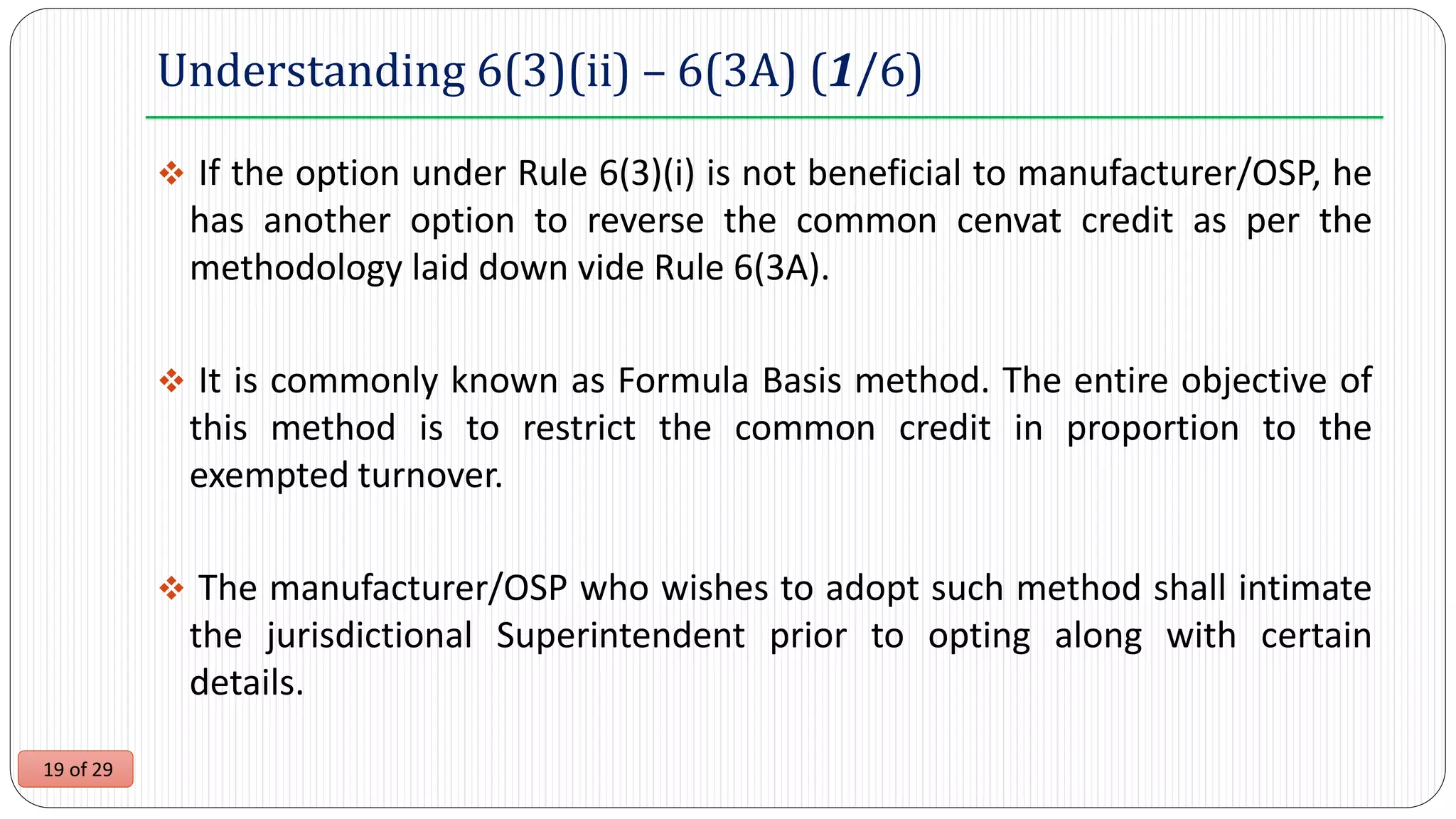
Understanding 6(3)(ii) – 6(3A) (1/6)
 If the option under Rule 6(3)(i) is not beneficial to manufacturer/OSP, he
has another option to reverse the common cenvat credit as per the
methodology laid down vide Rule 6(3A).
 It is commonly known as Formula Basis method. The entire objective of
this method is to restrict the common credit in proportion to the
exempted turnover.
 The manufacturer/OSP who wishes to adopt such method shall intimate
the jurisdictional Superintendent prior to opting along with certain
details.
20 of 29
Understanding 6(3)(ii) – 6(3A) (2/6)
 The formula has to be adopted on monthly basis by taking the figures of
previous financial year. Ineligible credit arrived on monthly basis has to be
checked with Ineligible credit arrived based on the actual figures at the
end of the year and adjustments for short/excess has to be done.
 Once adjustment is done based on the actual figures, the
manufacturer/OSP shall again intimate the jurisdictional Superintendent
such adjustment along with certain other details.
 Once adopted, the same method has to be continued for the entire
financial year.
21 of 29
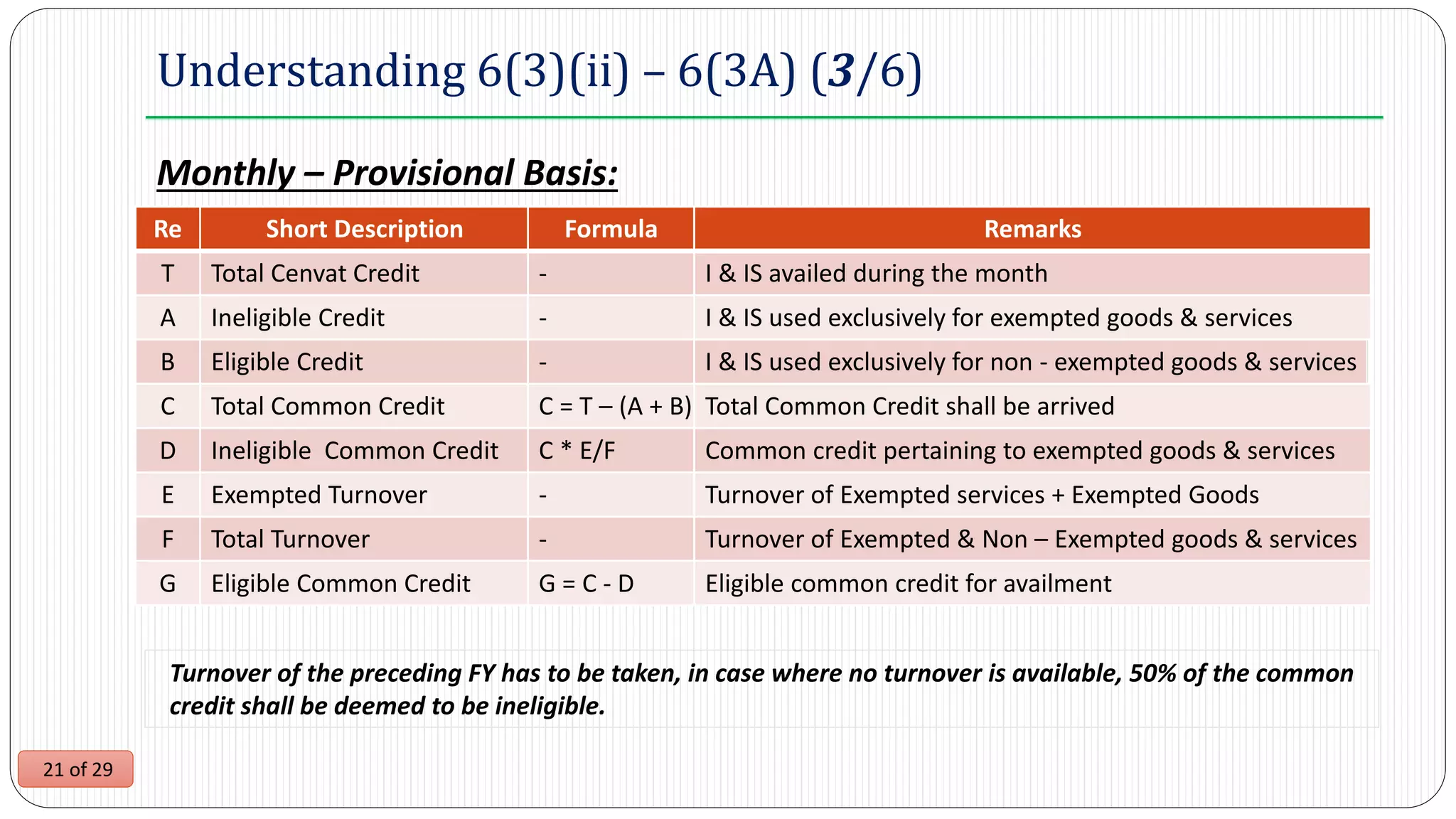
Understanding 6(3)(ii) – 6(3A) (3/6)
Monthly – Provisional Basis:
Turnover of the preceding FY has to be taken, in case where no turnover is available, 50% of the common
credit shall be deemed to be ineligible.
Re Short Description Formula Remarks
T Total Cenvat Credit - I & IS availed during the month
A Ineligible Credit - I & IS used exclusively for exempted goods & services
B Eligible Credit - I & IS used exclusively for non - exempted goods & services
C Total Common Credit C = T – (A + B) Total Common Credit shall be arrived
D Ineligible Common Credit C * E/F Common credit pertaining to exempted goods & services
E Exempted Turnover - Turnover of Exempted services + Exempted Goods
F Total Turnover - Turnover of Exempted & Non – Exempted goods & services
G Eligible Common Credit G = C - D Eligible common credit for availment
22 of 29
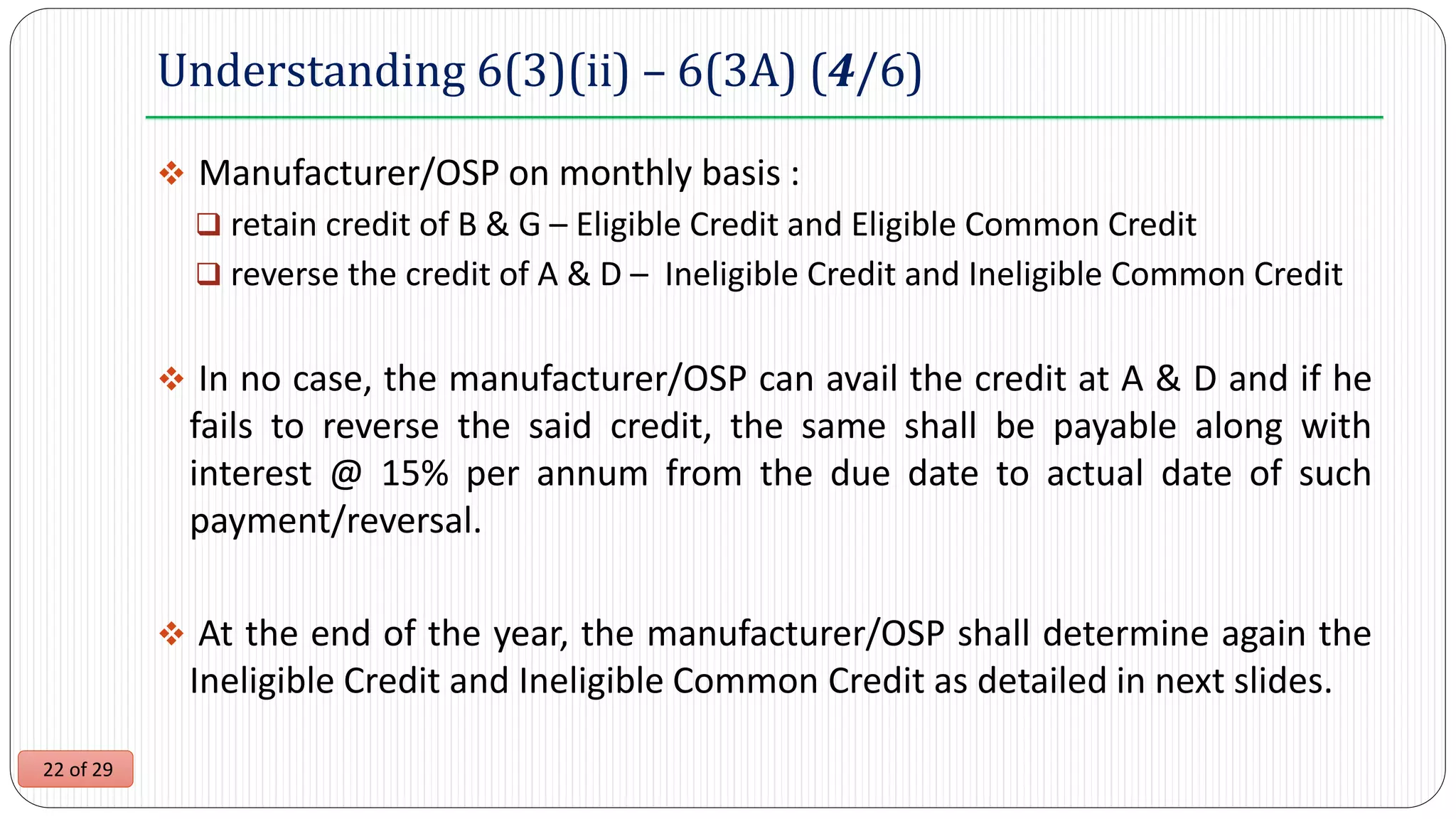
Understanding 6(3)(ii) – 6(3A) (4/6)
 Manufacturer/OSP on monthly basis :
 retain credit of B & G – Eligible Credit and Eligible Common Credit
 reverse the credit of A & D – Ineligible Credit and Ineligible Common Credit
 In no case, the manufacturer/OSP can avail the credit at A & D and if he
fails to reverse the said credit, the same shall be payable along with
interest @ 15% per annum from the due date to actual date of such
payment/reversal.
 At the end of the year, the manufacturer/OSP shall determine again the
Ineligible Credit and Ineligible Common Credit as detailed in next slides.
23 of 29
Understanding 6(3)(ii) – 6(3A) (5/6)
Year end – Actual Basis:
The turnover for the year under consideration shall be taken. The difference between the monthly
calculations and year end calculations would only differ because of the turnovers.
Re Short Description Formula Remarks
T(A) Total Cenvat Credit - I & IS availed during the year
A(A) Ineligible Credit - I & IS used exclusively for exempted goods & services
B(A) Eligible Credit - I & IS used exclusively for non – exempted goods & services
C(A) Total Common Credit T(A) - [A(A)+B(A)] Total Common Credit shall be arrived
D(A) Ineligible Common Credit C(A) * H/I Common credit pertaining to exempted goods & services
H Exempted Turnover - Turnover of [Exempted Goods + Exempted Services]
I Total Turnover - Turnover of Exempted & Non – Exempted goods & services
24 of 29
Understanding 6(3)(ii) – 6(3A) (6/6)
 Manufacturer/OSP before 30th June:
 Pay, If {A(A) + D(A)} > {A+D [aggregated for whole year]}
 Avail, If {A(A) + D(A)} < {A+D [aggregated for whole year]}
If manufacturer/OSP fails to pay the difference, he shall be liable to pay
the interest @ 15% per annum from 30th June to the actual date of
payment.
Manufacturer/OSP shall intimate within 15 days from the date of
payment/adjustment to the jurisdictional superintendent along with
other details.
25 of 29
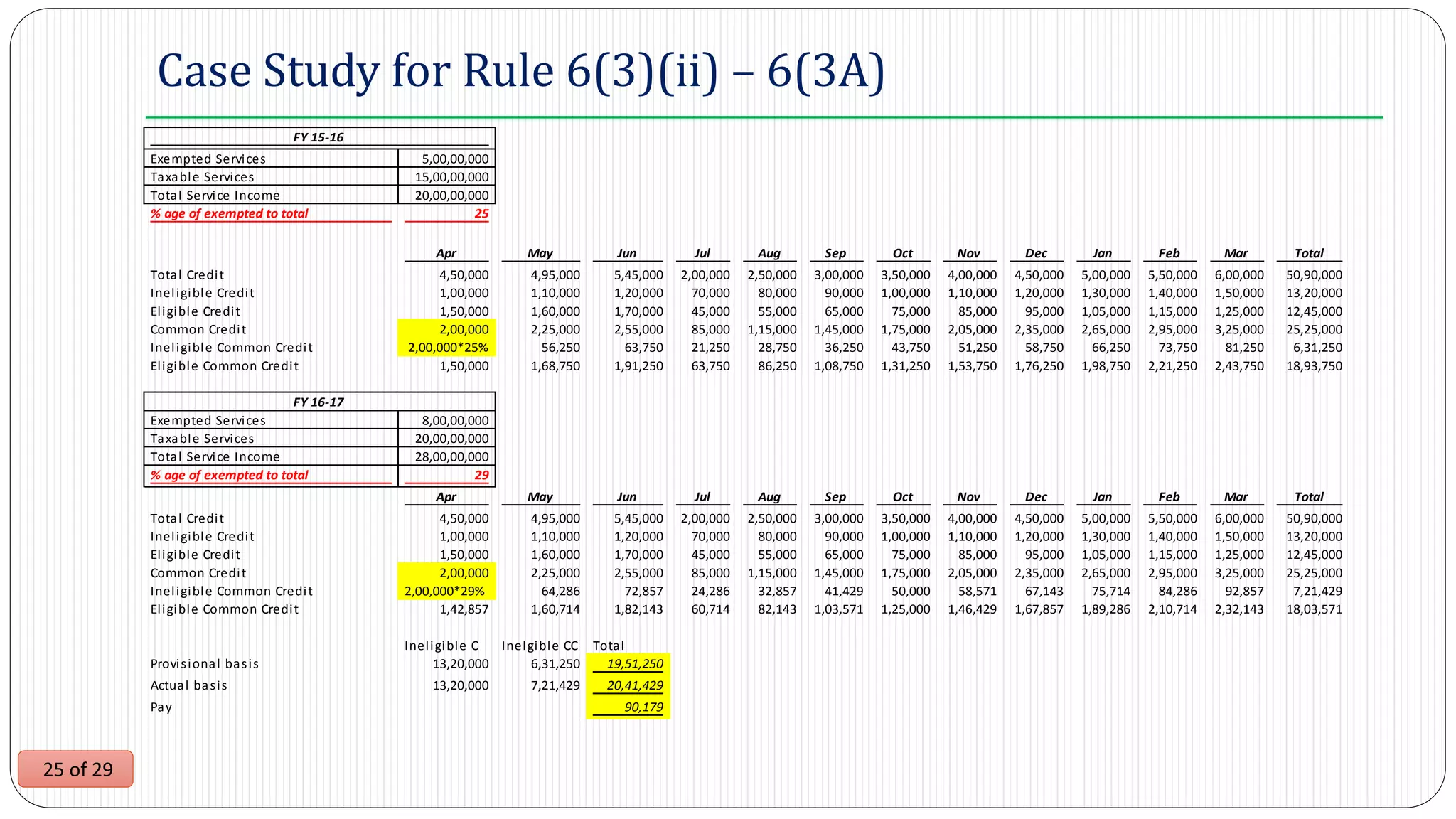
Case Study for Rule 6(3)(ii) – 6(3A)
Exempted Services 5,00,00,000
Taxable Services 15,00,00,000
Total Service Income 20,00,00,000
% age of exempted to total 25
Apr May Jun Jul Aug Sep Oct Nov Dec Jan Feb Mar Total
Total Credit 4,50,000 4,95,000 5,45,000 2,00,000 2,50,000 3,00,000 3,50,000 4,00,000 4,50,000 5,00,000 5,50,000 6,00,000 50,90,000
Ineligible Credit 1,00,000 1,10,000 1,20,000 70,000 80,000 90,000 1,00,000 1,10,000 1,20,000 1,30,000 1,40,000 1,50,000 13,20,000
Eligible Credit 1,50,000 1,60,000 1,70,000 45,000 55,000 65,000 75,000 85,000 95,000 1,05,000 1,15,000 1,25,000 12,45,000
Common Credit 2,00,000 2,25,000 2,55,000 85,000 1,15,000 1,45,000 1,75,000 2,05,000 2,35,000 2,65,000 2,95,000 3,25,000 25,25,000
Ineligible Common Credit 2,00,000*25% 56,250 63,750 21,250 28,750 36,250 43,750 51,250 58,750 66,250 73,750 81,250 6,31,250
Eligible Common Credit 1,50,000 1,68,750 1,91,250 63,750 86,250 1,08,750 1,31,250 1,53,750 1,76,250 1,98,750 2,21,250 2,43,750 18,93,750
Exempted Services 8,00,00,000
Taxable Services 20,00,00,000
Total Service Income 28,00,00,000
% age of exempted to total 29
Apr May Jun Jul Aug Sep Oct Nov Dec Jan Feb Mar Total
Total Credit 4,50,000 4,95,000 5,45,000 2,00,000 2,50,000 3,00,000 3,50,000 4,00,000 4,50,000 5,00,000 5,50,000 6,00,000 50,90,000
Ineligible Credit 1,00,000 1,10,000 1,20,000 70,000 80,000 90,000 1,00,000 1,10,000 1,20,000 1,30,000 1,40,000 1,50,000 13,20,000
Eligible Credit 1,50,000 1,60,000 1,70,000 45,000 55,000 65,000 75,000 85,000 95,000 1,05,000 1,15,000 1,25,000 12,45,000
Common Credit 2,00,000 2,25,000 2,55,000 85,000 1,15,000 1,45,000 1,75,000 2,05,000 2,35,000 2,65,000 2,95,000 3,25,000 25,25,000
Ineligible Common Credit 2,00,000*29% 64,286 72,857 24,286 32,857 41,429 50,000 58,571 67,143 75,714 84,286 92,857 7,21,429
Eligible Common Credit 1,42,857 1,60,714 1,82,143 60,714 82,143 1,03,571 1,25,000 1,46,429 1,67,857 1,89,286 2,10,714 2,32,143 18,03,571
Ineligible C Inelgible CC Total
Provisional basis 13,20,000 6,31,250 19,51,250
Actual basis 13,20,000 7,21,429 20,41,429
Pay 90,179
FY 15-16
FY 16-17
26 of 29
New Rule 6(3AA) (1/2)
Case Study:
 A service provider is engaged in providing taxable services and exempted
services during a year. He has failed to reverse the common credit
pertaining to exempted services. A departmental audit has been
conducted and authorities insisted on reversal on 7% of value of
exempted services.
However, the OSP is of the opinion that 7% method is leading to higher
reversal and wanted to adopt methodology under Rule 6(3A). The
authorities has rejected since no prior intimation has been given to
Superintendent . Can the service provider opt for Rule 6(3A) in such a
situation?
27 of 29
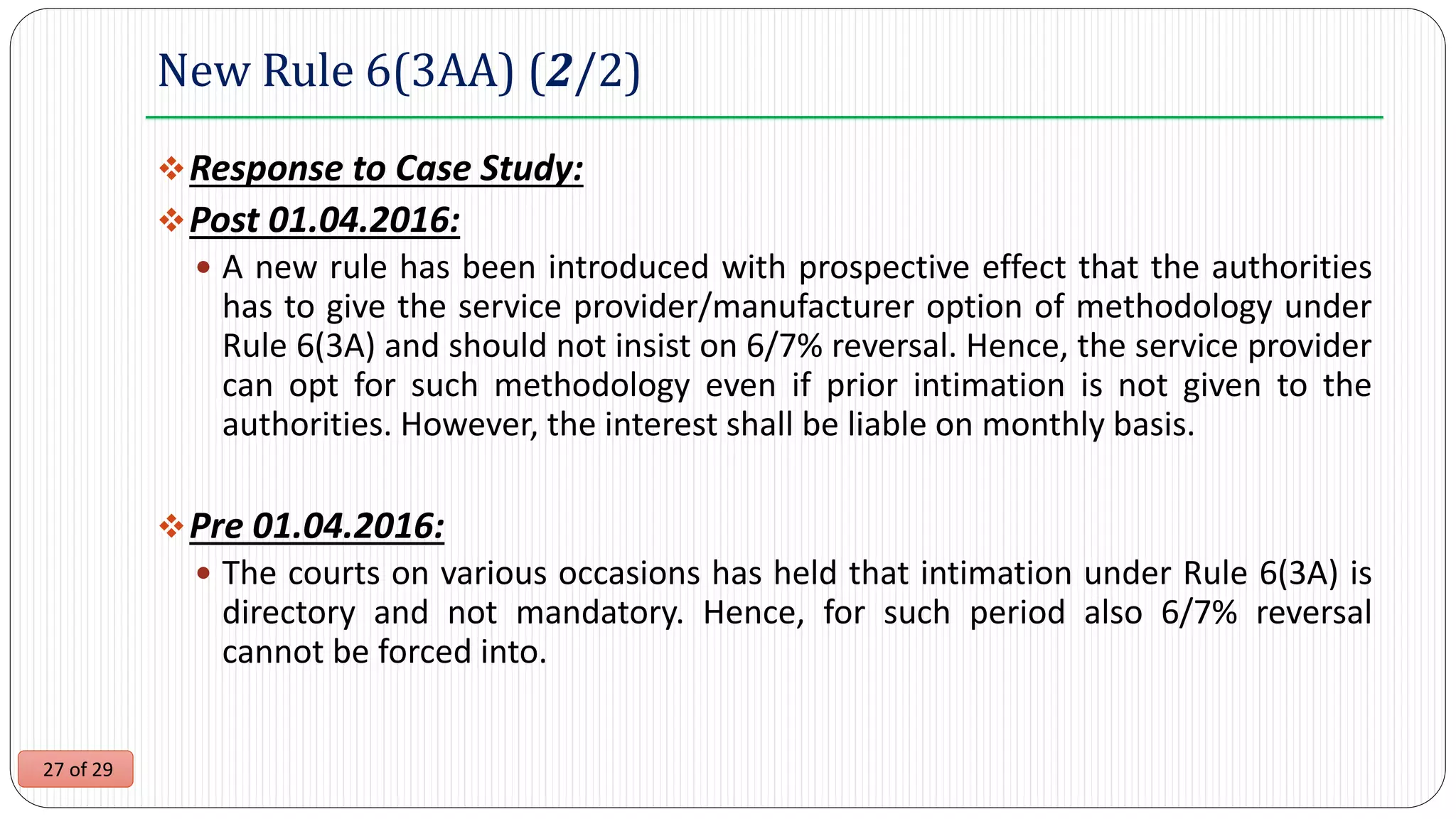
New Rule 6(3AA) (2/2)
Response to Case Study:
Post 01.04.2016:
 A new rule has been introduced with prospective effect that the authorities
has to give the service provider/manufacturer option of methodology under
Rule 6(3A) and should not insist on 6/7% reversal. Hence, the service provider
can opt for such methodology even if prior intimation is not given to the
authorities. However, the interest shall be liable on monthly basis.
Pre 01.04.2016:
 The courts on various occasions has held that intimation under Rule 6(3A) is
directory and not mandatory. Hence, for such period also 6/7% reversal
cannot be forced into.
28 of 29
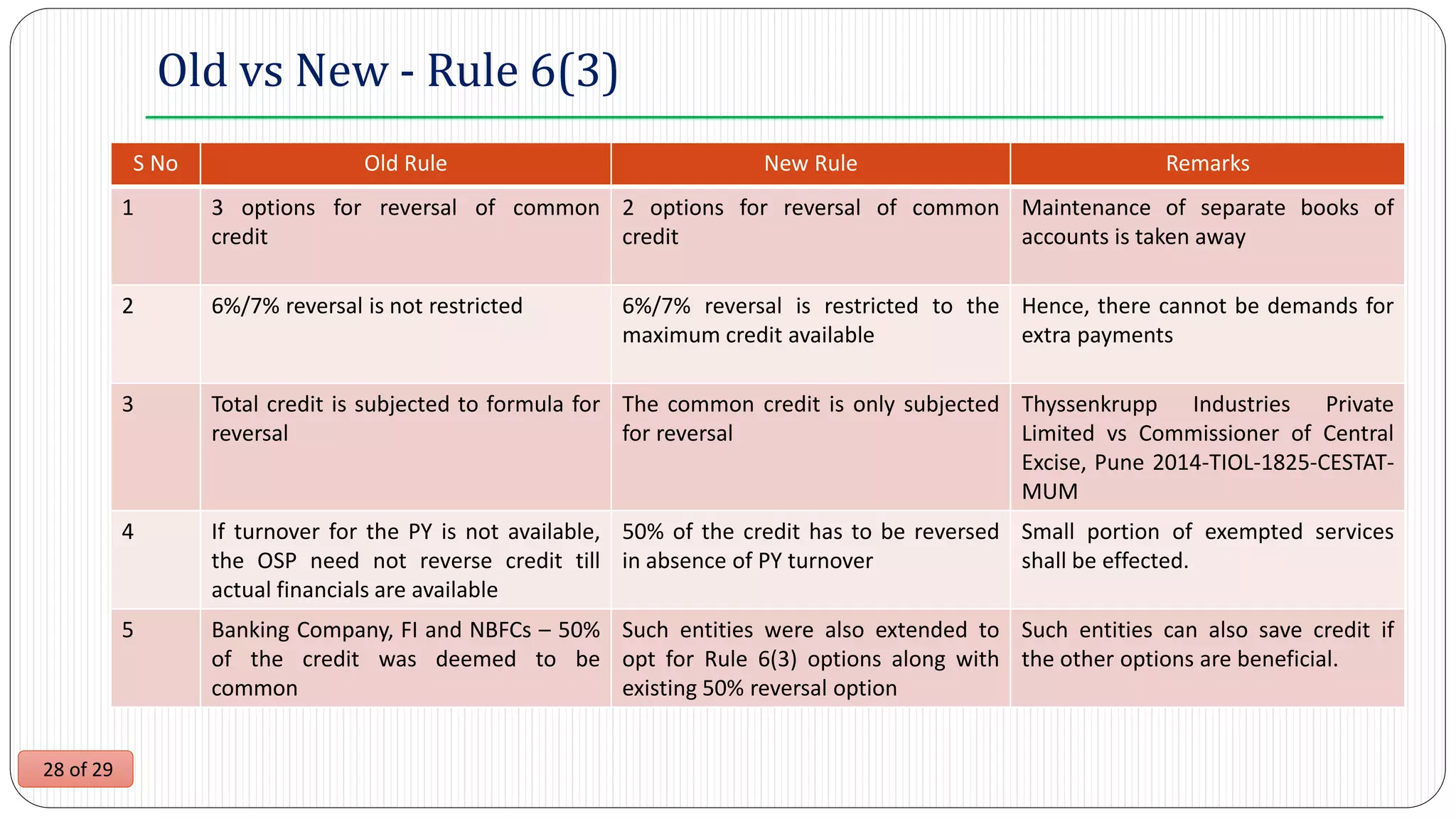
Old vs New - Rule 6(3)
S No Old Rule New Rule Remarks
1 3 options for reversal of common
credit
2 options for reversal of common
credit
Maintenance of separate books of
accounts is taken away
2 6%/7% reversal is not restricted 6%/7% reversal is restricted to the
maximum credit available
Hence, there cannot be demands for
extra payments
3 Total credit is subjected to formula for
reversal
The common credit is only subjected
for reversal
Thyssenkrupp Industries Private
Limited vs Commissioner of Central
Excise, Pune 2014-TIOL-1825-CESTAT-
MUM
4 If turnover for the PY is not available,
the OSP need not reverse credit till
actual financials are available
50% of the credit has to be reversed
in absence of PY turnover
Small portion of exempted services
shall be effected.
5 Banking Company, FI and NBFCs – 50%
of the credit was deemed to be
common
Such entities were also extended to
opt for Rule 6(3) options along with
existing 50% reversal option
Such entities can also save credit if
the other options are beneficial.
29 of 29
www.sbsandco.com/wiki
Read our monthly e-Journal
SBS and Company LLP
Chartered Accountants
6-3-900/6-9, Flat No. 103 & 104, Veeru Castle
Durga Nagar Colony,
Panjagutta, Hyderabad - 500 082
Telangana, India.
Our Presence in
Telangana: Hyderabad (HO)
Andhra Pradesh: Nellore, Kurnool, TADA (near Sri
City), Vizag
Karnataka: Bangalore
+91-40-40183366 / +91-40-64584494 / +91-9246883366
Sri Harsha
PH: +91 9581000327
harsha@sbsandco.com
Thank you!!!

Rule 6 of cenvat credit rules, 2004

  • 1.
    Analysis of NewRule 6 of Cenvat Credit Rules, 2004 CA Sri Harsha harsha@sbsandco.com by
  • 2.
    2 of 29 Overview of Rule 6 of Cenvat Credit Rules, 2004  Understanding Rule 6(3)  Instances where Rule 6(3) is applicable  Methodology to reverse common cenvat credit  Understanding Rule 6(3)(i)  Case Studies for Rule 6(3)(i)  Understanding Rule 6(3)(ii) – 6(3A)  Case Study for Rule 6(3)(ii) – 6(3A)  Old vs New - Rule 6(3) Discussion Items
  • 3.
    3 of 29 1)No cenvat on inputs and input services used for manufacture of exempted goods or for provision of exempted services and the credit not allowed shall be paid by OSP as specified in (2) or (3); 2) OSP who is engaged exclusively in exempted goods/exempted services, shall pay the whole amount of cenvat and in effect shall not be eligible for any credit of inputs and input services; Rule 6 – Overview (1/3) applies for manufacturer also
  • 4.
    4 of 29 3)OSP who provides non-exempted services and exempted services, shall adopt any of the 2 options to restrict the credit pertaining to exempted services; 4) OSP cannot avail credit of capital goods if such capital goods are exclusively used for provision of exempted services for a period of 2 years from the date of commencement of provision of services; Rule 6 – Overview (2/3)
  • 5.
    5 of 29 6)Certain clearances made by manufacturer without payment of duty does not require reversal mentioned under (1), (2), (3) and (4); 7) Certain services without payment of tax does not require reversal mentioned under (1), (2), (3) and (4); 8) Instances where export of service shall be treated as exempted services for the purposes of Rule 6. Rule 6 – Overview (3/3)
  • 6.
    6 of 29 UnderstandingRule 6(3) (1/3) The objective of Rule 6(3) is to restrict cenvat credit pertaining to inputs and input services used for provision of exempted services and manufacture of exempted goods.  It applies to: Manufacturer or Output Service Provider Non-Exempted Goods removed; Exempted Goods removed Non-Exempted Services; Exempted Services
  • 7.
    7 of 29 UnderstandingRule 6(3) (2/3)  Non – Exempted Goods removed means –  the final products excluding exempted goods manufactured and  cleared upto the place of removal.  Exempted Goods means –  excisable goods which are exempt from whole of excise duty and includes  goods which are chargeable to ‘Nil’ rate of duty and;  goods in respect of which benefit under Notification No 1/2011- CE is availed;  Entries at 67 and 128 of Notification No 12/2012 - CE
  • 8.
    8 of 29 UnderstandingRule 6(3) (3/3)  Non – Exempted Services means –  output services excluding exempted services  Exempted Services means –  taxable services which is exempt from whole of service tax; or  service, on which no service tax is leviable under Section 66B;  taxable service whose part of value is exempted with condition no credit of I& IS availed but shall not include;  which is exported in terms of Rule 6A of STR, 1994  Transportation of Goods by vessel from India to outside India Explanation to Rule 6(1):  Includes an activity which is not a service as defined in Section 65B(44)
  • 9.
    9 of 29 Instanceswhere Rule 6(3) is applicable Activity 1 Activity 2 Applicability of Rule 6(3) Exempted Services - - - - Exempted Services Exempted Goods Not Applicable Not Applicable Not Applicable Not Applicable Applicable Applicable Applicable Applicable Exempted Goods Non- Exempted Services Non- Exempted Goods Non- Exempted Services Non- Exempted ServicesExempted Goods Non- Exempted Goods Non- Exempted Goods Exempted Services
  • 10.
    10 of 29 Rule6(3) Option I Option II Methodology to reverse/pay Common CC Pay an amount equal to 7% of value of exempted services for OSP and 6% of value of exempted goods for Manufacturer Pay an amount as determined under (3A)
  • 11.
    11 of 29 UnderstandingRule 6(3)(i) (1/3)  Under this method, the manufacturer/OSP can avail the total cenvat credit subject to reversal of the following amounts:  6% * [value of exempted goods ] and  7% * [value of exempted services]  Such reversal has to be made every month/quarter, as the case may be and if failed, the same shall be recovered in terms of Rule 14 of CCR, 2004 The option shall be applicable for all exempted services and exempted goods and cannot be changed during the year.
  • 12.
    12 of 29 UnderstandingRule 6(3)(i) (2/3) Value Normal Scenarios As per Section 3, 4, 4A of CE Act + Rules As per Section 67 of FA + rules Other Scenarios Trading Goods Securities Abated Services
  • 13.
    13 of 29 UnderstandingRule 6(3)(i) (3/3) Value Trading - Goods Sale – COGS or 10% of COGS , which ever is higher Trading - Securities Sale Price – Purchase Price or 1% of Purchase Price, whichever is more Major - Abated Services 7% of Value of the exempted services
  • 14.
    14 of 29 CaseStudies for 6(3)(i) (1/5)  Case Study – 1:  A producer of the cinematographic film transfers the copyright for exhibition in theatre on a temporary basis and earns income to the tune of Rs 20 Crores. Further, he transfers the copyright in the said film to another person on a temporary basis not for exhibition and earns another stream of income to the tune of Rs 35 Crores. The total income generated is Rs 55 Crores.  The producer has availed services of various artists and others on which service tax was paid to the tune of Rs 1.5 Crores. The producer wishes to know how much cenvat credit is eligible for payment of service tax on his output services.
  • 15.
    15 of 29 CaseStudies for 6(3)(i) (2/5) Response for Case Study – 1: S.No Particulars Amount (INR) Remarks 1 Total Cenvat Credit 1,50,00,000 2 Total Income from Services 55,00,00,000 3 Value of Exempted Services 20,00,00,000 4 Value of Taxable Services 35,00,00,000 As per Section 67 of FA 5 Service Tax Payable 4,90,00,000 35 Crores * 14% 6 Swacch Bharath Cess 17,50,000 35 Crores * 0.5% 7 Reversal as per Rule 6(3)(i) 1,40,00,000 20 Crores * 7% 8 Eligible Credit 10,00,000 (1.5 – 1.4) Crore 9 Net Service Tax Payable 4,97,50,000 4.9 Crore -10 lakhs + 17.5 lakhs As per Section 67 of FA
  • 16.
    16 of 29 CaseStudies for 6(3)(i) (3/5) If Value of Exempted Services – 30 Crores S.No Particulars Amount (INR) Remarks 1 Total Cenvat Credit 1,50,00,000 2 Total Income from Services 55,00,00,000 3 Value of Exempted Services 30,00,00,000 4 Value of Taxable Services 25,00,00,000 As per Section 67 of FA 5 Service Tax Payable 3,50,00,000 25 Crores * 14% 6 Swacch Bharath Cess 12,50,000 25 Crores * 0.5% 7 Reversal as per Rule 6(3)(i)_ 1,50,00,000 8 Eligible Credit - 9 Net Service Tax Payable 3,62,50,000 3.5Cr - 0 + 12.5 lakhs As per Section 67 of FA 30 Crore * 7% = 2.1 Crore Subject to maximum CC
  • 17.
    17 of 29 CaseStudies for 6(3)(i) (4/5)  Case Study – 2:  A builder has taken up a project to construct and sell 150 residential flats. The value of each flat is Rs 80 lakhs. He has received advances for 100 flats before obtaining completion certificate. As on date of receipt of completion certificate, the flats for which no advance was received are 50 in number.  The builder has cenvat credit balance of Rs 5.04 crore. The builder now wishes to not charge service tax on sale of flats after the receipt of completion certificate. Please explain how much credit can he utilise. Ignore the issue of reading ‘and’ as ‘or’ in exempted services definition.
  • 18.
    18 of 29 CaseStudies for 6(3)(i) (5/5) Response for Case Study – 2: 120 Crores S.No Particulars Amount (INR) Remarks 1 Total Cenvat Credit 5,04,00,000 2 Total Income from Services 1,20,00,00,000 3 Value of Exempted Services 40,00,00,000 50 flats * 80 lakh/flat 4 Value of Taxable Services 80,00,00,000 100 flats * 80 lakh/flat 5 Service Tax Payable 2,80,00,000 80 Crores * 14% * 25% 6 Swacch Bharath Cess 10,00,000 80 Crores * 0.5% * 25% 7 Value for Rule 6(3)(i) 30,00,00,000 40 Cr *75% 8 Reversal as per Rule 6(3)(i) 2,10,00,000 30 Cr * 7% 9 Eligible Credit 2,94,00,000 (5.04 – 2.1) Cr 10 Net Service Tax Payable 10,00,000 SBC cannot be paid using CC
  • 19.
    19 of 29 Understanding6(3)(ii) – 6(3A) (1/6)  If the option under Rule 6(3)(i) is not beneficial to manufacturer/OSP, he has another option to reverse the common cenvat credit as per the methodology laid down vide Rule 6(3A).  It is commonly known as Formula Basis method. The entire objective of this method is to restrict the common credit in proportion to the exempted turnover.  The manufacturer/OSP who wishes to adopt such method shall intimate the jurisdictional Superintendent prior to opting along with certain details.
  • 20.
    20 of 29 Understanding6(3)(ii) – 6(3A) (2/6)  The formula has to be adopted on monthly basis by taking the figures of previous financial year. Ineligible credit arrived on monthly basis has to be checked with Ineligible credit arrived based on the actual figures at the end of the year and adjustments for short/excess has to be done.  Once adjustment is done based on the actual figures, the manufacturer/OSP shall again intimate the jurisdictional Superintendent such adjustment along with certain other details.  Once adopted, the same method has to be continued for the entire financial year.
  • 21.
    21 of 29 Understanding6(3)(ii) – 6(3A) (3/6) Monthly – Provisional Basis: Turnover of the preceding FY has to be taken, in case where no turnover is available, 50% of the common credit shall be deemed to be ineligible. Re Short Description Formula Remarks T Total Cenvat Credit - I & IS availed during the month A Ineligible Credit - I & IS used exclusively for exempted goods & services B Eligible Credit - I & IS used exclusively for non - exempted goods & services C Total Common Credit C = T – (A + B) Total Common Credit shall be arrived D Ineligible Common Credit C * E/F Common credit pertaining to exempted goods & services E Exempted Turnover - Turnover of Exempted services + Exempted Goods F Total Turnover - Turnover of Exempted & Non – Exempted goods & services G Eligible Common Credit G = C - D Eligible common credit for availment
  • 22.
    22 of 29 Understanding6(3)(ii) – 6(3A) (4/6)  Manufacturer/OSP on monthly basis :  retain credit of B & G – Eligible Credit and Eligible Common Credit  reverse the credit of A & D – Ineligible Credit and Ineligible Common Credit  In no case, the manufacturer/OSP can avail the credit at A & D and if he fails to reverse the said credit, the same shall be payable along with interest @ 15% per annum from the due date to actual date of such payment/reversal.  At the end of the year, the manufacturer/OSP shall determine again the Ineligible Credit and Ineligible Common Credit as detailed in next slides.
  • 23.
    23 of 29 Understanding6(3)(ii) – 6(3A) (5/6) Year end – Actual Basis: The turnover for the year under consideration shall be taken. The difference between the monthly calculations and year end calculations would only differ because of the turnovers. Re Short Description Formula Remarks T(A) Total Cenvat Credit - I & IS availed during the year A(A) Ineligible Credit - I & IS used exclusively for exempted goods & services B(A) Eligible Credit - I & IS used exclusively for non – exempted goods & services C(A) Total Common Credit T(A) - [A(A)+B(A)] Total Common Credit shall be arrived D(A) Ineligible Common Credit C(A) * H/I Common credit pertaining to exempted goods & services H Exempted Turnover - Turnover of [Exempted Goods + Exempted Services] I Total Turnover - Turnover of Exempted & Non – Exempted goods & services
  • 24.
    24 of 29 Understanding6(3)(ii) – 6(3A) (6/6)  Manufacturer/OSP before 30th June:  Pay, If {A(A) + D(A)} > {A+D [aggregated for whole year]}  Avail, If {A(A) + D(A)} < {A+D [aggregated for whole year]} If manufacturer/OSP fails to pay the difference, he shall be liable to pay the interest @ 15% per annum from 30th June to the actual date of payment. Manufacturer/OSP shall intimate within 15 days from the date of payment/adjustment to the jurisdictional superintendent along with other details.
  • 25.
    25 of 29 CaseStudy for Rule 6(3)(ii) – 6(3A) Exempted Services 5,00,00,000 Taxable Services 15,00,00,000 Total Service Income 20,00,00,000 % age of exempted to total 25 Apr May Jun Jul Aug Sep Oct Nov Dec Jan Feb Mar Total Total Credit 4,50,000 4,95,000 5,45,000 2,00,000 2,50,000 3,00,000 3,50,000 4,00,000 4,50,000 5,00,000 5,50,000 6,00,000 50,90,000 Ineligible Credit 1,00,000 1,10,000 1,20,000 70,000 80,000 90,000 1,00,000 1,10,000 1,20,000 1,30,000 1,40,000 1,50,000 13,20,000 Eligible Credit 1,50,000 1,60,000 1,70,000 45,000 55,000 65,000 75,000 85,000 95,000 1,05,000 1,15,000 1,25,000 12,45,000 Common Credit 2,00,000 2,25,000 2,55,000 85,000 1,15,000 1,45,000 1,75,000 2,05,000 2,35,000 2,65,000 2,95,000 3,25,000 25,25,000 Ineligible Common Credit 2,00,000*25% 56,250 63,750 21,250 28,750 36,250 43,750 51,250 58,750 66,250 73,750 81,250 6,31,250 Eligible Common Credit 1,50,000 1,68,750 1,91,250 63,750 86,250 1,08,750 1,31,250 1,53,750 1,76,250 1,98,750 2,21,250 2,43,750 18,93,750 Exempted Services 8,00,00,000 Taxable Services 20,00,00,000 Total Service Income 28,00,00,000 % age of exempted to total 29 Apr May Jun Jul Aug Sep Oct Nov Dec Jan Feb Mar Total Total Credit 4,50,000 4,95,000 5,45,000 2,00,000 2,50,000 3,00,000 3,50,000 4,00,000 4,50,000 5,00,000 5,50,000 6,00,000 50,90,000 Ineligible Credit 1,00,000 1,10,000 1,20,000 70,000 80,000 90,000 1,00,000 1,10,000 1,20,000 1,30,000 1,40,000 1,50,000 13,20,000 Eligible Credit 1,50,000 1,60,000 1,70,000 45,000 55,000 65,000 75,000 85,000 95,000 1,05,000 1,15,000 1,25,000 12,45,000 Common Credit 2,00,000 2,25,000 2,55,000 85,000 1,15,000 1,45,000 1,75,000 2,05,000 2,35,000 2,65,000 2,95,000 3,25,000 25,25,000 Ineligible Common Credit 2,00,000*29% 64,286 72,857 24,286 32,857 41,429 50,000 58,571 67,143 75,714 84,286 92,857 7,21,429 Eligible Common Credit 1,42,857 1,60,714 1,82,143 60,714 82,143 1,03,571 1,25,000 1,46,429 1,67,857 1,89,286 2,10,714 2,32,143 18,03,571 Ineligible C Inelgible CC Total Provisional basis 13,20,000 6,31,250 19,51,250 Actual basis 13,20,000 7,21,429 20,41,429 Pay 90,179 FY 15-16 FY 16-17
  • 26.
    26 of 29 NewRule 6(3AA) (1/2) Case Study:  A service provider is engaged in providing taxable services and exempted services during a year. He has failed to reverse the common credit pertaining to exempted services. A departmental audit has been conducted and authorities insisted on reversal on 7% of value of exempted services. However, the OSP is of the opinion that 7% method is leading to higher reversal and wanted to adopt methodology under Rule 6(3A). The authorities has rejected since no prior intimation has been given to Superintendent . Can the service provider opt for Rule 6(3A) in such a situation?
  • 27.
    27 of 29 NewRule 6(3AA) (2/2) Response to Case Study: Post 01.04.2016:  A new rule has been introduced with prospective effect that the authorities has to give the service provider/manufacturer option of methodology under Rule 6(3A) and should not insist on 6/7% reversal. Hence, the service provider can opt for such methodology even if prior intimation is not given to the authorities. However, the interest shall be liable on monthly basis. Pre 01.04.2016:  The courts on various occasions has held that intimation under Rule 6(3A) is directory and not mandatory. Hence, for such period also 6/7% reversal cannot be forced into.
  • 28.
    28 of 29 Oldvs New - Rule 6(3) S No Old Rule New Rule Remarks 1 3 options for reversal of common credit 2 options for reversal of common credit Maintenance of separate books of accounts is taken away 2 6%/7% reversal is not restricted 6%/7% reversal is restricted to the maximum credit available Hence, there cannot be demands for extra payments 3 Total credit is subjected to formula for reversal The common credit is only subjected for reversal Thyssenkrupp Industries Private Limited vs Commissioner of Central Excise, Pune 2014-TIOL-1825-CESTAT- MUM 4 If turnover for the PY is not available, the OSP need not reverse credit till actual financials are available 50% of the credit has to be reversed in absence of PY turnover Small portion of exempted services shall be effected. 5 Banking Company, FI and NBFCs – 50% of the credit was deemed to be common Such entities were also extended to opt for Rule 6(3) options along with existing 50% reversal option Such entities can also save credit if the other options are beneficial.
  • 29.
    29 of 29 www.sbsandco.com/wiki Readour monthly e-Journal SBS and Company LLP Chartered Accountants 6-3-900/6-9, Flat No. 103 & 104, Veeru Castle Durga Nagar Colony, Panjagutta, Hyderabad - 500 082 Telangana, India. Our Presence in Telangana: Hyderabad (HO) Andhra Pradesh: Nellore, Kurnool, TADA (near Sri City), Vizag Karnataka: Bangalore +91-40-40183366 / +91-40-64584494 / +91-9246883366 Sri Harsha PH: +91 9581000327 harsha@sbsandco.com Thank you!!!