Dr. Mohasin Abbas Tamboli
Associate Professor, PIRENS IBMA
Member,Board of Studies, SPPU, Pune.
NEW EDUCATION POLICY
(NEP)2020
1 NEP 2020 by Dr. Mohasin Tamboli
Overview of NEP 2020
 The NEP aspires to develop an education system
that directly contributes to the country’s
transformation by delivering high-quality
education to all citizens and developing India
into a global knowledge superpower.
 The new education policy was adopted by the
Central government. The 10 + 2 structure has
been fully eliminated in the new education
policy.
 New educational curriculum is based on 5+ 3+ 3+
4
2 NEP 2020 by Dr. Mohasin Tamboli
What is the New Education Policy
(NEP) 2020
 In July 2020, the Union Cabinet of India approved
the New National Education Policy (NEP) with the
aim to bring modern reforms in the Indian
education system from the school to the college
level.
 This policy stands on the ideology to make India
a ‘global knowledge superpower.’
 The new National Education Policy is based on
the pillars of Access, Equity, Quality,
Affordability, and Accountability.
 It aims to make both school and college
education more holistic, multidisciplinary, and
flexible.
3 NEP 2020 by Dr. Mohasin Tamboli
The Need for New National
Education Policy (NEP)
 There were many pitfalls in the Indian education
system.
 Memorisation was prioritised more over the
understanding of concepts
 The presence of multiple boards was a big issue.
 More emphasis was laid on learning or mastering
traditional subjects and less on developing
vocational skills.
 The new education policy intends to bridge the
gap between vocational and formal education.
4 NEP 2020 by Dr. Mohasin Tamboli
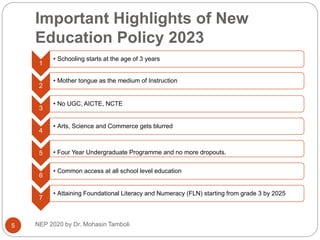
Important Highlights of New
Education Policy 2023
1
• Schooling starts at the age of 3 years
2
• Mother tongue as the medium of Instruction
3
• No UGC, AICTE, NCTE
4
• Arts, Science and Commerce gets blurred
5 • Four Year Undergraduate Programme and no more dropouts.
6
• Common access at all school level education
7
• Attaining Foundational Literacy and Numeracy (FLN) starting from grade 3 by 2025
5 NEP 2020 by Dr. Mohasin Tamboli
Important Highlights of New
Education Policy 2023
8
• Experiential learning in the school curriculum
9
• Increase the graduate enrollment ratio
10
• Enhancing the Standards of Open and Distance Learning
11
• Technological innovation in education
12
• Internationalisation of education
13
• Increase in public investment in education
6 NEP 2020 by Dr. Mohasin Tamboli
1. Schooling starts at the age of 3
years
 The New Education Policy extends compulsory
schooling from the age bracket of 6-14 years to 3-
18 years.
 The NEP includes three years of previously
unrecognized pre-schooling for children aged 3-6
years in the school curriculum.
 The new system will include 12 years of formal
education and three years of Anganwadi/pre-
school education.
 The 10+2 school curriculum framework will be
replaced with a 5+3+3+4 curricular structure
corresponding to ages 3-8, 8-11, 11-14, and 14-
18 years, respectively.
7 NEP 2020 by Dr. Mohasin Tamboli
2. Mother tongue as medium of
instruction
 According to the policy paper, children learn and
grasp non-trivial topics faster in their native
language.
 The home language, mother tongue, local
language, or regional language will be used as
the medium of instruction until at least Grade 5,
but preferably until Grade 8 and beyond.
 Following that, wherever practicable, the home or
local language will be taught as a language.
8 NEP 2020 by Dr. Mohasin Tamboli
3. NO UGC, AICTE, NCTE
NEP 2020 by Dr. Mohasin Tamboli
9
 The Higher Education Commission of India
(HECI) will be established as a single umbrella
body for all higher education in India, excluding
medical and legal education.
 Regulation, accreditation, and academic
standards will all be governed by the same set of
rules for public and private higher education
institutions.
 In 15 years, the government will phase down
college affiliation, and a stage-by-stage procedure
for providing colleges with graded autonomy will
be formed.
4. Science, Arts, and Commerce
gets blurred
NEP 2020 by Dr. Mohasin Tamboli
10
 Students can choose from a variety of disciplines
throughout the streams. Internships will be
included in vocational education, which will begin
in sixth grade.
5. Four Year Undergraduate
Programme and no more dropouts.
NEP 2020 by Dr. Mohasin Tamboli
11
 Under the NEP, undergraduate degrees will last
three or four years, with several exit alternatives
available during that time.
 After one year of study in a topic or field,
including vocational and professional fields,
colleges will be required to award a certificate, a
diploma following two years of study, or a
Bachelor’s degree after a three-year program.
 The government will also create an Academic
Bank of Credit to store academic credits earned
at various HEIs digitally so that they can be
transferred and counted toward a final degree.
6. Common access at all school-
level education
NEP 2020 by Dr. Mohasin Tamboli
12
 NEP 2020 focuses on bringing universal access
to school education to ensure the holistic
development of students right from the
beginning.
 Students will be given access to different learning
modes, like formal and informal teaching
methods.
 The policy states that vocational education
courses are to be included in the curriculum from
pre-school to 12th standard.
 The policy emphasises the inclusion of trained
counsellors and social workers in the schooling
system.
Attaining Foundational Literacy and
Numeracy (FLN) starting from grade 3 by
2025
NEP 2020 by Dr. Mohasin Tamboli
13
 FLN is a broad concept which refers to a child’s
capability to read basic texts and solve basic
numerical problems.
 the NEP has directed the states to prepare a plan
on how to implement and achieve this in the
curriculum for all primary school students by
2025.
8. Experiential learning in the
school curriculum
NEP 2020 by Dr. Mohasin Tamboli
14
 The policy states that the school curriculum and
pedagogy should aim for the holistic development
of students by designing the coursework that
would equip them with 21st-century skills.
 Students will have to study a reduced course
content, which will emphasise experiential
learning and critical thinking.
 ocational education will be made available in
class 6th-8th, along with internship opportunities.
9. Increase the graduate
enrollment ratio
NEP 2020 by Dr. Mohasin Tamboli
15
 The policy aims to incorporate a maximum
number of students in higher education, including
vocational education.
 The graduate enrolment ratio is expected to
increase up to 50% by 2035 from 26.3% in
2018.
 Also, with the multiple exit options in higher
education, it is expected that the student dropout
rate will reduce.
10. Enhancing the Standards of
Open and Distance Learning
NEP 2020 by Dr. Mohasin Tamboli
16
 The government has already taken initiatives to
bring the standards of distance learning
programmes at par with regular courses.
 Measures like online courses, digital repositories,
funding for improved student services and
research, and credit-based recognition of
MOOCs, among others are to be taken.
11. Technological innovation in
education
NEP 2020 by Dr. Mohasin Tamboli
17
 National Educational Technology Forum (NETF),
an autonomous body, will be started to offer a
free exchange of ideas related to the usage of
technology in enhancing the academic
experience.
 This integration of technology is expected to
improve the classroom processes, contribute to
teacher professional development.
12. Internationalisation of
education
NEP 2020 by Dr. Mohasin Tamboli
18
 An important aspect of the NEP 2020 is that it
promotes the internationalisation of education by
encouraging institutions to forge global
collaborations with universities and research
institutes.
 The policy aims to allow top world universities to
open their campuses in India.
13. Increase in public investment
in education
NEP 2020 by Dr. Mohasin Tamboli
19
 The Centre and State governments will be
working in collaboration to increase investment in
education.
 The collaboration is expected to reach 6% of
GDP in regard to the education sector at the
earliest in order to improve the educational
infrastructure.
Challenges of NEP
NEP 2020 by Dr. Mohasin Tamboli
20
 As the policy aims to double the gross enrollment
ratio by 2035, this requires the creation of a new
university every week for the next 15 years, which
is a huge challenge.
 To deliver the upgraded curriculum effectively, India
needs a sizable pool of competent teachers who are
familiar with the new pedagogical approach.
 Adequate funding and resources are required for
proper implementation.
 As teachers generally share a disciplinary
anchoring culture, it is difficult to have educators
with exceptional skills who are experts in one area
and lean in other subjects as well.

NATIONAL EDUCATION POLICY.ppsx

  • 1.
    Dr. Mohasin AbbasTamboli Associate Professor, PIRENS IBMA Member,Board of Studies, SPPU, Pune. NEW EDUCATION POLICY (NEP)2020 1 NEP 2020 by Dr. Mohasin Tamboli
  • 2.
    Overview of NEP2020  The NEP aspires to develop an education system that directly contributes to the country’s transformation by delivering high-quality education to all citizens and developing India into a global knowledge superpower.  The new education policy was adopted by the Central government. The 10 + 2 structure has been fully eliminated in the new education policy.  New educational curriculum is based on 5+ 3+ 3+ 4 2 NEP 2020 by Dr. Mohasin Tamboli
  • 3.
    What is theNew Education Policy (NEP) 2020  In July 2020, the Union Cabinet of India approved the New National Education Policy (NEP) with the aim to bring modern reforms in the Indian education system from the school to the college level.  This policy stands on the ideology to make India a ‘global knowledge superpower.’  The new National Education Policy is based on the pillars of Access, Equity, Quality, Affordability, and Accountability.  It aims to make both school and college education more holistic, multidisciplinary, and flexible. 3 NEP 2020 by Dr. Mohasin Tamboli
  • 4.
    The Need forNew National Education Policy (NEP)  There were many pitfalls in the Indian education system.  Memorisation was prioritised more over the understanding of concepts  The presence of multiple boards was a big issue.  More emphasis was laid on learning or mastering traditional subjects and less on developing vocational skills.  The new education policy intends to bridge the gap between vocational and formal education. 4 NEP 2020 by Dr. Mohasin Tamboli
  • 5.
    Important Highlights ofNew Education Policy 2023 1 • Schooling starts at the age of 3 years 2 • Mother tongue as the medium of Instruction 3 • No UGC, AICTE, NCTE 4 • Arts, Science and Commerce gets blurred 5 • Four Year Undergraduate Programme and no more dropouts. 6 • Common access at all school level education 7 • Attaining Foundational Literacy and Numeracy (FLN) starting from grade 3 by 2025 5 NEP 2020 by Dr. Mohasin Tamboli
  • 6.
    Important Highlights ofNew Education Policy 2023 8 • Experiential learning in the school curriculum 9 • Increase the graduate enrollment ratio 10 • Enhancing the Standards of Open and Distance Learning 11 • Technological innovation in education 12 • Internationalisation of education 13 • Increase in public investment in education 6 NEP 2020 by Dr. Mohasin Tamboli
  • 7.
    1. Schooling startsat the age of 3 years  The New Education Policy extends compulsory schooling from the age bracket of 6-14 years to 3- 18 years.  The NEP includes three years of previously unrecognized pre-schooling for children aged 3-6 years in the school curriculum.  The new system will include 12 years of formal education and three years of Anganwadi/pre- school education.  The 10+2 school curriculum framework will be replaced with a 5+3+3+4 curricular structure corresponding to ages 3-8, 8-11, 11-14, and 14- 18 years, respectively. 7 NEP 2020 by Dr. Mohasin Tamboli
  • 8.
    2. Mother tongueas medium of instruction  According to the policy paper, children learn and grasp non-trivial topics faster in their native language.  The home language, mother tongue, local language, or regional language will be used as the medium of instruction until at least Grade 5, but preferably until Grade 8 and beyond.  Following that, wherever practicable, the home or local language will be taught as a language. 8 NEP 2020 by Dr. Mohasin Tamboli
  • 9.
    3. NO UGC,AICTE, NCTE NEP 2020 by Dr. Mohasin Tamboli 9  The Higher Education Commission of India (HECI) will be established as a single umbrella body for all higher education in India, excluding medical and legal education.  Regulation, accreditation, and academic standards will all be governed by the same set of rules for public and private higher education institutions.  In 15 years, the government will phase down college affiliation, and a stage-by-stage procedure for providing colleges with graded autonomy will be formed.
  • 10.
    4. Science, Arts,and Commerce gets blurred NEP 2020 by Dr. Mohasin Tamboli 10  Students can choose from a variety of disciplines throughout the streams. Internships will be included in vocational education, which will begin in sixth grade.
  • 11.
    5. Four YearUndergraduate Programme and no more dropouts. NEP 2020 by Dr. Mohasin Tamboli 11  Under the NEP, undergraduate degrees will last three or four years, with several exit alternatives available during that time.  After one year of study in a topic or field, including vocational and professional fields, colleges will be required to award a certificate, a diploma following two years of study, or a Bachelor’s degree after a three-year program.  The government will also create an Academic Bank of Credit to store academic credits earned at various HEIs digitally so that they can be transferred and counted toward a final degree.
  • 12.
    6. Common accessat all school- level education NEP 2020 by Dr. Mohasin Tamboli 12  NEP 2020 focuses on bringing universal access to school education to ensure the holistic development of students right from the beginning.  Students will be given access to different learning modes, like formal and informal teaching methods.  The policy states that vocational education courses are to be included in the curriculum from pre-school to 12th standard.  The policy emphasises the inclusion of trained counsellors and social workers in the schooling system.
  • 13.
    Attaining Foundational Literacyand Numeracy (FLN) starting from grade 3 by 2025 NEP 2020 by Dr. Mohasin Tamboli 13  FLN is a broad concept which refers to a child’s capability to read basic texts and solve basic numerical problems.  the NEP has directed the states to prepare a plan on how to implement and achieve this in the curriculum for all primary school students by 2025.
  • 14.
    8. Experiential learningin the school curriculum NEP 2020 by Dr. Mohasin Tamboli 14  The policy states that the school curriculum and pedagogy should aim for the holistic development of students by designing the coursework that would equip them with 21st-century skills.  Students will have to study a reduced course content, which will emphasise experiential learning and critical thinking.  ocational education will be made available in class 6th-8th, along with internship opportunities.
  • 15.
    9. Increase thegraduate enrollment ratio NEP 2020 by Dr. Mohasin Tamboli 15  The policy aims to incorporate a maximum number of students in higher education, including vocational education.  The graduate enrolment ratio is expected to increase up to 50% by 2035 from 26.3% in 2018.  Also, with the multiple exit options in higher education, it is expected that the student dropout rate will reduce.
  • 16.
    10. Enhancing theStandards of Open and Distance Learning NEP 2020 by Dr. Mohasin Tamboli 16  The government has already taken initiatives to bring the standards of distance learning programmes at par with regular courses.  Measures like online courses, digital repositories, funding for improved student services and research, and credit-based recognition of MOOCs, among others are to be taken.
  • 17.
    11. Technological innovationin education NEP 2020 by Dr. Mohasin Tamboli 17  National Educational Technology Forum (NETF), an autonomous body, will be started to offer a free exchange of ideas related to the usage of technology in enhancing the academic experience.  This integration of technology is expected to improve the classroom processes, contribute to teacher professional development.
  • 18.
    12. Internationalisation of education NEP2020 by Dr. Mohasin Tamboli 18  An important aspect of the NEP 2020 is that it promotes the internationalisation of education by encouraging institutions to forge global collaborations with universities and research institutes.  The policy aims to allow top world universities to open their campuses in India.
  • 19.
    13. Increase inpublic investment in education NEP 2020 by Dr. Mohasin Tamboli 19  The Centre and State governments will be working in collaboration to increase investment in education.  The collaboration is expected to reach 6% of GDP in regard to the education sector at the earliest in order to improve the educational infrastructure.
  • 20.
    Challenges of NEP NEP2020 by Dr. Mohasin Tamboli 20  As the policy aims to double the gross enrollment ratio by 2035, this requires the creation of a new university every week for the next 15 years, which is a huge challenge.  To deliver the upgraded curriculum effectively, India needs a sizable pool of competent teachers who are familiar with the new pedagogical approach.  Adequate funding and resources are required for proper implementation.  As teachers generally share a disciplinary anchoring culture, it is difficult to have educators with exceptional skills who are experts in one area and lean in other subjects as well.