PHYSICS
What Is WORK ?
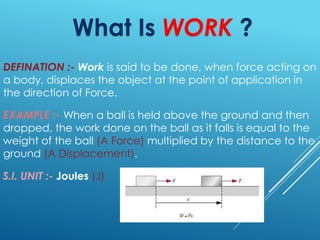
DEFINATION :- Work is said to be done, when force acting on
a body, displaces the object at the point of application in
the direction of Force.
EXAMPLE :- When a ball is held above the ground and then
dropped, the work done on the ball as it falls is equal to the
weight of the ball (A Force) multiplied by the distance to the
ground (A Displacement).
S.I. UNIT :- Joules (J)
DEFINATION :- The capacity to do work is known as, ENERGY.
TYPES OF ENERGY :- 1) Kinetic Energy
2) Potential Energy
3) Heat Energy
4) Thermal Energy
5) Hydel Energy
6) Tidal Energy
7) Mechanical Energy
8) Muscular Energy
9) Sound Energy
10) Chemical Energy
S.I. UNIT :- Joules (J)
Kinetic Energy
DEFINATION :- Kinetic Energy of an object is the energy that
it possesses due to its motion. It is defined as
the work needed to accelerate a body of a given mass
from rest to its stated velocity.
EXAMPLE :- * A planet rotating around the sun.
* Water flowing in a river or falling down a waterfall.
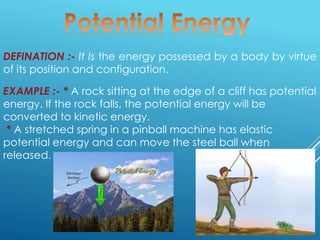
DEFINATION :- It Is the energy possessed by a body by virtue
of its position and configuration.
EXAMPLE :- * A rock sitting at the edge of a cliff has potential
energy. If the rock falls, the potential energy will be
converted to kinetic energy.
* A stretched spring in a pinball machine has elastic
potential energy and can move the steel ball when
released.
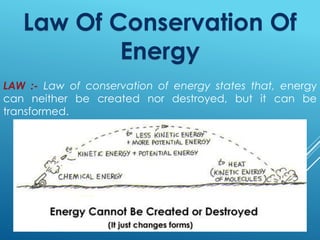
Law Of Conservation Of
Energy
LAW :- Law of conservation of energy states that, energy
can neither be created nor destroyed, but it can be
transformed.
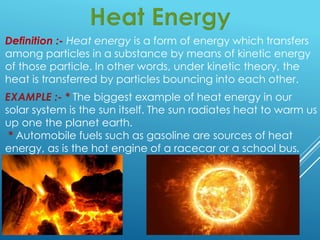
Definition :- Heat energy is a form of energy which transfers
among particles in a substance by means of kinetic energy
of those particle. In other words, under kinetic theory, the
heat is transferred by particles bouncing into each other.
EXAMPLE :- * The biggest example of heat energy in our
solar system is the sun itself. The sun radiates heat to warm us
up one the planet earth.
* Automobile fuels such as gasoline are sources of heat
energy, as is the hot engine of a racecar or a school bus.
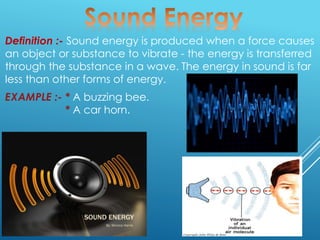
Definition :- Sound energy is produced when a force causes
an object or substance to vibrate - the energy is transferred
through the substance in a wave. The energy in sound is far
less than other forms of energy.
EXAMPLE :- * A buzzing bee.
* A car horn.
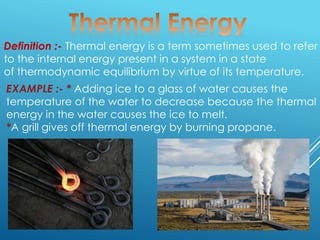
Definition :- Thermal energy is a term sometimes used to refer
to the internal energy present in a system in a state
of thermodynamic equilibrium by virtue of its temperature.
EXAMPLE :- * Adding ice to a glass of water causes the
temperature of the water to decrease because the thermal
energy in the water causes the ice to melt.
*A grill gives off thermal energy by burning propane.
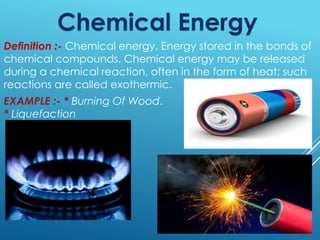
Chemical Energy
Definition :- Chemical energy, Energy stored in the bonds of
chemical compounds. Chemical energy may be released
during a chemical reaction, often in the form of heat; such
reactions are called exothermic.
EXAMPLE :- * Burning Of Wood.
* Liquefaction
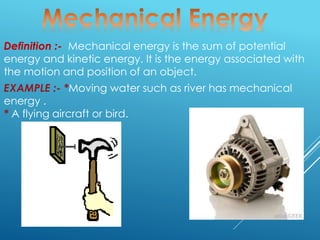
Definition :- Mechanical energy is the sum of potential
energy and kinetic energy. It is the energy associated with
the motion and position of an object.
EXAMPLE :- *Moving water such as river has mechanical
energy .
* A flying aircraft or bird.
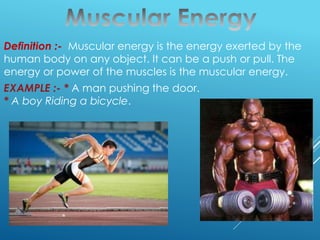
Definition :- Muscular energy is the energy exerted by the
human body on any object. It can be a push or pull. The
energy or power of the muscles is the muscular energy.
EXAMPLE :- * A man pushing the door.
* A boy Riding a bicycle.
POWER
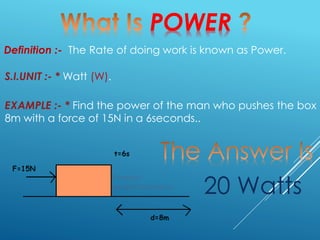
Definition :- The Rate of doing work is known as Power.
EXAMPLE :- * Find the power of the man who pushes the box
8m with a force of 15N in a 6seconds..
S.I.UNIT :- * Watt (W).
20 Watts
This Was Done By
Shrihari
Tusheet
Sukrit
Aarshiya
Rochelle

Work, energy and power

  • 1.
  • 2.
    What Is WORK? DEFINATION :- Work is said to be done, when force acting on a body, displaces the object at the point of application in the direction of Force. EXAMPLE :- When a ball is held above the ground and then dropped, the work done on the ball as it falls is equal to the weight of the ball (A Force) multiplied by the distance to the ground (A Displacement). S.I. UNIT :- Joules (J)
  • 3.
    DEFINATION :- Thecapacity to do work is known as, ENERGY. TYPES OF ENERGY :- 1) Kinetic Energy 2) Potential Energy 3) Heat Energy 4) Thermal Energy 5) Hydel Energy 6) Tidal Energy 7) Mechanical Energy 8) Muscular Energy 9) Sound Energy 10) Chemical Energy S.I. UNIT :- Joules (J)
  • 4.
    Kinetic Energy DEFINATION :-Kinetic Energy of an object is the energy that it possesses due to its motion. It is defined as the work needed to accelerate a body of a given mass from rest to its stated velocity. EXAMPLE :- * A planet rotating around the sun. * Water flowing in a river or falling down a waterfall.
  • 5.
    DEFINATION :- ItIs the energy possessed by a body by virtue of its position and configuration. EXAMPLE :- * A rock sitting at the edge of a cliff has potential energy. If the rock falls, the potential energy will be converted to kinetic energy. * A stretched spring in a pinball machine has elastic potential energy and can move the steel ball when released.
  • 6.
    Law Of ConservationOf Energy LAW :- Law of conservation of energy states that, energy can neither be created nor destroyed, but it can be transformed.
  • 7.
    Definition :- Heatenergy is a form of energy which transfers among particles in a substance by means of kinetic energy of those particle. In other words, under kinetic theory, the heat is transferred by particles bouncing into each other. EXAMPLE :- * The biggest example of heat energy in our solar system is the sun itself. The sun radiates heat to warm us up one the planet earth. * Automobile fuels such as gasoline are sources of heat energy, as is the hot engine of a racecar or a school bus.
  • 8.
    Definition :- Soundenergy is produced when a force causes an object or substance to vibrate - the energy is transferred through the substance in a wave. The energy in sound is far less than other forms of energy. EXAMPLE :- * A buzzing bee. * A car horn.
  • 9.
    Definition :- Thermalenergy is a term sometimes used to refer to the internal energy present in a system in a state of thermodynamic equilibrium by virtue of its temperature. EXAMPLE :- * Adding ice to a glass of water causes the temperature of the water to decrease because the thermal energy in the water causes the ice to melt. *A grill gives off thermal energy by burning propane.
  • 10.
    Chemical Energy Definition :-Chemical energy, Energy stored in the bonds of chemical compounds. Chemical energy may be released during a chemical reaction, often in the form of heat; such reactions are called exothermic. EXAMPLE :- * Burning Of Wood. * Liquefaction
  • 11.
    Definition :- Mechanicalenergy is the sum of potential energy and kinetic energy. It is the energy associated with the motion and position of an object. EXAMPLE :- *Moving water such as river has mechanical energy . * A flying aircraft or bird.
  • 12.
    Definition :- Muscularenergy is the energy exerted by the human body on any object. It can be a push or pull. The energy or power of the muscles is the muscular energy. EXAMPLE :- * A man pushing the door. * A boy Riding a bicycle.
  • 13.
    POWER Definition :- TheRate of doing work is known as Power. EXAMPLE :- * Find the power of the man who pushes the box 8m with a force of 15N in a 6seconds.. S.I.UNIT :- * Watt (W). 20 Watts
  • 14.
    This Was DoneBy Shrihari Tusheet Sukrit Aarshiya Rochelle