Construction Cost Engineering:
Work Breakdown
Structure (WBS)
NCE_4402
Work Breakdown Structure
1. Define Work Breakdown Structure (WBS)
2. Identify the levels of Work Breakdown Structure (WBS)
3. Identify the types of Work Breakdown Structure (WBS)
At the end of the lesson, the learner will be able to:
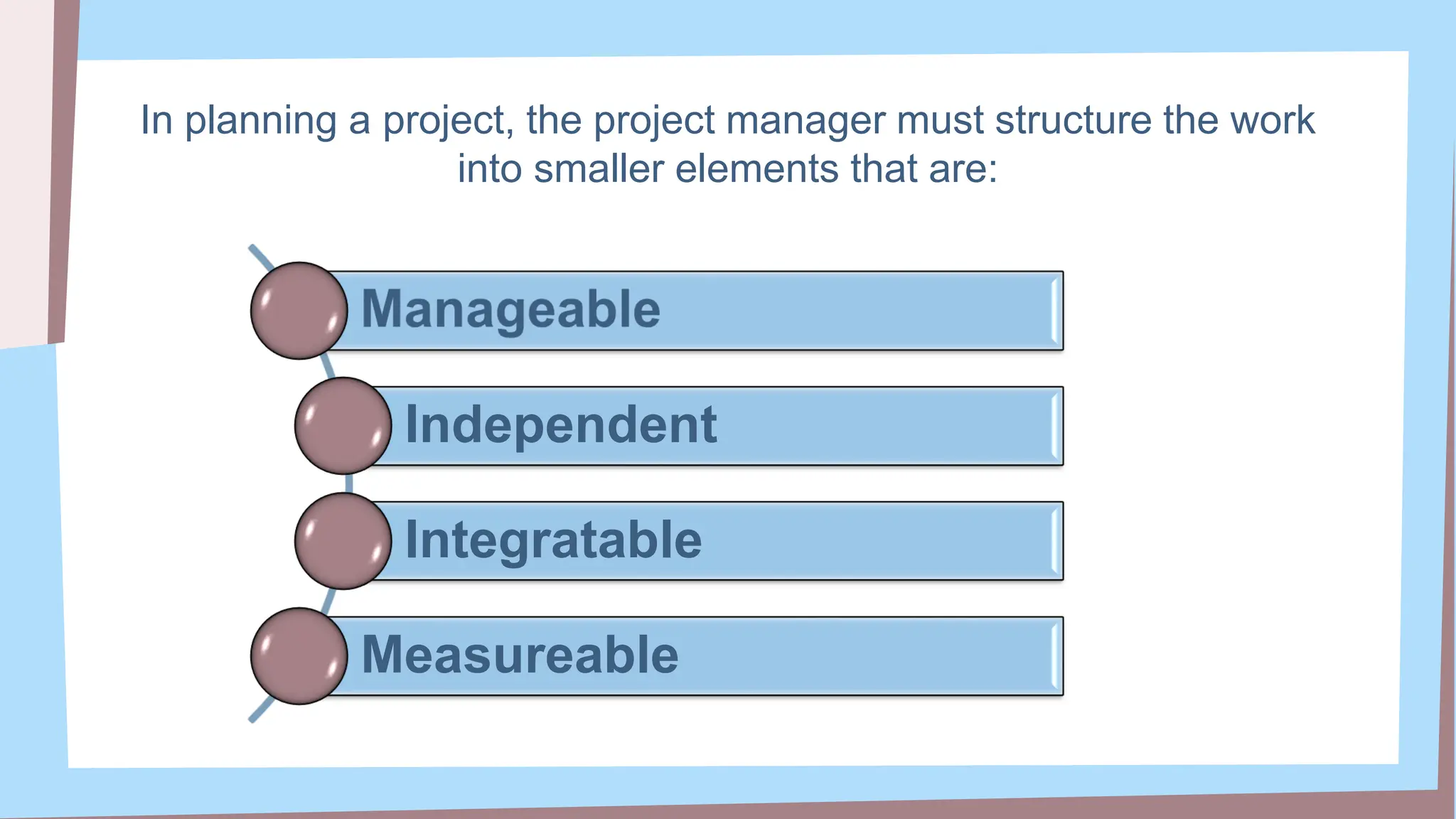
In planning a project, the project manager must structure the work
into smaller elements that are:
Independent
Integratable
Measureable
Work Breakdown
Structure (WBS)
Is a product-oriented family tree subdivision of
the materials, activities, and data required to
produce the end product.
Work Breakdown
Structure (WBS)
Preparation of the WBS also considers other
areas that require structured data, such as
scheduling, configuration management,
contract funding, and technical performance
parameters.
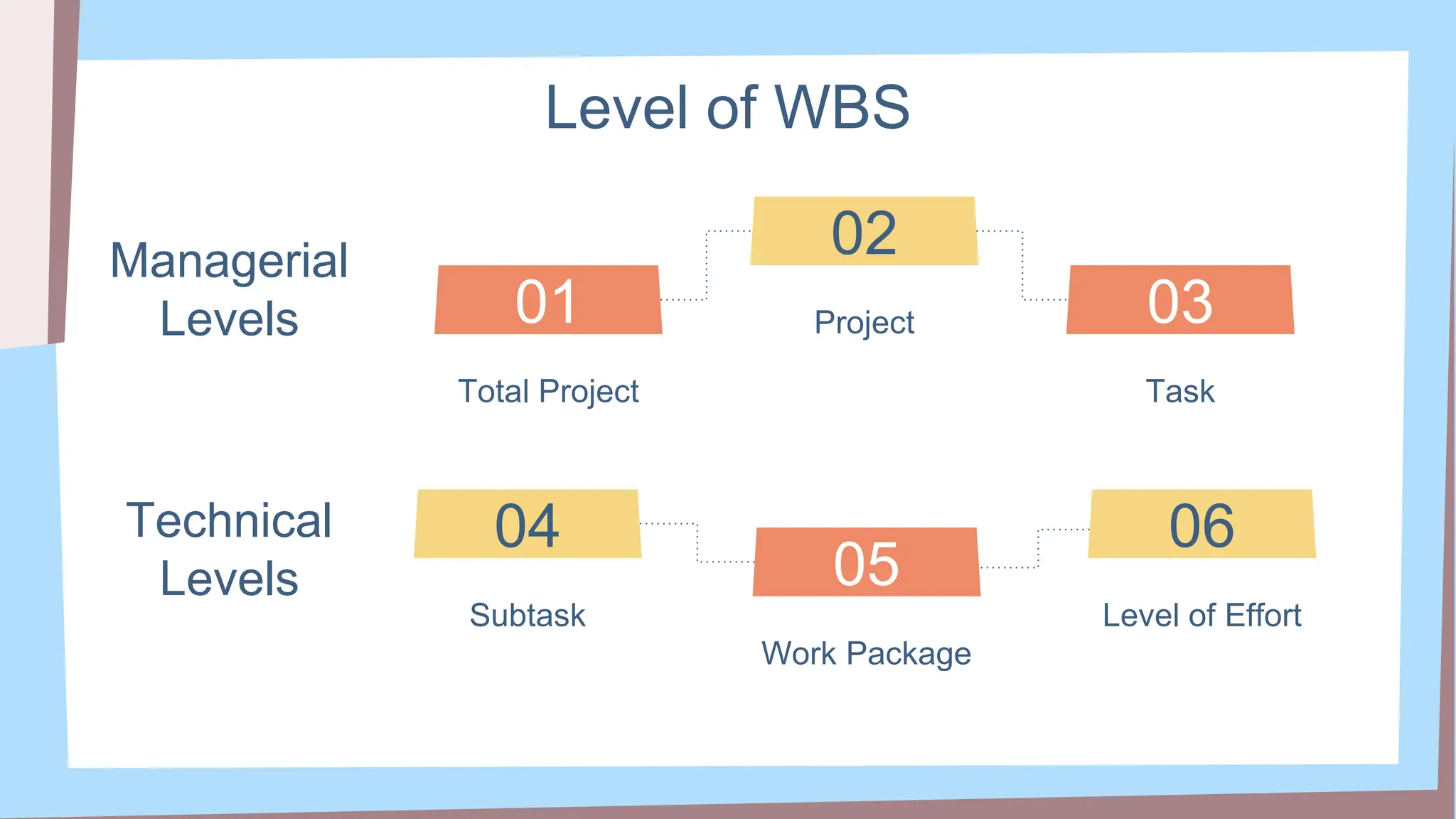
Level of WBS
Total Project
Project
Task
Subtask
01
02
03
04
Work Package
05
Level of Effort
06
Managerial
Levels
Technical
Levels
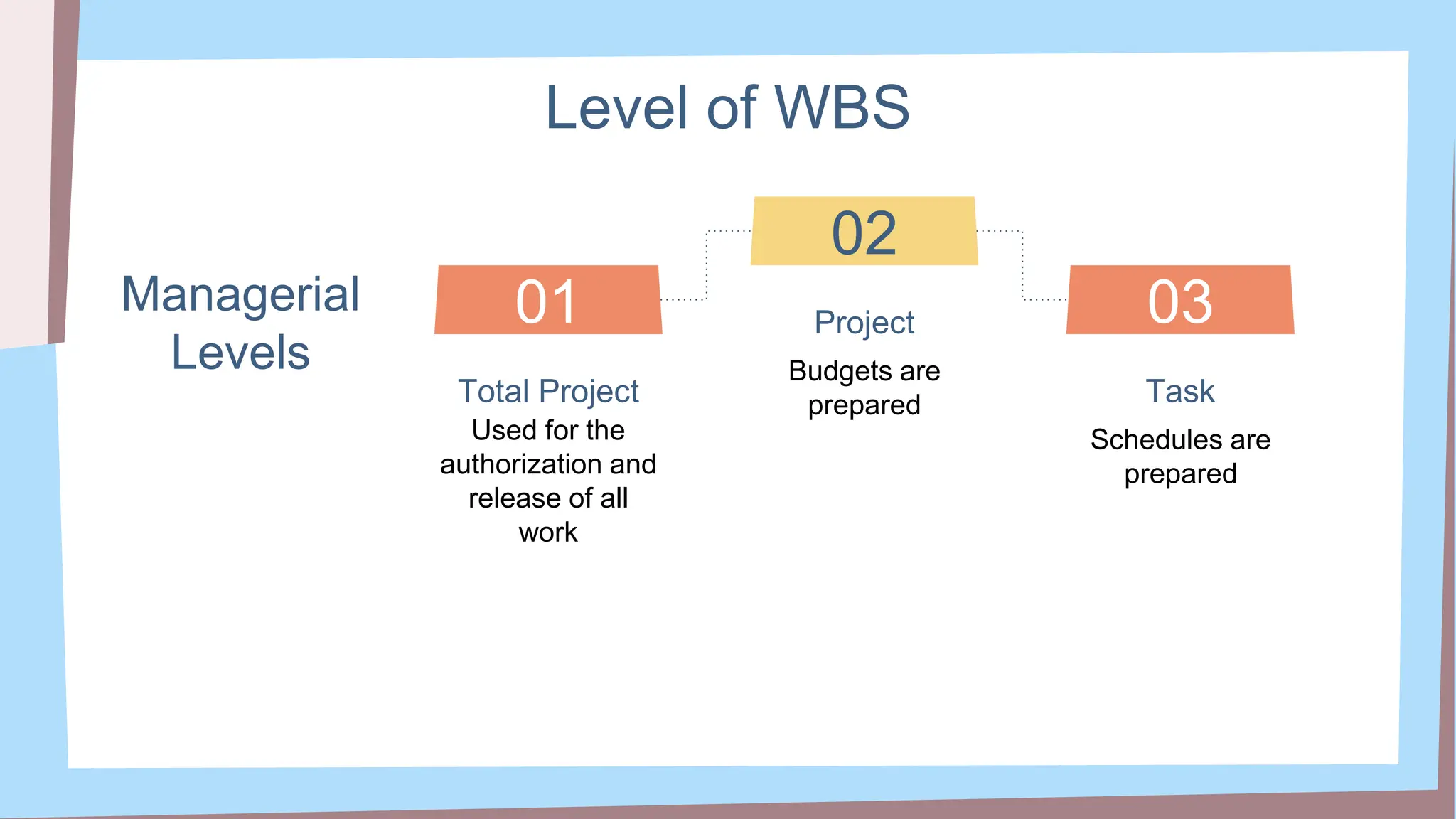
Level of WBS
Total Project
Project
Task
01
02
03
Managerial
Levels
Used for the
authorization and
release of all
work
Budgets are
prepared
Schedules are
prepared
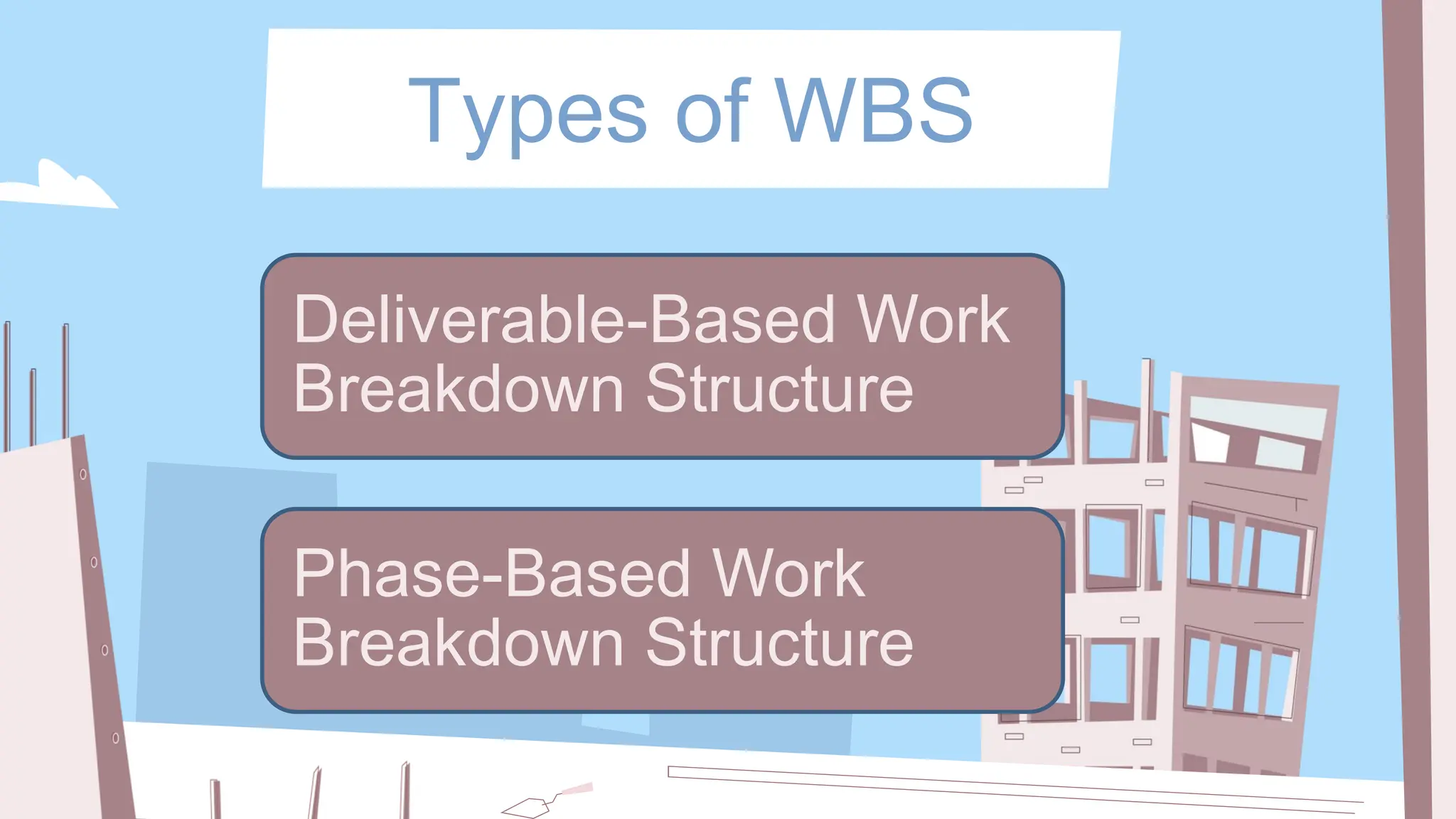
Types of WBS
Deliverable-Based Work
Breakdown Structure
Phase-Based Work
Breakdown Structure
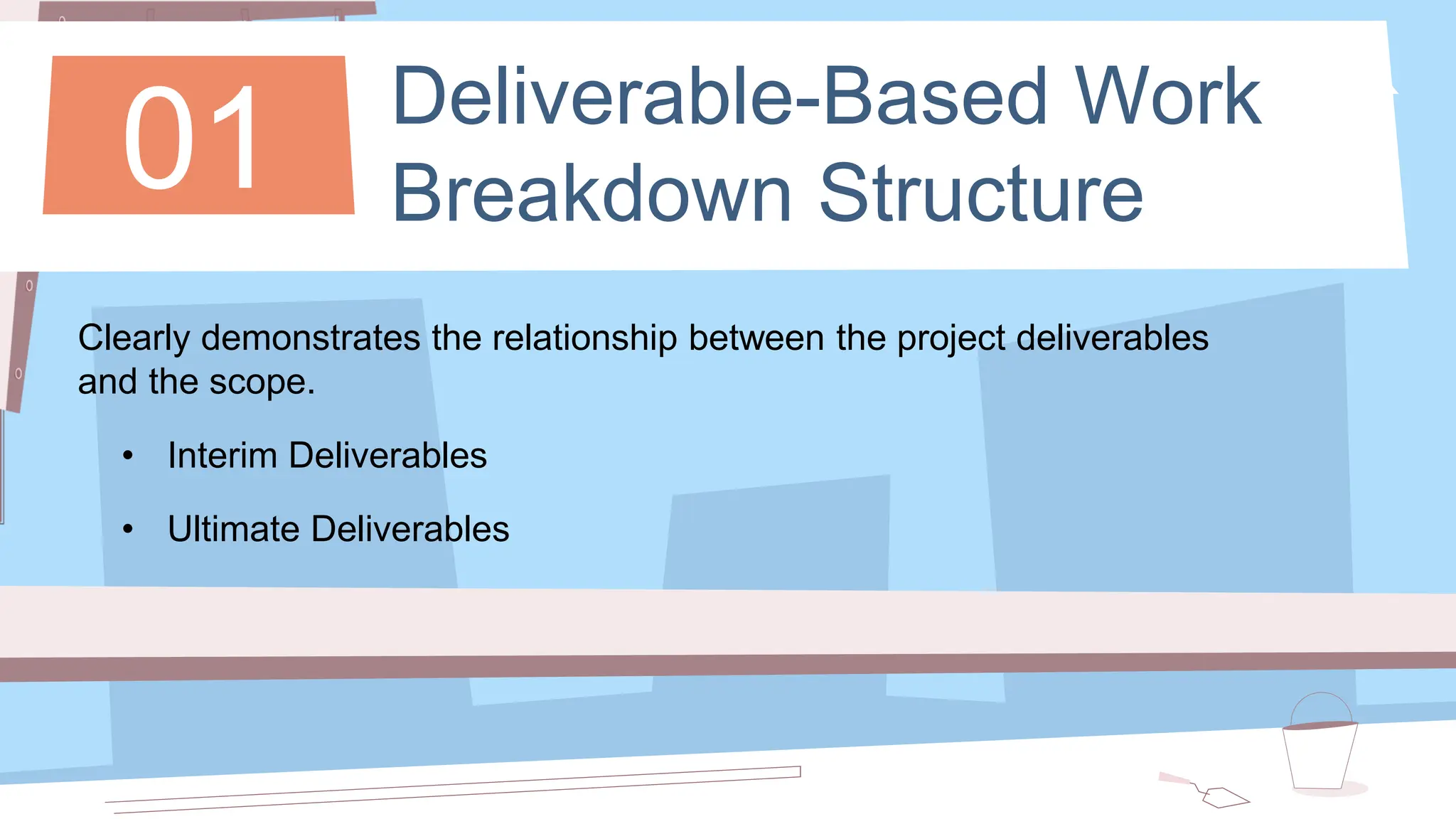
Deliverable-Based Work
Breakdown Structure
01
Clearly demonstrates the relationship between the project deliverables
and the scope.
• Interim Deliverables
• Ultimate Deliverables
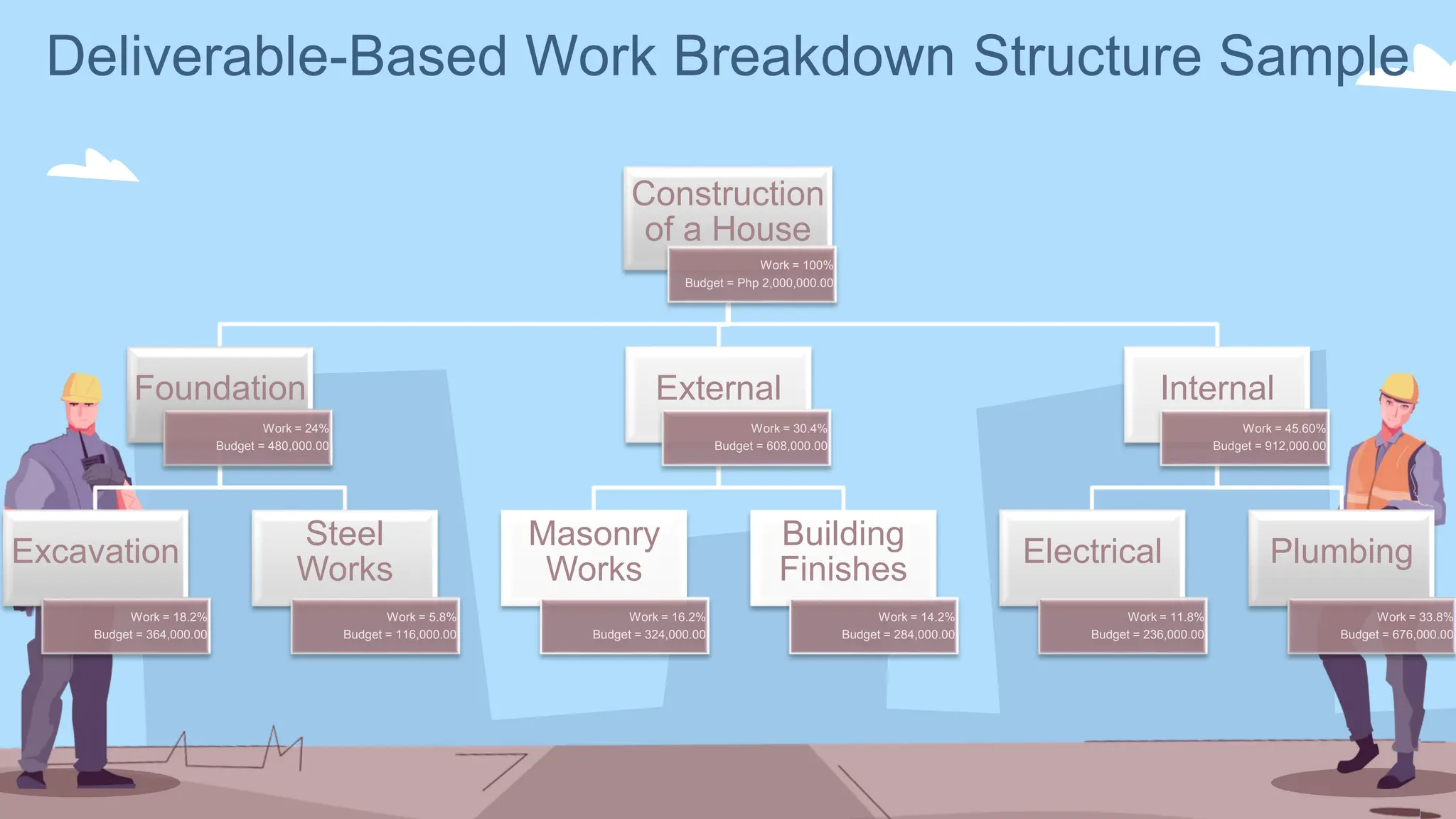
Deliverable-Based Work Breakdown Structure Sample
Construction
of a House
Work = 100%
Budget = Php 2,000,000.00
Foundation
Work = 24%
Budget = 480,000.00
Excavation
Work = 18.2%
Budget = 364,000.00
Steel
Works
Work = 5.8%
Budget = 116,000.00
External
Work = 30.4%
Budget = 608,000.00
Masonry
Works
Work = 16.2%
Budget = 324,000.00
Building
Finishes
Work = 14.2%
Budget = 284,000.00
Internal
Work = 45.60%
Budget = 912,000.00
Electrical
Work = 11.8%
Budget = 236,000.00
Plumbing
Work = 33.8%
Budget = 676,000.00
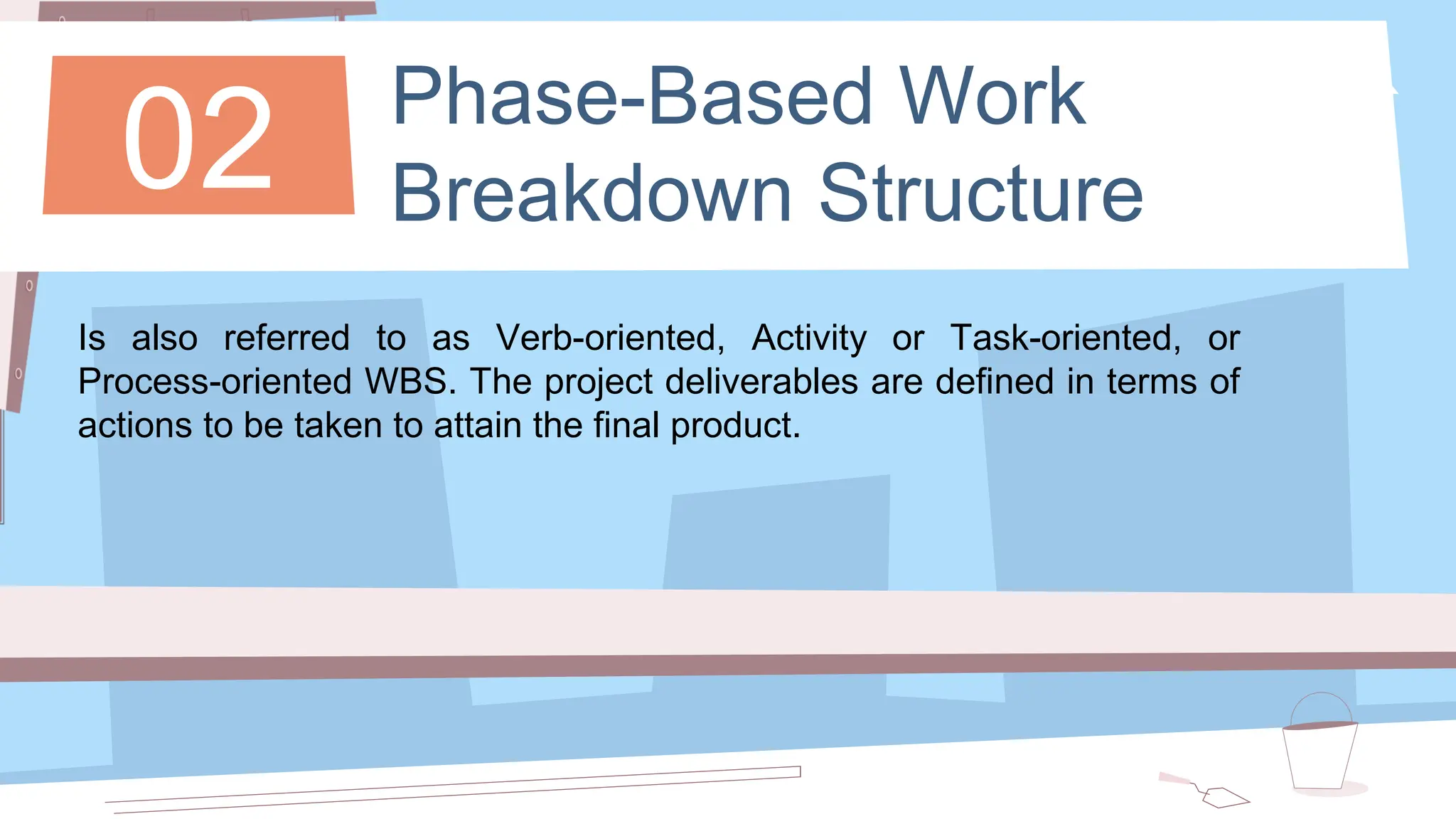
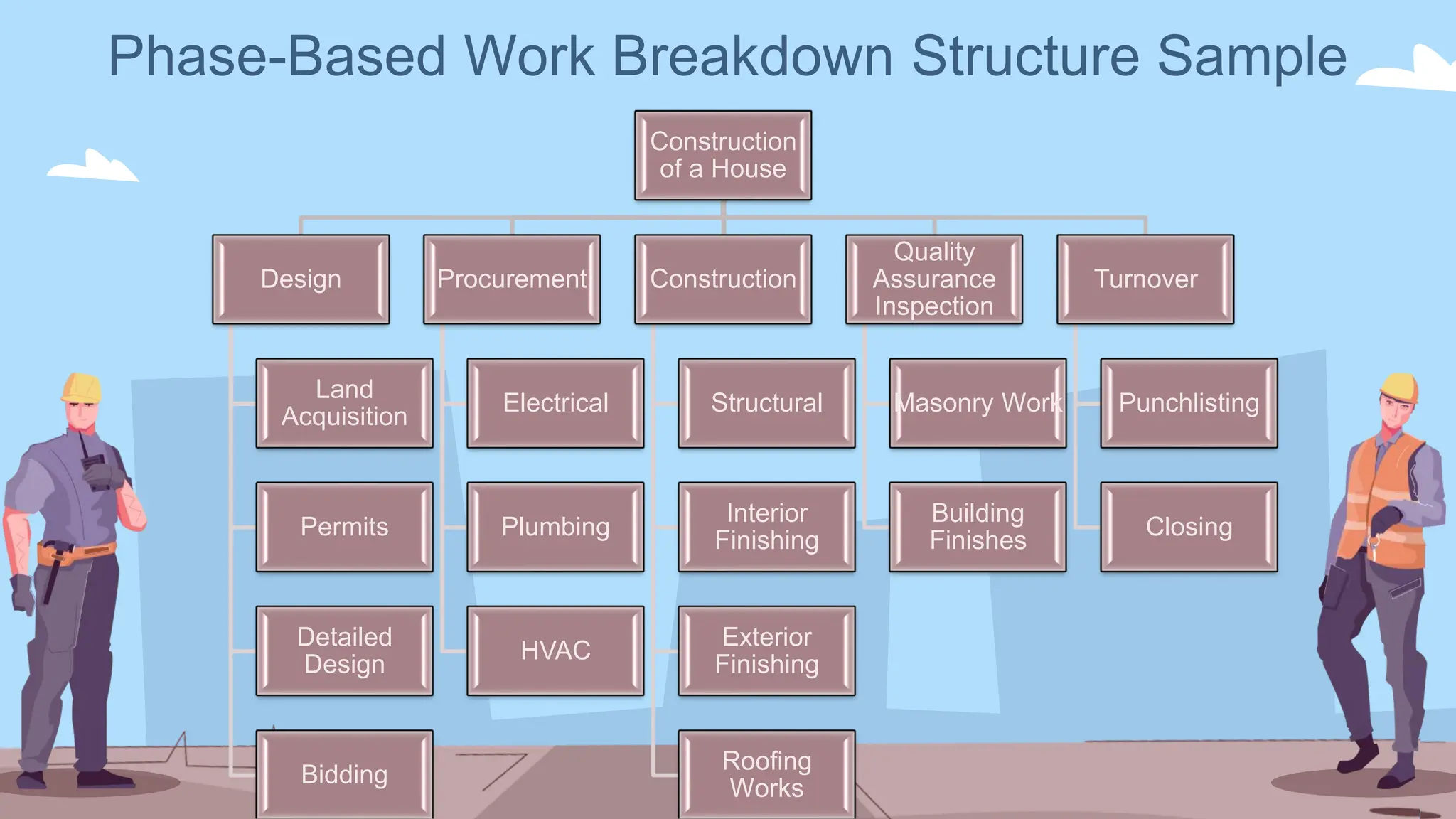
Phase-Based Work
Breakdown Structure
02
Is also referred to as Verb-oriented, Activity or Task-oriented, or
Process-oriented WBS. The project deliverables are defined in terms of
actions to be taken to attain the final product.
Phase-Based Work Breakdown Structure Sample
Construction
of a House
Design
Land
Acquisition
Permits
Detailed
Design
Bidding
Procurement
Electrical
Plumbing
HVAC
Construction
Structural
Interior
Finishing
Exterior
Finishing
Roofing
Works
Quality
Assurance
Inspection
Masonry Work
Building
Finishes
Turnover
Punchlisting
Closing
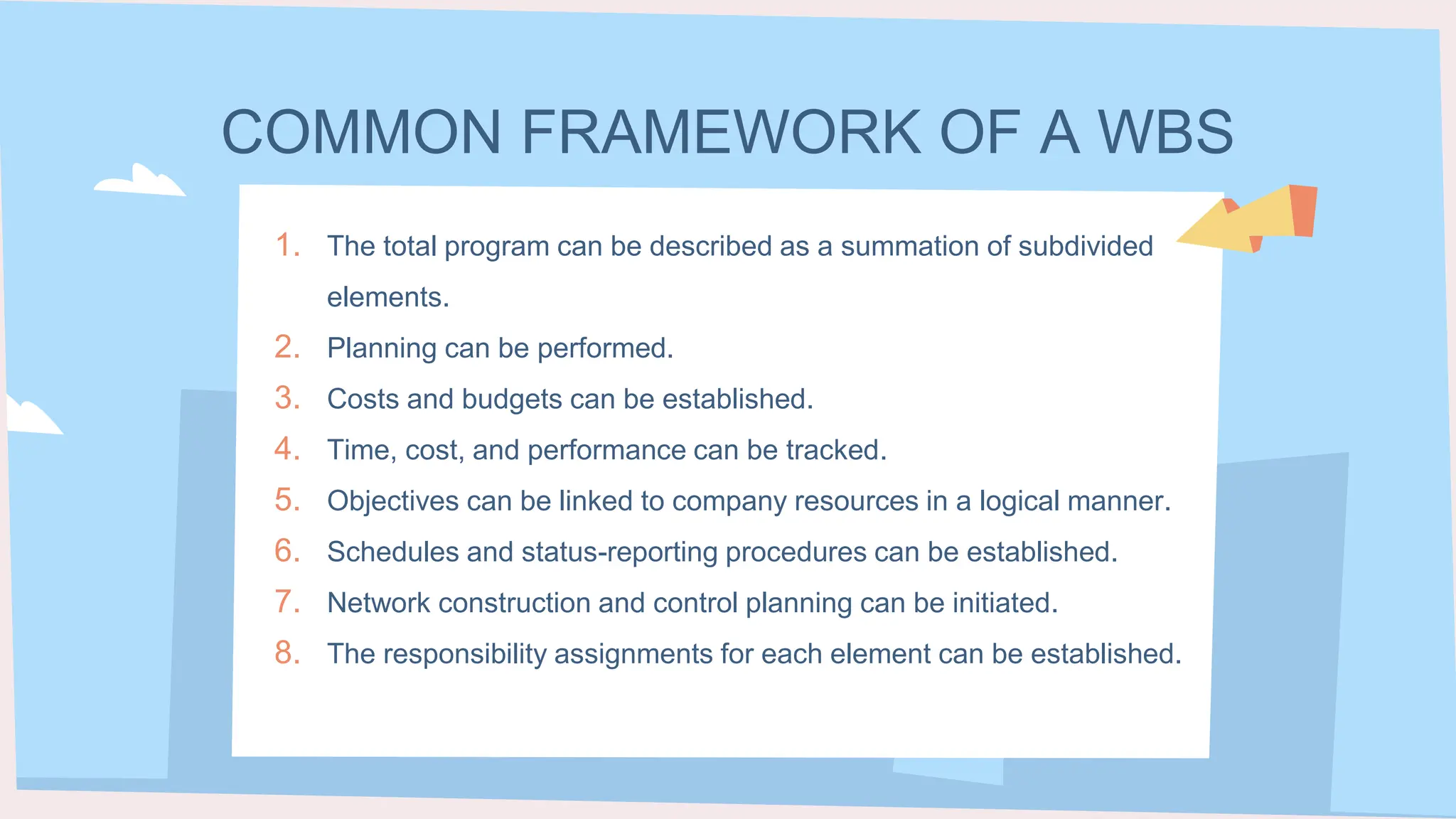
COMMON FRAMEWORK OF A WBS
1. The total program can be described as a summation of subdivided
elements.
2. Planning can be performed.
3. Costs and budgets can be established.
4. Time, cost, and performance can be tracked.
5. Objectives can be linked to company resources in a logical manner.
6. Schedules and status-reporting procedures can be established.
7. Network construction and control planning can be initiated.
8. The responsibility assignments for each element can be established.
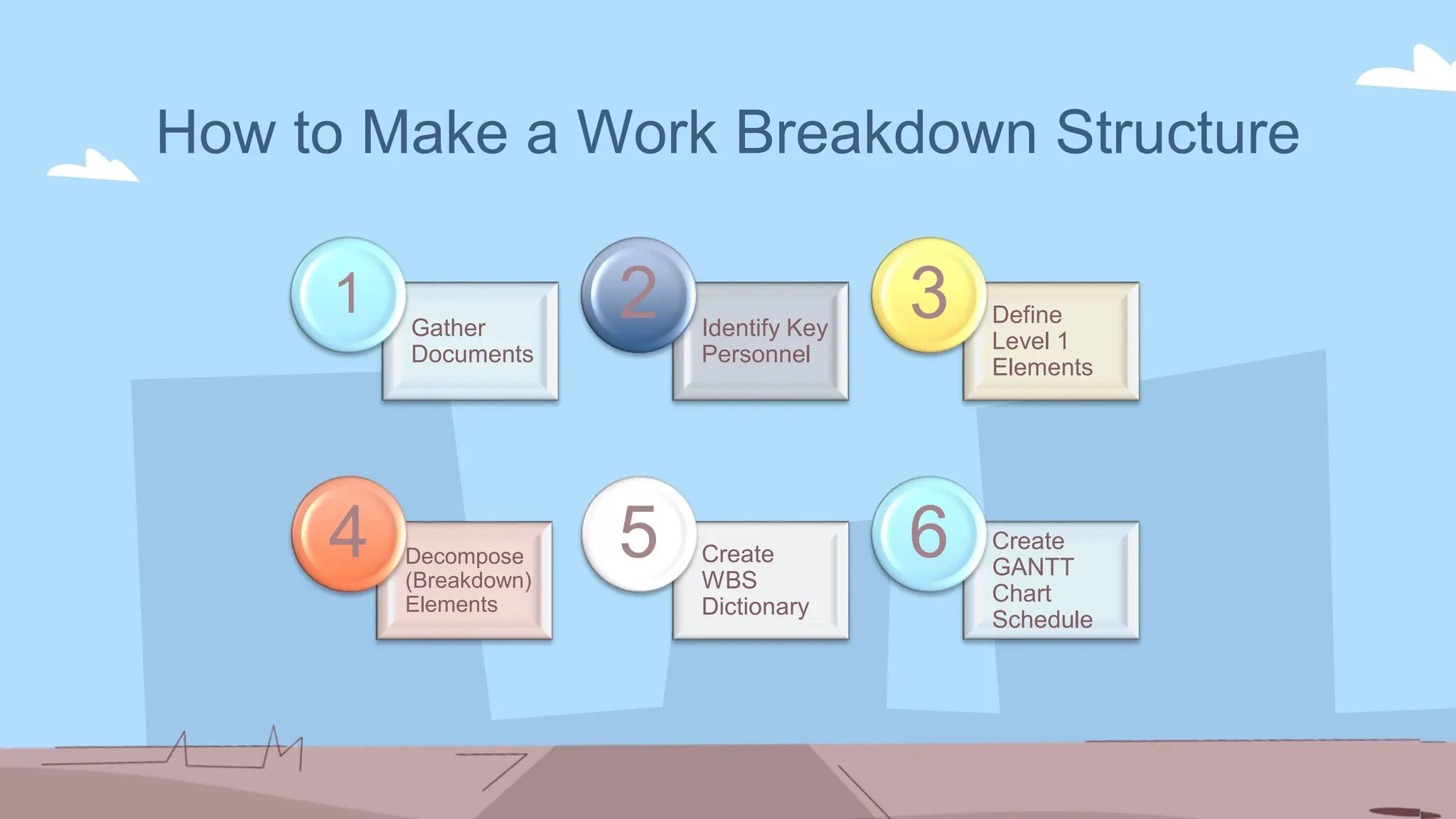
How to Make a Work Breakdown Structure
Gather
Documents
1 Identify Key
Personnel
2 Define
Level 1
Elements
3
Decompose
(Breakdown)
Elements
4 Create
WBS
Dictionary
5 Create
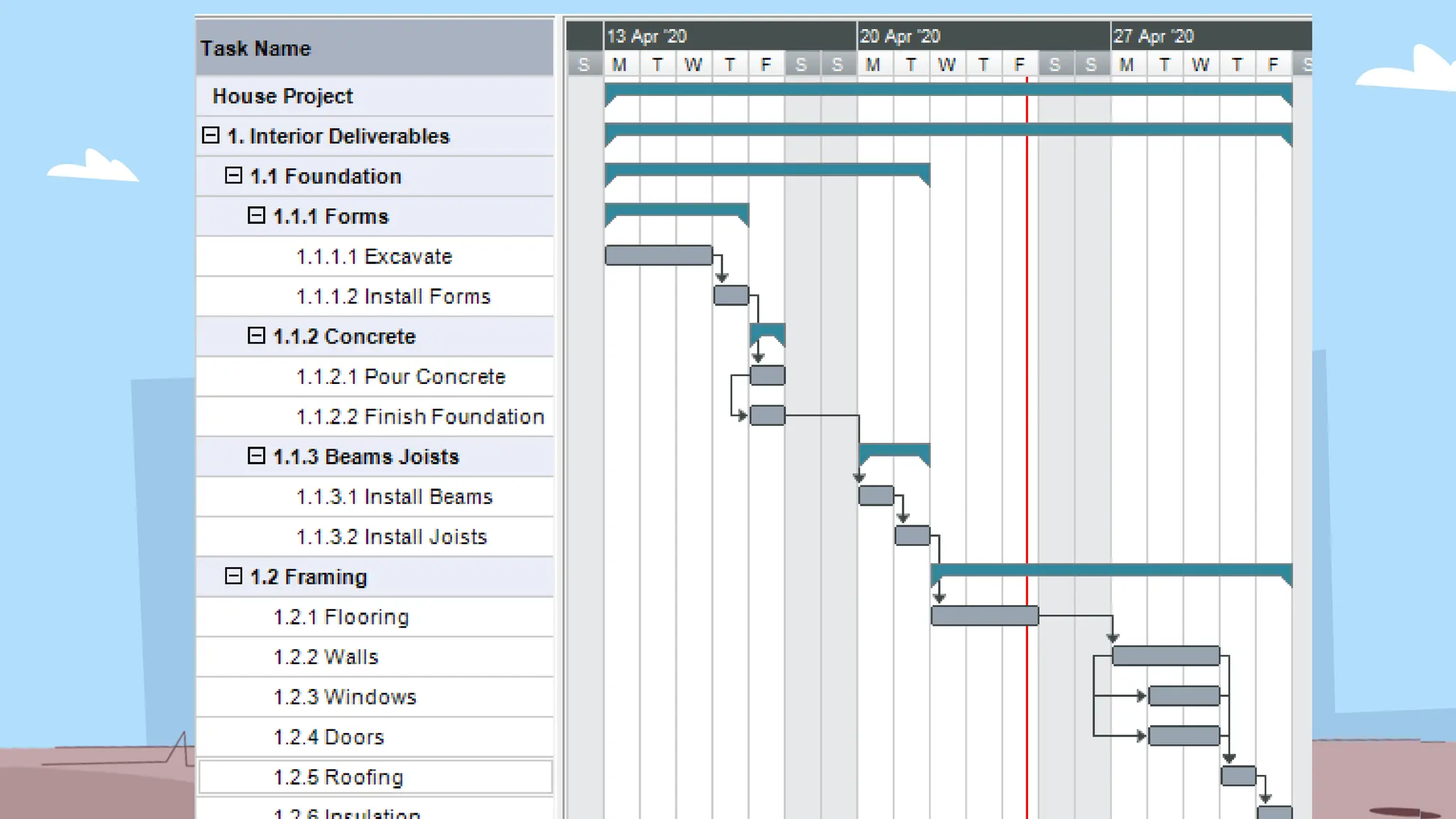
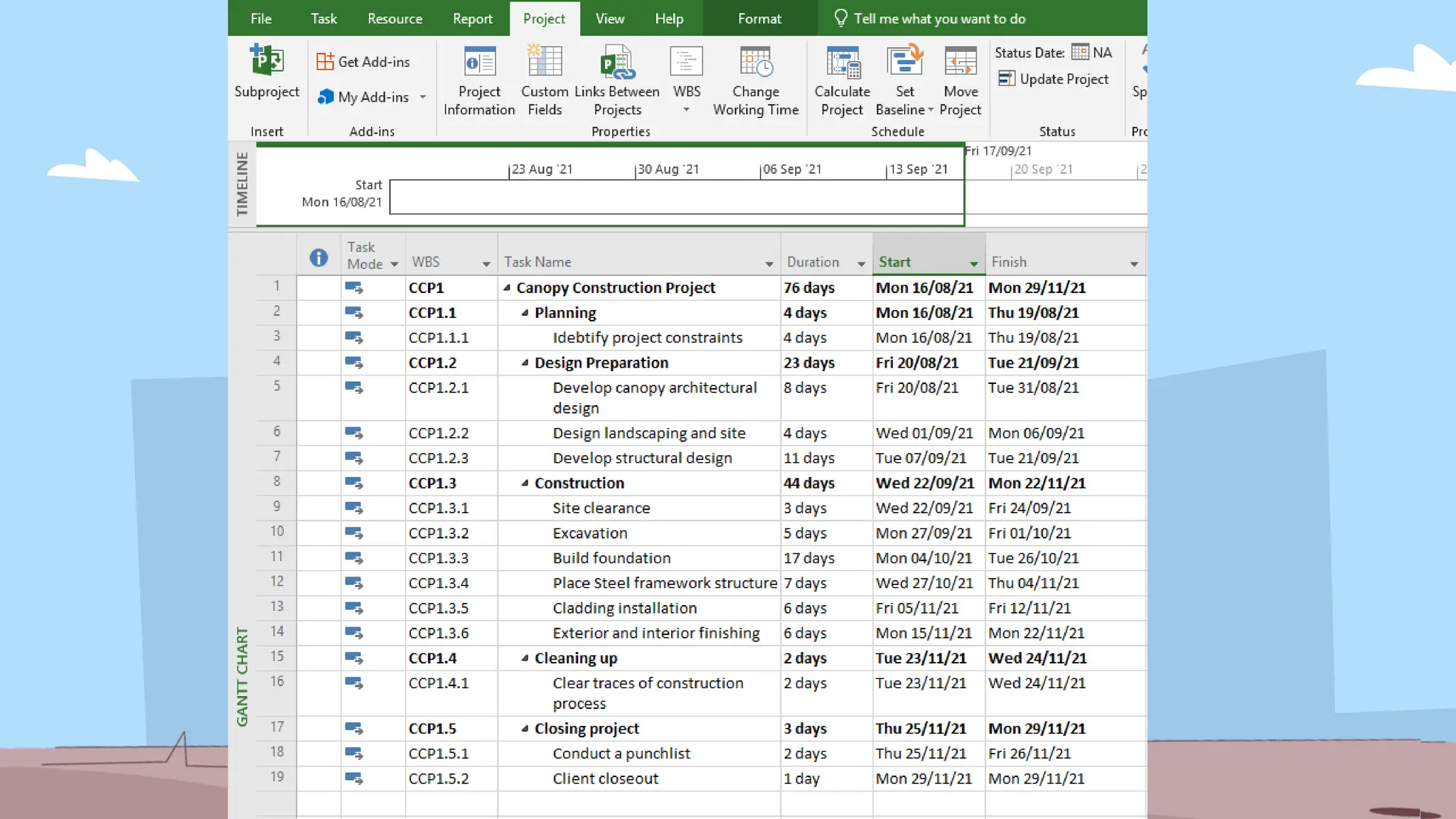
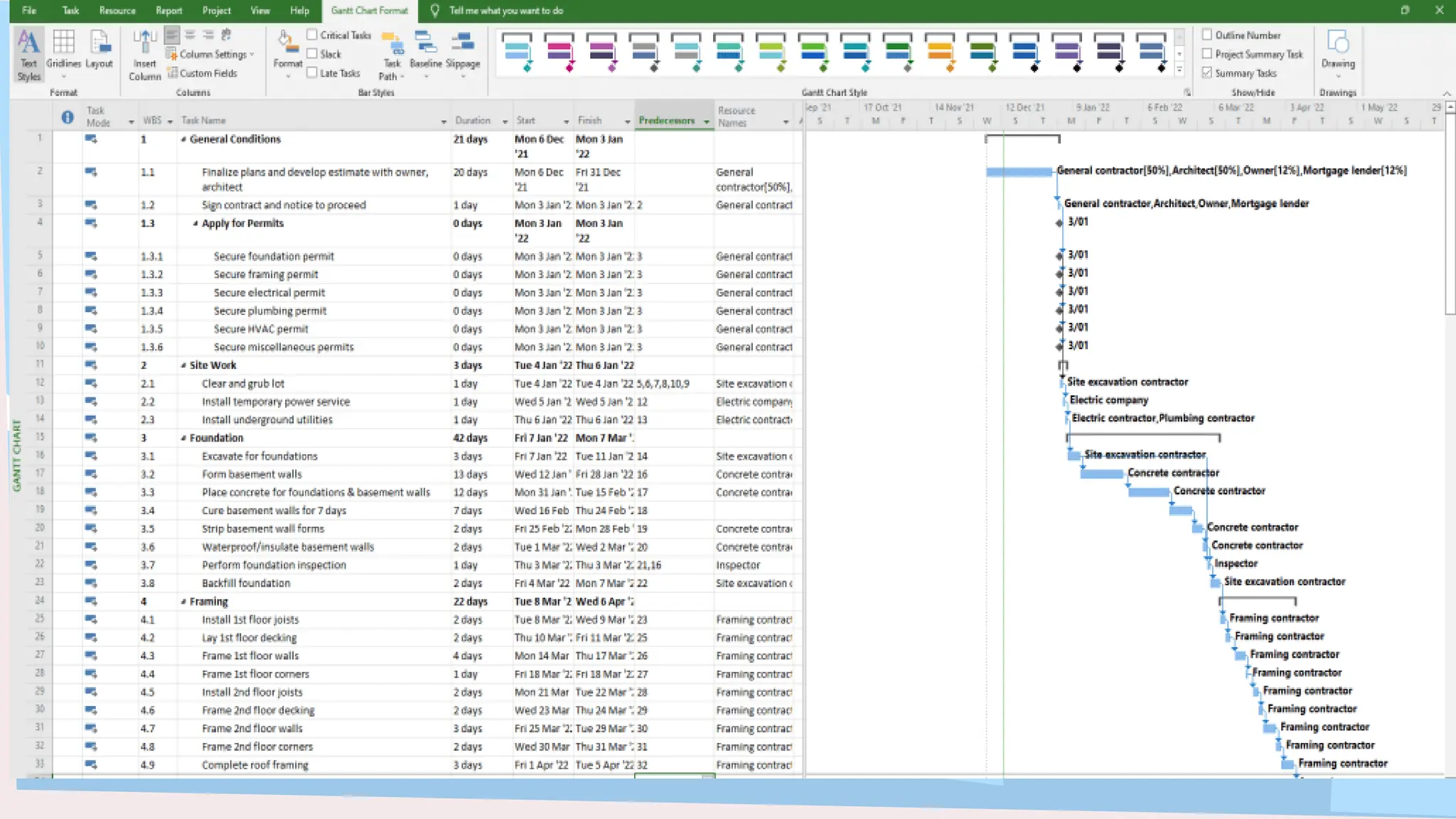
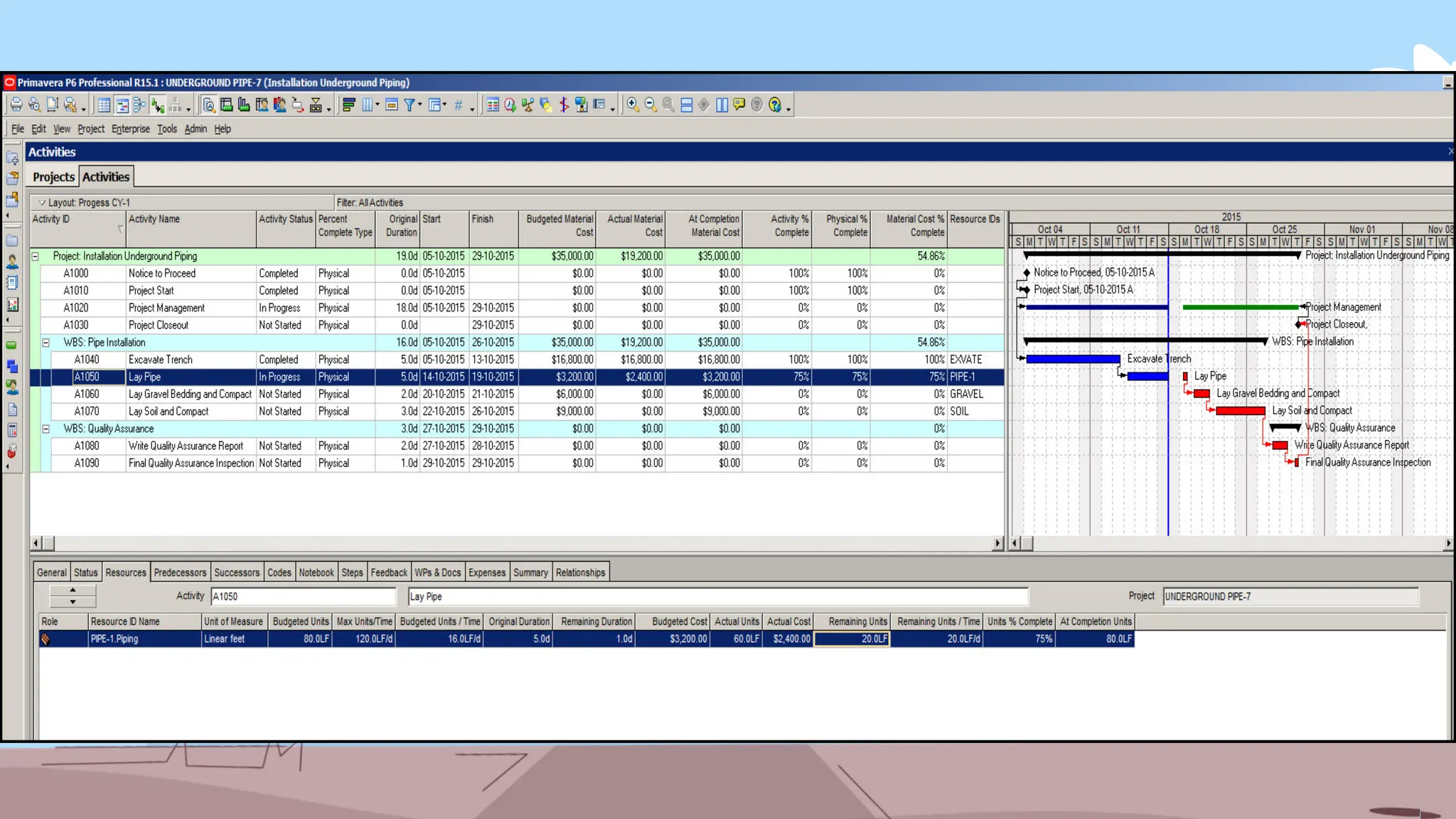
GANTT
Chart
Schedule
6
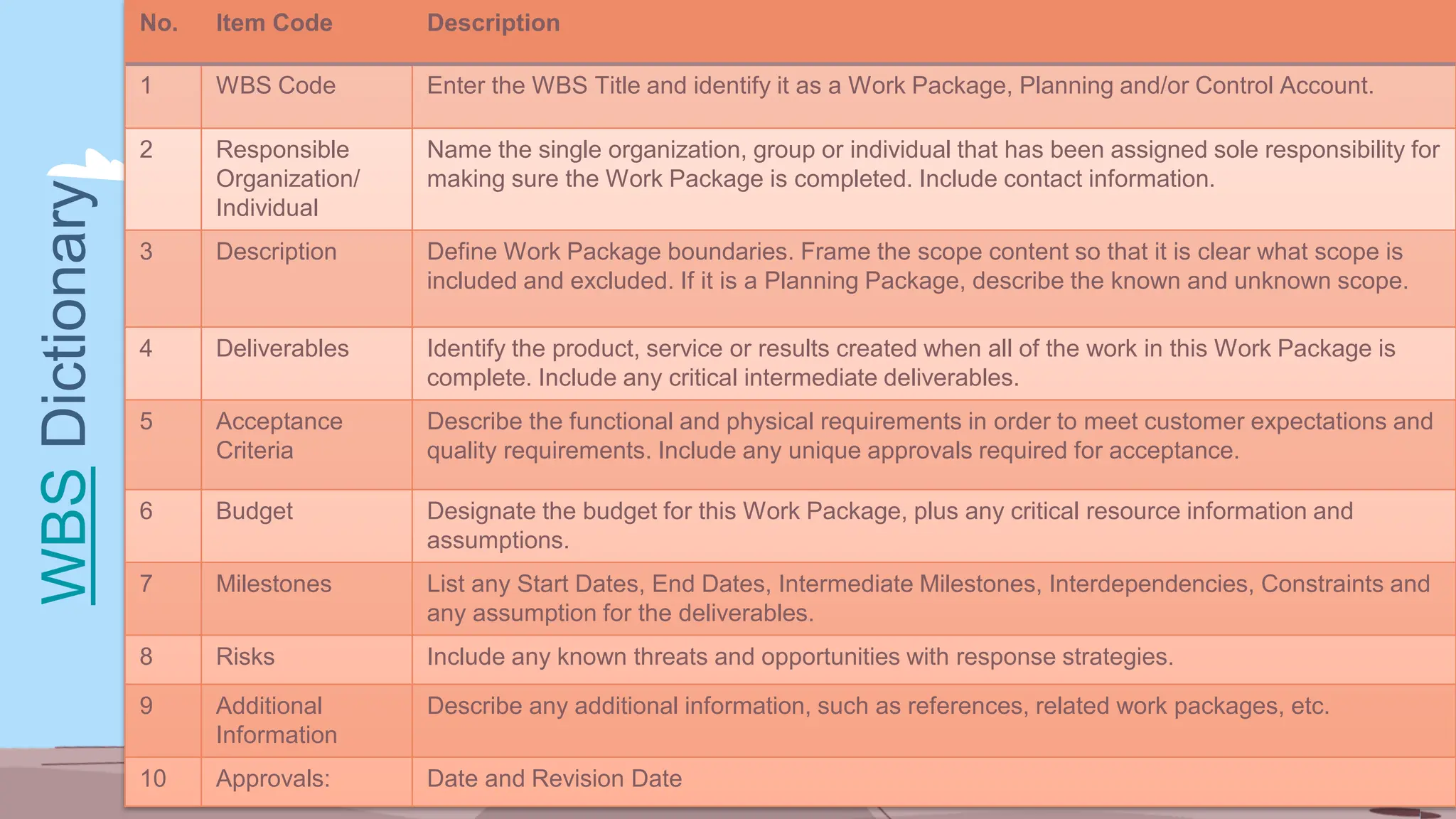
WBS
Dictionary
No. Item Code Description
1 WBS Code Enter the WBS Title and identify it as a Work Package, Planning and/or Control Account.
2 Responsible
Organization/
Individual
Name the single organization, group or individual that has been assigned sole responsibility for
making sure the Work Package is completed. Include contact information.
3 Description Define Work Package boundaries. Frame the scope content so that it is clear what scope is
included and excluded. If it is a Planning Package, describe the known and unknown scope.
4 Deliverables Identify the product, service or results created when all of the work in this Work Package is
complete. Include any critical intermediate deliverables.
5 Acceptance
Criteria
Describe the functional and physical requirements in order to meet customer expectations and
quality requirements. Include any unique approvals required for acceptance.
6 Budget Designate the budget for this Work Package, plus any critical resource information and
assumptions.
7 Milestones List any Start Dates, End Dates, Intermediate Milestones, Interdependencies, Constraints and
any assumption for the deliverables.
8 Risks Include any known threats and opportunities with response strategies.
9 Additional
Information
Describe any additional information, such as references, related work packages, etc.
10 Approvals: Date and Revision Date
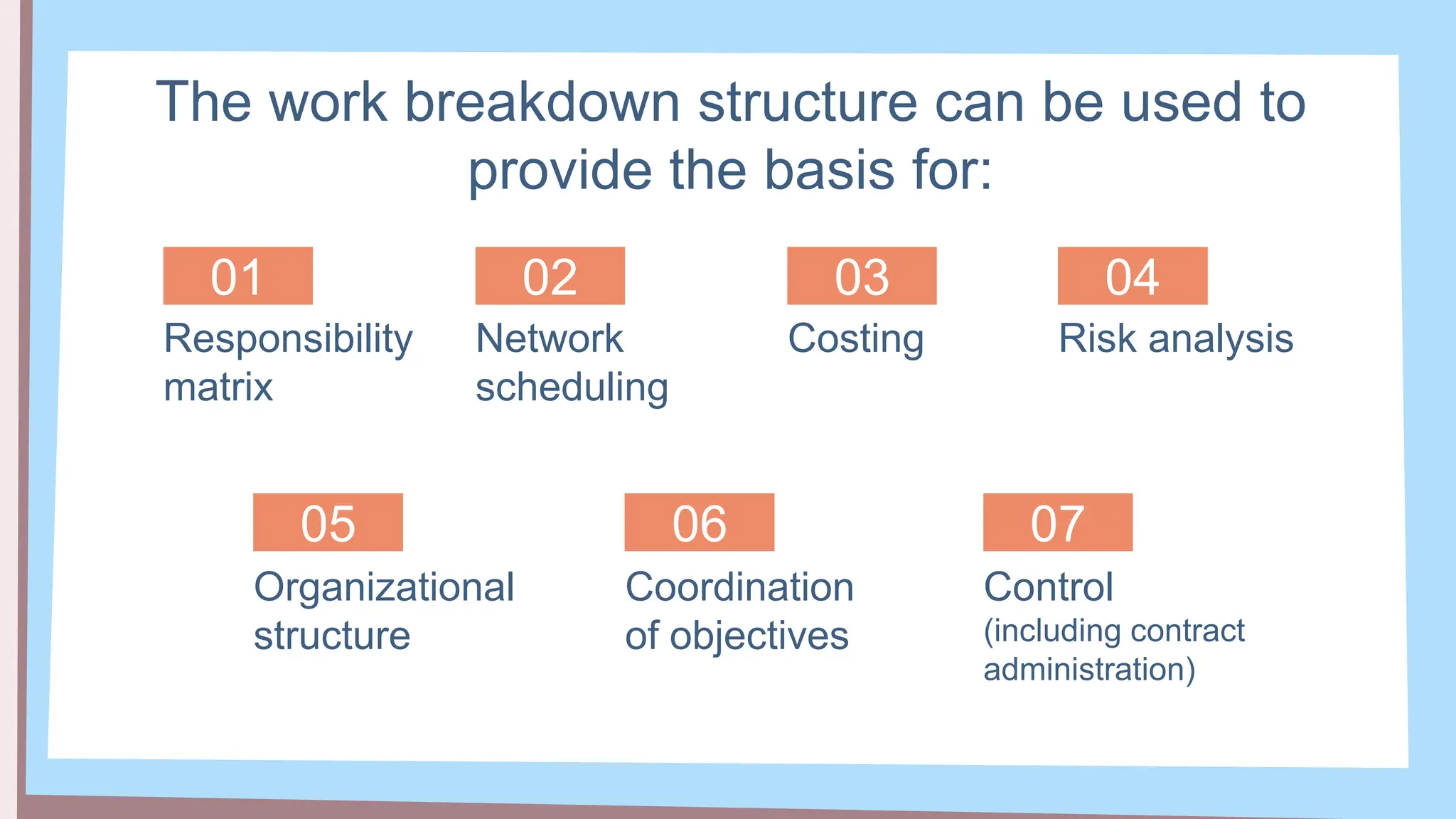
The work breakdown structure can be used to
provide the basis for:
Responsibility
matrix
Network
scheduling
Costing Risk analysis
01 02 03 04
Organizational
structure
Coordination
of objectives
Control
(including contract
administration)
05 06 07
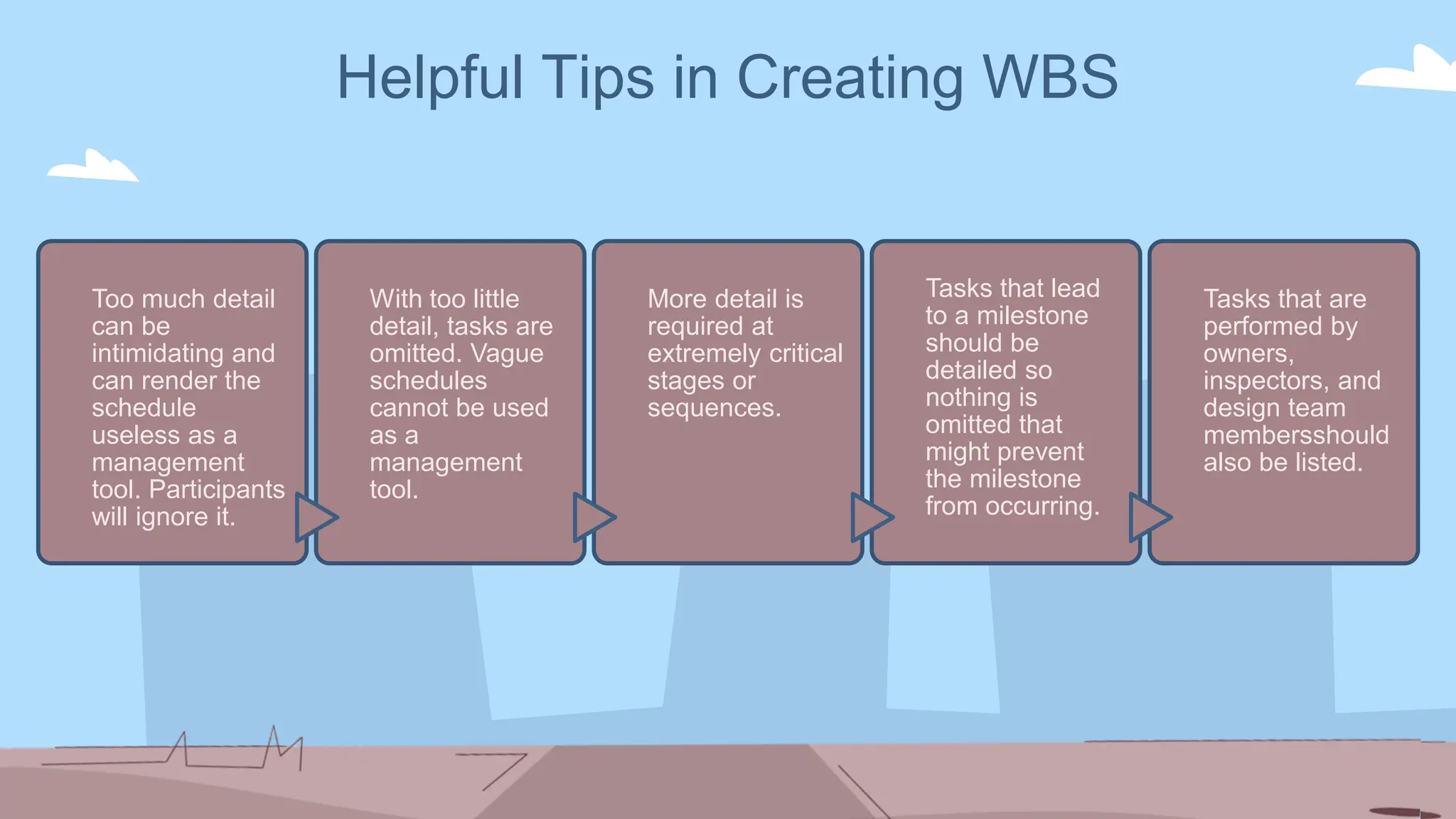
Helpful Tips in Creating WBS
Too much detail
can be
intimidating and
can render the
schedule
useless as a
management
tool. Participants
will ignore it.
With too little
detail, tasks are
omitted. Vague
schedules
cannot be used
as a
management
tool.
More detail is
required at
extremely critical
stages or
sequences.
Tasks that lead
to a milestone
should be
detailed so
nothing is
omitted that
might prevent
the milestone
from occurring.
Tasks that are
performed by
owners,
inspectors, and
design team
membersshould
also be listed.

Work Breakdown Structure of Construction Work

  • 1.
    Construction Cost Engineering: WorkBreakdown Structure (WBS) NCE_4402
  • 2.
    Work Breakdown Structure 1.Define Work Breakdown Structure (WBS) 2. Identify the levels of Work Breakdown Structure (WBS) 3. Identify the types of Work Breakdown Structure (WBS) At the end of the lesson, the learner will be able to:
  • 6.
    In planning aproject, the project manager must structure the work into smaller elements that are: Independent Integratable Measureable
  • 7.
    Work Breakdown Structure (WBS) Isa product-oriented family tree subdivision of the materials, activities, and data required to produce the end product.
  • 8.
    Work Breakdown Structure (WBS) Preparationof the WBS also considers other areas that require structured data, such as scheduling, configuration management, contract funding, and technical performance parameters.
  • 9.
    Level of WBS TotalProject Project Task Subtask 01 02 03 04 Work Package 05 Level of Effort 06 Managerial Levels Technical Levels
  • 10.
    Level of WBS TotalProject Project Task 01 02 03 Managerial Levels Used for the authorization and release of all work Budgets are prepared Schedules are prepared
  • 11.
    Types of WBS Deliverable-BasedWork Breakdown Structure Phase-Based Work Breakdown Structure
  • 12.
    Deliverable-Based Work Breakdown Structure 01 Clearlydemonstrates the relationship between the project deliverables and the scope. • Interim Deliverables • Ultimate Deliverables
  • 13.
    Deliverable-Based Work BreakdownStructure Sample Construction of a House Work = 100% Budget = Php 2,000,000.00 Foundation Work = 24% Budget = 480,000.00 Excavation Work = 18.2% Budget = 364,000.00 Steel Works Work = 5.8% Budget = 116,000.00 External Work = 30.4% Budget = 608,000.00 Masonry Works Work = 16.2% Budget = 324,000.00 Building Finishes Work = 14.2% Budget = 284,000.00 Internal Work = 45.60% Budget = 912,000.00 Electrical Work = 11.8% Budget = 236,000.00 Plumbing Work = 33.8% Budget = 676,000.00
  • 14.
    Phase-Based Work Breakdown Structure 02 Isalso referred to as Verb-oriented, Activity or Task-oriented, or Process-oriented WBS. The project deliverables are defined in terms of actions to be taken to attain the final product.
  • 15.
    Phase-Based Work BreakdownStructure Sample Construction of a House Design Land Acquisition Permits Detailed Design Bidding Procurement Electrical Plumbing HVAC Construction Structural Interior Finishing Exterior Finishing Roofing Works Quality Assurance Inspection Masonry Work Building Finishes Turnover Punchlisting Closing
  • 16.
    COMMON FRAMEWORK OFA WBS 1. The total program can be described as a summation of subdivided elements. 2. Planning can be performed. 3. Costs and budgets can be established. 4. Time, cost, and performance can be tracked. 5. Objectives can be linked to company resources in a logical manner. 6. Schedules and status-reporting procedures can be established. 7. Network construction and control planning can be initiated. 8. The responsibility assignments for each element can be established.
  • 17.
    How to Makea Work Breakdown Structure Gather Documents 1 Identify Key Personnel 2 Define Level 1 Elements 3 Decompose (Breakdown) Elements 4 Create WBS Dictionary 5 Create GANTT Chart Schedule 6
  • 18.
    WBS Dictionary No. Item CodeDescription 1 WBS Code Enter the WBS Title and identify it as a Work Package, Planning and/or Control Account. 2 Responsible Organization/ Individual Name the single organization, group or individual that has been assigned sole responsibility for making sure the Work Package is completed. Include contact information. 3 Description Define Work Package boundaries. Frame the scope content so that it is clear what scope is included and excluded. If it is a Planning Package, describe the known and unknown scope. 4 Deliverables Identify the product, service or results created when all of the work in this Work Package is complete. Include any critical intermediate deliverables. 5 Acceptance Criteria Describe the functional and physical requirements in order to meet customer expectations and quality requirements. Include any unique approvals required for acceptance. 6 Budget Designate the budget for this Work Package, plus any critical resource information and assumptions. 7 Milestones List any Start Dates, End Dates, Intermediate Milestones, Interdependencies, Constraints and any assumption for the deliverables. 8 Risks Include any known threats and opportunities with response strategies. 9 Additional Information Describe any additional information, such as references, related work packages, etc. 10 Approvals: Date and Revision Date
  • 23.
    The work breakdownstructure can be used to provide the basis for: Responsibility matrix Network scheduling Costing Risk analysis 01 02 03 04 Organizational structure Coordination of objectives Control (including contract administration) 05 06 07
  • 24.
    Helpful Tips inCreating WBS Too much detail can be intimidating and can render the schedule useless as a management tool. Participants will ignore it. With too little detail, tasks are omitted. Vague schedules cannot be used as a management tool. More detail is required at extremely critical stages or sequences. Tasks that lead to a milestone should be detailed so nothing is omitted that might prevent the milestone from occurring. Tasks that are performed by owners, inspectors, and design team membersshould also be listed.