
(Professional Business Analyst Training organisation)
Functional
Decomposition
Functional Decomposition:
Functional decomposition relates to the
various functional relationships as how the
original complex business functions were
developed.
 It mainly focuses on how the overall
functionality is developed and its interaction
between various components.
Functional Decomposition is used to break
down the high-level solution scope of a
project into its component parts.
 Then create a model of what needs to be
done to deliver all or part of the solution.
Functional decomposition is an outstanding
way to break things into manageable pieces
and understand the relationships between
those pieces.
Business Analysts use Functional
decomposition technique during the
requirements analysis phase of a project to
break either an organizational unit or the
solution scope into its component parts.
 Each outcome may have its own set of
requirements.
Traditional BA (Waterfall) Agile BA
Requirements are documented in Use
Cases,Business Requirements, Functional
requirements, UI Specifications, Business Rules.
Requirements are documented in Epics, User
Stories and optionally Business (or Essential) Use
cases.
Focuses on completeness of requirement and
spends time in ensuring the requirement is
unambiguous and has all the details.
Focuses on understanding the problem and being
the domain expert so that s/he can answer
questions from the development team swiftly and
decisively.
Focuses on getting a ‘sign off’ on the requirements.
Focuses on ensuring the requirements meet the
currentbusiness needs, even if it requires
updating them.
Often there is a wall between the BA/Business and
the Development team.
Agile BA (Often called as Product Owner) is part of
the team.
Tends to dictate solutions.
Has to remain in the problem domain, leaving the
development team ‘space’ to explore different
solutions.
Long turnaround. Quick turnaround.
Focus on what the requirements document said. In
other words, output (Artifact) is a well written
thorough requirements document.
Focus on the functionality of the developed
software. In other words, output (Artifact) is the
software that meets thebusiness needs.
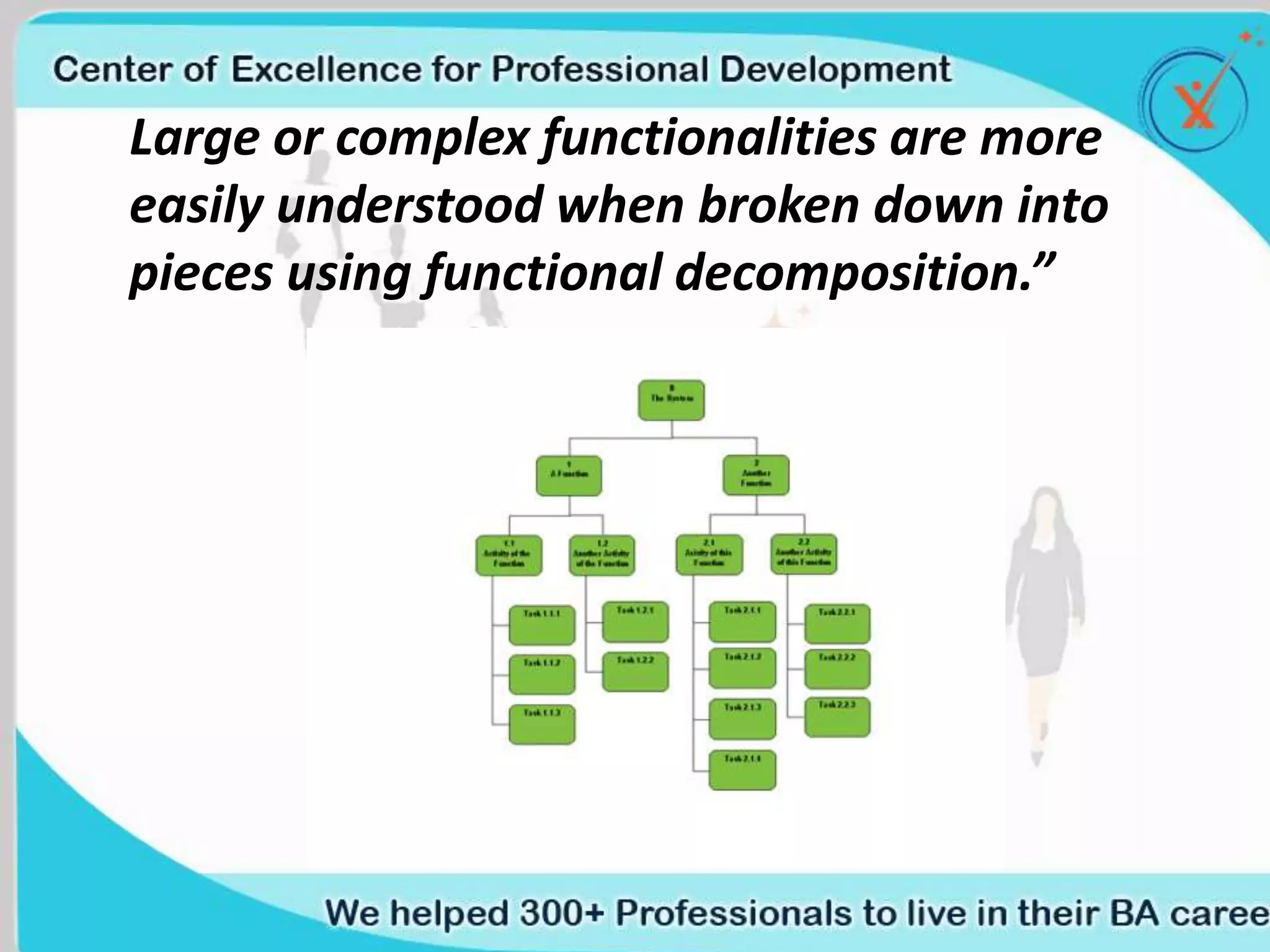
Large or complex functionalities are more
easily understood when broken down into
pieces using functional decomposition.”
When and How
•Functional Decomposition comes into picture
in project requirement analysis phase in order
to produce functional decomposition diagrams
as part of the functional requirements
document.
•After formal discussions with business analysts
and subject matter expertise Functional
Decomposition will be done.
Decompose the components with their
functions from root and continue to
decompose to lower levels until a sufficient
level of detail is achieved.
Perform an end-to-end observation of the
business operation and check each function
to confirm that it is correct.
Functional decomposition

Functional decomposition

  • 1.
    (Professional Business AnalystTraining organisation) Functional Decomposition
  • 2.
    Functional Decomposition: Functional decompositionrelates to the various functional relationships as how the original complex business functions were developed.  It mainly focuses on how the overall functionality is developed and its interaction between various components.
  • 3.
    Functional Decomposition isused to break down the high-level solution scope of a project into its component parts.  Then create a model of what needs to be done to deliver all or part of the solution. Functional decomposition is an outstanding way to break things into manageable pieces and understand the relationships between those pieces.
  • 4.
    Business Analysts useFunctional decomposition technique during the requirements analysis phase of a project to break either an organizational unit or the solution scope into its component parts.  Each outcome may have its own set of requirements.
  • 5.
    Traditional BA (Waterfall)Agile BA Requirements are documented in Use Cases,Business Requirements, Functional requirements, UI Specifications, Business Rules. Requirements are documented in Epics, User Stories and optionally Business (or Essential) Use cases. Focuses on completeness of requirement and spends time in ensuring the requirement is unambiguous and has all the details. Focuses on understanding the problem and being the domain expert so that s/he can answer questions from the development team swiftly and decisively. Focuses on getting a ‘sign off’ on the requirements. Focuses on ensuring the requirements meet the currentbusiness needs, even if it requires updating them. Often there is a wall between the BA/Business and the Development team. Agile BA (Often called as Product Owner) is part of the team. Tends to dictate solutions. Has to remain in the problem domain, leaving the development team ‘space’ to explore different solutions. Long turnaround. Quick turnaround. Focus on what the requirements document said. In other words, output (Artifact) is a well written thorough requirements document. Focus on the functionality of the developed software. In other words, output (Artifact) is the software that meets thebusiness needs. Large or complex functionalities are more easily understood when broken down into pieces using functional decomposition.”
  • 6.
    When and How •FunctionalDecomposition comes into picture in project requirement analysis phase in order to produce functional decomposition diagrams as part of the functional requirements document. •After formal discussions with business analysts and subject matter expertise Functional Decomposition will be done.
  • 7.
    Decompose the componentswith their functions from root and continue to decompose to lower levels until a sufficient level of detail is achieved. Perform an end-to-end observation of the business operation and check each function to confirm that it is correct.