WORK
and the
WORKPLACE
What is Work?
 Physical or mental effort or activity directed toward the
production or accomplishment of something.
 The ability to make use of strengths, knowledge, talents
and skills in useful way. It is both a privilege and a duty.
Paul Glenn (1965)
•Define “work” as man’s effort
applied to the production of goods.
HISTORY OF WORK
• In early Christian tradition work serves as a divine punishment.
• Hunting and gathering of food were the first known activities of human.
• As primitive people found out Agriculture to be more stable and efficient source of
food production.
• The advancement of agriculture tools paved the way for the changes of early
societies and nature of work.
• Division of labor
 Machineries, as instruments of production, enhanced man’s capacity for
work.
 Two social classes emerged
 Working class- workers or paid laborers
 Ruling class- capitalist businessmen, i.e., employers.
 Today Technology allows workers to do more complicated work
 With progress of Education Work become more specialized, performed
with greater skills and expertise.
Tuazon, et al. (1978), gives two
1. mental work-this refers to those types of activities in which remembering,
thinking, reasoning,judging , and other , are utilized.this has reference to our intellect
like teaching accounting, bookkeeping and the like.
2.physical work –this refers to those activities where speed,coordination and
intensity of muscular responses are the concern of the individual. This has reference
to our body and muscles like being a laborer, janitor, construction worker and the like.
THE CLASSIFICATION OF WORK
Antonio Ozaeta (1986) cited by Mison, et al. (1990) in his article.
“strategies in turbulent environment
1.blue-collar or manual workers. These include all those who account for
direct labor costs.
2.knowledge workers. These include
accountants,clerks,tellers,programmers,supervisors and executives
Markin jr (cited by Mison, et al. 1990)
Work is "the utilization of physiological and mental processes
to achieve a goal or accomplish a task"
"Work is a serious adult business that
enables one to get ahead and make a
contribution
ELEMETS OF WORK
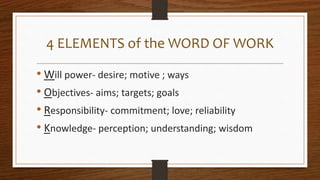
4 ELEMENTS of the WORD OF WORK
• Will power- desire; motive ; ways
• Objectives- aims; targets; goals
• Responsibility- commitment; love; reliability
• Knowledge- perception; understanding; wisdom
WILL POWER
•Is man's faculty which actually
determines his choice and
enables him to make and act
on decision.
OBJECTIVE•Refers to a goal or an intented
purpose, which defines the
scope and direction of the
effort.
RESPONSIBILTY
•Refers to the obligatory duty in
which a person os confined by
reason of his status, roles,
occupation, or assigned task.
3 Main Elements of Responsibility
•COMPLIANCE
•OBEDIENCE
•DEPENDABILITY
KNOWLEDGE
•Is a person's ability to extract the
essence of objects and reflect on
them, to analyze and generalize,
to be creative and be able to think
critically.
DIMENSION
OF WORK
Work in the objective sense refers to the various ways and
processes of achieving a purpose, while work in the
subjective sense refers to the processes whereby man
manifests and conforms himself as one who controls all
mental and physical activities.
Human work has an ethical value because the
one who performs it is a person who is
conscious and free.
WORKPLACE
-It refers to the place of the work
or to the place where work is done.
-Workplace is also called work
environment.
ACTIVITIES
IN THE
WORKPLACE
2 Types
of
Activities
Formal Activities
-Include all acts in the
pursuance of one’s official and
regular duties as an employee
or as a contractor of a service.
Examples:
-Preparing the payroll
-Keeping and maintaining office files
-Encoding or typing official
documents
Non-formal Activities
-As individuals existing in a social
environment, workers and employers also
perform non-formal practice or activities
in conformity to some customary and
tacitly observed practices and codes of
behavior.
Examples:
IN THE PHILIPPINES
-Utang na loob
-Mababang loob
-Pakikisama
THE WORKPLACE
ACROSS NATIONS
AND CULTURES
The Transformation of the Workplace
• The workplace has evolved into complex
economic and social system.
• The transformation of mans
political,economic and social life has resulted
in significant changes in the nature of his
work and how he performs it.
INFORMATION
•One of the remarkable transformations
of the workplace today is the change in
the nature and required skills of
workers,and the nature of the work they
perform.
GENDER•Changes in the economy of
nations across the world have
brought more oppotunities for
women to participate in work.
SAFETY AND INSURANCE
The blessings brought by the
information age are yet to be fully
experienced in workplaces in
developing countries.
PRIVACY
•Advances in technology
allowed employers to directly
monitor the performance of
their employees.
• In the 1970s,married women began entering
the labor force in great numbers.Since men
and women now equally participate in the
workplace,it is inevitable that conflicts
between work and family duties will arise.
THE WORKER
AND THE
EMPLOYER
THE WORKER AND THE EMPLOYER
There are different but interdependent elements that
operate in the workplace. We have the employer,
the worker (i.e, employee) the consumer or the
clientele and the government.
The employee usually the person who provides
work for workers, compensating them in exchange
for their labor or services.
 A worker is usually referred to as a paid laborer, or
broadly, any person who does manual or industrial labor
as a means of livelihood.
 The Labor code of the Philippines includes in its definition
of employee, any individual whose work has ceased as a
result of, or in connection with any current labor dispute,
or because of any unfair labor practice if he has not
obtained any other substantially equivalent and regular
employment.
DUTIES OF
WORKERS AND
EMPLOYERS
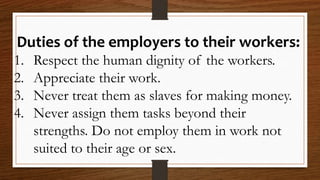
Duties of the employers to their workers:
1. Respect the human dignity of the workers.
2. Appreciate their work.
3. Never treat them as slaves for making money.
4. Never assign them tasks beyond their
strengths. Do not employ them in work not
suited to their age or sex.
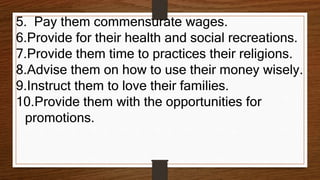
5. Pay them commensurate wages.
6.Provide for their health and social recreations.
7.Provide them time to practices their religions.
8.Advise them on how to use their money wisely.
9.Instruct them to love their families.
10.Provide them with the opportunities for
promotions.
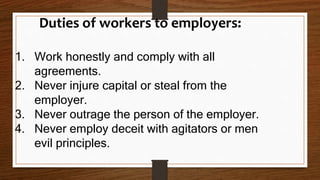
Duties of workers to employers:
1. Work honestly and comply with all
agreements.
2. Never injure capital or steal from the
employer.
3. Never outrage the person of the employer.
4. Never employ deceit with agitators or men
evil principles.
DISPUTE AND
DISAGREEMENT IN THE
WORKPLACE
Dispute & Agreement
Disagreements in the workplace are
inevitable as both workers and employers
bring with them their differing , and
oftentimes, conflicting expectations, interest,
values and attitudes to the workplace.
Causes of disputes
• Wage and salary that are not fair and commensurate to the
difficulty of the job and the responsibilities inherent to it.
•Poor working condition.
•Unreasonable personnel policy.
•Lack of job security and stability of
employment.
• Lack of opportunity for advancement
and self-improvement.
•Inconsiderate supervisors or
managers.
POSSIBILITY
FOR
COOPERATION
•The middle ground is the
possibility of one party
pursuing its interest without
necessarily hampering the
other party from pursuing its
own . Some believe that the
"wrongful" presumption of
conflict between the interests
of employers and workers have
resulted in their gladiatorial
relationship.
DISAGREEMENT
AMONG WORKERS
Here are some of them
Loud and irritating mobile phone rings
Outdated or inadequate functioning equipment
Job jockeying
Body odor and bad breath
Colleagues who do not change an empty toilet roll
Colleagues who arrive late and leave early
Know-it-all colleagues who do no wrong
Colleagues who do not reload paper trays or fix jams in the printer or copier
Messages taken down incorrectly
Taking items from your desk without asking
Thank you !!
Work and the workplace

Work and the workplace

  • 1.
  • 2.
    What is Work? Physical or mental effort or activity directed toward the production or accomplishment of something.  The ability to make use of strengths, knowledge, talents and skills in useful way. It is both a privilege and a duty.
  • 3.
    Paul Glenn (1965) •Define“work” as man’s effort applied to the production of goods.
  • 4.
    HISTORY OF WORK •In early Christian tradition work serves as a divine punishment. • Hunting and gathering of food were the first known activities of human. • As primitive people found out Agriculture to be more stable and efficient source of food production. • The advancement of agriculture tools paved the way for the changes of early societies and nature of work. • Division of labor
  • 5.
     Machineries, asinstruments of production, enhanced man’s capacity for work.  Two social classes emerged  Working class- workers or paid laborers  Ruling class- capitalist businessmen, i.e., employers.  Today Technology allows workers to do more complicated work  With progress of Education Work become more specialized, performed with greater skills and expertise.
  • 6.
    Tuazon, et al.(1978), gives two 1. mental work-this refers to those types of activities in which remembering, thinking, reasoning,judging , and other , are utilized.this has reference to our intellect like teaching accounting, bookkeeping and the like. 2.physical work –this refers to those activities where speed,coordination and intensity of muscular responses are the concern of the individual. This has reference to our body and muscles like being a laborer, janitor, construction worker and the like. THE CLASSIFICATION OF WORK
  • 7.
    Antonio Ozaeta (1986)cited by Mison, et al. (1990) in his article. “strategies in turbulent environment 1.blue-collar or manual workers. These include all those who account for direct labor costs. 2.knowledge workers. These include accountants,clerks,tellers,programmers,supervisors and executives
  • 8.
    Markin jr (citedby Mison, et al. 1990) Work is "the utilization of physiological and mental processes to achieve a goal or accomplish a task" "Work is a serious adult business that enables one to get ahead and make a contribution ELEMETS OF WORK
  • 9.
    4 ELEMENTS ofthe WORD OF WORK • Will power- desire; motive ; ways • Objectives- aims; targets; goals • Responsibility- commitment; love; reliability • Knowledge- perception; understanding; wisdom
  • 10.
    WILL POWER •Is man'sfaculty which actually determines his choice and enables him to make and act on decision.
  • 11.
    OBJECTIVE•Refers to agoal or an intented purpose, which defines the scope and direction of the effort.
  • 12.
    RESPONSIBILTY •Refers to theobligatory duty in which a person os confined by reason of his status, roles, occupation, or assigned task.
  • 13.
    3 Main Elementsof Responsibility •COMPLIANCE •OBEDIENCE •DEPENDABILITY
  • 14.
    KNOWLEDGE •Is a person'sability to extract the essence of objects and reflect on them, to analyze and generalize, to be creative and be able to think critically.
  • 15.
  • 16.
    Work in theobjective sense refers to the various ways and processes of achieving a purpose, while work in the subjective sense refers to the processes whereby man manifests and conforms himself as one who controls all mental and physical activities. Human work has an ethical value because the one who performs it is a person who is conscious and free.
  • 17.
    WORKPLACE -It refers tothe place of the work or to the place where work is done. -Workplace is also called work environment.
  • 18.
  • 19.
  • 20.
    Formal Activities -Include allacts in the pursuance of one’s official and regular duties as an employee or as a contractor of a service.
  • 21.
    Examples: -Preparing the payroll -Keepingand maintaining office files -Encoding or typing official documents
  • 22.
    Non-formal Activities -As individualsexisting in a social environment, workers and employers also perform non-formal practice or activities in conformity to some customary and tacitly observed practices and codes of behavior.
  • 23.
    Examples: IN THE PHILIPPINES -Utangna loob -Mababang loob -Pakikisama
  • 24.
  • 25.
    The Transformation ofthe Workplace • The workplace has evolved into complex economic and social system. • The transformation of mans political,economic and social life has resulted in significant changes in the nature of his work and how he performs it.
  • 26.
    INFORMATION •One of theremarkable transformations of the workplace today is the change in the nature and required skills of workers,and the nature of the work they perform.
  • 27.
    GENDER•Changes in theeconomy of nations across the world have brought more oppotunities for women to participate in work.
  • 28.
    SAFETY AND INSURANCE Theblessings brought by the information age are yet to be fully experienced in workplaces in developing countries.
  • 29.
    PRIVACY •Advances in technology allowedemployers to directly monitor the performance of their employees.
  • 30.
    • In the1970s,married women began entering the labor force in great numbers.Since men and women now equally participate in the workplace,it is inevitable that conflicts between work and family duties will arise.
  • 31.
  • 32.
    THE WORKER ANDTHE EMPLOYER There are different but interdependent elements that operate in the workplace. We have the employer, the worker (i.e, employee) the consumer or the clientele and the government. The employee usually the person who provides work for workers, compensating them in exchange for their labor or services.
  • 33.
     A workeris usually referred to as a paid laborer, or broadly, any person who does manual or industrial labor as a means of livelihood.  The Labor code of the Philippines includes in its definition of employee, any individual whose work has ceased as a result of, or in connection with any current labor dispute, or because of any unfair labor practice if he has not obtained any other substantially equivalent and regular employment.
  • 34.
  • 35.
    Duties of theemployers to their workers: 1. Respect the human dignity of the workers. 2. Appreciate their work. 3. Never treat them as slaves for making money. 4. Never assign them tasks beyond their strengths. Do not employ them in work not suited to their age or sex.
  • 36.
    5. Pay themcommensurate wages. 6.Provide for their health and social recreations. 7.Provide them time to practices their religions. 8.Advise them on how to use their money wisely. 9.Instruct them to love their families. 10.Provide them with the opportunities for promotions.
  • 37.
    Duties of workersto employers: 1. Work honestly and comply with all agreements. 2. Never injure capital or steal from the employer. 3. Never outrage the person of the employer. 4. Never employ deceit with agitators or men evil principles.
  • 38.
  • 39.
    Dispute & Agreement Disagreementsin the workplace are inevitable as both workers and employers bring with them their differing , and oftentimes, conflicting expectations, interest, values and attitudes to the workplace.
  • 40.
    Causes of disputes •Wage and salary that are not fair and commensurate to the difficulty of the job and the responsibilities inherent to it.
  • 41.
  • 42.
  • 43.
    •Lack of jobsecurity and stability of employment.
  • 44.
    • Lack ofopportunity for advancement and self-improvement.
  • 45.
  • 46.
  • 47.
    •The middle groundis the possibility of one party pursuing its interest without necessarily hampering the other party from pursuing its own . Some believe that the "wrongful" presumption of conflict between the interests of employers and workers have resulted in their gladiatorial relationship.
  • 48.
    DISAGREEMENT AMONG WORKERS Here aresome of them Loud and irritating mobile phone rings Outdated or inadequate functioning equipment Job jockeying Body odor and bad breath Colleagues who do not change an empty toilet roll Colleagues who arrive late and leave early Know-it-all colleagues who do no wrong Colleagues who do not reload paper trays or fix jams in the printer or copier Messages taken down incorrectly Taking items from your desk without asking
  • 49.