WHAT WE KNOW ABOUT
WORK, WORKING, AND WORKER
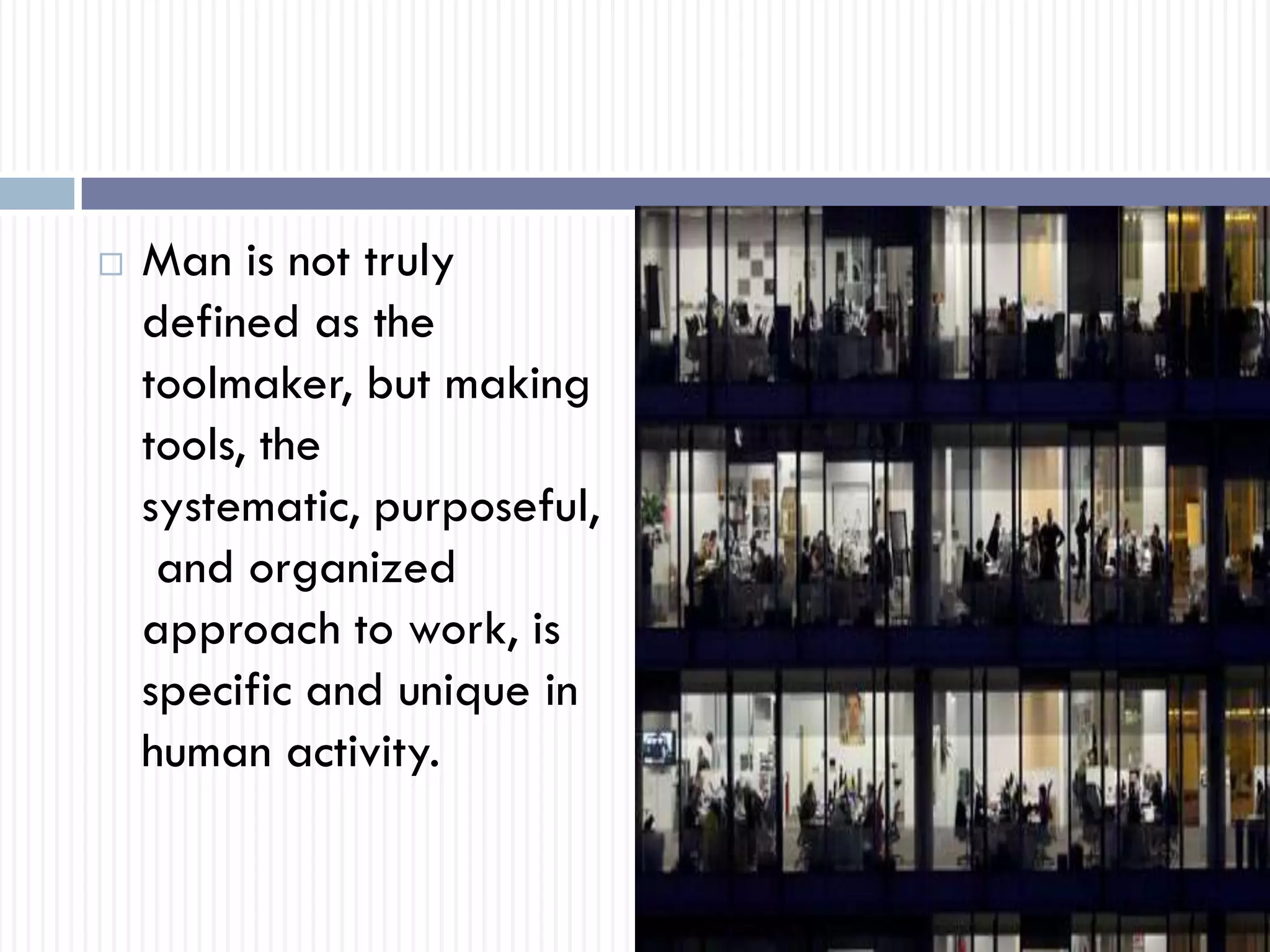
 Man is not truly
defined as the
toolmaker, but making
tools, the
systematic, purposeful,
and organized
approach to work, is
specific and unique in
human activity.
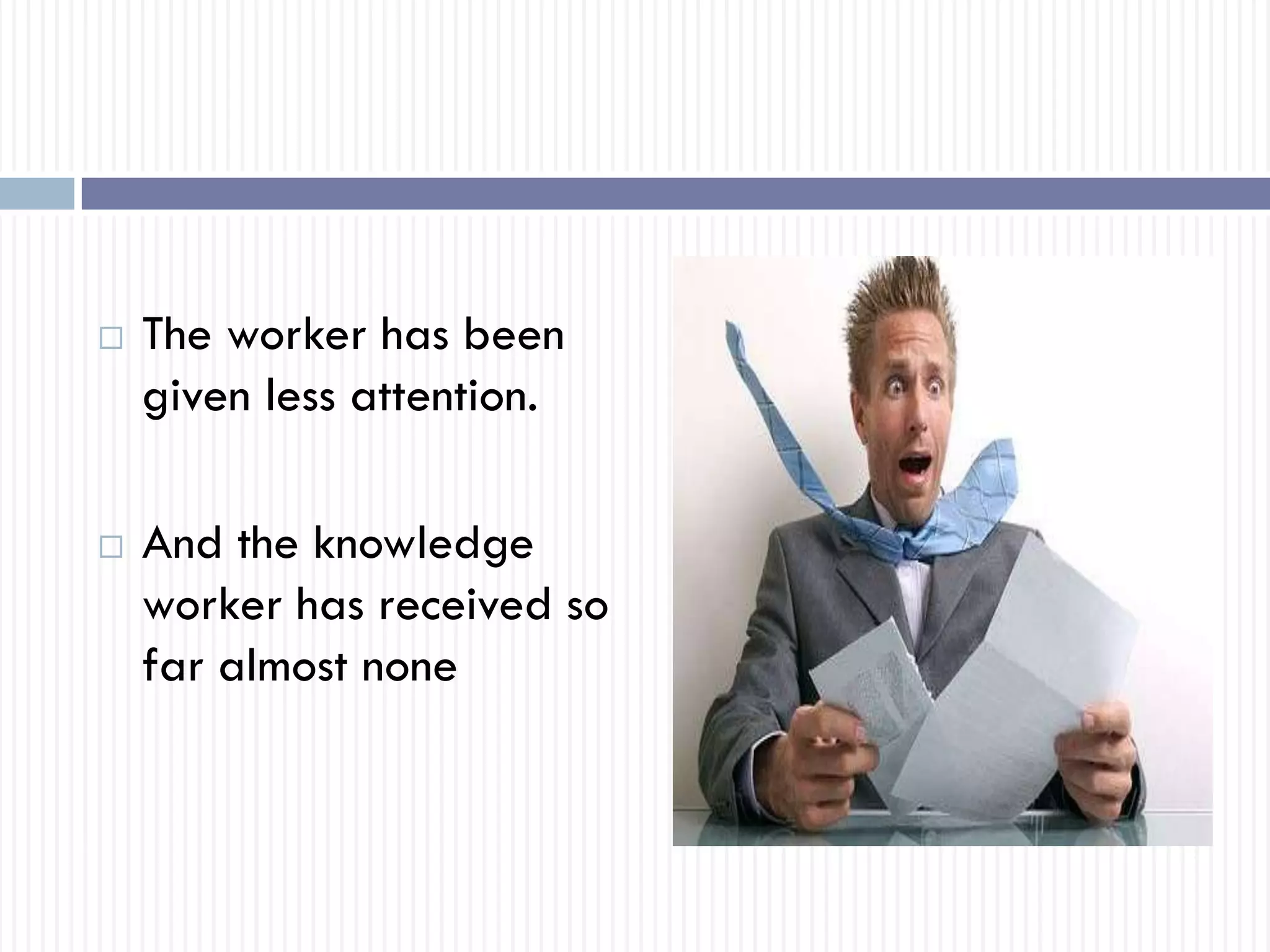
 The worker has been
given less attention.
 And the knowledge
worker has received so
far almost none
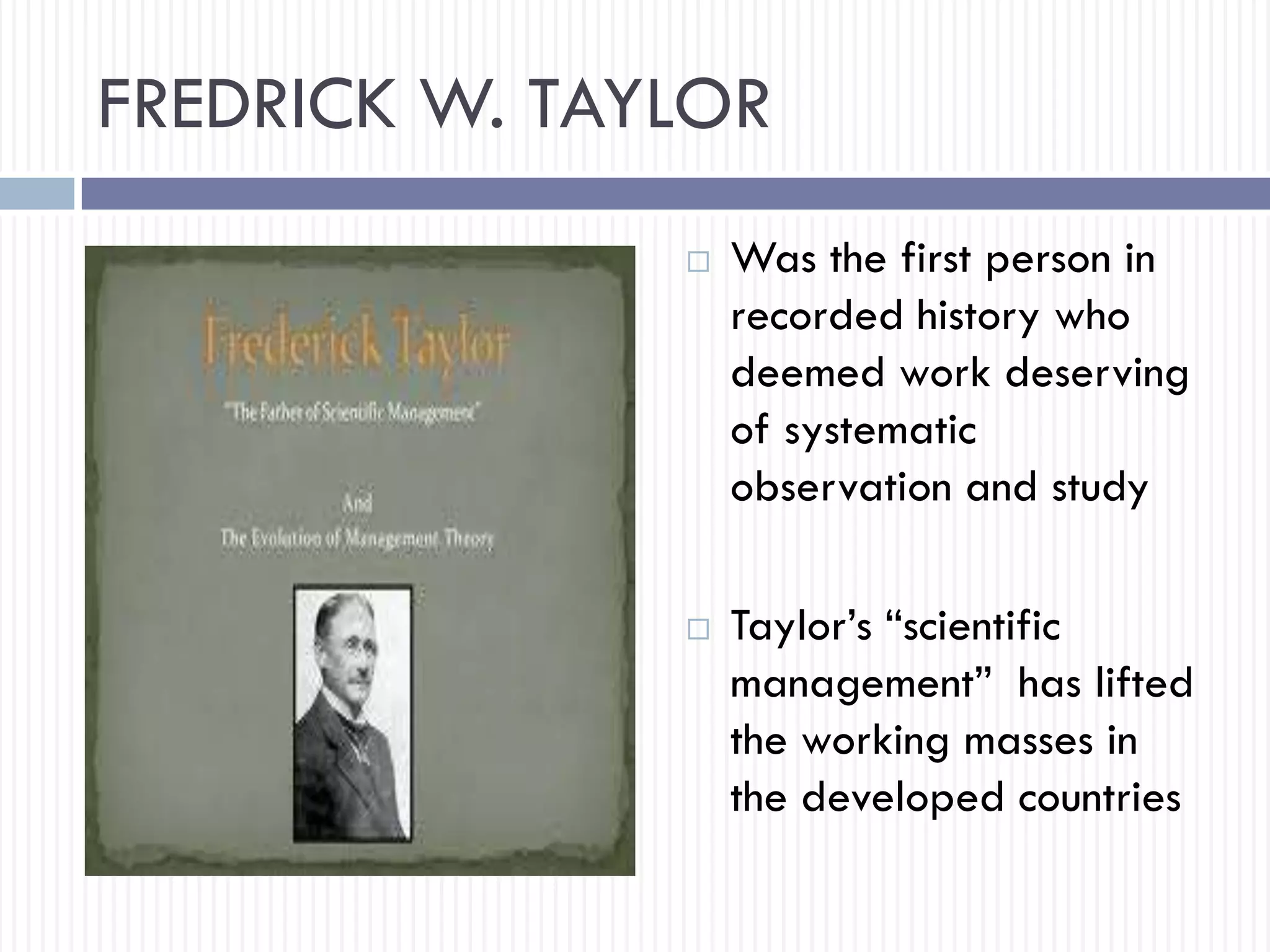
FREDRICK W. TAYLOR
 Was the first person in
recorded history who
deemed work deserving
of systematic
observation and study
 Taylor’s “scientific
management” has lifted
the working masses in
the developed countries
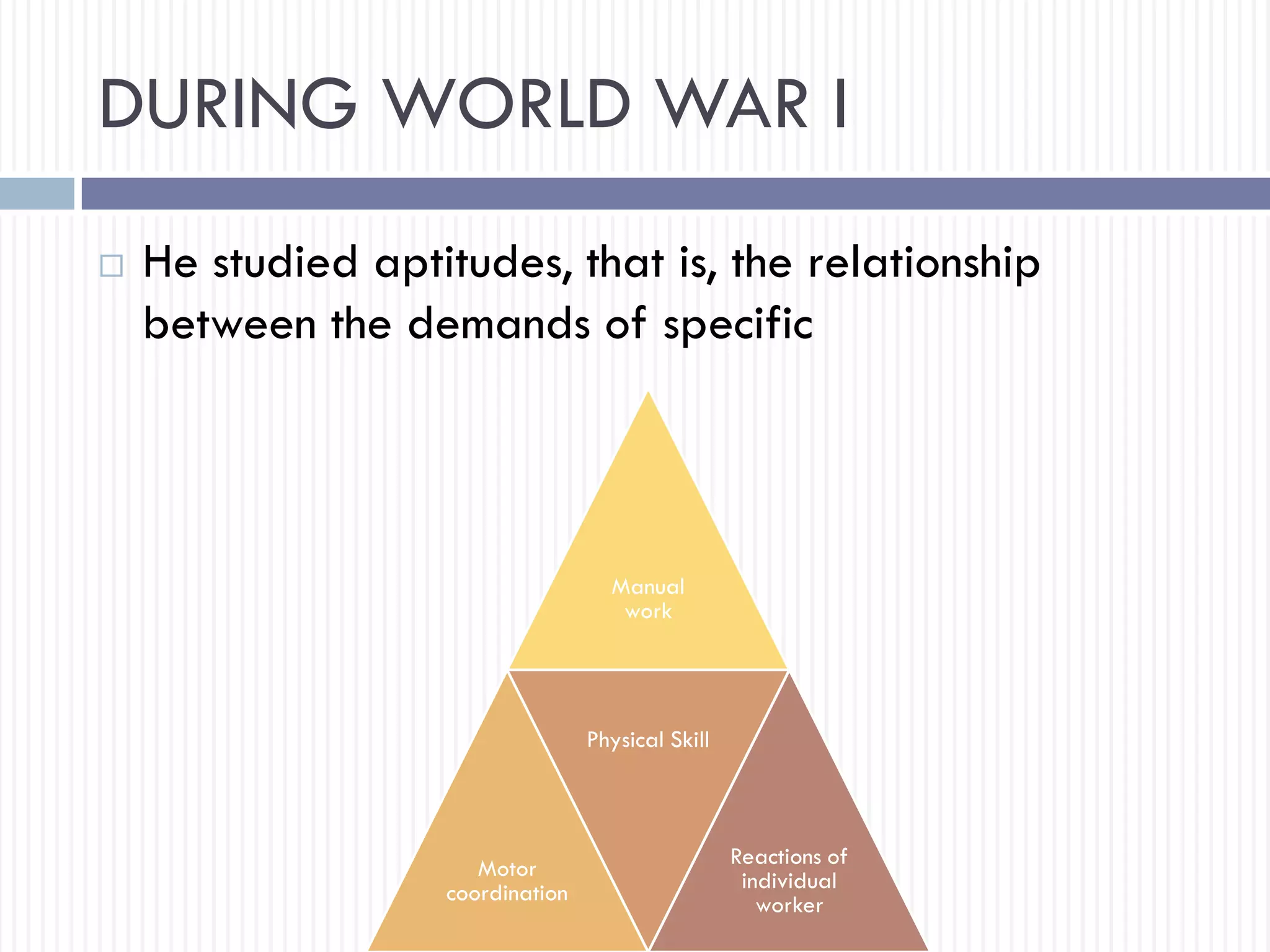
DURING WORLD WAR I
 He studied aptitudes, that is, the relationship
between the demands of specific
Manual
work
Motor
coordination
Physical Skill
Reactions of
individual
worker
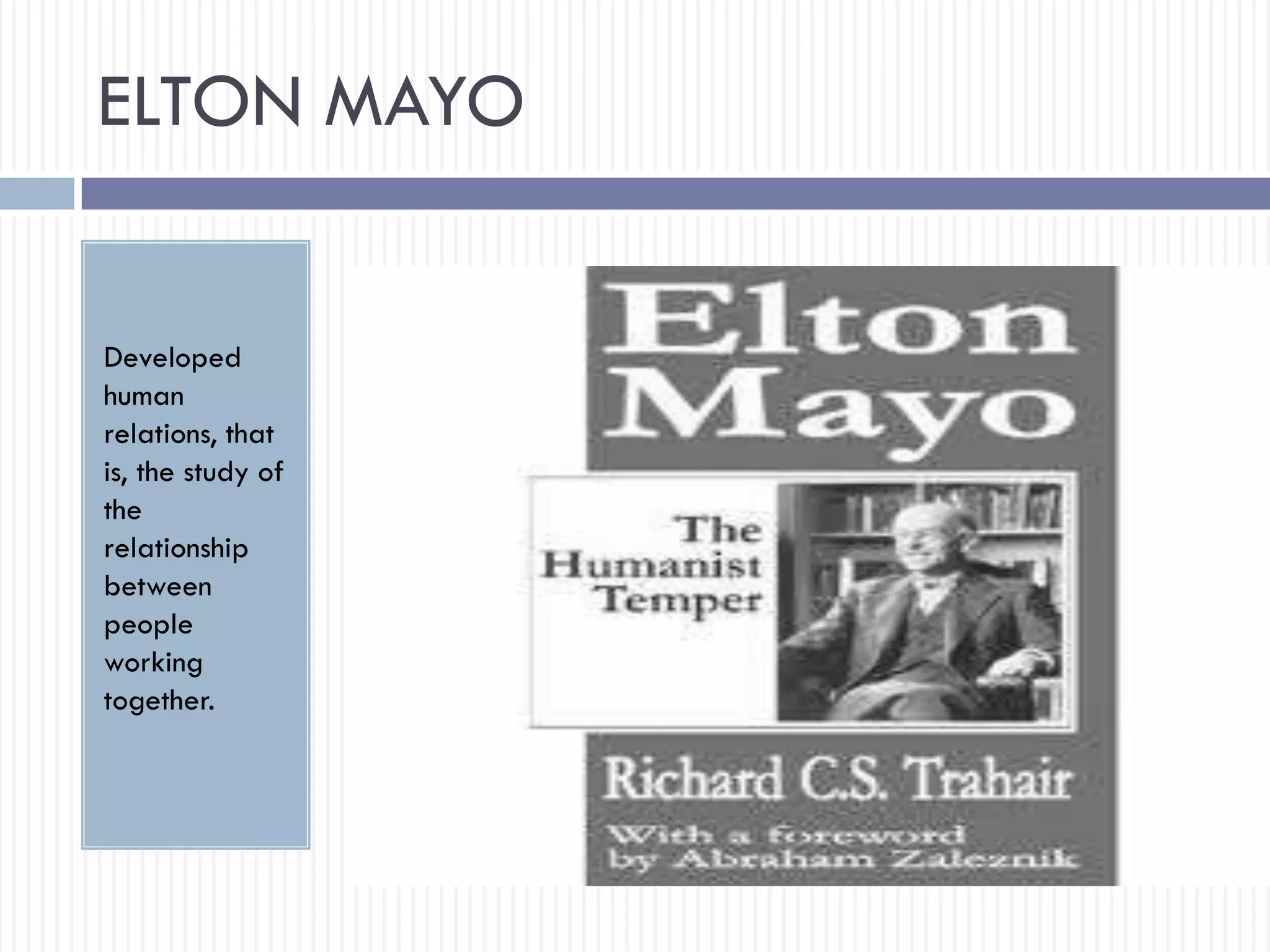
ELTON MAYO
Developed
human
relations, that
is, the study of
the
relationship
between
people
working
together.
THE TOTALITY OF
 Worker and Working
 Task and Job
 Perception and Personality
 Work community, Rewards and Power Relations.
 HAS RECEIVED PRACTICALLY NO ATTENTION
 The Manager cannot wait till the scientists and
scholars have done their work.
 The Manager has to try to make work productive
and the worker achieving.
 It might, therefore be appropriate to put down what
we know about work and working.
ANALYSIS, SYNTHESIS, AND CONTROL
 The most important thing we know is that work and
working are fundamentally different phenomena.
 But what is needed to make work
productive is quite different from
what is needed to make the
worker achieving.
 The worker must, therefore, be
managed according to both the
logic of the work and the
dynamics of working.
 Personal satisfaction of the
worker without productive work is
failure.
WHAT IS WORK
 Work is impersonal and
objective.
 Work is a task.
 It is a “something”.
 Work has logic.
 It requires
analysis, synthesis, and
control.
 The first step toward understanding work is to
analyze it.
 Taylor realised a century ago, means identifying the
basic operations, analyzing each of them, and
arranging them in logical, balanced, and rational
sequence.
PRINCIPLES OF PRODUCTION
 Put together individual
operations into
individual jobs, and
individual jobs into
“production.”
GANTT CHART (1861-1919)
 Gantt Chart tells us very little about the logic that is
appropriate to given kinds of processes.
 The output of the knowledge worker always
becomes somebody else’s input
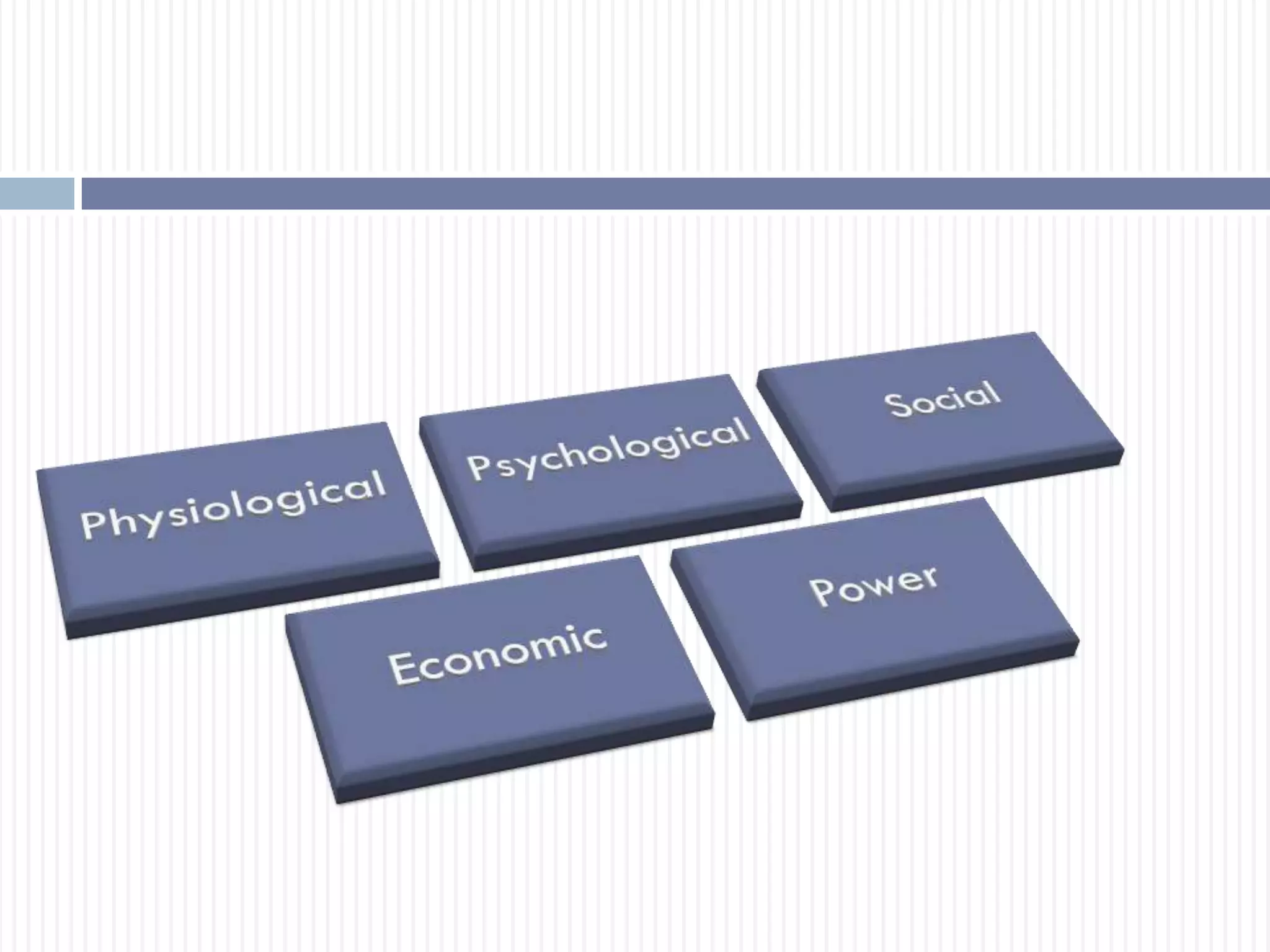
FIVE DIMENSIONS OF WORKING
 Working is the activity of the worker; it is human
being’s activity and an essential part of humanity.
 It does not have logic.
 It has dynamics and dimensions.
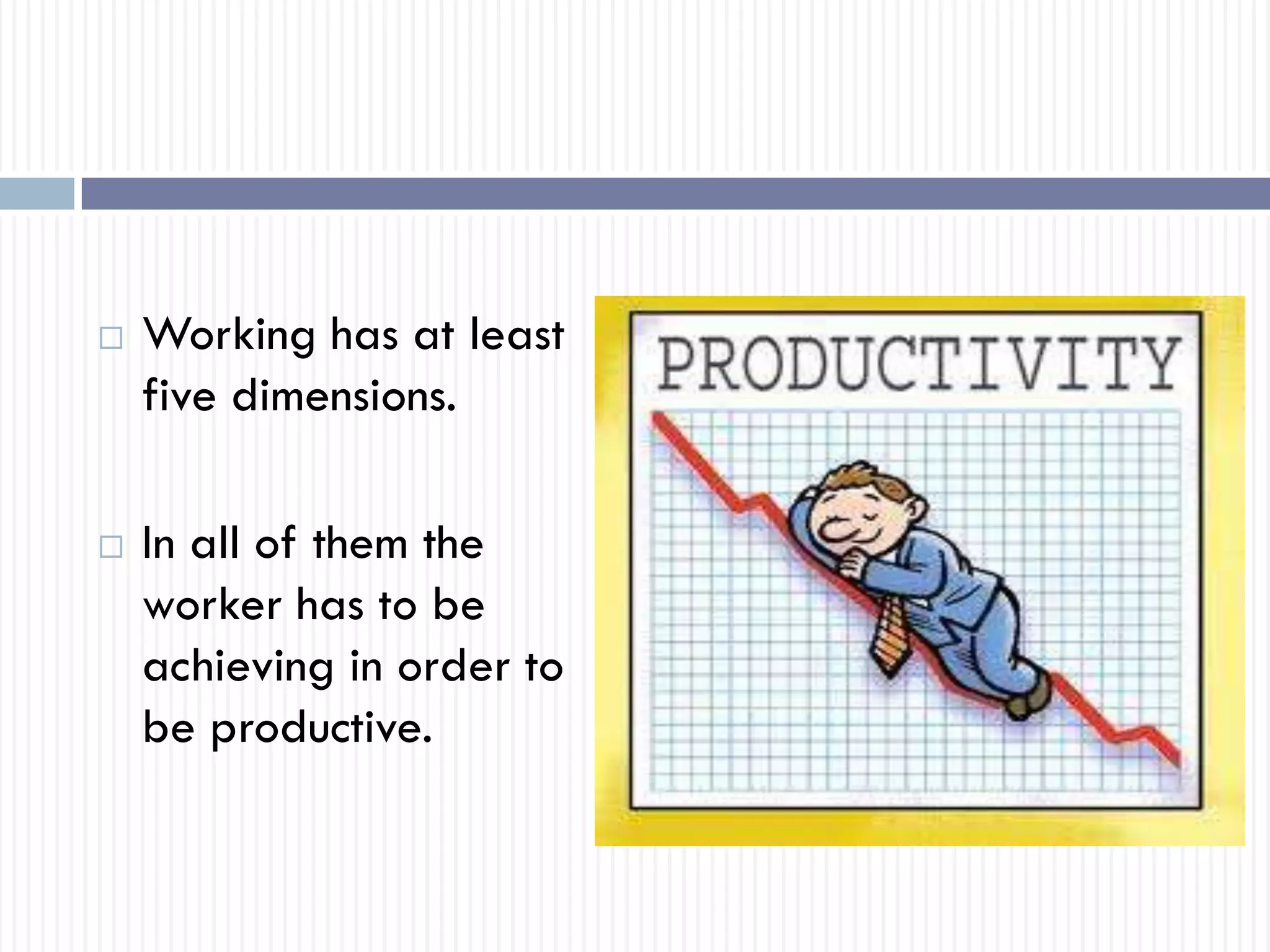
 Working has at least
five dimensions.
 In all of them the
worker has to be
achieving in order to
be productive.
Physiological Dimension
 The human being is not a machine and does not
work like a machine.
 Machines work best if they do only one task.
 Complex tasks are done best as a step-by-step
series of simple tasks in which the work shifts from
machine to machine
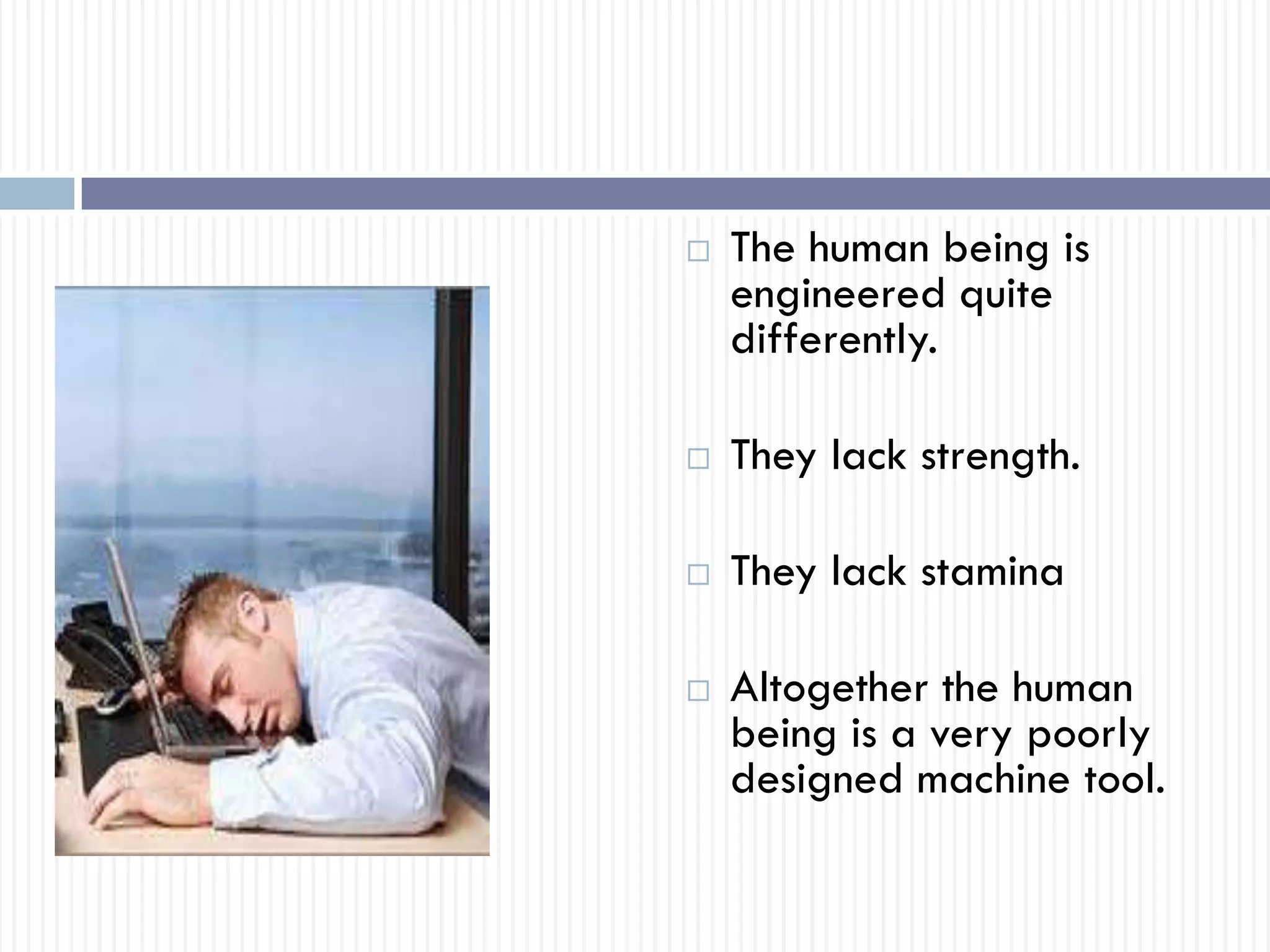
 The human being is
engineered quite
differently.
 They lack strength.
 They lack stamina
 Altogether the human
being is a very poorly
designed machine tool.
 Machines work best if run at the same speed, the
same rhythm, and with a minimum of moving parts
 There is no “one right” speed and n “one right”
rhythm for human beings.
 Speed, rhythm, and attention span vary greatly
among individuals
Psychological Dimension
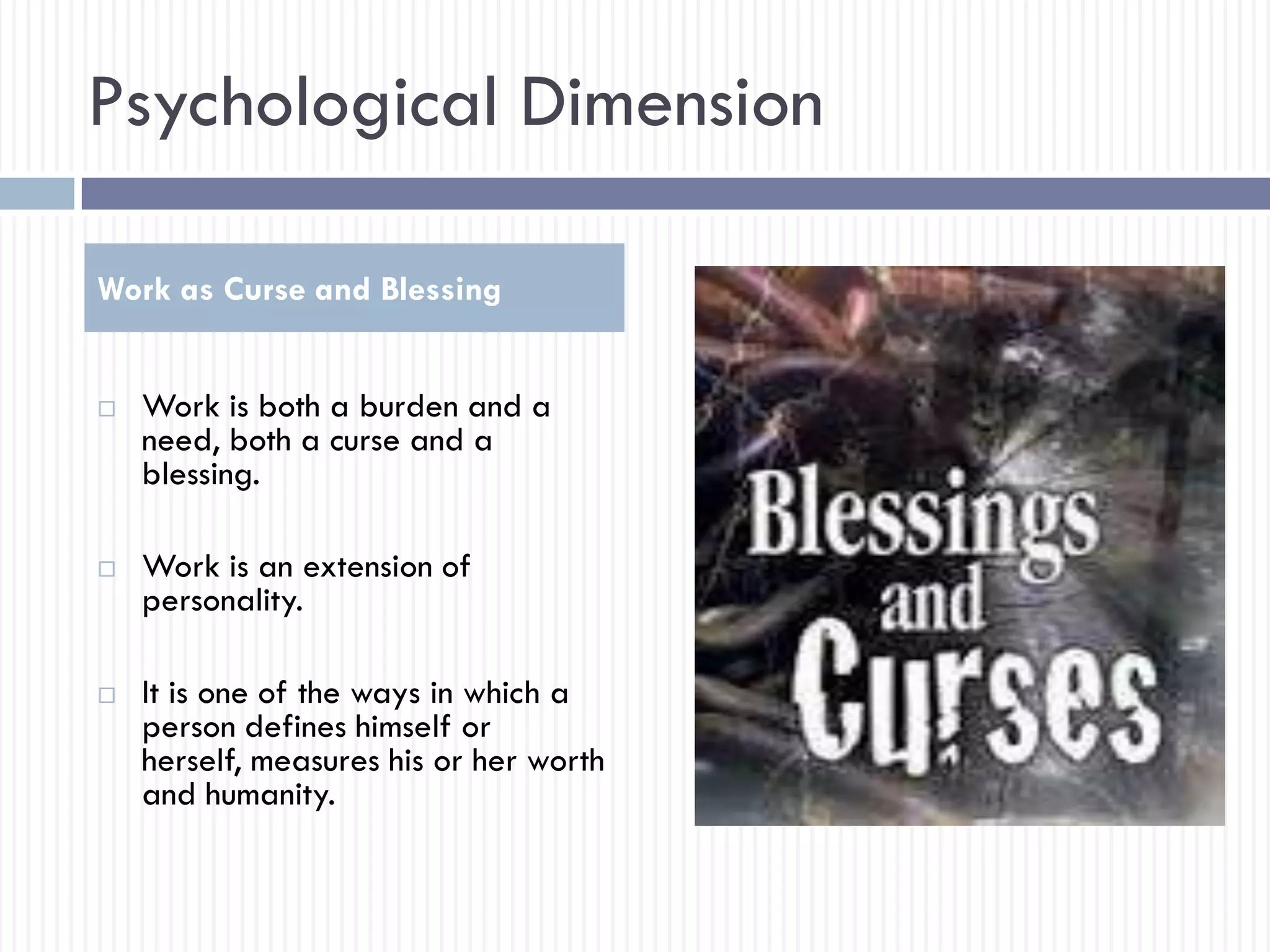
 Work is both a burden and a
need, both a curse and a
blessing.
 Work is an extension of
personality.
 It is one of the ways in which a
person defines himself or
herself, measures his or her worth
and humanity.
Work as Curse and Blessing
Psychological Dimension
 It largely determines status.
 Work has been the means to satisfy our need for
belonging to a group and for a meaningful
relationship to others.
Work as Social and Community Bond
 Work is for most people the one bond outside of
their own narrow family.
 The work place becomes their community, their
social club, their means of escaping loneliness, with
their husbands at their own jobs and the children
gone.
Economic Dimension
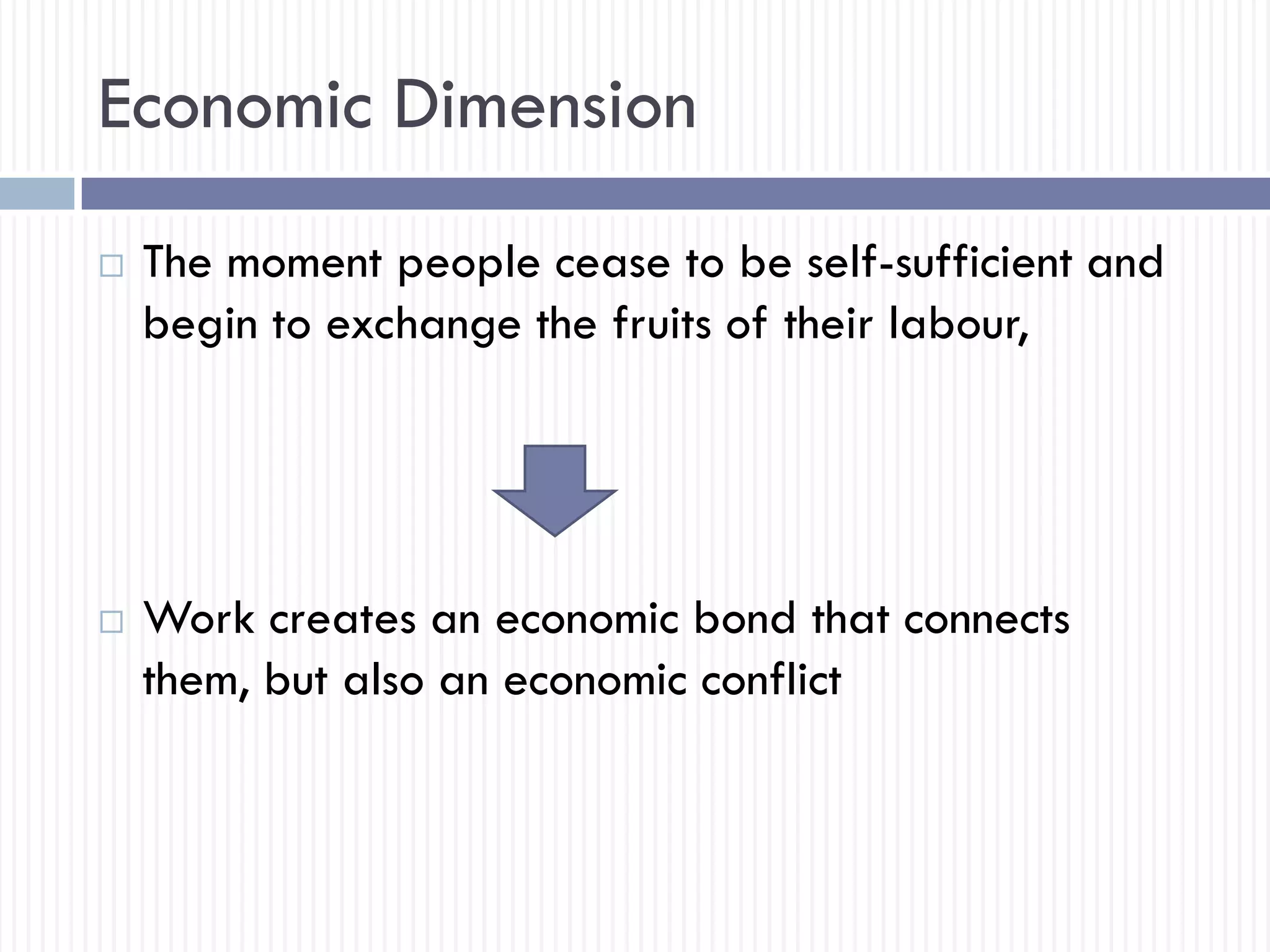
 The moment people cease to be self-sufficient and
begin to exchange the fruits of their labour,
 Work creates an economic bond that connects
them, but also an economic conflict
 There is no resolution to this
conflict.
 One has to live with it.
 The workers needs more than
anyone else, to be protected
against the risk of uncertainty.
 The worker, more than anyone
else, needs the jobs of
tomorrow.
WORK AS LIVING AND WORK AS
WAGE
 There is even more fundamental conflict between
wage as living and wage as cost.
 As “living”, wage needs to be
predictable, continuous, and adequate to the
expenditures of a family, its aspirations, and its
position in society and community..
 As “costs,” wage needs to be appropriate to the
productivity of a given employment or industry.
 America has socialized ownership without
nationalizing it.
 This has by no means resolved or even lessened the
conflict between wage fund and capital fund &
between wage as living and wage as cost.
Power Dimension of Working &
Economics
 People are promoted or
not promoted.
 Authority is an essential
dimension of work.
 Power relationships
which may affect
everybody directly & in
his or her capacity as a
worker
 A need for authority
with respect to economic
shares.
 There has to be a
redistribution and an
authority to make the
redistribution decisions.
THE FALLACY OF THE DOMINANT
DIMENSION
 Each dimension of working are separate.
 Each should be analyzed separately and
independently.
 But they always exist together in the worker’s
relationship to work and job, fellow workers and
management.
 Marx and most other economists saw the economic
dimension as dominating everything else.
 Elton Mayo to give other radically different
example, saw the dominant dimension as the
interpersonal relations within the work group i.e in
psychological & social aspects
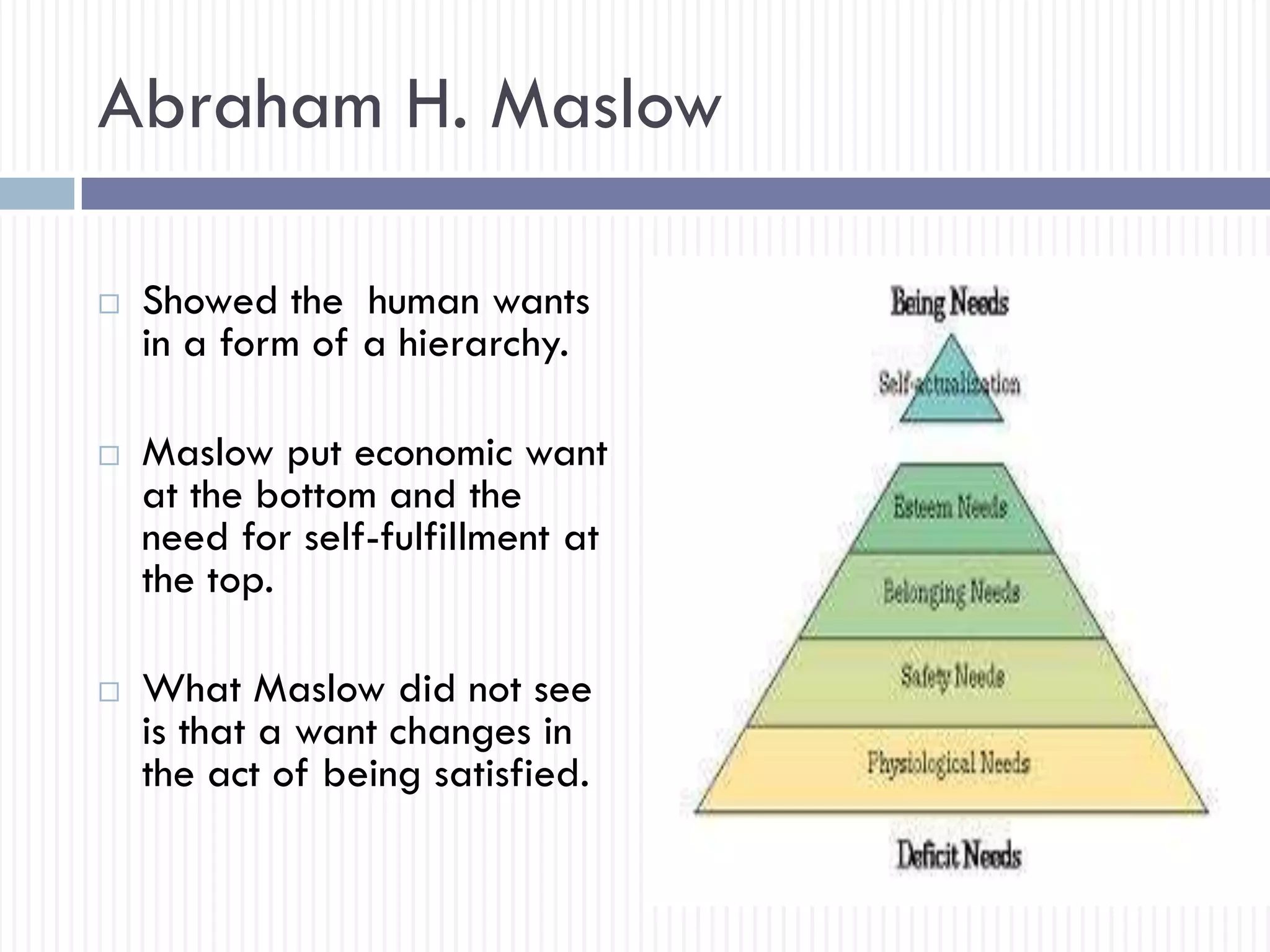
Abraham H. Maslow
 Showed the human wants
in a form of a hierarchy.
 Maslow put economic want
at the bottom and the
need for self-fulfillment at
the top.
 What Maslow did not see
is that a want changes in
the act of being satisfied.
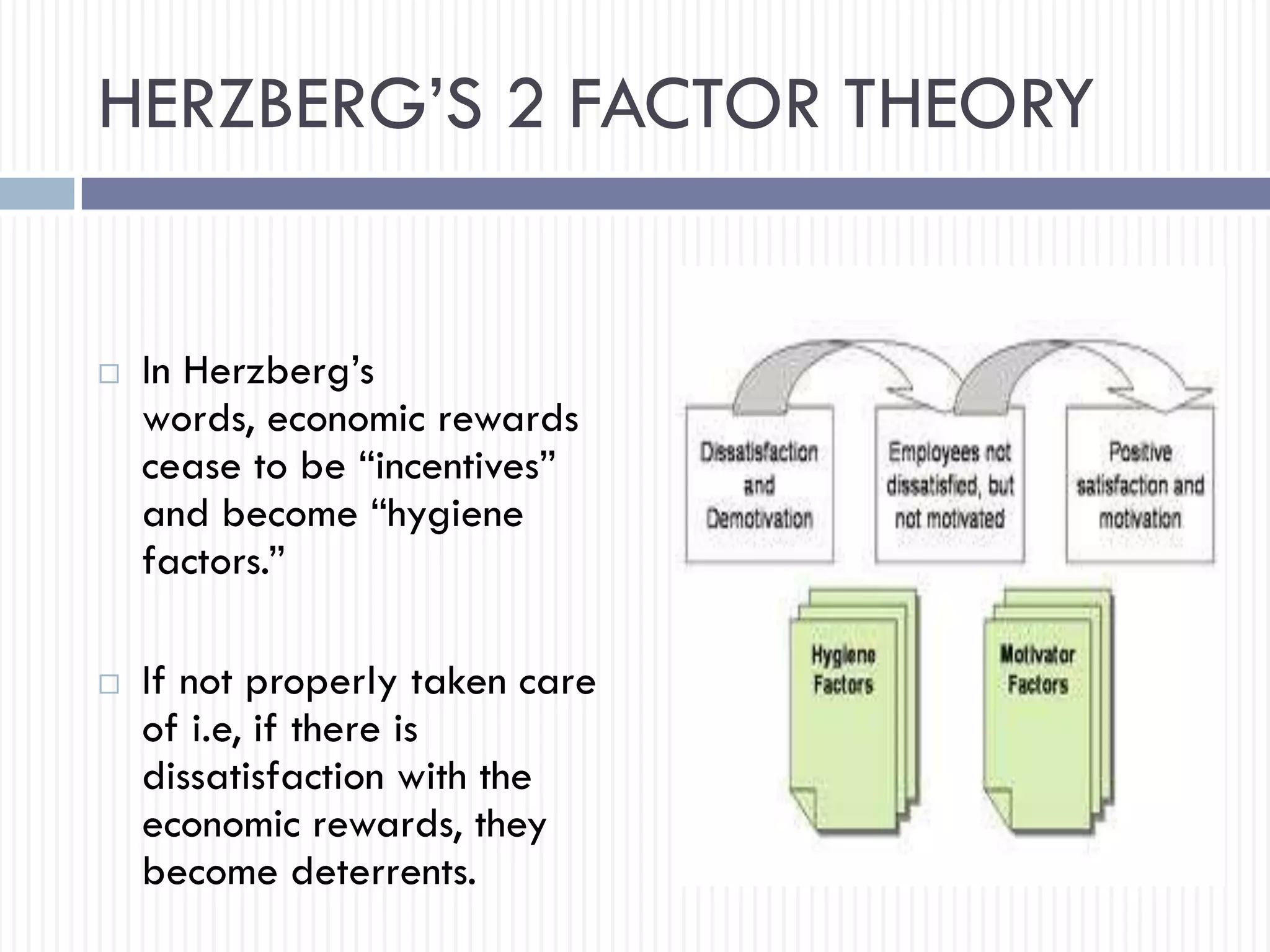
HERZBERG’S 2 FACTOR THEORY
 In Herzberg’s
words, economic rewards
cease to be “incentives”
and become “hygiene
factors.”
 If not properly taken care
of i.e, if there is
dissatisfaction with the
economic rewards, they
become deterrents.
 Nevertheless, managers have to manage now.
 They have to understand what the demands are.
 They will have to develop new approaches, new
principles, and new methods and fast.
MEGHA THAKKAR

What we know about work, working,

  • 1.
    WHAT WE KNOWABOUT WORK, WORKING, AND WORKER
  • 2.
     Man isnot truly defined as the toolmaker, but making tools, the systematic, purposeful, and organized approach to work, is specific and unique in human activity.
  • 3.
     The workerhas been given less attention.  And the knowledge worker has received so far almost none
  • 4.
    FREDRICK W. TAYLOR Was the first person in recorded history who deemed work deserving of systematic observation and study  Taylor’s “scientific management” has lifted the working masses in the developed countries
  • 5.
    DURING WORLD WARI  He studied aptitudes, that is, the relationship between the demands of specific Manual work Motor coordination Physical Skill Reactions of individual worker
  • 6.
    ELTON MAYO Developed human relations, that is,the study of the relationship between people working together.
  • 7.
    THE TOTALITY OF Worker and Working  Task and Job  Perception and Personality  Work community, Rewards and Power Relations.  HAS RECEIVED PRACTICALLY NO ATTENTION
  • 8.
     The Managercannot wait till the scientists and scholars have done their work.  The Manager has to try to make work productive and the worker achieving.  It might, therefore be appropriate to put down what we know about work and working.
  • 9.
    ANALYSIS, SYNTHESIS, ANDCONTROL  The most important thing we know is that work and working are fundamentally different phenomena.
  • 10.
     But whatis needed to make work productive is quite different from what is needed to make the worker achieving.  The worker must, therefore, be managed according to both the logic of the work and the dynamics of working.  Personal satisfaction of the worker without productive work is failure.
  • 11.
    WHAT IS WORK Work is impersonal and objective.  Work is a task.  It is a “something”.  Work has logic.  It requires analysis, synthesis, and control.
  • 12.
     The firststep toward understanding work is to analyze it.  Taylor realised a century ago, means identifying the basic operations, analyzing each of them, and arranging them in logical, balanced, and rational sequence.
  • 13.
    PRINCIPLES OF PRODUCTION Put together individual operations into individual jobs, and individual jobs into “production.”
  • 14.
    GANTT CHART (1861-1919) Gantt Chart tells us very little about the logic that is appropriate to given kinds of processes.  The output of the knowledge worker always becomes somebody else’s input
  • 15.
    FIVE DIMENSIONS OFWORKING  Working is the activity of the worker; it is human being’s activity and an essential part of humanity.  It does not have logic.  It has dynamics and dimensions.
  • 16.
     Working hasat least five dimensions.  In all of them the worker has to be achieving in order to be productive.
  • 18.
    Physiological Dimension  Thehuman being is not a machine and does not work like a machine.  Machines work best if they do only one task.  Complex tasks are done best as a step-by-step series of simple tasks in which the work shifts from machine to machine
  • 19.
     The humanbeing is engineered quite differently.  They lack strength.  They lack stamina  Altogether the human being is a very poorly designed machine tool.
  • 20.
     Machines workbest if run at the same speed, the same rhythm, and with a minimum of moving parts  There is no “one right” speed and n “one right” rhythm for human beings.  Speed, rhythm, and attention span vary greatly among individuals
  • 21.
    Psychological Dimension  Workis both a burden and a need, both a curse and a blessing.  Work is an extension of personality.  It is one of the ways in which a person defines himself or herself, measures his or her worth and humanity. Work as Curse and Blessing
  • 22.
    Psychological Dimension  Itlargely determines status.  Work has been the means to satisfy our need for belonging to a group and for a meaningful relationship to others. Work as Social and Community Bond
  • 23.
     Work isfor most people the one bond outside of their own narrow family.  The work place becomes their community, their social club, their means of escaping loneliness, with their husbands at their own jobs and the children gone.
  • 24.
    Economic Dimension  Themoment people cease to be self-sufficient and begin to exchange the fruits of their labour,  Work creates an economic bond that connects them, but also an economic conflict
  • 25.
     There isno resolution to this conflict.  One has to live with it.  The workers needs more than anyone else, to be protected against the risk of uncertainty.  The worker, more than anyone else, needs the jobs of tomorrow.
  • 26.
    WORK AS LIVINGAND WORK AS WAGE  There is even more fundamental conflict between wage as living and wage as cost.  As “living”, wage needs to be predictable, continuous, and adequate to the expenditures of a family, its aspirations, and its position in society and community..
  • 27.
     As “costs,”wage needs to be appropriate to the productivity of a given employment or industry.  America has socialized ownership without nationalizing it.  This has by no means resolved or even lessened the conflict between wage fund and capital fund & between wage as living and wage as cost.
  • 28.
    Power Dimension ofWorking & Economics  People are promoted or not promoted.  Authority is an essential dimension of work.  Power relationships which may affect everybody directly & in his or her capacity as a worker  A need for authority with respect to economic shares.  There has to be a redistribution and an authority to make the redistribution decisions.
  • 29.
    THE FALLACY OFTHE DOMINANT DIMENSION  Each dimension of working are separate.  Each should be analyzed separately and independently.  But they always exist together in the worker’s relationship to work and job, fellow workers and management.
  • 30.
     Marx andmost other economists saw the economic dimension as dominating everything else.  Elton Mayo to give other radically different example, saw the dominant dimension as the interpersonal relations within the work group i.e in psychological & social aspects
  • 31.
    Abraham H. Maslow Showed the human wants in a form of a hierarchy.  Maslow put economic want at the bottom and the need for self-fulfillment at the top.  What Maslow did not see is that a want changes in the act of being satisfied.
  • 32.
    HERZBERG’S 2 FACTORTHEORY  In Herzberg’s words, economic rewards cease to be “incentives” and become “hygiene factors.”  If not properly taken care of i.e, if there is dissatisfaction with the economic rewards, they become deterrents.
  • 33.
     Nevertheless, managershave to manage now.  They have to understand what the demands are.  They will have to develop new approaches, new principles, and new methods and fast.
  • 34.