


1 Kayce Joy L. Saliendrez
Word formation
 Creating entirely new words .
 Etymology
 Clipping
 Acronym
2
Kayce Joy L. Saliendrez
Etymology
 is the study of the history of words, their
origins, and how their form
and meaning have changed over time.
By an extension, the term "etymology (of
a word)" means the origin of a particular
word.
3
Kayce Joy L. Saliendrez
Etymologists apply a number of methods to
study the origins of words, some of which are:
 Philological research. Changes in the
form and meaning of the word can be
traced with the aid of older texts, if such
are available.
 Making use of dialectological data. The
form or meaning of the word might show
variations between dialects, which may
yield clues about its earlier history.
4
Kayce Joy L. Saliendrez
 The comparative method. By a systematic
comparison of related languages,
etymologists may often be able to detect
which words derive from their common
ancestor language and which were instead
later borrowed from another language.
 The study of semantic change. Etymologists
must often make hypotheses about changes
in the meaning of particular words. Such
hypotheses are tested against the general
knowledge of semantic shifts. For example,
the assumption of a particular change of
meaning may be substantiated by showing
the same type of change has occurred in
other language .
5
Kayce Joy L. Saliendrez
What's the Difference Between a Definition
and an Etymology?
 A definition tells us what a word means
and how it's used in our own time.
An etymology tells us where a word came
from (often, but not always, from another
language) and what it used to mean.
6
Kayce Joy L. Saliendrez
Example :
 the definition of the word disaster is "an
occurrence causing widespread
destruction and distress; a catastrophe" or
"a grave misfortune." But the etymology of
the word disaster takes us back to a time
when people commonly blamed great
misfortunes on the influence of the stars.
7
Kayce Joy L. Saliendrez
Is the Etymology of a Word
Its True Definition?
 Not at all, though people sometimes try to
make this argument. The
word etymology is derived from the Greek
word etymon, which means "the true
sense of a word." But in fact the original
meaning of a word is often different from
its contemporary definition.
8
Kayce Joy L. Saliendrez
Example:
Salary
9
Kayce Joy L. Saliendrez
Clipping
 In morphology, a word formed by
dropping one or more syllables from a
polysyllabic word
 A part of a word which serves for the
whole
 such as cell from cellular phone
 Indie(independent),exam(examination)
Flu(influenza) fax(facsimile).
10
Kayce Joy L. Saliendrez
Types of Clipping
 Back clipping
 Back clipping is the most common type, in
which the beginning is retained. The
unclipped original may be either a simple
or a composite.
 Examples:
ad (advertisement), cable (cablegram),
doc(doctor), exam (examination), fax (facs
imile), gas (gasoline), gym (gymnastics,
gymnasium), memo (memorandum), mutt (
muttonhead), pub (public
house), pop (popular music).
11
Kayce Joy L. Saliendrez
Types of Clipping
 Fore-clipping
 Fore-clipping retains the final part.
 Example:
chute (parachute), coon (raccoon), gator
(alligator), phone (telephone), pike (turn
pike), varsity (university).
12
Kayce Joy L. Saliendrez
Types of Clipping
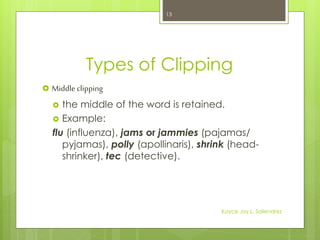
 Middle clipping
 the middle of the word is retained.
 Example:
flu (influenza), jams or jammies (pajamas/
pyjamas), polly (apollinaris), shrink (head-
shrinker), tec (detective).
13
Kayce Joy L. Saliendrez
Types of Clipping
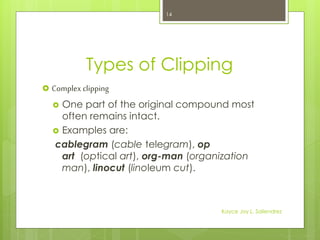
 Complex clipping
 One part of the original compound most
often remains intact.
 Examples are:
cablegram (cable telegram), op
art (optical art), org-man (organization
man), linocut (linoleum cut).
14
Kayce Joy L. Saliendrez
Types of Clipping
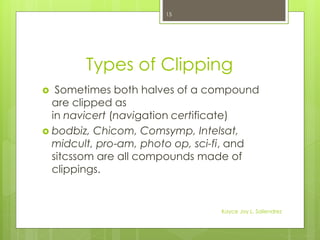
 Sometimes both halves of a compound
are clipped as
in navicert (navigation certificate)
 bodbiz, Chicom, Comsymp, Intelsat,
midcult, pro-am, photo op, sci-fi, and
sitcssom are all compounds made of
clippings.
15
Kayce Joy L. Saliendrez
16
Kayce Joy L. Saliendrez

Word formation-kayce english

  • 1.
    1 Kayce JoyL. Saliendrez
  • 2.
    Word formation  Creatingentirely new words .  Etymology  Clipping  Acronym 2 Kayce Joy L. Saliendrez
  • 3.
    Etymology  is thestudy of the history of words, their origins, and how their form and meaning have changed over time. By an extension, the term "etymology (of a word)" means the origin of a particular word. 3 Kayce Joy L. Saliendrez
  • 4.
    Etymologists apply anumber of methods to study the origins of words, some of which are:  Philological research. Changes in the form and meaning of the word can be traced with the aid of older texts, if such are available.  Making use of dialectological data. The form or meaning of the word might show variations between dialects, which may yield clues about its earlier history. 4 Kayce Joy L. Saliendrez
  • 5.
     The comparativemethod. By a systematic comparison of related languages, etymologists may often be able to detect which words derive from their common ancestor language and which were instead later borrowed from another language.  The study of semantic change. Etymologists must often make hypotheses about changes in the meaning of particular words. Such hypotheses are tested against the general knowledge of semantic shifts. For example, the assumption of a particular change of meaning may be substantiated by showing the same type of change has occurred in other language . 5 Kayce Joy L. Saliendrez
  • 6.
    What's the DifferenceBetween a Definition and an Etymology?  A definition tells us what a word means and how it's used in our own time. An etymology tells us where a word came from (often, but not always, from another language) and what it used to mean. 6 Kayce Joy L. Saliendrez
  • 7.
    Example :  thedefinition of the word disaster is "an occurrence causing widespread destruction and distress; a catastrophe" or "a grave misfortune." But the etymology of the word disaster takes us back to a time when people commonly blamed great misfortunes on the influence of the stars. 7 Kayce Joy L. Saliendrez
  • 8.
    Is the Etymologyof a Word Its True Definition?  Not at all, though people sometimes try to make this argument. The word etymology is derived from the Greek word etymon, which means "the true sense of a word." But in fact the original meaning of a word is often different from its contemporary definition. 8 Kayce Joy L. Saliendrez
  • 9.
  • 10.
    Clipping  In morphology,a word formed by dropping one or more syllables from a polysyllabic word  A part of a word which serves for the whole  such as cell from cellular phone  Indie(independent),exam(examination) Flu(influenza) fax(facsimile). 10 Kayce Joy L. Saliendrez
  • 11.
    Types of Clipping Back clipping  Back clipping is the most common type, in which the beginning is retained. The unclipped original may be either a simple or a composite.  Examples: ad (advertisement), cable (cablegram), doc(doctor), exam (examination), fax (facs imile), gas (gasoline), gym (gymnastics, gymnasium), memo (memorandum), mutt ( muttonhead), pub (public house), pop (popular music). 11 Kayce Joy L. Saliendrez
  • 12.
    Types of Clipping Fore-clipping  Fore-clipping retains the final part.  Example: chute (parachute), coon (raccoon), gator (alligator), phone (telephone), pike (turn pike), varsity (university). 12 Kayce Joy L. Saliendrez
  • 13.
    Types of Clipping Middle clipping  the middle of the word is retained.  Example: flu (influenza), jams or jammies (pajamas/ pyjamas), polly (apollinaris), shrink (head- shrinker), tec (detective). 13 Kayce Joy L. Saliendrez
  • 14.
    Types of Clipping Complex clipping  One part of the original compound most often remains intact.  Examples are: cablegram (cable telegram), op art (optical art), org-man (organization man), linocut (linoleum cut). 14 Kayce Joy L. Saliendrez
  • 15.
    Types of Clipping Sometimes both halves of a compound are clipped as in navicert (navigation certificate)  bodbiz, Chicom, Comsymp, Intelsat, midcult, pro-am, photo op, sci-fi, and sitcssom are all compounds made of clippings. 15 Kayce Joy L. Saliendrez
  • 16.
    16 Kayce Joy L.Saliendrez