Three forms
of
Literature
Instructor:
Mr. Phillip Armand G. Lajom
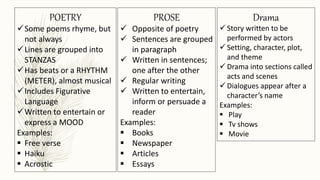
POETRY
Some poems rhyme, but
not always
Lines are grouped into
STANZAS
Has beats or a RHYTHM
(METER), almost musical
Includes Figurative
Language
Written to entertain or
express a MOOD
Examples:
 Free verse
 Haiku
 Acrostic
PROSE
 Opposite of poetry
 Sentences are grouped
in paragraph
 Written in sentences;
one after the other
 Regular writing
 Written to entertain,
inform or persuade a
reader
Examples:
 Books
 Newspaper
 Articles
 Essays
Drama
 Story written to be
performed by actors
 Setting, character, plot,
and theme
 Drama into sections called
acts and scenes
 Dialogues appear after a
character’s name
Examples:
 Play
 Tv shows
 Movie
Prose
– is discourse that follows the usual flow of
conversation which uses sentences forming
paragraphs to express ideas, feelings and
actions.
– is a form of language that has no formal
metrical structure.
Prose Form
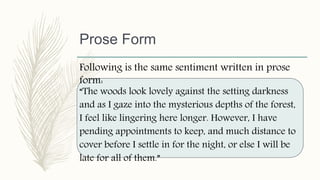
“The woods look lovely against the setting darkness
and as I gaze into the mysterious depths of the forest,
I feel like lingering here longer. However, I have
pending appointments to keep, and much distance to
cover before I settle in for the night, or else I will be
late for all of them.”
Following is the same sentiment written in prose
form:
Two Divisions of Prose:
Fiction
- is a literary work which is a result of the
author’s imagination.
Non-Fiction
- is a literary work which is all about reality.
Types of FICTION
a. Short Story is a
narrative involving one
or more characters, one
plot, and one single
impression.
Ex. Dead Stars by Paz
Marquez Benitez
b. Novel is a true-
to-life story
divided into
chapters where
many characters
are involved and
spans long period
of time.
Ex. Things Fall
Apart by Chinua
Achebe
c. Legend is a
narrative about the
origin of man,
place, event and
happenings.
Ex. Maria Makiling,
Daragang Magayon
d. Fable is a narrative
where characters are
animals and
inanimate objects that
speak and act like
people, and usually
ends with values that
can mold their
attitudes.
Ex. The Monkey and
the Turtle
Types of NON-FICTION
a. Essay is an attempt to express the viewpoint and
opinion of the writer on a particular problem or
event.
o Formal Essay
o Informal Essay
b. Oration is a formal treatment of the subject and
intended to be spoken before a crowd.
c. Biography is a literary work that gives
the life account of a person written by
another person.
d. Autobiography is a literary work where
the author writes his own life account.
e. News is a report of expected and
unexpected events in society and
governments and incidents in the field of
science, business, etc.
f. Letters is a written message conveyed from
one party to another party through a medium.
Besides a means of communication and a store
of information.
• Letters can be formal and informal.
g. Diaries and Journals
• Diaries a book in which one keeps a daily
record of events and experiences.
• Journals a newspaper or magazine that deals
with a particular subject of professional
activity. A daily record of news and events of
a personal nature; a diary
Poetry
– is the spontaneous overflow of powerful feelings
taking its origin from emotion.
– is a type of literature that combines the sound and
meaning of language to create and express ideas and
feelings.
– it is a record of the best and happiest moments of the
best minds, the very image of life expressed in its
eternal truth.
Poetry Form
“The woods are lovely, dark and deep.
But I have promises to keep,
And miles to go before I sleep,
And miles to go before I sleep.”
Following is a poetry verse from a popular work of
Robert Frost:
Three Types of Poetry:
Narrative Poetry
Dramatic Poetry
Lyric poetry
Narrative Poetry
- is a form of poetry that tells a story, often
making the voices of a narrator and
characters as well; the entire story is usually
written in metered verse.
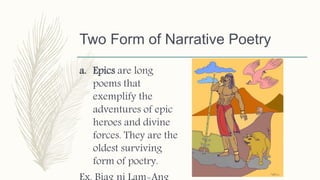
Two Form of Narrative Poetry
a. Epics are long
poems that
exemplify the
adventures of epic
heroes and divine
forces. They are the
oldest surviving
form of poetry.
Longest epic in the World
b. Ballads are narrative poems intended to be
sung. They are shorter than the epics and
they usually tell stories about a particular
person.
Dramatic Poetry
– It tells stories but one or more characters act out the
poem.
– There are plays that are written as dramatic poetry.
– William Shakespeare, an English Playwright, is the most
famous dramatic poet.
– In dramatic monologue, the story is dramatically told y
only one character.
– Robert browning, an English poet of the 1800, wrote
many poems of this style.
Lyric Poetry
– is a short poem that expresses the poet’s
thoughts and feelings.
– The word lyric comes from the Greek word
rhein which means lyre, a harp-like
musical instrument used by poets in ancient
Greece.
Forms of Lyric Poetry
a. Haiku one of the
shortest lyric Japanese
poem consisting of three
short lines that do not
rhyme and has 17
syllables arranged in
three lines, the first line
has 5, the second 7 and
the third 5.
b. Ode is a serious
elaborate lyric poem
full of high praises
and noble feelings. It
is an elaborately
structured poem prais
ing or glorifying an
event or individual,
describing nature
intellectually as well
as emotionally.
c. Elegy
is a poem of
meditation of
life and
death. Many
elegies
mourn the
death of a
famous
person or a
close friend.
d. Sonnet
is a 14-line lyric
poem with
certain pattern
of rhyme and
rhythm.
Ex. “How do I
love thee?” by
Elizabeth Barett
Browning
e. Song is a lyric poem intended to be sung.
Ex. “Sound of Silence” by Bob Dylan and Paul
Simon
Ex. Let Her Go by Boyce Avenue
Drama
– In literature, the word drama defines
a genre, or style of writing.
– is a play that can be performed for theatre,
radio or even television. These plays are
usually written out as a script, or a written
version of a play that is read by the actors
but not the audience.
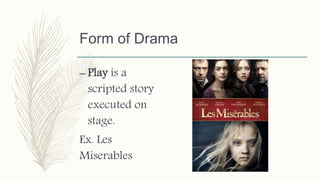
Form of Drama
– Play is a
scripted story
executed on
stage.
Ex. Les
Miserables

Prose-and-Poetry.pptx

  • 1.
  • 2.
    POETRY Some poems rhyme,but not always Lines are grouped into STANZAS Has beats or a RHYTHM (METER), almost musical Includes Figurative Language Written to entertain or express a MOOD Examples:  Free verse  Haiku  Acrostic PROSE  Opposite of poetry  Sentences are grouped in paragraph  Written in sentences; one after the other  Regular writing  Written to entertain, inform or persuade a reader Examples:  Books  Newspaper  Articles  Essays Drama  Story written to be performed by actors  Setting, character, plot, and theme  Drama into sections called acts and scenes  Dialogues appear after a character’s name Examples:  Play  Tv shows  Movie
  • 3.
    Prose – is discoursethat follows the usual flow of conversation which uses sentences forming paragraphs to express ideas, feelings and actions. – is a form of language that has no formal metrical structure.
  • 4.
    Prose Form “The woodslook lovely against the setting darkness and as I gaze into the mysterious depths of the forest, I feel like lingering here longer. However, I have pending appointments to keep, and much distance to cover before I settle in for the night, or else I will be late for all of them.” Following is the same sentiment written in prose form:
  • 5.
    Two Divisions ofProse: Fiction - is a literary work which is a result of the author’s imagination. Non-Fiction - is a literary work which is all about reality.
  • 6.
    Types of FICTION a.Short Story is a narrative involving one or more characters, one plot, and one single impression. Ex. Dead Stars by Paz Marquez Benitez
  • 7.
    b. Novel isa true- to-life story divided into chapters where many characters are involved and spans long period of time. Ex. Things Fall Apart by Chinua Achebe
  • 8.
    c. Legend isa narrative about the origin of man, place, event and happenings. Ex. Maria Makiling, Daragang Magayon
  • 9.
    d. Fable isa narrative where characters are animals and inanimate objects that speak and act like people, and usually ends with values that can mold their attitudes. Ex. The Monkey and the Turtle
  • 10.
    Types of NON-FICTION a.Essay is an attempt to express the viewpoint and opinion of the writer on a particular problem or event. o Formal Essay o Informal Essay b. Oration is a formal treatment of the subject and intended to be spoken before a crowd.
  • 11.
    c. Biography isa literary work that gives the life account of a person written by another person. d. Autobiography is a literary work where the author writes his own life account. e. News is a report of expected and unexpected events in society and governments and incidents in the field of science, business, etc.
  • 12.
    f. Letters isa written message conveyed from one party to another party through a medium. Besides a means of communication and a store of information. • Letters can be formal and informal. g. Diaries and Journals • Diaries a book in which one keeps a daily record of events and experiences. • Journals a newspaper or magazine that deals with a particular subject of professional activity. A daily record of news and events of a personal nature; a diary
  • 13.
    Poetry – is thespontaneous overflow of powerful feelings taking its origin from emotion. – is a type of literature that combines the sound and meaning of language to create and express ideas and feelings. – it is a record of the best and happiest moments of the best minds, the very image of life expressed in its eternal truth.
  • 14.
    Poetry Form “The woodsare lovely, dark and deep. But I have promises to keep, And miles to go before I sleep, And miles to go before I sleep.” Following is a poetry verse from a popular work of Robert Frost:
  • 15.
    Three Types ofPoetry: Narrative Poetry Dramatic Poetry Lyric poetry
  • 16.
    Narrative Poetry - isa form of poetry that tells a story, often making the voices of a narrator and characters as well; the entire story is usually written in metered verse.
  • 17.
    Two Form ofNarrative Poetry a. Epics are long poems that exemplify the adventures of epic heroes and divine forces. They are the oldest surviving form of poetry.
  • 18.
    Longest epic inthe World
  • 19.
    b. Ballads arenarrative poems intended to be sung. They are shorter than the epics and they usually tell stories about a particular person.
  • 20.
    Dramatic Poetry – Ittells stories but one or more characters act out the poem. – There are plays that are written as dramatic poetry. – William Shakespeare, an English Playwright, is the most famous dramatic poet. – In dramatic monologue, the story is dramatically told y only one character. – Robert browning, an English poet of the 1800, wrote many poems of this style.
  • 21.
    Lyric Poetry – isa short poem that expresses the poet’s thoughts and feelings. – The word lyric comes from the Greek word rhein which means lyre, a harp-like musical instrument used by poets in ancient Greece.
  • 22.
    Forms of LyricPoetry a. Haiku one of the shortest lyric Japanese poem consisting of three short lines that do not rhyme and has 17 syllables arranged in three lines, the first line has 5, the second 7 and the third 5.
  • 23.
    b. Ode isa serious elaborate lyric poem full of high praises and noble feelings. It is an elaborately structured poem prais ing or glorifying an event or individual, describing nature intellectually as well as emotionally.
  • 24.
    c. Elegy is apoem of meditation of life and death. Many elegies mourn the death of a famous person or a close friend.
  • 25.
    d. Sonnet is a14-line lyric poem with certain pattern of rhyme and rhythm. Ex. “How do I love thee?” by Elizabeth Barett Browning
  • 26.
    e. Song isa lyric poem intended to be sung. Ex. “Sound of Silence” by Bob Dylan and Paul Simon
  • 27.
    Ex. Let HerGo by Boyce Avenue
  • 28.
    Drama – In literature,the word drama defines a genre, or style of writing. – is a play that can be performed for theatre, radio or even television. These plays are usually written out as a script, or a written version of a play that is read by the actors but not the audience.
  • 29.
    Form of Drama –Play is a scripted story executed on stage. Ex. Les Miserables