Choosing right:
Word Choice
and Style
“The difference between the right word and the almost right word is
the difference between lightning and a lightning bug.” – Mark Twain
Word Choice - ENGL 151L 1
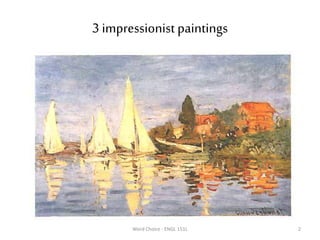
3 impressionist paintings
Word Choice - ENGL 151L 2
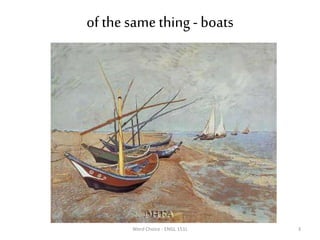
of the same thing - boats
Word Choice - ENGL 151L 3
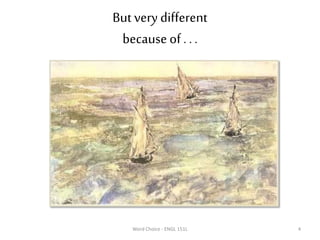
But very different
because of . ..
Word Choice - ENGL 151L 4
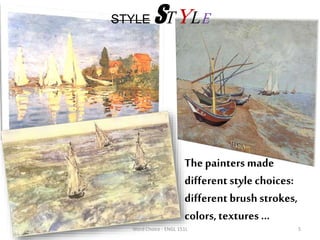
The painters made
different style choices:
different brushstrokes,
colors,textures …
STYLE STYLE
Word Choice - ENGL 151L 5
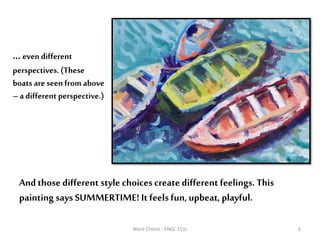
…even different
perspectives. (These
boats areseen from above
–a different perspective.)
Word Choice - ENGL 151L 6
And those different style choices create different feelings. This
painting says SUMMERTIME! It feels fun, upbeat, playful.
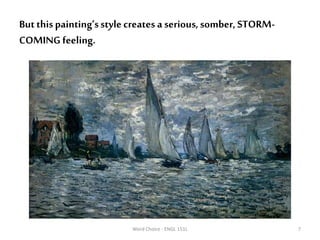
Butthispainting’sstylecreates a serious,somber, STORM-
COMING feeling.
Word Choice - ENGL 151L 7
How do
writers
create
their
Style?
A constant stream of small decisions shapes
a writer’s larger style. Many of these
decisions have to do with word choice, also
known as diction. The order of the words is
important too; that’s covered in Style 2.
If you’ve ever changed the words you
choose based on who you’re talking to then
you know about diction. Imagine giving
instructions to a six year old vs to a
teenager, or sharing a story about a night
out with a work supervisor vs a friend.
What about a cover letter sent with a
resume vs a memo at work vs a Facebook
post? Different words needed!
Word Choice - ENGL 151L 8
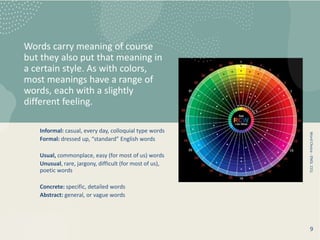
Words carry meaning of course
but they also put that meaning in
a certain style. As with colors,
most meanings have a range of
words, each with a slightly
different feeling.
Informal: casual, every day, colloquial type words
Formal: dressed up, “standard” English words
Usual, commonplace, easy (for most of us) words
Unusual, rare, jargony, difficult (for most of us),
poetic words
Concrete: specific, detailed words
Abstract: general, or vague words
Word
Choice
-
ENGL
151L
9
Informal to Formal
Informal, casual, colloquial,
“slang” from different times
In between Formal, fancy, dressed up,
“standard” English
crib, pad, digs* my place, apartment,
house, home
residence, place of residence,
abode*
foot it, hoof it, pound the
sidewalk, burn the shoe leather
walk, take a walk, stroll Perambulate, amble, sashay,
mosey
Rad, bad, mad cool, slaying,
snatched, neat-o, boss*
Awesome, amazing, very
impressive, marvelous
Bodacious (slang tho?),
stupendous, prodigious
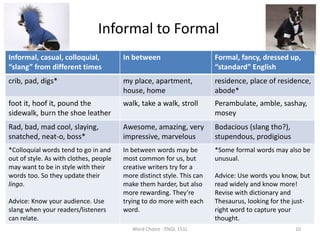
*Colloquial words tend to go in and
out of style. As with clothes, people
may want to be in style with their
words too. So they update their
lingo.
Advice: Know your audience. Use
slang when your readers/listeners
can relate.
In between words may be
most common for us, but
creative writers try for a
more distinct style. This can
make them harder, but also
more rewarding. They’re
trying to do more with each
word.
*Some formal words may also be
unusual.
Advice: Use words you know, but
read widely and know more!
Revise with dictionary and
Thesaurus, looking for the just-
right word to capture your
thought.
Word Choice - ENGL 151L 10
Many words
come with a
feeling, a
certain spin.
Take the
synonyms
for Home on
the previous
slide
Home – Warm feeling. Home is where the heart is. “There’s
no place like home, there’s no place like home...”
House – Cold impersonal feeling. A new house on the block.
Crib – Modern, hip, youthful. “Now this crib's about to kick
off, this party looks wack.”
Pad – Once modern, beatnik then hippie. “Hey daddy-o let’s
go to my pad.”
Place – Neutral feeling and casual. “Nice place you got here.”
Residence – Neutral feeling and formal. Official language.
“State your place of residence.”
Abode – Fancy, poetic diction. Pretentious? “Welcome to my
humble abode.” (But haha not so a humble word choice)
Word Choice - ENGL 151L 11
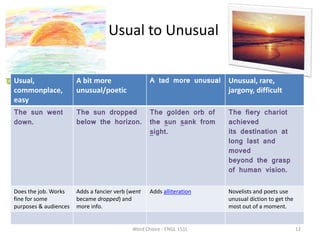
Usual to Unusual
Usual,
commonplace,
easy
A bit more
unusual/poetic
A tad more unusual Unusual, rare,
jargony, difficult
The sun went
down.
The sun dropped
below the horizon.
The golden orb of
the sun sank from
sight.
The fiery chariot
achieved
its destination at
long last and
moved
beyond the grasp
of human vision.
Does the job. Works
fine for some
purposes & audiences
Adds a fancier verb (went
became dropped) and
more info.
Adds alliteration Novelists and poets use
unusual diction to get the
most out of a moment.
Word Choice - ENGL 151L 12
Concrete to Abstract
Concrete, specific, detailed Abstract, general, vague
Red Honda with a dented back bumper Damaged compact car
Rhododendron in full bloom Pretty bush
Ride the elliptical for 20 minutes Exercise a while
Square piece of old parchment Paper
Tip: When revising, look for the more specific,
concrete word or phrase. Good writing in most
fields is concrete writing.
Tip: Do you tend to give too much detail? Find just
the right spot between concrete and abstract. Ask:
Why am I writing, and to whom? What does the
occasion and the audience need?
Word Choice - ENGL 151L 13
Novelist Cormac
McCarthy (The
Road, No
Country for Old
Men)
is known for
unusual, poetic
word choices
Schmoop has a brief analysis of McCarthy’s diction here. They
quote this stunning passage from The Road. I’ve underlined
unusual word choices. We see hard words and also common
words used in uncommon ways:
He rose and stood tottering in that cold autistic dark with
his arms outheld for balance while the vestibular
calculations in his skull cranked out their reckonings. An
old chronicle. To seek out the upright. No fall but
preceded by a declination. [< 3 sentence fragments] He
took great marching steps into the nothingness, counting
them against his return. Eyes closed, arms oaring.
Upright to what? Something nameless in the night, lode
or matrix. To which he and the stars were common
satellite. Like the great pendulum in its rotunda scribing
through the long day movements of the universe of which
you may say it knows nothing and yet know it must.
For up to 10 bonus points send an email explaining how the verb
“oaring” is used here. Hint: 1) It a metaphor that implies a
comparison.
Word Choice - ENGL 151L 14
Goodwriting
is specific &
concrete
I returned and saw under the sun, that the
race is not to the swift, nor the battle to the
strong, neither yet bread to the wise, nor yet
riches to men of understanding, nor yet
favour to men of skill; but time and chance
happeneth to them all. — Ecclesiastes
To highlight the emptiness of bad writing, George
Orwell (1984, Animal Farm) translated the above
passage into abstract, vague, bureaucratic English:
Objective considerations of contemporary
phenomena compel the conclusion that
success or failure in competitive activities
exhibits no tendency to be commensurate
with innate capacity, but that a considerable
element of the unpredictable must invariably
be taken into account.
Word Choice - ENGL 151L 15
Mess up a Saying:
20 pt Bonus Point Opp
Study the previous slide and do the same to a common saying for 10 Bonus Points. Use a
longer passage of very good writing for up to 20 points. Ask me if you need examples of very
good writing. Try searching famous speeches and inspirational writing from the world’s
religions.
An example:
Before. That old saying “A bird in hand is worth two in the bush” reminds us to value what we
have more than what we might be able to get. Here is my Owellian rewrite, changing word
choice, word order and sentence structure to make the language so vague, abstract, and
empty that it is nearly meaningless:
After “Any one item that one already holds in one’s possession can and certainly should be
valued at a more high rate than twice the amount of that same or a similar item that is not
yet actually and fully within one’s possession.”
Have fun! And remember, you’re not explaining the saying or passage; you’re
totally messing it up. Email in with a brief cover letter.
Word Choice - ENGL 151L 16
Starting an Essay that focuses on Style
Select a few stand-out words from the pieces you’ve
chosen. Select words that add to the tone (funny, serious,
sarcastic, sad…). Then write the feelings each word gives
you. Ask friends and family what feeling the word gives
them. If the writer is any good (skilled), the feelings you
list will be close to what he/she was aiming for. If a word
seems like a bad choice – yay! You have a weakness to
address in your essay.
Word Choice - ENGL 151L 17
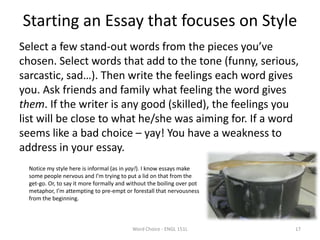
Notice my style here is informal (as in yay!). I know essays make
some people nervous and I’m trying to put a lid on that from the
get-go. Or, to say it more formally and without the boiling over pot
metaphor, I’m attempting to pre-empt or forestall that nervousness
from the beginning.
Word Choice questions
for Compare and Contrast essays
• Are these two in the same genre (fiction, poetry)? Better not to compare
apples & oranges, but if you’d like to try let’s plan.
• Are the styles very different? If so, good choice for this essay.
• Where do the two pieces fall in the 3 ranges on slide 9?
• What passages really show off the writers’ different styles?
• What 3 word choices from each piece have strong connotations (see slide 11)?
• Does one piece change styles more than the other? That’s interesting. Where?
Why?
• Do you like the style of one writer a lot more? Why? Give examples.
• If characters talk, what is their speaking style? Is it different from the style of
the narrator telling the story?
• Does the poem or story’s style chance in the last scene/stanza?
• Do I need most of the points on this essay? How else can I use this lecture to
write a well-developed essay. Is there a 3rd piece I could use?
Word Choice - ENGL 151L 18

Word choice lecture

  • 1.
    Choosing right: Word Choice andStyle “The difference between the right word and the almost right word is the difference between lightning and a lightning bug.” – Mark Twain Word Choice - ENGL 151L 1
  • 2.
    3 impressionist paintings WordChoice - ENGL 151L 2
  • 3.
    of the samething - boats Word Choice - ENGL 151L 3
  • 4.
    But very different becauseof . .. Word Choice - ENGL 151L 4
  • 5.
    The painters made differentstyle choices: different brushstrokes, colors,textures … STYLE STYLE Word Choice - ENGL 151L 5
  • 6.
    …even different perspectives. (These boatsareseen from above –a different perspective.) Word Choice - ENGL 151L 6 And those different style choices create different feelings. This painting says SUMMERTIME! It feels fun, upbeat, playful.
  • 7.
    Butthispainting’sstylecreates a serious,somber,STORM- COMING feeling. Word Choice - ENGL 151L 7
  • 8.
    How do writers create their Style? A constantstream of small decisions shapes a writer’s larger style. Many of these decisions have to do with word choice, also known as diction. The order of the words is important too; that’s covered in Style 2. If you’ve ever changed the words you choose based on who you’re talking to then you know about diction. Imagine giving instructions to a six year old vs to a teenager, or sharing a story about a night out with a work supervisor vs a friend. What about a cover letter sent with a resume vs a memo at work vs a Facebook post? Different words needed! Word Choice - ENGL 151L 8
  • 9.
    Words carry meaningof course but they also put that meaning in a certain style. As with colors, most meanings have a range of words, each with a slightly different feeling. Informal: casual, every day, colloquial type words Formal: dressed up, “standard” English words Usual, commonplace, easy (for most of us) words Unusual, rare, jargony, difficult (for most of us), poetic words Concrete: specific, detailed words Abstract: general, or vague words Word Choice - ENGL 151L 9
  • 10.
    Informal to Formal Informal,casual, colloquial, “slang” from different times In between Formal, fancy, dressed up, “standard” English crib, pad, digs* my place, apartment, house, home residence, place of residence, abode* foot it, hoof it, pound the sidewalk, burn the shoe leather walk, take a walk, stroll Perambulate, amble, sashay, mosey Rad, bad, mad cool, slaying, snatched, neat-o, boss* Awesome, amazing, very impressive, marvelous Bodacious (slang tho?), stupendous, prodigious *Colloquial words tend to go in and out of style. As with clothes, people may want to be in style with their words too. So they update their lingo. Advice: Know your audience. Use slang when your readers/listeners can relate. In between words may be most common for us, but creative writers try for a more distinct style. This can make them harder, but also more rewarding. They’re trying to do more with each word. *Some formal words may also be unusual. Advice: Use words you know, but read widely and know more! Revise with dictionary and Thesaurus, looking for the just- right word to capture your thought. Word Choice - ENGL 151L 10
  • 11.
    Many words come witha feeling, a certain spin. Take the synonyms for Home on the previous slide Home – Warm feeling. Home is where the heart is. “There’s no place like home, there’s no place like home...” House – Cold impersonal feeling. A new house on the block. Crib – Modern, hip, youthful. “Now this crib's about to kick off, this party looks wack.” Pad – Once modern, beatnik then hippie. “Hey daddy-o let’s go to my pad.” Place – Neutral feeling and casual. “Nice place you got here.” Residence – Neutral feeling and formal. Official language. “State your place of residence.” Abode – Fancy, poetic diction. Pretentious? “Welcome to my humble abode.” (But haha not so a humble word choice) Word Choice - ENGL 151L 11
  • 12.
    Usual to Unusual Usual, commonplace, easy Abit more unusual/poetic A tad more unusual Unusual, rare, jargony, difficult The sun went down. The sun dropped below the horizon. The golden orb of the sun sank from sight. The fiery chariot achieved its destination at long last and moved beyond the grasp of human vision. Does the job. Works fine for some purposes & audiences Adds a fancier verb (went became dropped) and more info. Adds alliteration Novelists and poets use unusual diction to get the most out of a moment. Word Choice - ENGL 151L 12
  • 13.
    Concrete to Abstract Concrete,specific, detailed Abstract, general, vague Red Honda with a dented back bumper Damaged compact car Rhododendron in full bloom Pretty bush Ride the elliptical for 20 minutes Exercise a while Square piece of old parchment Paper Tip: When revising, look for the more specific, concrete word or phrase. Good writing in most fields is concrete writing. Tip: Do you tend to give too much detail? Find just the right spot between concrete and abstract. Ask: Why am I writing, and to whom? What does the occasion and the audience need? Word Choice - ENGL 151L 13
  • 14.
    Novelist Cormac McCarthy (The Road,No Country for Old Men) is known for unusual, poetic word choices Schmoop has a brief analysis of McCarthy’s diction here. They quote this stunning passage from The Road. I’ve underlined unusual word choices. We see hard words and also common words used in uncommon ways: He rose and stood tottering in that cold autistic dark with his arms outheld for balance while the vestibular calculations in his skull cranked out their reckonings. An old chronicle. To seek out the upright. No fall but preceded by a declination. [< 3 sentence fragments] He took great marching steps into the nothingness, counting them against his return. Eyes closed, arms oaring. Upright to what? Something nameless in the night, lode or matrix. To which he and the stars were common satellite. Like the great pendulum in its rotunda scribing through the long day movements of the universe of which you may say it knows nothing and yet know it must. For up to 10 bonus points send an email explaining how the verb “oaring” is used here. Hint: 1) It a metaphor that implies a comparison. Word Choice - ENGL 151L 14
  • 15.
    Goodwriting is specific & concrete Ireturned and saw under the sun, that the race is not to the swift, nor the battle to the strong, neither yet bread to the wise, nor yet riches to men of understanding, nor yet favour to men of skill; but time and chance happeneth to them all. — Ecclesiastes To highlight the emptiness of bad writing, George Orwell (1984, Animal Farm) translated the above passage into abstract, vague, bureaucratic English: Objective considerations of contemporary phenomena compel the conclusion that success or failure in competitive activities exhibits no tendency to be commensurate with innate capacity, but that a considerable element of the unpredictable must invariably be taken into account. Word Choice - ENGL 151L 15
  • 16.
    Mess up aSaying: 20 pt Bonus Point Opp Study the previous slide and do the same to a common saying for 10 Bonus Points. Use a longer passage of very good writing for up to 20 points. Ask me if you need examples of very good writing. Try searching famous speeches and inspirational writing from the world’s religions. An example: Before. That old saying “A bird in hand is worth two in the bush” reminds us to value what we have more than what we might be able to get. Here is my Owellian rewrite, changing word choice, word order and sentence structure to make the language so vague, abstract, and empty that it is nearly meaningless: After “Any one item that one already holds in one’s possession can and certainly should be valued at a more high rate than twice the amount of that same or a similar item that is not yet actually and fully within one’s possession.” Have fun! And remember, you’re not explaining the saying or passage; you’re totally messing it up. Email in with a brief cover letter. Word Choice - ENGL 151L 16
  • 17.
    Starting an Essaythat focuses on Style Select a few stand-out words from the pieces you’ve chosen. Select words that add to the tone (funny, serious, sarcastic, sad…). Then write the feelings each word gives you. Ask friends and family what feeling the word gives them. If the writer is any good (skilled), the feelings you list will be close to what he/she was aiming for. If a word seems like a bad choice – yay! You have a weakness to address in your essay. Word Choice - ENGL 151L 17 Notice my style here is informal (as in yay!). I know essays make some people nervous and I’m trying to put a lid on that from the get-go. Or, to say it more formally and without the boiling over pot metaphor, I’m attempting to pre-empt or forestall that nervousness from the beginning.
  • 18.
    Word Choice questions forCompare and Contrast essays • Are these two in the same genre (fiction, poetry)? Better not to compare apples & oranges, but if you’d like to try let’s plan. • Are the styles very different? If so, good choice for this essay. • Where do the two pieces fall in the 3 ranges on slide 9? • What passages really show off the writers’ different styles? • What 3 word choices from each piece have strong connotations (see slide 11)? • Does one piece change styles more than the other? That’s interesting. Where? Why? • Do you like the style of one writer a lot more? Why? Give examples. • If characters talk, what is their speaking style? Is it different from the style of the narrator telling the story? • Does the poem or story’s style chance in the last scene/stanza? • Do I need most of the points on this essay? How else can I use this lecture to write a well-developed essay. Is there a 3rd piece I could use? Word Choice - ENGL 151L 18