Tone. ENGL 151L 1
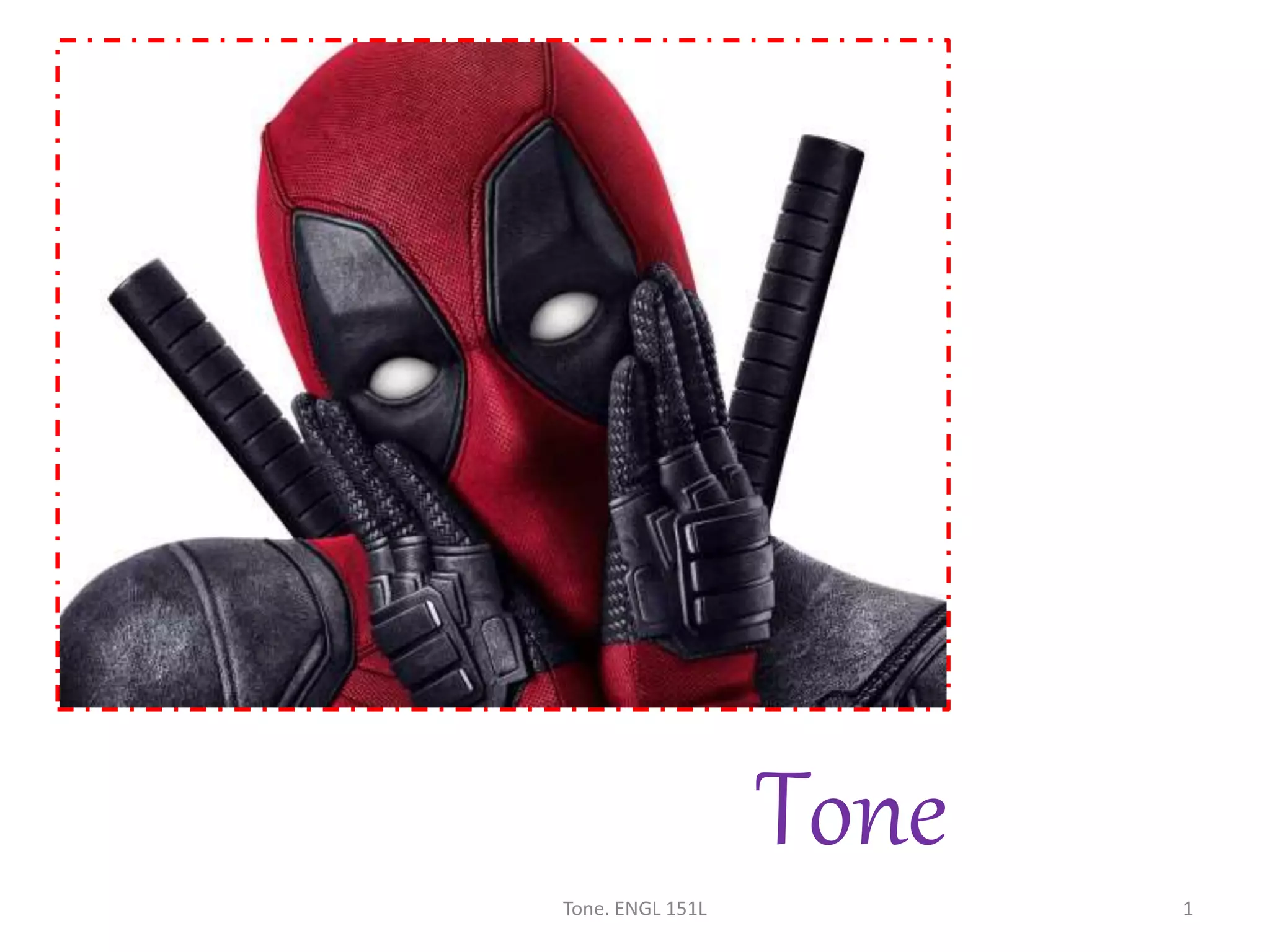
Tone
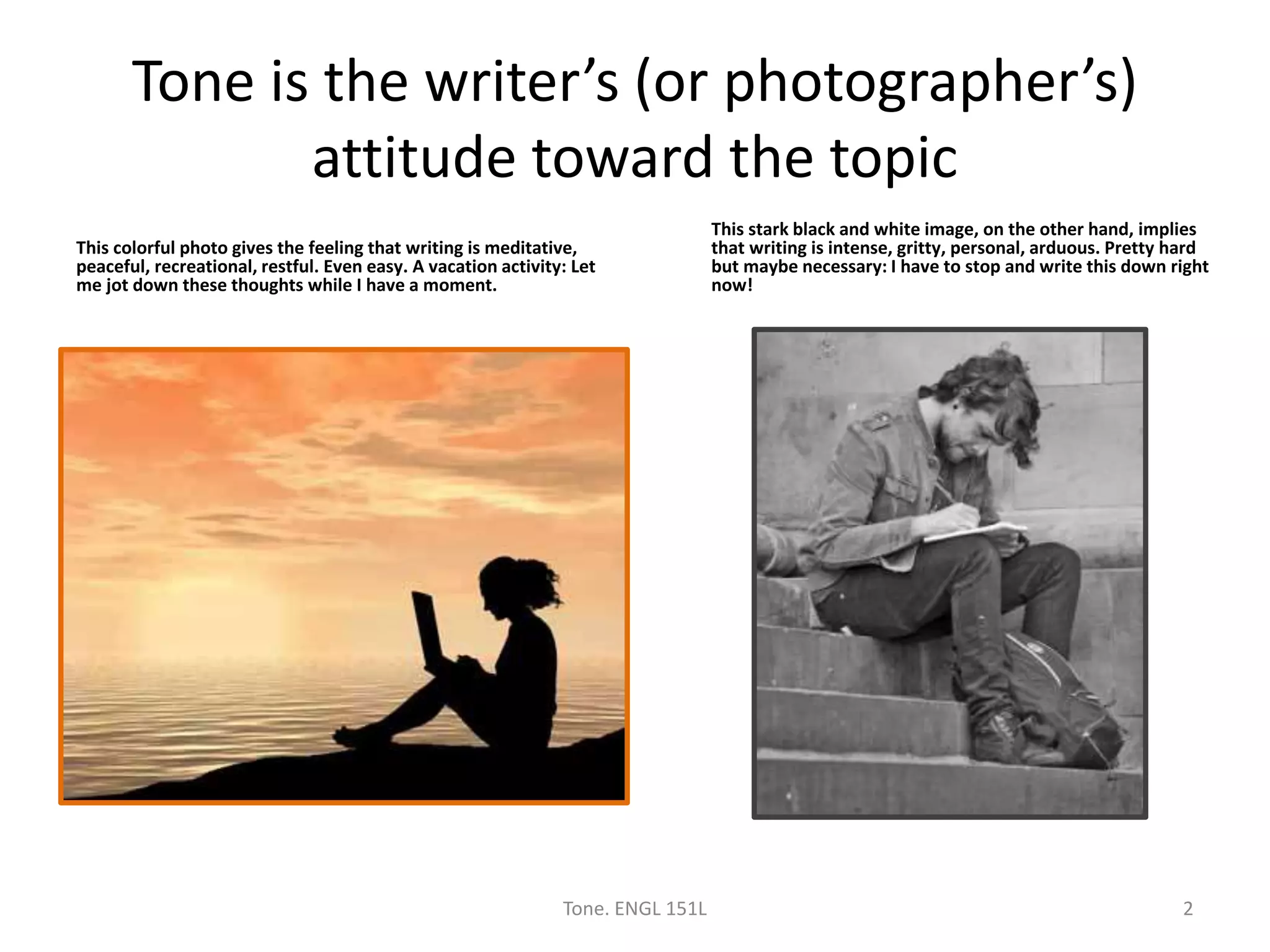
Tone is the writer’s (or photographer’s)
attitude toward the topic
This colorful photo gives the feeling that writing is meditative,
peaceful, recreational, restful. Even easy. A vacation activity: Let
me jot down these thoughts while I have a moment.
This stark black and white image, on the other hand, implies
that writing is intense, gritty, personal, arduous. Pretty hard
but maybe necessary: I have to stop and write this down right
now!
Tone. ENGL 151L 2
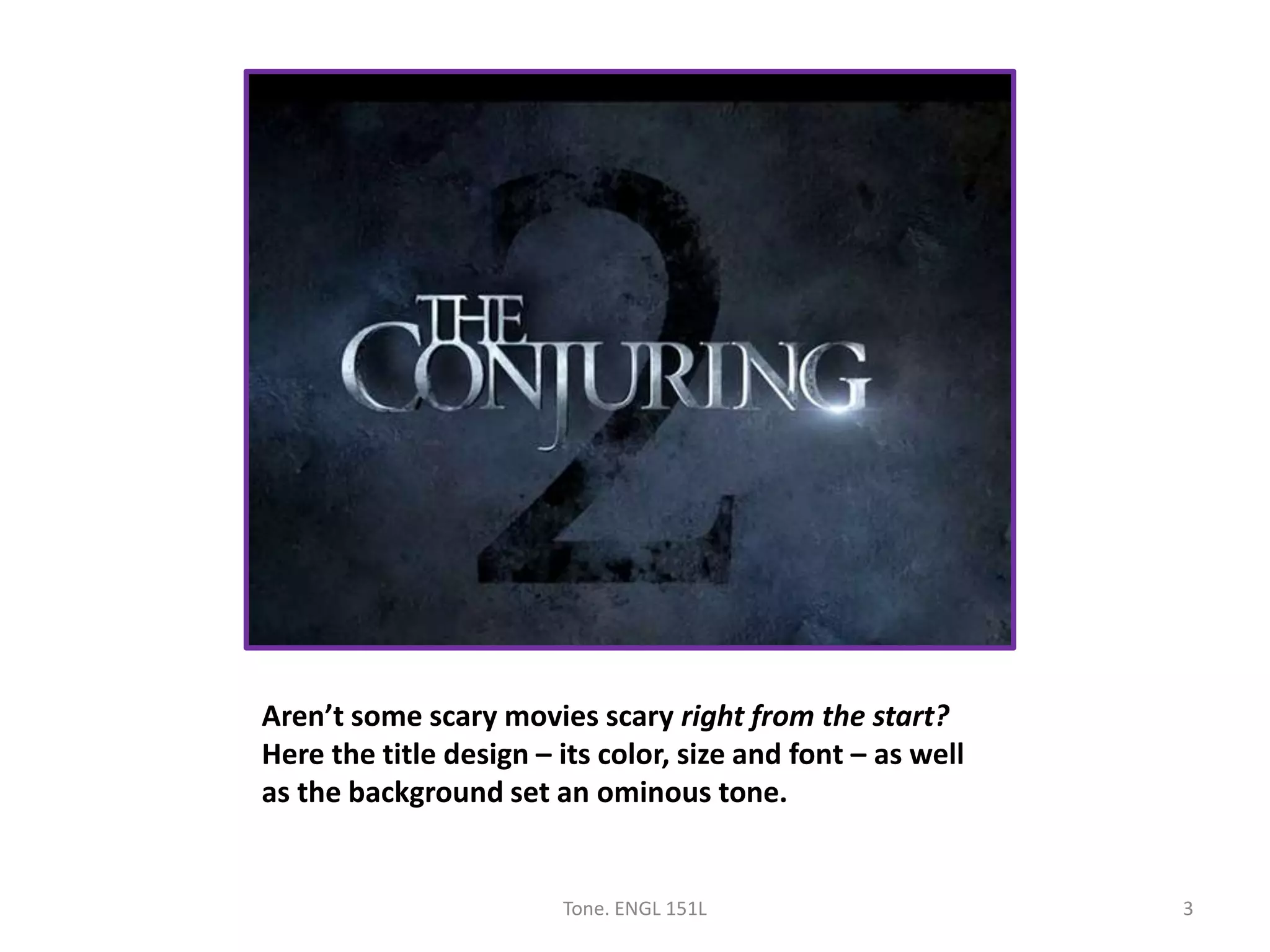
Aren’t some scary movies scary right from the start?
Here the title design – its color, size and font – as well
as the background set an ominous tone.
Tone. ENGL 151L 3
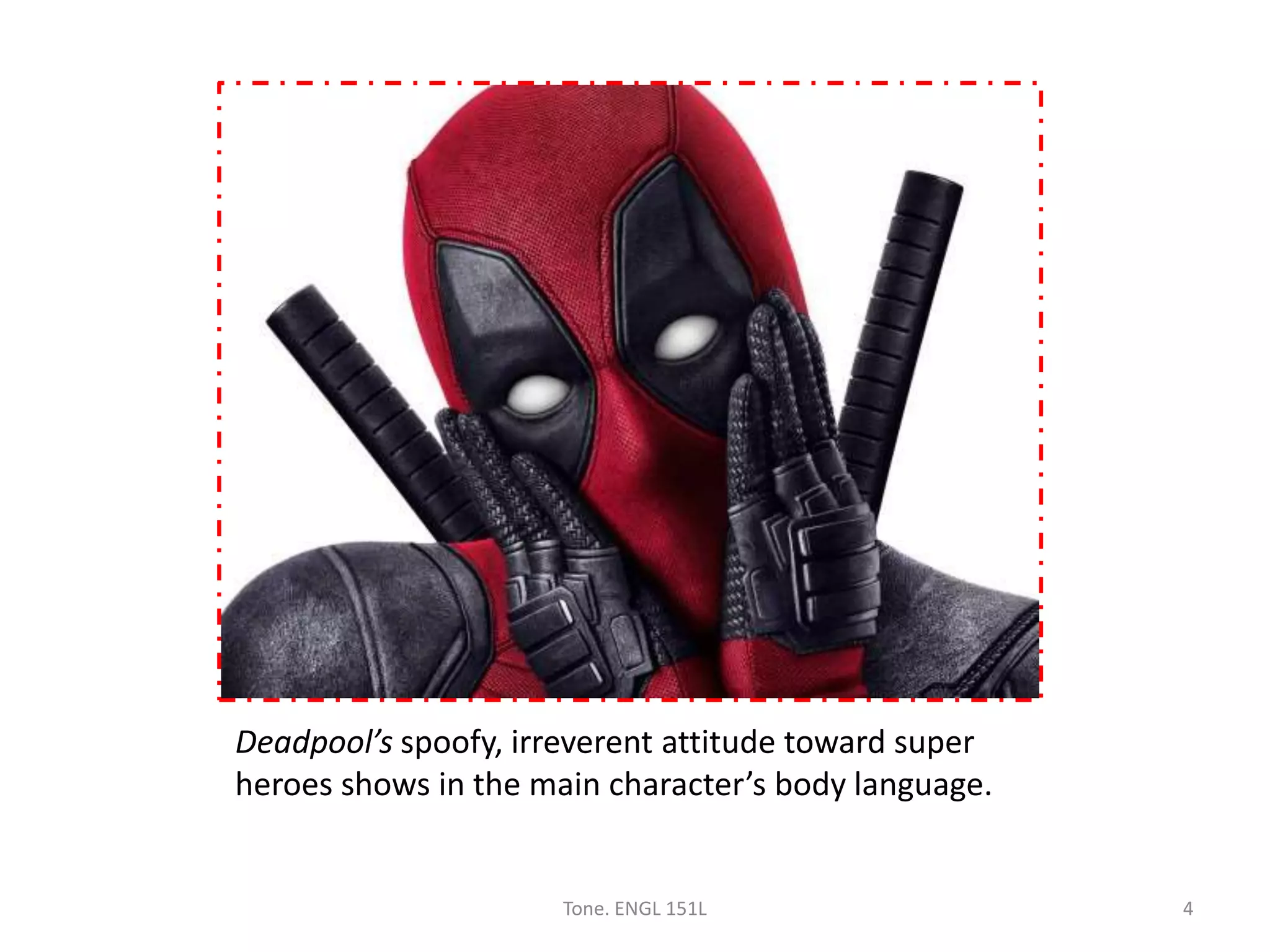
Deadpool’s spoofy, irreverent attitude toward super
heroes shows in the main character’s body language.
Tone. ENGL 151L 4
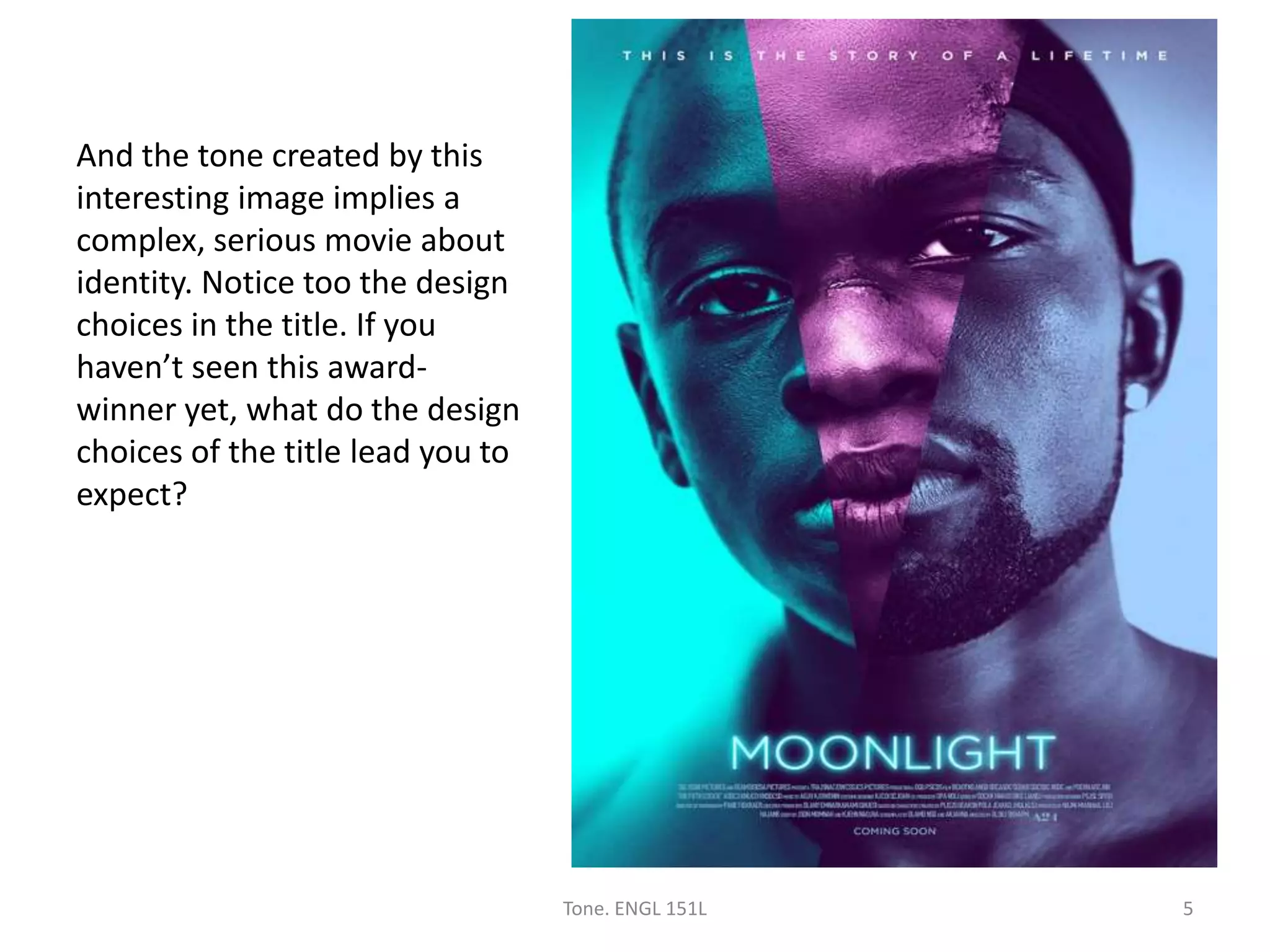
And the tone created by this
interesting image implies a
complex, serious movie about
identity. Notice too the design
choices in the title. If you
haven’t seen this award-
winner yet, what do the design
choices of the title lead you to
expect?
Tone. ENGL 151L 5
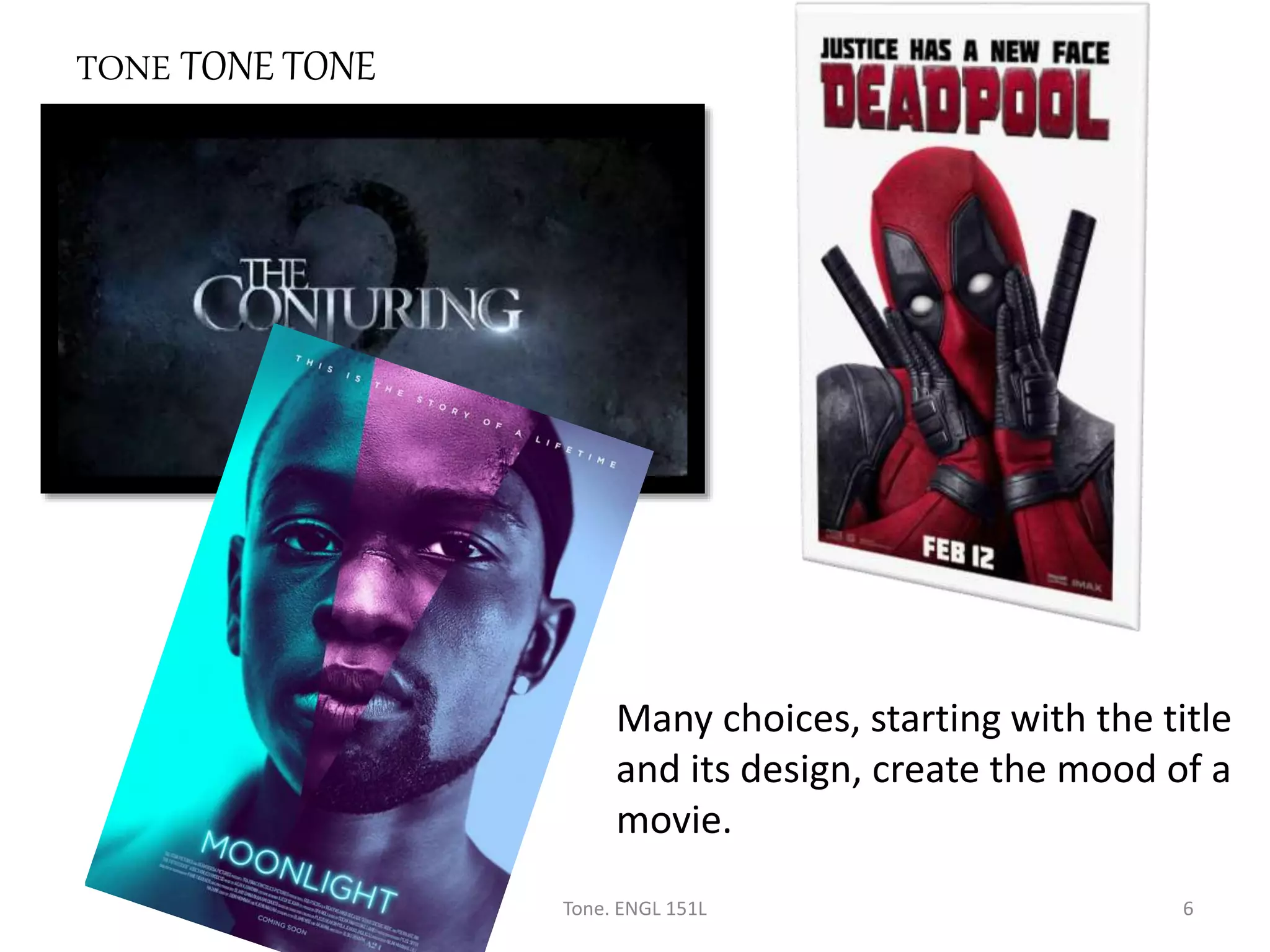
Many choices, starting with the title
and its design, create the mood of a
movie.
TONE TONE TONE
Tone. ENGL 151L 6
Music and Tone
Music affects tone too. With so many epic films,
isn’t the sound track essential? What are your
favorite examples? Wonder Woman, Iron Man,
Black Panther, Fury Road? And going farther back
Star Wars, Rocky, Jaws, The Godfather. We hear a
few notes and feel it again – the power and mood
of the movie.
Tone. ENGL 151L 7
Spoken
Words and
Tone
Tone.
ENGL
151L
8
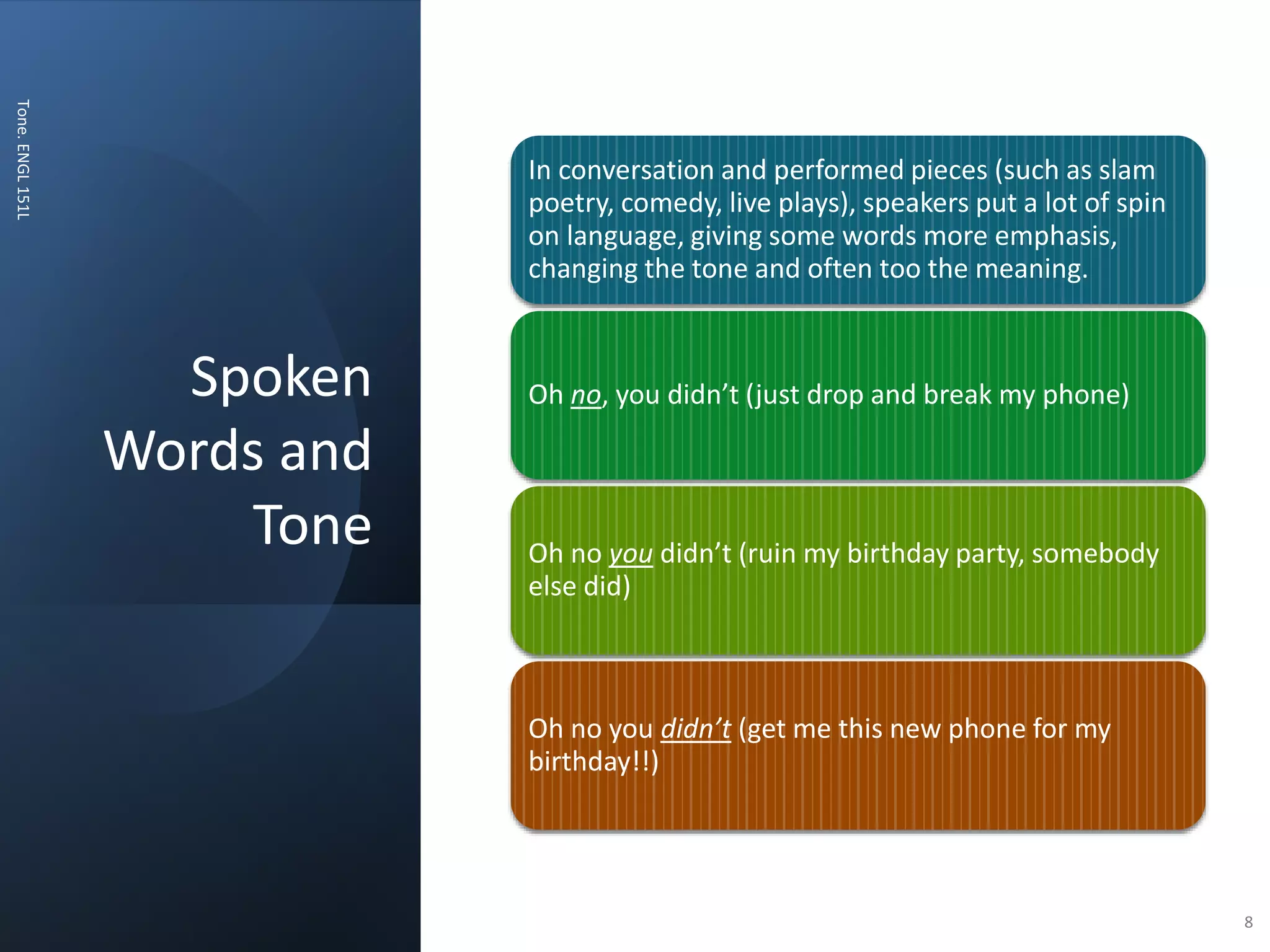
In conversation and performed pieces (such as slam
poetry, comedy, live plays), speakers put a lot of spin
on language, giving some words more emphasis,
changing the tone and often too the meaning.
Oh no, you didn’t (just drop and break my phone)
Oh no you didn’t (ruin my birthday party, somebody
else did)
Oh no you didn’t (get me this new phone for my
birthday!!)
Tone
breaks
through
language
barriers.
9
We can hear tone of voice even in a language we
don’t know. I was in Turkey once being hosted by
the aunt of a Turkish friend. I didn’t know much
Turkish yet, and she spoke little English. My first
day there I got lost in the outdoor market. When
we found each other, Husneye let out a stream
of words. Her tone went from anxious to ticked
off to relieved. I felt pretty sure she said
something like – Where the heck were you?!
Don’t wander off like that again! If I lose you
Fatma will kill me. Well, anyway I found you, let’s
go eat. I responded with a stream of English that
she seemed to understand exactly. We laughed,
and in laughter we were each multilingual.
Do you have a story like this? There’s a forum
thread for sharing.
Tone. ENGL 151L
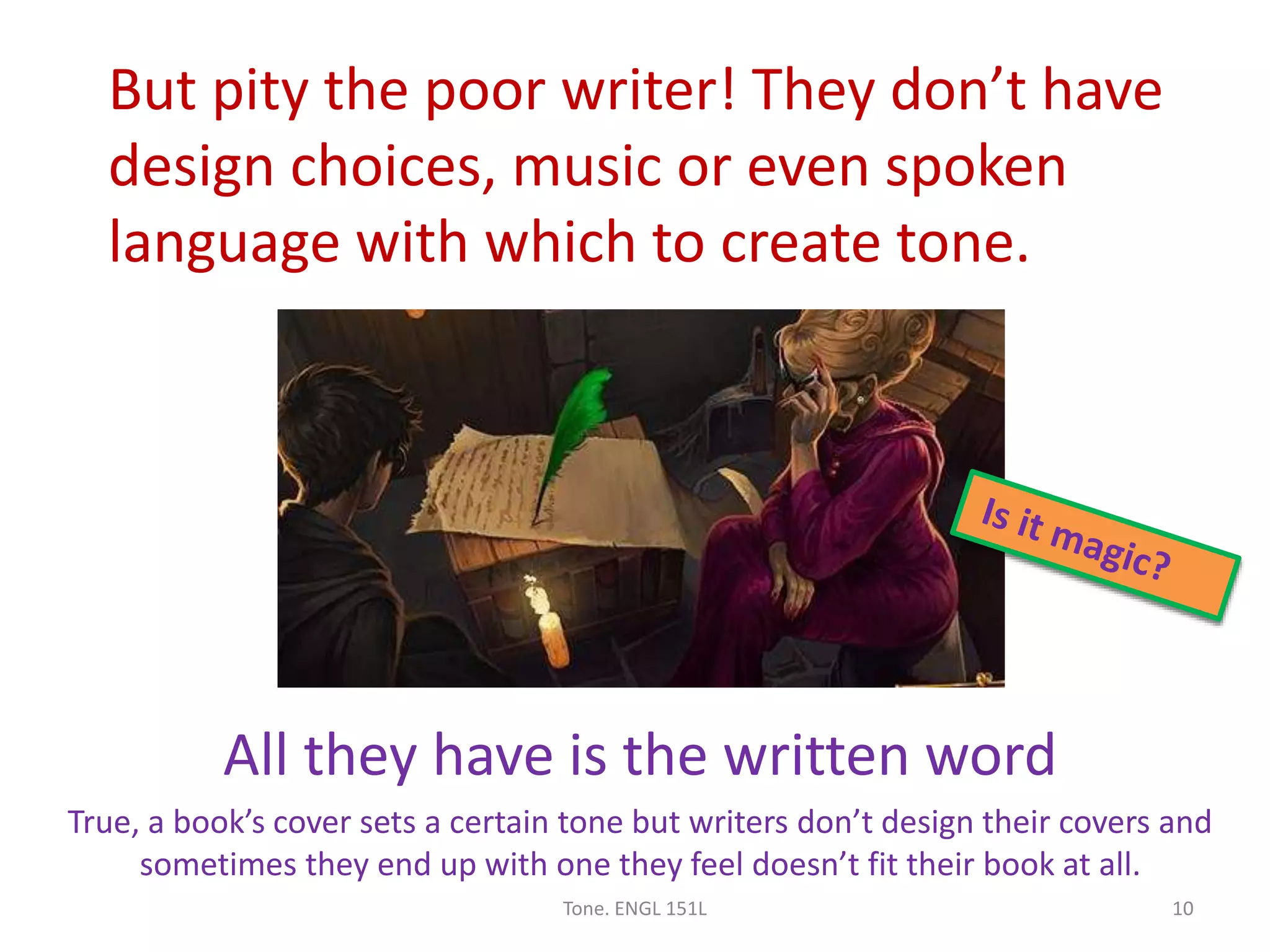
But pity the poor writer! They don’t have
design choices, music or even spoken
language with which to create tone.
All they have is the written word
True, a book’s cover sets a certain tone but writers don’t design their covers and
sometimes they end up with one they feel doesn’t fit their book at all.
Tone. ENGL 151L 10
So how do we
get tone into
written words?
Tone.
ENGL
151L
11
1. Figurative language –
Comparisons known as similes and
metaphors.
2. Style choices, especially around
specific words and the order
they’re in.
3. Descriptions of Settings – the
place and the feel of the time – also
create tone. We’ll cover Setting in a
later week.
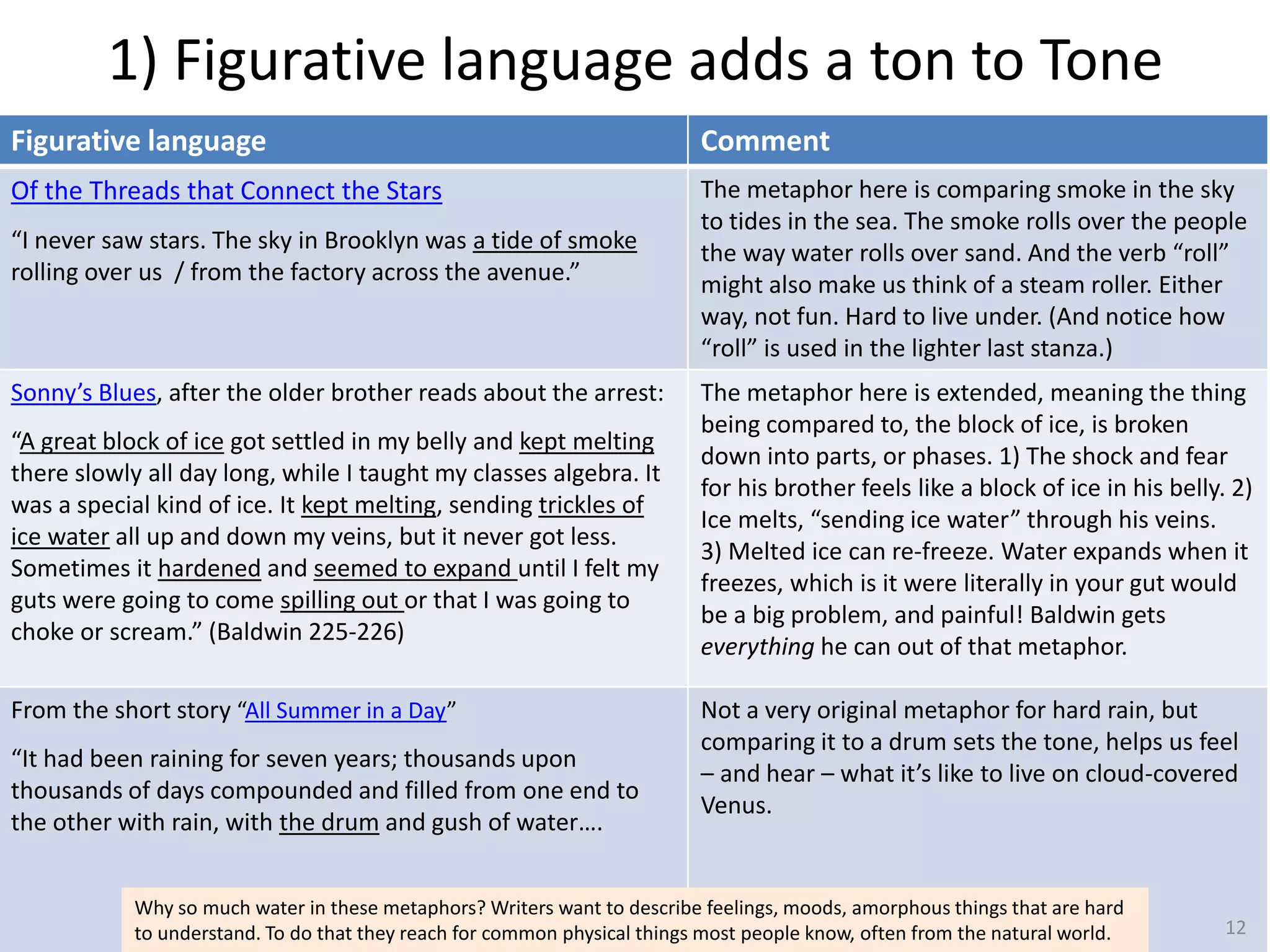
1) Figurative language adds a ton to Tone
Figurative language Comment
Of the Threads that Connect the Stars
“I never saw stars. The sky in Brooklyn was a tide of smoke
rolling over us / from the factory across the avenue.”
The metaphor here is comparing smoke in the sky
to tides in the sea. The smoke rolls over the people
the way water rolls over sand. And the verb “roll”
might also make us think of a steam roller. Either
way, not fun. Hard to live under. (And notice how
“roll” is used in the lighter last stanza.)
Sonny’s Blues, after the older brother reads about the arrest:
“A great block of ice got settled in my belly and kept melting
there slowly all day long, while I taught my classes algebra. It
was a special kind of ice. It kept melting, sending trickles of
ice water all up and down my veins, but it never got less.
Sometimes it hardened and seemed to expand until I felt my
guts were going to come spilling out or that I was going to
choke or scream.” (Baldwin 225-226)
The metaphor here is extended, meaning the thing
being compared to, the block of ice, is broken
down into parts, or phases. 1) The shock and fear
for his brother feels like a block of ice in his belly. 2)
Ice melts, “sending ice water” through his veins.
3) Melted ice can re-freeze. Water expands when it
freezes, which is it were literally in your gut would
be a big problem, and painful! Baldwin gets
everything he can out of that metaphor.
From the short story “All Summer in a Day”
“It had been raining for seven years; thousands upon
thousands of days compounded and filled from one end to
the other with rain, with the drum and gush of water….
Not a very original metaphor for hard rain, but
comparing it to a drum sets the tone, helps us feel
– and hear – what it’s like to live on cloud-covered
Venus.
12
Why so much water in these metaphors? Writers want to describe feelings, moods, amorphous things that are hard
to understand. To do that they reach for common physical things most people know, often from the natural world.
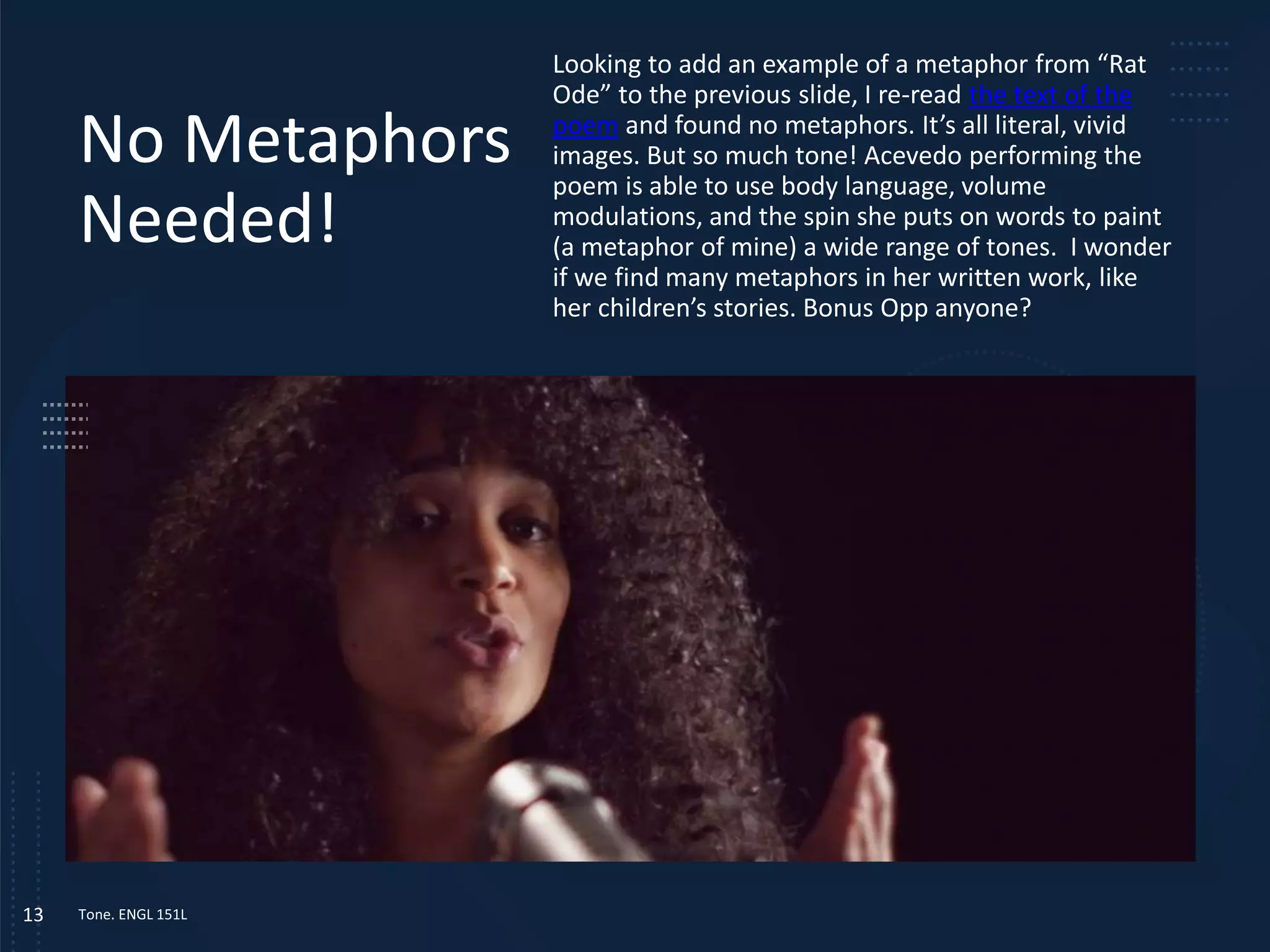
No Metaphors
Needed!
Looking to add an example of a metaphor from “Rat
Ode” to the previous slide, I re-read the text of the
poem and found no metaphors. It’s all literal, vivid
images. But so much tone! Acevedo performing the
poem is able to use body language, volume
modulations, and the spin she puts on words to paint
(a metaphor of mine) a wide range of tones. I wonder
if we find many metaphors in her written work, like
her children’s stories. Bonus Opp anyone?
Tone. ENGL 151L
13
2) Style Choices Shape Tone
Tone.
ENGL
151L
 The choice of words - Diction
• Casual to formal (or colloquial vs “standard” English)
• Concrete to abstract
• Usual to unusual (or conversational vs poetic)
 The order of the words - Syntax
• Expected to surprising
• Usual to unusual
 The types of sentences – Sentence Structure
• Short to long
• Simple, compound, complex
• Mainly the same to great variety
*Style is covered in more detail in a later lecture. Use it & this lecture if you focus
on style in an essay.
14
Example of style choices creating tone
in “Sonny’s Blues”
Tone.
ENGL
151L
“I read about it in the paper, in the subway, on my way to work. I read it, and I
couldn't believe it, and I read it again.”
This is the first line of “Sonny’s Blues.” We don’t even know what the “it” is yet
but we can sense it’s some unwelcome shock. Can you feel too that it’s not a
shock about world events but rather something personal to the narrator? The
more we read the better we get at hearing/feeling tone.
The repetition of “read it” 3x conveys his shock. Also, both sentences are made
of 3 short clauses. The syntax is almost a record skipping or someone stuttering.
Or a mind stopping and starting and stopping on one horrible fact. Which we
don’t even know yet!
15
Style choices creating tone in
“Of the Threads that Connect the Stars.”
Tone.
ENGL
151L
“My father saw stars. My son sees stars. The earth rolls beneath
our feet. We lurch ahead, and one day we have walked this far.”
This is the last 2 lines and also the last stanza. Like Baldwin, Espada repeats words and
word order, “My father…” “My son....” He also uses 3 short sentences in a row, like
Baldwin’s 3 clauses, to create a serious tone. Almost processional. But here the tone is
uplifting. We see that verb roll again. First it was the tide of smoke rolling over people.
Now it is the earth that “rolls beneath [their] feet.” As it should be. Time passes.
Generations heal and “one day we have walked this far.” Later in the semester we’ll talk
about how beat and meter create tone (it’s a whole science, ask MF Doom), but for now
I’ll just note that double beat of “this far.” Ta-dum. This type of beat in poetry is called a
spondee – two stressed syllables. A resounding ending. Imagine the line this way:
“We lurch ahead, and one day we have walked quite a long distance.”
Hmm. Not so strong. I also like how the “this” can refer to the poet, the son of the father
whose only stars were concussions, writing this tender, hopeful poem.
16
Style choices creating tone
in “Rat Ode”
Tone.
ENGL
151L
Diction choices: “You birthed a legion,” “You reigned that summer,” “You raise
yourself.” Here verbs are key to creating the tone.
Syntax: Acevedo’s diction (word order) is expected and usual. Conversation. Like
she is telling a story, but the other style choices and all the tone her spoken voice
adds make this more poem than story.
Sentence Structure:
Because you are not the admired nightingale.
Because you are not the noble doe.
Because you are not the blackbird.
The first 3 sentences begin with the same set of words, and then the next two
stanzas also start with “Because.” This creates great momentum and intensity.
Try it in an argument lol.
17
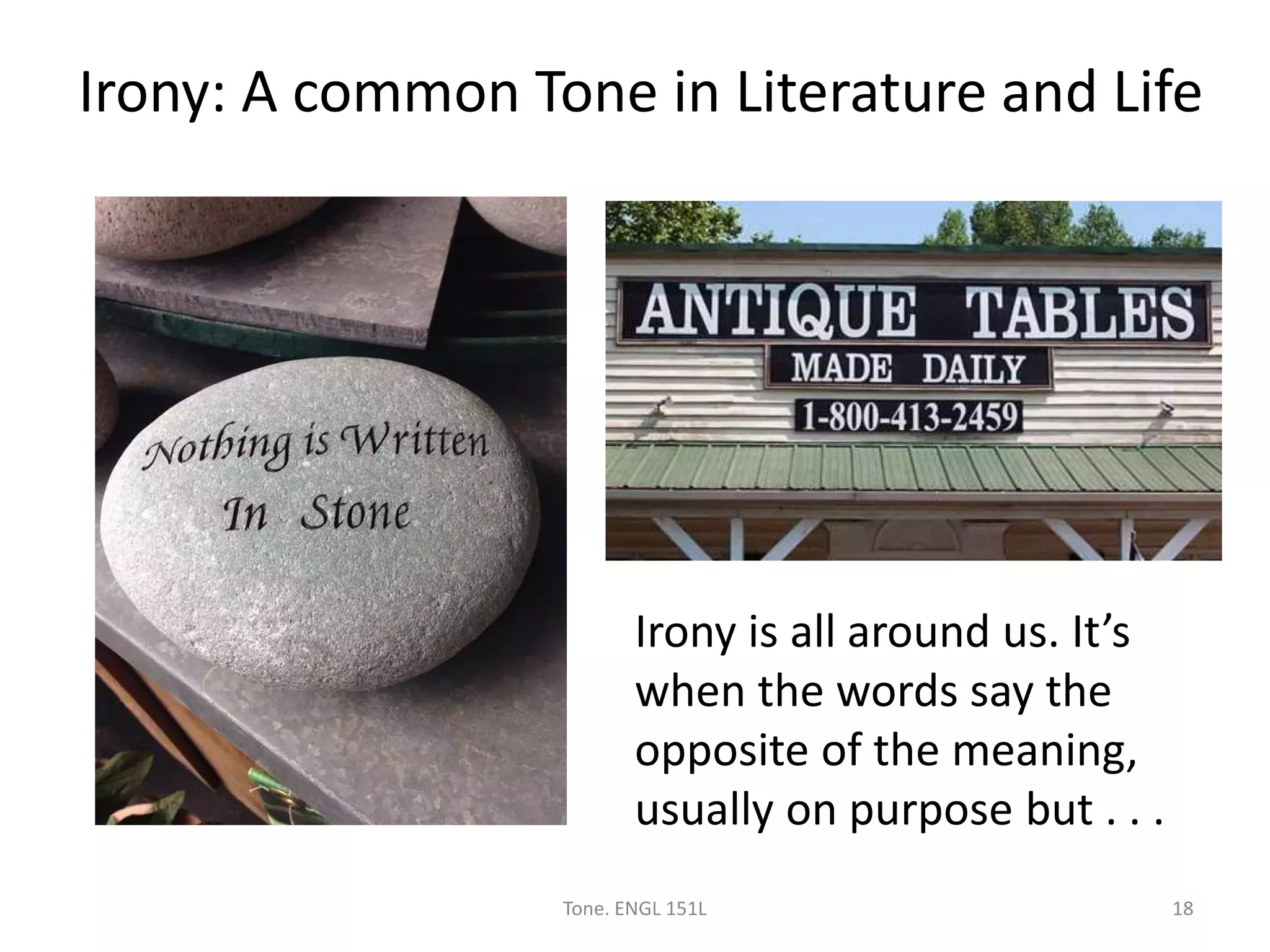
Irony: A common Tone in Literature and Life
Tone. ENGL 151L 18
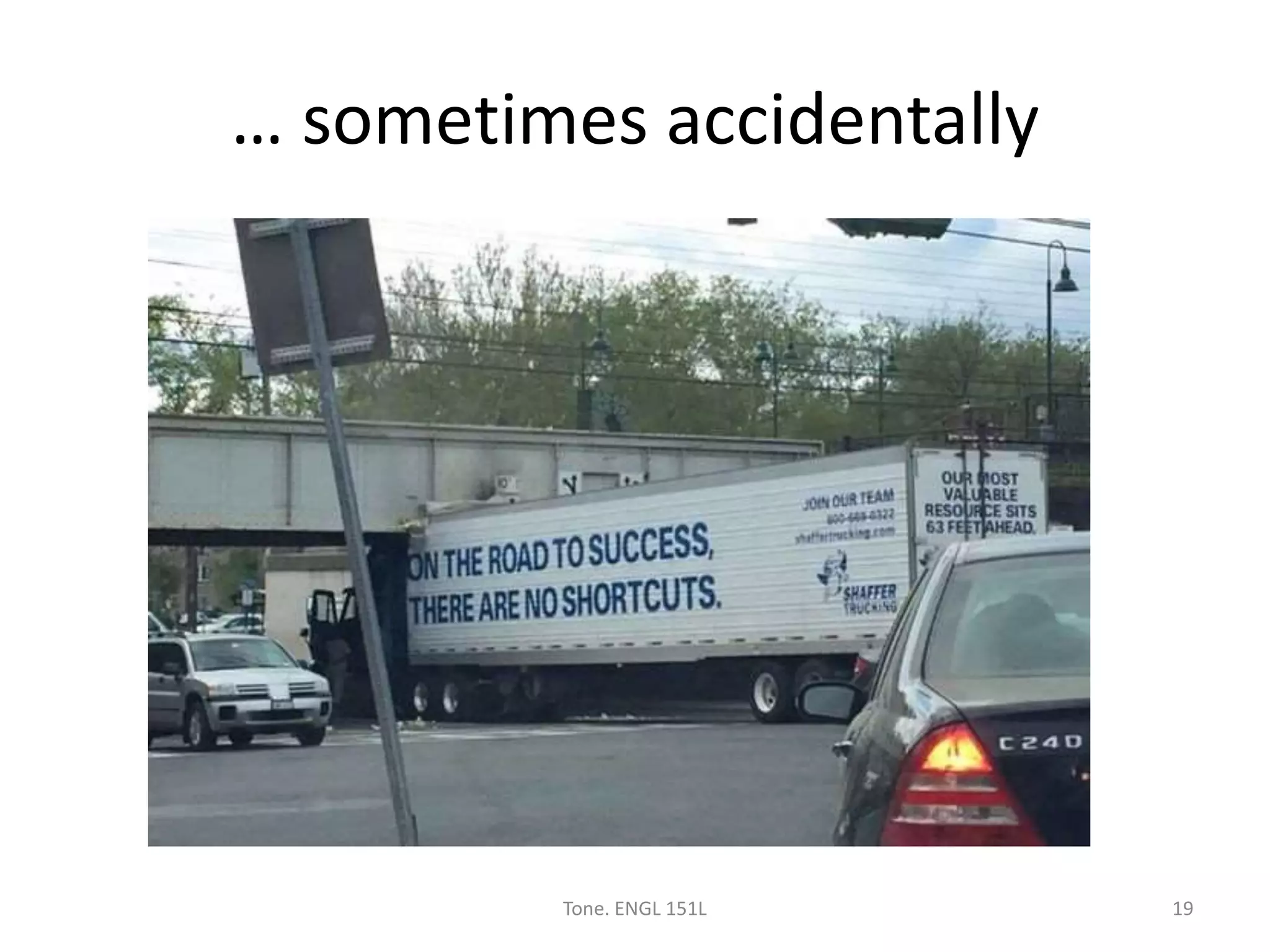
Irony is all around us. It’s
when the words say the
opposite of the meaning,
usually on purpose but . . .
… sometimes accidentally
Tone. ENGL 151L 19
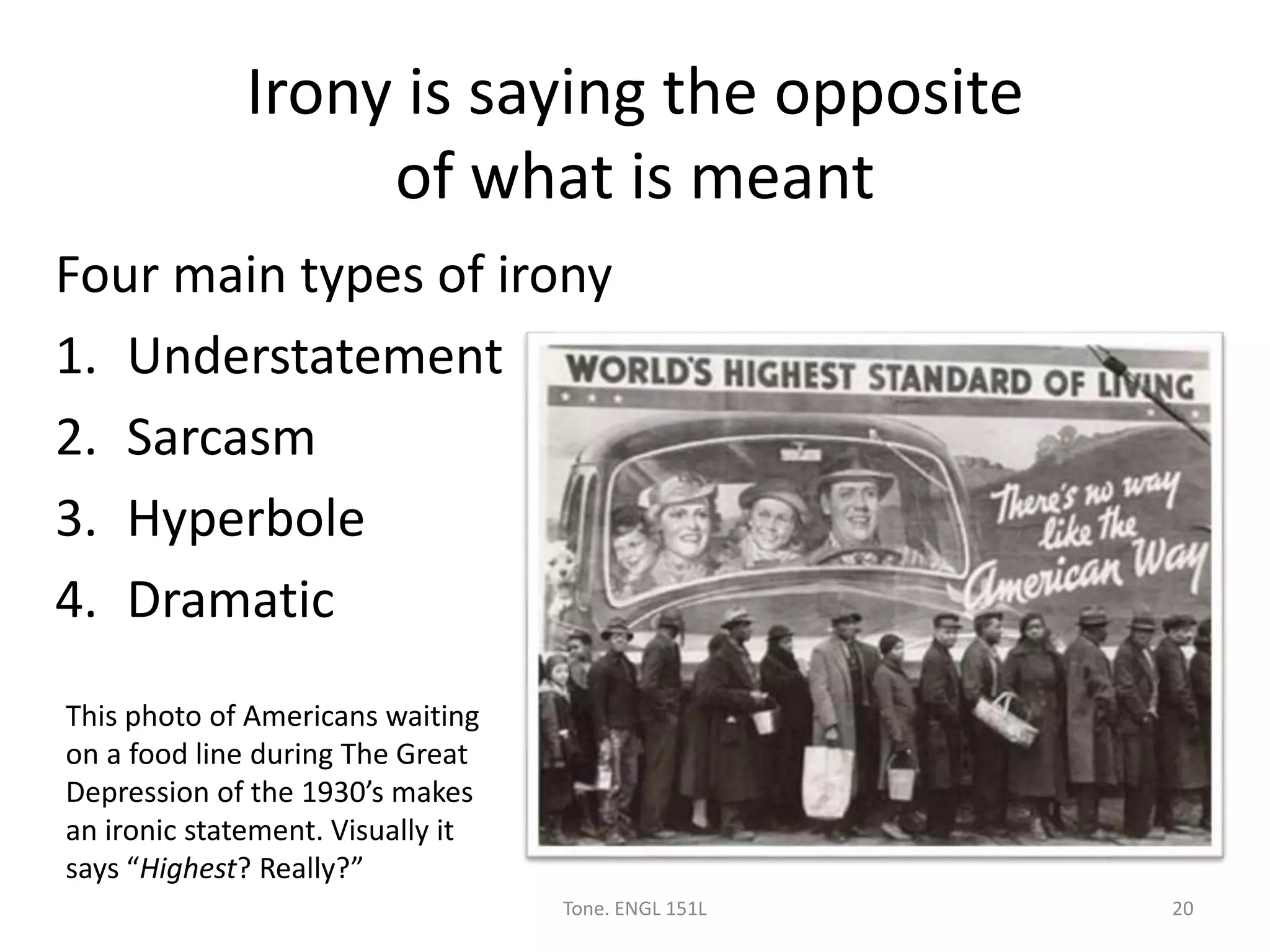
Irony is saying the opposite
of what is meant
Four main types of irony
1. Understatement
2. Sarcasm
3. Hyperbole
4. Dramatic
Tone. ENGL 151L 20
This photo of Americans waiting
on a food line during The Great
Depression of the 1930’s makes
an ironic statement. Visually it
says “Highest? Really?”
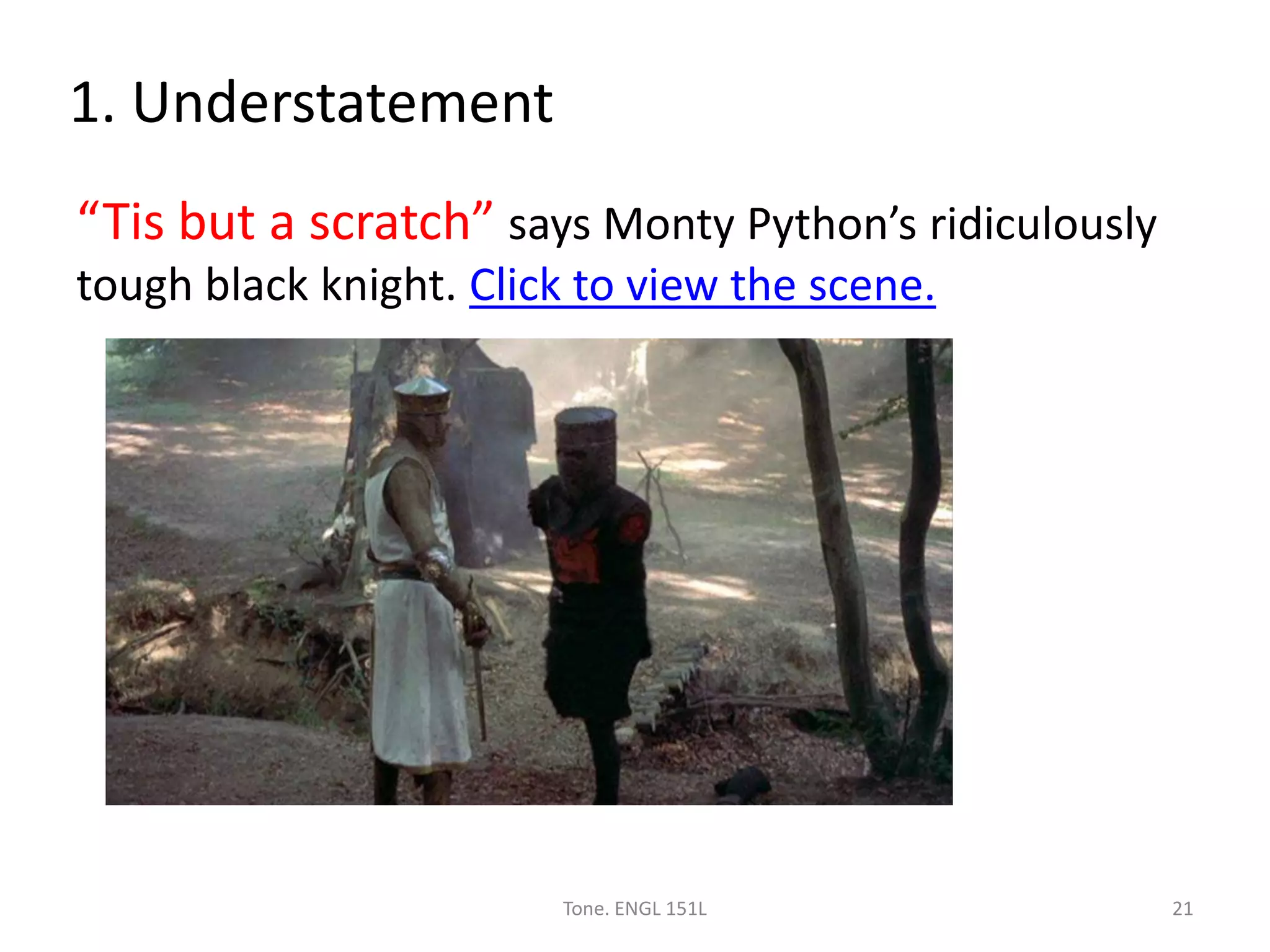
1. Understatement
“Tis but a scratch” says Monty Python’s ridiculously
tough black knight. Click to view the scene.
Tone. ENGL 151L 21
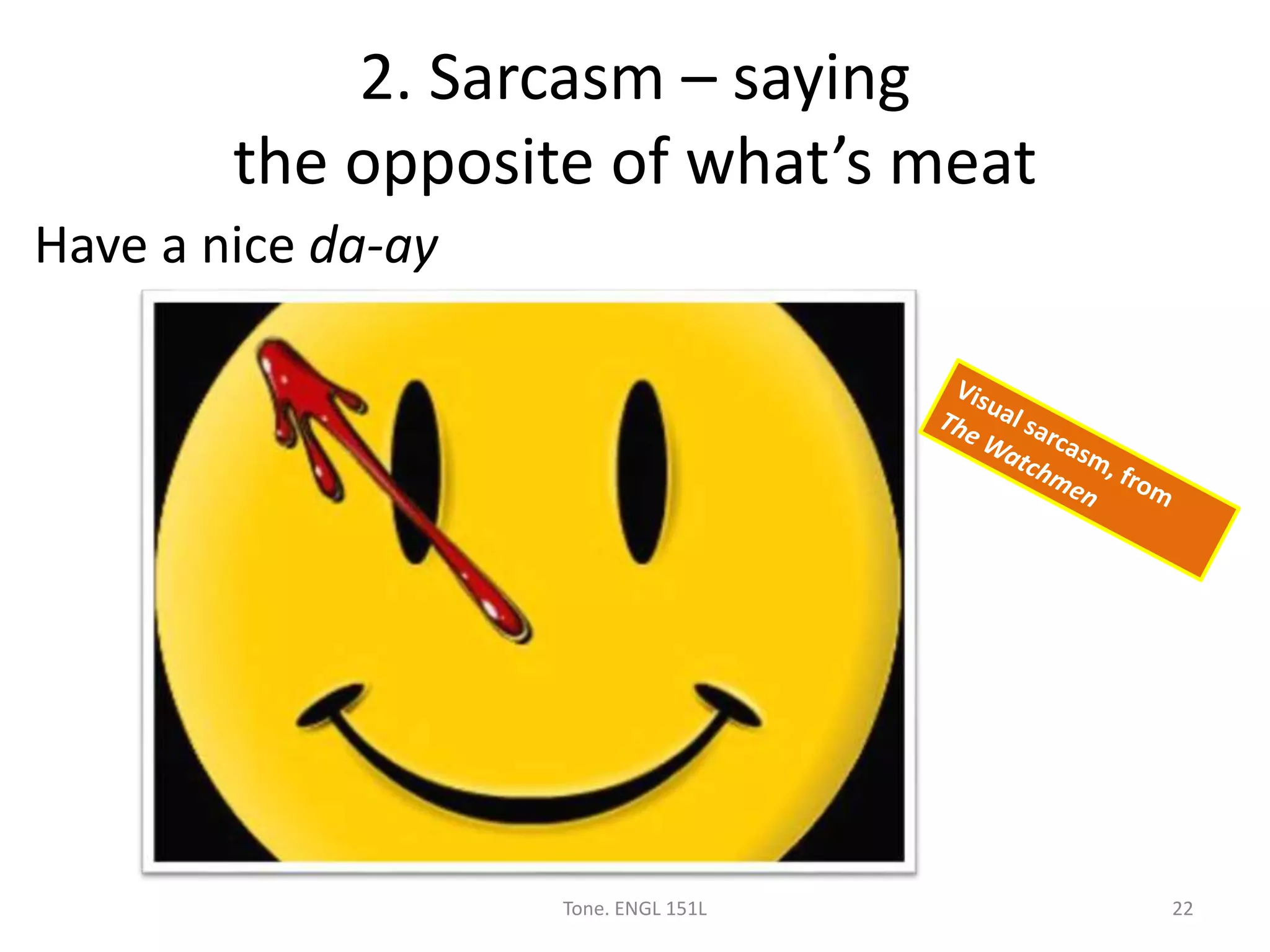
2. Sarcasm – saying
the opposite of what’s meat
Have a nice da-ay
Tone. ENGL 151L 22
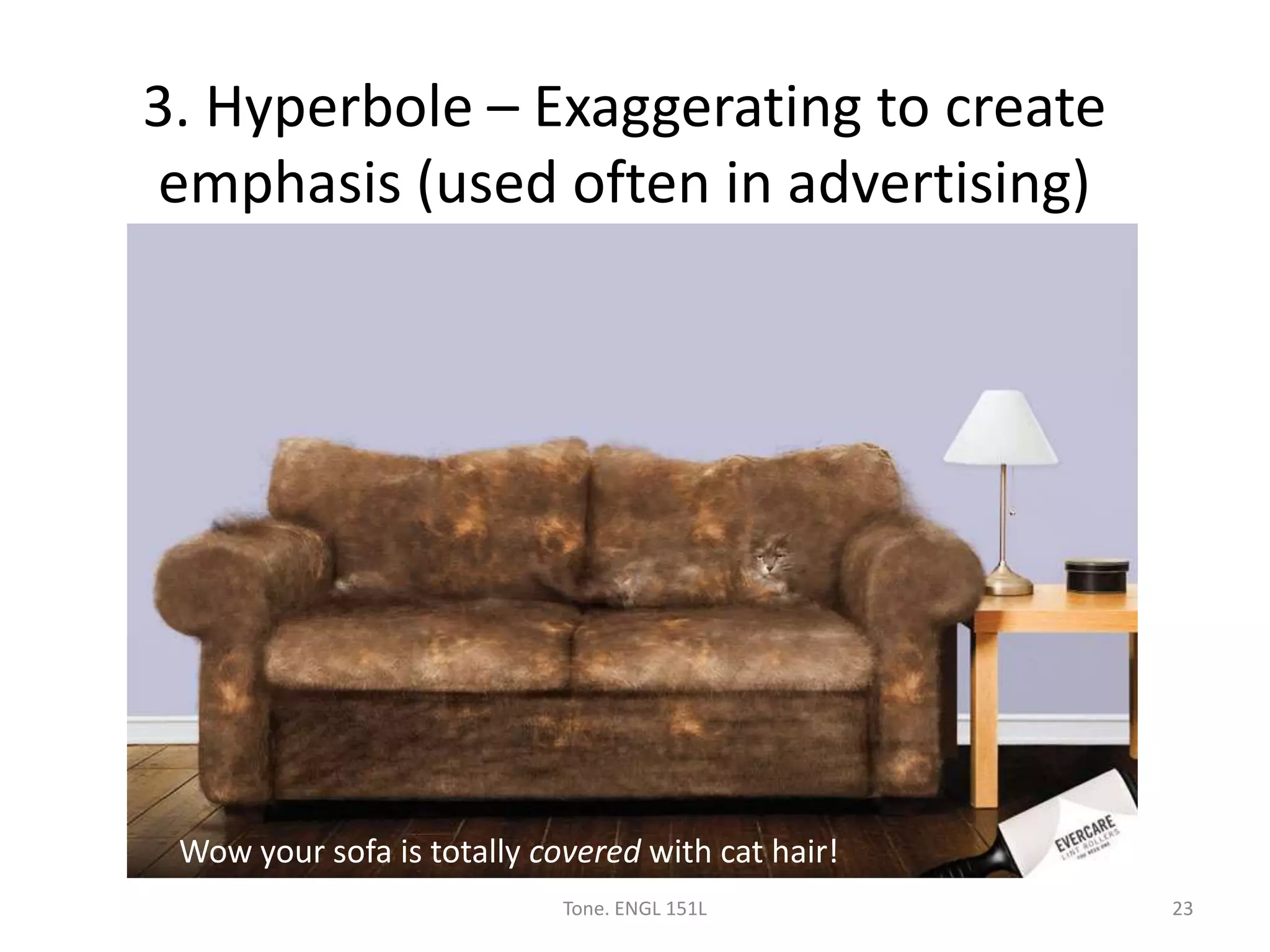
3. Hyperbole – Exaggerating to create
emphasis (used often in advertising)
Tone. ENGL 151L 23
Wow your sofa is totally covered with cat hair!
Watch sharp Irony reverse a whole crowd: Marc Anthony's oration
from Shakespeare's "Julius Caesar"
When that the poor have cried, Caesar wept:
Ambition should be made of sterner stuff:
Yet Brutus says he was ambitious;
And Brutus is an honorable man.
You all did see that on the Lupercal
I thrice presented [Caesar] a kingly crown,
Which he did thrice refuse: was this ambition?
Yet Brutus says he was ambitious;
And, sure, he is an honorable man.
I speak not to disprove what Brutus spoke,
But here I am to speak what I do know.
Tone. ENGL 151L 24
And Dramatic Irony
Dramatic irony is when the audience knows something a character doesn’t,
creating tension and, in comedy, humor. Examples past students sent:
• From Disney: Snow White doesn't know the old woman is the queen in
disguise or that the apple is poisoned. Little Mermaid’s Ariel doesn't know
Ursula is only using her to get to Triton. Eric doesn't know Ariel is a mermaid.
• In X-Men: First Class (the one with Fassbender & McAvoy) most of the
audience knows Charles & Erik end up lifelong enemies.
• Star Wars prequels: The audience knows Anakin will become Darth Vader.
• Flash: The audience knows Flash’s mentor Dr. Harrison Wells is not really
confined to that wheelchair and comes from the future.
• In The Dark Knight Rises, Selina / Catwoman leads Batman into Bane's trap,
only to discover too late that Batman is actually the millionaire Bruce Wayne,
which we haha knew all along. Ironic and dramatic.
If you think of a good new example, send it along for 10 Bonus Points – kgordon@Northampton.edu
Tone. ENGL 151L 25
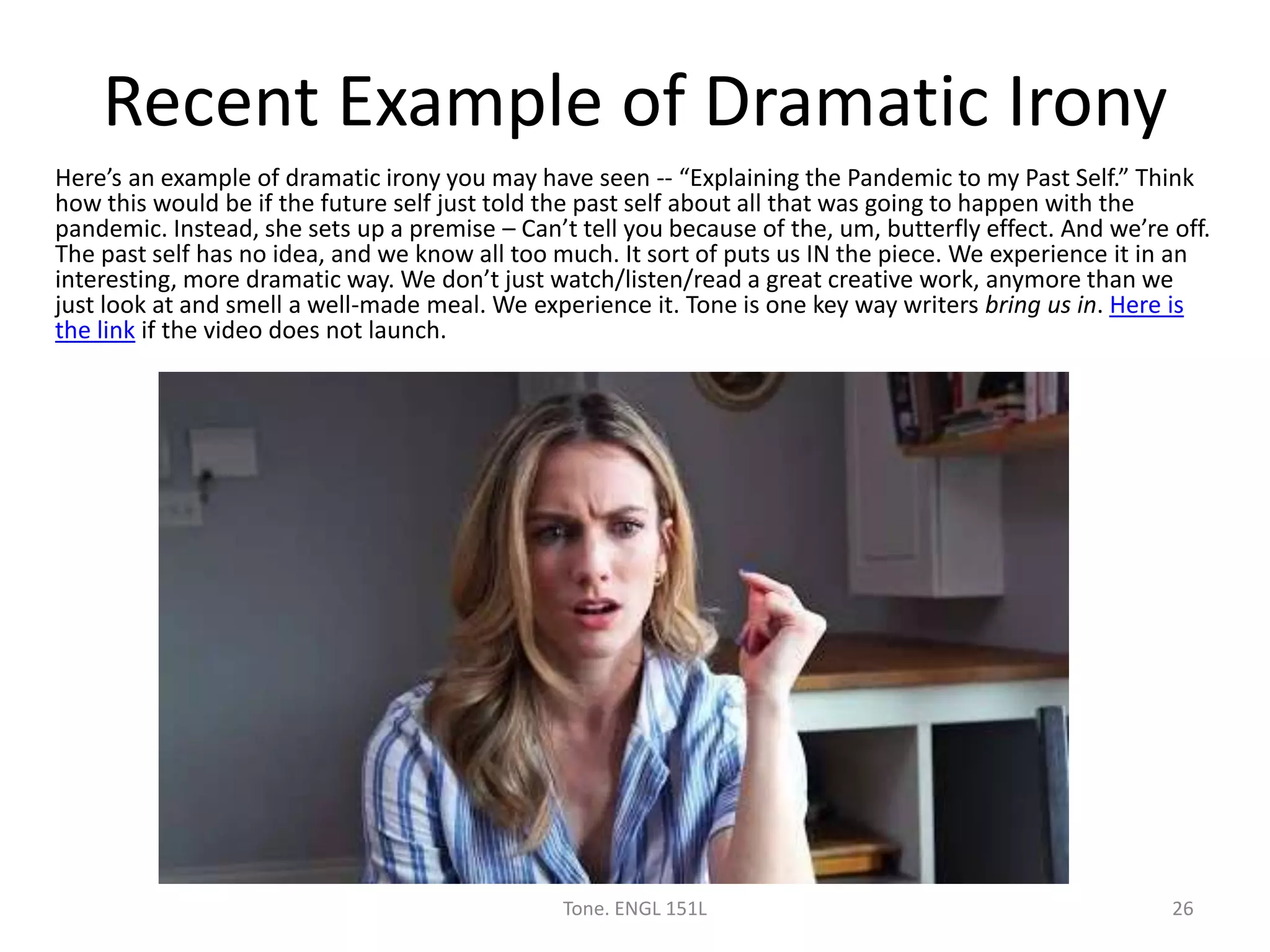
Recent Example of Dramatic Irony
Here’s an example of dramatic irony you may have seen -- “Explaining the Pandemic to my Past Self.” Think
how this would be if the future self just told the past self about all that was going to happen with the
pandemic. Instead, she sets up a premise – Can’t tell you because of the, um, butterfly effect. And we’re off.
The past self has no idea, and we know all too much. It sort of puts us IN the piece. We experience it in an
interesting, more dramatic way. We don’t just watch/listen/read a great creative work, anymore than we
just look at and smell a well-made meal. We experience it. Tone is one key way writers bring us in. Here is
the link if the video does not launch.
Tone. ENGL 151L 26
Questions to help with
a React and Response essay
once you’ve chosen a piece*
• How much is my response to the piece related to its tone?
• What 3 words describe the tone of this piece?
• Does the tone change? Where, how?
• What passage can I point to to show the tone and tone shifts?
• What example of tone-shaping figurative language can I quote?
• Are there any unusual words? What specific words add to the tone? (Discussion of
one word or phrase could be a whole paragraph in your essay. Look especially at
verbs.)
• Which passage really shows off the author’s style choices and how they add to the
tone?
• Does this lecture change my understanding of a piece? How?
• Is there any irony in the piece? What type(s)?
• Do I hear the tone more if I read a passage out loud? What if I try to read it with 2
very different tones? Do I feel the tone more when I read it out loud? Why?
*Any piece assigned or offered as optional extra in weeks 1-5 will work.
Tone. ENGL 151L 27

Tone lecture revised 9 15

  • 1.
  • 2.
    Tone is thewriter’s (or photographer’s) attitude toward the topic This colorful photo gives the feeling that writing is meditative, peaceful, recreational, restful. Even easy. A vacation activity: Let me jot down these thoughts while I have a moment. This stark black and white image, on the other hand, implies that writing is intense, gritty, personal, arduous. Pretty hard but maybe necessary: I have to stop and write this down right now! Tone. ENGL 151L 2
  • 3.
    Aren’t some scarymovies scary right from the start? Here the title design – its color, size and font – as well as the background set an ominous tone. Tone. ENGL 151L 3
  • 4.
    Deadpool’s spoofy, irreverentattitude toward super heroes shows in the main character’s body language. Tone. ENGL 151L 4
  • 5.
    And the tonecreated by this interesting image implies a complex, serious movie about identity. Notice too the design choices in the title. If you haven’t seen this award- winner yet, what do the design choices of the title lead you to expect? Tone. ENGL 151L 5
  • 6.
    Many choices, startingwith the title and its design, create the mood of a movie. TONE TONE TONE Tone. ENGL 151L 6
  • 7.
    Music and Tone Musicaffects tone too. With so many epic films, isn’t the sound track essential? What are your favorite examples? Wonder Woman, Iron Man, Black Panther, Fury Road? And going farther back Star Wars, Rocky, Jaws, The Godfather. We hear a few notes and feel it again – the power and mood of the movie. Tone. ENGL 151L 7
  • 8.
    Spoken Words and Tone Tone. ENGL 151L 8 In conversationand performed pieces (such as slam poetry, comedy, live plays), speakers put a lot of spin on language, giving some words more emphasis, changing the tone and often too the meaning. Oh no, you didn’t (just drop and break my phone) Oh no you didn’t (ruin my birthday party, somebody else did) Oh no you didn’t (get me this new phone for my birthday!!)
  • 9.
    Tone breaks through language barriers. 9 We can heartone of voice even in a language we don’t know. I was in Turkey once being hosted by the aunt of a Turkish friend. I didn’t know much Turkish yet, and she spoke little English. My first day there I got lost in the outdoor market. When we found each other, Husneye let out a stream of words. Her tone went from anxious to ticked off to relieved. I felt pretty sure she said something like – Where the heck were you?! Don’t wander off like that again! If I lose you Fatma will kill me. Well, anyway I found you, let’s go eat. I responded with a stream of English that she seemed to understand exactly. We laughed, and in laughter we were each multilingual. Do you have a story like this? There’s a forum thread for sharing. Tone. ENGL 151L
  • 10.
    But pity thepoor writer! They don’t have design choices, music or even spoken language with which to create tone. All they have is the written word True, a book’s cover sets a certain tone but writers don’t design their covers and sometimes they end up with one they feel doesn’t fit their book at all. Tone. ENGL 151L 10
  • 11.
    So how dowe get tone into written words? Tone. ENGL 151L 11 1. Figurative language – Comparisons known as similes and metaphors. 2. Style choices, especially around specific words and the order they’re in. 3. Descriptions of Settings – the place and the feel of the time – also create tone. We’ll cover Setting in a later week.
  • 12.
    1) Figurative languageadds a ton to Tone Figurative language Comment Of the Threads that Connect the Stars “I never saw stars. The sky in Brooklyn was a tide of smoke rolling over us / from the factory across the avenue.” The metaphor here is comparing smoke in the sky to tides in the sea. The smoke rolls over the people the way water rolls over sand. And the verb “roll” might also make us think of a steam roller. Either way, not fun. Hard to live under. (And notice how “roll” is used in the lighter last stanza.) Sonny’s Blues, after the older brother reads about the arrest: “A great block of ice got settled in my belly and kept melting there slowly all day long, while I taught my classes algebra. It was a special kind of ice. It kept melting, sending trickles of ice water all up and down my veins, but it never got less. Sometimes it hardened and seemed to expand until I felt my guts were going to come spilling out or that I was going to choke or scream.” (Baldwin 225-226) The metaphor here is extended, meaning the thing being compared to, the block of ice, is broken down into parts, or phases. 1) The shock and fear for his brother feels like a block of ice in his belly. 2) Ice melts, “sending ice water” through his veins. 3) Melted ice can re-freeze. Water expands when it freezes, which is it were literally in your gut would be a big problem, and painful! Baldwin gets everything he can out of that metaphor. From the short story “All Summer in a Day” “It had been raining for seven years; thousands upon thousands of days compounded and filled from one end to the other with rain, with the drum and gush of water…. Not a very original metaphor for hard rain, but comparing it to a drum sets the tone, helps us feel – and hear – what it’s like to live on cloud-covered Venus. 12 Why so much water in these metaphors? Writers want to describe feelings, moods, amorphous things that are hard to understand. To do that they reach for common physical things most people know, often from the natural world.
  • 13.
    No Metaphors Needed! Looking toadd an example of a metaphor from “Rat Ode” to the previous slide, I re-read the text of the poem and found no metaphors. It’s all literal, vivid images. But so much tone! Acevedo performing the poem is able to use body language, volume modulations, and the spin she puts on words to paint (a metaphor of mine) a wide range of tones. I wonder if we find many metaphors in her written work, like her children’s stories. Bonus Opp anyone? Tone. ENGL 151L 13
  • 14.
    2) Style ChoicesShape Tone Tone. ENGL 151L  The choice of words - Diction • Casual to formal (or colloquial vs “standard” English) • Concrete to abstract • Usual to unusual (or conversational vs poetic)  The order of the words - Syntax • Expected to surprising • Usual to unusual  The types of sentences – Sentence Structure • Short to long • Simple, compound, complex • Mainly the same to great variety *Style is covered in more detail in a later lecture. Use it & this lecture if you focus on style in an essay. 14
  • 15.
    Example of stylechoices creating tone in “Sonny’s Blues” Tone. ENGL 151L “I read about it in the paper, in the subway, on my way to work. I read it, and I couldn't believe it, and I read it again.” This is the first line of “Sonny’s Blues.” We don’t even know what the “it” is yet but we can sense it’s some unwelcome shock. Can you feel too that it’s not a shock about world events but rather something personal to the narrator? The more we read the better we get at hearing/feeling tone. The repetition of “read it” 3x conveys his shock. Also, both sentences are made of 3 short clauses. The syntax is almost a record skipping or someone stuttering. Or a mind stopping and starting and stopping on one horrible fact. Which we don’t even know yet! 15
  • 16.
    Style choices creatingtone in “Of the Threads that Connect the Stars.” Tone. ENGL 151L “My father saw stars. My son sees stars. The earth rolls beneath our feet. We lurch ahead, and one day we have walked this far.” This is the last 2 lines and also the last stanza. Like Baldwin, Espada repeats words and word order, “My father…” “My son....” He also uses 3 short sentences in a row, like Baldwin’s 3 clauses, to create a serious tone. Almost processional. But here the tone is uplifting. We see that verb roll again. First it was the tide of smoke rolling over people. Now it is the earth that “rolls beneath [their] feet.” As it should be. Time passes. Generations heal and “one day we have walked this far.” Later in the semester we’ll talk about how beat and meter create tone (it’s a whole science, ask MF Doom), but for now I’ll just note that double beat of “this far.” Ta-dum. This type of beat in poetry is called a spondee – two stressed syllables. A resounding ending. Imagine the line this way: “We lurch ahead, and one day we have walked quite a long distance.” Hmm. Not so strong. I also like how the “this” can refer to the poet, the son of the father whose only stars were concussions, writing this tender, hopeful poem. 16
  • 17.
    Style choices creatingtone in “Rat Ode” Tone. ENGL 151L Diction choices: “You birthed a legion,” “You reigned that summer,” “You raise yourself.” Here verbs are key to creating the tone. Syntax: Acevedo’s diction (word order) is expected and usual. Conversation. Like she is telling a story, but the other style choices and all the tone her spoken voice adds make this more poem than story. Sentence Structure: Because you are not the admired nightingale. Because you are not the noble doe. Because you are not the blackbird. The first 3 sentences begin with the same set of words, and then the next two stanzas also start with “Because.” This creates great momentum and intensity. Try it in an argument lol. 17
  • 18.
    Irony: A commonTone in Literature and Life Tone. ENGL 151L 18 Irony is all around us. It’s when the words say the opposite of the meaning, usually on purpose but . . .
  • 19.
  • 20.
    Irony is sayingthe opposite of what is meant Four main types of irony 1. Understatement 2. Sarcasm 3. Hyperbole 4. Dramatic Tone. ENGL 151L 20 This photo of Americans waiting on a food line during The Great Depression of the 1930’s makes an ironic statement. Visually it says “Highest? Really?”
  • 21.
    1. Understatement “Tis buta scratch” says Monty Python’s ridiculously tough black knight. Click to view the scene. Tone. ENGL 151L 21
  • 22.
    2. Sarcasm –saying the opposite of what’s meat Have a nice da-ay Tone. ENGL 151L 22
  • 23.
    3. Hyperbole –Exaggerating to create emphasis (used often in advertising) Tone. ENGL 151L 23 Wow your sofa is totally covered with cat hair!
  • 24.
    Watch sharp Ironyreverse a whole crowd: Marc Anthony's oration from Shakespeare's "Julius Caesar" When that the poor have cried, Caesar wept: Ambition should be made of sterner stuff: Yet Brutus says he was ambitious; And Brutus is an honorable man. You all did see that on the Lupercal I thrice presented [Caesar] a kingly crown, Which he did thrice refuse: was this ambition? Yet Brutus says he was ambitious; And, sure, he is an honorable man. I speak not to disprove what Brutus spoke, But here I am to speak what I do know. Tone. ENGL 151L 24
  • 25.
    And Dramatic Irony Dramaticirony is when the audience knows something a character doesn’t, creating tension and, in comedy, humor. Examples past students sent: • From Disney: Snow White doesn't know the old woman is the queen in disguise or that the apple is poisoned. Little Mermaid’s Ariel doesn't know Ursula is only using her to get to Triton. Eric doesn't know Ariel is a mermaid. • In X-Men: First Class (the one with Fassbender & McAvoy) most of the audience knows Charles & Erik end up lifelong enemies. • Star Wars prequels: The audience knows Anakin will become Darth Vader. • Flash: The audience knows Flash’s mentor Dr. Harrison Wells is not really confined to that wheelchair and comes from the future. • In The Dark Knight Rises, Selina / Catwoman leads Batman into Bane's trap, only to discover too late that Batman is actually the millionaire Bruce Wayne, which we haha knew all along. Ironic and dramatic. If you think of a good new example, send it along for 10 Bonus Points – kgordon@Northampton.edu Tone. ENGL 151L 25
  • 26.
    Recent Example ofDramatic Irony Here’s an example of dramatic irony you may have seen -- “Explaining the Pandemic to my Past Self.” Think how this would be if the future self just told the past self about all that was going to happen with the pandemic. Instead, she sets up a premise – Can’t tell you because of the, um, butterfly effect. And we’re off. The past self has no idea, and we know all too much. It sort of puts us IN the piece. We experience it in an interesting, more dramatic way. We don’t just watch/listen/read a great creative work, anymore than we just look at and smell a well-made meal. We experience it. Tone is one key way writers bring us in. Here is the link if the video does not launch. Tone. ENGL 151L 26
  • 27.
    Questions to helpwith a React and Response essay once you’ve chosen a piece* • How much is my response to the piece related to its tone? • What 3 words describe the tone of this piece? • Does the tone change? Where, how? • What passage can I point to to show the tone and tone shifts? • What example of tone-shaping figurative language can I quote? • Are there any unusual words? What specific words add to the tone? (Discussion of one word or phrase could be a whole paragraph in your essay. Look especially at verbs.) • Which passage really shows off the author’s style choices and how they add to the tone? • Does this lecture change my understanding of a piece? How? • Is there any irony in the piece? What type(s)? • Do I hear the tone more if I read a passage out loud? What if I try to read it with 2 very different tones? Do I feel the tone more when I read it out loud? Why? *Any piece assigned or offered as optional extra in weeks 1-5 will work. Tone. ENGL 151L 27