Putting one Word after the other: Word
Order
& how it creates Style
Best if read after the Word Choice Lecture
This lecture and Essay #3
In Essay #3, we explicate a poem, examining and
explaining how it is put together – its craft. One
aspect of an author’s craft is the order of the words.
Or ‘The order of the words is one aspect of an
author’s craft.”
or [with a diction edit that makes it more casual]
“Word order is a big part of a writer’s craft.”
Or… So many choices. This lecture looks at the why
and how of those choices.
Word Order. ENGL 151L 2
Word order choices
create a writer’s Style
To quote the Word Choice lecture: “A constant stream of choices
shapes a writer’s style.” In revising, skilled writers make small
changes that mark the writing as their own. Think of a musician
you love; can you recognize a new song by them right away?
That’s because you know their style well.
To achieve the style they want, writers make basic choices about
what order to put their words in – syntax. Related to that are the
types of sentences they tend to use – sentence structure.
In revising something for work or school, or in your social media
posts, do you ever change the order of your words to add a little
style or spin? Might you make a sentence longer or shorter to
better fit those you’re communicating with?
Word Order. ENGL 151L 3
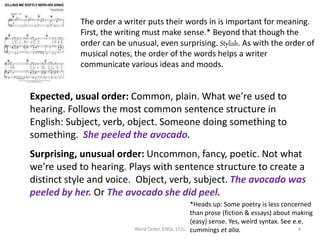
The order a writer puts their words in is important for meaning.
First, the writing must make sense.* Beyond that though the
order can be unusual, even surprising. Stylish. As with the order of
musical notes, the order of the words helps a writer
communicate various ideas and moods.
Word Order. ENGL 151L 4
*Heads up: Some poetry is less concerned
than prose (fiction & essays) about making
(easy) sense. Yes, weird syntax. See e.e.
cummings et alia.
Expected, usual order: Common, plain. What we’re used to
hearing. Follows the most common sentence structure in
English: Subject, verb, object. Someone doing something to
something. She peeled the avocado.
Surprising, unusual order: Uncommon, fancy, poetic. Not what
we’re used to hearing. Plays with sentence structure to create a
distinct style and voice. Object, verb, subject. The avocado was
peeled by her. Or The avocado she did peel.
Expected to Surprising
Syntax
Expected, usual order of words Surprising, unusual order of words
They shopped for a chair. For a chair they shopped
Joy came to them [I’m happy for them]. To them joy came [woo-hoo, yes!]
What do you want? You want what?
Hand me that pen please. That pen, please hand it to me.
I can dance Dance I can / Can I dance!
Now is the time The time is now [okay, LET’S DO IT!]
In much communication, the usual word
order is best. Be concise and clear.
In literary writing, it’s not about giving
instructions or explaining what happened.
It’s about creating experiences for us—
the readers—with the language.
Meaning might stay the same but tone &
emphasis are different.
Word Order. ENGL 151L 5
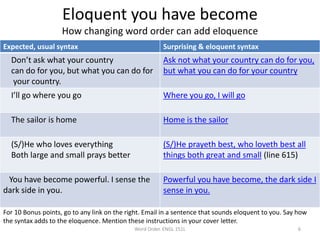
Eloquent you have become
How changing word order can add eloquence
Word Order. ENGL 151L 6
Expected, usual syntax Surprising & eloquent syntax
Don’t ask what your country
can do for you, but what you can do for
your country.
Ask not what your country can do for you,
but what you can do for your country
I’ll go where you go Where you go, I will go
The sailor is home Home is the sailor
(S/)He who loves everything
Both large and small prays better
(S/)He prayeth best, who loveth best all
things both great and small (line 615)
You have become powerful. I sense the
dark side in you.
Powerful you have become, the dark side I
sense in you.
For 10 Bonus points, go to any link on the right. Email in a sentence that sounds eloquent to you. Say how
the syntax adds to the eloquence. Mention these instructions in your cover letter.
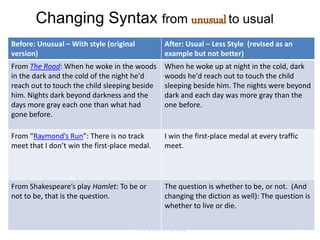
Changing Syntax from unusualto usual
Word Order. ENGL 151L 7
Before: Unusual – With style (original
version)
After: Usual – Less Style (revised as an
example but not better)
From The Road: When he woke in the woods
in the dark and the cold of the night he'd
reach out to touch the child sleeping beside
him. Nights dark beyond darkness and the
days more gray each one than what had
gone before.
When he woke up at night in the cold, dark
woods he'd reach out to touch the child
sleeping beside him. The nights were beyond
dark and each day was more gray than the
one before.
From “Raymond’s Run”: There is no track
meet that I don’t win the first-place medal.
I win the first-place medal at every traffic
meet.
From Shakespeare’s play Hamlet: To be or
not to be, that is the question.
The question is whether to be, or not. (And
changing the diction as well): The question is
whether to live or die.
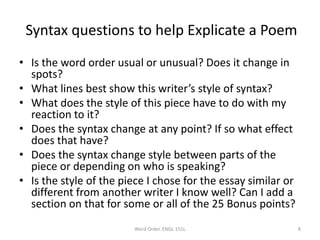
Syntax questions to help Explicate a Poem
• Is the word order usual or unusual? Does it change in
spots?
• What lines best show this writer’s style of syntax?
• What does the style of this piece have to do with my
reaction to it?
• Does the syntax change at any point? If so what effect
does that have?
• Does the syntax change style between parts of the
piece or depending on who is speaking?
• Is the style of the piece I chose for the essay similar or
different from another writer I know well? Can I add a
section on that for some or all of the 25 Bonus points?
Word Order. ENGL 151L 8
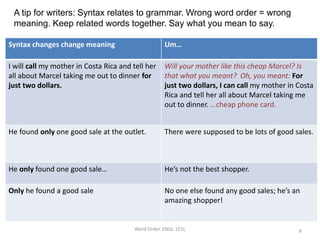
A tip for writers: Syntax relates to grammar. Wrong word order = wrong
meaning. Keep related words together. Say what you mean to say.
Word Order. ENGL 151L 9
Syntax changes change meaning Um…
I will call my mother in Costa Rica and tell her
all about Marcel taking me out to dinner for
just two dollars.
Will your mother like this cheap Marcel? Is
that what you meant? Oh, you meant: For
just two dollars, I can call my mother in Costa
Rica and tell her all about Marcel taking me
out to dinner. …cheap phone card.
He found only one good sale at the outlet. There were supposed to be lots of good sales.
He only found one good sale… He’s not the best shopper.
Only he found a good sale No one else found any good sales; he’s an
amazing shopper!
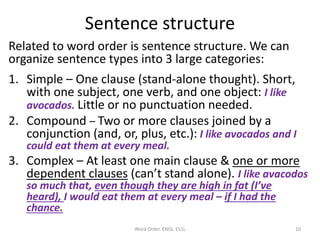
Sentence structure
Related to word order is sentence structure. We can
organize sentence types into 3 large categories:
1. Simple – One clause (stand-alone thought). Short,
with one subject, one verb, and one object: I like
avocados. Little or no punctuation needed.
2. Compound – Two or more clauses joined by a
conjunction (and, or, plus, etc.): I like avocados and I
could eat them at every meal.
3. Complex – At least one main clause & one or more
dependent clauses (can’t stand alone). I like avacodos
so much that, even though they are high in fat (I’ve
heard), I would eat them at every meal – if I had the
chance.
Word Order. ENGL 151L 10
Examples of Simple & Compound Sentences
Simple- One independent clause
• Then one day the lion was wounded in a fight with an elephant. He retired to his
cave and stayed there for several days. His friends came to offer sympathy. They
tried to catch prey for the hungry lion but failed. The camel had no problem as he
lived on grass while the others were starving. (The Camel & His Friends)
• I do not dance on my toes. I run. (Raymond’s Run)
• Ships at a distance have every man's wish on board. For some they come in with
the tide. (Their Eyes were Watching God)
Compound–Two+ simple sentences joined by and, oror but
• Then the second-graders line up and I don’t even bother to watch because
Raphael Perez always wins. (Raymond’s Run)
• Women forget all those things they don't want to remember, and remember
everything they don't want to forget. (Their Eyes were Watching God)
• I have eaten / the plums / that were in / the icebox // and which / you were
probably / saving / for breakfast [back slashes indicate line breaks in a poem.
Double shows a stanza break. See p ]
Word Order. ENGL 151L 11
Cormac McCarthy’s diction is unusual, as mentioned in
the Word Choice lecture. His sentence structure style is
to mix the simple and complex.
Schmoop has a brief analysis of McCarthy’s diction here. They quote this stunning passage
from The Road. I’ve put long and short sentences in different colors.
He rose and stood tottering in that cold autistic dark with his arms
outheld for balance while the vestibular calculations in his skull cranked
out their reckonings. An old chronicle. To seek out the upright. No fall
but preceded by a declination. [< 3 sentence fragments capture his
wandering thoughts.] He took great marching steps into the nothingness,
counting them against his return. Eyes closed, arms oaring. Upright to
what? Something nameless in the night, lode or matrix. To which he and
the stars were common satellite. Like the great pendulum in its rotunda
scribing through the long day movements of the universe of which you
may say it knows nothing and yet know it must.
Notice that this paragraph, which is the very first of the novel, starts and ends with a long
sentence. The first sentence has 27 words and the last 29. All the sentences in between,
except one, are short fragments.
Word Order. ENGL 151L 12
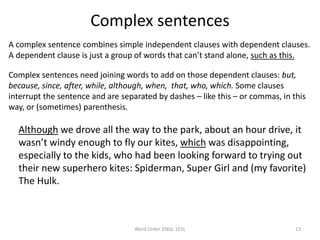
Complex sentences
A complex sentence combines simple independent clauses with dependent clauses.
A dependent clause is just a group of words that can’t stand alone, such as this.
Complex sentences need joining words to add on those dependent clauses: but,
because, since, after, while, although, when, that, who, which. Some clauses
interrupt the sentence and are separated by dashes – like this – or commas, in this
way, or (sometimes) parenthesis.
Although we drove all the way to the park, about an hour drive, it
wasn’t windy enough to fly our kites, which was disappointing,
especially to the kids, who had been looking forward to trying out
their new superhero kites: Spiderman, Super Girl and (my favorite)
The Hulk.
Word Order. ENGL 151L 13
Complex sentences help capture the complexity of
life. Reading more of them deepens your thinking.
Also called the periodic
sentence, a long complex
sentence builds on itself,
adding brick to brick,
thought to thought,
expectation growing.
There’s a pleasing variety
and texture poets love.
Sharon Olds’ poem “Sex
without Love” (572) starts
with a simple sentence then
dives into 3 long complex
ones. Here are two, with
the ellipses [. . . . ] showing
where one was left out.
How do they do it, the ones who make love
without love? [They are] Beautiful as dancers,
gliding over each other like ice skaters
over the ice, fingers hooked
inside each other’s bodies, faces
red as steak, wine, wet as the
children at birth whose mothers are going to
give them away [. . . .] They are
like great runners: they know they are alone
with the road surface, the cold, the wind,
the fit of their shoes, their over-all cardio-
vascular health – just factors, like the partner
in the bed, and not the truth, which is the
single body alone in the universe
against its own best time.
Word Order. ENGL 151L 14
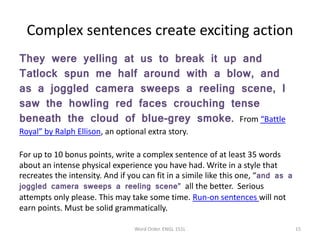
Complex sentences create exciting action
They were yelling at us to break it up and
Tatlock spun me half around with a blow, and
as a joggled camera sweeps a reeling scene, I
saw the howling red faces crouching tense
beneath the cloud of blue-grey smoke. From “Battle
Royal” by Ralph Ellison, an optional extra story.
For up to 10 bonus points, write a complex sentence of at least 35 words
about an intense physical experience you have had. Write in a style that
recreates the intensity. And if you can fit in a simile like this one, “and as a
joggled camera sweeps a reeling scene” all the better. Serious
attempts only please. This may take some time. Run-on sentences will not
earn points. Must be solid grammatically.
Word Order. ENGL 151L 15
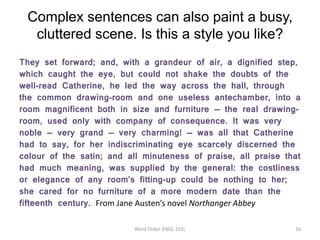
Complex sentences can also paint a busy,
cluttered scene. Is this a style you like?
They set forward; and, with a grandeur of air, a dignified step,
which caught the eye, but could not shake the doubts of the
well-read Catherine, he led the way across the hall, through
the common drawing-room and one useless antechamber, into a
room magnificent both in size and furniture -– the real drawing-
room, used only with company of consequence. It was very
noble -– very grand -– very charming! -– was all that Catherine
had to say, for her indiscriminating eye scarcely discerned the
colour of the satin; and all minuteness of praise, all praise that
had much meaning, was supplied by the general: the costliness
or elegance of any room’s fitting-up could be nothing to her;
she cared for no furniture of a more modern date than the
fifteenth century. From Jane Austen’s novel Northanger Abbey
Word Order. ENGL 151L 16
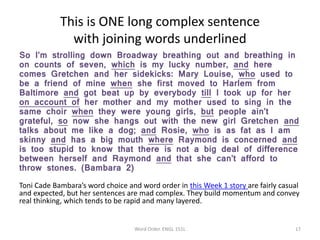
This is ONE long complex sentence
with joining words underlined
So I’m strolling down Broadway breathing out and breathing in
on counts of seven, which is my lucky number, and here
comes Gretchen and her sidekicks: Mary Louise, who used to
be a friend of mine when she first moved to Harlem from
Baltimore and got beat up by everybody till I took up for her
on account of her mother and my mother used to sing in the
same choir when they were young girls, but people ain’t
grateful, so now she hangs out with the new girl Gretchen and
talks about me like a dog; and Rosie, who is as fat as I am
skinny and has a big mouth where Raymond is concerned and
is too stupid to know that there is not a big deal of difference
between herself and Raymond and that she can’t afford to
throw stones. (Bambara 2)
Toni Cade Bambara’s word choice and word order in this Week 1 story are fairly casual
and expected, but her sentences are mad complex. They build momentum and convey
real thinking, which tends to be rapid and many layered.
Word Order. ENGL 151L 17
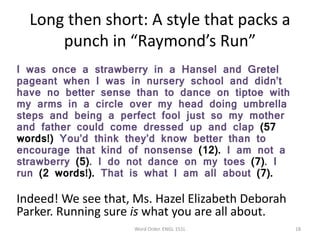
Long then short: A style that packs a
punch in “Raymond’s Run”
I was once a strawberry in a Hansel and Gretel
pageant when I was in nursery school and didn’t
have no better sense than to dance on tiptoe with
my arms in a circle over my head doing umbrella
steps and being a perfect fool just so my mother
and father could come dressed up and clap (57
words!) You’d think they’d know better than to
encourage that kind of nonsense (12). I am not a
strawberry (5). I do not dance on my toes (7). I
run (2 words!). That is what I am all about (7).
Indeed! We see that, Ms. Hazel Elizabeth Deborah
Parker. Running sure is what you are all about.
Word Order. ENGL 151L 18
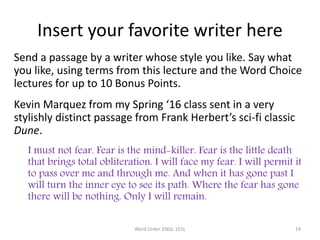
Insert your favorite writer here
Send a passage by a writer whose style you like. Say what
you like, using terms from this lecture and the Word Choice
lectures for up to 10 Bonus Points.
Kevin Marquez from my Spring ‘16 class sent in a very
stylishly distinct passage from Frank Herbert’s sci-fi classic
Dune.
I must not fear. Fear is the mind-killer. Fear is the little death
that brings total obliteration. I will face my fear. I will permit it
to pass over me and through me. And when it has gone past I
will turn the inner eye to see its path. Where the fear has gone
there will be nothing. Only I will remain.
Word Order. ENGL 151L 19
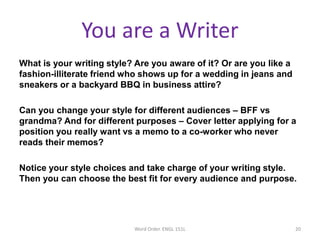
You are a Writer
What is your writing style? Are you aware of it? Or are you like a
fashion-illiterate friend who shows up for a wedding in jeans and
sneakers or a backyard BBQ in business attire?
Can you change your style for different audiences – BFF vs
grandma? And for different purposes – Cover letter applying for a
position you really want vs a memo to a co-worker who never
reads their memos?
Notice your style choices and take charge of your writing style.
Then you can choose the best fit for every audience and purpose.
Word Order. ENGL 151L 20
Sentence Structure questions to help
with an Explication Essay
• What does the sentence structure style of this
piece have to do with my reaction to it?
• Are most sentences simple, compound,
complex or is there a mix?
• Do the sentences change style between parts
of the piece or depending on who is speaking?
• Is the sentence style of the piece I chose
similar or different from another writer’s? Can
I add a section on that for bonus points?
Word Order. ENGL 151L 21
Tips for the Essay – If you choose to link your
reaction to syntax and/or sentence structure
• Study this lecture. Use terms and ideas from it.
• Be specific and concrete. When you make general statements, give
examples right away. Use the phrase “for example” a lot.
• Syntax may be harder to see than sentence structure or diction. If you
achieve a cogent discussion of it, even if just one paragraph, I’ll be
impressed.
• Sentence structure should be easy to see. Pick out a long, hard, unusual
sentence to discuss.
• I love analyzing style. If stuck, send me a passage from your piece and I’ll
analyze it with you.
• What if you say something wrong about style? Don’t worry. This is a
writing class not an upper level lit class. I’m interested in concrete,
detailed writing that shows thought and revision (often the same thing).
If the point you make is wrong, or not quite the way I see it, no harm
done. I might take the time to explain how I see it. If you show
engagement I will too.
Word Order. ENGL 151L 22

Word order lecture

  • 1.
    Putting one Wordafter the other: Word Order & how it creates Style Best if read after the Word Choice Lecture
  • 2.
    This lecture andEssay #3 In Essay #3, we explicate a poem, examining and explaining how it is put together – its craft. One aspect of an author’s craft is the order of the words. Or ‘The order of the words is one aspect of an author’s craft.” or [with a diction edit that makes it more casual] “Word order is a big part of a writer’s craft.” Or… So many choices. This lecture looks at the why and how of those choices. Word Order. ENGL 151L 2
  • 3.
    Word order choices createa writer’s Style To quote the Word Choice lecture: “A constant stream of choices shapes a writer’s style.” In revising, skilled writers make small changes that mark the writing as their own. Think of a musician you love; can you recognize a new song by them right away? That’s because you know their style well. To achieve the style they want, writers make basic choices about what order to put their words in – syntax. Related to that are the types of sentences they tend to use – sentence structure. In revising something for work or school, or in your social media posts, do you ever change the order of your words to add a little style or spin? Might you make a sentence longer or shorter to better fit those you’re communicating with? Word Order. ENGL 151L 3
  • 4.
    The order awriter puts their words in is important for meaning. First, the writing must make sense.* Beyond that though the order can be unusual, even surprising. Stylish. As with the order of musical notes, the order of the words helps a writer communicate various ideas and moods. Word Order. ENGL 151L 4 *Heads up: Some poetry is less concerned than prose (fiction & essays) about making (easy) sense. Yes, weird syntax. See e.e. cummings et alia. Expected, usual order: Common, plain. What we’re used to hearing. Follows the most common sentence structure in English: Subject, verb, object. Someone doing something to something. She peeled the avocado. Surprising, unusual order: Uncommon, fancy, poetic. Not what we’re used to hearing. Plays with sentence structure to create a distinct style and voice. Object, verb, subject. The avocado was peeled by her. Or The avocado she did peel.
  • 5.
    Expected to Surprising Syntax Expected,usual order of words Surprising, unusual order of words They shopped for a chair. For a chair they shopped Joy came to them [I’m happy for them]. To them joy came [woo-hoo, yes!] What do you want? You want what? Hand me that pen please. That pen, please hand it to me. I can dance Dance I can / Can I dance! Now is the time The time is now [okay, LET’S DO IT!] In much communication, the usual word order is best. Be concise and clear. In literary writing, it’s not about giving instructions or explaining what happened. It’s about creating experiences for us— the readers—with the language. Meaning might stay the same but tone & emphasis are different. Word Order. ENGL 151L 5
  • 6.
    Eloquent you havebecome How changing word order can add eloquence Word Order. ENGL 151L 6 Expected, usual syntax Surprising & eloquent syntax Don’t ask what your country can do for you, but what you can do for your country. Ask not what your country can do for you, but what you can do for your country I’ll go where you go Where you go, I will go The sailor is home Home is the sailor (S/)He who loves everything Both large and small prays better (S/)He prayeth best, who loveth best all things both great and small (line 615) You have become powerful. I sense the dark side in you. Powerful you have become, the dark side I sense in you. For 10 Bonus points, go to any link on the right. Email in a sentence that sounds eloquent to you. Say how the syntax adds to the eloquence. Mention these instructions in your cover letter.
  • 7.
    Changing Syntax fromunusualto usual Word Order. ENGL 151L 7 Before: Unusual – With style (original version) After: Usual – Less Style (revised as an example but not better) From The Road: When he woke in the woods in the dark and the cold of the night he'd reach out to touch the child sleeping beside him. Nights dark beyond darkness and the days more gray each one than what had gone before. When he woke up at night in the cold, dark woods he'd reach out to touch the child sleeping beside him. The nights were beyond dark and each day was more gray than the one before. From “Raymond’s Run”: There is no track meet that I don’t win the first-place medal. I win the first-place medal at every traffic meet. From Shakespeare’s play Hamlet: To be or not to be, that is the question. The question is whether to be, or not. (And changing the diction as well): The question is whether to live or die.
  • 8.
    Syntax questions tohelp Explicate a Poem • Is the word order usual or unusual? Does it change in spots? • What lines best show this writer’s style of syntax? • What does the style of this piece have to do with my reaction to it? • Does the syntax change at any point? If so what effect does that have? • Does the syntax change style between parts of the piece or depending on who is speaking? • Is the style of the piece I chose for the essay similar or different from another writer I know well? Can I add a section on that for some or all of the 25 Bonus points? Word Order. ENGL 151L 8
  • 9.
    A tip forwriters: Syntax relates to grammar. Wrong word order = wrong meaning. Keep related words together. Say what you mean to say. Word Order. ENGL 151L 9 Syntax changes change meaning Um… I will call my mother in Costa Rica and tell her all about Marcel taking me out to dinner for just two dollars. Will your mother like this cheap Marcel? Is that what you meant? Oh, you meant: For just two dollars, I can call my mother in Costa Rica and tell her all about Marcel taking me out to dinner. …cheap phone card. He found only one good sale at the outlet. There were supposed to be lots of good sales. He only found one good sale… He’s not the best shopper. Only he found a good sale No one else found any good sales; he’s an amazing shopper!
  • 10.
    Sentence structure Related toword order is sentence structure. We can organize sentence types into 3 large categories: 1. Simple – One clause (stand-alone thought). Short, with one subject, one verb, and one object: I like avocados. Little or no punctuation needed. 2. Compound – Two or more clauses joined by a conjunction (and, or, plus, etc.): I like avocados and I could eat them at every meal. 3. Complex – At least one main clause & one or more dependent clauses (can’t stand alone). I like avacodos so much that, even though they are high in fat (I’ve heard), I would eat them at every meal – if I had the chance. Word Order. ENGL 151L 10
  • 11.
    Examples of Simple& Compound Sentences Simple- One independent clause • Then one day the lion was wounded in a fight with an elephant. He retired to his cave and stayed there for several days. His friends came to offer sympathy. They tried to catch prey for the hungry lion but failed. The camel had no problem as he lived on grass while the others were starving. (The Camel & His Friends) • I do not dance on my toes. I run. (Raymond’s Run) • Ships at a distance have every man's wish on board. For some they come in with the tide. (Their Eyes were Watching God) Compound–Two+ simple sentences joined by and, oror but • Then the second-graders line up and I don’t even bother to watch because Raphael Perez always wins. (Raymond’s Run) • Women forget all those things they don't want to remember, and remember everything they don't want to forget. (Their Eyes were Watching God) • I have eaten / the plums / that were in / the icebox // and which / you were probably / saving / for breakfast [back slashes indicate line breaks in a poem. Double shows a stanza break. See p ] Word Order. ENGL 151L 11
  • 12.
    Cormac McCarthy’s dictionis unusual, as mentioned in the Word Choice lecture. His sentence structure style is to mix the simple and complex. Schmoop has a brief analysis of McCarthy’s diction here. They quote this stunning passage from The Road. I’ve put long and short sentences in different colors. He rose and stood tottering in that cold autistic dark with his arms outheld for balance while the vestibular calculations in his skull cranked out their reckonings. An old chronicle. To seek out the upright. No fall but preceded by a declination. [< 3 sentence fragments capture his wandering thoughts.] He took great marching steps into the nothingness, counting them against his return. Eyes closed, arms oaring. Upright to what? Something nameless in the night, lode or matrix. To which he and the stars were common satellite. Like the great pendulum in its rotunda scribing through the long day movements of the universe of which you may say it knows nothing and yet know it must. Notice that this paragraph, which is the very first of the novel, starts and ends with a long sentence. The first sentence has 27 words and the last 29. All the sentences in between, except one, are short fragments. Word Order. ENGL 151L 12
  • 13.
    Complex sentences A complexsentence combines simple independent clauses with dependent clauses. A dependent clause is just a group of words that can’t stand alone, such as this. Complex sentences need joining words to add on those dependent clauses: but, because, since, after, while, although, when, that, who, which. Some clauses interrupt the sentence and are separated by dashes – like this – or commas, in this way, or (sometimes) parenthesis. Although we drove all the way to the park, about an hour drive, it wasn’t windy enough to fly our kites, which was disappointing, especially to the kids, who had been looking forward to trying out their new superhero kites: Spiderman, Super Girl and (my favorite) The Hulk. Word Order. ENGL 151L 13
  • 14.
    Complex sentences helpcapture the complexity of life. Reading more of them deepens your thinking. Also called the periodic sentence, a long complex sentence builds on itself, adding brick to brick, thought to thought, expectation growing. There’s a pleasing variety and texture poets love. Sharon Olds’ poem “Sex without Love” (572) starts with a simple sentence then dives into 3 long complex ones. Here are two, with the ellipses [. . . . ] showing where one was left out. How do they do it, the ones who make love without love? [They are] Beautiful as dancers, gliding over each other like ice skaters over the ice, fingers hooked inside each other’s bodies, faces red as steak, wine, wet as the children at birth whose mothers are going to give them away [. . . .] They are like great runners: they know they are alone with the road surface, the cold, the wind, the fit of their shoes, their over-all cardio- vascular health – just factors, like the partner in the bed, and not the truth, which is the single body alone in the universe against its own best time. Word Order. ENGL 151L 14
  • 15.
    Complex sentences createexciting action They were yelling at us to break it up and Tatlock spun me half around with a blow, and as a joggled camera sweeps a reeling scene, I saw the howling red faces crouching tense beneath the cloud of blue-grey smoke. From “Battle Royal” by Ralph Ellison, an optional extra story. For up to 10 bonus points, write a complex sentence of at least 35 words about an intense physical experience you have had. Write in a style that recreates the intensity. And if you can fit in a simile like this one, “and as a joggled camera sweeps a reeling scene” all the better. Serious attempts only please. This may take some time. Run-on sentences will not earn points. Must be solid grammatically. Word Order. ENGL 151L 15
  • 16.
    Complex sentences canalso paint a busy, cluttered scene. Is this a style you like? They set forward; and, with a grandeur of air, a dignified step, which caught the eye, but could not shake the doubts of the well-read Catherine, he led the way across the hall, through the common drawing-room and one useless antechamber, into a room magnificent both in size and furniture -– the real drawing- room, used only with company of consequence. It was very noble -– very grand -– very charming! -– was all that Catherine had to say, for her indiscriminating eye scarcely discerned the colour of the satin; and all minuteness of praise, all praise that had much meaning, was supplied by the general: the costliness or elegance of any room’s fitting-up could be nothing to her; she cared for no furniture of a more modern date than the fifteenth century. From Jane Austen’s novel Northanger Abbey Word Order. ENGL 151L 16
  • 17.
    This is ONElong complex sentence with joining words underlined So I’m strolling down Broadway breathing out and breathing in on counts of seven, which is my lucky number, and here comes Gretchen and her sidekicks: Mary Louise, who used to be a friend of mine when she first moved to Harlem from Baltimore and got beat up by everybody till I took up for her on account of her mother and my mother used to sing in the same choir when they were young girls, but people ain’t grateful, so now she hangs out with the new girl Gretchen and talks about me like a dog; and Rosie, who is as fat as I am skinny and has a big mouth where Raymond is concerned and is too stupid to know that there is not a big deal of difference between herself and Raymond and that she can’t afford to throw stones. (Bambara 2) Toni Cade Bambara’s word choice and word order in this Week 1 story are fairly casual and expected, but her sentences are mad complex. They build momentum and convey real thinking, which tends to be rapid and many layered. Word Order. ENGL 151L 17
  • 18.
    Long then short:A style that packs a punch in “Raymond’s Run” I was once a strawberry in a Hansel and Gretel pageant when I was in nursery school and didn’t have no better sense than to dance on tiptoe with my arms in a circle over my head doing umbrella steps and being a perfect fool just so my mother and father could come dressed up and clap (57 words!) You’d think they’d know better than to encourage that kind of nonsense (12). I am not a strawberry (5). I do not dance on my toes (7). I run (2 words!). That is what I am all about (7). Indeed! We see that, Ms. Hazel Elizabeth Deborah Parker. Running sure is what you are all about. Word Order. ENGL 151L 18
  • 19.
    Insert your favoritewriter here Send a passage by a writer whose style you like. Say what you like, using terms from this lecture and the Word Choice lectures for up to 10 Bonus Points. Kevin Marquez from my Spring ‘16 class sent in a very stylishly distinct passage from Frank Herbert’s sci-fi classic Dune. I must not fear. Fear is the mind-killer. Fear is the little death that brings total obliteration. I will face my fear. I will permit it to pass over me and through me. And when it has gone past I will turn the inner eye to see its path. Where the fear has gone there will be nothing. Only I will remain. Word Order. ENGL 151L 19
  • 20.
    You are aWriter What is your writing style? Are you aware of it? Or are you like a fashion-illiterate friend who shows up for a wedding in jeans and sneakers or a backyard BBQ in business attire? Can you change your style for different audiences – BFF vs grandma? And for different purposes – Cover letter applying for a position you really want vs a memo to a co-worker who never reads their memos? Notice your style choices and take charge of your writing style. Then you can choose the best fit for every audience and purpose. Word Order. ENGL 151L 20
  • 21.
    Sentence Structure questionsto help with an Explication Essay • What does the sentence structure style of this piece have to do with my reaction to it? • Are most sentences simple, compound, complex or is there a mix? • Do the sentences change style between parts of the piece or depending on who is speaking? • Is the sentence style of the piece I chose similar or different from another writer’s? Can I add a section on that for bonus points? Word Order. ENGL 151L 21
  • 22.
    Tips for theEssay – If you choose to link your reaction to syntax and/or sentence structure • Study this lecture. Use terms and ideas from it. • Be specific and concrete. When you make general statements, give examples right away. Use the phrase “for example” a lot. • Syntax may be harder to see than sentence structure or diction. If you achieve a cogent discussion of it, even if just one paragraph, I’ll be impressed. • Sentence structure should be easy to see. Pick out a long, hard, unusual sentence to discuss. • I love analyzing style. If stuck, send me a passage from your piece and I’ll analyze it with you. • What if you say something wrong about style? Don’t worry. This is a writing class not an upper level lit class. I’m interested in concrete, detailed writing that shows thought and revision (often the same thing). If the point you make is wrong, or not quite the way I see it, no harm done. I might take the time to explain how I see it. If you show engagement I will too. Word Order. ENGL 151L 22