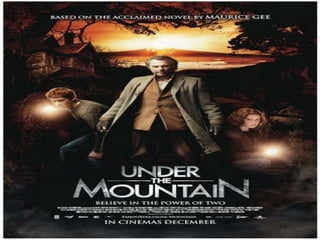
UNDER THE MOUNTAIN Maurice Gee
MAURICE GEE Maurice Gough Gee was born in 1931, the middle of three brothers, and spent his childhood and school years in the small semi-rural town of Henderson west of Auckland. He has published over a dozen novels, a collection of short stories, and at least eight books of fiction for children.  Live Bodies won the New Zealand Book of the Year Award in 1998. Plumb (1978), the first in a trilogy of novels covering over a century of New Zealand history, earned him four awards including the James Tait Black Memorial Prize in Britain.  Maurice received a Distinguished Alumni Award in 1998, and was awarded an honorary Doctor of Literature in 2004.  Gathering
CHARACTER OVERVIEW In pairs, list all the characters introduced in chapter 1 & 2 and beside each write a description next to each one. Thinking Relating to others Using language, text and symbols Managing self Participating and contributing Gathering
CHAPTER 2 Imagine that you are either Theo or Rachel and write a letter to your mum and dad telling them what you have been doing so far. Include  – Going to the beach Going to Mount Eden Seeing Mr Jones Theo – the canoe ride on the lake Rachel – going to the library Your thoughts and feelings about being on holiday You should write at least 150 words. Thinking Using language, text and symbols Managing self Processing Applying
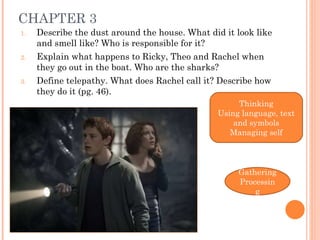
CHAPTER 3 Describe the dust around the house. What did it look like and smell like? Who is responsible for it? Explain what happens to Ricky, Theo and Rachel when they go out in the boat. Who are the sharks? Define telepathy. What does Rachel call it?  Describe how they do it (pg. 46). Thinking Using language, text and symbols Managing self Gathering Processing
CHAPTER 4 What do the twins hear coming from the Wilberforce's house? Describe what they see in the Wilberforce's house. Explain how they escape. Thinking Using language, text and symbols Managing self Gathering Processing
CHAPTER 5 Draw a picture of Theo and Rachel going down the tunnel. Describe the room at the end of the tunnel. Explain how the twins repel the slugs. How did they escape and where did they end up? Thinking Using language, text and symbols Managing self Gathering Processing
PLOT STRUCTURE Every plot or story usually follows the same structure. It begins setting the scene or describing the  situation , then we are introduced to a  conflict  or problem, the action then reaches a climax or  crisis  where all of the characters from all the different plots meet up and the story is  resolved  (resolution). Under the following headings write 3 bullet points that outline what happens. You may work in pairs. Situation Conflict Crisis Point Resolution Thinking Relating to others Using language, text and symbols Managing self Participating and contributing Gathering
NARRATION Under the Mountain is written in the 3rd person. Third person point of view can be recognized by the author's use of the pronouns he, she, it or they.  The narrator is not a part of the action, and can be in the mind of one or more characters at once but is still limited.   For example, “ For a while  he  lay gasping and winded…” “’ It was all my fault!’  Natalie  wept…” “ Sophie was tumbling in ever expanding spaces…” The benefits of writing in 3rd person are: Third person is usually more formal, but it allows you to flesh out many different characters. And with this style, it's much easier to keep a novel interesting, because whenever it needs a change you can just switch to someone else.  Seeing different perspectives about a certain event really helps you to get to know yourself and gain an understanding of others.  Most fantasy novels are third-person.  Gathering
NARRATION Writing in the third person is like remembering a movie you have watched and all you are doing is writing down what you saw in the scenes from the movie.  If you want a broader perspective you simply pan your mental camera out for a large scene and describe what you see in my mind's eye.  If you want a narrower perspective you zoom in on one or two characters at a time. Task: Creative Writing Re-read chapter 11 and chapter 12 up to the bottom of page 148. Describe what you think would of happened to Ricky. Write in 3rd person. Write at least 150 words. Thinking Using language, text and symbols Managing self Processing Applying
CHARACTER In pairs, using the chart, compare and contrast 2 characters. Differences  Similarities Differences Thinking Relating to others Using language, text and symbols Managing self Participating and contributing Gathering processing Rachel Mr Jones
CHARACTER: PURPOSE For each of the following characters write 2-3 sentences to describe what you think their purpose was in the novel. Theo Rachel Mr Jones Mr Wilberforce Ricky Consider the following to help you: Why is their story important? Who did they hinder/help? How are they presented by the author – positively, negatively or neutrally? What is the most important thing that they do on the novel? What did you learn from them? Thinking Using language, text and symbols Managing self Processing Applying
LINK THE FOLLOWING SPEECH BUBBLES TO THE CHARACTER WHO SPOKE IT. Rachel Theo Mr Jones Ricky They aren’t porpoises – they’re sharks! Ch. 3 Help me twins, before it is too late. Ch. 4 You don’t have to get burned. Ch.9 They’re coming I can hear them.  Ch.12 Just learn to hold the stone. Ch. 9 Oh, please. Don’t treat me like a child.  Ch. 7 I’ll take you for a spin one day. Ch. 1 I’ll be guarding you. Ch. 6 Shine the torch in his eyes! Ch. 4 We’re a people dead and gone and memory is painful.  Ch. 6 TUMP Gathering Processing
CLOSE READING Explain what  bewildered  means on page 11. Explain why Ricky says: “Let me warm my hands.”(pg. 15) Describe Mr Wilberforce (pg. 26). Why do Rachel and Theo want to “be themselves”? (pg. 33) Describe the process of ‘pebbling’. (pg. 46) Write 2-3 sentences to describe the stones. (pg 48) What were the names of the other twins and where were they from?(pg.93) Describe what happened to the other twins. (pg. 96) Explain how Rachel and Theo fight the Wilberforce on page 103. Write the simile that describes Theo’s actions on page 104. Thinking Using language, text and symbols Managing self Gathering Processing
CHARACTER ESSAY Identify an important character in the text and explain why they are important. Write at least 250 words. Thinking Using language, text and symbols Managing self Processing Applying
SETTING Setting should be apparent from the book's first chapters.  It is commonly where the story takes place and can include a particular location, a city, or a country.   There will almost always be more than one setting in a novel.  Setting can include a time period if the book takes place before the present.   Setting is not the same as the context because it is directly related to the action that takes place.
SETTING List all the different settings from the novel. Match 2-3 characters with each setting. Choose and describe a setting from the novel using the describe filter. Draw a map of the setting. Using a compare and contrast chart, analyse 2 settings from the novel.  Thinking Using language, text and symbols Managing self Gathering Processing
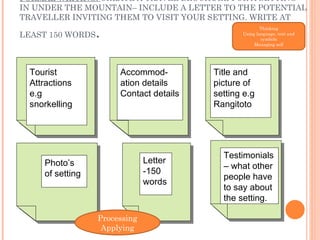
FORMAL WRITING:  CREATE A TRAVEL BROCHURE FOR A SETTING IN UNDER THE MOUNTAIN– INCLUDE A LETTER TO THE POTENTIAL TRAVELLER INVITING THEM TO VISIT YOUR SETTING. WRITE AT LEAST 150 WORDS . Tourist Attractions e.g snorkelling Accommod-ation details Contact details Title and picture of setting e.g Rangitoto Photo’s of setting Letter-150 words Testimonials – what other people have to say about the setting. Thinking Using language, text and symbols Managing self Processing Applying
SETTING DESCRIPTION 150 words 1.  Describe the setting – 50 words For example, Rangitoto is a dormant volcano in the stunning Waitemata Harbour. It is covered in luscious green bush but also a lot of loose grey/black scree etc. 2.  Explain where it is and how to get there – 50 words For example, Rangitoto is accessible by sea and by tunnel. The tunnels are very exciting because… 3.  Describe what you can do there – 50 words For example, Once you are there you can simply swim in the clear sparkling water or you can… 4.  End with a slogan For example, Rangitoto. A rare and wonderful experience.
WHAT IS A THEME? Themes are the "keys" to understanding the novel.  All novels and poems have themes that the author wants to get across to the reader.  If nothing else, a theme is the impression that a reader gets that the book is about.   It is not the action of the story, but rather the reader's interpretation of the purpose of the action.   A theme can be a moral but it is not the same thing because not all books have traditional morals.   Themes are arguably the most important aspect of a novel because they are the reason for the author's writing the novel.   Themes are often vague principles or emotions, such as good versus evil, abuse of power, love, change or growing up.   The 2 themes that we will study are: 1.  Good vs.Evil 2. Earth’s Vulnerability: Destruction  Gathering
GOOD VS. EVIL This is a very common theme in literature and usually good conquers over evil. In UTM, good is represented by the twins and Mr Jones who have to outwit the evil of the Wilberforce’s who want to takeover and destroy the Earth.  Mr Jones has to train the twins so that their powers can overcome the evil of the Wilberforce’s in order to save the planet.  This theme is also a metaphor to help us think about the good and the evil amongst humans than we witness on an everyday basis. Gathering
READ CHAPTER 8 & COMPLETE THE CHART BELOW: Thinking Using language, text and symbols Managing self Participating and  contributing Gathering Processing Characters Explanation Quote Good 1.Rachel 2. Mr Jones 1.Rachel thinks that they should try and save the Wilberforce’s because they are the last of their kind. 2.  pg.99 Pg. 110 Evil 3. Wilberforces 3.  3. Pg. 107
EARTH’S VULNERABILITY: DESTRUCTION The Wilberforce’s are the characters that are intent on destroying the Earth in the novel.  This does make us think about Earth in reality and how we are slowly polluting it and causing its destruction.
TASK: In pairs, list 3 examples of how the Wilberforce's impact the environment in the novel. 1. chapter 5: The model of the solar system 2. chapter 6: Mr Jones tells the twins about the capability of the Wilberforces 3. chapter 11: The tunnel has been created by the W’s Find a quote to support each example. Thinking Relating to others Using language, text and symbols Managing self Participating and contributing Gathering
THEME POSTER In pairs, design and create a poster to represent one of the themes we have studied. Include: A picture At least one quote A border A picture Lots of colour! Thinking Relating to others Using language, text and symbols Managing self Participating and contributing Processing Applying
THEME ESSAY Identify a key theme/idea in the text and explain why it was important. Write at least 250 words. Thinking Using language, text and symbols Managing self Processing Applying
COMMON TEST It is recommended that you spend  5-10 minutes planning and the remainder of the lesson writing this essay. You must  choose one question  to write your essay on.  Remember to support your points with  specific details  from the text.  Write down the question you have chosen to answer and then write an essay that answers that question:  1. Describe an important character in the text that you have studied. Explain why the character was important.   2. Describe a key theme/idea in the text .Explain why it was important.    3. Describe an interesting relationship in your text. Explain why this relationship was interesting.  
BIBLIOGRAPHY Under the Mountain study – Jenny Thomas http://en.wikipedia.org/wiki/Maurice_Gee

Under the Mountain

  • 1.
    UNDER THE MOUNTAINMaurice Gee
  • 2.
    MAURICE GEE MauriceGough Gee was born in 1931, the middle of three brothers, and spent his childhood and school years in the small semi-rural town of Henderson west of Auckland. He has published over a dozen novels, a collection of short stories, and at least eight books of fiction for children. Live Bodies won the New Zealand Book of the Year Award in 1998. Plumb (1978), the first in a trilogy of novels covering over a century of New Zealand history, earned him four awards including the James Tait Black Memorial Prize in Britain. Maurice received a Distinguished Alumni Award in 1998, and was awarded an honorary Doctor of Literature in 2004. Gathering
  • 3.
    CHARACTER OVERVIEW Inpairs, list all the characters introduced in chapter 1 & 2 and beside each write a description next to each one. Thinking Relating to others Using language, text and symbols Managing self Participating and contributing Gathering
  • 4.
    CHAPTER 2 Imaginethat you are either Theo or Rachel and write a letter to your mum and dad telling them what you have been doing so far. Include – Going to the beach Going to Mount Eden Seeing Mr Jones Theo – the canoe ride on the lake Rachel – going to the library Your thoughts and feelings about being on holiday You should write at least 150 words. Thinking Using language, text and symbols Managing self Processing Applying
  • 5.
    CHAPTER 3 Describethe dust around the house. What did it look like and smell like? Who is responsible for it? Explain what happens to Ricky, Theo and Rachel when they go out in the boat. Who are the sharks? Define telepathy. What does Rachel call it? Describe how they do it (pg. 46). Thinking Using language, text and symbols Managing self Gathering Processing
  • 6.
    CHAPTER 4 Whatdo the twins hear coming from the Wilberforce's house? Describe what they see in the Wilberforce's house. Explain how they escape. Thinking Using language, text and symbols Managing self Gathering Processing
  • 7.
    CHAPTER 5 Drawa picture of Theo and Rachel going down the tunnel. Describe the room at the end of the tunnel. Explain how the twins repel the slugs. How did they escape and where did they end up? Thinking Using language, text and symbols Managing self Gathering Processing
  • 8.
    PLOT STRUCTURE Everyplot or story usually follows the same structure. It begins setting the scene or describing the situation , then we are introduced to a conflict or problem, the action then reaches a climax or crisis where all of the characters from all the different plots meet up and the story is resolved (resolution). Under the following headings write 3 bullet points that outline what happens. You may work in pairs. Situation Conflict Crisis Point Resolution Thinking Relating to others Using language, text and symbols Managing self Participating and contributing Gathering
  • 9.
    NARRATION Under theMountain is written in the 3rd person. Third person point of view can be recognized by the author's use of the pronouns he, she, it or they.  The narrator is not a part of the action, and can be in the mind of one or more characters at once but is still limited.  For example, “ For a while he lay gasping and winded…” “’ It was all my fault!’ Natalie wept…” “ Sophie was tumbling in ever expanding spaces…” The benefits of writing in 3rd person are: Third person is usually more formal, but it allows you to flesh out many different characters. And with this style, it's much easier to keep a novel interesting, because whenever it needs a change you can just switch to someone else. Seeing different perspectives about a certain event really helps you to get to know yourself and gain an understanding of others. Most fantasy novels are third-person. Gathering
  • 10.
    NARRATION Writing inthe third person is like remembering a movie you have watched and all you are doing is writing down what you saw in the scenes from the movie. If you want a broader perspective you simply pan your mental camera out for a large scene and describe what you see in my mind's eye. If you want a narrower perspective you zoom in on one or two characters at a time. Task: Creative Writing Re-read chapter 11 and chapter 12 up to the bottom of page 148. Describe what you think would of happened to Ricky. Write in 3rd person. Write at least 150 words. Thinking Using language, text and symbols Managing self Processing Applying
  • 11.
    CHARACTER In pairs,using the chart, compare and contrast 2 characters. Differences Similarities Differences Thinking Relating to others Using language, text and symbols Managing self Participating and contributing Gathering processing Rachel Mr Jones
  • 12.
    CHARACTER: PURPOSE Foreach of the following characters write 2-3 sentences to describe what you think their purpose was in the novel. Theo Rachel Mr Jones Mr Wilberforce Ricky Consider the following to help you: Why is their story important? Who did they hinder/help? How are they presented by the author – positively, negatively or neutrally? What is the most important thing that they do on the novel? What did you learn from them? Thinking Using language, text and symbols Managing self Processing Applying
  • 13.
    LINK THE FOLLOWINGSPEECH BUBBLES TO THE CHARACTER WHO SPOKE IT. Rachel Theo Mr Jones Ricky They aren’t porpoises – they’re sharks! Ch. 3 Help me twins, before it is too late. Ch. 4 You don’t have to get burned. Ch.9 They’re coming I can hear them. Ch.12 Just learn to hold the stone. Ch. 9 Oh, please. Don’t treat me like a child. Ch. 7 I’ll take you for a spin one day. Ch. 1 I’ll be guarding you. Ch. 6 Shine the torch in his eyes! Ch. 4 We’re a people dead and gone and memory is painful. Ch. 6 TUMP Gathering Processing
  • 14.
    CLOSE READING Explainwhat bewildered means on page 11. Explain why Ricky says: “Let me warm my hands.”(pg. 15) Describe Mr Wilberforce (pg. 26). Why do Rachel and Theo want to “be themselves”? (pg. 33) Describe the process of ‘pebbling’. (pg. 46) Write 2-3 sentences to describe the stones. (pg 48) What were the names of the other twins and where were they from?(pg.93) Describe what happened to the other twins. (pg. 96) Explain how Rachel and Theo fight the Wilberforce on page 103. Write the simile that describes Theo’s actions on page 104. Thinking Using language, text and symbols Managing self Gathering Processing
  • 15.
    CHARACTER ESSAY Identifyan important character in the text and explain why they are important. Write at least 250 words. Thinking Using language, text and symbols Managing self Processing Applying
  • 16.
    SETTING Setting shouldbe apparent from the book's first chapters.  It is commonly where the story takes place and can include a particular location, a city, or a country.  There will almost always be more than one setting in a novel.  Setting can include a time period if the book takes place before the present.  Setting is not the same as the context because it is directly related to the action that takes place.
  • 17.
    SETTING List allthe different settings from the novel. Match 2-3 characters with each setting. Choose and describe a setting from the novel using the describe filter. Draw a map of the setting. Using a compare and contrast chart, analyse 2 settings from the novel. Thinking Using language, text and symbols Managing self Gathering Processing
  • 18.
    FORMAL WRITING: CREATE A TRAVEL BROCHURE FOR A SETTING IN UNDER THE MOUNTAIN– INCLUDE A LETTER TO THE POTENTIAL TRAVELLER INVITING THEM TO VISIT YOUR SETTING. WRITE AT LEAST 150 WORDS . Tourist Attractions e.g snorkelling Accommod-ation details Contact details Title and picture of setting e.g Rangitoto Photo’s of setting Letter-150 words Testimonials – what other people have to say about the setting. Thinking Using language, text and symbols Managing self Processing Applying
  • 19.
    SETTING DESCRIPTION 150words 1. Describe the setting – 50 words For example, Rangitoto is a dormant volcano in the stunning Waitemata Harbour. It is covered in luscious green bush but also a lot of loose grey/black scree etc. 2. Explain where it is and how to get there – 50 words For example, Rangitoto is accessible by sea and by tunnel. The tunnels are very exciting because… 3. Describe what you can do there – 50 words For example, Once you are there you can simply swim in the clear sparkling water or you can… 4. End with a slogan For example, Rangitoto. A rare and wonderful experience.
  • 20.
    WHAT IS ATHEME? Themes are the "keys" to understanding the novel.  All novels and poems have themes that the author wants to get across to the reader.  If nothing else, a theme is the impression that a reader gets that the book is about.  It is not the action of the story, but rather the reader's interpretation of the purpose of the action.  A theme can be a moral but it is not the same thing because not all books have traditional morals.  Themes are arguably the most important aspect of a novel because they are the reason for the author's writing the novel.  Themes are often vague principles or emotions, such as good versus evil, abuse of power, love, change or growing up.  The 2 themes that we will study are: 1. Good vs.Evil 2. Earth’s Vulnerability: Destruction Gathering
  • 21.
    GOOD VS. EVILThis is a very common theme in literature and usually good conquers over evil. In UTM, good is represented by the twins and Mr Jones who have to outwit the evil of the Wilberforce’s who want to takeover and destroy the Earth. Mr Jones has to train the twins so that their powers can overcome the evil of the Wilberforce’s in order to save the planet. This theme is also a metaphor to help us think about the good and the evil amongst humans than we witness on an everyday basis. Gathering
  • 22.
    READ CHAPTER 8& COMPLETE THE CHART BELOW: Thinking Using language, text and symbols Managing self Participating and contributing Gathering Processing Characters Explanation Quote Good 1.Rachel 2. Mr Jones 1.Rachel thinks that they should try and save the Wilberforce’s because they are the last of their kind. 2. pg.99 Pg. 110 Evil 3. Wilberforces 3. 3. Pg. 107
  • 23.
    EARTH’S VULNERABILITY: DESTRUCTIONThe Wilberforce’s are the characters that are intent on destroying the Earth in the novel. This does make us think about Earth in reality and how we are slowly polluting it and causing its destruction.
  • 24.
    TASK: In pairs,list 3 examples of how the Wilberforce's impact the environment in the novel. 1. chapter 5: The model of the solar system 2. chapter 6: Mr Jones tells the twins about the capability of the Wilberforces 3. chapter 11: The tunnel has been created by the W’s Find a quote to support each example. Thinking Relating to others Using language, text and symbols Managing self Participating and contributing Gathering
  • 25.
    THEME POSTER Inpairs, design and create a poster to represent one of the themes we have studied. Include: A picture At least one quote A border A picture Lots of colour! Thinking Relating to others Using language, text and symbols Managing self Participating and contributing Processing Applying
  • 26.
    THEME ESSAY Identifya key theme/idea in the text and explain why it was important. Write at least 250 words. Thinking Using language, text and symbols Managing self Processing Applying
  • 27.
    COMMON TEST Itis recommended that you spend 5-10 minutes planning and the remainder of the lesson writing this essay. You must choose one question to write your essay on. Remember to support your points with specific details from the text. Write down the question you have chosen to answer and then write an essay that answers that question: 1. Describe an important character in the text that you have studied. Explain why the character was important.   2. Describe a key theme/idea in the text .Explain why it was important.    3. Describe an interesting relationship in your text. Explain why this relationship was interesting.  
  • 28.
    BIBLIOGRAPHY Under theMountain study – Jenny Thomas http://en.wikipedia.org/wiki/Maurice_Gee