Creative
Writing
LESSON 3: LANGUAGE (DICTION)
PREPARED BY: MARIA LOURDES V. VITALES
“
”
Let’s Do a Challenge!
Read silently
then
demonstrate.
 He walked towards
the door.
 He tiptoed
towards the door.
 He glided
towards the door.
 He skipped
towards the door.
 He hurried
towards the door.
 He stomped
towards the door.
 He limped
towards the door.
He swaggered
towards the door.
What do all the
sentences have in
common?
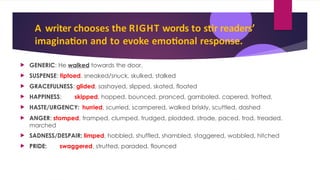
A writer chooses the RIGHT words to stir readers’
imagination and to evoke emotional response.
 GENERIC: He walked towards the door.
 SUSPENSE: tiptoed, sneaked/snuck, skulked, stalked
 GRACEFULNESS: glided, sashayed, slipped, skated, floated
 HAPPINESS: skipped, hopped, bounced, pranced, gamboled, capered, trotted,
 HASTE/URGENCY: hurried, scurried, scampered, walked briskly, scuttled, dashed
 ANGER: stomped, tramped, clumped, trudged, plodded, strode, paced, trod, treaded,
marched
 SADNESS/DESPAIR: limped, hobbled, shuffled, shambled, staggered, wobbled, hitched
 PRIDE: swaggered, strutted, paraded, flounced
Language Style or DICTION
TOPIC of the DAY
1.Use appropriate language
style/diction to evoke emotional
and intellectual responses from
readers;
2.Compose a vignette
using proper diction;
3.Express appreciation of
language style/diction used in
creative writing
Objectives
Diction Defined
Diction can be defined as style of
speaking or writing determined by
the choice of words by a speaker or
a writer.
What does IT do?
Diction or choice of words separates
good writing from bad writing.
“
”
How
?
Functions of Diction
 In literature, writers choose words to create and convey
a typical mood, tone and atmosphere to their readers.
 A writer’s choice of words and his selection of graphic
words not only affects the reader’s attitude but also
conveys the writer’s feelings toward the literary work.
 Moreover, poetry is known for its unique diction that
separates it from prose. Usually, a poetic diction is
marked by the use of figures of speech, rhyming words
etc.
Writers’ skillfully choose words to develop a certain TONE
and ATMOSPHERE in their works. Read the following excerpt from a
short story “The School” by Donald Barthelme:
 “And the trees all died. They were orange trees. I don’t know why
they died, they just died. Something wrong with the soil possibly or
maybe the stuff we got from the nursery wasn’t the best. We
complained about it. So we’ve got thirty kids there, each kid had
his or her own little tree to plant and we’ve got these thirty dead
trees. All these kids looking at these little brown sticks, it was
depressing.”
 TONE: gloomy
“
”
Importanc
e
Proper diction or proper choice of words
is important to get the message across.
In contrast, the wrong choice of words
can easily divert listeners or readers
which results in misinterpretation of the
message intended to be conveyed.
”
“ How to Separate
Good
Writing
from Bad
Writing
 Firstly, the word has to be right and
accurate.
 Secondly, words should be appropriate to
the context (what comes before or after
the passage) in which they are used.
 Lastly, the choice of words should be such
that the listener or readers understand
easily.
What’s the difference?
“We do not hurry, we hasten.”
- Julie Andrews in Princess Diary 2
For example:
A gentleman chuckles.
A happy lady titters.
A playful girl giggles.
A boisterous boy chortles.
Abar girl cackles.
A drunken man guffaws.
”
“
Types of
Diction
Formal Diction
Individuals vary their diction depending on different
contexts and settings.
 “Formal” diction is where formal words are used in
formal situations e.g. press conferences, presentations
etc.
Formal Diction
 Example: excerpts from “Ode to the Grecian Urn”
“Heard melodies are sweet, but those unheard
Are sweeter: therefore, ye soft pipes, play on”
 In the same poem he says:
“Ah, happy, happy boughs! that cannot shed
Your leaves, nor ever bid the spring adieu.”
- Keats used the formal ye instead of you, in the
same manner he used adieu instead of goodbye.
Informal Diction
 “Informal” diction is used in informal situations like writing
or talking to our friends.
 “Colloquial” diction uses words common in everyday
speech.
 “Slang” is the use of words that are impolite or newly
coined.
Informal Diction
COLLOQUIALISM:
 Excerpt from John Donne’s poem “The Sun Rising”:
 “Busy old fool,
unruly Sun, Why dost
thou thus,
Through windows, and
through curtains, call
on us?
Must to thy motions lovers’ seasons run?
Saucy pedantic wretch,”
Informal Diction
SLANG:
 There’s no point in takin’ Kit with you. He’s a
yellow lily-livered good for nothin’ thug!
Diction Examples in Literature
REPETITION
 Sometimes writers repeat their chosen words or phrases to achieve an
artistic effect. Read the following example from “ A Tale of Two Cities”
by Charles Dickens:
 “It was the best of times, it was the worst of times, it was the age of
wisdom, it was the age of foolishness, it was the epoch of belief, it was
the epoch of incredulity, it was the season of Light, it was the season of
Darkness, it was the spring of hope, it was the winter of despair.”
 PURPOSE of the AUTHOR: to ensure that the readers will give more
consideration to characteristic of the “age” they are going to read
about in the novel.
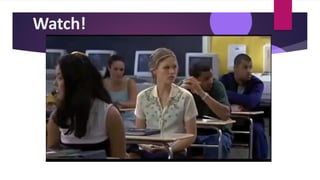
Watch!
Let’s Do These!
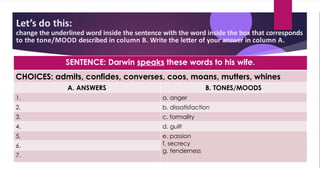
Let’s do this:
change the underlined word inside the sentence with the word inside the box that corresponds
to the tone/MOOD described in column B. Write the letter of your answer in column A.
SENTENCE: Darwin speaks these words to his wife.
CHOICES: admits, confides, converses, coos, moans, mutters, whines
A. ANSWERS B. TONES/MOODS
1. a. anger
2. b. dissatisfaction
3. c. formality
4. d. guilt
5. e. passion
f. secrecy
g. tenderness
6.
7.
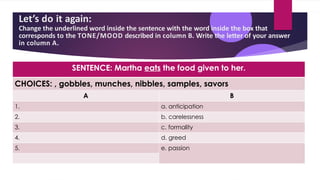
Let’s do it again:
Change the underlined word inside the sentence with the word inside the box that
corresponds to the TONE/MOOD described in column B. Write the letter of your answer
in column A.
SENTENCE: Martha eats the food given to her.
CHOICES: , gobbles, munches, nibbles, samples, savors
A B
1. a. anticipation
2. b. carelessness
3. c. formality
4. d. greed
5. e. passion
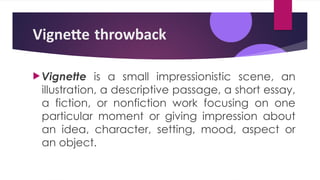
Vignette throwback
Vignette is a small impressionistic scene, an
illustration, a descriptive passage, a short essay,
a fiction, or nonfiction work focusing on one
particular moment or giving impression about
an idea, character, setting, mood, aspect or
an object.
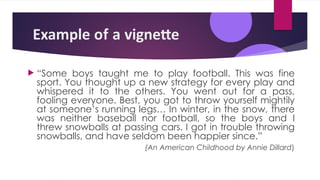
Example of a vignette
 “Some boys taught me to play football. This was fine
sport. You thought up a new strategy for every play and
whispered it to the others. You went out for a pass,
fooling everyone. Best, you got to throw yourself mightily
at someone’s running legs… In winter, in the snow, there
was neither baseball nor football, so the boys and I
threw snowballs at passing cars. I got in trouble throwing
snowballs, and have seldom been happier since.”
(An American Childhood by Annie Dillard)
Example of a vignette
 “Then Uncle Nacho is pulling and pulling my arm and it
doesn’t matter how new the dress Mama bought is because
my feet are ugly until my uncle who is a liar says, “You are the
prettiest girl here, will you dance… My uncle and me bow
and he walks me back in my thick shoes to my mother who is
proud to be my mother. All night the boy who is a man
watches me dance. He watched me dance.”
(House on Mango Street by Sandra Cisneros)
Now, What have WE learned?
 That diction is a style of speaking or writing determined by the choice of
words used by writers/speakers
 That there are two major types of diction: formal & informal
(including colloquial & slang)
 that In literature, the functions of diction are:
 to create and convey a typical mood, tone and atmosphere;
 to affect the reader’s attitude and conveys the writer’s feelings toward the
literary work;
 to distinguish poetry from prose.
Let’s write!
Draw inspiration from your own experiences.
Use proper diction in your paragraph.
Words must be no more than 500 but not less than
100.
Use ½ sheet of paper for the draft.
Encode final draft in 1 short bond paper.
references
Topics Source:
http://www.literarydevices.net
Video excerpt from “Ten Things I
Hate About You” (Youtube)

Understanding Diction a Lesson on Word Choice

  • 1.
    Creative Writing LESSON 3: LANGUAGE(DICTION) PREPARED BY: MARIA LOURDES V. VITALES
  • 2.
  • 3.
  • 4.
     He walkedtowards the door.
  • 5.
  • 6.
  • 7.
  • 8.
  • 9.
  • 10.
  • 11.
  • 12.
    What do allthe sentences have in common?
  • 13.
    A writer choosesthe RIGHT words to stir readers’ imagination and to evoke emotional response.  GENERIC: He walked towards the door.  SUSPENSE: tiptoed, sneaked/snuck, skulked, stalked  GRACEFULNESS: glided, sashayed, slipped, skated, floated  HAPPINESS: skipped, hopped, bounced, pranced, gamboled, capered, trotted,  HASTE/URGENCY: hurried, scurried, scampered, walked briskly, scuttled, dashed  ANGER: stomped, tramped, clumped, trudged, plodded, strode, paced, trod, treaded, marched  SADNESS/DESPAIR: limped, hobbled, shuffled, shambled, staggered, wobbled, hitched  PRIDE: swaggered, strutted, paraded, flounced
  • 14.
    Language Style orDICTION TOPIC of the DAY
  • 15.
    1.Use appropriate language style/dictionto evoke emotional and intellectual responses from readers; 2.Compose a vignette using proper diction; 3.Express appreciation of language style/diction used in creative writing Objectives
  • 16.
    Diction Defined Diction canbe defined as style of speaking or writing determined by the choice of words by a speaker or a writer.
  • 17.
    What does ITdo? Diction or choice of words separates good writing from bad writing.
  • 18.
  • 19.
    Functions of Diction In literature, writers choose words to create and convey a typical mood, tone and atmosphere to their readers.  A writer’s choice of words and his selection of graphic words not only affects the reader’s attitude but also conveys the writer’s feelings toward the literary work.  Moreover, poetry is known for its unique diction that separates it from prose. Usually, a poetic diction is marked by the use of figures of speech, rhyming words etc.
  • 20.
    Writers’ skillfully choosewords to develop a certain TONE and ATMOSPHERE in their works. Read the following excerpt from a short story “The School” by Donald Barthelme:  “And the trees all died. They were orange trees. I don’t know why they died, they just died. Something wrong with the soil possibly or maybe the stuff we got from the nursery wasn’t the best. We complained about it. So we’ve got thirty kids there, each kid had his or her own little tree to plant and we’ve got these thirty dead trees. All these kids looking at these little brown sticks, it was depressing.”  TONE: gloomy
  • 21.
  • 22.
    Proper diction orproper choice of words is important to get the message across. In contrast, the wrong choice of words can easily divert listeners or readers which results in misinterpretation of the message intended to be conveyed.
  • 23.
    ” “ How toSeparate Good Writing from Bad Writing
  • 24.
     Firstly, theword has to be right and accurate.  Secondly, words should be appropriate to the context (what comes before or after the passage) in which they are used.  Lastly, the choice of words should be such that the listener or readers understand easily.
  • 25.
    What’s the difference? “Wedo not hurry, we hasten.” - Julie Andrews in Princess Diary 2
  • 26.
    For example: A gentlemanchuckles. A happy lady titters. A playful girl giggles. A boisterous boy chortles. Abar girl cackles. A drunken man guffaws.
  • 27.
  • 28.
    Formal Diction Individuals varytheir diction depending on different contexts and settings.  “Formal” diction is where formal words are used in formal situations e.g. press conferences, presentations etc.
  • 29.
    Formal Diction  Example:excerpts from “Ode to the Grecian Urn” “Heard melodies are sweet, but those unheard Are sweeter: therefore, ye soft pipes, play on”  In the same poem he says: “Ah, happy, happy boughs! that cannot shed Your leaves, nor ever bid the spring adieu.” - Keats used the formal ye instead of you, in the same manner he used adieu instead of goodbye.
  • 30.
    Informal Diction  “Informal”diction is used in informal situations like writing or talking to our friends.  “Colloquial” diction uses words common in everyday speech.  “Slang” is the use of words that are impolite or newly coined.
  • 31.
    Informal Diction COLLOQUIALISM:  Excerptfrom John Donne’s poem “The Sun Rising”:  “Busy old fool, unruly Sun, Why dost thou thus, Through windows, and through curtains, call on us? Must to thy motions lovers’ seasons run? Saucy pedantic wretch,”
  • 32.
    Informal Diction SLANG:  There’sno point in takin’ Kit with you. He’s a yellow lily-livered good for nothin’ thug!
  • 33.
    Diction Examples inLiterature REPETITION  Sometimes writers repeat their chosen words or phrases to achieve an artistic effect. Read the following example from “ A Tale of Two Cities” by Charles Dickens:  “It was the best of times, it was the worst of times, it was the age of wisdom, it was the age of foolishness, it was the epoch of belief, it was the epoch of incredulity, it was the season of Light, it was the season of Darkness, it was the spring of hope, it was the winter of despair.”  PURPOSE of the AUTHOR: to ensure that the readers will give more consideration to characteristic of the “age” they are going to read about in the novel.
  • 34.
  • 35.
  • 36.
    Let’s do this: changethe underlined word inside the sentence with the word inside the box that corresponds to the tone/MOOD described in column B. Write the letter of your answer in column A. SENTENCE: Darwin speaks these words to his wife. CHOICES: admits, confides, converses, coos, moans, mutters, whines A. ANSWERS B. TONES/MOODS 1. a. anger 2. b. dissatisfaction 3. c. formality 4. d. guilt 5. e. passion f. secrecy g. tenderness 6. 7.
  • 37.
    Let’s do itagain: Change the underlined word inside the sentence with the word inside the box that corresponds to the TONE/MOOD described in column B. Write the letter of your answer in column A. SENTENCE: Martha eats the food given to her. CHOICES: , gobbles, munches, nibbles, samples, savors A B 1. a. anticipation 2. b. carelessness 3. c. formality 4. d. greed 5. e. passion
  • 38.
    Vignette throwback Vignette isa small impressionistic scene, an illustration, a descriptive passage, a short essay, a fiction, or nonfiction work focusing on one particular moment or giving impression about an idea, character, setting, mood, aspect or an object.
  • 39.
    Example of avignette  “Some boys taught me to play football. This was fine sport. You thought up a new strategy for every play and whispered it to the others. You went out for a pass, fooling everyone. Best, you got to throw yourself mightily at someone’s running legs… In winter, in the snow, there was neither baseball nor football, so the boys and I threw snowballs at passing cars. I got in trouble throwing snowballs, and have seldom been happier since.” (An American Childhood by Annie Dillard)
  • 40.
    Example of avignette  “Then Uncle Nacho is pulling and pulling my arm and it doesn’t matter how new the dress Mama bought is because my feet are ugly until my uncle who is a liar says, “You are the prettiest girl here, will you dance… My uncle and me bow and he walks me back in my thick shoes to my mother who is proud to be my mother. All night the boy who is a man watches me dance. He watched me dance.” (House on Mango Street by Sandra Cisneros)
  • 41.
    Now, What haveWE learned?  That diction is a style of speaking or writing determined by the choice of words used by writers/speakers  That there are two major types of diction: formal & informal (including colloquial & slang)  that In literature, the functions of diction are:  to create and convey a typical mood, tone and atmosphere;  to affect the reader’s attitude and conveys the writer’s feelings toward the literary work;  to distinguish poetry from prose.
  • 42.
    Let’s write! Draw inspirationfrom your own experiences. Use proper diction in your paragraph. Words must be no more than 500 but not less than 100. Use ½ sheet of paper for the draft. Encode final draft in 1 short bond paper.
  • 43.