PARAGRAPH DEVELOPMENT
    Methods, with examples
THE METHODS
1.    Narration and description
2.    Definition
3.    Elaboration
4.    Comparison/contrast
5.    Summarization
6.    Analysis
      Classification (parts)
      Process (steps)
      Causation (causes and/or effects)
NARRATION AND DESCRIPTION
Narrate the
story of
anything that
unfolds in
time…

Eras
Events
Experiments
Universes
Romance
FROM BILL BRYSON’S A SHORT HISTORY OF
NEARLY EVERYTHING
In the first lively second [of the big bang] (a second that many
 cosmologists will devote careers to shaving into ever-finer
 wafers) is produced gravity and the other forces that govern
 physics. In less than a minute the universe is a million billion
 miles across and growing fast. There is a lot of heat now, ten
 billion degrees of it, enough to begin the nuclear reactions that
 create the lighter elements--principally hydrogen and
 helium, with a dash (about one atom in a hundred million) of
 lithium. In three minutes, 98 percent of all the matter there is or
 will ever be has been produced. We have a universe. It is a
 place of the most wondrous and gratifying possibility, and
 beautiful, too. And it was all done in about the time it takes to
 make a sandwich.
DESCRIBE A PROCESS

 Kennedy’s mistake, in technical terms, was that he failed to
 keep his wings level. That was critical, because when a
 plane banks to one side it begins to turn and its wings lose
 some of their vertical lift. Left unchecked, this process
 accelerates. The angle of the bank increases, the turn gets
 sharper
 and sharper,
 and the plane starts
 to dive toward the
 ground in an ever –
 narrowing cork screw.
 Pilots call this
 the graveyard spiral.
NARRATION & DESCRIPTION
IN ―SEEING IS NOT BELIEVING‖

 Lance Corporal Ted ―Joey‖ Boudreaux Jr. was
 bored. It was the summer of 2003 in Iraq […] and
 you can joyride around the desert in a dusty
 Humvee only so often. Loitering at the back gate of
 his base, mingling with locals, Boudreaux says he
 scribbled ―Welcome marines‖ on a piece of
 cardboard and gave it to some kids, who then
 posed with him, smiling, for a snapshot. He e-
 mailed the picture to his mom, a cousin and a few
 friends[….] That wasn’t the last of the
 photo, though.
                                     Steve Casimiro
SUMMARIZATION

Narrative condensed and denuded of detail, with a
more statement of or connection to theme.
FROM THE ART OF FAILURE – A SEGUEWAY
BETWEEN NARRATIVE & THEME


Human beings sometimes falter under pressure. Pilots
crash and divers drown. Under the glare of
competition, basketball players cannot find the basket and
golfers cannot find the pin. When that happens, we say
variously that people have ―panicked‖ or, to use the sports
colloquialism, ―choked.‖ (summary)

But what do those words mean? To choke or panic is
considered to be as bad as to quit. But are all forms of
failure equal? (intro of central comparison and theme)
SUMMARIZING THE HISTORY OF LOBSTER, FROM
CONSIDER THE LOBSTER

 Up until sometime in the 1800s, though, lobster was
 literally low-class food, eaten only by the poor and
 institutionalized. Even in the harsh penal
 environment of early America, some colonies had
 laws against feeding lobsters to inmates more than
 once a week because it was thought to be cruel
 and unusual, like making people eat rats.

 Narrative would be: a particular person in a
 particular prison scowling at the sight of, oh
 no, lobster. Again.
Late 14c., "setting of boundaries," from O.Fr. definicion , from L.defi
nitionem , noun of action from definire . In logic, meaning "a stateme
nt of the essential nature of something" is
from late 14c.;
                      http://dictionary.reference.com/browse/definition


       DEFINITION
  1.   The act of defining or making definite, distinct, or clear.
  2.   Optics. Sharpness of the image formed by an optical system.
DEFINITION WITH DRIVE
 Skill is the connection between life and tools, or life and
 machines. Once, skill was defined in qualitative terms:
 How well did a person work. But as machines grow
 larger and more complex […] we tend to define skill
 quantitatively: How speedily and cheaply can a person
 work? And the more quantifiable skills become, the
 easier they are to replace with machines.

                                    Wendell Berry, ―The Un-
                                       settling of America‖
STEREOTYPE
THREAT

Every heard of it?
It’s defined on page 91
of ―The Art of Failure‖
(after a summary
of a study)
ELABORATION
Describing the indescribable
Bringing in experts
Giving examples
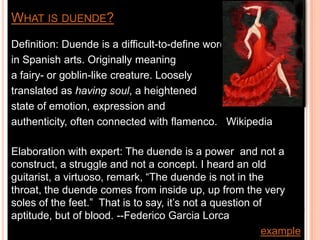
WHAT IS DUENDE?
Definition: Duende is a difficult-to-define word used
in Spanish arts. Originally meaning
a fairy- or goblin-like creature. Loosely
translated as having soul, a heightened
state of emotion, expression and
authenticity, often connected with flamenco. Wikipedia

Elaboration with expert: The duende is a power and not a
construct, a struggle and not a concept. I heard an old
guitarist, a virtuoso, remark, ―The duende is not in the
throat, the duende comes from inside up, up from the very
soles of the feet.‖ That is to say, it’s not a question of
aptitude, but of blood. --Federico Garcia Lorca
                                                          example
WHAT IS LOBSTER: ELABORATION VIA NICELY
ORDERED FACTS

   Taxonomically speaking, a lobster is a marine
    crustacean of the family Homaridae, characterized by
    five pairs of jointed legs, the first pair terminating in large
    pincerish claws used for subduing prey. Like many other
    species of benthic carnivore, lobsters are both hunters
    and scavengers. They have stalked eyes, gills on their
    legs, and antennae. There are dozens of different kinds
    worldwide, of which the relevant species here is the
    Maine lobster, Homarus americanus. The name ―lobster‖
    comes from the Old English loppestre, which is thought
    to be a corrupt form of the Latin word for locust
    combined with the Old English loppe, which meant
    spider.
DEFINE OR ELABORATE WITH NEGATIVES


Love is not all: it is not meat nor drink
Nor slumber nor a roof against the rain;
Nor yet a floating spar to men that sink
And rise and sink and rise and sink again;
Love can not fill the thickened lung with
breath,
Nor clean the blood, nor set the fractured
bone;
Yet many a man is making friends with
death
Even as I speak, for lack of love alone.
Enrique Chagoya


COMPARISON/CONTRAST
1. COMPARE & CONTRAST IN ORDER TO
   Reveal unseen qualities/efficacy of A by analogy to
    more familiar B.‖

    Just as bullets are traced to a gun, photos may one
    day reveal the camera that made them.
    [B then A]
                        --―Can Digital Photos Be Trusted‖
COMPARISON STRUCTURES
   Compare in blocks, in order: Axyz then Bxyz
                (two paragraphs)
                        or
      point by point: Ax Bx / Ay By / Az Bz

Panic […] is the opposite of choking. Choking is
about thinking too much. Panic is about thinking too
little. Choking is about loss of instinct. Panic is
reversion to instinct. They may look the same, but
they are worlds apart [….]
ANALYSIS
 Classification – parts & their relationships
 Process – mechanism and sequence
 Causation – causes and/or effects
ANALYZING
PARTS
ANALYZING PROCESSES
   Consider what happens when you double the size
    of an image in Photoshop. You start with a 100-by-
    200-pixel image and enlarge it to 200 by 200.
    Photoshop must create new pixels to make the
    image bigger [….] Photoshop will ―look‖ at a whote
    pixel and an adjoining black pixel and decide that
    the best option for the new pizel being inserted is
    gray. [a ―digital watermark‖]
                         -- Can Digital Photos be Trusted?

                                  With Narration assisting
ANALYZING CAUSATION
(CAUSES OR EFFECTS)

It won’t take long—if it hasn’t happened already—
   before every image becomes potentially suspect.
                           So?

[A]s fakes proliferate, real evidence, such as the
  photos of abuse at Abu Ghraib pruison in
  Iraq, could be discounted as unreliable.

                      Doesn’t affect me

And then there’s the judicial system, in which altered
 photos could harm the innocent, free the guilty, or
 simply cause havoc.
GROUPWORK #3
    Assign a development method to each group member
•    Narration and description
•    Definition
•    Elaboration
•    Comparison/contrast
•    Summarization
•    Analysis
    • Classification (break down by parts)
    • Process (break down by steps)
    • Causation (break down by causes and/or effects


  Then create a short essay with several well- developed
paragraphs on our chosen topic.

Paragraph Development

  • 1.
    PARAGRAPH DEVELOPMENT Methods, with examples
  • 2.
    THE METHODS 1. Narration and description 2. Definition 3. Elaboration 4. Comparison/contrast 5. Summarization 6. Analysis  Classification (parts)  Process (steps)  Causation (causes and/or effects)
  • 3.
  • 4.
    Narrate the story of anythingthat unfolds in time… Eras Events Experiments Universes Romance
  • 5.
    FROM BILL BRYSON’SA SHORT HISTORY OF NEARLY EVERYTHING In the first lively second [of the big bang] (a second that many cosmologists will devote careers to shaving into ever-finer wafers) is produced gravity and the other forces that govern physics. In less than a minute the universe is a million billion miles across and growing fast. There is a lot of heat now, ten billion degrees of it, enough to begin the nuclear reactions that create the lighter elements--principally hydrogen and helium, with a dash (about one atom in a hundred million) of lithium. In three minutes, 98 percent of all the matter there is or will ever be has been produced. We have a universe. It is a place of the most wondrous and gratifying possibility, and beautiful, too. And it was all done in about the time it takes to make a sandwich.
  • 6.
    DESCRIBE A PROCESS Kennedy’s mistake, in technical terms, was that he failed to keep his wings level. That was critical, because when a plane banks to one side it begins to turn and its wings lose some of their vertical lift. Left unchecked, this process accelerates. The angle of the bank increases, the turn gets sharper and sharper, and the plane starts to dive toward the ground in an ever – narrowing cork screw. Pilots call this the graveyard spiral.
  • 7.
    NARRATION & DESCRIPTION IN―SEEING IS NOT BELIEVING‖ Lance Corporal Ted ―Joey‖ Boudreaux Jr. was bored. It was the summer of 2003 in Iraq […] and you can joyride around the desert in a dusty Humvee only so often. Loitering at the back gate of his base, mingling with locals, Boudreaux says he scribbled ―Welcome marines‖ on a piece of cardboard and gave it to some kids, who then posed with him, smiling, for a snapshot. He e- mailed the picture to his mom, a cousin and a few friends[….] That wasn’t the last of the photo, though. Steve Casimiro
  • 8.
    SUMMARIZATION Narrative condensed anddenuded of detail, with a more statement of or connection to theme.
  • 9.
    FROM THE ARTOF FAILURE – A SEGUEWAY BETWEEN NARRATIVE & THEME Human beings sometimes falter under pressure. Pilots crash and divers drown. Under the glare of competition, basketball players cannot find the basket and golfers cannot find the pin. When that happens, we say variously that people have ―panicked‖ or, to use the sports colloquialism, ―choked.‖ (summary) But what do those words mean? To choke or panic is considered to be as bad as to quit. But are all forms of failure equal? (intro of central comparison and theme)
  • 10.
    SUMMARIZING THE HISTORYOF LOBSTER, FROM CONSIDER THE LOBSTER Up until sometime in the 1800s, though, lobster was literally low-class food, eaten only by the poor and institutionalized. Even in the harsh penal environment of early America, some colonies had laws against feeding lobsters to inmates more than once a week because it was thought to be cruel and unusual, like making people eat rats. Narrative would be: a particular person in a particular prison scowling at the sight of, oh no, lobster. Again.
  • 11.
    Late 14c., "settingof boundaries," from O.Fr. definicion , from L.defi nitionem , noun of action from definire . In logic, meaning "a stateme nt of the essential nature of something" is from late 14c.; http://dictionary.reference.com/browse/definition DEFINITION 1. The act of defining or making definite, distinct, or clear. 2. Optics. Sharpness of the image formed by an optical system.
  • 12.
    DEFINITION WITH DRIVE Skill is the connection between life and tools, or life and machines. Once, skill was defined in qualitative terms: How well did a person work. But as machines grow larger and more complex […] we tend to define skill quantitatively: How speedily and cheaply can a person work? And the more quantifiable skills become, the easier they are to replace with machines. Wendell Berry, ―The Un- settling of America‖
  • 13.
    STEREOTYPE THREAT Every heard ofit? It’s defined on page 91 of ―The Art of Failure‖ (after a summary of a study)
  • 14.
  • 15.
    WHAT IS DUENDE? Definition:Duende is a difficult-to-define word used in Spanish arts. Originally meaning a fairy- or goblin-like creature. Loosely translated as having soul, a heightened state of emotion, expression and authenticity, often connected with flamenco. Wikipedia Elaboration with expert: The duende is a power and not a construct, a struggle and not a concept. I heard an old guitarist, a virtuoso, remark, ―The duende is not in the throat, the duende comes from inside up, up from the very soles of the feet.‖ That is to say, it’s not a question of aptitude, but of blood. --Federico Garcia Lorca example
  • 16.
    WHAT IS LOBSTER:ELABORATION VIA NICELY ORDERED FACTS  Taxonomically speaking, a lobster is a marine crustacean of the family Homaridae, characterized by five pairs of jointed legs, the first pair terminating in large pincerish claws used for subduing prey. Like many other species of benthic carnivore, lobsters are both hunters and scavengers. They have stalked eyes, gills on their legs, and antennae. There are dozens of different kinds worldwide, of which the relevant species here is the Maine lobster, Homarus americanus. The name ―lobster‖ comes from the Old English loppestre, which is thought to be a corrupt form of the Latin word for locust combined with the Old English loppe, which meant spider.
  • 17.
    DEFINE OR ELABORATEWITH NEGATIVES Love is not all: it is not meat nor drink Nor slumber nor a roof against the rain; Nor yet a floating spar to men that sink And rise and sink and rise and sink again; Love can not fill the thickened lung with breath, Nor clean the blood, nor set the fractured bone; Yet many a man is making friends with death Even as I speak, for lack of love alone.
  • 18.
  • 19.
    1. COMPARE &CONTRAST IN ORDER TO  Reveal unseen qualities/efficacy of A by analogy to more familiar B.‖ Just as bullets are traced to a gun, photos may one day reveal the camera that made them. [B then A] --―Can Digital Photos Be Trusted‖
  • 20.
    COMPARISON STRUCTURES Compare in blocks, in order: Axyz then Bxyz (two paragraphs) or point by point: Ax Bx / Ay By / Az Bz Panic […] is the opposite of choking. Choking is about thinking too much. Panic is about thinking too little. Choking is about loss of instinct. Panic is reversion to instinct. They may look the same, but they are worlds apart [….]
  • 21.
    ANALYSIS Classification –parts & their relationships Process – mechanism and sequence Causation – causes and/or effects
  • 22.
  • 23.
    ANALYZING PROCESSES  Consider what happens when you double the size of an image in Photoshop. You start with a 100-by- 200-pixel image and enlarge it to 200 by 200. Photoshop must create new pixels to make the image bigger [….] Photoshop will ―look‖ at a whote pixel and an adjoining black pixel and decide that the best option for the new pizel being inserted is gray. [a ―digital watermark‖] -- Can Digital Photos be Trusted?  With Narration assisting
  • 24.
    ANALYZING CAUSATION (CAUSES OREFFECTS) It won’t take long—if it hasn’t happened already— before every image becomes potentially suspect. So? [A]s fakes proliferate, real evidence, such as the photos of abuse at Abu Ghraib pruison in Iraq, could be discounted as unreliable. Doesn’t affect me And then there’s the judicial system, in which altered photos could harm the innocent, free the guilty, or simply cause havoc.
  • 25.
    GROUPWORK #3  Assign a development method to each group member • Narration and description • Definition • Elaboration • Comparison/contrast • Summarization • Analysis • Classification (break down by parts) • Process (break down by steps) • Causation (break down by causes and/or effects  Then create a short essay with several well- developed paragraphs on our chosen topic.

Editor's Notes

  • #4 Perhaps the oldest way of developing ideas. Can be skimmed when scanning & reviewing
  • #5 Narrate…and describe what you need to within that. Narration is the structure.
  • #8 A character, a setting, foreshadowing, plot, descriptive adjectives. The purpose? Hook the reader. Humanize the issue. We narrate processes, but might better be called analysis. What to leave out?
  • #9 Should be read closely when scanning & reviewing
  • #10 Studies, surveys, interviews, theories, experts (w quotes & paraphrase). Some stories already told.
  • #13 Has a thesis—driving to a point. Takes a new look. Expanding the readers view. Moving toward a point. Old way A, I show it’s really B. Move from definition to thesis. Berry's nonfiction serves as an extended conversation about the life he values. According to him, the good life includes sustainable agriculture, appropriate technologies, healthy rural communities, connection to place, the pleasures of good food, husbandry, good work, local economics, the miracle of life, fidelity, frugality, reverence, and the interconnectedness of life. The threats Berry finds to this good life include: industrial farming and the industrialization of life, ignorance, hubris, greed, violence against others and against the natural world, the eroding topsoil in the United States, global economics, and environmental destruction. As a prominent defender of agrarian values
  • #14 Page 208
  • #15 Doesn’t do it…or it’s too interesting, or indefinable.
  • #16 Up elaborates on up
  • #18 Late 14c., "setting of boundaries," from O.Fr. definicion , from L.definitionem . “a power and not a construct, a struggle and not a concept.”
  • #20 Choking vs panic in “The Art of Failure”. “Just as bullets are traced to a gun, photos may one day reveal the camera that made them (“Seeing is Not Believing” )
  • #22 the ancient Greek ἀνάλυσις (analusis, "a breaking up",) -  the process of breaking a complex topic or substance into smaller parts to gain a better. "Analysis as an independent subject was created in the 17th century during the scientific revolution. Kepler, Galileo, Descartes, Newton and Leibniz, contributed. The field of chemistry uses analysis in at least three ways: to identify the components of a particular chemical compound (qualitative analysis), to identify the proportions of components in a mixture(quantitative analysis), and to break down chemical processes and examine chemical reactions between elements of matter.