Unit II
WATER JET MACHINING
BY
Dr. A. Asha, Professor/Mechanical Engineering
Kamaraj College of Engineering & Technology, Madurai 625701
WATER JET MACHINING
• Water jet machining is an extension of abrasive jet
machining process. In this process high pressure and
high velocity stream of water is used to cut the
relatively soft and non metallic materials like paper
boards, wood, plastics, rubber, fibre glass, leather
WATER JET MACHINING
•Principle : When the high velocity water jet
comes out of the nozzle and strikes the material
its kinetic energy is converted into pressure
energy including high stresses in the work
material. When this induced stress exceeds the
ultimate shear stress of the material, small chips
of the material get loosened and fresh surface is
exposed.
WATER JET MACHINING
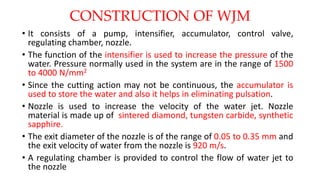
CONSTRUCTION OF WJM
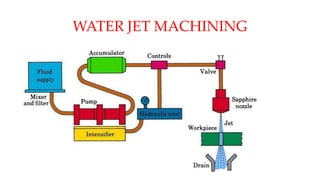
• It consists of a pump, intensifier, accumulator, control valve,
regulating chamber, nozzle.
• The function of the intensifier is used to increase the pressure of the
water. Pressure normally used in the system are in the range of 1500
to 4000 N/mm2
• Since the cutting action may not be continuous, the accumulator is
used to store the water and also it helps in eliminating pulsation.
• Nozzle is used to increase the velocity of the water jet. Nozzle
material is made up of sintered diamond, tungsten carbide, synthetic
sapphire.
• The exit diameter of the nozzle is of the range of 0.05 to 0.35 mm and
the exit velocity of water from the nozzle is 920 m/s.
• A regulating chamber is provided to control the flow of water jet to
the nozzle
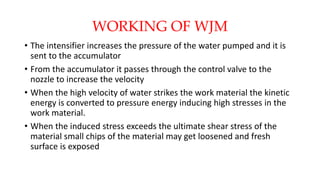
WORKING OF WJM
• The intensifier increases the pressure of the water pumped and it is
sent to the accumulator
• From the accumulator it passes through the control valve to the
nozzle to increase the velocity
• When the high velocity of water strikes the work material the kinetic
energy is converted to pressure energy inducing high stresses in the
work material.
• When the induced stress exceeds the ultimate shear stress of the
material small chips of the material may get loosened and fresh
surface is exposed
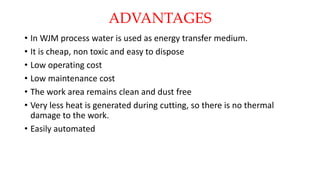
ADVANTAGES
• In WJM process water is used as energy transfer medium.
• It is cheap, non toxic and easy to dispose
• Low operating cost
• Low maintenance cost
• The work area remains clean and dust free
• Very less heat is generated during cutting, so there is no thermal
damage to the work.
• Easily automated
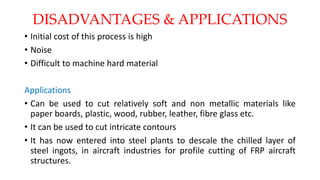
DISADVANTAGES & APPLICATIONS
• Initial cost of this process is high
• Noise
• Difficult to machine hard material
Applications
• Can be used to cut relatively soft and non metallic materials like
paper boards, plastic, wood, rubber, leather, fibre glass etc.
• It can be used to cut intricate contours
• It has now entered into steel plants to descale the chilled layer of
steel ingots, in aircraft industries for profile cutting of FRP aircraft
structures.

Wjm unit ii

  • 1.
    Unit II WATER JETMACHINING BY Dr. A. Asha, Professor/Mechanical Engineering Kamaraj College of Engineering & Technology, Madurai 625701
  • 2.
    WATER JET MACHINING •Water jet machining is an extension of abrasive jet machining process. In this process high pressure and high velocity stream of water is used to cut the relatively soft and non metallic materials like paper boards, wood, plastics, rubber, fibre glass, leather
  • 3.
    WATER JET MACHINING •Principle: When the high velocity water jet comes out of the nozzle and strikes the material its kinetic energy is converted into pressure energy including high stresses in the work material. When this induced stress exceeds the ultimate shear stress of the material, small chips of the material get loosened and fresh surface is exposed.
  • 4.
  • 5.
    CONSTRUCTION OF WJM •It consists of a pump, intensifier, accumulator, control valve, regulating chamber, nozzle. • The function of the intensifier is used to increase the pressure of the water. Pressure normally used in the system are in the range of 1500 to 4000 N/mm2 • Since the cutting action may not be continuous, the accumulator is used to store the water and also it helps in eliminating pulsation. • Nozzle is used to increase the velocity of the water jet. Nozzle material is made up of sintered diamond, tungsten carbide, synthetic sapphire. • The exit diameter of the nozzle is of the range of 0.05 to 0.35 mm and the exit velocity of water from the nozzle is 920 m/s. • A regulating chamber is provided to control the flow of water jet to the nozzle
  • 6.
    WORKING OF WJM •The intensifier increases the pressure of the water pumped and it is sent to the accumulator • From the accumulator it passes through the control valve to the nozzle to increase the velocity • When the high velocity of water strikes the work material the kinetic energy is converted to pressure energy inducing high stresses in the work material. • When the induced stress exceeds the ultimate shear stress of the material small chips of the material may get loosened and fresh surface is exposed
  • 7.
    ADVANTAGES • In WJMprocess water is used as energy transfer medium. • It is cheap, non toxic and easy to dispose • Low operating cost • Low maintenance cost • The work area remains clean and dust free • Very less heat is generated during cutting, so there is no thermal damage to the work. • Easily automated
  • 8.
    DISADVANTAGES & APPLICATIONS •Initial cost of this process is high • Noise • Difficult to machine hard material Applications • Can be used to cut relatively soft and non metallic materials like paper boards, plastic, wood, rubber, leather, fibre glass etc. • It can be used to cut intricate contours • It has now entered into steel plants to descale the chilled layer of steel ingots, in aircraft industries for profile cutting of FRP aircraft structures.