Module-3: ADVANCED MATERIAL REMOVAL PROCESSES
Lecture No-11
Wire Cut Electric Discharge Machining (WEDM)
The Wire Electric Discharge Machining (WEDM) is a variation of EDM and is
commonly known as wire-cut EDM or wire cutting. In this process, a thin metallic wire is
fed on-to the workpiece, which is submerged in a tank of dielectric fluid such as de-
ionized water. This process can also cut plates as thick as 300mm and is used for making
punches, tools and dies from hard metals that are difficult to machine with other methods.
The wire, which is constantly fed from a spool, is held between upper and lower diamond
guides. The guides are usually CNC-controlled and move in the x–y plane. On most
machines, the upper guide can move independently in the z–u–v axis, giving it a
flexibility to cut tapered and transitioning shapes (example: square at the bottom and
circle on the top). The upper guide can control axis movements in x–y–u–v–i–j–k–l–.
This helps in programming the wire-cut EDM, for cutting very intricate and delicate
shapes.
In the wire-cut EDM process, water is commonly used as the dielectric fluid. Filters and
de-ionizing units are used for controlling the resistivity and other electrical properties.
Wires made of brass are generally preferred. The water helps in flushing away the debris
from the cutting zone. The flushing also helps to determine the feed rates to be given for
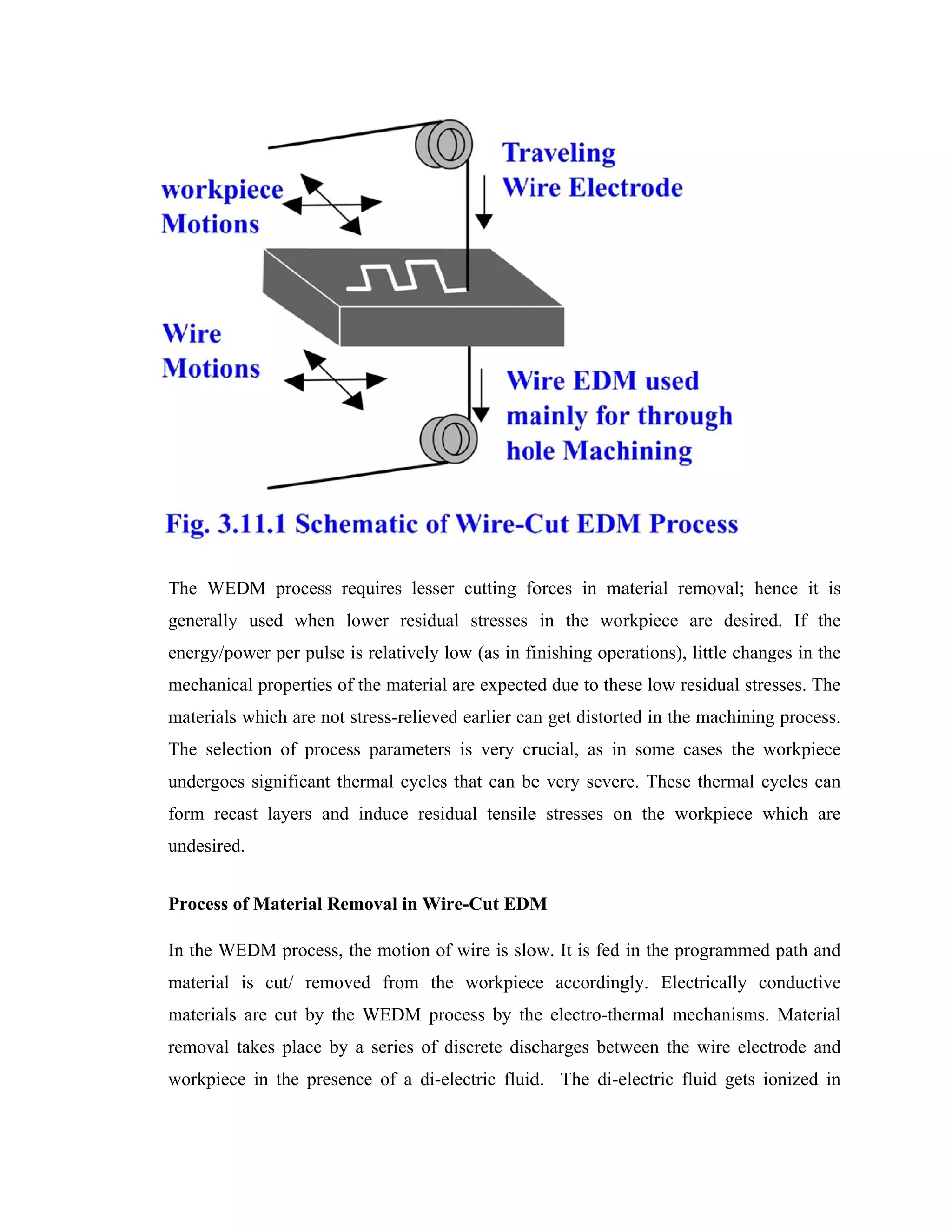
different thickness of the materials. The schematic of wire cut EDM is shown in Figure
3.11.1
T
g
en
m
m
T
un
fo
un
P
In
m
m
re
w
The WEDM
enerally use
nergy/power
mechanical p
materials whi
The selection
ndergoes sig
orm recast
ndesired.
Process of M
n the WEDM
material is c
materials are
emoval take
workpiece in
process re
ed when lo
r per pulse i
roperties of
ich are not s
n of process
gnificant the
layers and
Material Rem
M process, th
cut/ remove
cut by the
es place by
n the presen
quires lesse
ower residu
s relatively
the material
stress-relieve
s parameter
ermal cycles
induce resi
moval in Wi
he motion o
ed from th
WEDM pr
a series of
ce of a di-e
er cutting fo
ual stresses
low (as in fi
l are expecte
ed earlier can
s is very cr
s that can be
dual tensile
ire-Cut EDM
f wire is slo
he workpiec
ocess by th
discrete disc
electric fluid
forces in ma
in the wo
finishing ope
ed due to the
n get distort
rucial, as in
e very sever
e stresses on
M
ow. It is fed
ce according
he electro-the
charges betw
d. The di-e
aterial remo
rkpiece are
erations), litt
ese low resid
ted in the ma
n some case
re. These th
n the work
in the progr
gly. Electric
ermal mech
ween the wi
electric fluid
oval; hence
e desired. I
tle changes i
dual stresses
achining pro
es the work
hermal cycle
kpiece which
rammed path
cally condu
hanisms. Ma
ire electrode
d gets ioniz
it is
f the
in the
s. The
ocess.
kpiece
s can
h are
h and
uctive
aterial
e and
ed in
between the tool-electrode gap thereby creating a path for each discharge. The area
wherein discharge takes place gets heated to very high temperatures such that the surface
gets melted and removed. The cut particles (debris) get flushed away by the continuously
flowing dielectric fluid.
WEDM is a non-conventional process and is very widely used in tool steels for pattern
and die making industries. The process is also used for cutting intricate shapes in
components used for the electric and aerospace industries.
Applications of Wire-Cut EDM
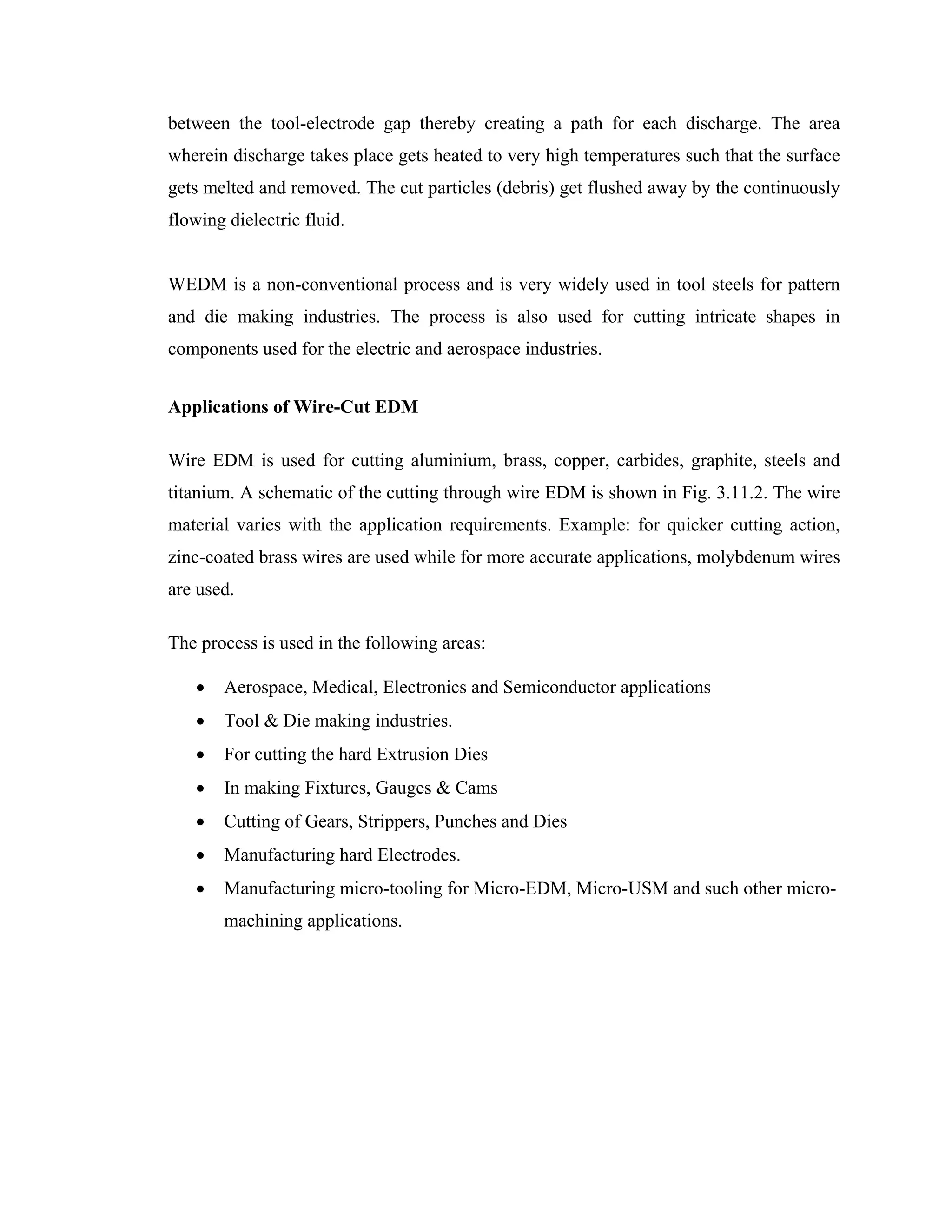
Wire EDM is used for cutting aluminium, brass, copper, carbides, graphite, steels and
titanium. A schematic of the cutting through wire EDM is shown in Fig. 3.11.2. The wire
material varies with the application requirements. Example: for quicker cutting action,
zinc-coated brass wires are used while for more accurate applications, molybdenum wires
are used.
The process is used in the following areas:
 Aerospace, Medical, Electronics and Semiconductor applications
 Tool & Die making industries.
 For cutting the hard Extrusion Dies
 In making Fixtures, Gauges & Cams
 Cutting of Gears, Strippers, Punches and Dies
 Manufacturing hard Electrodes.
 Manufacturing micro-tooling for Micro-EDM, Micro-USM and such other micro-
machining applications.
T
T
co
In
in
T
co
is
ro
p
pr
The Subsyste
 Power
 Dielec
 Wire f
 Positi
The power su
onventional
n wire cut ED
n the require
The drive sys
ontinuously
ssue in WED
ollers which
ower to the
rocess. The
ems of Wire
r supply.
ctric system.
feeding syst
oning system
upply and d
EDM. The m
DM, a movi
ed workpiece
stem continu
exposed to
DM process.
direct the w
wire and gu
other parts
e EDM
.
em.
m.
di-electric sy
main differe
ng wire elec
e. The wire
uously deliv
the workpie
. The wire f
wire through
uides it furth
are the pin
ystem used i
nce lies only
ctrode is used
is wound on
vers the fresh
ece hence the
feeding syste
the machine
her in-order t
nch rollers w
in WEDM i
y in the type
d to cut com
n a spool an
h wire on-to
e wear of th
em consists
e. The presen
to keep it st
which provid
is very simi
e of dielectric
mplex outline
nd is kept in
o the work a
e wire (tool)
of a large s
nce of metal
traight throu
de drive and
lar to that o
c used.
es and fine d
constant ten
area. New w
) is not the m
spool of wire
l contact pro
ughout the cu
d wire tensi
of the
details
nsion.
wire is
major
e and
ovides
utting
ion, a
sy
th
P
T
W
fi
ystem to thr
he wire runs
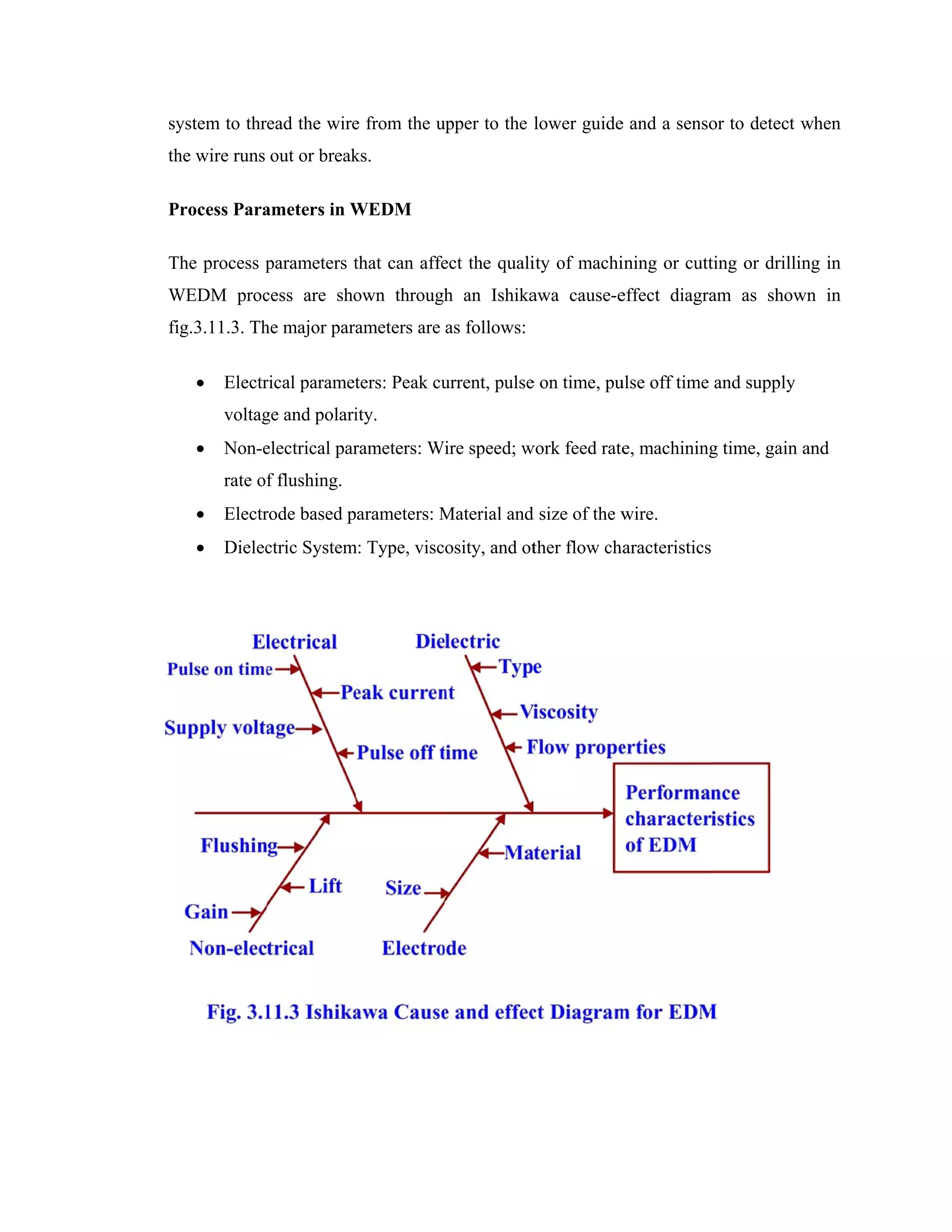
Process Para
The process p
WEDM proc
ig.3.11.3. Th
 Electr
voltag
 Non-e
rate of
 Electr
 Dielec
ead the wire
out or break
ameters in W
parameters t
cess are sho
he major para
rical paramet
ge and polari
electrical par
f flushing.
rode based p
ctric System
e from the u
ks.
WEDM
that can affe
own through
ameters are
ters: Peak cu
ity.
rameters: W
arameters: M
m: Type, visc
upper to the l
ect the quali
h an Ishika
as follows:
urrent, pulse
ire speed; w
Material and
osity, and ot
lower guide
ity of machi
awa cause-e
e on time, pu
work feed rate
d size of the w
ther flow cha
e and a senso
ining or cutt
effect diagra
ulse off time
e, machining
wire.
aracteristics
or to detect w
ting or drilli
am as show
and supply
g time, gain
when
ing in
wn in
and

Lecture11

  • 1.
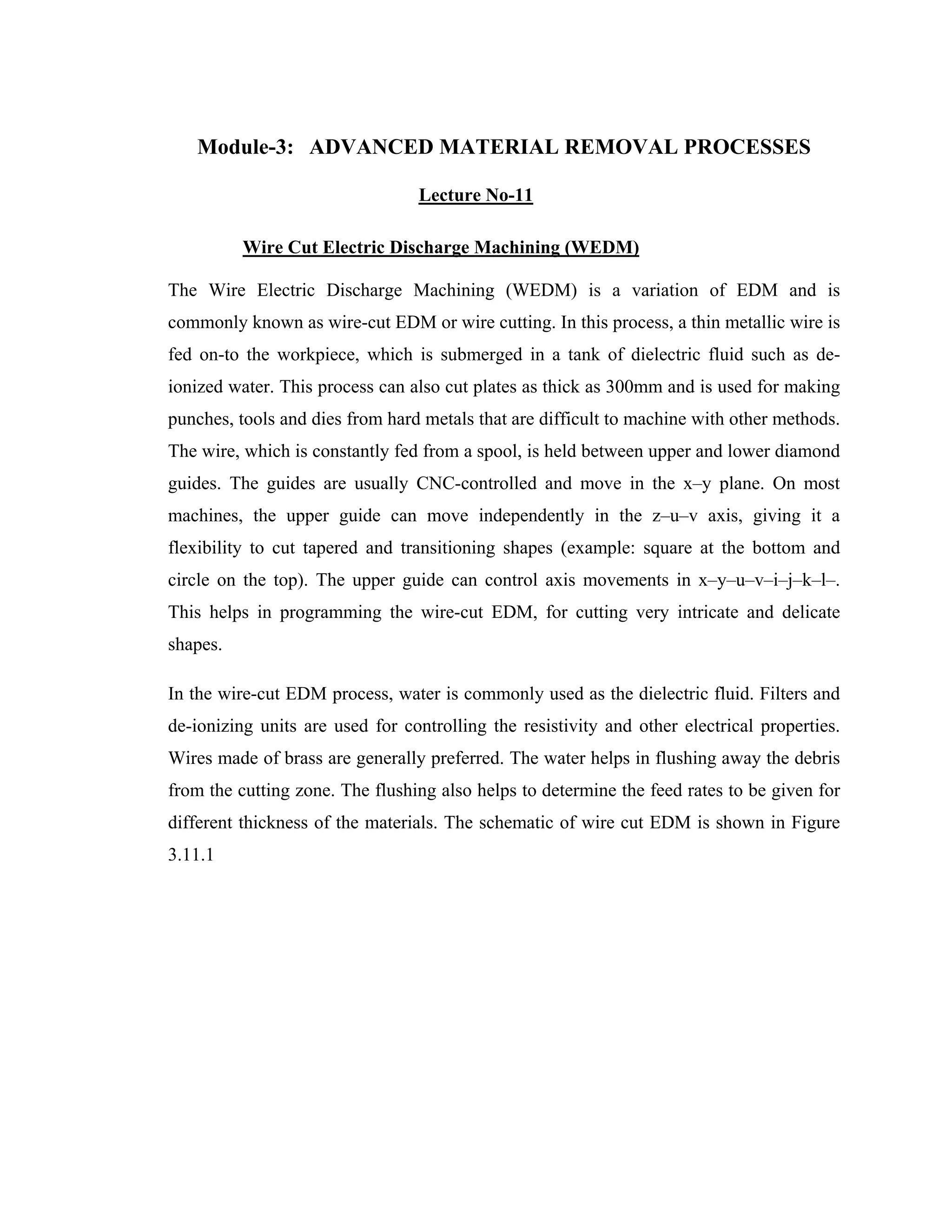
    Module-3: ADVANCED MATERIALREMOVAL PROCESSES Lecture No-11 Wire Cut Electric Discharge Machining (WEDM) The Wire Electric Discharge Machining (WEDM) is a variation of EDM and is commonly known as wire-cut EDM or wire cutting. In this process, a thin metallic wire is fed on-to the workpiece, which is submerged in a tank of dielectric fluid such as de- ionized water. This process can also cut plates as thick as 300mm and is used for making punches, tools and dies from hard metals that are difficult to machine with other methods. The wire, which is constantly fed from a spool, is held between upper and lower diamond guides. The guides are usually CNC-controlled and move in the x–y plane. On most machines, the upper guide can move independently in the z–u–v axis, giving it a flexibility to cut tapered and transitioning shapes (example: square at the bottom and circle on the top). The upper guide can control axis movements in x–y–u–v–i–j–k–l–. This helps in programming the wire-cut EDM, for cutting very intricate and delicate shapes. In the wire-cut EDM process, water is commonly used as the dielectric fluid. Filters and de-ionizing units are used for controlling the resistivity and other electrical properties. Wires made of brass are generally preferred. The water helps in flushing away the debris from the cutting zone. The flushing also helps to determine the feed rates to be given for different thickness of the materials. The schematic of wire cut EDM is shown in Figure 3.11.1
  • 2.
    T g en m m T un fo un P In m m re w The WEDM enerally use nergy/power mechanicalp materials whi The selection ndergoes sig orm recast ndesired. Process of M n the WEDM material is c materials are emoval take workpiece in process re ed when lo r per pulse i roperties of ich are not s n of process gnificant the layers and Material Rem M process, th cut/ remove cut by the es place by n the presen quires lesse ower residu s relatively the material stress-relieve s parameter ermal cycles induce resi moval in Wi he motion o ed from th WEDM pr a series of ce of a di-e er cutting fo ual stresses low (as in fi l are expecte ed earlier can s is very cr s that can be dual tensile ire-Cut EDM f wire is slo he workpiec ocess by th discrete disc electric fluid forces in ma in the wo finishing ope ed due to the n get distort rucial, as in e very sever e stresses on M ow. It is fed ce according he electro-the charges betw d. The di-e aterial remo rkpiece are erations), litt ese low resid ted in the ma n some case re. These th n the work in the progr gly. Electric ermal mech ween the wi electric fluid oval; hence e desired. I tle changes i dual stresses achining pro es the work hermal cycle kpiece which rammed path cally condu hanisms. Ma ire electrode d gets ioniz it is f the in the s. The ocess. kpiece s can h are h and uctive aterial e and ed in
  • 3.
    between the tool-electrodegap thereby creating a path for each discharge. The area wherein discharge takes place gets heated to very high temperatures such that the surface gets melted and removed. The cut particles (debris) get flushed away by the continuously flowing dielectric fluid. WEDM is a non-conventional process and is very widely used in tool steels for pattern and die making industries. The process is also used for cutting intricate shapes in components used for the electric and aerospace industries. Applications of Wire-Cut EDM Wire EDM is used for cutting aluminium, brass, copper, carbides, graphite, steels and titanium. A schematic of the cutting through wire EDM is shown in Fig. 3.11.2. The wire material varies with the application requirements. Example: for quicker cutting action, zinc-coated brass wires are used while for more accurate applications, molybdenum wires are used. The process is used in the following areas:  Aerospace, Medical, Electronics and Semiconductor applications  Tool & Die making industries.  For cutting the hard Extrusion Dies  In making Fixtures, Gauges & Cams  Cutting of Gears, Strippers, Punches and Dies  Manufacturing hard Electrodes.  Manufacturing micro-tooling for Micro-EDM, Micro-USM and such other micro- machining applications.
  • 4.
    T T co In in T co is ro p pr The Subsyste  Power Dielec  Wire f  Positi The power su onventional n wire cut ED n the require The drive sys ontinuously ssue in WED ollers which ower to the rocess. The ems of Wire r supply. ctric system. feeding syst oning system upply and d EDM. The m DM, a movi ed workpiece stem continu exposed to DM process. direct the w wire and gu other parts e EDM . em. m. di-electric sy main differe ng wire elec e. The wire uously deliv the workpie . The wire f wire through uides it furth are the pin ystem used i nce lies only ctrode is used is wound on vers the fresh ece hence the feeding syste the machine her in-order t nch rollers w in WEDM i y in the type d to cut com n a spool an h wire on-to e wear of th em consists e. The presen to keep it st which provid is very simi e of dielectric mplex outline nd is kept in o the work a e wire (tool) of a large s nce of metal traight throu de drive and lar to that o c used. es and fine d constant ten area. New w ) is not the m spool of wire l contact pro ughout the cu d wire tensi of the details nsion. wire is major e and ovides utting ion, a
  • 5.
    sy th P T W fi ystem to thr hewire runs Process Para The process p WEDM proc ig.3.11.3. Th  Electr voltag  Non-e rate of  Electr  Dielec ead the wire out or break ameters in W parameters t cess are sho he major para rical paramet ge and polari electrical par f flushing. rode based p ctric System e from the u ks. WEDM that can affe own through ameters are ters: Peak cu ity. rameters: W arameters: M m: Type, visc upper to the l ect the quali h an Ishika as follows: urrent, pulse ire speed; w Material and osity, and ot lower guide ity of machi awa cause-e e on time, pu work feed rate d size of the w ther flow cha e and a senso ining or cutt effect diagra ulse off time e, machining wire. aracteristics or to detect w ting or drilli am as show and supply g time, gain when ing in wn in and