winning with  leadership!
about this  presentation….
you’ll hear : The difference between ‘management’ and ‘leadership’ How to get your people ‘on board’ Ways to maximise people performance Ideas to create the culture you want
what’s the difference  between management   and  leadership ?
managers maintain the status quo monitor situation allocate resources communicate targets measure the results feedback on the trends
leaders strategic thinkers look forward and create visions challenge motivate inspire
“ a leader's job is  to rally people  toward a  better future” marcus buckingham
why is  leadership so important?
“  The surplus society has a surplus of  similar companies, employing similar  people, with similar educational backgrounds,  working in similar jobs, coming up with  similar ideas, producing similar things,  with similar prices, warranties, and qualities.” Jonas Ridderstrale and Kjel Nordstrom Authors, Funky Business
“ when people leave companies,  they tend not to quit the company,  they are more  likely to have quit the boss.” Ken Blanchard
“ The   talented employee may join a company because of its charismatic leaders, its generous benefits, and its world-class training programs, but how long that employee stays and how productive he is while he is there is determined by his relationship with his immediate supervisor"  Research from thousands of employees Marcus Buckingham ‘First Break All The Rules’
trust in management  is declining
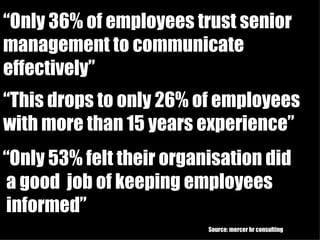
“ Only 36% of employees trust senior management to communicate effectively” “ This drops to only 26% of employees  with more than 15 years experience” Source: mercer hr consulting   “ Only 53% felt their organisation did a good  job of keeping employees informed”
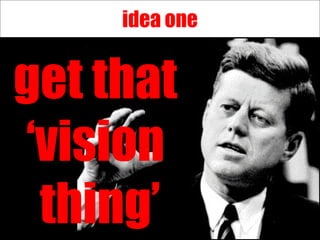
idea one get that  ‘ vision  thing’
getting that ‘vision thing’ Creating a clear picture of the future that ‘stimulates, excites and inspires’ Getting everyone to ‘buy’ into it Ensuring that everyone understands what’s expected of them Turning it into meaningful goals and targets Communicating progress towards it continuously Celebrating successes Working ‘On’ it consistently
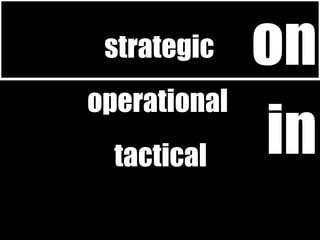
strategic operational tactical on in
what does  a  vision  look like?
a vision Is not simply a set of financial figures Is not a business plan Is not a ‘pie in the sky’ idea Is more than words in the MD’s annual speech Is a picture of the future that we want Includes customers, people and finances Typically is a 2 year / 1 year / 6 month ‘thing’ Is a point of strategic focus for the leadership of the business Is something for everyone to work towards
people tell  us they need to know
How is this vision relevant to me? What specifically do you want me to do? How will I be measured? What consequences will I face? What tools and support are available? What’s in it for me? How are we doing?
the leader’s role?
to help people answer these questions
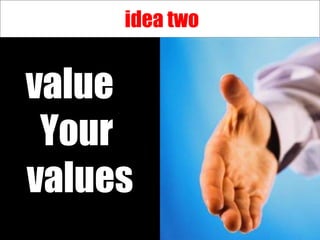
value  Your  values idea two
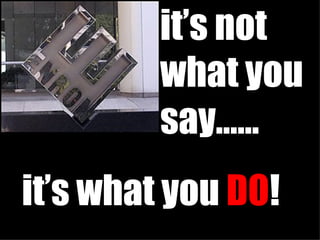
it’s not what you say…… it’s what you  DO !
values can: define the fundamental character of a business help create the culture you want create a sense of identity for the business reduce game playing, politics and confusion provide guidelines for managers and staff provide guidance for acceptable and   unacceptable behaviours
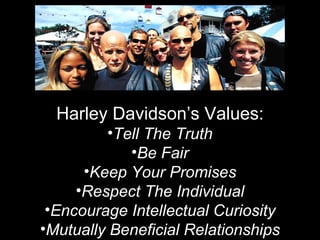
Harley Davidson’s Values: Tell The Truth Be Fair Keep Your Promises Respect The Individual Encourage Intellectual Curiosity Mutually Beneficial Relationships
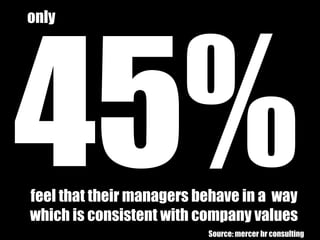
45% feel that their managers behave in a  way which is consistent with company values only Source: mercer hr consulting
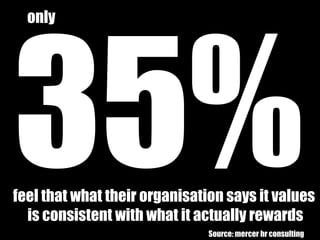
35% feel that what their organisation says it values is consistent with what it actually rewards only Source: mercer hr consulting
turn your values into ‘preferred behaviours’
TEAMWORK Offers support – doesn’t wait to be asked Strives to understand and contribute to departmental/team goals Recognises the implications of their actions/inactions on others Shows respect to the needs, feelings and views of others Promotes ‘collective’ ownership across the business Encourages contributions from all team members
be a role model
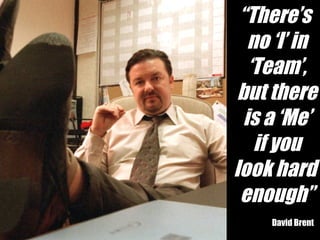
“ There’s  no ‘I’ in ‘ Team’, but there is a ‘Me’ if you look hard  enough” David Brent
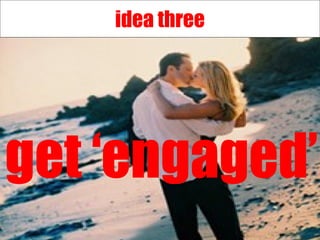
idea three get ‘engaged’
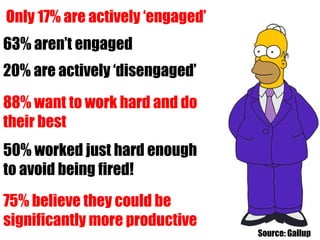
Only 17% are actively ‘engaged’ 63% aren’t engaged 20% are actively ‘disengaged’ 88% want to work hard and do  their best 50% worked just hard enough  to avoid being fired! 75% believe they could be  significantly more productive Source: Gallup
the benefits of an ‘engaged’ workforce
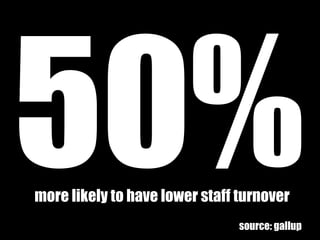
50% more likely to have lower staff turnover source: gallup
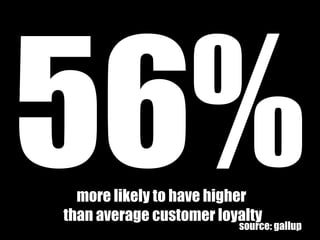
56% more likely to have higher  than average customer loyalty source: gallup
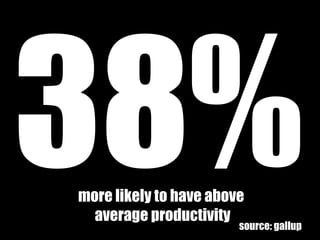
38% more likely to have above  average productivity source: gallup
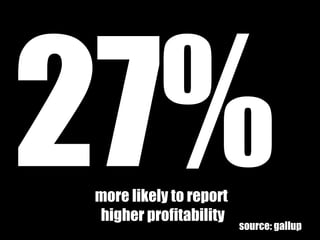
27% more likely to report  higher profitability source: gallup
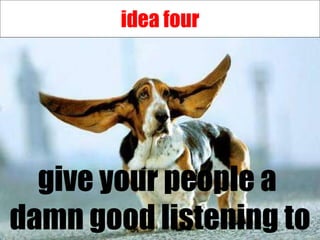
idea four give your people a  damn good listening to
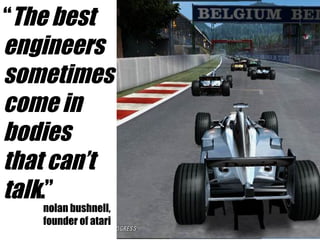
“ The best  engineers  sometimes come in  bodies that can’t  talk .” nolan bushnell, founder of atari
ideas for action….
set up feedback systems that  suit your team, not you ‘ beat the brainwashing’ – ask your newcomers to spot your business ‘stupidities’ ‘ kill a stupid rule’ – commerce bank offers $50 ‘ experience days’ ‘ fiver down the pub’ fridays ‘ pizzas and problems’ resist recruiting ‘replicants’
ask your team ‘what do you  want from   me?’
Stop Start Continue
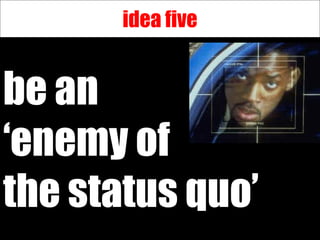
be an  ‘ enemy of  the status quo’ idea five
when two people  in business  always  agree,  one of them is  unnecessary william wrigley jr
four common traits: leadership systems and processes culture measurement
what  processes   do you have to encourage your people to ‘revolutionise’ your business?
“ find great ideas,  exaggerate them, and spread them like hell  around the business  with the speed of light” Jan Carlzon, Head of Scandinavian Airlines
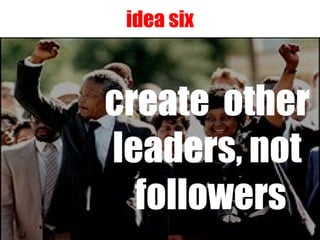
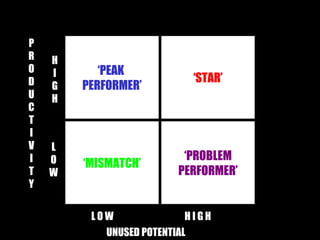
idea six create  other  leaders, not  followers
‘ PEAK  PERFORMER’ ‘ MISMATCH’ ‘ STAR’ ‘ PROBLEM PERFORMER’ P R O D U C T I V I T Y UNUSED POTENTIAL H I G H L O W L O W H I G H
and finally….
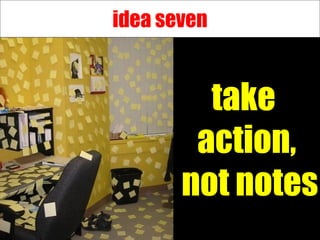
idea seven take  action, not notes
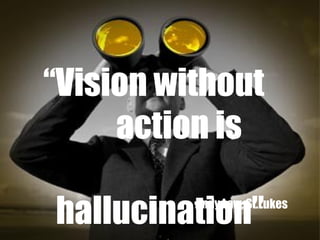
“ Vision without  action is  hallucination” Andy Law, St.Lukes
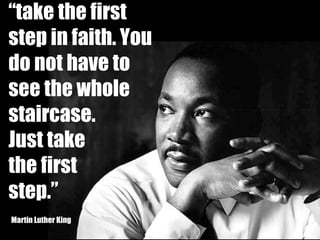
“ take the first  step in faith. You  do not have to  see the whole  staircase. Just take  the first  step.” Martin Luther King
we can  all be  leaders
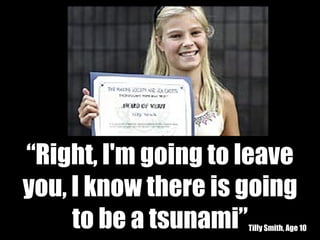
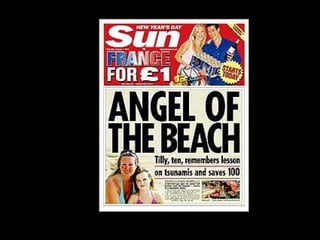
Tilly Smith, Age 10 “ Right, I'm going to leave you, I know there is going to be a tsunami”
 
don’t just stand there….. do something! dick dastardly
for stuff like this (and more)  visit . . . . . www.andyhanselman.com

Winning With Leadership

  • 1.
    winning with leadership!
  • 2.
    about this presentation….
  • 3.
    you’ll hear :The difference between ‘management’ and ‘leadership’ How to get your people ‘on board’ Ways to maximise people performance Ideas to create the culture you want
  • 4.
    what’s the difference between management and leadership ?
  • 5.
    managers maintain thestatus quo monitor situation allocate resources communicate targets measure the results feedback on the trends
  • 6.
    leaders strategic thinkerslook forward and create visions challenge motivate inspire
  • 7.
    “ a leader'sjob is to rally people toward a better future” marcus buckingham
  • 8.
    why is leadership so important?
  • 9.
    “ Thesurplus society has a surplus of similar companies, employing similar people, with similar educational backgrounds, working in similar jobs, coming up with similar ideas, producing similar things, with similar prices, warranties, and qualities.” Jonas Ridderstrale and Kjel Nordstrom Authors, Funky Business
  • 10.
    “ when peopleleave companies, they tend not to quit the company, they are more likely to have quit the boss.” Ken Blanchard
  • 11.
    “ The talented employee may join a company because of its charismatic leaders, its generous benefits, and its world-class training programs, but how long that employee stays and how productive he is while he is there is determined by his relationship with his immediate supervisor" Research from thousands of employees Marcus Buckingham ‘First Break All The Rules’
  • 12.
    trust in management is declining
  • 13.
    “ Only 36%of employees trust senior management to communicate effectively” “ This drops to only 26% of employees with more than 15 years experience” Source: mercer hr consulting “ Only 53% felt their organisation did a good job of keeping employees informed”
  • 14.
    idea one getthat ‘ vision thing’
  • 15.
    getting that ‘visionthing’ Creating a clear picture of the future that ‘stimulates, excites and inspires’ Getting everyone to ‘buy’ into it Ensuring that everyone understands what’s expected of them Turning it into meaningful goals and targets Communicating progress towards it continuously Celebrating successes Working ‘On’ it consistently
  • 16.
  • 17.
    what does a vision look like?
  • 18.
    a vision Isnot simply a set of financial figures Is not a business plan Is not a ‘pie in the sky’ idea Is more than words in the MD’s annual speech Is a picture of the future that we want Includes customers, people and finances Typically is a 2 year / 1 year / 6 month ‘thing’ Is a point of strategic focus for the leadership of the business Is something for everyone to work towards
  • 19.
    people tell us they need to know
  • 20.
    How is thisvision relevant to me? What specifically do you want me to do? How will I be measured? What consequences will I face? What tools and support are available? What’s in it for me? How are we doing?
  • 21.
  • 22.
    to help peopleanswer these questions
  • 23.
    value Your values idea two
  • 24.
    it’s not whatyou say…… it’s what you DO !
  • 25.
    values can: definethe fundamental character of a business help create the culture you want create a sense of identity for the business reduce game playing, politics and confusion provide guidelines for managers and staff provide guidance for acceptable and unacceptable behaviours
  • 26.
    Harley Davidson’s Values:Tell The Truth Be Fair Keep Your Promises Respect The Individual Encourage Intellectual Curiosity Mutually Beneficial Relationships
  • 27.
    45% feel thattheir managers behave in a way which is consistent with company values only Source: mercer hr consulting
  • 28.
    35% feel thatwhat their organisation says it values is consistent with what it actually rewards only Source: mercer hr consulting
  • 29.
    turn your valuesinto ‘preferred behaviours’
  • 30.
    TEAMWORK Offers support– doesn’t wait to be asked Strives to understand and contribute to departmental/team goals Recognises the implications of their actions/inactions on others Shows respect to the needs, feelings and views of others Promotes ‘collective’ ownership across the business Encourages contributions from all team members
  • 31.
    be a rolemodel
  • 32.
    “ There’s no ‘I’ in ‘ Team’, but there is a ‘Me’ if you look hard enough” David Brent
  • 33.
    idea three get‘engaged’
  • 34.
    Only 17% areactively ‘engaged’ 63% aren’t engaged 20% are actively ‘disengaged’ 88% want to work hard and do their best 50% worked just hard enough to avoid being fired! 75% believe they could be significantly more productive Source: Gallup
  • 35.
    the benefits ofan ‘engaged’ workforce
  • 36.
    50% more likelyto have lower staff turnover source: gallup
  • 37.
    56% more likelyto have higher than average customer loyalty source: gallup
  • 38.
    38% more likelyto have above average productivity source: gallup
  • 39.
    27% more likelyto report higher profitability source: gallup
  • 40.
    idea four giveyour people a damn good listening to
  • 41.
    “ The best engineers sometimes come in bodies that can’t talk .” nolan bushnell, founder of atari
  • 42.
  • 43.
    set up feedbacksystems that suit your team, not you ‘ beat the brainwashing’ – ask your newcomers to spot your business ‘stupidities’ ‘ kill a stupid rule’ – commerce bank offers $50 ‘ experience days’ ‘ fiver down the pub’ fridays ‘ pizzas and problems’ resist recruiting ‘replicants’
  • 44.
    ask your team‘what do you want from me?’
  • 45.
  • 46.
    be an ‘ enemy of the status quo’ idea five
  • 47.
    when two people in business always agree, one of them is unnecessary william wrigley jr
  • 48.
    four common traits:leadership systems and processes culture measurement
  • 49.
    what processes do you have to encourage your people to ‘revolutionise’ your business?
  • 50.
    “ find greatideas, exaggerate them, and spread them like hell around the business with the speed of light” Jan Carlzon, Head of Scandinavian Airlines
  • 51.
    idea six create other leaders, not followers
  • 52.
    ‘ PEAK PERFORMER’ ‘ MISMATCH’ ‘ STAR’ ‘ PROBLEM PERFORMER’ P R O D U C T I V I T Y UNUSED POTENTIAL H I G H L O W L O W H I G H
  • 53.
  • 54.
    idea seven take action, not notes
  • 55.
    “ Vision without action is hallucination” Andy Law, St.Lukes
  • 56.
    “ take thefirst step in faith. You do not have to see the whole staircase. Just take the first step.” Martin Luther King
  • 57.
    we can all be leaders
  • 58.
    Tilly Smith, Age10 “ Right, I'm going to leave you, I know there is going to be a tsunami”
  • 59.
  • 60.
    don’t just standthere….. do something! dick dastardly
  • 61.
    for stuff likethis (and more) visit . . . . . www.andyhanselman.com