SAP Certified Consultant
SAP Activate -05 Activate Manager
SAP ERP 6.0 Sourcing & Procurement
SAP S/4 HANA Sourcing & Procurement
SAP EWM 9.5
Contents
 What is material ledger ?
 Objective Of Material Ledger.
 Why Material Ledger is mandatory in SAP S/4 HANA
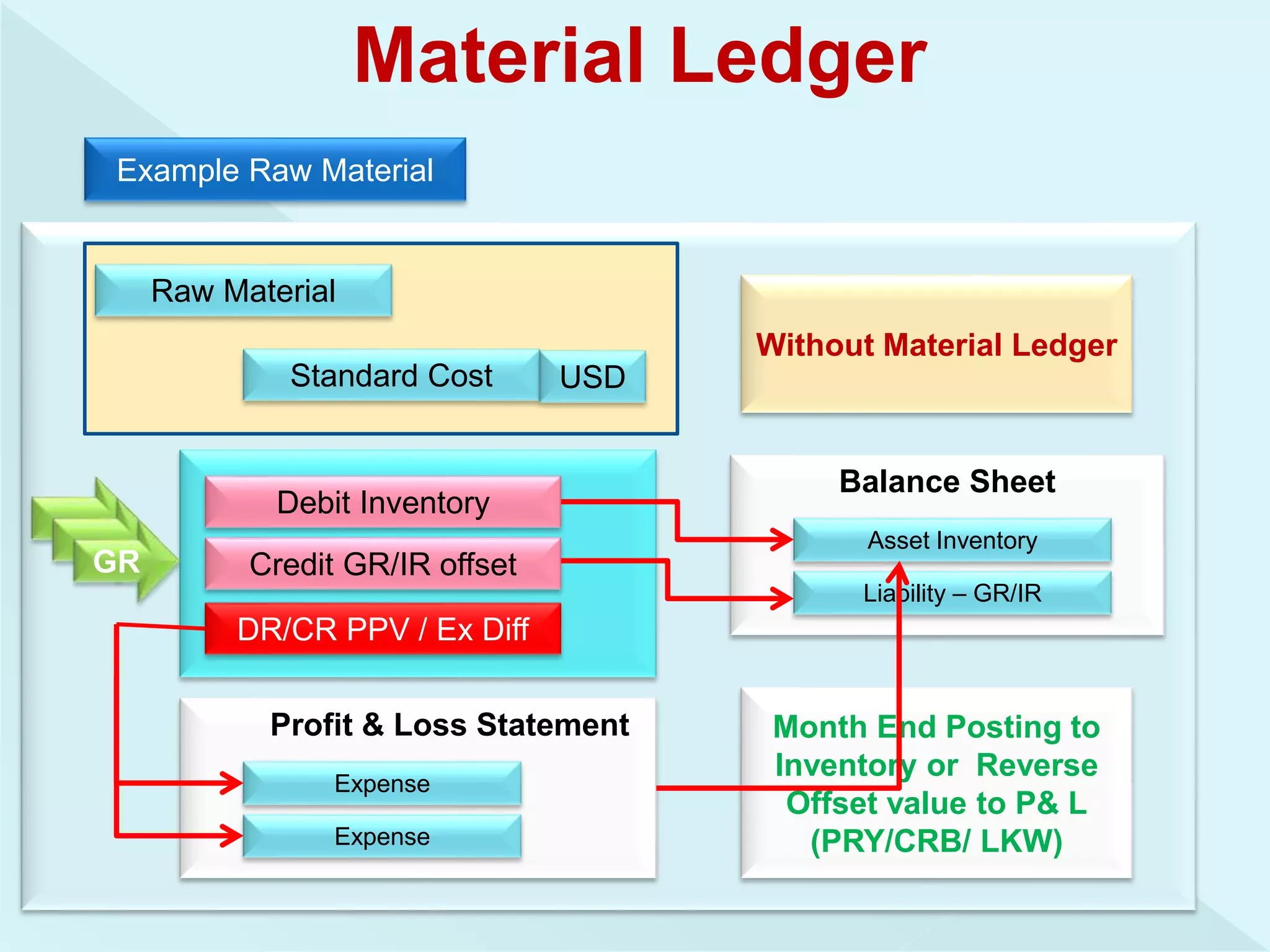
Material Ledger
Example Raw Material
Raw Material
Without Material Ledger
Debit Inventory
Credit GR/IR offset
DR/CR PPV / Ex Diff
Profit & Loss Statement
Expense
Expense
Asset Inventory
Liability – GR/IR
Balance Sheet
Month End Posting to
Inventory or Reverse
Offset value to P& L
(PRY/CRB/ LKW)
GR
Standard Cost USD
Material Ledger
Example Raw Material
Raw Material
With Material Ledger
Debit Inventory
Credit GR/IR offset
DR/CR PPV / Ex Diff
Profit & Loss Statement
Expense
Expense
Asset Inventory
Liability – GR/IR
Balance Sheet
Month End Wrong
Inventory Value with
Gain or Loss
GR
Standard Cost USD
Material Ledger
Periodic Actual Costing
Method Of Processing
Previous Period
Create
STOCK
Allow Price
Determination
Multi Level Price
Determination
Perform Selection
Costing Sequence
Individual
Cost Run
Recommended
Consumption Single Level Price
Determination
Allow Closing Entry
Closing Entry
Revaluation
Material Ledger
 What is material ledger ?
Material Ledger (ML) is a most useful and important tool with in SAP ERP
Software. SAP making continuous improvement in Material Ledger.
Material ledger is classified as a sub-ledger of General Ledger (G/L) accounts.
It is an important power full tool is cost management. Material ledger is solution
To perform actual costing. There are two traditional methods of valuation of
Material.
1. Standard Costing: Standard costing an effective method of obtaining stable price
of a material which can be benchmark for any price fluctuation. That price variance
posted in P& L account if the all product not sale. Price variance effect the cost of
product if that products remains long time in your stock.
2. Moving Average Costing: Moving average price is a method which is capable to
keep your material cost up to date. Because in present era the cost of material
having fluctuation. Every time business is perform a goods or invoice receipt. The
moving average price is updated based on the total inventory value in which the
latest purchase prices is consider and dividing it by the total inventory quantity,. One
draw back of moving average costing is that the new price is only posted in back of
inventory. Existing inventory will allocated back to inventory. And remainder will be
posted to the price variance account. If we looked at moving average price of the
material it will not represent the true current price of material.
Objectives Of Material Ledger
The objective of material ledger are
1. Inventory valuation in up to three currencies and valuation method.
2. Performing actual costing.
The material ledger takes the price variances that occur from inventory
transactions and posted them back to inventories in order to value them at
actual cost. It does while retaining cost is standard cost of the material as
benchmark. We have option to revaluate the current standard cost with the
periodic unit price. Which is the actual cost of the material cost calculated by
Material Ledger. The price determination with material ledger are of two types.
1. Single level Price determination: This take the price variance which occur for
an individual material and roll them back into its ending inventory.
2. Multi level Price Determination: This takes the variance that occur for a lower
level product for a lower level product example Raw Material. And roll them into
proportion of consume quantity into a higher level product example finished product.
By using Material ledger revaluation of consumption can be complete and we
can achieve actual cost of ending inventory of single or multilevel products and
cost of sales. We can measure easily procurement processes according to
Standard Costs.
Material Ledger SAP S/4 HANA v/s SAP ERP 6.0
The objective of material ledger are
1. Inventory valuation in up to three currencies and valuation method.
2. Performing actual costing.
In SAP S/4 HANA activation of Material Ledger is mandatory. Material Ledger
valuates inventory in multiple currencies. In SAP ERP traditionally a single
currency valuates the inventory, While in SAP S/4 HANA Material Ledger allows
valuation in two additional currencies. This is essential helpful to the global
Companies which are evaluating there inventories in multiple currencies.
If an organization records inventory on its balance sheet, they need a sub ledger of sub
ledger of inventory postings which provide more granular detail about
Inventory transactions than General ledger postings As done with AP, AR, and fixed
assets which are also sub ledger of the SAP General Ledger. The sub ledger inventory
is existed in SAP ERP system in the form of inventory valuation tables XBEW(H). Such
as EBEW, EBEWH, MBEW, MBEWH, OBEW, OBEWH, QBEW and QBEWH. SAP
enhanced these tables in SAP S/4 HANA by introducing the Universal Journal.
SAP leveraged the existing functionality of Material Ledger to create a cohesive sub
ledger for inventory valuation in SAP S/4 HANA.
Material Ledger SAP S/4 HANA v/s SAP ERP 6.0
The actual functionality of costing is still optional its depends upon the requirement of
the companies. If any company not need to report their inventory and cost of sake at
actual sales at actual cost don’t need to activate this functionality.
SAP S/4 HANA offer a few new currencies options, but more important is SAP S/4
HANA offers new ways of evaluation Material Ledger data. Currency settings available
in Universal Journal is integrated with Material Ledger.
Multiple currencies, or parallel currencies is a functionality that allows the companies to
record transactions in more than one currencies for every transactions posted to FI.
This parallel currency functionality has been extended to the Material Ledger for any
inventory transactions, which can be viewed in Material Ledger reports.
In SAP ERP System, you can have one company code currency (local Currency one
and up to two parallel currencies local currency 2 and local currency 3 in the FI module,
We have the option of adopting the currencies in FI module, the CO module, or both or
assigning currency types individually. The currencies are translated are based on the
historical rates in the Material Master.
In SAP S/4 HANA, a key improvement that SAP has made with parallel currencies is to
allow up to eight free definable currencies in the Universal Journal Table in addition to
fixed )local and global currencies as follows:
Material Ledger SAP S/4 HANA v/s SAP ERP 6.0
Local : The company code currency
Global: The Controlling area currency
Freely defined: Up to eight currency types
“Freely defined” means that you can name the currencies any way that makes sense
for your business and not rely on SAP’s predefined currency type names.
Also, if creating these currencies for parallel ledger, you don’t need to base these
currencies on the currency of the leading ledger( as is the case with an SAP ERP
system)
Exchange rates should be maintained for these extra currencies and system will
perform the real time currency translations of the postings in FI module (and related
sub-modules) into these additional currencies.
Alternatively, we could specify that the translation is performed at the end of the period
with the foreign currency valuation program. As a result, a company can present it’s
financial and management reports to different stakeholders in different currencies, as
needed.
In the ledger settings for a company code, you can configure additional currencies
along with the local and global currency types by using transaction FINSC_LEDGER.
Material Ledger SAP S/4 HANA v/s SAP ERP 6.0
Even though eight additional currencies are allowed in the Universal Journal, only three
currencies are allowed in the ML. Therefore, when defining the currencies in ML(which
is based on the currencies of the leading ledger), you’ll need to specify which additional
currencies in the Universal Journal should be mapped to the ML. Also, all the valuation
areas(plants) that belong to a company code should have the same currency type
settings in the ML.
.
Activate Material Ledger
Configuration
These configuration settings are sub divided in to three groups
1. Prerequisite Settings that have to be checked which delivered by SAP
as part of standard delivery. The term check refers to these prerequisite.
2. Setting Define by the customer by the customer in the customer namespace,
and customer specific. The system uses automation to request individual customer
setting during the personalization process. These settings can be initial or can be
reused from existing SAP ERP system.
3. Additional Settings that need to be made covered either by automation or manual
configuration in the customer namespace.
.
1. Enterprise Structure Define Valuation Class
T-Code: SPRO
IMG Screen Enterprise Structure Definition Define Valuation Area
2 Option 1. Valuation area Plant Level 2. Valuation Area Company Code Level
Select Radio button of Valuation Area Plant Level it is mandatory
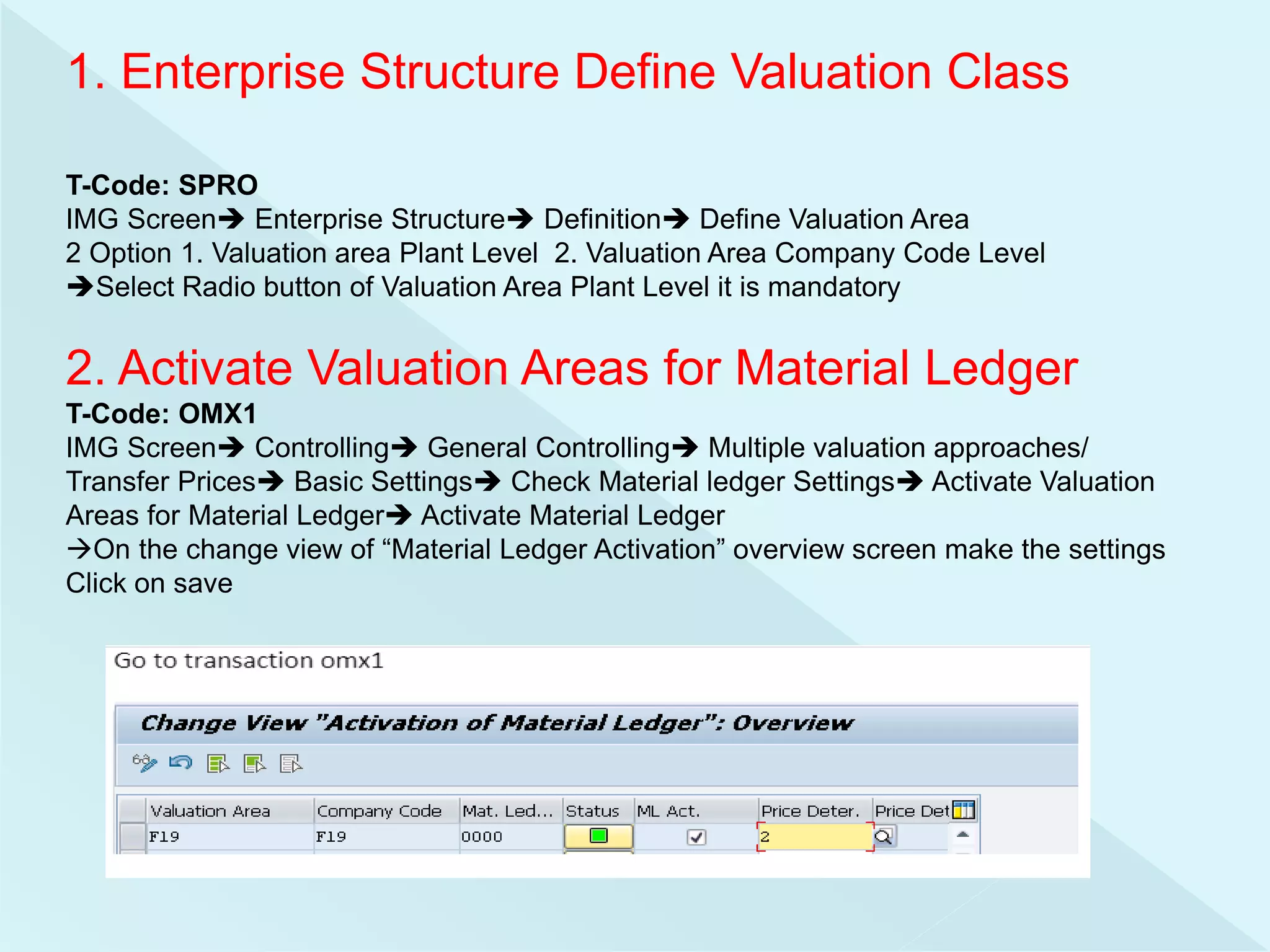
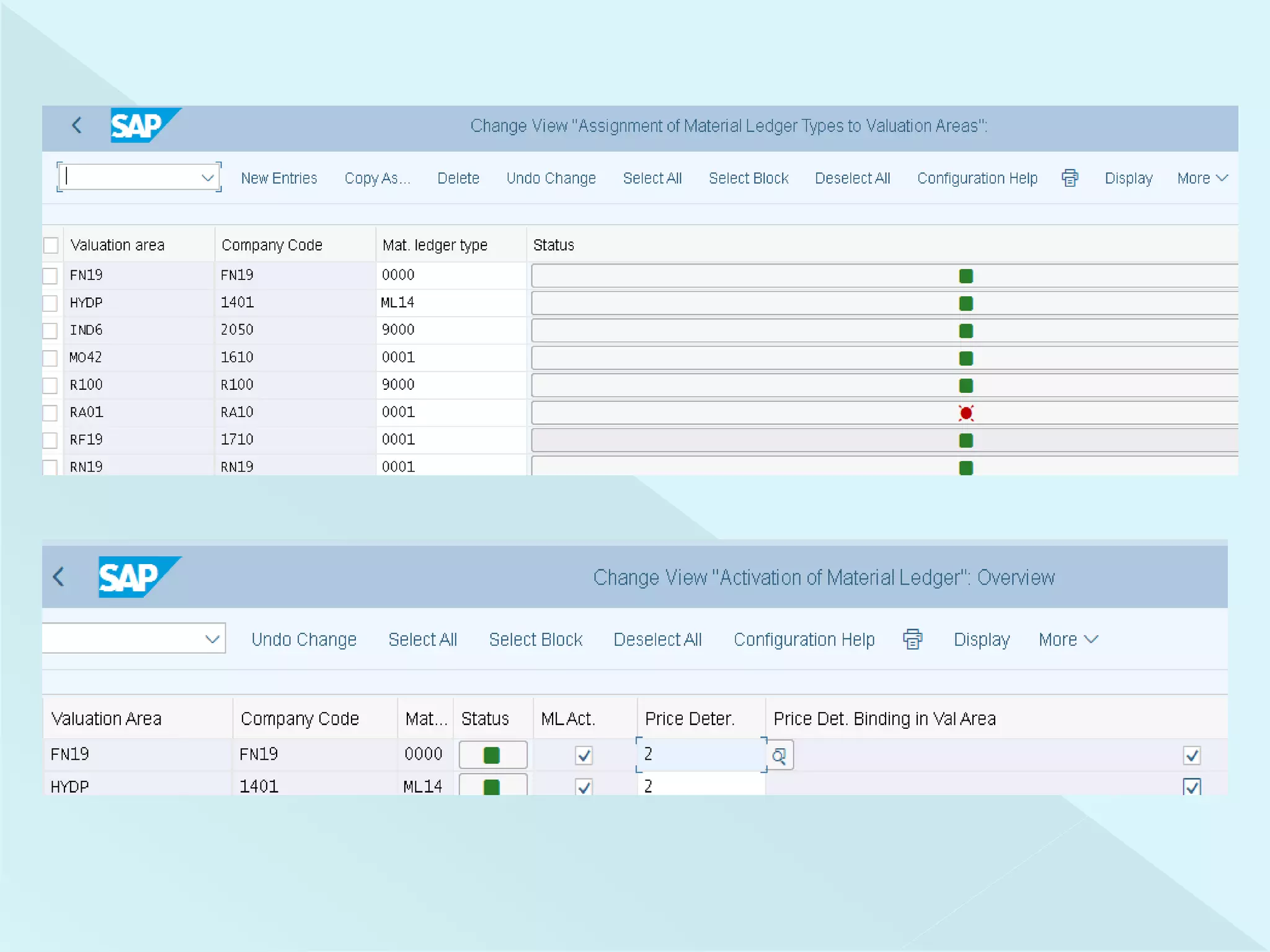
2. Activate Valuation Areas for Material Ledger
T-Code: OMX1
IMG Screen Controlling General Controlling Multiple valuation approaches/
Transfer Prices Basic Settings Check Material ledger Settings Activate Valuation
Areas for Material Ledger Activate Material Ledger
On the change view of “Material Ledger Activation” overview screen make the settings
Click on save
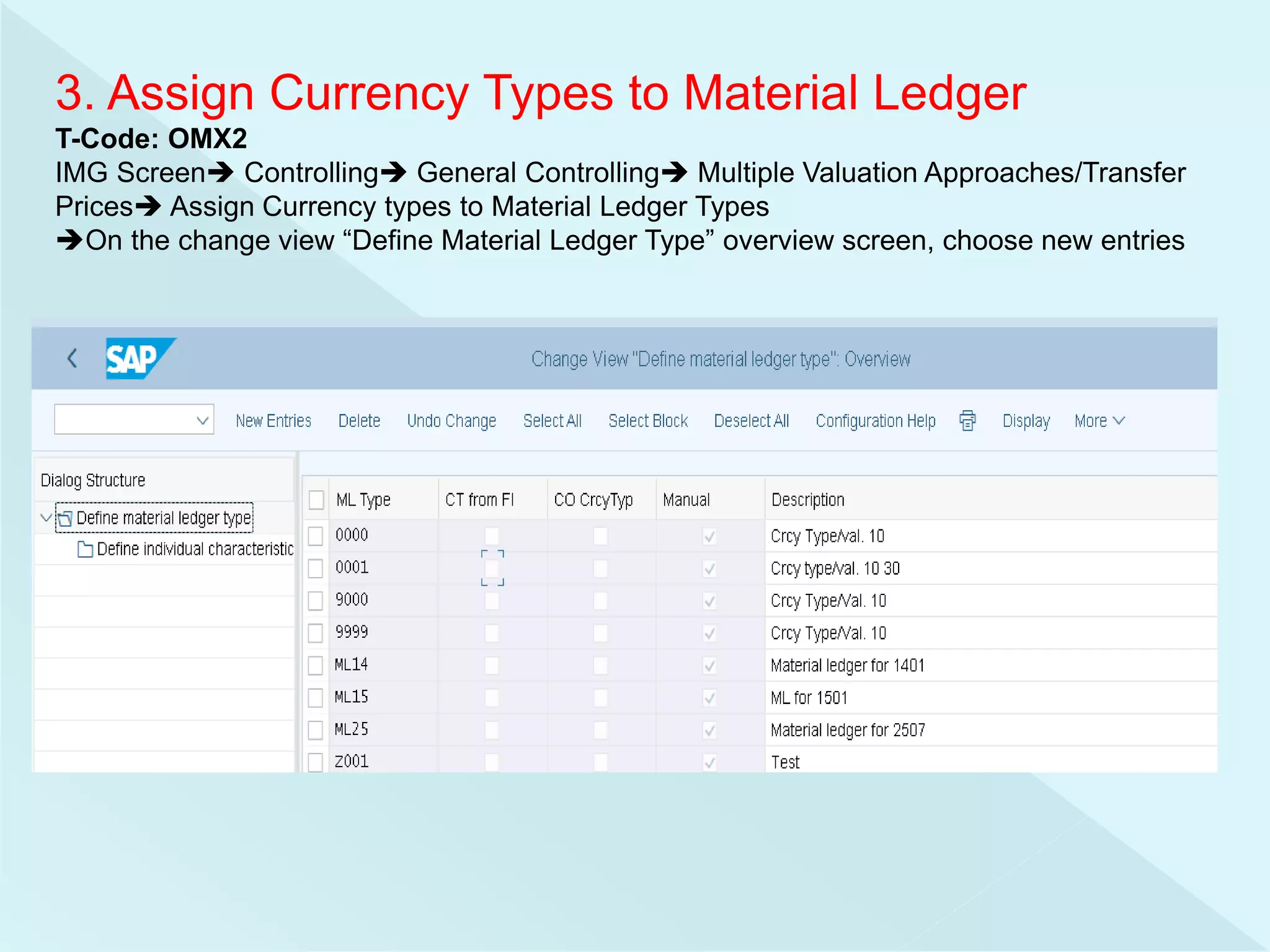
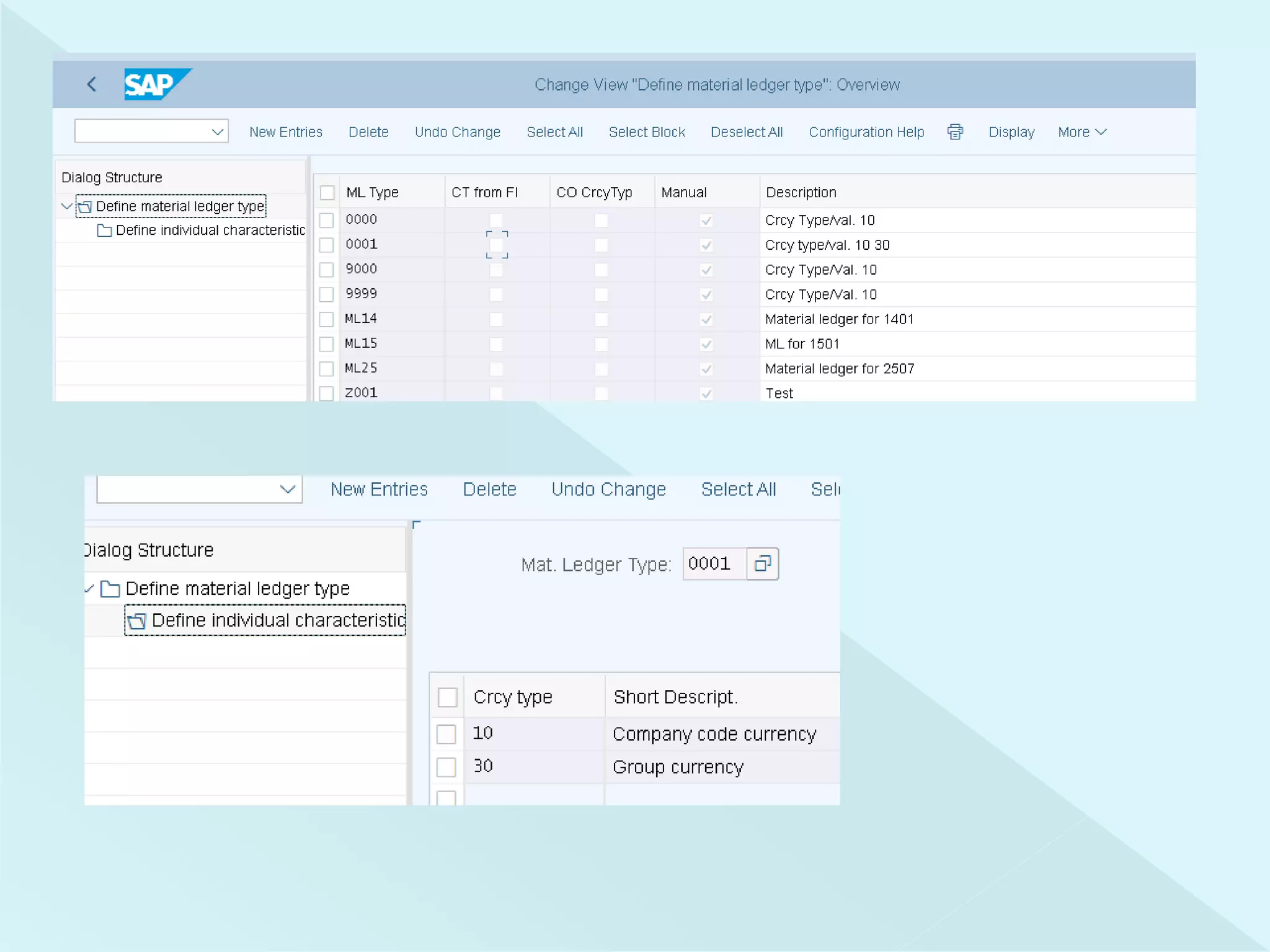
3. Assign Currency Types to Material Ledger
T-Code: OMX2
IMG Screen Controlling General Controlling Multiple Valuation Approaches/Transfer
Prices Assign Currency types to Material Ledger Types
On the change view “Define Material Ledger Type” overview screen, choose new entries
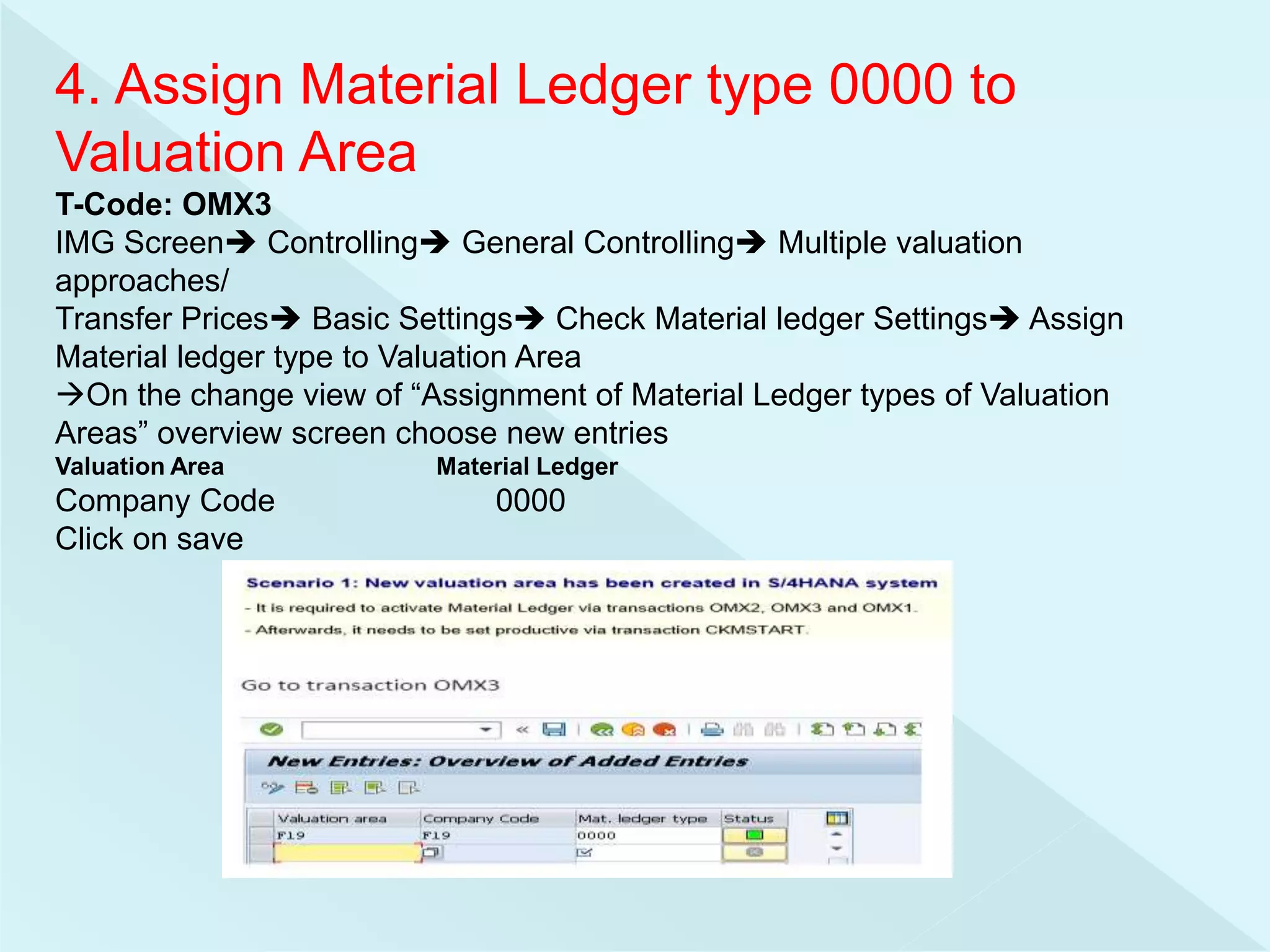
4. Assign Material Ledger type 0000 to
Valuation Area
T-Code: OMX3
IMG Screen Controlling General Controlling Multiple valuation
approaches/
Transfer Prices Basic Settings Check Material ledger Settings Assign
Material ledger type to Valuation Area
On the change view of “Assignment of Material Ledger types of Valuation
Areas” overview screen choose new entries
Valuation Area Material Ledger
Company Code 0000
Click on save
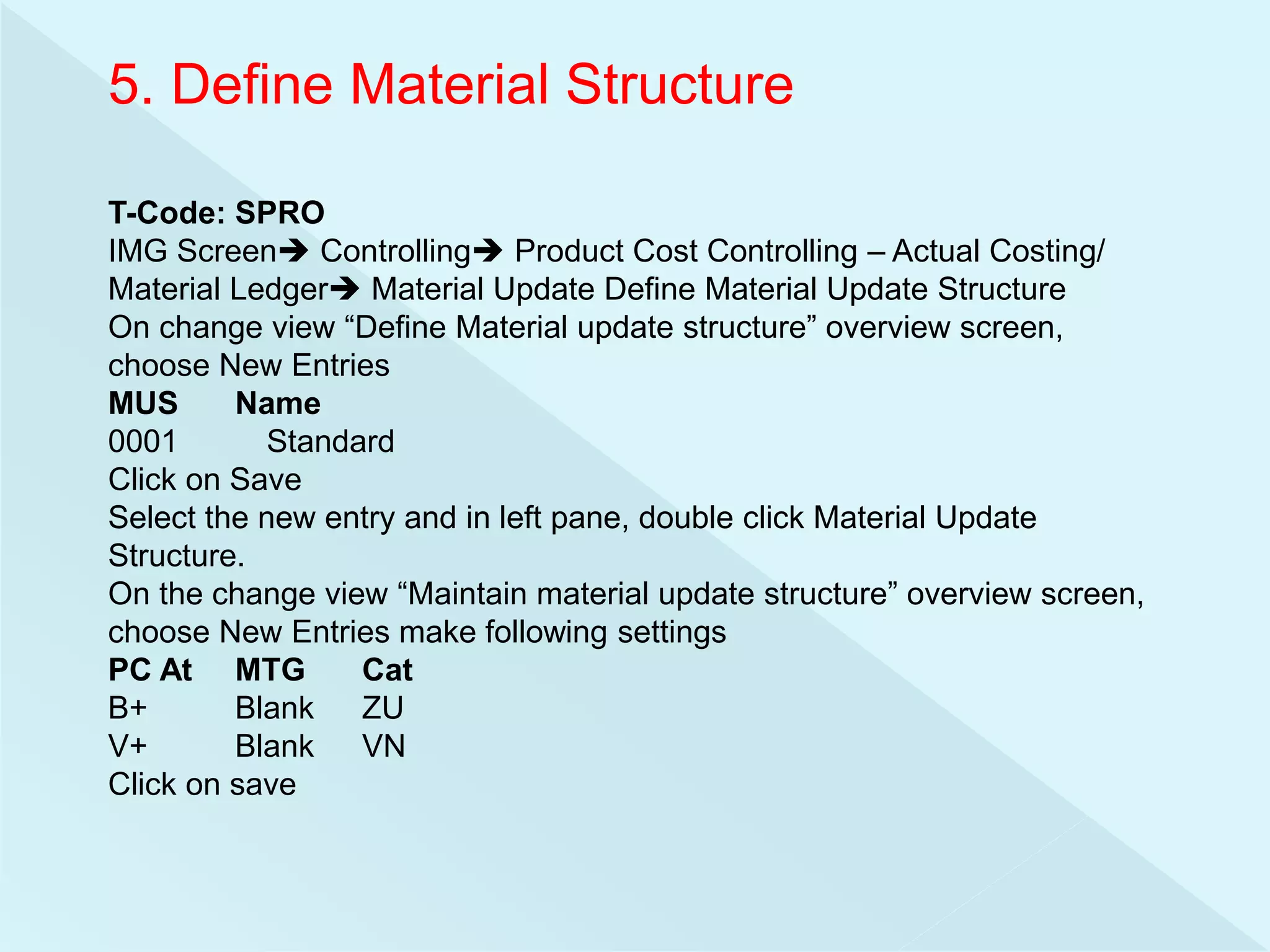
5. Define Material Structure
T-Code: SPRO
IMG Screen Controlling Product Cost Controlling – Actual Costing/
Material Ledger Material Update Define Material Update Structure
On change view “Define Material update structure” overview screen,
choose New Entries
MUS Name
0001 Standard
Click on Save
Select the new entry and in left pane, double click Material Update
Structure.
On the change view “Maintain material update structure” overview screen,
choose New Entries make following settings
PC At MTG Cat
B+ Blank ZU
V+ Blank VN
Click on save
6. Assign Material Update Structure 0001 to a
Valuation Area
T-Code: SPRO
IMG Screen Controlling Product Cost Controlling – Actual Costing/ Material Ledger
Assign Material Update Structure to a valuation area
On change view “Assign Material update structure” overview screen, choose New Entries
Valuation Area Material Update Structure
Company code 0001
Click on Save
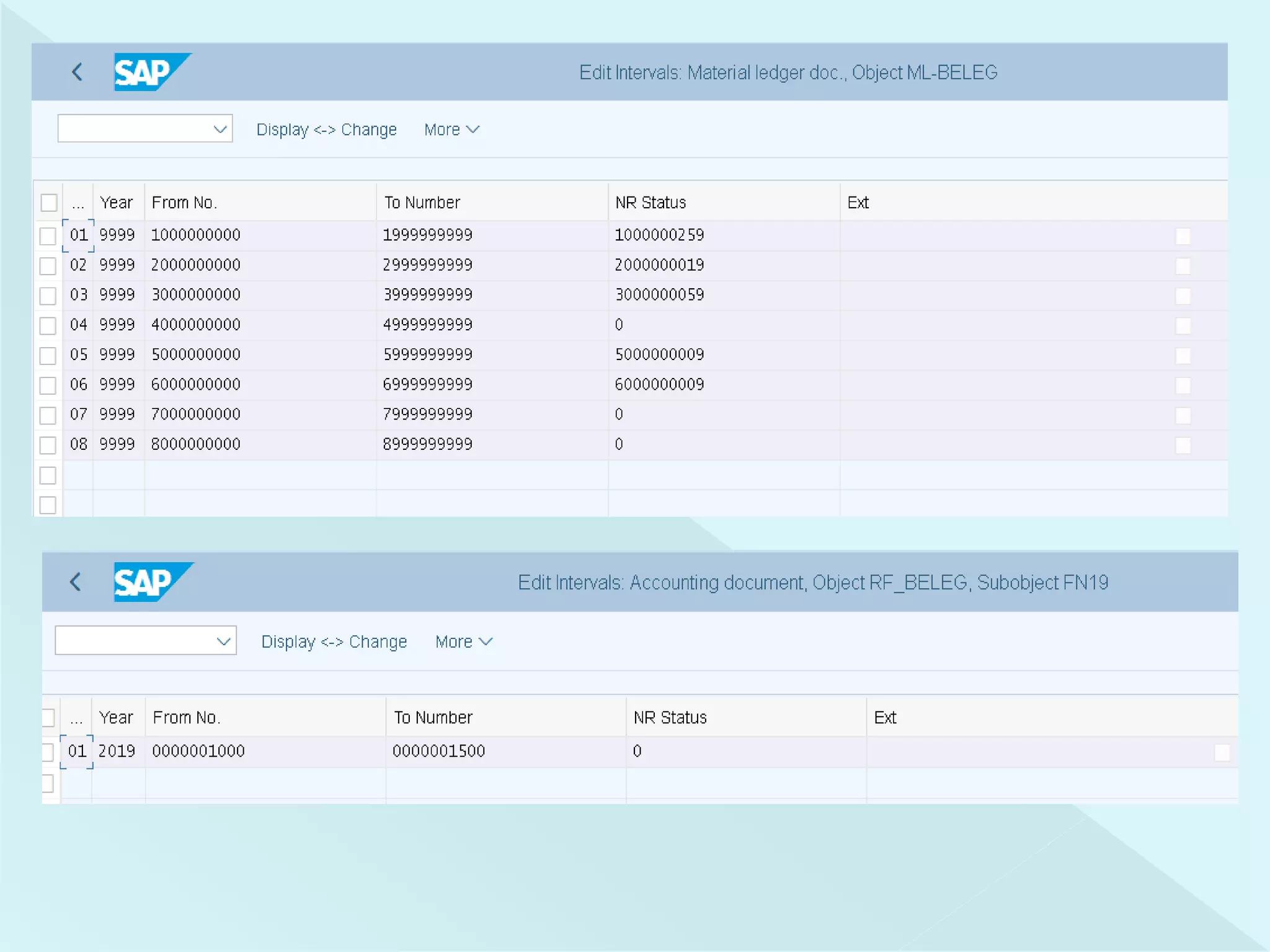
7. Maintain Number Ranges For Material Ledger
Documents
T-Code: SPRO
IMG Screen Material Management Valuation and Account Assignment Maintain
Number Ranges for Material ledger documents
On the Range Maintenance Material Ledger doc screen,
Number Range From No To No External
01 1000000000 1999999999 No
02 3000000000 3999999999 No
03 6000000000 6999999999 No
Click on Save
Choose Back (F3) Choose change NR Status
Click on save
8. Run Reports
SAPRCKM_OBLIGATORY_SETTINGS
T-Code: SE38
On ABAP Editor screen, in the program field, enter SAPRCKA_OBLIGATORY_SETTINGS
and choose execute
Number Range NR Status
01 0
02 0
03 0
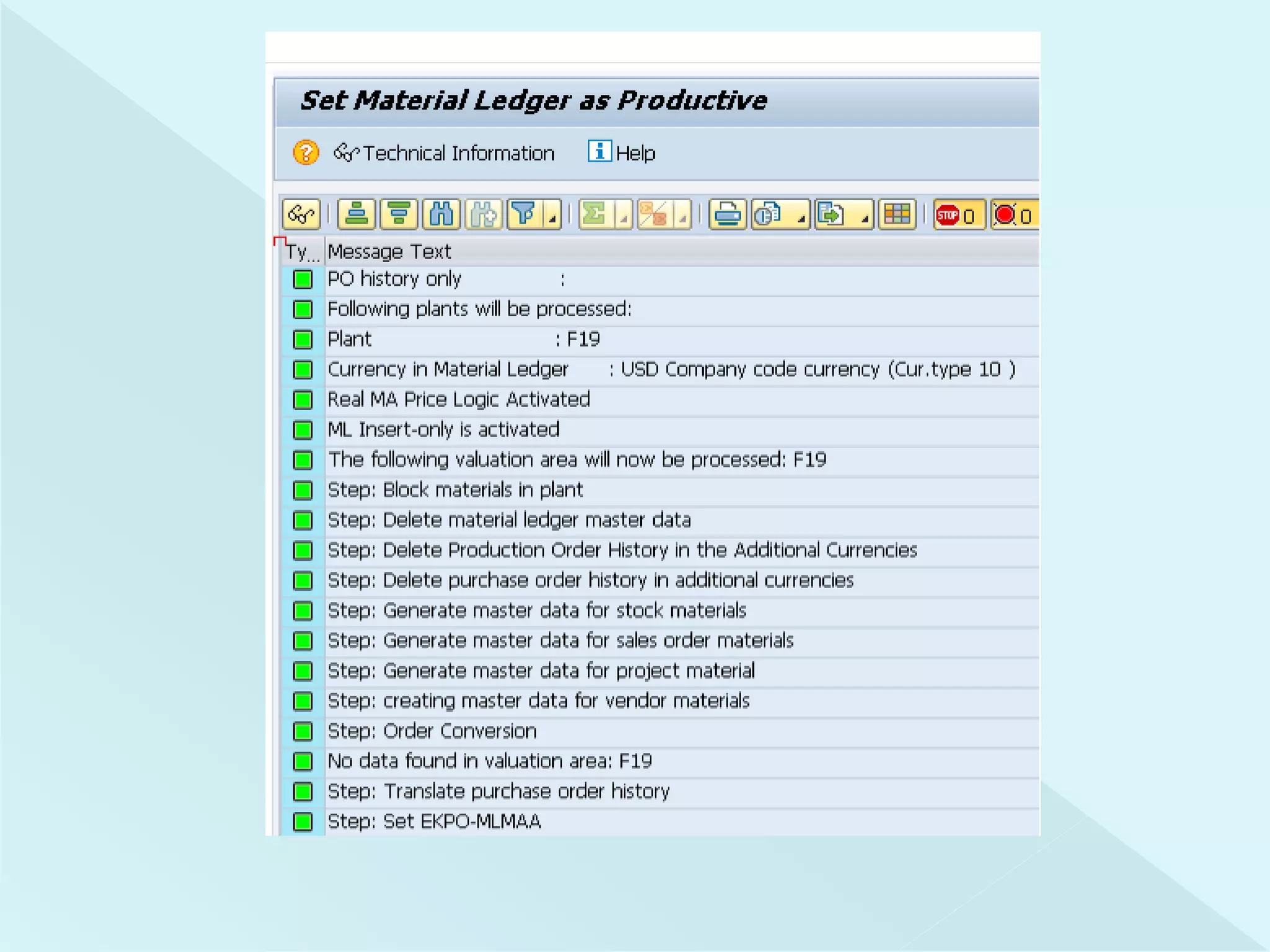
8. Production Startup Material Ledger
In this activity execute the production startup for the Material Ledger
T-Code: CKMSTART
SAP Menu Screen
8. Production Startup Material Ledger
In this activity execute the production startup for the Material Ledger
T-Code: CKMSTART
SAP Menu Screen
Thank You…………………..

Sap s4 hana ml

  • 1.
    SAP Certified Consultant SAPActivate -05 Activate Manager SAP ERP 6.0 Sourcing & Procurement SAP S/4 HANA Sourcing & Procurement SAP EWM 9.5
  • 2.
    Contents  What ismaterial ledger ?  Objective Of Material Ledger.  Why Material Ledger is mandatory in SAP S/4 HANA
  • 3.
    Material Ledger Example RawMaterial Raw Material Without Material Ledger Debit Inventory Credit GR/IR offset DR/CR PPV / Ex Diff Profit & Loss Statement Expense Expense Asset Inventory Liability – GR/IR Balance Sheet Month End Posting to Inventory or Reverse Offset value to P& L (PRY/CRB/ LKW) GR Standard Cost USD
  • 4.
    Material Ledger Example RawMaterial Raw Material With Material Ledger Debit Inventory Credit GR/IR offset DR/CR PPV / Ex Diff Profit & Loss Statement Expense Expense Asset Inventory Liability – GR/IR Balance Sheet Month End Wrong Inventory Value with Gain or Loss GR Standard Cost USD
  • 5.
    Material Ledger Periodic ActualCosting Method Of Processing Previous Period Create STOCK Allow Price Determination Multi Level Price Determination Perform Selection Costing Sequence Individual Cost Run Recommended Consumption Single Level Price Determination Allow Closing Entry Closing Entry Revaluation
  • 6.
    Material Ledger  Whatis material ledger ? Material Ledger (ML) is a most useful and important tool with in SAP ERP Software. SAP making continuous improvement in Material Ledger. Material ledger is classified as a sub-ledger of General Ledger (G/L) accounts. It is an important power full tool is cost management. Material ledger is solution To perform actual costing. There are two traditional methods of valuation of Material. 1. Standard Costing: Standard costing an effective method of obtaining stable price of a material which can be benchmark for any price fluctuation. That price variance posted in P& L account if the all product not sale. Price variance effect the cost of product if that products remains long time in your stock. 2. Moving Average Costing: Moving average price is a method which is capable to keep your material cost up to date. Because in present era the cost of material having fluctuation. Every time business is perform a goods or invoice receipt. The moving average price is updated based on the total inventory value in which the latest purchase prices is consider and dividing it by the total inventory quantity,. One draw back of moving average costing is that the new price is only posted in back of inventory. Existing inventory will allocated back to inventory. And remainder will be posted to the price variance account. If we looked at moving average price of the material it will not represent the true current price of material.
  • 7.
    Objectives Of MaterialLedger The objective of material ledger are 1. Inventory valuation in up to three currencies and valuation method. 2. Performing actual costing. The material ledger takes the price variances that occur from inventory transactions and posted them back to inventories in order to value them at actual cost. It does while retaining cost is standard cost of the material as benchmark. We have option to revaluate the current standard cost with the periodic unit price. Which is the actual cost of the material cost calculated by Material Ledger. The price determination with material ledger are of two types. 1. Single level Price determination: This take the price variance which occur for an individual material and roll them back into its ending inventory. 2. Multi level Price Determination: This takes the variance that occur for a lower level product for a lower level product example Raw Material. And roll them into proportion of consume quantity into a higher level product example finished product. By using Material ledger revaluation of consumption can be complete and we can achieve actual cost of ending inventory of single or multilevel products and cost of sales. We can measure easily procurement processes according to Standard Costs.
  • 8.
    Material Ledger SAPS/4 HANA v/s SAP ERP 6.0 The objective of material ledger are 1. Inventory valuation in up to three currencies and valuation method. 2. Performing actual costing. In SAP S/4 HANA activation of Material Ledger is mandatory. Material Ledger valuates inventory in multiple currencies. In SAP ERP traditionally a single currency valuates the inventory, While in SAP S/4 HANA Material Ledger allows valuation in two additional currencies. This is essential helpful to the global Companies which are evaluating there inventories in multiple currencies. If an organization records inventory on its balance sheet, they need a sub ledger of sub ledger of inventory postings which provide more granular detail about Inventory transactions than General ledger postings As done with AP, AR, and fixed assets which are also sub ledger of the SAP General Ledger. The sub ledger inventory is existed in SAP ERP system in the form of inventory valuation tables XBEW(H). Such as EBEW, EBEWH, MBEW, MBEWH, OBEW, OBEWH, QBEW and QBEWH. SAP enhanced these tables in SAP S/4 HANA by introducing the Universal Journal. SAP leveraged the existing functionality of Material Ledger to create a cohesive sub ledger for inventory valuation in SAP S/4 HANA.
  • 9.
    Material Ledger SAPS/4 HANA v/s SAP ERP 6.0 The actual functionality of costing is still optional its depends upon the requirement of the companies. If any company not need to report their inventory and cost of sake at actual sales at actual cost don’t need to activate this functionality. SAP S/4 HANA offer a few new currencies options, but more important is SAP S/4 HANA offers new ways of evaluation Material Ledger data. Currency settings available in Universal Journal is integrated with Material Ledger. Multiple currencies, or parallel currencies is a functionality that allows the companies to record transactions in more than one currencies for every transactions posted to FI. This parallel currency functionality has been extended to the Material Ledger for any inventory transactions, which can be viewed in Material Ledger reports. In SAP ERP System, you can have one company code currency (local Currency one and up to two parallel currencies local currency 2 and local currency 3 in the FI module, We have the option of adopting the currencies in FI module, the CO module, or both or assigning currency types individually. The currencies are translated are based on the historical rates in the Material Master. In SAP S/4 HANA, a key improvement that SAP has made with parallel currencies is to allow up to eight free definable currencies in the Universal Journal Table in addition to fixed )local and global currencies as follows:
  • 10.
    Material Ledger SAPS/4 HANA v/s SAP ERP 6.0 Local : The company code currency Global: The Controlling area currency Freely defined: Up to eight currency types “Freely defined” means that you can name the currencies any way that makes sense for your business and not rely on SAP’s predefined currency type names. Also, if creating these currencies for parallel ledger, you don’t need to base these currencies on the currency of the leading ledger( as is the case with an SAP ERP system) Exchange rates should be maintained for these extra currencies and system will perform the real time currency translations of the postings in FI module (and related sub-modules) into these additional currencies. Alternatively, we could specify that the translation is performed at the end of the period with the foreign currency valuation program. As a result, a company can present it’s financial and management reports to different stakeholders in different currencies, as needed. In the ledger settings for a company code, you can configure additional currencies along with the local and global currency types by using transaction FINSC_LEDGER.
  • 11.
    Material Ledger SAPS/4 HANA v/s SAP ERP 6.0 Even though eight additional currencies are allowed in the Universal Journal, only three currencies are allowed in the ML. Therefore, when defining the currencies in ML(which is based on the currencies of the leading ledger), you’ll need to specify which additional currencies in the Universal Journal should be mapped to the ML. Also, all the valuation areas(plants) that belong to a company code should have the same currency type settings in the ML. .
  • 12.
    Activate Material Ledger Configuration Theseconfiguration settings are sub divided in to three groups 1. Prerequisite Settings that have to be checked which delivered by SAP as part of standard delivery. The term check refers to these prerequisite. 2. Setting Define by the customer by the customer in the customer namespace, and customer specific. The system uses automation to request individual customer setting during the personalization process. These settings can be initial or can be reused from existing SAP ERP system. 3. Additional Settings that need to be made covered either by automation or manual configuration in the customer namespace. .
  • 13.
    1. Enterprise StructureDefine Valuation Class T-Code: SPRO IMG Screen Enterprise Structure Definition Define Valuation Area 2 Option 1. Valuation area Plant Level 2. Valuation Area Company Code Level Select Radio button of Valuation Area Plant Level it is mandatory 2. Activate Valuation Areas for Material Ledger T-Code: OMX1 IMG Screen Controlling General Controlling Multiple valuation approaches/ Transfer Prices Basic Settings Check Material ledger Settings Activate Valuation Areas for Material Ledger Activate Material Ledger On the change view of “Material Ledger Activation” overview screen make the settings Click on save
  • 14.
    3. Assign CurrencyTypes to Material Ledger T-Code: OMX2 IMG Screen Controlling General Controlling Multiple Valuation Approaches/Transfer Prices Assign Currency types to Material Ledger Types On the change view “Define Material Ledger Type” overview screen, choose new entries
  • 15.
    4. Assign MaterialLedger type 0000 to Valuation Area T-Code: OMX3 IMG Screen Controlling General Controlling Multiple valuation approaches/ Transfer Prices Basic Settings Check Material ledger Settings Assign Material ledger type to Valuation Area On the change view of “Assignment of Material Ledger types of Valuation Areas” overview screen choose new entries Valuation Area Material Ledger Company Code 0000 Click on save
  • 16.
    5. Define MaterialStructure T-Code: SPRO IMG Screen Controlling Product Cost Controlling – Actual Costing/ Material Ledger Material Update Define Material Update Structure On change view “Define Material update structure” overview screen, choose New Entries MUS Name 0001 Standard Click on Save Select the new entry and in left pane, double click Material Update Structure. On the change view “Maintain material update structure” overview screen, choose New Entries make following settings PC At MTG Cat B+ Blank ZU V+ Blank VN Click on save
  • 17.
    6. Assign MaterialUpdate Structure 0001 to a Valuation Area T-Code: SPRO IMG Screen Controlling Product Cost Controlling – Actual Costing/ Material Ledger Assign Material Update Structure to a valuation area On change view “Assign Material update structure” overview screen, choose New Entries Valuation Area Material Update Structure Company code 0001 Click on Save 7. Maintain Number Ranges For Material Ledger Documents T-Code: SPRO IMG Screen Material Management Valuation and Account Assignment Maintain Number Ranges for Material ledger documents On the Range Maintenance Material Ledger doc screen, Number Range From No To No External 01 1000000000 1999999999 No 02 3000000000 3999999999 No 03 6000000000 6999999999 No
  • 18.
    Click on Save ChooseBack (F3) Choose change NR Status Click on save 8. Run Reports SAPRCKM_OBLIGATORY_SETTINGS T-Code: SE38 On ABAP Editor screen, in the program field, enter SAPRCKA_OBLIGATORY_SETTINGS and choose execute Number Range NR Status 01 0 02 0 03 0
  • 22.
    8. Production StartupMaterial Ledger In this activity execute the production startup for the Material Ledger T-Code: CKMSTART SAP Menu Screen
  • 23.
    8. Production StartupMaterial Ledger In this activity execute the production startup for the Material Ledger T-Code: CKMSTART SAP Menu Screen
  • 25.