The World Leader in High Performance Signal Processing Solutions


Blackfin Device Drivers
        Presented By:
        David Lannigan
About this Module


    This module discusses the device driver model for the
    Blackfin family of processors.

    It is recommended that users should have an understanding
    of the Blackfin architecture and is familiar with the Blackfin
    System Services software.


2
Module Outline

! Overview
    " General
            Information
     ! Common conventions, terminology, return codes etc.

! Device Driver API
! Buffers
! Dataflow Methods
! UART example (VisualDSP, December 2005 update)


3
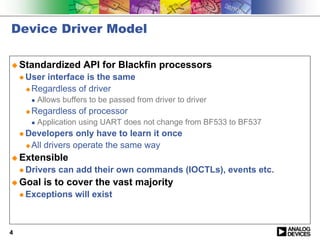
Device Driver Model

! Standardized            API for Blackfin processors
    " Userinterface is the same
     ! Regardless of driver

         "   Allows buffers to be passed from driver to driver
     !   Regardless of processor
         "   Application using UART does not change from BF533 to BF537
    " Developers    only have to learn it once
     ! All drivers operate the same way

! Extensible
    " Drivers      can add their own commands (IOCTLs), events etc.
! Goal        is to cover the vast majority
    " Exceptions       will exist


4
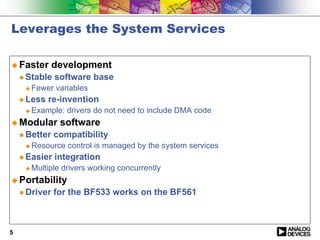
Leverages the System Services

! Faster       development
    " Stable   software base
     !   Fewer variables
    " Less   re-invention
     !   Example: drivers do not need to include DMA code
! Modular        software
    " Better   compatibility
     !   Resource control is managed by the system services
    " Easier   integration
     !   Multiple drivers working concurrently
! Portability
    " Driver   for the BF533 works on the BF561


5
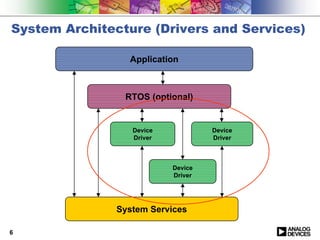
System Architecture (Drivers and Services)

                 Application


                RTOS (optional)


                  Device            Device
                  Driver            Driver


                           Device
                           Driver


               System Services

6
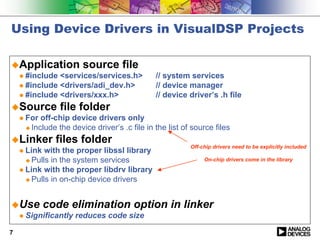
Using Device Drivers in VisualDSP Projects

!Application source file
 " #include <services/services.h>           // system services
 " #include <drivers/adi_dev.h>             // device manager
 " #include <drivers/xxx.h>                 // device driver’s .h file
!Source file folder
 " For off-chip device drivers only
   ! Include the device driver’s .c file in the list of source files

!Linker files folder
                                                       Off-chip drivers need to be explicitly included
 " Link with the proper libssl library
   ! Pulls in the system services                           On-chip drivers come in the library

 " Link with the proper libdrv library
   ! Pulls in on-chip device drivers


!Use code elimination option                     in linker
 " Significantly reduces code size

7
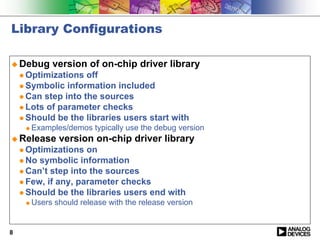
Library Configurations

! Debug       version of on-chip driver library
    " Optimizations  off
    " Symbolic information included
    " Can step into the sources
    " Lots of parameter checks
    " Should be the libraries users start with
     !   Examples/demos typically use the debug version
! Release       version on-chip driver library
    " Optimizations  on
    " No symbolic information
    " Can’t step into the sources
    " Few, if any, parameter checks
    " Should be the libraries users end with
     !   Users should release with the release version


8
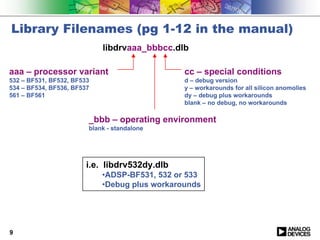
Library Filenames (pg 1-12 in the manual)
                            libdrvaaa_bbbcc.dlb

aaa – processor variant                        cc – special conditions
532 – BF531, BF532, BF533                      d – debug version
534 – BF534, BF536, BF537                      y – workarounds for all silicon anomolies
561 – BF561                                    dy – debug plus workarounds
                                               blank – no debug, no workarounds

                        _bbb – operating environment
                        blank - standalone


                        i.e. libdrv532dy.dlb
                            •ADSP-BF531, 532 or 533
                            •Debug plus workarounds


9
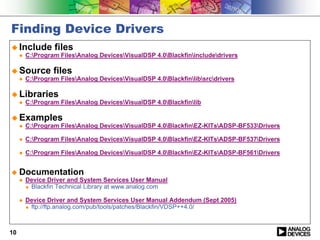
Finding Device Drivers
! Include         files
     "   C:Program FilesAnalog DevicesVisualDSP 4.0Blackfinincludedrivers

! Source          files
     "   C:Program FilesAnalog DevicesVisualDSP 4.0Blackfinlibsrcdrivers

! Libraries
     "   C:Program FilesAnalog DevicesVisualDSP 4.0Blackfinlib

! Examples
     "   C:Program FilesAnalog DevicesVisualDSP 4.0BlackfinEZ-KITsADSP-BF533Drivers

     "   C:Program FilesAnalog DevicesVisualDSP 4.0BlackfinEZ-KITsADSP-BF537Drivers

     "   C:Program FilesAnalog DevicesVisualDSP 4.0BlackfinEZ-KITsADSP-BF561Drivers


! Documentation
  " Device Driver and System Services User Manual
    ! Blackfin Technical Library at www.analog.com


     "   Device Driver and System Services User Manual Addendum (Sept 2005)
         ! ftp://ftp.analog.com/pub/tools/patches/Blackfin/VDSP++4.0/


10
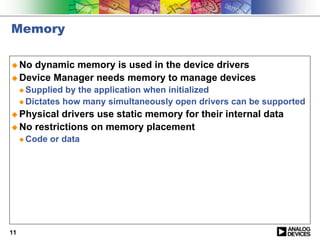
Memory

! No dynamic memory is used in the device drivers
! Device Manager needs memory to manage devices
     " Supplied  by the application when initialized
     " Dictates how many simultaneously open drivers can be supported

! Physical drivers use static memory for their internal data
! No restrictions on memory placement
     " Code   or data


11
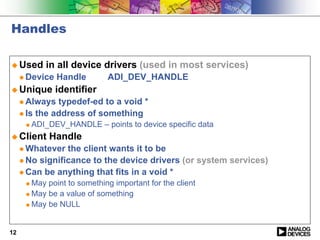
Handles

! Used       in all device drivers (used in most services)
     " Device   Handle       ADI_DEV_HANDLE
! Unique        identifier
     " Always  typedef-ed to a void *
     " Is the address of something
      !   ADI_DEV_HANDLE – points to device specific data
! Client      Handle
     " Whatever  the client wants it to be
     " No significance to the device drivers (or system services)
     " Can be anything that fits in a void *
      ! May point to something important for the client
      ! May be a value of something

      ! May be NULL


12
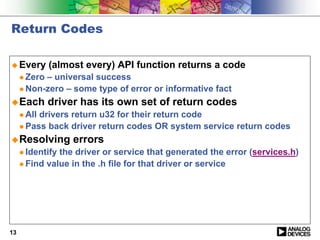
Return Codes

! Every       (almost every) API function returns a code
     " Zero– universal success
     " Non-zero – some type of error or informative fact

! Each        driver has its own set of return codes
     " Alldrivers return u32 for their return code
     " Pass back driver return codes OR system service return codes

! Resolving        errors
     " Identifythe driver or service that generated the error (services.h)
     " Find value in the .h file for that driver or service


13
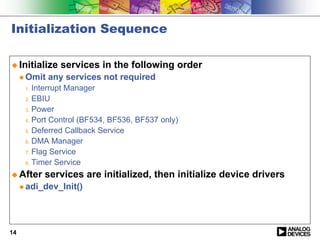
Initialization Sequence

! Initialize    services in the following order
     " Omit   any services not required
      1. Interrupt Manager
      2. EBIU

      3. Power

      4. Port Control (BF534, BF536, BF537 only)

      5. Deferred Callback Service

      6. DMA Manager

      7. Flag Service

      8. Timer Service

! After    services are initialized, then initialize device drivers
     " adi_dev_Init()


14
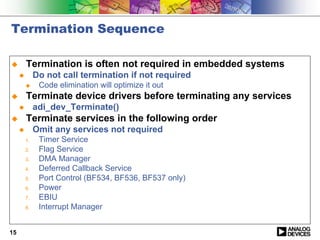
Termination Sequence

!        Termination is often not required in embedded systems
     "        Do not call termination if not required
         !     Code elimination will optimize it out
!        Terminate device drivers before terminating any services
     "        adi_dev_Terminate()
!        Terminate services in the following order
     "        Omit any services not required
         1.    Timer Service
         2.    Flag Service
         3.    DMA Manager
         4.    Deferred Callback Service
         5.    Port Control (BF534, BF536, BF537 only)
         6.    Power
         7.    EBIU
         8.    Interrupt Manager


15
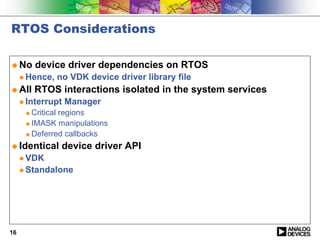
RTOS Considerations

! No      device driver dependencies on RTOS
     " Hence,   no VDK device driver library file
! All     RTOS interactions isolated in the system services
     " Interrupt   Manager
      ! Critical regions
      ! IMASK manipulations

      ! Deferred callbacks

! Identical      device driver API
     " VDK
     " Standalone


16
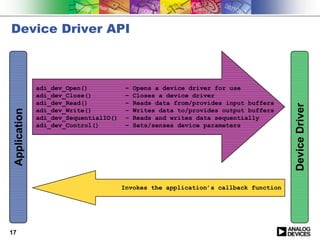
Device Driver API


               adi_dev_Open()            –   Opens a device driver for use
               adi_dev_Close()           –   Closes a device driver
               adi_dev_Read()            –   Reads data from/provides input buffers


                                                                                      Device Driver
 Application


               adi_dev_Write()           –   Writes data to/provides output buffers
               adi_dev_SequentialIO()    –   Reads and writes data sequentially
               adi_dev_Control()         –   Sets/senses device parameters


                                        Invokes the application’s callback function


17
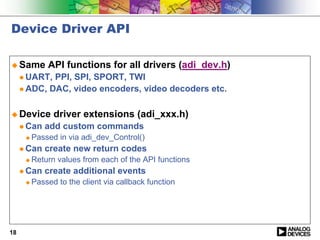
Device Driver API

! Same        API functions for all drivers (adi_dev.h)
     " UART, PPI, SPI, SPORT, TWI
     " ADC, DAC, video encoders, video decoders etc.


! Device        driver extensions (adi_xxx.h)
     " Can   add custom commands
      !   Passed in via adi_dev_Control()
     " Can   create new return codes
      !   Return values from each of the API functions
     " Can   create additional events
      !   Passed to the client via callback function


18
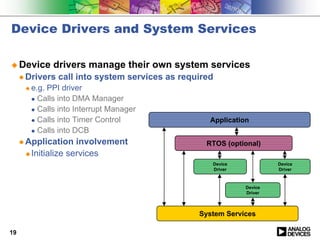
Device Drivers and System Services

! Device        drivers manage their own system services
     " Drivers   call into system services as required
      !   e.g. PPI driver
          " Calls into DMA Manager

          " Calls into Interrupt Manager

          " Calls into Timer Control                 Application
          " Calls into DCB

     " Application   involvement                    RTOS (optional)
      ! Initialize services
                                                     Device             Device
                                                     Driver             Driver


                                                               Device
                                                               Driver


                                                  System Services

19
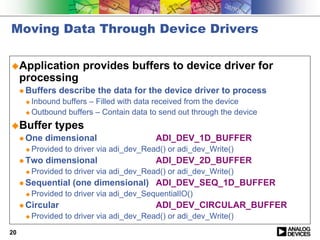
Moving Data Through Device Drivers

!Application            provides buffers to device driver for
     processing
     " Buffers    describe the data for the device driver to process
      ! Inbound buffers – Filled with data received from the device
      ! Outbound buffers – Contain data to send out through the device

!Buffer         types
     " One   dimensional                    ADI_DEV_1D_BUFFER
      !   Provided to driver via adi_dev_Read() or adi_dev_Write()
     " Two   dimensional                    ADI_DEV_2D_BUFFER
      !   Provided to driver via adi_dev_Read() or adi_dev_Write()
     " Sequential    (one dimensional) ADI_DEV_SEQ_1D_BUFFER
      !   Provided to driver via adi_dev_SequentialIO()
     " Circular                             ADI_DEV_CIRCULAR_BUFFER
      !   Provided to driver via adi_dev_Read() or adi_dev_Write()
20
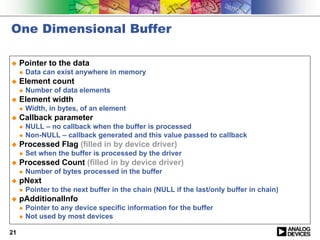
One Dimensional Buffer

!    Pointer to the data
     "   Data can exist anywhere in memory
!    Element count
     "   Number of data elements
!    Element width
     "   Width, in bytes, of an element
!    Callback parameter
     "   NULL – no callback when the buffer is processed
     "   Non-NULL – callback generated and this value passed to callback
!    Processed Flag (filled in by device driver)
     "   Set when the buffer is processed by the driver
!    Processed Count (filled in by device driver)
     "   Number of bytes processed in the buffer
!    pNext
     "   Pointer to the next buffer in the chain (NULL if the last/only buffer in chain)
!    pAdditionalInfo
     "   Pointer to any device specific information for the buffer
     "   Not used by most devices

21
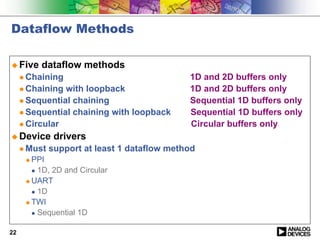
Dataflow Methods

! Five    dataflow methods
     " Chaining                               1D and 2D buffers only
     " Chaining with loopback                 1D and 2D buffers only
     " Sequential chaining                    Sequential 1D buffers only
     " Sequential chaining with loopback      Sequential 1D buffers only
     " Circular                               Circular buffers only
! Device       drivers
     " Must   support at least 1 dataflow method
      ! PPI
        " 1D, 2D and Circular

      ! UART

        " 1D

      ! TWI

        " Sequential 1D


22
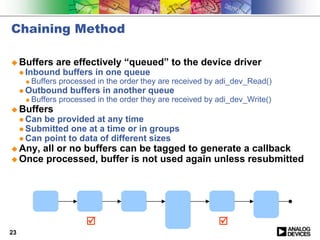
Chaining Method

! Buffers       are effectively “queued” to the device driver
     " Inbound    buffers in one queue
      !   Buffers processed in the order they are received by adi_dev_Read()
     " Outbound     buffers in another queue
      !   Buffers processed in the order they are received by adi_dev_Write()
! Buffers
     " Can be provided at any time
     " Submitted one at a time or in groups
     " Can point to data of different sizes
! Any,all or no buffers can be tagged to generate a callback
! Once processed, buffer is not used again unless resubmitted


                         #                                    #
23
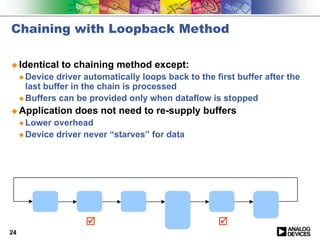
Chaining with Loopback Method

! Identical     to chaining method except:
     " Device  driver automatically loops back to the first buffer after the
       last buffer in the chain is processed
     " Buffers can be provided only when dataflow is stopped

! Application      does not need to re-supply buffers
     " Lower overhead
     " Device driver never “starves” for data


                     #                                 #
24
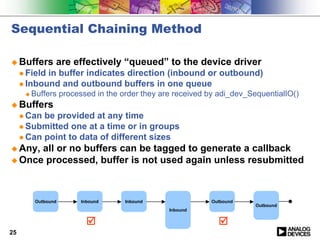
Sequential Chaining Method

! Buffers         are effectively “queued” to the device driver
     " Fieldin buffer indicates direction (inbound or outbound)
     " Inbound and outbound buffers in one queue
      !   Buffers processed in the order they are received by adi_dev_SequentialIO()
! Buffers
     " Can be provided at any time
     " Submitted one at a time or in groups
     " Can point to data of different sizes
! Any,all or no buffers can be tagged to generate a callback
! Once processed, buffer is not used again unless resubmitted


           Outbound    Inbound     Inbound                 Outbound
                                                                        Outbound
                                                Inbound

                         #                                   #
25
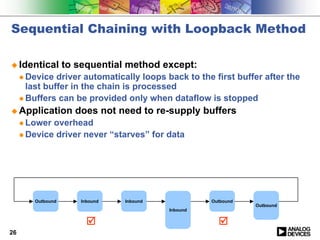
Sequential Chaining with Loopback Method

! Identical         to sequential method except:
     " Device  driver automatically loops back to the first buffer after the
       last buffer in the chain is processed
     " Buffers can be provided only when dataflow is stopped

! Application         does not need to re-supply buffers
     " Lower overhead
     " Device driver never “starves” for data


         Outbound       Inbound   Inbound             Outbound
                                                                 Outbound
                                            Inbound

                          #                             #
26
Streaming Command

! Can       be used with any chained dataflow method
     " Chaining,     chaining w/loopback, sequential, sequential w/loopback
! Assertions          to device driver
     " Application  will insure the driver never runs out of buffers
     " If buffers with callbacks are used, system timing insures interrupts
       won’t be lost
! Device        drivers maximize throughput
     " Peripheral DMA supported devices use streaming DMA
     " Useful for audio and video
      !   Eliminates clicks, pops, glitches etc.


27
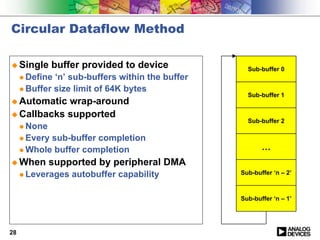
Circular Dataflow Method

! Single       buffer provided to device            Sub-buffer 0
     " Define ‘n’ sub-buffers within the buffer
     " Buffer size limit of 64K bytes
                                                    Sub-buffer 1
! Automatic wrap-around
! Callbacks supported
                                                    Sub-buffer 2
     " None
     " Everysub-buffer completion
     " Whole buffer completion                           …
! When        supported by peripheral DMA
     " Leverages   autobuffer capability          Sub-buffer ‘n – 2’


                                                  Sub-buffer ‘n – 1’


28
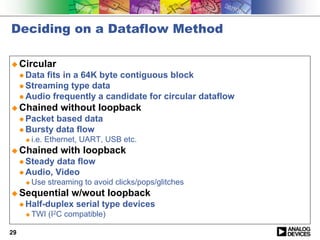
Deciding on a Dataflow Method

! Circular
     " Data fits in a 64K byte contiguous block
     " Streaming type data
     " Audio frequently a candidate for circular dataflow
! Chained         without loopback
     " Packet based data
     " Bursty data flow
      !   i.e. Ethernet, UART, USB etc.
! Chained         with loopback
     " Steady data flow
     " Audio, Video
      !   Use streaming to avoid clicks/pops/glitches
! Sequential         w/wout loopback
     " Half-duplex    serial type devices
      !   TWI (I2C compatible)

29
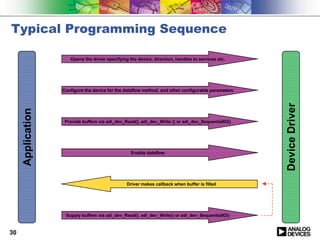
Typical Programming Sequence

                      Opens the driver specifying the device, direction, handles to services etc.


                   Configure the device for the dataflow method, and other configurable parameters


                                                                                                     Device Driver
     Application


                    Provide buffers via adi_dev_Read(), adi_dev_Write () or adi_dev_SequentialIO()


                                                   Enable dataflow


                                                 Driver makes callback when buffer is filled


                    Supply buffers via adi_dev_Read(), adi_dev_Write() or adi_dev_SequentialIO()


30
UART Example

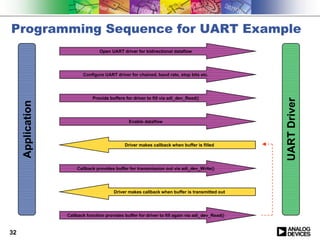
! Echo     program for UART device driver
     " Characters
                entered in terminal are received by the Blackfin
      program and echoed back to the terminal
! Connect  serial cable from BF537 EZ-Kit to PC
! Start hyperterminal
     " 57600   baud, 8 data bits, 1 stop bit, no parity
! Example        demonstrates
     " Usage  of the UART device driver
     " Chained dataflow method
     " Callbacks


31
Programming Sequence for UART Example
                                  Open UART driver for bidirectional dataflow


                          Configure UART driver for chained, baud rate, stop bits etc.


                               Provide buffers for driver to fill via adi_dev_Read()


                                                                                                   UART Driver
     Application


                                                 Enable dataflow


                                               Driver makes callback when buffer is filled


                       Callback provides buffer for transmission out via adi_dev_Write()


                                         Driver makes callback when buffer is transmitted out


                   Callback function provides buffer for driver to fill again via adi_dev_Read()


32
Conclusion

Device drivers provide:
! Faster development
     " Stable   software base for application development
      !   Fewer variables
     " Less   re-invention
      !   Do not need to create everything from scratch
! Modular        software
     " Better   compatibility
      !   Resource control is managed by the system services
     " Easier   integration
      !   Multiple software components working concurrently
! Portability
     " Code    portable to other Blackfin processors


33
Additional Information

! Documentation
     " Device
            Drivers and System Services Manual for Blackfin
      Processors
         − http://www.analog.com/processors/manuals
     " Device   Drivers and System Services Addendum (Sept 2005)
         − ftp://ftp.analog.com/pub/tools/patches/Blackfin/VDSP++4.0/


! For   questions, click “Ask A Question” button or
     send an email to Processor.support@analog.com


34

Blackfin Device Drivers

  • 1.
    The World Leaderin High Performance Signal Processing Solutions Blackfin Device Drivers Presented By: David Lannigan
  • 2.
    About this Module This module discusses the device driver model for the Blackfin family of processors. It is recommended that users should have an understanding of the Blackfin architecture and is familiar with the Blackfin System Services software. 2
  • 3.
    Module Outline ! Overview " General Information ! Common conventions, terminology, return codes etc. ! Device Driver API ! Buffers ! Dataflow Methods ! UART example (VisualDSP, December 2005 update) 3
  • 4.
    Device Driver Model !Standardized API for Blackfin processors " Userinterface is the same ! Regardless of driver " Allows buffers to be passed from driver to driver ! Regardless of processor " Application using UART does not change from BF533 to BF537 " Developers only have to learn it once ! All drivers operate the same way ! Extensible " Drivers can add their own commands (IOCTLs), events etc. ! Goal is to cover the vast majority " Exceptions will exist 4
  • 5.
    Leverages the SystemServices ! Faster development " Stable software base ! Fewer variables " Less re-invention ! Example: drivers do not need to include DMA code ! Modular software " Better compatibility ! Resource control is managed by the system services " Easier integration ! Multiple drivers working concurrently ! Portability " Driver for the BF533 works on the BF561 5
  • 6.
    System Architecture (Driversand Services) Application RTOS (optional) Device Device Driver Driver Device Driver System Services 6
  • 7.
    Using Device Driversin VisualDSP Projects !Application source file " #include <services/services.h> // system services " #include <drivers/adi_dev.h> // device manager " #include <drivers/xxx.h> // device driver’s .h file !Source file folder " For off-chip device drivers only ! Include the device driver’s .c file in the list of source files !Linker files folder Off-chip drivers need to be explicitly included " Link with the proper libssl library ! Pulls in the system services On-chip drivers come in the library " Link with the proper libdrv library ! Pulls in on-chip device drivers !Use code elimination option in linker " Significantly reduces code size 7
  • 8.
    Library Configurations ! Debug version of on-chip driver library " Optimizations off " Symbolic information included " Can step into the sources " Lots of parameter checks " Should be the libraries users start with ! Examples/demos typically use the debug version ! Release version on-chip driver library " Optimizations on " No symbolic information " Can’t step into the sources " Few, if any, parameter checks " Should be the libraries users end with ! Users should release with the release version 8
  • 9.
    Library Filenames (pg1-12 in the manual) libdrvaaa_bbbcc.dlb aaa – processor variant cc – special conditions 532 – BF531, BF532, BF533 d – debug version 534 – BF534, BF536, BF537 y – workarounds for all silicon anomolies 561 – BF561 dy – debug plus workarounds blank – no debug, no workarounds _bbb – operating environment blank - standalone i.e. libdrv532dy.dlb •ADSP-BF531, 532 or 533 •Debug plus workarounds 9
  • 10.
    Finding Device Drivers !Include files " C:Program FilesAnalog DevicesVisualDSP 4.0Blackfinincludedrivers ! Source files " C:Program FilesAnalog DevicesVisualDSP 4.0Blackfinlibsrcdrivers ! Libraries " C:Program FilesAnalog DevicesVisualDSP 4.0Blackfinlib ! Examples " C:Program FilesAnalog DevicesVisualDSP 4.0BlackfinEZ-KITsADSP-BF533Drivers " C:Program FilesAnalog DevicesVisualDSP 4.0BlackfinEZ-KITsADSP-BF537Drivers " C:Program FilesAnalog DevicesVisualDSP 4.0BlackfinEZ-KITsADSP-BF561Drivers ! Documentation " Device Driver and System Services User Manual ! Blackfin Technical Library at www.analog.com " Device Driver and System Services User Manual Addendum (Sept 2005) ! ftp://ftp.analog.com/pub/tools/patches/Blackfin/VDSP++4.0/ 10
  • 11.
    Memory ! No dynamicmemory is used in the device drivers ! Device Manager needs memory to manage devices " Supplied by the application when initialized " Dictates how many simultaneously open drivers can be supported ! Physical drivers use static memory for their internal data ! No restrictions on memory placement " Code or data 11
  • 12.
    Handles ! Used in all device drivers (used in most services) " Device Handle ADI_DEV_HANDLE ! Unique identifier " Always typedef-ed to a void * " Is the address of something ! ADI_DEV_HANDLE – points to device specific data ! Client Handle " Whatever the client wants it to be " No significance to the device drivers (or system services) " Can be anything that fits in a void * ! May point to something important for the client ! May be a value of something ! May be NULL 12
  • 13.
    Return Codes ! Every (almost every) API function returns a code " Zero– universal success " Non-zero – some type of error or informative fact ! Each driver has its own set of return codes " Alldrivers return u32 for their return code " Pass back driver return codes OR system service return codes ! Resolving errors " Identifythe driver or service that generated the error (services.h) " Find value in the .h file for that driver or service 13
  • 14.
    Initialization Sequence ! Initialize services in the following order " Omit any services not required 1. Interrupt Manager 2. EBIU 3. Power 4. Port Control (BF534, BF536, BF537 only) 5. Deferred Callback Service 6. DMA Manager 7. Flag Service 8. Timer Service ! After services are initialized, then initialize device drivers " adi_dev_Init() 14
  • 15.
    Termination Sequence ! Termination is often not required in embedded systems " Do not call termination if not required ! Code elimination will optimize it out ! Terminate device drivers before terminating any services " adi_dev_Terminate() ! Terminate services in the following order " Omit any services not required 1. Timer Service 2. Flag Service 3. DMA Manager 4. Deferred Callback Service 5. Port Control (BF534, BF536, BF537 only) 6. Power 7. EBIU 8. Interrupt Manager 15
  • 16.
    RTOS Considerations ! No device driver dependencies on RTOS " Hence, no VDK device driver library file ! All RTOS interactions isolated in the system services " Interrupt Manager ! Critical regions ! IMASK manipulations ! Deferred callbacks ! Identical device driver API " VDK " Standalone 16
  • 17.
    Device Driver API adi_dev_Open() – Opens a device driver for use adi_dev_Close() – Closes a device driver adi_dev_Read() – Reads data from/provides input buffers Device Driver Application adi_dev_Write() – Writes data to/provides output buffers adi_dev_SequentialIO() – Reads and writes data sequentially adi_dev_Control() – Sets/senses device parameters Invokes the application’s callback function 17
  • 18.
    Device Driver API !Same API functions for all drivers (adi_dev.h) " UART, PPI, SPI, SPORT, TWI " ADC, DAC, video encoders, video decoders etc. ! Device driver extensions (adi_xxx.h) " Can add custom commands ! Passed in via adi_dev_Control() " Can create new return codes ! Return values from each of the API functions " Can create additional events ! Passed to the client via callback function 18
  • 19.
    Device Drivers andSystem Services ! Device drivers manage their own system services " Drivers call into system services as required ! e.g. PPI driver " Calls into DMA Manager " Calls into Interrupt Manager " Calls into Timer Control Application " Calls into DCB " Application involvement RTOS (optional) ! Initialize services Device Device Driver Driver Device Driver System Services 19
  • 20.
    Moving Data ThroughDevice Drivers !Application provides buffers to device driver for processing " Buffers describe the data for the device driver to process ! Inbound buffers – Filled with data received from the device ! Outbound buffers – Contain data to send out through the device !Buffer types " One dimensional ADI_DEV_1D_BUFFER ! Provided to driver via adi_dev_Read() or adi_dev_Write() " Two dimensional ADI_DEV_2D_BUFFER ! Provided to driver via adi_dev_Read() or adi_dev_Write() " Sequential (one dimensional) ADI_DEV_SEQ_1D_BUFFER ! Provided to driver via adi_dev_SequentialIO() " Circular ADI_DEV_CIRCULAR_BUFFER ! Provided to driver via adi_dev_Read() or adi_dev_Write() 20
  • 21.
    One Dimensional Buffer ! Pointer to the data " Data can exist anywhere in memory ! Element count " Number of data elements ! Element width " Width, in bytes, of an element ! Callback parameter " NULL – no callback when the buffer is processed " Non-NULL – callback generated and this value passed to callback ! Processed Flag (filled in by device driver) " Set when the buffer is processed by the driver ! Processed Count (filled in by device driver) " Number of bytes processed in the buffer ! pNext " Pointer to the next buffer in the chain (NULL if the last/only buffer in chain) ! pAdditionalInfo " Pointer to any device specific information for the buffer " Not used by most devices 21
  • 22.
    Dataflow Methods ! Five dataflow methods " Chaining 1D and 2D buffers only " Chaining with loopback 1D and 2D buffers only " Sequential chaining Sequential 1D buffers only " Sequential chaining with loopback Sequential 1D buffers only " Circular Circular buffers only ! Device drivers " Must support at least 1 dataflow method ! PPI " 1D, 2D and Circular ! UART " 1D ! TWI " Sequential 1D 22
  • 23.
    Chaining Method ! Buffers are effectively “queued” to the device driver " Inbound buffers in one queue ! Buffers processed in the order they are received by adi_dev_Read() " Outbound buffers in another queue ! Buffers processed in the order they are received by adi_dev_Write() ! Buffers " Can be provided at any time " Submitted one at a time or in groups " Can point to data of different sizes ! Any,all or no buffers can be tagged to generate a callback ! Once processed, buffer is not used again unless resubmitted # # 23
  • 24.
    Chaining with LoopbackMethod ! Identical to chaining method except: " Device driver automatically loops back to the first buffer after the last buffer in the chain is processed " Buffers can be provided only when dataflow is stopped ! Application does not need to re-supply buffers " Lower overhead " Device driver never “starves” for data # # 24
  • 25.
    Sequential Chaining Method !Buffers are effectively “queued” to the device driver " Fieldin buffer indicates direction (inbound or outbound) " Inbound and outbound buffers in one queue ! Buffers processed in the order they are received by adi_dev_SequentialIO() ! Buffers " Can be provided at any time " Submitted one at a time or in groups " Can point to data of different sizes ! Any,all or no buffers can be tagged to generate a callback ! Once processed, buffer is not used again unless resubmitted Outbound Inbound Inbound Outbound Outbound Inbound # # 25
  • 26.
    Sequential Chaining withLoopback Method ! Identical to sequential method except: " Device driver automatically loops back to the first buffer after the last buffer in the chain is processed " Buffers can be provided only when dataflow is stopped ! Application does not need to re-supply buffers " Lower overhead " Device driver never “starves” for data Outbound Inbound Inbound Outbound Outbound Inbound # # 26
  • 27.
    Streaming Command ! Can be used with any chained dataflow method " Chaining, chaining w/loopback, sequential, sequential w/loopback ! Assertions to device driver " Application will insure the driver never runs out of buffers " If buffers with callbacks are used, system timing insures interrupts won’t be lost ! Device drivers maximize throughput " Peripheral DMA supported devices use streaming DMA " Useful for audio and video ! Eliminates clicks, pops, glitches etc. 27
  • 28.
    Circular Dataflow Method !Single buffer provided to device Sub-buffer 0 " Define ‘n’ sub-buffers within the buffer " Buffer size limit of 64K bytes Sub-buffer 1 ! Automatic wrap-around ! Callbacks supported Sub-buffer 2 " None " Everysub-buffer completion " Whole buffer completion … ! When supported by peripheral DMA " Leverages autobuffer capability Sub-buffer ‘n – 2’ Sub-buffer ‘n – 1’ 28
  • 29.
    Deciding on aDataflow Method ! Circular " Data fits in a 64K byte contiguous block " Streaming type data " Audio frequently a candidate for circular dataflow ! Chained without loopback " Packet based data " Bursty data flow ! i.e. Ethernet, UART, USB etc. ! Chained with loopback " Steady data flow " Audio, Video ! Use streaming to avoid clicks/pops/glitches ! Sequential w/wout loopback " Half-duplex serial type devices ! TWI (I2C compatible) 29
  • 30.
    Typical Programming Sequence Opens the driver specifying the device, direction, handles to services etc. Configure the device for the dataflow method, and other configurable parameters Device Driver Application Provide buffers via adi_dev_Read(), adi_dev_Write () or adi_dev_SequentialIO() Enable dataflow Driver makes callback when buffer is filled Supply buffers via adi_dev_Read(), adi_dev_Write() or adi_dev_SequentialIO() 30
  • 31.
    UART Example ! Echo program for UART device driver " Characters entered in terminal are received by the Blackfin program and echoed back to the terminal ! Connect serial cable from BF537 EZ-Kit to PC ! Start hyperterminal " 57600 baud, 8 data bits, 1 stop bit, no parity ! Example demonstrates " Usage of the UART device driver " Chained dataflow method " Callbacks 31
  • 32.
    Programming Sequence forUART Example Open UART driver for bidirectional dataflow Configure UART driver for chained, baud rate, stop bits etc. Provide buffers for driver to fill via adi_dev_Read() UART Driver Application Enable dataflow Driver makes callback when buffer is filled Callback provides buffer for transmission out via adi_dev_Write() Driver makes callback when buffer is transmitted out Callback function provides buffer for driver to fill again via adi_dev_Read() 32
  • 33.
    Conclusion Device drivers provide: !Faster development " Stable software base for application development ! Fewer variables " Less re-invention ! Do not need to create everything from scratch ! Modular software " Better compatibility ! Resource control is managed by the system services " Easier integration ! Multiple software components working concurrently ! Portability " Code portable to other Blackfin processors 33
  • 34.
    Additional Information ! Documentation " Device Drivers and System Services Manual for Blackfin Processors − http://www.analog.com/processors/manuals " Device Drivers and System Services Addendum (Sept 2005) − ftp://ftp.analog.com/pub/tools/patches/Blackfin/VDSP++4.0/ ! For questions, click “Ask A Question” button or send an email to Processor.support@analog.com 34