WINDOW TREATMENT
WINDOW TREATMENT
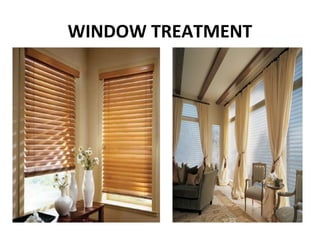
Window treatments are used to control the
degree to which windows perform their
various functions. They have great design
potential as sources of beauty and character
too. Window treatments can be classified as
Stiff Window Treatments and Soft Window
Treatments
WINDOW TREATMENTS
STIFF WINDOW TREATMENTS
• BLINDS
• SHADES
• SHUTTERS
• SCREENS
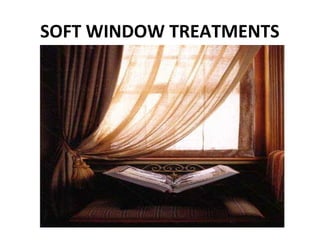
SOFT WINDOW TREATMENTS
• CURTAINS
• DRAPERY
• VALANCE
• SWAGS
STIFF WINDOW TREATMENTS
BLINDS
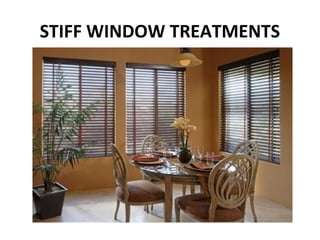
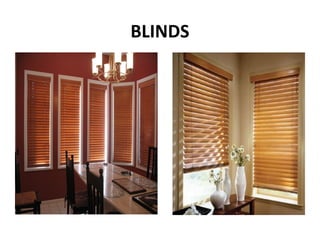
A window blind is a type of window covering
which is made with slats of fabric, wood,
plastic or metal that adjust by rotating from
an open position to a closed position by
allowing slats to overlap.
BLINDS
ROLLER BLINDS
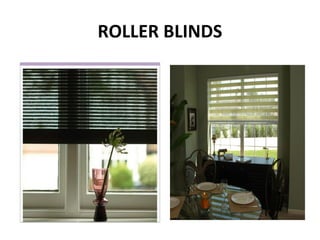
These let in plenty of light when drawn
up, yet give complete privacy when
unrolled and let down. Roller blinds are
made of thick fabrics used in conjunction
with rollers.
ROLLER BLINDS
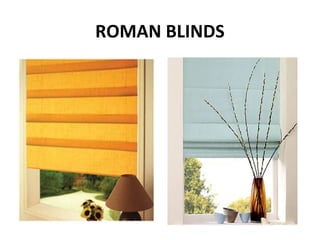
ROMAN BLINDS
These are made of Fabrics attached to
cords. When the cords are pulled, the
blinds rise up in accordion pleats to form
pelmet. They are heavier and warmer
than roller blinds.
ROMAN BLINDS
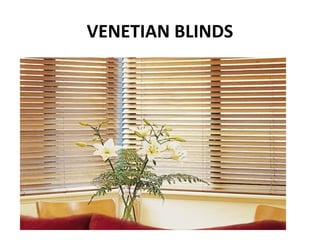
VENETIAN BLINDS
They are made of parallel slats of wood, metal
or plastic aligned horizontally or vertically.
They are popular for their almost complete
control of air, light and view. They are usually
low in price and some custom- designed
blinds come in different colours and patterns.
VENETIAN BLINDS
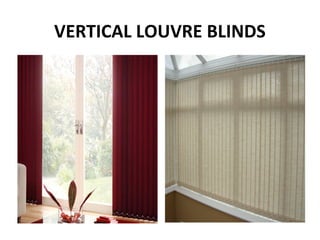
VERTICAL LOUVRE BLINDS
These are most effective on large floor-to-
ceiling window. They work on the same
principal as the venetian blinds, except that
they close across the window rather than
down. The slats are wider than the venetian
type but less opaque.
VERTICAL LOUVRE BLINDS
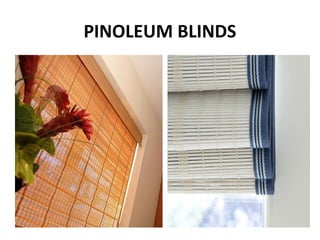
PINOLEUM BLINDS
These inexpensive covering for large
windows. They are made of fine strips of
wood held together by cotton, and let a
pleasant, soft light filter through. They may be
mounted on a spring-operated roller or
moved up and down by cords.
PINOLEUM BLINDS
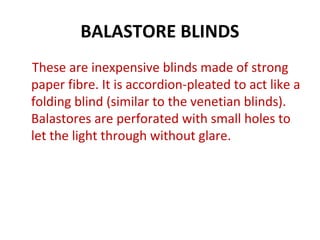
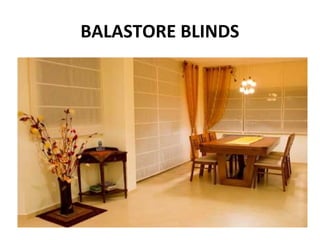
BALASTORE BLINDS
These are inexpensive blinds made of strong
paper fibre. It is accordion-pleated to act like a
folding blind (similar to the venetian blinds).
Balastores are perforated with small holes to
let the light through without glare.
BALASTORE BLINDS
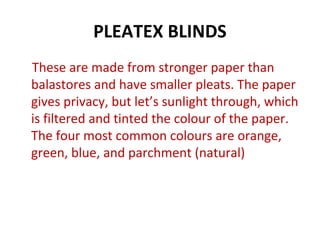
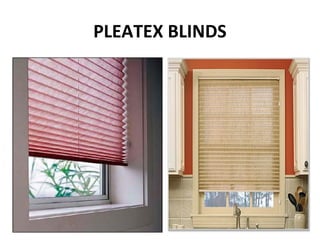
PLEATEX BLINDS
These are made from stronger paper than
balastores and have smaller pleats. The paper
gives privacy, but let’s sunlight through, which
is filtered and tinted the colour of the paper.
The four most common colours are orange,
green, blue, and parchment (natural)
PLEATEX BLINDS
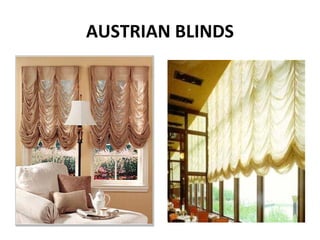
AUSTRIAN BLINDS
These are ruched fabrics (trimmed with
gathers). They may be used partially raised,
and when fully raised, they form a decorative
pelmet. They are used in banquet halls and
large lobbies for a sumptuous effect.
AUSTRIAN BLINDS
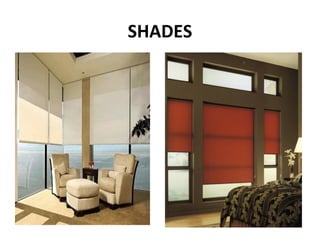
SHADES
A window blind does not have slats but
comprises a single piece of material that can
be rolled to control the degree of the various
functions of the window. These blinds are
machine-operated as well as hand operated.
SHADES
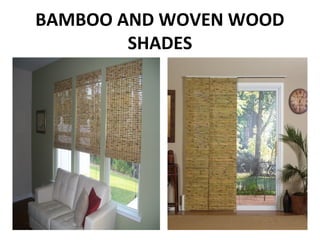
BAMBOO AND WOVEN WOOD
SHADES
Slatted shades have the advantage in that
they let through some light and air, and allow
outwards-only visibility in the day time. They
block the inward view at the same time,
depending on the tightness of the weave or
the size of the slats.
BAMBOO AND WOVEN WOOD
SHADES
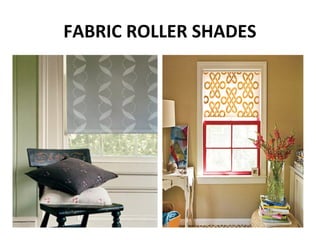
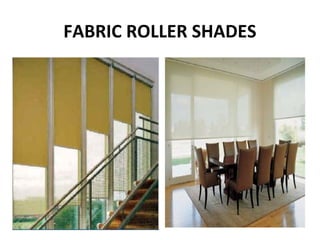
FABRIC ROLLER SHADES
These are inexpensive and can be flexibly
adjusted to cover as much of windows as
required at a particular time. They can be
translucent, letting in some light or completely
opaque. These shades are available in many
colours, textures, and patterns, although neutral
white or off-white, fairly smooth fabrics are the
standard. Decals or stencilled patterns on roller
shades give interesting look on to the windows
when the light filters through the designs.
FABRIC ROLLER SHADES
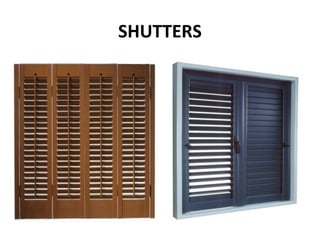
SHUTTER
A window shutter is a solid and stable window
covering usually consisting of a frame of
vertical stiles and horizontal rails (top, center
and bottom). Set within this frame can
be louvers (both operable or fixed, horizontal
or vertical), solid panels, fabric, glass and most
any other item that can be mounted within a
frame
SHUTTERS
SCREENS
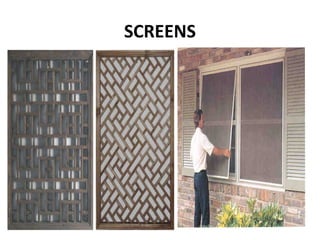
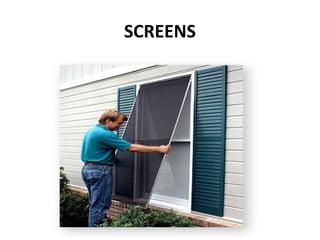
A window screen, insect screen or bug
screen is a metal wire, fibreglass, or other
synthetic fibre mesh, stretched in a frame of
wood or metal, designed to cover the opening
of an open window. Its primary purpose is to
keep insects, leaves, debris, birds, and other
animals from entering a building, while
permitting fresh air-flow
SCREENS
SCREENS
SOFT WINDOW TREATMENTS
CURTAINS
CURTAIN
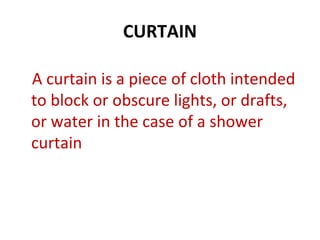
A curtain is a piece of cloth intended
to block or obscure lights, or drafts,
or water in the case of a shower
curtain
CURTAINS
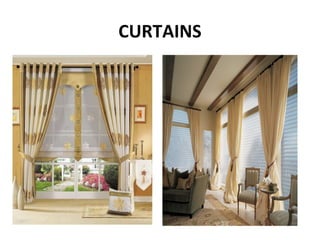
Curtains often contribute more to the
atmosphere of the room than any other item
of furnishing. Plain, heavy curtains falling
down to the floor can be used to create a
formal setting. Short curtains made of light,
brightly patterned fabrics are used to create
an informal, relaxed atmosphere. Apart from
creating the desired atmosphere, curtains give
flexible control over privacy, heat, light, and to
some extent noise.
CURTAINS
• Curtains fulfil several important functions:
• They give flexible control over privacy, heat and light.
• They soak up the noise in proportions to the area
they cover, the thickness of the fabric, and the
depths of the fold.
• The can add colour and pattern to the decor.
• They cover bareness and furnish a room even
without furniture
• They can change the apparent size of the room or
conceal architectural flaws
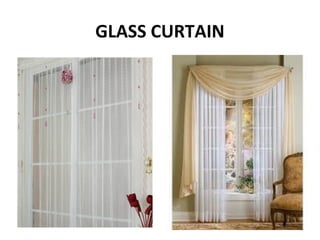
GLASS CURTAIN
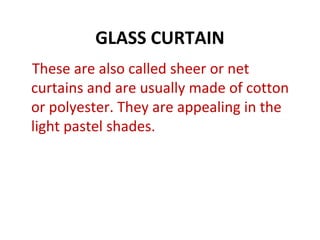
These are also called sheer or net
curtains and are usually made of cotton
or polyester. They are appealing in the
light pastel shades.
GLASS CURTAIN
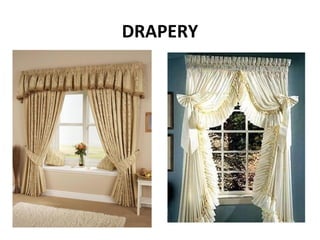
DPARERY
A drapery refers to a loosely hung
soft furnishing. These are made of
heavier fabrics and may be lined. The
heading is usually pleated.
DRAPERY
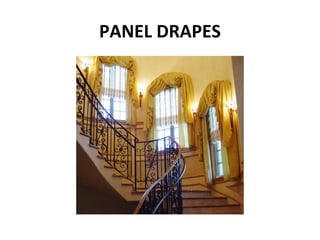
PANEL DRAPES
These cover only the sides of a window
area
PANEL DRAPES
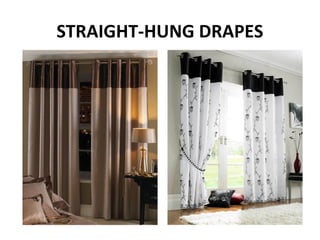
STRAIGHT-HUNG DRAPES
These can be used with valance or
cornice, but the window will seem taller
without a decorative heading.
STRAIGHT-HUNG DRAPES
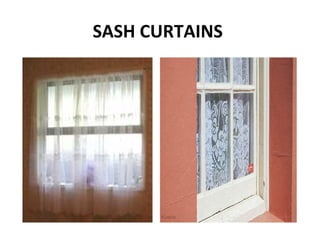
SASH CURTAINS
These are types of glass curtain hung on
the window sash. They can be stretched
taut between rods along with the top
and bottom of the window sashes or
hung in loose folds.
SASH CURTAINS
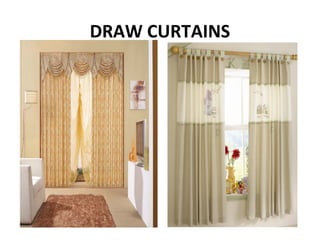
DRAW CURTAINS
These are usually made of translucent or
opaque fabrics and are mounted on traverse
rods. In earlier days, they were used between
glass curtains and draperies, but these days
they are more often used alone.
DRAW CURTAINS
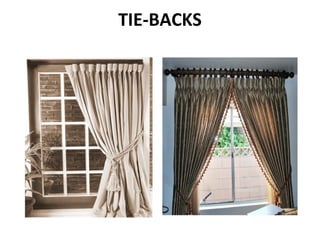
TIE-BACKS
Either one panel can be tied back to one side or both
the panels can be tied back to the two sides. They
are often tied back to the window frame. A pair of
curtain looped back makes a window seem much
narrower than a single curtain tied back. Such
curtains should preferably be tied back just below or
above the mid-section of the window. Usually the
higher the tie-back, the taller the window appears.
TIE-BACKS
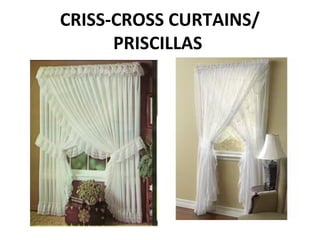
CRISS-CROSS CURTAINS/
PRISCILLAS
These curtains are a variation of the tie-back
type. Both the curtain panels overlap each
other at the top along the entire width of the
window and then criss-cross each other when
they are tied back. Criss-cross curtains
generally make a window seem wider. They
also assure an impression of fullness.
CRISS-CROSS CURTAINS/
PRISCILLAS
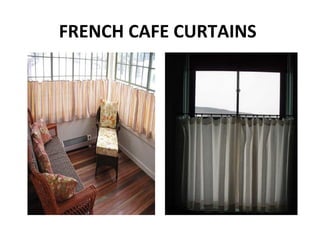
FRENCH CAFE CURTAINS
These cover only the lower part of the
window, with the casing slipped over a
tension rod mounted in the window frame.
They provide privacy at one level and light at
another. These are ideal for informal setting.
FRENCH CAFE CURTAINS
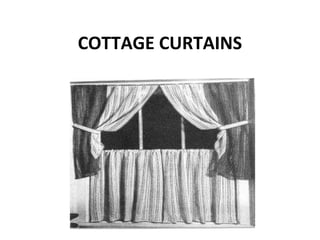
COTTAGE CURTAINS
These are a combination of the cafe
curtain and tie-back styles
COTTAGE CURTAINS
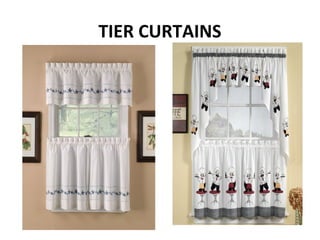
TIER CURTAINS
These are double-decker cafe curtains
TIER CURTAINS
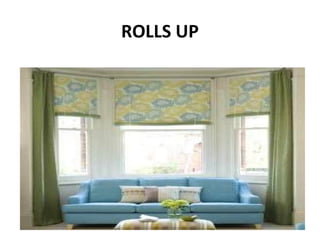
ROLLS UP
These are shades made of o sturdy fabric and
lined with a contrasting fabric. The shade can
be rolled or unrolled to the desired position
and held in place by means of a sash. When
rolled up, the contrast-coloured lining and top
fabrics are shown off together.
ROLLS UP
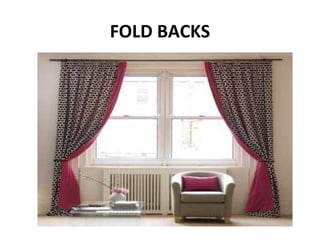
FOLD BACKS
These are made up of sets of two-double
sided shades hung across the entire width of
the window on double curtain rods. They are
then folded back to expose the contrasting
under-panels and each panel is tied back.
FOLD BACKS
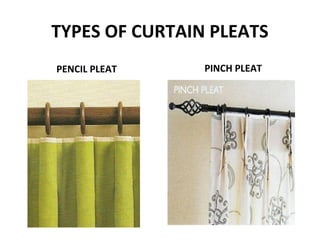
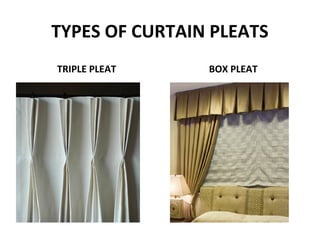
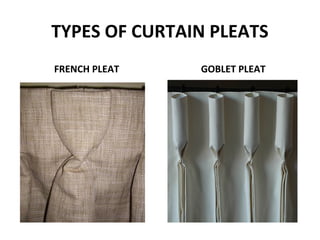
TYPES OF CURTAIN PLEATS
The various types of curtain pleats are
standard pleats, pencil or cartridge
pleats, pinch pleats, triple pleats, box
pleats, French or Windsor pleats, and
goblet pleats
TYPES OF CURTAIN PLEATS
PENCIL PLEAT PINCH PLEAT
TYPES OF CURTAIN PLEATS
TRIPLE PLEAT BOX PLEAT
TYPES OF CURTAIN PLEATS
FRENCH PLEAT GOBLET PLEAT
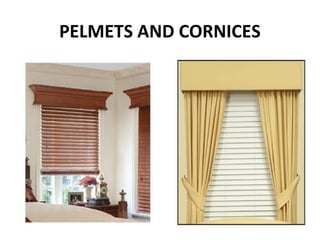
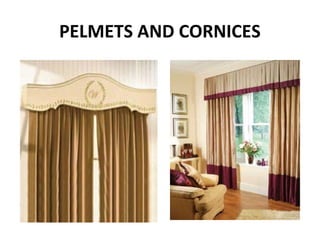
PELMETS AND CORNICES
Cornices are box-like shapes used at the top horizontal
portion of the drapery treatment to hide the poles and
other hardware. They are generally 4 to 7 inches deep.
The width of a cornice should be little less than one-
eighth of the overall length of the floor length drapery.
They should be made of wood, plastic, or mirrored glass.
Wooden cornices are the most frequently used and a
plain wooden board with an interesting moulding at the
top and bottom is always good taste. Wooden cornices
may be finished in their natural colour, painted in some
other colour, or covered with cloth, cork or leather.
Sometimes the coverings are edged in brass nails.
PELMETS AND CORNICES
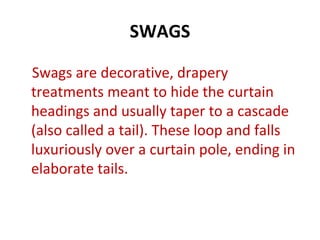
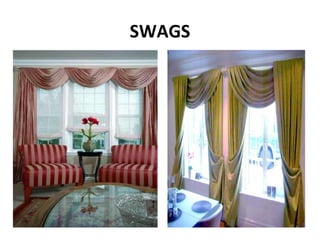
SWAGS
Swags are decorative, drapery
treatments meant to hide the curtain
headings and usually taper to a cascade
(also called a tail). These loop and falls
luxuriously over a curtain pole, ending in
elaborate tails.
SWAGS
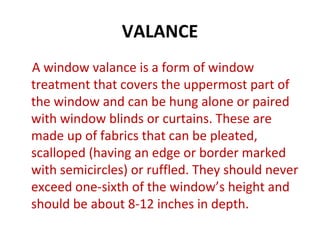
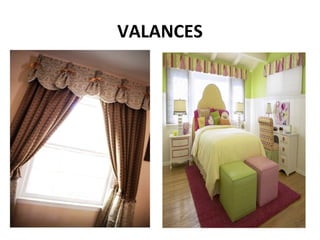
VALANCE
A window valance is a form of window
treatment that covers the uppermost part of
the window and can be hung alone or paired
with window blinds or curtains. These are
made up of fabrics that can be pleated,
scalloped (having an edge or border marked
with semicircles) or ruffled. They should never
exceed one-sixth of the window’s height and
should be about 8-12 inches in depth.
VALANCES
CURTAIN RODS
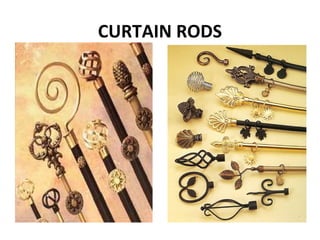
Finding the right hardware is essential to the
success of the window treatment. Curtain
rods are generally used for shirred curtains of
simple cafes. Most rods are now in adjustable
lengths.
CURTAIN RODS
CURTAIN ROD HOLDERS
THANK YOU

Window treatment

  • 1.
  • 2.
    WINDOW TREATMENT Window treatmentsare used to control the degree to which windows perform their various functions. They have great design potential as sources of beauty and character too. Window treatments can be classified as Stiff Window Treatments and Soft Window Treatments
  • 3.
    WINDOW TREATMENTS STIFF WINDOWTREATMENTS • BLINDS • SHADES • SHUTTERS • SCREENS SOFT WINDOW TREATMENTS • CURTAINS • DRAPERY • VALANCE • SWAGS
  • 4.
  • 5.
    BLINDS A window blindis a type of window covering which is made with slats of fabric, wood, plastic or metal that adjust by rotating from an open position to a closed position by allowing slats to overlap.
  • 6.
  • 7.
    ROLLER BLINDS These letin plenty of light when drawn up, yet give complete privacy when unrolled and let down. Roller blinds are made of thick fabrics used in conjunction with rollers.
  • 8.
  • 9.
    ROMAN BLINDS These aremade of Fabrics attached to cords. When the cords are pulled, the blinds rise up in accordion pleats to form pelmet. They are heavier and warmer than roller blinds.
  • 10.
  • 11.
    VENETIAN BLINDS They aremade of parallel slats of wood, metal or plastic aligned horizontally or vertically. They are popular for their almost complete control of air, light and view. They are usually low in price and some custom- designed blinds come in different colours and patterns.
  • 12.
  • 13.
    VERTICAL LOUVRE BLINDS Theseare most effective on large floor-to- ceiling window. They work on the same principal as the venetian blinds, except that they close across the window rather than down. The slats are wider than the venetian type but less opaque.
  • 14.
  • 15.
    PINOLEUM BLINDS These inexpensivecovering for large windows. They are made of fine strips of wood held together by cotton, and let a pleasant, soft light filter through. They may be mounted on a spring-operated roller or moved up and down by cords.
  • 16.
  • 17.
    BALASTORE BLINDS These areinexpensive blinds made of strong paper fibre. It is accordion-pleated to act like a folding blind (similar to the venetian blinds). Balastores are perforated with small holes to let the light through without glare.
  • 18.
  • 19.
    PLEATEX BLINDS These aremade from stronger paper than balastores and have smaller pleats. The paper gives privacy, but let’s sunlight through, which is filtered and tinted the colour of the paper. The four most common colours are orange, green, blue, and parchment (natural)
  • 20.
  • 21.
    AUSTRIAN BLINDS These areruched fabrics (trimmed with gathers). They may be used partially raised, and when fully raised, they form a decorative pelmet. They are used in banquet halls and large lobbies for a sumptuous effect.
  • 22.
  • 23.
    SHADES A window blinddoes not have slats but comprises a single piece of material that can be rolled to control the degree of the various functions of the window. These blinds are machine-operated as well as hand operated.
  • 24.
  • 25.
    BAMBOO AND WOVENWOOD SHADES Slatted shades have the advantage in that they let through some light and air, and allow outwards-only visibility in the day time. They block the inward view at the same time, depending on the tightness of the weave or the size of the slats.
  • 26.
    BAMBOO AND WOVENWOOD SHADES
  • 27.
    FABRIC ROLLER SHADES Theseare inexpensive and can be flexibly adjusted to cover as much of windows as required at a particular time. They can be translucent, letting in some light or completely opaque. These shades are available in many colours, textures, and patterns, although neutral white or off-white, fairly smooth fabrics are the standard. Decals or stencilled patterns on roller shades give interesting look on to the windows when the light filters through the designs.
  • 28.
  • 29.
  • 30.
    SHUTTER A window shutteris a solid and stable window covering usually consisting of a frame of vertical stiles and horizontal rails (top, center and bottom). Set within this frame can be louvers (both operable or fixed, horizontal or vertical), solid panels, fabric, glass and most any other item that can be mounted within a frame
  • 31.
  • 32.
    SCREENS A window screen,insect screen or bug screen is a metal wire, fibreglass, or other synthetic fibre mesh, stretched in a frame of wood or metal, designed to cover the opening of an open window. Its primary purpose is to keep insects, leaves, debris, birds, and other animals from entering a building, while permitting fresh air-flow
  • 33.
  • 34.
  • 35.
  • 36.
  • 37.
    CURTAIN A curtain isa piece of cloth intended to block or obscure lights, or drafts, or water in the case of a shower curtain
  • 38.
    CURTAINS Curtains often contributemore to the atmosphere of the room than any other item of furnishing. Plain, heavy curtains falling down to the floor can be used to create a formal setting. Short curtains made of light, brightly patterned fabrics are used to create an informal, relaxed atmosphere. Apart from creating the desired atmosphere, curtains give flexible control over privacy, heat, light, and to some extent noise.
  • 39.
    CURTAINS • Curtains fulfilseveral important functions: • They give flexible control over privacy, heat and light. • They soak up the noise in proportions to the area they cover, the thickness of the fabric, and the depths of the fold. • The can add colour and pattern to the decor. • They cover bareness and furnish a room even without furniture • They can change the apparent size of the room or conceal architectural flaws
  • 40.
    GLASS CURTAIN These arealso called sheer or net curtains and are usually made of cotton or polyester. They are appealing in the light pastel shades.
  • 41.
  • 42.
    DPARERY A drapery refersto a loosely hung soft furnishing. These are made of heavier fabrics and may be lined. The heading is usually pleated.
  • 43.
  • 44.
    PANEL DRAPES These coveronly the sides of a window area
  • 45.
  • 46.
    STRAIGHT-HUNG DRAPES These canbe used with valance or cornice, but the window will seem taller without a decorative heading.
  • 47.
  • 48.
    SASH CURTAINS These aretypes of glass curtain hung on the window sash. They can be stretched taut between rods along with the top and bottom of the window sashes or hung in loose folds.
  • 49.
  • 50.
    DRAW CURTAINS These areusually made of translucent or opaque fabrics and are mounted on traverse rods. In earlier days, they were used between glass curtains and draperies, but these days they are more often used alone.
  • 51.
  • 52.
    TIE-BACKS Either one panelcan be tied back to one side or both the panels can be tied back to the two sides. They are often tied back to the window frame. A pair of curtain looped back makes a window seem much narrower than a single curtain tied back. Such curtains should preferably be tied back just below or above the mid-section of the window. Usually the higher the tie-back, the taller the window appears.
  • 53.
  • 54.
    CRISS-CROSS CURTAINS/ PRISCILLAS These curtainsare a variation of the tie-back type. Both the curtain panels overlap each other at the top along the entire width of the window and then criss-cross each other when they are tied back. Criss-cross curtains generally make a window seem wider. They also assure an impression of fullness.
  • 55.
  • 56.
    FRENCH CAFE CURTAINS Thesecover only the lower part of the window, with the casing slipped over a tension rod mounted in the window frame. They provide privacy at one level and light at another. These are ideal for informal setting.
  • 57.
  • 58.
    COTTAGE CURTAINS These area combination of the cafe curtain and tie-back styles
  • 59.
  • 60.
    TIER CURTAINS These aredouble-decker cafe curtains
  • 61.
  • 62.
    ROLLS UP These areshades made of o sturdy fabric and lined with a contrasting fabric. The shade can be rolled or unrolled to the desired position and held in place by means of a sash. When rolled up, the contrast-coloured lining and top fabrics are shown off together.
  • 63.
  • 64.
    FOLD BACKS These aremade up of sets of two-double sided shades hung across the entire width of the window on double curtain rods. They are then folded back to expose the contrasting under-panels and each panel is tied back.
  • 65.
  • 66.
    TYPES OF CURTAINPLEATS The various types of curtain pleats are standard pleats, pencil or cartridge pleats, pinch pleats, triple pleats, box pleats, French or Windsor pleats, and goblet pleats
  • 67.
    TYPES OF CURTAINPLEATS PENCIL PLEAT PINCH PLEAT
  • 68.
    TYPES OF CURTAINPLEATS TRIPLE PLEAT BOX PLEAT
  • 69.
    TYPES OF CURTAINPLEATS FRENCH PLEAT GOBLET PLEAT
  • 70.
    PELMETS AND CORNICES Cornicesare box-like shapes used at the top horizontal portion of the drapery treatment to hide the poles and other hardware. They are generally 4 to 7 inches deep. The width of a cornice should be little less than one- eighth of the overall length of the floor length drapery. They should be made of wood, plastic, or mirrored glass. Wooden cornices are the most frequently used and a plain wooden board with an interesting moulding at the top and bottom is always good taste. Wooden cornices may be finished in their natural colour, painted in some other colour, or covered with cloth, cork or leather. Sometimes the coverings are edged in brass nails.
  • 71.
  • 72.
  • 73.
    SWAGS Swags are decorative,drapery treatments meant to hide the curtain headings and usually taper to a cascade (also called a tail). These loop and falls luxuriously over a curtain pole, ending in elaborate tails.
  • 74.
  • 75.
    VALANCE A window valanceis a form of window treatment that covers the uppermost part of the window and can be hung alone or paired with window blinds or curtains. These are made up of fabrics that can be pleated, scalloped (having an edge or border marked with semicircles) or ruffled. They should never exceed one-sixth of the window’s height and should be about 8-12 inches in depth.
  • 76.
  • 77.
    CURTAIN RODS Finding theright hardware is essential to the success of the window treatment. Curtain rods are generally used for shirred curtains of simple cafes. Most rods are now in adjustable lengths.
  • 78.
  • 79.
  • 80.