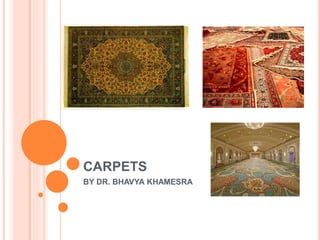
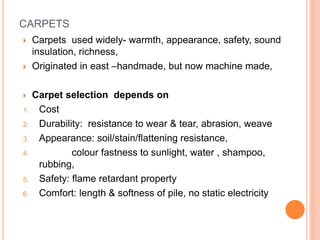
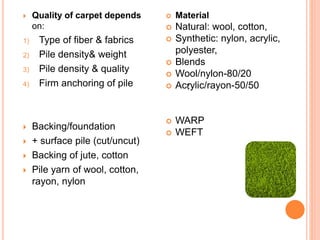
CARPETS
BY DR. BHAVYA KHAMESRA
CARPETS
 Carpets used widely- warmth, appearance, safety, sound
insulation, richness,
 Originated in east –handmade, but now machine made,
 Carpet selection depends on
1. Cost
2. Durability: resistance to wear & tear, abrasion, weave
3. Appearance: soil/stain/flattening resistance,
4. colour fastness to sunlight, water , shampoo,
rubbing,
5. Safety: flame retardant property
6. Comfort: length & softness of pile, no static electricity
 Quality of carpet depends
on:
1) Type of fiber & fabrics
2) Pile density& weight
3) Pile density & quality
4) Firm anchoring of pile
 Backing/foundation
 + surface pile (cut/uncut)
 Backing of jute, cotton
 Pile yarn of wool, cotton,
rayon, nylon
 Material
 Natural: wool, cotton,
 Synthetic: nylon, acrylic,
polyester,
 Blends
 Wool/nylon-80/20
 Acrylic/rayon-50/50
 WARP
 WEFT
:
 WOOL
 Resielence, feel warm
 Withstand abrasion
 Do not soil or ignite easily
 Retains appearance
COTTON
 Little resielence
 Fades badly,loose
appearance
 RAYON
 Cheaper, used in blend
 Nylon, acrylic,
 polyester,
 polypropylene
 Resistant to abrasion
 Low moisture absorbancy
 Melt with heat,cigar
 Electrostatic in dry
condition
 Moth resistant
natural
Man made/ synthetic
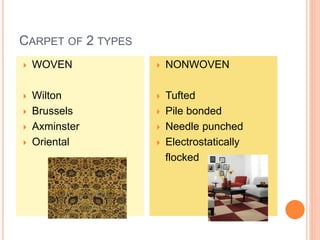
CARPET OF 2 TYPES
 WOVEN
 Wilton
 Brussels
 Axminster
 Oriental
 NONWOVEN
 Tufted
 Pile bonded
 Needle punched
 Electrostatically
flocked
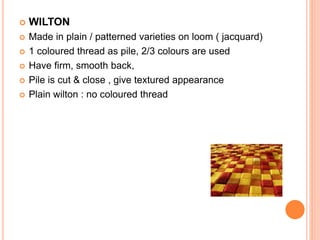
 WILTON
 Made in plain / patterned varieties on loom ( jacquard)
 1 coloured thread as pile, 2/3 colours are used
 Have firm, smooth back,
 Pile is cut & close , give textured appearance
 Plain wilton : no coloured thread
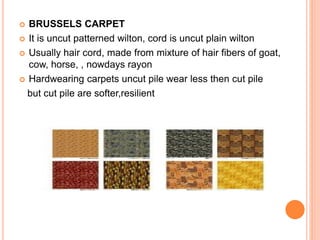
 BRUSSELS CARPET
 It is uncut patterned wilton, cord is uncut plain wilton
 Usually hair cord, made from mixture of hair fibers of goat,
cow, horse, , nowdays rayon
 Hardwearing carpets uncut pile wear less then cut pile
but cut pile are softer,resilient
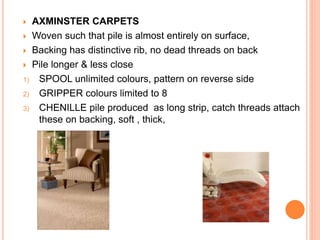
 AXMINSTER CARPETS
 Woven such that pile is almost entirely on surface,
 Backing has distinctive rib, no dead threads on back
 Pile longer & less close
1) SPOOL unlimited colours, pattern on reverse side
2) GRIPPER colours limited to 8
3) CHENILLE pile produced as long strip, catch threads attach
these on backing, soft , thick,
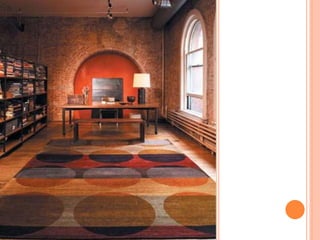
 ORIENTAL CARPETS
 Hand woven from middle east, India, Persia, china
 Extremely hardwearing, high priced, design , colourful,
sharp patterns, antiques,
 Pile –wool, silk, blend, knotting lengths to cotton warp
threads on handloom
I. Persian – rugs, as wall/ floor coverings, delicate,
symbolic motifs, flowers , vegetable dyes for colour,
II. Indian – coarser longer pile, less patterned,
III. Chinese- silky pile, well defined patterns
Tufted
Much faster, cheaper, rayon pile/synthetic fibers on backing, by
adhesive, pile cut / uncut, secondary backing
Pile bonded
Pile of nylon, polypropylene stuck on PVC backing, also
as tiles, has dense pile, carpet stuck to floor
Needle punched resin impregnated or heat treated
,sheet/ tiles, nylon/pp /acr/poly fed by needles, suppo
Electrostatically flocked
Projecting electroststically charged fibers on adhesive
coated backing material hard wearing,
SIZE OF CARPETS
Broadloom carpets-
extra wide,2m/5m
wide
Body/strip carpets-
70-90 cm wide, no
border, wall to wall,
pile in 1 direction
care while fixing
Carpet square- all
edges neated, not
necessary square ,
120 cm *210 cm
Stair carpets- has a
border, 45/56/68/90
cm wide, same
design used in
corridors also
CHOICE OF CARPETS
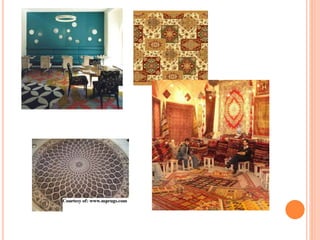
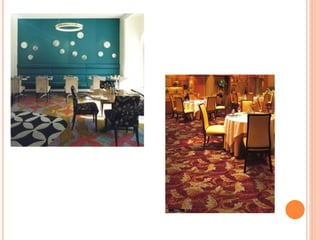
 Plain- makes room larger, allow pattern on furnishings,
walls, but show stains/dirt easily
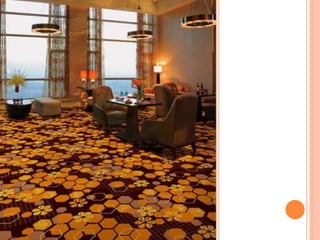
 patterned- should not make room appear smaller, do
not shows soil easily
 Some colours fade easily -use improved dyes
 Price range- life expectancy, wear & tear
 Function of area- low / heavy traffic
 décor Frequently changed- use cheaper carpet
 Good carpet –firm backing & pile anchorage
 Pile height-.5- .76 cm, lower pile height, closer weave,
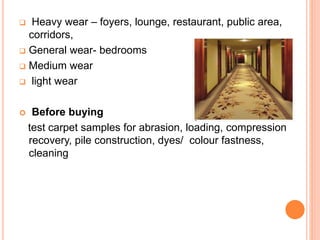
 Heavy wear – foyers, lounge, restaurant, public area,
corridors,
 General wear- bedrooms
 Medium wear
 light wear
 Before buying
test carpet samples for abrasion, loading, compression
recovery, pile construction, dyes/ colour fastness,
cleaning
CARPET LAYING
 Well laid by expert for max. wear
 Subfloor be dry, smooth, no cracks
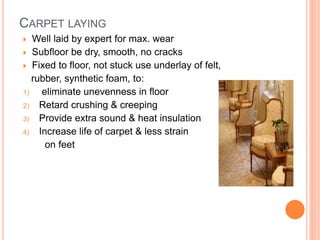
 Fixed to floor, not stuck use underlay of felt,
rubber, synthetic foam, to:
1) eliminate unevenness in floor
2) Retard crushing & creeping
3) Provide extra sound & heat insulation
4) Increase life of carpet & less strain
on feet
 Fixed to non woven
 harmed by dampness &
abrasion
 Natural fibers loose
resilience
 Of same size as carpet
 May have canvas
 Stairs-need fixing
 Held by clip/ rod
 Rugs backed by thin
foam rubber
 Glued-
 Tackless gripper
steelpins,plywood/metal
strips
 Turn & tack
turn under&tacks put
 Sunken
Where lifted to clean
Banquets
 Pin & socket
 Ring & peg
 Press studs
Underlay Methods to fix carpets
CARPET PROTECTION
 By a suitable underlay
 Firm fixing to avoid rucks
 Jute/coconut matting at doors, Dust control mats
 Strips of canvas, rubber, brass over edge
 Druggets lengths of canvas to take dirt, dust
 Jogging a stair carpet
 Turning carpets to avoid traffic lanes
 Flexible furniture arrangement, use of castors
 Spraying against moths,
 Repairing of frayed edges & worn parts
 Protecting & drying damp carpet
 Dry cleaning fluid away from rubber backing
Daily cleaning
Remove dust & crumbs by carpet sweeper
Grit & other soiling by suction/vaccum cleaner
Vacc should pass 3- 4 times,
Stains removed as soon as possible
Liquid bolt up with clean , dry absorbent paper
Scrap up semi solid / greasy material
Wipe area with damp cloth
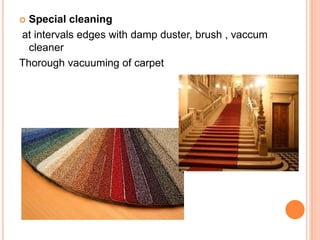
 Special cleaning
at intervals edges with damp duster, brush , vaccum
cleaner
Thorough vacuuming of carpet
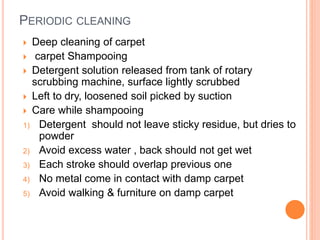
PERIODIC CLEANING
 Deep cleaning of carpet
 carpet Shampooing
 Detergent solution released from tank of rotary
scrubbing machine, surface lightly scrubbed
 Left to dry, loosened soil picked by suction
 Care while shampooing
1) Detergent should not leave sticky residue, but dries to
powder
2) Avoid excess water , back should not get wet
3) Each stroke should overlap previous one
4) No metal come in contact with damp carpet
5) Avoid walking & furniture on damp carpet
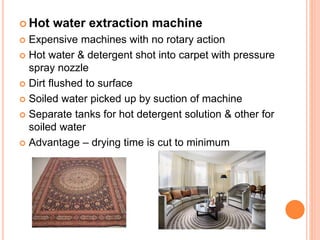
 Hot water extraction machine
 Expensive machines with no rotary action
 Hot water & detergent shot into carpet with pressure
spray nozzle
 Dirt flushed to surface
 Soiled water picked up by suction of machine
 Separate tanks for hot detergent solution & other for
soiled water
 Advantage – drying time is cut to minimum
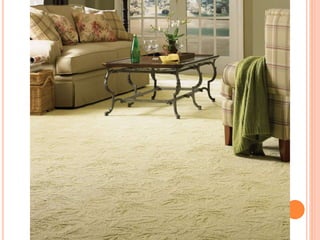
Dry foam extraction machine
Cylindrical brush type
machine
Lays down a moist foam, brushes it,
immediately extracts soil laden foam
Built in vacuum head located
behind power brush
advantages disadvantages
Add decorative
appearance to room
holds dirt, bacteria, careful
cleaning required
Luxurious appearance,
warmth
Cut by grit, sharp castors,
burnt by cigarr., heat
Provide sound insulation &
quietness
Attacked by moths, moisture,
Non slip quality, soft to walk
& feel
Shading can occur
Fitted carpets –room larger Fitted carpets difficult to
remove,
Patterned not look stained Plain carpets show stains
easily
Carpet squares can be
turned around
Initial cost is high
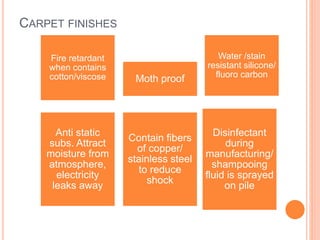
CARPET FINISHES
Fire retardant
when contains
cotton/viscose Moth proof
Water /stain
resistant silicone/
fluoro carbon
Anti static
subs. Attract
moisture from
atmosphere,
electricity
leaks away
Contain fibers
of copper/
stainless steel
to reduce
shock
Disinfectant
during
manufacturing/
shampooing
fluid is sprayed
on pile
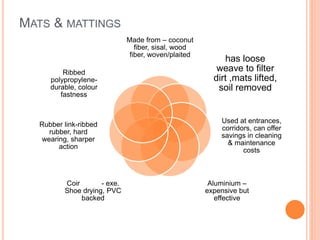
MATS & MATTINGS
Made from – coconut
fiber, sisal, wood
fiber, woven/plaited
has loose
weave to filter
dirt ,mats lifted,
soil removed
Used at entrances,
corridors, can offer
savings in cleaning
& maintenance
costs
Aluminium –
expensive but
effective
Coir - exe.
Shoe drying, PVC
backed
Rubber link-ribbed
rubber, hard
wearing, sharper
action
Ribbed
polypropylene-
durable, colour
fastness

Carpet

  • 1.
  • 2.
    CARPETS  Carpets usedwidely- warmth, appearance, safety, sound insulation, richness,  Originated in east –handmade, but now machine made,  Carpet selection depends on 1. Cost 2. Durability: resistance to wear & tear, abrasion, weave 3. Appearance: soil/stain/flattening resistance, 4. colour fastness to sunlight, water , shampoo, rubbing, 5. Safety: flame retardant property 6. Comfort: length & softness of pile, no static electricity
  • 3.
     Quality ofcarpet depends on: 1) Type of fiber & fabrics 2) Pile density& weight 3) Pile density & quality 4) Firm anchoring of pile  Backing/foundation  + surface pile (cut/uncut)  Backing of jute, cotton  Pile yarn of wool, cotton, rayon, nylon  Material  Natural: wool, cotton,  Synthetic: nylon, acrylic, polyester,  Blends  Wool/nylon-80/20  Acrylic/rayon-50/50  WARP  WEFT :
  • 4.
     WOOL  Resielence,feel warm  Withstand abrasion  Do not soil or ignite easily  Retains appearance COTTON  Little resielence  Fades badly,loose appearance  RAYON  Cheaper, used in blend  Nylon, acrylic,  polyester,  polypropylene  Resistant to abrasion  Low moisture absorbancy  Melt with heat,cigar  Electrostatic in dry condition  Moth resistant natural Man made/ synthetic
  • 5.
    CARPET OF 2TYPES  WOVEN  Wilton  Brussels  Axminster  Oriental  NONWOVEN  Tufted  Pile bonded  Needle punched  Electrostatically flocked
  • 6.
     WILTON  Madein plain / patterned varieties on loom ( jacquard)  1 coloured thread as pile, 2/3 colours are used  Have firm, smooth back,  Pile is cut & close , give textured appearance  Plain wilton : no coloured thread
  • 7.
     BRUSSELS CARPET It is uncut patterned wilton, cord is uncut plain wilton  Usually hair cord, made from mixture of hair fibers of goat, cow, horse, , nowdays rayon  Hardwearing carpets uncut pile wear less then cut pile but cut pile are softer,resilient
  • 8.
     AXMINSTER CARPETS Woven such that pile is almost entirely on surface,  Backing has distinctive rib, no dead threads on back  Pile longer & less close 1) SPOOL unlimited colours, pattern on reverse side 2) GRIPPER colours limited to 8 3) CHENILLE pile produced as long strip, catch threads attach these on backing, soft , thick,
  • 9.
     ORIENTAL CARPETS Hand woven from middle east, India, Persia, china  Extremely hardwearing, high priced, design , colourful, sharp patterns, antiques,  Pile –wool, silk, blend, knotting lengths to cotton warp threads on handloom I. Persian – rugs, as wall/ floor coverings, delicate, symbolic motifs, flowers , vegetable dyes for colour, II. Indian – coarser longer pile, less patterned, III. Chinese- silky pile, well defined patterns
  • 11.
    Tufted Much faster, cheaper,rayon pile/synthetic fibers on backing, by adhesive, pile cut / uncut, secondary backing Pile bonded Pile of nylon, polypropylene stuck on PVC backing, also as tiles, has dense pile, carpet stuck to floor Needle punched resin impregnated or heat treated ,sheet/ tiles, nylon/pp /acr/poly fed by needles, suppo Electrostatically flocked Projecting electroststically charged fibers on adhesive coated backing material hard wearing,
  • 13.
    SIZE OF CARPETS Broadloomcarpets- extra wide,2m/5m wide Body/strip carpets- 70-90 cm wide, no border, wall to wall, pile in 1 direction care while fixing Carpet square- all edges neated, not necessary square , 120 cm *210 cm Stair carpets- has a border, 45/56/68/90 cm wide, same design used in corridors also
  • 14.
    CHOICE OF CARPETS Plain- makes room larger, allow pattern on furnishings, walls, but show stains/dirt easily  patterned- should not make room appear smaller, do not shows soil easily  Some colours fade easily -use improved dyes  Price range- life expectancy, wear & tear  Function of area- low / heavy traffic  décor Frequently changed- use cheaper carpet  Good carpet –firm backing & pile anchorage  Pile height-.5- .76 cm, lower pile height, closer weave,
  • 16.
     Heavy wear– foyers, lounge, restaurant, public area, corridors,  General wear- bedrooms  Medium wear  light wear  Before buying test carpet samples for abrasion, loading, compression recovery, pile construction, dyes/ colour fastness, cleaning
  • 17.
    CARPET LAYING  Welllaid by expert for max. wear  Subfloor be dry, smooth, no cracks  Fixed to floor, not stuck use underlay of felt, rubber, synthetic foam, to: 1) eliminate unevenness in floor 2) Retard crushing & creeping 3) Provide extra sound & heat insulation 4) Increase life of carpet & less strain on feet
  • 18.
     Fixed tonon woven  harmed by dampness & abrasion  Natural fibers loose resilience  Of same size as carpet  May have canvas  Stairs-need fixing  Held by clip/ rod  Rugs backed by thin foam rubber  Glued-  Tackless gripper steelpins,plywood/metal strips  Turn & tack turn under&tacks put  Sunken Where lifted to clean Banquets  Pin & socket  Ring & peg  Press studs Underlay Methods to fix carpets
  • 19.
    CARPET PROTECTION  Bya suitable underlay  Firm fixing to avoid rucks  Jute/coconut matting at doors, Dust control mats  Strips of canvas, rubber, brass over edge  Druggets lengths of canvas to take dirt, dust  Jogging a stair carpet  Turning carpets to avoid traffic lanes  Flexible furniture arrangement, use of castors  Spraying against moths,  Repairing of frayed edges & worn parts  Protecting & drying damp carpet  Dry cleaning fluid away from rubber backing
  • 20.
    Daily cleaning Remove dust& crumbs by carpet sweeper Grit & other soiling by suction/vaccum cleaner Vacc should pass 3- 4 times, Stains removed as soon as possible Liquid bolt up with clean , dry absorbent paper Scrap up semi solid / greasy material Wipe area with damp cloth
  • 21.
     Special cleaning atintervals edges with damp duster, brush , vaccum cleaner Thorough vacuuming of carpet
  • 22.
    PERIODIC CLEANING  Deepcleaning of carpet  carpet Shampooing  Detergent solution released from tank of rotary scrubbing machine, surface lightly scrubbed  Left to dry, loosened soil picked by suction  Care while shampooing 1) Detergent should not leave sticky residue, but dries to powder 2) Avoid excess water , back should not get wet 3) Each stroke should overlap previous one 4) No metal come in contact with damp carpet 5) Avoid walking & furniture on damp carpet
  • 23.
     Hot waterextraction machine  Expensive machines with no rotary action  Hot water & detergent shot into carpet with pressure spray nozzle  Dirt flushed to surface  Soiled water picked up by suction of machine  Separate tanks for hot detergent solution & other for soiled water  Advantage – drying time is cut to minimum
  • 24.
    Dry foam extractionmachine Cylindrical brush type machine Lays down a moist foam, brushes it, immediately extracts soil laden foam Built in vacuum head located behind power brush
  • 26.
    advantages disadvantages Add decorative appearanceto room holds dirt, bacteria, careful cleaning required Luxurious appearance, warmth Cut by grit, sharp castors, burnt by cigarr., heat Provide sound insulation & quietness Attacked by moths, moisture, Non slip quality, soft to walk & feel Shading can occur Fitted carpets –room larger Fitted carpets difficult to remove, Patterned not look stained Plain carpets show stains easily Carpet squares can be turned around Initial cost is high
  • 28.
    CARPET FINISHES Fire retardant whencontains cotton/viscose Moth proof Water /stain resistant silicone/ fluoro carbon Anti static subs. Attract moisture from atmosphere, electricity leaks away Contain fibers of copper/ stainless steel to reduce shock Disinfectant during manufacturing/ shampooing fluid is sprayed on pile
  • 30.
    MATS & MATTINGS Madefrom – coconut fiber, sisal, wood fiber, woven/plaited has loose weave to filter dirt ,mats lifted, soil removed Used at entrances, corridors, can offer savings in cleaning & maintenance costs Aluminium – expensive but effective Coir - exe. Shoe drying, PVC backed Rubber link-ribbed rubber, hard wearing, sharper action Ribbed polypropylene- durable, colour fastness